|
time Line 1975
research generating ideas |


|
Amazing serendipity buzzer: Transcendental flash
Bathwater fallacy: Fallacy of misplaced concreteness
Bridge: Operationalisation:
the magical link between ideas and
appearances
See
chapter eight
| Cricket pitch: Test ground for scientific theories |
Dervish dance: Formal choreography of testing rituals
Digging: Knowing, feeling, understanding
Do-it-yourself-multi-purpose-data-matrix: Classification of modes of
data stipulation which may be appropriate for social science purposes
Dwarves: Operationalisers by appointment to the
Fairy Courts
See
chapter sixteen
|
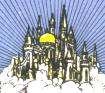
Fairies: Ideas, potentially thoughts and/or images, manifestations or appearances. Fairy tale: Connection of idea in the form of an explanatory story, or theory. Fairyland: Land of ideas. Any realm of thought. Alternative universe. |
Julie Ford argues that science has to begin with fairytales told about the world. There are different levels of fairytale (page 80):
"Common sense provides us with a way of spinning fairy tales about what might be going on 'out there', and while we continue to believe in them we have a firm foothold in reality""At the same time, academics insist that the methods of reasoning on which we rely as real people in the real world can be extended and organised into paradigms which, while still answerable to common sense, yet transcend it. Thus grander fairy tales are spun..."
"And all the while even stranger sages tell stories that are stranger still.."
| Gold star: Honorific title awarded for faithfulness to deductive methods in science. Gold star badge: Mark of gold star status. Gold-star- rabbit: One recognised as of gold-star merit. |
Julie Ford only awards gold stars to those who support falsification as the standard for testing:
"remember that the test pitches used by Gold_Star Rabbits, and specified by such distinguished umpires as Sir Karl Popper, are intentionally aslant. The Gold-Star spirit requires players to do their damnedest to falsify their research hypotheses, not to verify them." (Ford, J. 1975, p.403)
|
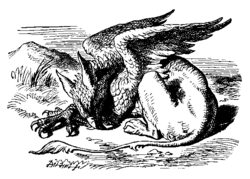
Gryphon: Chance See chapter fourteen Julie considers the case for probability sampling "a most unlikely story". |
Library: Storehouse of written thoughts kept as knowledge.
See
chapter three
Lights: Guides
See
chapter ten
"It seems that you have already made one move down the dark warren which leads from this fairy-tale place to the lands of reality outside. You have moved from your starting position under the sign puzzle to a part illuminated by the implicit theory" [HUNCH?]." (p. 223)
The following lights are analytic theory - deductive nomological explanation - hypotheses - research inventory - and, finally, one's research strategy
Mock Turtle Soup: Positivistic inductivistic universe
See
chapter fourteen
Mountain: Solid conventions of academic scientific thought
Rabbit: Scientist (but see
white rabbit)
Red: Positivistic
Red herring: Red herring
Sampling game: Process of selecting 'representative' samples
Spider: Confusion or intimation thereof. Spider battle:
Philosophical brawl.
Statistricks: Statistical tricks. [Performed on
cricket pitch]
Thirty-nine stips: Contents of the
Do-it-yourself-multi-purpose-data-
matrix
Umpire: Philosopher of science [See
Cricket Pitch]
Underwear: Theory construction procedures [Have a look at
fairytales]
White: Idealistic
White Rabbit:
Science teacher
Andrew Roberts likes to hear from users:"sociologists are no longer confined to an obscure corner in
the magical mountain of science. Over the last couple of decades they have
been taking an increasingly important place in the magical establishment"
(p.79)
"Karl Popper... lives in one of the towers at the top of the
mountain but, luckily, there is no need for us to go through all those
dreary laboratories to get there: we can get to his door by climbing up the
outside of the mountain and walking across a
sloping
cricket pitch" (p.97)
See chapters
fourteen and fifteen
See
chapter nineteen
 Study
links outside this site
Study
links outside this site
 Picture introduction to this site
Andrew Roberts' web Study Guide
Top of
Page
Picture introduction to this site
Andrew Roberts' web Study Guide
Top of
Page
 Take a Break - Read a Poem
 Click coloured words to go where you want
To contact him, please
use the Communication
Form
Good research
Begins with
a fairy tale
 You create a fairy tale
(called a theory)
which pretends to be a symbolic
replica of the real world
You create a fairy tale
(called a theory)
which pretends to be a symbolic
replica of the real world
If it is a good (true) replica it will provide an explanation of
reality
that people feel they understand and it will enable you to make predictions
about what will happen in the real world
To find out if it is a good replica, you test it
(Ford, J. 1972.
Part 5)
Julie Ford's theory is reviewed by Stephanie Delgado in her essay Science: the case for imagination: Mary Wollstonecraft and Julienne Ford