|
Earthcore: Draft Timeline for the Core of Earth
From Manchuria to Cape Town Linked to the social science and mental health time lines |
638 - 1200 - 1300 - 1400 - 1500 - 1600 - 1700 - 1800 - 1822 - 1826 - 1828 - 1838 - 1841 - 1849 - 1856 - 1860 - 1861 - 1862 - 1863 - 1864 - 1865 - 1866 - 1867 - 1868 - 1869 - 1885 - 1886 - 1887 - 1888 - 1889 - 1890 - 1891 - 1892 - 1893 - 1894 - 1895 - 1896 - 1897 - 1898 - 1899 - 1900 - 1904 - 1914 - 1918 - 1919 - 1920 - 1921 - 1922 - 1923 - 1924 - 1925 - 1926 - 1927 - 1928 - 1929 - 1930 - 1933 - 1934 - 1935 - 1936 - 1939 - 1940 - 1941 - 1942 - 1943 - 1944 - 1945 - 1946 - 1947 - 1948 - 1949 - 1950 - 1951 - 1952 - 1953 - 1954 - 1955 - 1956 - 1957 - 1958 - 1959 - 1960 - 1961 - 1962 - 1963 - 1964 - 1965 - 1966 - 1967 - 1968 - 1969 - 1970 - 1971 - 1972 - 1973 - 1974 - 1975 - 1976 - 1977 - 1978 - 1979 - 1980 - 1981 - 1982 - 1983 - 1984 - 1985 - 1986 - 1987 - 1988 - 1989 - 1990 - 1991 - 1992 - 1993 - 1994 - 1995 - 1996 - 1997 - 1998 - 1999 - 2000 - 2001 - 2002 - 2003 - 2004 - 2005 - 2006 - 2007 - 2008 - 2009 - 2010 - 2011 - 2012 - 2013 - 2014 - 2015 -
For surmises on mind and healing before we have written records click here. For interpretations of prehistoric art click here.
According to Ackernecht, E. H. (1959 ch.2 p.9) "...the great cultures of old, such as those of Egypt and Mesopotamia, vacillated between naturalistic and supernatural explanations of diseases...". For some other people's thoughts click here
Ackernecht (1959 ch.2 p.9) argues that: "The history of psychiatry, like that of scientific medicine in general, really begins with the Greeks. The Greco-Roman outlook survived unchanged until the eighteenth century, and even today we still use a large part of the Greek nomenclature... the Greeks declared themselves outspokenly in favour of naturalistic explanations and thus became the founders of scientific medicine and of psychiatry." ... For some other people's thoughts click here
|
638
Moslem conquest of Syria. 637 Moslem conquest of
Iraq. 640 Moslem conquest of Egypt. 710 Moslems invade Spain.
They went as far as
France, but were defeated at Tours in 732 and moved back to
Spain. Ackernecht (1959 ch.3 p.16-17) says: "There is not much to say about medieval psychiatry... classical naturalistic concepts of mental illness were ... preserved in a few places and among some sections of society. This was particularly true within the hospitals which were the greatest medical achievement of the Middle Ages. Although we know that large hospitals were established as early as the fourth century, we have details about psychiatric sections in such institutions only since the founding of the great Arabic hospitals" [Muhammad]He lists: Baghdad as opening in 750. - Baghdad was made the capital of the Abbasid dynasty in 750 AD by the Caliph Abu-Jaifar Al-Mansur (external link). The hospital known as Baghdad Hospital was established under his successor Harun Arl-Rashid (786-809 AD) - But there were other Baghdad hospitals. (Hossam Arafa). See also Iraq history. "The most illustrious among the Arab physicians was Rhazes (865-925), the 'Persian Galen'... physician-in- chief to the Baghdad Hospital, one of the first of the ancient hospitals to have a ward devoted to the mentally ill" (Alexander and Selesnick 1966, p.62) Cairo as opening in 873. Al-Fustat Hospital, in what is now Old Cairo, was built in 872 and was open for six centuries. Al- Mansuri Hospital was built in 1284. It was divided into different sections according to ailments. Music was used as therapy for psychiatric patients. It served 4,000 patients daily and the stay in the hospital was free. On discharge, patients were given food and money as compensation for being out of work during the hospital stay. It is now used for ophthalmology and renamed Qalawun Hospital. (Hossam Arafa). See also Ted Thornton's History of the Middle East database Ackernecht (1959 ch.3 p.16-17) says:
"(The Arabs also accommodated the mentally ill in monasteries.) To this day the Mohammedans have unusually sympathetic attitudes to the mentally ill which are reflected in the Koran. [Bible and Koran weblinks] The Arabs were also apparently the first to build special institutions for the insane: Damascus, 800; Aleppo, 1270; Kaladun, 1283; Cairo, 1304; Fez, 1500. The Arabs achieved more in the care of the insane than in the field of psychiatry itself. Here, as in the rest of medicine, they merely repeated and expanded the Greek concepts of mental illness. Ackernecht, E. H. 1959 ch.3 p.16-17 |
This somewhat mysterious (and anachronistic) passage in Ackernecht, E. H. 1959 (ch.3 p.16-17) presumably refers to places like London's Bedlam. [Does anyone have a better idea what he refers to?]
"Psychiatric departments in general hospitals were not rare in the Middle Ages. They existed in the west since the thirteenth century, e.g. in Paris, Lyon, Montpellier, London, Munich, Braunschweig, Freiburg, Zurich, Basle etc. Here the classical traditions undoubtedly survived."
Heidelberg University founded 1386
(map) -
Wikipedia -
University website history
See 1855 -
chair of psychiatry 1871 -
1930 -
1933 -
Wolfgang Huber 1964
Leipzig University (map) Founded 1409 as a breakaway from Prague University. From the early 19th century Leipzig played an important part in the development of psychology and psychiatry.
"In 1457 the Freiburg Cathedral was the site of the foundation
of a university. The financier and figure after whom the institution was
named was Archduke Albert 6th, of whose dominion, Western Austria, Freiburg
was then a part. The "Albertina" was founded as a comprehensive university,
including all important faculties of the time: Theology, Law, Medicine, and
Philosophy. Its purpose was to educate young theologians and
administrators. Some of the first students lived in "Bursen" (hostels) on
the site of what is now known as the "Old University," where the first
lectures also took place. Classes were held in Latin."
(source)
Asylums outside Spain: "The opening of special institutions in Spain was followed in the 16th century by the founding of similar hospitals in Rome, Paris, Amsterdam, Marseilles, Avignon, Hamburg, Lubeck and elsewhere". Ackernecht, E. H. 1959 ch.3 p.21-22
Rome: pazzarella, or place for mad people, may have existed in Rome since the mid-14th century. OR "The pazzarella at Rome already mentioned was founded during the sixteenth century by Ferrantez Ruiz and the Bruni, father and son, all three Navarrese". A legacy enabled the management, with the approbation of Pope Pius 4th, to open a new house in 1561, in the Via Lata. (Catholic Encyclopedia)
Dolhuys, Amsterdam, 1562 may have been the second purpose built
asylum in Europe.
In 1641 the Charenton Asylum was founded in one of the suburbs of
Paris, near the Park of Vincennes, and was placed under monastic rule.
After the foundation of the Sisters of Charity of St. Vincent de Paul, the
charge of this institution was given to them
(Catholic Encyclopedia).
See 1826
|
Ackernecht's
(1959) (ch.4 p.29)
decription of 17th century institutional developments is a summary of
Foucault:
"The absolutist governments of the mid-seventeenth century decided to resolve their social crisis by incarcerating all the poor. In Paris this occurred in May 1657. The men were taken to the Bicetre, the women to the Salpetriere. In France these pauper prisons were deceitfully called "Hopital general"; in Germany, more truthfully, "Zuchthaus" [discipline- house]; in Great Britain "workhouse." |
"Halle was founded in 1694 by the elector Frederick 3rd of Brandenburg as a centre for the Lutheran party. It has been called the first modern university, largely because it soon renounced religious orthodoxy in favour of objectivity and rationalism, scientific attitudes, and free investigation. Canonical texts were replaced by systematic lectures, and disputations by seminars; German took the place of Latin as the language of instruction; an elective system replaced the traditional formalized curriculum; and professors were given almost complete control of their work. The relative liberalism of Halle was adopted by Göttingen a generation later and was gradually taken up by all German, and then most American, universities". (source) - See HalleWittenberg
|
From
"Focus on psychiatry in South Africa" Robin Emsley,
The British Journal of Psychiatry (2001) 178: 382-386:
"Institutional medical practice began in South Africa over 300 years ago with the establishment of a small hospital in Cape Town by Jan van Riebeeck. The first hospital to cater specifically for mentally deranged persons was established in 1711. It was an apartment that was added to the new Cape Hospital, which had been completed in 1699 by Simon van der Stel." See 19th century |
1737
University of Gottingen founded by George
2nd, King of Great Britain and Elector of Hanover.
1749 Gottfried Achenwall (1719-1772), professor at Gottingen,
used the term
Statistik in
his Staatsverfassung der heutigen vornehmsten europäischen Reiche
und
Völker im Grundrisse [Political Constitution of the present
principal
European countries and Peoples]
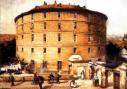
Johann Christian Reil (1759-1813). Graduated in Halle 1782. After 1787, professor at Halle and, at the same time, the official physician of the city of Halle (Stadtphysikus). His Rhapsodieen über die Anwendung der psychischen Curmethode auf Geisteszerrüttungen (Rhapsodies on the Application of Psychic Treatment Methods to Mental Disturbances) was published in 1803.
"Ueber den Begriff der Medicin und ihre Verzweigungen, besonders in Beziehung auf die Berichtigung der Topik der Psychiaterie" (On the term of medicine and its branches, especially with regard to the rectification of the topic in psychiatry) by Reil published in Beyträge zur Beförderung einer Kurmethode auf psychischem Wege in 1808. - See psychiatry and its alleged 200th birthday and index of official starts.
In 1810 Reil became professor of Medicine at the newly founded University of Berlin. Campaigned unsuccessfully for the foundation of psychiatric institutes in Berlin and Halle. Coined term Psychiaterie in a publication of 1808.
|
1810 University of Berlin (Universität zu Berlin) founded by
Wilhelm von Humboldt.
Johann Christian Reil professor of medicine 1810
Georg Friedrich Hegel Professor of Philosophy from 1818 Leopold von Ranke Professor of history? 1824 to 1871. "At the university, Ranke became deeply involved in the dispute between the followers of the legal professor Friedrich Carl von Savigny who emphasized the varieties of different periods of history and the followers of the philosopher Georg Wilhelm Friedrich Hegel who saw history as the unfolding of a universal story. Ranke supported Savigny and criticized the Hegelian view of history as being a one-size-fits-all approach". (Wikipedia 24.12.2010)
|
|
From
"Focus on psychiatry in South Africa" Robin Emsley,
The British Journal of Psychiatry (2001) 178: 382-386:
In South Africa "The Old Somerset Hospital was the first hospital offering care for the insane from its inception in 1818. However, these facilities were regarded as inappropriate for this purpose, and in 1846 the prison colony on Robben Island was converted into a hospital for lepers, lunatics and other chronically ill patients. By 1912, the Robben Island Infirmary housed 500 mental patients. During this period, several other `lunatic asylums' were built, ensuring that mentally ill patients were largely isolated from the community. These included the Town Hill Asylum in Pietermaritzburg, Fort England Mental Hospital in Grahamstown, Valkenberg Lunatic Asylum in Cape Town, and the Pretoria Lunatic Asylum" |
| 1817 The two Prussian universities of Halle and Wittenberg merged External link - archive |
|
Gotthard Guggenmoos. Born 5.5.1775 Stötten/Auerberg (Germany),
Died
29.1.1838 Hallein (Salzburg, Austria). Private teacher. Taught
children with impaired hearing and speech from 1812. In
1829 opened
in Salzburg his "Stummen und Kretinenschule" (institute for deaf-mutes and
cretins). "The first school for the mentally impaired in German-speaking
countries". Closed in 1835 for financial reasons.
External link
biography at Der Gotthard Guggenmoos Schule -
Encyclopedia of
Austria
Johann Jakob Guggenbühl(1816-1863). "In the face of much opposition, built the first institution for cretins on the Abendberg near Interlaaken in 1840". In 1845 Extracts from the First Report of the Institution on the Abendberg, near Interlachen, Switzerland; for the Cure of Cretinism, by Guggenbühl, published in London. London.] "The immortal soul is essentially the same in every creature born of woman" (Guggenbühl) |
Ackernecht says
(1959 ch.8 pp 63-64):
"German administrative psychiatry flourished during this period. Modern institutions were opened everywhere" The examples he gives (flushed left), with others (flushed right) are: Sonnenstein opened in 1811
21.10.1811 Johann Christian August Heinroth (1773-1843) was
appointed the first associate professor of "psychic therapy" at
Leipzig
University. This has been decribed as the "first university
chair in
psychiatry". (Although an associate professor did not have his own chair
and when Heinroth became a full professor it was in "medicine") Coined the
word "psychosomatic". According to
Ackernecht
(1959 ch.8 p.60) Heinroth "regarded mental illness purely as a disease of
the soul and essentially as a 'lack of freedom'. God had punished the
sinner by depriving him of his freedom of will." See
A Short History of Psychiatry at Leipzig University
An English translation
(by Dirk Carius 12.10.2004)
of:
Eine Kurze Geschichte der Leipziger Universitätspsychiatrie
by Holger Steinberg, Historian Archives for the History of
Psychiatry in Leipzig.
Prague (capital of Bohemia) opened 1822
Siegburg, north of Bonn, south of Koln (Cologne, capital Rhenish Province of Prussia), opened in 1825 (map). Under the direction of Carl Wigand Maximilian Jacobi
Dusseldorf opened in 1826 Rhenish Province? of Prussia
Hildesheim (Hanover) opened in 1827 Colditz opened in 1829 (between Leipzig and Dresden in Saxony) (map)
Schwerin-Sachsenberg is not the
same as
Lichtenfels-Sachsenberg.
Sachsenberg "Irren-Heilanstalt Sachsenberg",
opened in 1830
Under
the direction of K. (C.F.?) Flemming (1799-1880).
(external link)
(external link - blanket dated just before Nazi
period) "Sachsenberg psychiatric asylum in Schwerin".
Museums list includes
Museum
at the Sachsenberg at Schwerin. Address: 19055 Schwerin, Wismar
Strasse 393. The "former" lunatic asylum was opened 1830 as the first
German purpose built lunatic asylum. Exhibitions about the history of
psychiatry: in the former water tower.
Winnenthal opened in 1834 (map). Superintendent: A. Zeller, 1804-1872, Griesinger's teacher Halle opened in 1836 (map?) Under the direction of H. Damerow, 1798-1866, a pupil of Esquirol Illenau Institution, near Achern (map) in the Black Forest, opened in 1842 Superintendent: Christian Roller, 1802-1878. history link
"During this period 30 institutions were opened in Germany, 18 in France and as many as 38 in Great Britain. |
1822: "En 1822, les docteurs Voisin et Falret ouvrirent á Vanves une maison de santé pour le traitement des aliénés." external link. Jean-Pierre Falret (1794-1870) with his friend Felix Voisin (1794-1872) founded the famous private hospital in Vanves. Falret began his work with studies on suicide. Voisin, who was much influenced by Gall, devoted himself above all to the study and training of the feebleminded. (Ackernecht, E. H. 1959 ch.6 p.51) [See Jacobi]
1826: Esquirol's "private sanatorium in Ivry and his institution at Charenton, which were built according to his own plans and which he administered from 1826, were model institutions. Charenton (at present under the direction of Professor Baruk who lovingly guards Esquirol's beautiful library) is to this day a remarkable place. The asylums in Saint- Yon, Le Mans, Montpellier and Marseilles were also built according to his plans". (Ackernecht, E. H. 1959 ch.6 p.50) - [Rouen was also designed on Esquirol's principles]
1828 Ospedale provinciale de' mentecatti in the Papal State of Pesaro opened. Known as Ospizio di San Benedetto di Pesaro - Manicomio provinciale di San Benedetto di Pesaro - Ospedale psichiatrico provinciale San Benedetto di Pesaro from 1929. Until 1834 the asylum was managed by an accountant and a group of physicians in the city were responsible for the care of the sick. From 1834, a resident doctor ran the asylum and a team of doctors and nurses was recruited to work exclusively within the asylum. In 1871 a competition was announced: submitted an application 22 doctors, including Cesare Lombroso, who from 1872 took over the leadership of the hospital, making improvements of sanitary conditions, setting up study rooms and a pathology laboratory. A men's school in the psychiatric hospital started in 1871 and a women's school in 1872: teaching patients and nurses. The early years of the twentieth century saw small and medium enhancements. In 1928, the Board of Supervisors on asylums (introduced by Law no. 36 of 14.2.1904) denounced the serious deficiency of the mental health and hygiene of Pesaro. Closed 1981. (source).
30.6.1838 "Avec la loi du 30 juin 1838, qui fait obligation … chaque département de se doter d'un asile d'aliénés (ou de traiter avec un asile d'un autre département), leur nombre s'accroit au fil des décennies (en 1865, 41 asiles départementaux, 18 quartiers d'hospice, 16 asiles privés faisant fonction d'asiles publics, et la Maison impériale de Charenton), et celui des lits approche les 55.000 en 1888". Histoire de la psychiatrie en France
1838: The old hospital at Maréville has a gatehouse dating back to the eighteenth century. After the French Revolution it progressively become an asylum for lunatics. By accepting patients from other departments. it achieved 500 patients by 1814. From 1818 it was run by the Sisters of Saint Charles. Then, in 1838, it became the departmental hospital for the insane. (Asile d'Aliénés de Maréville at Nancy). Benedict Augustin Morel was director from 1848 to 1856, when he was appointed director of the mental asylum at Saint-Yon in Rouen. Charles Joseph Jouy was confined in the asylum in 1867 In 1879, Mareville was the most important asylum in France (French Wikipedia). In 1949 he took the name of centre psychotherapique and it becomes a public health facility on 30.10.1970.
|
1848 and 1849 European missionaries saw the mountains in East
Africa that are called (from African languages) Kilimanjaro and Kenya.
Kenya gave its name to Kenya Colony (previously
British East
Africa) in 1920 and, after that, it became usual to call the
mountain "Mount Kenya".
1938:
Facing Mount Kenya
|
|
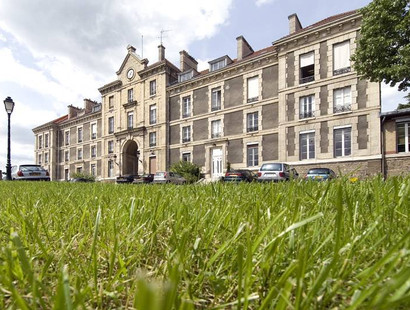
Hospital Perray-Vaucluse built on an estate acquired in Épinay-sur- Orge by the Department of the Seine in 1863. Opened 26.1.1869. One of five mental health institutions sectorialised on Paris. It later absorbed Esquirol, Maison Blanche and Sainte-Anne. (source) - See Groupe d'information sur le Asiles 1972 |
|
From 1855
Wilhelm Maximillian Wundt (1832-1920) worked with Mueller
and
then Helmhotz at
Heidelberg University where he was appointed professor in
1864. From 1867 he taught physiological psychology and in 1873 published
the first volume of
The Principles of Physiological Psychology. In
1874 Wundt was appointed to professor of inductive philosophy at the
University of Zurich and in 1875 professor at the University of
Leipzig, where he remained for forty-five years. He was given
his first
laboratory (one room) in
1875. In 1879 he opened his first full
laboratory with more rooms and equipment. In 1883 he founded the
first (?) psychological journal, which was called Philosophische
Studien (Philosophical Studies). In 1897 he was given his own
building for a laboratory. Died in Grossbothen near Leipzig in 1920
(external link)
External link: Emil Kraepelin Wilhelm Griesinger (1817-1868): "In 1860, he was appointed medical clinic in Zurich and director of the university psychiatric clinic of the Burghölzli. These new functions allowed him to initiate the official teaching of psychiatry, which he continued in Berlin until 1865" Ackernecht says (1959 ch.9 p.74): "...the period which was now to begin was that of "university psychiatry," and "As far as its orientation was concerned, psychiatry was now predominantly brain psychiatry". He notes the establishment of these professorial chairs in psychiatry in universities within the German speaking area of Europe: Berlin in 1864 Gottingen in 1866 Zurich in 1869
18.1.1871 German Empire:
Political unification of large parts of German speaking Europe Heidelberg in 1871 - Badische [Baden] Universitäts-Irrenklinik, the first university hospital for the insane, opened in 1878. (External link to history). The first chair holder C. Fürstner was neuropathologist. In 1890, he moved to Strasbourg. Emil Kraepelin was in charge of it from 1891 to 1903. He was succeded by Karl Bonhoeffer (two months only) and Franz Nissl (1904-1918). See 1909. Karl Wilmanns ran the clinic from 1918 to 1933. See 1919. Wilmanns was removed by the Nazis. His Nazi successor, Carl Schneider, committed suicide on 11.12.1946. Kurt Schneider was chair of psychiatry from 1945 to 1955, Walter Ritter von Baeyer from 1955 to 1972. Wolfgang Huber began working at the clinic 1964. In 1970 Huber was at the centre of the post-1968 student conflicts in the clinic leading to the formation of the SPK. Werner Janzarik (1973-1988) restored order. From 1989 to 2009 Christoph Mundt, who wrote a "History of Psychiatry in Heidelberg". Sabine C Herpertz took over in 2009 Vienna in 1877
Leipzig and Bonn in 1882.
|
German History - mid-ninteeenth century
2.1.1861 Wilhelm 1st of Prussia. (b.1797 d.1888)
September 1862 Bismarck chief minister of Prussia. In 1860s he flirted
with the Lassalleans
1863 Leipzig congress of workers' unions founds Lassallean socialist party
[ADAV]. Ferdinand Lassalle (d. 1864) wanted producers' co-ops funded by the
state
1864 Danish war over Schleswig Holstein. Weber born
First International Workingmen's Association established by French and
English Labour leaders in London (dissolved 1876). Marx drew up its
Inaugural Address - a much more moderate document than the Communist
Manifesto (1848). The Lassallean's did not join.
1866 "Seven Weeks War" of Prussia and her allies with Austria and other
German states. - Old German ties cut. The Austrian Empire advocated
Grossdeutschland, a concept whereby all German-speaking lands would
unite. Prussia however, preferred
Kleindeutschland whereby all German states except those in Austria,
would be led by Prussia. The outcome of the Prussian victory was the
exclusion of Austria from the German Confederation and the termination of
Austrian dominance of the German nations. Prussian victory was followed by
the establishment of two German blocks:
1867 North German Federation. Constitution based on the Frankfurt
Constitution of 1849. [Institutions established (e.g. Bundesrat and
Reichstag) continued throughout German Empire (from 1871)]. National
Liberal Party founded. [From 1867 to 1878 Bismark supported the Liberals:
Free trade policies]
1867 Austro-Hungarian Empire (See Wikipedia
Austria-Hungary)
1869 "Eisenach Party" (SAP) [South German Party] founded by Marx's German
followers (including Wilhelm Liebknecht and August Bebel). The Eisenach
Programme adhered in general to the line of the International.
|
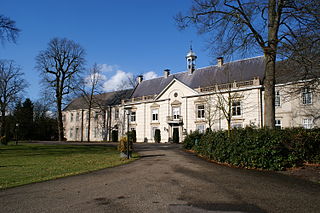
In 1870 an estate in west Netherlands was purchased by Doctors E. Coudewater van den Bogaert and L. Pompe of the Society for the care of the insane. Here they established the asylum called Coudewater. See 1970. |
14.7.1870 Ems telegram
18.7.1870 Decree of Papal Infallibility
1870-1871 FRANCO-PRUSSIAN WAR
Liebknecht and Bebel were imprisoned for opposing the war
19.7.1870 French declaration of war on Prussia
August: French defeats
1.9.1870: Surrender of Napoleon 3rd and MacMahon at Sedan
18.1.1871 German Empire:
Political unification of large
parts of German speaking Europe
18.1.1871: German Empire proclaimed at Versailles. Wilhelm 1st: Emperor Bismarck: Imperial Chancellor. German Unification.
28.1.1871: Armistice
1871 (to 1878 or 1887: see below) KULTURKAMPF ("Conflict of Beliefs") between Bismarck and Catholic Church. Prussian "Falk Laws" of May 1873 completely subordinated the church to state regimentation. Election of Pope Leo 13th in 1878 began negotiations which restored most Catholic rights by 1887. [Palmer].
1871 Centre Party formed.
Period of boom
1873 Verein fur Sozialpolitik (Association for Social-Politics?) formed
|
Khartoum - the Congo - "Darkest Africa"
29.1. 1881 Muhammad Ahmad announced his claim to be the Mahdi so as to prepare the way for the second coming of the Prophet Isa (Jesus). 1883/1884 British General Charles George Gordon accepted an offer from Leopold 2nd, King of the Belgians, to take charge of the Congo. However, he was then asked by the British government to proceed to the Sudan, where he had been Governor. 13.3. 1884 Troops loyal to the Mahdi Muhammad Ahmad began a siege of Khartoum. Charles George Gordon killed. 15,11.1884 to 26.2.1885 Berlin Conference of European powers - Kongokonferenz (Congo Conference) - Afrikakonferenz (Africa Conference) - 26.1. 1885 Khartoum fell to the Mahdists. 7.8.1885 Arrival of five German warships to intimidate the Sultan of Zanzibar who had protested against the activities of the Gesellschaft für Deutsche Kolonisation. "The British and Germans agreed to divide the mainland between themselves, and the Sultan had no option but to agree". (Wikipedia) 1885 to 1908 État indépendant du Congo (The Congo Free State), which "was privately controlled by Leopold 2nd, King of the Belgians through... the Association internationale africaine." Rubber, copper and other minerals in the upper Lualaba River basin. (Wikipedia)
1886 to
1889 "Emin Pasha Relief Expedition" by Europeans and
Americans under Henry Morton Stanley, for the relief of Emin Pasha, General
Charles Gordon's besieged governor of Equatoria. Reported 1890 in
In Darkest Africa.
2.9. 1898 Mahdist forces defeated by British forces under Herbert Kitchener. In 1899, Khartoum became the capital of Anglo-Egyptian Sudan. 1904 British Parliamentary Papers, 1904, LXII, Cd. 1933 [Roger Casement's report] - Wikipedia 1907 Babikir Badri (1856 - 1954), a survivor of 1898, was given permission to start a school for girls. He "began his secular school for girls in a mud hut with nine of his own daughters and eight of those of his neighbors. From this humble beginning, the Badri family has nurtured private education in Sudan for over three generations. Babiker's son, Yusuf, carried on his father's work, and in 1966 established the Ahfad University College for Women in Omdurman across the Nile from Khartoum and near the site of the battle in which Babiker had fought as a young Sudanese soldier." March 1913 Charlotte Mew's Men and Trees 2 "human sacrifices are still being offered by American and European syndicates to the sacred tree of civilisation, the rubber tree. Civilisation demands speed, speed demands rubber, and rubber, coated with blood and slime, turns quickly into gold. We have almost forgotten the Congo".
See
|
1882-1884 Famine in what became Kenya. A smallpox epidemic broke out at Sagalla and quickly spread across the country. Another epidemic occurred during famine in 1898. It also hit Nyanza Province in 1899, 1909 and 1915.
|
Sociology in Germany
"Following an interest in German thought,"
[Albion] "Small went on to study history, social economics and
social politics at the universities of Berlin (1879-1880) and Leipzig
(1880-1881). He also spent some time at Weimar and at the British Museum in
London. His experiences in Europe subsequently shaped his writings as a
sociologist"
(external source)
Simmel: See dictionary
Interaction
Georg Simmel (1858-1918) taught at the University of Berlin as a Privatdozent from 1885 to 1901, and then as Ausserordentlicher Professor to 1914, when he was appointed Professor at the University of Strasbourg. [Simmel's] "courses ranged from logic and the history of philosophy to ethics, social psychology, and sociology. He lectured on Kant, Schopenhauer, Darwin, and Nietzsche, among many others. Often during a single academic year he would survey new trends in sociology as well as in metaphysics" (Lewis Coser External Link)
Albion Small published
translations of Simmel into English in the
American Journal of Sociology in
1896 -
1898 -
1902 -
1904 -
1906 and 1910
1900 Georg Simmel Philosophy of Money. From 1900 he "devoted himself for over a decade primarily to the fledgling discipline of sociology. At that point there were still no chair of sociology in Germany" (Lloyd Spencer) - weblinks 1908 Georg Simmel's Sociologie attempted an analysis, classification and interpretation of several forms of social relations, such as isolation, contact, superordination, subordination, opposition, persistence or continuity of social group, social differentiation, and integration. Sociologie incorporated previous studies such Über soziale Differenzierung - Das Problem der Sociologie - Comment les formes sociales se maintennent.
See
Pitirim Sorokin on
Formal Sociology
|
|
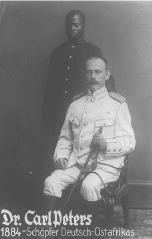
Carl Peters (or Karl) (27.9.1856-10.9.1918) founded the
Gesellschaft für Deutsche Kolonisation (Society for German
Colonization) in March 1884. - See
East Africa
1885 Declaration of a German protectorate in the Africa Great Lakes region. Lutheran and Moravian missionaries began to arrive from Germany. They took over the work of British Missions. 1886 Evangelische Mission nach Deutsch Ostafrika. From 1891 it was led by Friedrich von Bodelschwingh, Senior of the Bethel Institution. See Lutindi |
British and allied troops effectively controlled East Africa from October 1916, but the German forces kept fighting until November 1918. The larger part of German East Africa became Tanganyika Territory administered by the British from 20.7.1922.
6.6.1886 Hans Prinzhorn born in Hemer, Westphalia. After studying art history and philosophy (Ph.D. Vienna 1908) he trained as a singer. He then qualified as a doctor and became a psychiatrist. From 1919 to 1921 he built up a Museum for Pathological Art at Heildelberg. His Bildnerei der Geisteskranken (Artistry of the Mentally Ill) in 1922 made comparisons with the art of children, "primitives" and contemporary art. died 14.6.1933
22.1.1891 Antonio Gramsci born. See 1926 - 1929 - 1934 - death: 1937 - 1957
19.12.1891 Carl Schneider born in Gembitz im Kreis Mogilno, Posen. In 1926, he published an article on psychology and psychiatry and in 1930 a book on The Psychology of schizophrenics, In this he said he sought to overcome "therapeutic nihilism". He joined the Nazi party on 1.5.1932. In October 1933 he took over the Heidelberg Clinic. Under him the research and courses offered by the clinic was narrowed to racial hygiene and genetic biology related topics. He was recruited to the T4 Programme autumn 1939 as one of its top evaluaters of who should be killed in the "euthanasia" programme. (At least 200,000 patients were killed under this programme). With funds from the "euthanasia center", Carl Schneider led from 1942 a research program to differentiate the various forms of "idiocy" and epilepsy. As part of this, some (21?) children examined at the Heidelberg Clinic were then sent to the Kinderfachabteilung (Childrens department) at the Eichberg state clinic (asylum), where they were killed with the intention of having their brains returned to Heidelberg for research.
In 1893 the Imperial British East Africa Company transferred its administration rights of territory consisting mainly of Buganda Kingdom to the British Government. In 1894 the Uganda Protectorate was established, and the territory was extended beyond the borders of Buganda to an area that roughly corresponds to that of present-day Uganda. (Wikipedia) - Typewritten postage stamps (1895) developed into printed ones for the Uganda Protectorate, but from 1903 stamps were for East Africa and Uganda, then Kenya and Uganda (1922-1927) and then Kenya, Uganda and Tanganyika/Tanzania (1935-1976). See British East Africa . Prison asylums 1920s - 1967 - Mental Health Uganda 1997
|
1895 Plantesamfund published by Johannes Eugenius
Bülow
Warming (1841-1924), professor of botany and director of the botanical
garden at the university of Copenhagen (1185-1911)
Previously (1882-1885) professor of botany at the Royal Institute of
Technology in Stockholm -
(Wikipedia -
biographical sketch)
Plantesamfund was translated into German in 1896 as Lehrbuch der Ökologischen Pflanzengeographie. An extended version of this was translaated into English in 1909 as Oecology of Plants; An Introduction to the Study of Plant- Communities "In this work Warming developed the notion of the plant community, relating this unifying concept to more particular conditions of plant physiognomy and adaptation, and to varying substrates and moisture regimes. Through this book Warming effectively invented the field of plant ecology, also establishing a new foundation for the ecological side of plant geography studies" (External source) Henry Cowles learnt Danish in order to read Warming Arthur Tansley learnt German in 1894 and read Warming in German. This reading gave him the ecological framework of thought. [See Burgess 1925] |
|
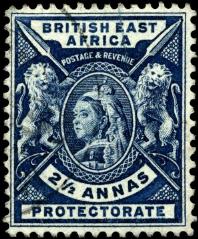
The British "sphere of influence", agreed in
Berlin in 1885 extended inland across the future
Kenya
and after
1894 included
Uganda as well. On 1.7.1895 the British government
proclaimed a protectorate.
(See Wikipedia)
See 1900 colonial asylums and Njenga 2002 Tanganyika Territory became part of British East Africa after the first world war. |
1896/1897 In Lutindi (in the Usambara Mountain), in what is now in Korogwe, Tanga, Tanzania, the German "Bethel Mission" (Lutheran) established a slave sanctuary for children who had been freed from slavery. With the decline of slavery Lutindi developed as a school and orphanage. Asylum established 1904
1896. Adolf Meyer's visit to Emil Kraepelin at the Heidelberg Clinic - See books
|
Colonial lunatic asylums
About 1900: Of the British empire's 74 colonial lunatic asylums, 21 are in India (or British Asia), six in South Africa, one in Sierra Leone (Kissy Lunatic Asylum 1820); one in Gold Coast (Accra, 1887). Yaba close to Lagos (Nigeria) opened in 1907 and Nairobi (Kenya) in 1910. In the German Africa, missionaries opened an asylum in Lutindi Tanganiyka (Tanzania) in 1905. In the Dutch East Indies there were three asylums on Java (Surabaya, 1876; Buitenzorg close to Batavia, 1881, and Lawan in 1902. From 1897 The Dutch East Indies had comprehensive lunacy legislation, similar to the law in Holland and France. Folie et ordre colonial. Les difficultés de mise en place d'une assistance psychiatrique au Sénégal et en Afrique occidentale René Collignon, Paris, CNRS. available as a pdf or view as html (no longer available) In South Africa, "The Mental Disorders Act was introduced in 1916. No provision was made for neurotic and personality disorders, alcohol dependence or learning disability. When the Union of South Africa was formed in 1910, there were eight mental institutions caring for 3624 patients. In 1955 there were 13 government mental hospitals and 17 881 patients. Today there are 24 registered public psychiatric hospitals, accommodating some 14 000 acute and long-term care patients." ( "Focus on psychiatry in South Africa" Robin Emsley, The British Journal of Psychiatry (2001) 178: 382-386) |
1903: Due to poor therapeutic conditions, including overcrowding, at the Heidelberg Clinic and better research facilities at Munich, Kraepelin moved to Munich.
28.7.1903 Ernest William Hens Bohle born Bradford, Yorkshire West Riding. 24.6.1904 Certificate of Naturalisation for Hermann Bohle [4.10.1876-12.7.1943] 14 Bertram Road, Bradford, a subject of Germany, having been born at Bergneustadt; the son of Friederick Wilhelm and Ida Bohle, both subjects of Germany. Twenty Seven years old a lecturer and teacher of science and electrical engineering. Married [to Antonie, née Knode] Three children: Hermine Johhnna Bohle aged six years [about 1898] - Anne Maria Bohle aged five years [about 1899] - Ernest William Hans aged 9 months [Had reside in UK at least five years during the last eight and intended to stay.] - Harry (Heinrich) Bohle was born about 1907. There may have been another sister called Johanna - The family went to South Africa in 1906 - 1931/1933: Auslands Organisation - 1938 Kristallnacht - January 1939 Greene-Bohle letters -
"... the Japanese, who are brown, defeated the Russians, who are white. In the course of the next few months the news of this remarkable event penetrated ... the uttermost ends of the earth. It sent a thrill through all Asia and it was known in the darkest corners of Central Africa. Everywhere it awakened strange and fantastic dreams." Park, R.E. and Burgess, E.W. 1921
See Wikipedia
14.2.1904 "The first comprehensive law on mental health in Italy dates back to 1904. At that time, the mental hospital was regarded as the cornerstone of the care system, 'admitting individuals with all types of mental disorders of any cause whatsoever, when they were dangerous to themselves or the others or were prone to public scandal' (Legge n. 36, 1904). Admission to a mental hospital could be requested by anyone 'in the interest of the patient or the society' (Legge n. 36, 1904) and even by the police on the basis of a medical certificate. The police soon became the most common source of referral since most admissions took place under emergency conditions. Admissions were compulsory, might last indefinitely and implied the loss of civil and political rights. Each province was responsible for the local provision and organisation of mental health care and set up its own mental hospital, which was kept apart from the general health care system." Piccinelli, Politi and Barale 2002
28.5.1904 Walter Ritter von Baeyer born, Munich. See 1964 Died: 26.6.1987 Heidelberg
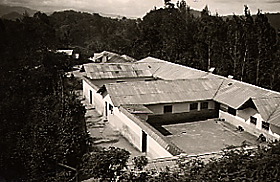
1930 picture |
1904
"Kolonialirrenanstalt" (colonial insane (irren) asylum (anstalt))
Lutindi, the "Klein-Bethel Ostafrikas" (Little Bethel East
Africa) built to plans by the architect
Karl Siebold. Friedrich Wilhelm Bokermann (1867-1947), Lutindi's
lead missionary, is said to have suggested the transformation.
(But see
Snyder 2013). In 1914, the
asylum had 86 patients.
|
Treatment focused on outdoor work in the coffee and banana fields (men) and the vegetable garden (women). Weaker members exercised in the courtyard. No corporal punishment was allowed, but handcuffs and straitjackets were used, especially in the early years. Potassium bromide used in epilepsy, replacing sedatives and hypnotics such as chloral hydrate. There was an attempt to initiate a family care system. "By World War the work was only briefly interrupted". See 1921. "In 1927 and then again in 1951 came the Bethel missionaries back to Lutindi". A government lunatic asylum was opened at Dodoma in the 1920s
Treaties with the Masai in 1904 and 1911 gave the British
government huge tracts of land in central Kenya which became
the larger part of the "White Highlands."
1904 A small pox isolation centre established in
Mathari, Nairobi,
Kenya. Redesigned as Nairobi Lunatic Asylum in 1910.
Known as Mathari Lunatic Asylum. Renamed Mathari Mental Hospital
16.9.1924 -
James Cobb
and other psychiatrists - See
McCulloch1995 -
Njenga 2002 -
Wikipedia -
about 1909 The Heidelberg Clinic assembled a teaching collection
of
patient's art.
17.2.1911 Birth of a double agent?
Joachim Benemann born Hamburg, Germany, port on the Elbe just
south of Denmark.
Said to have been very close to the
Communist Party in the early 1930s while employed in Moscow. First went to
the United Kingdom
25.8.1931. Came to
England 8.12.1933 and
left
11.2.1934.
In 1934 and
1935 he worked in the United Kingdom under Otto Bene of the
German Embassy
arranging boys camps for members of the
Hitler Youth
and English boys. In December
1935 he was in Germany, trying to link the Hitler Youth with the
British Scouts.
In
1936 and
1937 he arranged camps in Germany and the United Kingdom.
In 1937 he returned to study at London University
and to develop the Hitler Youth in the UK.
Organised
cycling tours and gliding, which thought possibly a cover for
espionage. He played a key role in a
tea party for Baden Powell (Scouts) and Rose Kerr (Guides) at
the German Embassy in London.
Became a member of the Nazi Party in April 1938 [??]. Party
number 5518162. Left the UK in
1939. [He was on a list of people who should be interned]. In
Second World War he worked for the Communist-influenced Resistance in
Denmark. [Which may indicate that Hamburg, where he was born,
had remained
a base for him]. He returned to England after the war and married an
English woman.
His anti-Nazi affiliations were investigated when he applied unsuccesfully
for British naturalisation in 1953. He died in Devon, aged 95, in 2007.
1913 Mulago Hospital, Kampala, Uganda founded by Albert Ruskin Cook.
- Wikipedia -
See Hoima.
|
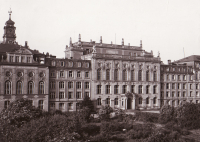
Sometime in 1914, a citizens' university was established at Frankfurt in Germany, by wealthy Frankfurt citizens, including prominent businesspeople, scholars, and philanthropists. Carl Grünberg founded the Institut für Sozialforschung there in 1923. The university was re-named the Johann Wolfgang Goethe- Universität in 1932. Nazification in 1933. In 1950 the Institut fü Sozialforschung returned to Frankfurt from its exile in the USA |
|
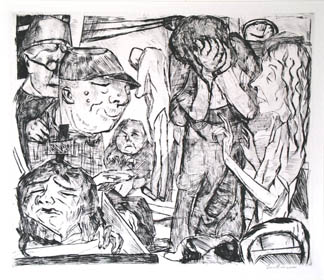
Max Beckmann
(1884-1950). Irrenhaus (Madhouse) 1918. Drypoint on laid paper It comes from a series called Gesichter (faces) |
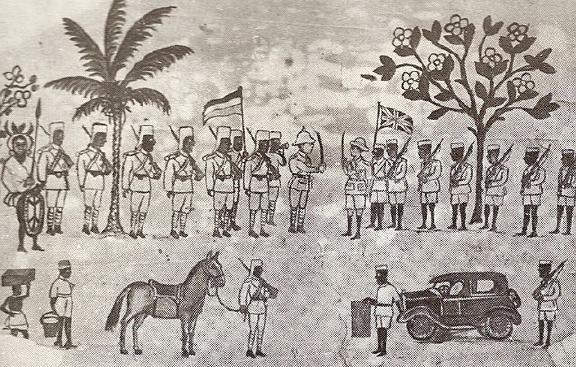
|
1919
A sociology department established in the Law Faculty at the University of
Warsaw.
1919 A Museum for Pathological Art authorised at the
Heidelberg Clinic (one room).
Hans Prinzhorn (supported by Karl Wilmanns) built up the
collection. In 1921 it staged an exhibition at Frankfurt's Gallery Zinglers
Kabinett, which then moved to Gallery Garvens in Hannover.
1919Partito
Nazionale
Fascisto formed in Italy. In power 1922 to 1943.
|
THE WEIMAR REPUBLIC - GERMANY
The Weimar Republic started with the election of a National Assembly on 19.1.1919 (Or established 11.8.1919). Friederich Ebert of the SPD was German President from 11.2.1919 to 28.2.1925 - Government by decree began 29.3.1930 |
5.1.1919 to 12.1.1919 Spartacist Uprising. Ebert used troops to suppress an uprising led by the Spartacus League and the Independent Social Democrats in Berlin. Luxemburg and Liebknecht were arrested by the troops and murdered.
5.1.1919 Deutsche Arbeiterpartei (German Workers' Party) (D.A.P.) formed by Anton Drexler, a virulent anit-Semite.
January 1919 Founding conference of the Third International (the Communist International) - meant an external influence on policies of the KPD and other communist parties outside the USSR.
15.4.1919 Save the Children Fund was founded in London as an effort to alleviate starvation of children in Germany and Austria-Hungary during the Allied blockade of Germany, which continued after the Armistice.
28.6.1919 Treaty of Versailles ended the state of war between Germany and the Allied Powers. Germany to pay reparations.
15.10.1919: The ABC of Communism
|
9.10.1921 J. Spittles and his wife, C. M. Spittles, became Superintendent and Matron of Lutindi Lunatic Asylum. The asylum had 86 patients on 31.12.1921. 21 new patients were admitted in 1921. Nine patients died and six died. "With the exception of thirteen men and six women, who are necessary as attendants, and to take charge of tools, stores, etc., all work was performed by patients. Work undertaken was cultivation of fields, care of stock, making and repairing clothing, all necessary repairs to buildings and building new drains and latrines in male and female wards." Miss B. G. Allardes, Nursing Sister. C. A. Patel, Fourth Grade Clerk. (P.M.O.'s Office). D. B. Somvasi, Fourth Grade Clerk, J. B. da Cunha, Third Grade Clerk. (P.M.O.'s Office There was no serious casualty during the year. One patient required forcible feeding for three weeks. One man with hydrocele was 57 tapped four times during the year. One female suffering from Syphilis was sent to Tanga Hospital for injections. The treatment was successful. The rate for each patient per day was cents 6o (Shg.) It has since been found that it can be reduced cents 10 per day, resulting in a saving of shillings 240/- per month. Besides the aboveś a small asylum sufficient to accommodate six lunatics has been erected at Tabora. The building of a large Central Lunatic Asylum is contemplated in the near future. |
"Communism equals the power of the Soviets
plus electrification of the whole country"
1920 Florian Znaniecki (15.1.1882 -) became the (first) Professor of Sociology at the University in Poznan, in Poland. There he organized the Polish Sociological Institute (Polski Instytut Socjologii) and began publishing The Polish Sociological Review (Polski Przeglad Socjologiczny). [See 1946 and 1957] (Wikipedia)
Early 1920 Deutsche Arbeiterpartei became Nationalsozialistische Deutsche Arbeiterpartei. Adolph Hitler, its propaganda officer, drafted a twenty five point party programme that became the permanent basis for the party.
13.3.1920. Kapp Putsch (Counter-Revolutionary)
About 1921 [Possibly 1920] (Benjamin) Ben Greene (28.12.1901 - October 1978) joined the Quakers, left Oxford University and went, on a Nansen Pass (Save the Children Fund Pass), with Quaker Relief Work in Germany, Poland, Czeco- Slovakia and Russia. He was in Russia on famine relief work for 18 months. Probably returned towards the end of 1923. In 1935 he was deputy chief returning officer of the Saar Plebiscite, after which he gave a lecture on his experiences expressing sympathy with German ideals and aspirations.. See 1936 Berkhamsted - 1938 change of allegiance - 1938 Kristallnacht - January 1939 Greene-Bohle letters - 1939 British People's Party. Greene was detained under Regulation 18B on 23.5.1940 because of his German sympathies ("hostile associations"), but was released in 1942. After the war, his views on the British constitution were published the nationalist Candour which supported the League of Empire Loyalists. His daughter, Leslie, was the secretary of the League and a founder of the National Front in 1967.
March 1921 "March Action" of workers and KPD in Germany. Abortive.
|
GERMANY
1922-1923 FINANCIAL COLLAPSE AND RUNAWAY INFLATION January 1923 to Summer 1925 French and Belgian troops occupied the Ruhr to secure reparations. October 1923 "The German October" and "Hamburg Uprising": abortive communist revolutions. 8-9.11.1923 Bierkeller Putsch, Münchener Putsch or Hitlerputsch. The publicity of Hitler's trial gave momentum to the Völkischer Block, an alliance of racist organisations, which became the third largest party in the Bavarian parliament. Confined in Landsberg Castle, Hitler dictated the first part of Mein Kampf (My Struggle) to Rudolph Hess:
|
19.8.1923 The First Agricultural and Crafts Exhibition opened in Moscow. The Exhibition appears to have been a showcase for the Societ Union but is said to have emphasised international aspects of the display and to have attracted foreign businesses wanting to exhibit their products. Lenin toured exhibition in October 19234, despite being extremely sick. (about the exhibition)
Ben Greene probably returned to England towards the end of 1923. He came home via Moscow, St Petersburg, Helsinki, Bergen and Newcastle. At the Moscow Trade Fair he admired the "proud flag of Italian fascism", but had less time for that flown by "that parody of the German republic". 29.10.1924: unsuccessful Labour Party candidate for Basingstoke in the General Election. He married in London in March 1925.
May June 1924. Pravda published Joseph Stalin's lectures on The Foundations of Leninism (External link to Peking edition). Lecture 9 on "Style in Work" explains that "The combination of Russian revolutionary sweep with American efficiency is the essence of Leninism in Party and state work"
|
1924-1929 A DEGREE OF POLITICAL AND ECONOMIC STABILITY IN GERMANY
1925-1933 Field Marshal von Hindenberg President of Germany 1925 Adolf Hitler's Mein Kampf (First volume). Promoting the hierarchic Fürer-state, aryan supremacy, anti-semitism and expansionist Lebensraum (living-space) ideas.
|
Gwynneth and her husband Donald Latham (a young doctor) arrived in Tanganyika. Her diaries include description of visit to Lutindi and reference to the planned asylum at Dodoma.
3.9.1925 Report by His Britannic Majesty's Government on the Administration under Mandate of Tanganyika Territory for the year 1924 Société des Nations - League of Nations Genève 1925 Geneva
"A certain number of lunatics are confined at the Lunatic Asylum at Lutindi, but the Asylum is situated in a remote district and the accommodation available is inadequate for the needs of the Territory. It is necessary at present to confine criminal and other lunatics in ordinary gaols. This is most undesirable and the erection of a Central Lunatic Asylum at Dodoma to accommodate both criminal and civil lunatics is about to be commenced. A small asylum and gaol for criminal lepers will also be erected at Dodoma."
|
Zygmunt Bauman was born on 19.11.1925 in Poznan, Poland. His
parents
were non practising Jews.
Janina Lewinson was born on 18.8.1926 in Warsaw. She remained in Poland when Germany invaded. When Germany and Russia invaded Poland in 1939, Zygmunt escaped to the Russian zone. Later he served in a Polish military unit under Russian control.
"he was a teenager when the Germans invaded. His family caught the last train east to Russia. When he was old enough he joined the Fourth Division of the Polish exile army in Russia - with whom he entered Poland." Bauman says he was a "communist" from 1946 to 1967. When he was 19 he joined the Polish Secret Service, for three years. (1945 to 1948) From 1945 to 1953 Bauman was a political instructor in the Internal Security Corps (KBW), a military unit formed to combat Ukrainian nationalist insurgents and part of the remnants of the Polish Home Army. At some point after the war Bauman became a student of sociology at Warsaw University. March 1948: Janina Lewinson met Zygmunt Bauman at Warsaw University. They became engaged very shortly afterwards. Zygmunt taught at Warsaw University from 1954 to 1968, Zygmunt studied for a year in the late 1950s at London School of Economics. He published in Polish in 1959 - 1960 - 1961 - 1962 - 1964 - Zygmunt became Professor of General Sociology in 1964. He published in Polish in 1965 and 1966. An anti-semitic purge in 1968 meant that Zygmunt and Janina lost their jobs. Bauman taught at the University of Tel Aviv from 1968 to 1970, at the University of Leeds from 1972 to 1990. Modernity and The Holocaust, published in 1989, was influenced by the recollections of a Warsaw childhood published by his wife, Janina, in 1986. |
|
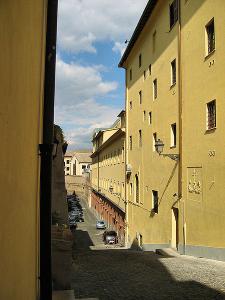
9.11.1926 The Fascist government enacted a new wave of emergency laws, taking as a pretext an alleged attempt on Mussolini's life several days earlier. The fascist police arrested Gramsci, despite his parliamentary immunity, and brought him to the Rome prison Regina Coeli. |
1926 or 1927 Mirembe Asylum built in Dodoma, by the British colonial administration to serve the whole of the Tanganyika Territory. - Wikipedia - facebook - partnership. "The hospital was founded in 1926, originated from an orphanage, and was originally used for patients with malaria and fever (and associated confusion) to absorb. Now it is a National Referral Hospital for Mental Health. The only psychiatric hospital in Tanzania, but there are still patients with physical illnesses, such as HIV / AIDS, malaria, tuberculosis, etc. There are 700 beds, of which 250 forensic places. There are five divisions: Mirembe for ordinary patients (about 500), Isanga for forensic examination and Mirembe annex is an intermediate form of these two.Hombolo is a kind of small town where patients can live as they have nowhere else to go, and where they can live their own farming business with chickens, goats, cows and agriculture such as corn. If there is a 5th part Nurses Training related to hospital (with 25 students) .. The treatment is free or based on 50% cost sharing. That is determined by a Social Worker. The management did their policies well, but they are just not able to deliver. Every care to 100% They just make do with what they have and they were very positive. They hope that the situation would improve". (Fortune of Africa)
1927 German missionaries return to Lutindi. Heinrich Waltenberg (born 1902) arrived in 1930 as Pastor. He and his wife, Hildegard Waltenberg, were interred as enemy aliens at the start of World War two, but then commissioned by the Tanganyika Government to head the Lutindi Mental Hospital during the War.
4.6.1928 Antonio Gramsci sentenced (with other Italian Communist leaders) to 20 years, 4 months and 5 days in prison. Sent to a prison in Turi, in the province of Bari, which turned out to be his longest place of detention (June 1928 -- November 1933).
1929- 1935 Antonio Gramsci's Prison Notebooks written
Mental health services in Uganda started in Hoima prison in the 1920s. [Hoima Prison built 1930s?]. In 1934-1936, a ward at Mulago hospital was opened to receive mental health patients from Hoima. "In 1940, the remaining batch of patients in Hoima was transferred to Mulago in the legendary ward 16". See Butabika
From Maling 2015:
1920s: Confinement in Prison Asylums.
1935: Patients were transferred from Hoima to Mulago in Kampala
1954: Butabika Hospital was built,
1960: Butabika School of Psychiatric Nursing established
1962 Butabika Hospital expanded
1964: Mental Treatment Act (1964).
1970: Out Patient Department (ward 16) started at Mulago Hospital
1970s: Mental health units in large Regional Referral Hospitals (OPD & in-
patient services offered)
1979 PCO school was opened by Prof. Bbosa
1930 Alfred Rosenberg's The Myth of the 20th Century
Heidelberg:
1930
"Foundations laid for the New University
1933-1939 59 of
the 214 teaching staff deprived of their posts in the National Socialist
era
1945
Gradual resumption of teaching (15 August); first rector: Karl
Heinrich Bauer (Medicine); Collegium Academicum established
1962 Opening of
the interdisciplinary South Asia Institute
1962
Establishment of the Cancer
Research Centre (from 1972: German Cancer Research Centre)
1964 Opening of
the University hospital complex in Mannheim (1969: Faculty of Clinical
Medicine, Mannheim)
1969 New constitution for
the University: 16 Faculties
instead of 5
1986 600th anniversary of Heidelberg University with Gisbert
zu Pulitz as rector
1994
The Faculty of Medicine is the largest in Germany;
the University now has 15 Faculties"
(source)
1.5.1931 Auslands (Foreign) Organisation of the NSDAP (Nazi Party) founded at Hamburg "upon suggestion of some Germans abroad". Ernst Wilhelm Bohle became a volunteer assistant in December 1931 and joined the Party on 1.3.1932. On 8 May 1933 he became leader On account of my experience and my connections abroad -- I was born in England and raised in South Africa. (Nuremberg Proceedings). About 1937 two relatives of Ernst Wilhelm were listed working for the Auslands Organisation in the Amt für Technik (Office for technology). Im Germany: Heinrich Bohle "Bruder von Ernst Wilhelm Bohle" and in South Africa Hermann Bohle "Vater des Gauleiters Bohle"
25.8.1931 When Joachim Benemann arrived in the United Kingdom, he had already worked in Italy (under Mussolini), Russia (under Stalin), and Scandanavia.
| 14.9.1931 Second Spanish Republic proclaimed 9.12.1931 Constitution adopted |
Antonio Gramsci's Notebook 12 contains "Notes on the History of Intellectuals" 3 Notes
1932: A project for exchanging political prisoners (including Gramsci) between Italy and the Soviet Union failed
|
"By chance in the mid-1930s promethazine, a compound with
antihistamine
(anti-allergy) properties from a group called
phenothiazines, was shown in
France to calm people who were suffering from delusions, hallucinations, or
similar conditions (collectively called psychoses). A related compound
chlorpromazine was synthesized by the French company
Rhône-Poulenc in
1950?
and Henri Laborit, a surgeon, tried it to decrease anxiety before surgery.
Noting the calming effect of this drug on his patients, he suggested that
it might be useful in treating mental illness."
(Flanagan, R.J.
2002)
"Après découverte du rôle de l'histamine dans les allergies, le laboratoire Rhône-Poulenc cherche à développer dès 1933 des "anti-histaminiques", les chimistes synthétisent donc en 1947 un dérivé phénothiazinique, la prométhazine, qui possède, des propriétés sédatives marquées. En 1948, le chirurgien Pierre Huguenard l'utilise dans un cocktail lytique pour provoquer sédation et indifférence chez les opérés, et Henri Laborit, un autre chirurgien, cherche à prévenir le choc opératoire, et soupçonne un effet "stabilisant" du Système Nerveux Central (SNC) pouvant créer une hibernation artificielle et une sédation sans narcose, il demande alors au laboratoire Rhône-Poulenc de travailler sur des composés aux propriétés stabilisante plus marquées, ce qui permet la création de la chlorpromazine." Wikipedia |
30.1.1933 Nationalsozialist party in power in Germany
around 25.2.1933 Nazi commissar for Frankfurt announced. "Frankfurt was the first university the Nazis tackled, precisely because it was the most self-confidently liberal of major German universities," Peter Drucker
Karl Wilmanns (1873-1945), director of the University Hospital of Psychiatry at Heidelberg was forced to leave his post. Carl Schneider (1891- 11.12.1946), a National Socialist, was appointed in his place.
|
1933 Publication of Datos históricos científicos y
estadísticos, referentes al Hospital de Inocentes de la ciudad de
Valladolid, de 1489 a 1932 by Francisco de Sisniega y
Pérez. Published in Valladolid: Gráficas Valencia, 1933. 24
pages. Available
http://bibliotecadigital.jcyl.es/i18n/consulta/registro.cmd?id=2466
Francisco de Sisniega y Pérez had been the doctor in charge of the provincial lunatic asylum for 25 years and was a delagate to the Spanish League of Mental Hygiene. |
1934 Antonio Gramsci's Notebook 22 contains "Americanism and Fordism" (16 Notes)
In 1934 Gramsci gained conditional freedom on health grounds, after visiting hospitals in Civitavecchia, Formia and Rome.
1934 Hitler named Joachim von Ribbentrop Special Commissioner for Disarmament. In August 1934 Ribbentrop founded the Büro Ribbentrop (later the Dienststelle Ribbentrop), linked to the Nazi Party, which functioned as an alternative foreign ministry. See Deutsch- Englische Gesellschaft - Ambassador - Ribbentrop Bohle 1937 - Foreign Minister 1938
1934 Intercepted letters Joachim Benemann, generally relating to Hitler Youth. Spring: From Kurt Weitbrecht in Hamburg to England. July from Benemann in Hamburg to Otto Bene. He is returning to England 11.7.1934. Negotiations with the Scouts are under way. He wishes to enlist sympathy in British Public Schools.
|
1935 Carrel, A. (1935) L'Homme, cet Inconnu. Paris: Plon. -
See
Wikipedia
Dr Alexis Carrel, a Nobel prizewinner [Physiology, 1912 - external link and an extreme advocate of eugenic measures, believing that "families where there exists syphilis, cancer, tuberculosis, neurosis and feeble-mindedness are more dangerous than those of thieves and assassins" (J.L.T. Birley 2002, translating from l'Homme, cet inconnu) Alexis Carrel, l'Homme, cet inconnu: "Quant aux autres, ceux qui ont tué, qui ont volé à main armée, qui ont enlevé des enfants, qui ont dépouillé les pauvres, qui ont gravement trompé la confiance du public, un établissement euthanasique, pourvu de gaz appropriés, permettrait d'en disposer de façon humaine et e conomique. Le même traitement ne serait-il pas applicable aux fous qui ont commis des actes criminels ? Il ne faut pas hésiter à ordonner la socié moderne par rapport à l'individu sain. Les systèmes philosophiques et les préjugés sentimentaux doivent disparaître devant cette nécessité. Après tout, c'est le développement de la personnalité humaine qui est le but suprême de la civilisation " (Taken from Les archives de l'Humanité - archive) As for the others, those who killed, who fled at gun-point, who removed children, who stripped the poor, who seriously misled the public, an establishment for euthanasia, equipped with appropriate gases, would allow them to be removed in a human and economic way. Should not the same treatment be applied to the insane who have done criminal acts? We should not hesitate to create a modern society that one can compare to the healthy individual. The philosophical systems and the sentimental prejudices must disappear in front of this need. After all, it is the development of the human personality which is the supreme goal of civilisation |
early 1935 Wolfgang Huber born - See 1964 - 1966 - 1968 - 1970 - 1971 - 1973 - 1995 ruprecht - 1998 - 2001 list of dates - 2006 - 2007 -
13.1.1935 A plebiscite held in the Saar territory, which was the
only part of Germany still under foreign occupation following World War I.
90.8%, voted to re-join the German Reich. 8.8% wanted to remain under
British and French occupation under a League of Nations mandate. 0.4%
wanted to join France. The main reason why 8.8% voted to remain occupied
was tat they did not wish to be ruled by Nazis.

|
Bryanston School Camp
May 1935
Copy of dual language Unser Lager - Our Camp sent to MI5 in 1935 showed the efforts to link Hitler Youth with the Boy Scouts. Benemann had "failed so far" to reach agreement with the "Boy Scout Headquarters" |
11.4.1935 A broadcast (BBC?) made by Joachim Benemann. MI5 sent information about him to the UK Home Office and Foreign Office. Shortly after a letter from Lotte Wolff, Croydon was intercepted sayingthat organisation of Benemann's camps was continuing despite his return to Germany. Leslie Wood working as his representative in England. They are about to found an Anglo- German circle.
2.12.1935 The Deutsch-Englische Gesellschaft founded by Ribbentrop. It was a sister organisation to the Anglo-German Fellowship. The Deutsch-Englische Kreis (German-English Circle) was the youth organisation of the Deutsch-Englische Gesellschaf, which organised youth camps. The organisations were disbanded when war broke out in 1939.

|
26.12.1935 to 5.1.1936
Anglo-German Camp near Berchtesgaden for the
winter sports. At this camp a programme for 1936 will be drawn up.
6.2.1936 to 16.2.1936 Winter Olympics Garmisch-Partenkirchen in Bavaria, Germany. The last year in which the Summer and Winter Games were both held in the same country |
|
17.7.1936 Spanish Civil War
1.4.1939 Fall of the Republic |
Sometime 1936 A camp organised at Berkhamsted School in Hertfordshire. Joachim Benemann, the organiser, stayed as the guest of the headmaster (Cuthbert Machell Cox from 1931 to 1946). At sometime during the camp he was in hospital. MI5 files mention "Unser Lager, published by the Anglo-German Circle, of which the parent organisation is the Deutsch-Englisher Kreis. J. Benemann is head of the German organisation" [Benemann worked with Ben Greene , whose uncle was Charles Henry Greene (father of Graham Greene), who was headmaster of Berkhamsted from 1911 to 1927)]
1.8.1936: Berlin Olympic Games opened
August 1936 Ribbentrop appointed Ambassador to the United Kingdom with orders to negotiate an Anglo-German alliance. He arrived to take up his position in October 1936
1937: Martin Niemoller arrested by the Gestapo. Eventually sent to Sachsenhausen and then to Dachau. Moved in 1945 to the Tirol.
January 1937 Church and State in Germany. The attitude of the National Socialist Party and the German government towards Christianity by Baron Friedrich von der Ropp. (Service Volume 8, Number 1)
2.3.1937 Orange Street meeting of the Civil Service Christian Union with Baron Friedrich von der Ropp.
27.4.1937 Death of Antonio Gramsci, at the "Quisisana" Hospital in Rome (46years old). His ashes are buried in the Protestant Cemetery there. External link (deceased) to John M. Cammett's 1998 bibliography which includes a bibliography of translations from the Italian into other languages.
25.5.1937 Musée de l'Homme founded in Paris.
19.7.1937 Exhibition of Entartete Kunst (Degenerate Art), organized by Adolf Ziegler and the Nazi Party, opens in Munich.
30.9.1937 Press photograph of Ribbentrop, the German ambassador, with Ernst Bohle, the leader of the foreign organisation of the Nazi party, at Croydon airport. Bohl was visiting Britain to speak at a harvest festival meeting of German Nazi's at the Porchester Hall in Paddington, London, a hall that had been used by the Nazis since 1934. Bohle coming from Germany meant a large attendance was expected. Brendan Bracken, conservative MP for North Paddington and a Winston Churchill's supporter protested strongly at the hall being used. The council were assured the meeting would be orderly, especially as the Ambassador was to be present.
1937 James Cobb succeeded H.L. Gordon in charge of Mathari. Succeeded by John Colin Dixon Carothers (1903-1989). James Cobb publicly had sexual intercourse with large animals.
4.2.1938 Ribbentrop succeeded Konstantin von Neurath as German Foreign Minister
19.7.1938? Düsseldorf speech by Carl Schneider on the first anniversary of the Entartete Kunst (Degenerate Art) exhibition.
He attributed the "successful cure" of a "schizophrenic artist" who had "already produced pathological works" to the following measures:
"We (did) the opposite to what ... Lombroso, Prinzhorn and others had done. Instead of saving the woman's morbid works we destroyed them, and guided her while she went about her normal, self-allotted tasks."
29.9.1938 and 30.9.1938 Munich and "giving way" to Hitler.
September 1938 Ben Greene resigned from the Labour Party because he was in favour of Chamberlain's policy of peace with Hitler and the Labour Party opposed it. He worked for the Peace Pledge Union before going to Germany after Kristallnacht.
7.11.1938 A Polish-Jewish student, Herschel Grynszpan, shot a German
diplomat, Ernst vom Rath, in Paris. Ernst vom Rath died 9.11.1938.
Kristallnacht was organised as reprisals.
9/10.11.1938
Kristallnacht
(Night of Crystal). Night of broken glass. Anti-Jewish pogrom initiated by
Joseph Goebbels, Minister of Propaganda, and
the Sturmabteilung (SA) (Sturmtruppen - Storm Troopers). Ninety-one Jews
were killed, hundreds seriously injured. About 7,500 Jewish businesses were
gutted and an estimated 177 synagogues burned or otherwise demolished.
[Hermann Göring led the economic despoliation of the Jews in Germany
and
the territories Germany occupied. (Encyclopedia Britannica)]
12.11.1938 Speech by Hermann Göring (Hitler's second in
command) proposed
ghettos as a means of concentrating and controlling the Jews.
12/13.11.1938 Decrees confiscated the major part of Jewish wealth
and
imposed a fine of one million marks on the Jewish community.
Ben Greene in Germany.
He went on behalf of the
Germany Emergency Committee
, travelling out via Amsterdam, where he met the Dutch Prime
Minister (discussing passage of Jews through Holland if the United Kingdom
should allow them in). John Scanlon (Daily Express then Oswald Mosley
journalist) gave Greene contact details for
Ernst-Wilhem Bohl and Harry Bohl
1.1.1939 Letter addressed to
Herrn H. Bohle, Berlin, W8, Krausen St
W1 from
Ben Greene in Berkhamstead (Telephone Berkhamstead 1), who will
follow Bohle's advice to postpone going to Germany until after he has seen
him in London.
29.8.1939 A reply letter to "Dear Ben" from "Bohle" 30, Wetzler
Stresse, Berlin-Wilmersdorf. -
29.8.1939 A reply letter to "Dear Ben" from "Bohle" 30, Wetzler
Stresse, Berlin-Wilmersdorf. [This Bohle, who Greene considered a friend,
is
Heinrich (Harry)]
January 1939 Office to promote emigration of Jews "by every possible
means" established.
30.1.1939 Hitler speaks of "the destruction of the Jewish race in
Europe" in the event of a second world war fermented by "international
finance
Jewry".
Spring 1939: Reich Committee for Scientific
Research of Hereditary and Severe Constitutional Diseases established.
This oversaw the killing of an
estimated 5,000 'deformed' children in a 'euthanasia' programme that only
finished in November 1944.
July 1939 Planning of 'T4' programme of 'mercy killings' of the
insane
began. Experimental gas chambers were tried out at Brandenburg euthanasia
centre in late 1939. An estimated 80,000 to 100,000 people were killed
before the T4 programme was 'stalled' in August 1941 after public protest.
In October 1939, Hitler signed a back-dated "euthanasia decree" to 1
September 1939 which authorised Philipp Bouhler and Karl Brandt to carry
out the programme of euthanasia (translated into English as follows):
Reich Leader Bouhler and Dr. med. Brandt are charged with the
responsibility of enlarging the competence of certain physicians,
designated by name, so that patients who, on the basis of human judgment
[menschlichem Ermessen], are considered incurable, can be granted mercy
death [Gnadentod] after a discerning diagnosis."
The new recruits were mostly psychiatrists, notably
Carl Schneider
(Heidelberg), Max de Crinis (Berlin) and Paul Nitsche from the
Sonnenstein state institution. (Wikipedia)
Friday 1.9.1939 Russia and Germany invaded Poland.
During the occupation, Universities in Poland were closed down, but the "Secret University of Warsaw" (Tajny Uniwersytet Warszawski) was organised by lecturers and met in people's homes.
The Bauman family, who were Jews, ran away from their home in Posnan, near the German boarder, as the Germans invaded. "We took the last train east, but we were stopped at a station which was being bombed by the Germans. We should have run away from the station because that was the object of the bombing, but" [my father] "wanted to find a ticket inspector to pay for our tickets." (Zygmunt Bauman quoted Bunting, M. 2003)
The family of Janina Lewinson (also Jews) remained in Poland.
Janina's father was a surgeon and a Polish Army reservist. He was attached to a military hospital during the German invasion, was captured by the Red Army and taken to Kozielsk, officers' camp. His family received just one letter before he was killed in the Katyn Forest massacre.
|
15.9.1939 House of Commons Debate: ANGLO-GERMAN ORGANISATIONS.
Mr. Mander asked the Home Secretary whether the activities of the Anglo- German Kameradschaft, the Anglo-German Circle, and the Anglo-German Academic Bureau, have now closed down; and whether the Anglo-German Review has ceased publication. Sir J. Anderson: I am informed that the Anglo-German Kameradschaft and Anglo-German Circle have been disbanded, that the Anglo-German Academic Bureau is in process of being wound-up, and that the publication of the Anglo-German Review has been discontinued. Commander Locker-Lampson: Are the British Fascists in Smith Square also being liquidated? Sir J. Anderson: That is another question, which my hon. and gallant Friend had better put on the Paper |
18.8.1939 Janina Lewinson's thirteenth birthday.
15.9.1939 to 28.9.1939 Siege of Warsaw by German army.
"On 25 September - it was Monday, the day of Rosh Hashna, the Jewish New Year - all hell on earth broke loose. We learnt later that it was the final German storming of Warsaw... An immense wall of flame... We stood in perfect emptiness, Artek and I... on the brink of life...l Then we kissed, the first kiss of my life and his. And the last - we believed" (Janina, pp 25-26)
"since I was just 13. I had to wear a band, a white band with a blue star. It started at 13 and I was just that. My sister was still not obliged to wear it, she was just nine."
5.3.1940 A proposal of Lavrentiy Beria's to execute all members of
the Polish Officer Corps, was approved and signed by the Soviet Politburo,
including Joseph Stalin. About 22,000 victims were murdered in the Katyn
Forest in Russia, the Kalinin and Kharkov prisons and elsewhere during
April and May 1940.
9.4.1940 The German army crossed the Danish border by land, sea and
air. Denmark was the way to Norway.
10.5.1940 - 22.6.1940:
Germany invaded France
|
22.4.1940 German armistice with French government under which
Germany would occupy northern and western France including the entire
Atlantic coast. The remaining two-fifths of the country would be governed
by the French government with the capital at Vichy under Pétain.
"official rations amounted to 1200 calories per day, insufficient to support life. French citizens went hungry, but did not starve to death - they were expected to obtain extra food in various ways. Many groups were allowed extra rations: the young, heavy labourers, pregnant and nursing mothers and hospital patients. But not all hospital patients. Those in psychiatric hospitals were specifically excluded. Their death rate rose dramatically." |
18.8.1940 Janina Lewinson's fourteenth birthday.
16.10.1940 Warsaw Ghetto established.
Janina, her sister, Zosia, and their mother were in the Warsaw ghetto from October 1940 to January 1943. They spent 26 months there. . Janina's Warsaw experiences are online - (archive)
18.8.1941
Janina Lewinson's fifteenth birthday.
"The next day, 22 July 1942, the mass deportation of people from the Warsaw
ghetto began" (Janina p.64) Beginning of the "Grossaktion".
23.7.1942 Mass extermination. by gassing, of Jews from the Warsaw
Ghetto begins at the Treblinka death camp.
Towards the winter of 1942/1943,
Janina Lewinson remembers seeing leaflets calling Jews to fight
and defend themselves. The second 'aktion' began in January.
25.1.1943
Janina Lewinson, her mother and Sophie escaped from the Ghetto
and hid with families in the Aryan areas of Warsaw.
25.8.1944
Free French recapture Paris.
Saturday 27.1.1945
freeing of Auschwitz by Russian troops.
October 1945 "
Les Temps Modernes est une revue politique,
littéraire et philosophique, fondée en octobre 1945 par Jean-
Paul Sartre et Simone de Beauvoir, publiée chez Gallimard d'octobre
1945 à décembre 1948, chez Julliard de janvier 1949
à septembre 1965, aux Presses d'aujourd'hui d'octobre 1965
à mars 1985, chez Gallimard à
partir d'avril 1985."
Wikipedia
December 1945 Lectures resumed for almost 4,000 students in the
ruins of Warsaw University. The buildings were gradually rebuilt.
Zygmunt Bauman says he was a "communist" from 1946 to
1967.
1946
Polski Przeglad Socjologiczny began to appear again (but
not for
long)
Autumn 1946 the City of Frankfurt, Hesse and
Frankfurt University expressed a wish to reestablish the
Institut für Sozialforschung at the university.
After many doubts and skeptical considerations
Horkheimer agreed to return.
(Geschichte) - He returned in
1949 and
the Institute reopened in
1950 (Wikipedia).
"I was trying to make out what day it was, what date. Great-
Aunt Bella, who had been keeping a diary, helped me: it was Tuesday 18
August, which meant it was my birthday, probably the last. I was sixteen"
(Janina p.72)"
"Poland was a very backward country before the war, which was exacerbated
by the occupation. In an impoverished country you expect deprivation,
humiliation, human indignity and so on, a whole complex of social and
cultural problems to be dealt with. If you looked at the political spectrum
in Poland at that time, the Communist party promised the best solution. Its
political programme was the most fitting for the issues which Poland faced.
And I was completely dedicated. Communist ideas were just a continuation of
the Enlightenment."
(Guardian interview 28.4.2001)
|
The twelve USA trials before the
Nuremberg Military Tribunals took place
from 9.12.1946 to 13.4.1949. The trials were:
The Doctors' Trial (9.12.1946 - 20.8.1947)
January
1948 Marian and Eugene Brody returned to the USA. "Dr. Brody
told an interviewer in 1999 that he was dealing with "death squad leaders,
people who had been in charge of major occupied areas and were responsible
for the deaths of many - doctors who condemned schizophrenic and
developmentally disabled people to death, [and] industrialists who had used
slave labor - it was difficult to carry out the purely psychiatric tasks
without being concerned about the entire issue of human rights and Nazi
atrocities"
(Baltimore Sun obituary)
4.3.1947. American forces at Dachau charged 28 former camp personnel, 2 former kapos, and 1 former prisoner with participating in the Operation of the Buchenwald concentration camp. The former prisoner was Edwin Katzen- Ellenbogen 5.8.1947 Dr. Edwin Katzen-Ellenbogen on the witness stand
|
1947 First students enrolled in the Warsaw University Institute of Sociology (External link Polish links to English and German translations)
1948 East African High Commission established cooperation between the Kenya Colony, Uganda Protectorate, and Tanganyika Territory (of the United Kingdom). There was a customs union, with a common external tariff, currency, and postage. It also dealt with common services in transport and communications, research, and education. Following independence (1961- 1964), these integrated activities were reconstituted and the East African Common Services Organisation.
Bauman
- the 'persecution' years
March 1948 Birth of
Margrit Schiller. Eldest child of an army major in the West
German Military Counterintelligence. Her mother a and a local CDU
politician. She studied psychology in Bonn and Heidelberg. A student member
of the
1970 Socialist Patients' Collective. Became first a supporter
and then active member of the Red Army Faction. Arrested
22.10.1971 in
Hamburg, when policeman Norbert Schmid was shot (but
not with Schiller's weapon). The alleged shooter Gerhard Mller later
became witness of the Attorney General .
According to their own statements, Schiller was in prison several times in
solitary confinement . She participated in several hunger strikes . After
her release from prison in
1973 she went back
underground. Arrested again
4.2.1974 and serving a prison sentence
until
1979. The offense, on the basis she was sentenced, closed card
forgery , unauthorized possession of firearms as well as membership and
support of the
RAF one. To avoid a feared re-arrest, she went in
1985
after Cuba into exile, where granted her the government for political
asylum .
(source)
"I cooperated for two, three years, I was the object of
persecution from the secret services for 15 years. Immediately afterwards,
I was spied on, I was reported on, I had my flat bugged, my telephone was
bugged, and so on. I was thrown away from the internal army, and in the
end, as you know, I was expelled from the university, expelled from any
ability to publish." Zygmunt Bauman
(Guardian interview 28.4.2001)
"
|
1949
Theodor W. Adorno wrote "Kulturkritik und Gesellschaft"
(Cultural Criticism and Society),
published in Prismen (Frankfurt: Suhrkamp, 1955), pages 7-31
"The more total the society, the more reified also the spirit [mind] and all the more paradoxical its beginning, of itself to extricate itself from reification. Yet even the most extreme consciousness of calamity threatens to degenerate into empty chatter. Cultural critique finds itself opposite the final stage of the dialectic of culture and barbarism : to write a poem after Auschwitz is barbaric, and that eats away also at that insight that explains why it has become impossible to write poetry today." (30-31)
See 1995 and (external link)
Poetry of the Holocaust
October 1949 Adorno left America for Europe just as The Authoritarian Personality was being published. Adorno resumed his teaching at the university soon after his arrival, with seminars on "Kant's Transcendental Dialectic," aesthetics, Hegel, "Contemporary Problems in the Theory of Knowledge" and "The Concept of Knowledge." (Wikipedia on Adorno) |
|
Chlorpromazine
(see above) was synthesized on 11.12.1951 by Paul
Charpentier, in the laboratories of Rhône-Poulenc, a French
pharmaceutical company, and released for clinical investigation in May
1952 as a possible potentiator of general anesthesia... Chlorpromazine
became
available on prescription in France, under the
proprietary name of Largactil, ie, large in action, in November
1952. The proprietary name was chosen to reflect the diversity of
pharmacological actions and potential clinical indications of the drug.
1951 Henri Laborit, a surgeon at the Val-de-Grâce military hospital in Paris reasoned that 'surgical shock' might be lessened if patients' metabolic rates were reduced by external cooling by using ice packs and administering a mixture of various 'potientiating' drugs. Laborit decided to use antihistamines as part of this cocktail to exploit their drowsiness effect. Rhône-Poulenc gave him a sample of the experimental drug 4560RP, chlorpromazine. Laborit noticed that instead of patients anxiously awaiting the mask, they showed a certain 'uninterest' which he termed 'euphoric quietude'. He noted in his report: "These findings allow one to anticipate certain indications for the use of this compound in psychiatry, possibly in connection with barbiturates, in a deep sleep cure"(Dronsfield and Ellis 2006) 1952 Henri Laborit, P. Huguenard, R. Alluaume "Un noveau stabilisateur végétatif (le 4560 RP)" La Presse Médicale. 1952; 60: pp 206-208. 1952 J. Delay and P.Deniker "Le traitments de psychoses par une méthode neurolytique dérivée de l'hibernothérapie; le 4560 RP utilisée seul en cure prolongée et continue". Comptes rendus du 50e congrès des médecins aliénistes et neurologistes de France et des pays de langue française, (France) 1952; 50: pp 497-502. Between 1953 and 1955, chlorpromazine treatment in psychiatry spread around the world. (Ban, T. 2007) |
1951 to 1954 Gomulka denounced as right-wing and reactionary,
and expelled from the Polish United Workers' Party - imprisoned.
5.3.1953 Death of Joseph Stalin
Sometime in 1953 (aged 28),
Zygmunt Bauman was dismissed from his post in the army. He was
told that his father had been seen making enquiries at the Israeli Embassy
about the possibility of emigration.
1954
Zygmunt Bauman teaching at the University of Warsaw from
1954
"The 'thaw' which set in after the death of Stalin greatly
benefited Polish sociology, and under
Gomulka the Polish sociologists, who are for the most part, like
Ossowski, convinced Marxists, placed themselves unreservedly at the
disposal of the work of reconstruction in their country" (
Maus, H. 1956/1962 p.169)
|
1955 Butabika Hospital opened in Kampala,
Uganda. -
Wikipedia -
east london
link
In 1955 Butabika hospital, located on the shores of Lake Victoria, was started as a mental asylum for psychotic patients and serving the whole of East and Central Africa. It catered for both civil and forensic cases. The latter were criminal psychotics who could not be contained by just the prison services. The location at Butabika Hospital was considered because it was more spacious than Mulago hospital where patients would often be a nuisance to passers-by in the densely populated suburbs of Mulago. In the early years, expatriate psychiatric workers manned the mental health facilities in Uganda right from Hoima, Mulago and Butabika hospitals. The first indigenous mental health workers learnt on the job as far back as 1956. Some were sent abroad for specialized training in psychiatry. |
25.2.1956 Nikita Khrushchev's report "On the Personality Cult and its Consequences" to a closed session of the 20th Party Congress
12.3.1956 Boleslaw Bierut, president of Poland, died in Moscow.
22.8.1956 to 29.8.1956 Soviet bloc delegates attend World Congress of Sociology in Amsterdam.
19.10.1956 Rehabilitation of Wladyslaw Gomulka in Poland - Wikipedia - General Secretary of the Polish United Workers' Party from 1956 to 1970.
26.10.1956 Red Army troops invade Hungary.
29.10.1956 Israel invades the Sinai Peninsula and push Egyptian forces back toward the Suez Canal.
31.10.1956 The United Kingdom and France begin bombing Egypt to force the reopening of the Suez Canal.
1957 to 1959 Russian publication (three volumes) of selected works of Antonio Gramsci. See Social Science Timeline.
"I discovered Gramsci and he gave me the opportunity of an honourable discharge from Marxism. It was a way out of orthodox Marxism, but I never became anti-Marxist as most did. I learnt a lot from Karl Marx and I'm grateful" ( Zygmunt Bauman quoted Bunting, M. 2003)
"The Institute of Sociology at the Warsaw University emerged from the Faculty of Philosophy in 1957 and since 1968 has been known as the Institute of Sociology." "The existence of the Institute has been always related to the outstanding work of the best Polish Sociologists including among others: Stanislaw Ossowski, Stefan Nowak, Zygmunt Bauman, Jerzy Szacki, Antonina Kloskowska". "Stanislaw Ossowski (1897-1963) - The patron of the Institute of Sociology." "When Poland was still under control of the Soviet Union, the Institute of Sociology was one of the centres of Polish democratic political opposition which ignited problems with the communist state authorities." ( Powerpoint Presentation by Anna Broda and Dariusz Brzosko of The Insitute of Sociology - University of Warsaw, Poland. Also available as html
1957 Polski Przeglad Socjologiczny re-appeared.
Friday 4.10.1957 First Sputnik (Russian satellite). Second was sent on 3.11.1957 with a dog on board.
1959 Zygmunt Bauman (in Polish) British Socialism: Sources, Philosophy, Political Doctrine
1960 Klasa-ruch-elita. Studium Socjologiczne Dziejow Angilskiego
Ruchu Robotniczego [Class, Movement, Elite: A Sociological Study on the
History of the British Labour Movement] by Zygmunt Bauman published in
Warszawa [Warsaw]. It was translated into English in 1972 (publication) by
Sheila Patterson as Between Class and Elite: The Evolution of the
British Labour Movement: A Sociological Study
Wednesday 12.4.1961 Major Yuri Gagarin made first flight into space
and back.
Zygmunt Bauman (in Polish) Questions of Modern American
Sociology
|
From
"Focus on psychiatry in East Africa" by Frank Njenga
The British Journal of Psychiatry October 2002, 181 (4) pages 354-
359
East Africa is made up of Kenya, Uganda and Tanzania, all previous colonies of the British Empire which attained their independence in the early 1960s. At the time of independence, the East African community held the three countries together. Political expedience broke up the community in 1977 but greater wisdom and economic reality have brought the three countries back together in December 2001, in the form of a common Legislative Assembly and Court of Appeal. A Customs Union is expected soon, ahead of full political integration. Geographically, the three countries surround the second largest freshwater lake in the world, Lake Victoria. They can be treated as one system for the purpose of this discussion but, as will become evident, the three developed in distinctly different ways following political independence. Kenya embraced a strict capitalist market-driven economy, Tanzania committed itself to a socialist system of government called Ujamaa, while Uganda experimented with rapidly changing and increasingly violent political systems. In recent times, the three have once again discovered commonality in being home to 1.5 million refugees from all the surrounding countries, namely Somalia, Sudan, Ethiopia, Burundi, Congo, Malawi and Mozambique. Their mental health services have, however, remained united in their apparent refusal to improve. A visit to the famous mental hospitals, Muhimbili" [ Mirembe? (Tanzania), Butabika (Uganda) and Mathari (Kenya), in the late 1960s and early 1970s told the same story of neglected, dilapidated, overcrowded asylums located far from the centre of the city; areas not to be visited by those with any medical authority. Many of the patients spent years in these institutions, never visited by psychiatrists or relatives and often receiving chlorpromazine or barbiturates (when available) for sedation. |
1962 Zygmunt Bauman co-edited with S. Chodak, J. Strojnowski, J. Banaszkiewicz (in Polish) The Party Systems of Modern Capitalism, and published (in Polish) his own The Society We Live In and Outline of Sociology. Questions and Concepts
15.10.1964 Khrushchev ousted as Party Leader
1964-1968 Zygmunt Bauman Professor of General Sociology at Warsaw University.
In 1964 Bauman published (in Polish) Outline of the Marxist Theory of Society and Socjologia na co dzien (Sociology for Everyday Life). Socjologia na co dzien "reached a large popular audience in Poland and later formed the foundation for the English-language text-book Thinking Sociologically (1990). (Wikipedia)
1964 Baeyer, Häfner, and Kisker's Psychiatrie der Verfolgten. [Baeyer in charge of the Heidelberg Psychiatric Hospital from 1955 to 1972. Wolfgang Huber began working there in 1964.
1965 Zygmunt Bauman published (in Polish) Visions of a Human World: Studies on the social genesis and the function of sociology
1966 Zygmunt Bauman published (in Polish) Culture and Society, Preliminaries
22.6.1966 "sit-in" at the Free University of Berlin
1966-1970 "Dr. HUBER expands his voluntarily undertaken work in the
Policlinic of the Psychiatric University Clinic well beyond his personal
duties".
2.6.1967 Student
Benno Ohnesorg shot and killed by a Police
officer, on a demonstration against an official visit of the Shah of Iran
to West Germany.
An anti-semitic purge in 1968 meant that
Zygmunt Bauman and his wife Janina lost their jobs. "They joined
their daughter in Israel, but he was not a Zionist, and they felt
uncomfortable. By the time they arrived in Leeds they were in their 40s."
(Guardian interview 28.4.2001)
1967 Power of Milton Obote in
Uganda cemented by parliament passing a new constitution that
abolished the federal structure of the independence constitution and
created an executive presidency. The "kingdoms" were abolished by Article
118(1) of the 'republican constitution' of 1967, which stated thus: "The
institution of King or Ruler of a Kingdom or Constitutional Head of a
District, by whatever name called, existing immediately before the
commencement of this Constitution under the law then in force, is hereby
abolished." As well as
Buganda, this included Ankole (also called Nkore)
in south west Uganda was abolished by Obote in 1967. the 1967 that
ultimately eliminated kingdoms.
1968 Wilhelm Hahn (14.5.1909-9.12.1996) was CDU Minister for Culture
[education) in Baden-Wuerttemberg from 1968 to 1978.
"When Minister HAHN introduced his new university law and HUBER, at that
time vice director of the policlinic of psychiatry, stood against this law
in his quality as candidate of his 'list Demos' with the votes of 90
colleagues, he had long since opened the clinic to the population. "Get
along with each other and stick together, foremost outside, too. If
necessary also against me and the other physicians." - and the students
among the patients, numerically in the minority, were included in this
dynamic of dialogue -> dialectic -> collectivity."
1968
At Heidelberg,
Wolfgang Huber developed a
Patientenkollektivs (Patient Collective) "1968: Entwicklung und
Gründung des ursprünglichen Patientenkollektivs durch Dr. HUBER,
mehr außerhalb, aber auch zunehmend innerhalb seines neuen
Arbeitsplatzes". "Development and foundation of the original Patients'
Collective by Dr. HUBER, more outside of but also and increasing inside his
new sphere of work." (2001 list of dates)
30.5.1968 Notstandgesetze (Emergency Acts) passed as 17th
constitutional amendment to the Grundgesetz, adding emergency clauses to
ensure the federal government's ability to act in crises such as natural
disasters, uprisings or war. The laws came into effect on 28.6.1968,
marking the end of the special powers the Allied forces had been given over
Germany in the Statute of Occupation of
21.9.1949.
(Wikipedia)
28.4.1969 "Je cesse d'exercer mes fonctions de président de
la République. Cette décision prend effet aujourd'hui …
midi". (Charles de Gaulle)
May 1969 Dr Spazier denied a medical position previously offered -
Dr Rauch, assistant medical officer replaced (Helen)
October 1969 Dr Kretz appointed
January 1970 to November 1972 Rolf Rendtorff rector of Heidelberg
University. The problems of mediating between conservative professors, the
Ministry of education
(Kultusministerium) of Baden-Wrttemberg and the students
demanding reforms, led eventually to his resignation.
February 1970 At Heidelberg,
patients held several "assemblies", some with the press present.
This may have been the origin of the Sozialistisches Patientenkollektiv
(Socialist Patient Collective)
5.2.1970 "first general assembly of patients in medical
history" demanding the withdrawal of Wolfgang Huber's notice and the
resignation of Kretz
29.2.1970 Compromise solution
"Assistant Medical Officer Dr. Huber was eventually fired together with his
patients in February 1970 and was banned from entering the psychiatric
clinic and the out-patient clinic"
(Huber 1972/1973 p.20)
2.3.1970 Sozialistisches Patientenkollektiv founded at Heidelberg
University by Wolfgang Huber, his wife Ursula Schaefer, two colleagues and
40 ex-patients from the Heidelberg Psychiatric Clinic. [From this point, I
think the story means that the Sozialistisches Patientenkollektiv existed
as a unit within the University - not within the clinic]
April 1970 First issue of
Cahiers pour la Folie
[Directors of the Maoist journal La Cause du peuple were imprisoned
in early 1970. Jean-Paul Sartre was asked to become the Director on the
grounds that the government would not arrest him.]
1.5.1970 Number 20 of
with Jean-Paul Sartre as Director of publication of La Cause du
peuple. In May 1971 it merged
with J'accuse and the first Cause of the people - J'accuse
appeared on 24.5.1971. Sartre remained Director until September 1973.
La Cause du peuple gave publicity to prison issues.
5.6.1970 Founding statement of the Rote Armee Fraktion, "Die
Rote Armee aufbauen!", published in 883 magazine.
In a paper on the concept of the urban guerilla, the Rote Armee
Fraktion wrote that "American imperialism is a paper tiger. This means
that it may be finally defeated. Victory is possible if we fight in
every corner of the world, forcing it to split its forces to make it
possible to cut it down because of this division. If the
theory of the Chinese Communists is right, there is then no
reason for any country or region to opt out of the anti-imperialist
struggle under the pretext that forces of the revolution are low while
those of the reaction are strong". [Les Temps Modernes March 1974]
9.12.1970 Eviction order against the
SPK. (2001 list of dates)
8.2.1971 (France)
Manifesto of the Le Groupe d'information sur les prisons signed
by Jean-Marie Domenach, Michel Foucault et Pierre Vidal-Naquet.
24.3.1971
"PATIENTS' INFO No 33: It concerns telephoned death threats against
Wolfgang HUBER". (2001 list
of dates)
16.4.1971 and 5.5.1971 "PATIENTS' INFO No 35-36 ... Suicide
equals murder / starvation equals murder. Concerning what the press
describes as a so called suicide of an SPK(H)-patient on 8.4.1971".
(2001 list of dates)
24.6.1971 "a mysterious shooting at Heidelberg police station".
Search of
Wolfgang Huber's house.
Wolfgang Huber and two other SPK members arrested. Wolfgang
Huber was released a day later, the other two remained in custody.
25.6.1971 and 26.6.1971. "a mass search operation". Eight SPK
members arrested.
30.6.1971 PATIENTS' INFO No 47: - GORILLAS IN HEIDELBERG
" ... we demand the licenses to make use of 500 weapons for patients so
that they can defend their often demanded right to self-defense, against
the outbreak of unrestricted police terror, by these means". "30.06.71:
PATIENTEN-INFO Nr. 47 - GORILLAS IN HEIDELBERG
"... fordern wir 500 Waffenscheine für Patienten, damit sie ihr
oftmals gefordertes Recht auf Selbstverteidigung gegen den losgebrochenen
maßlosen Polizeiterror durch diese Mittel unterstreichen
können." (2001 list of
dates)
16.7.1971
Informationezentrum Rote Volksuniversitat [Information Centre of
the Red People's University] formed in place of Sozialistisches
Patientenkollektiv.
19.7.1971 - 20.7.1971 New arrest warrants against 11 SPK
members, house searches and arrests. (2001 list of dates) [May have included the re-
arrest of
Wolfgang Huber. He was in prison from 1971 to
January 1976.
22.10.1971 Arrest of
Margrit Schiller
in Hamburg. "While arresting her,
RAF members Irmgard
Möller and Gerhard Müller attempt to rescue her, getting into a
shootout with police. Police sergeant Heinz Lemke is shot in the foot.
Sergeant Norbert Schmid is killed".
(source)
7.11.1972 Beginning of the trials of Wolfgang and Ursel Huber
and others. A teach-in on the trials with, among others, Professor
Brueckner was held.
November 1972 Counter-inquiry (French: Enquête) of European
supporters held in Heidelberg over several weeks: International Information
Group for Counterinvestigations into the SPK trial. Organised by the
IZRU,
very actively supported by Jean-Paul Sartre.
19.12.1972
Wolfgang Huber and Ursel Huber each sentenced to
four and a half years in prison.
Groupe d'information sur le Asiles (Groupe Information
Asiles or GIA) (Group for Information on Asylums) formed sometime in 1972
28.1.1972 West German Chancellor Willy Brandt and the premiers of
the states instituted the "Radikalenerlass" (Anti-Radical Decree).
17.4.1972 Jean Paul Sartre's
preface to SPK - Aus der Kranheit eine Waffe Machen [Make
Your Illness a
Weapon]
Link to web copy of manuscript of Sartre's
letter and a translation into English.
A.R.M. (Association contre la répression médico-
policière) was an organisation of the non-authoritarian
left in France that existed in 1973.
8.5.1973
Hunger strike of German political prisoners began on
"the
anniversary of the victory over Nazi fascism".
Political prisoners in Germany were (almost completely) members of the
RAF - Rote Armee Fraktion RAF or the
SPK, which Les Temps Modernes called "Collectif
socialiste de patients de l'universite de Heidelberg"
[Les Temps Modernes March 1974]
end of June 1973 end of hunger strike.
Saturday 30.6.1973
Fresnes, outside Paris: "it was rather a shock when a group in
one of the
workshops introduced themselves as the
Red Army Faction or RAF from
Germany, who said they were associated with the Bader Meinhof Group."
(Lesley). "we divided into small groups, where many people did speak
English, there were police with guns wandering amongst us and closely
listening in. Like Lesley we had not reckoned on the involvement of the
Socialist Patients Kollective (SPK) and their links with the Red Army
Faction. We remember that some members of the RAF were in prison at that
time and on hunger strike as there were leaflets about this." (Liz and
Brian).
Sunday 1.7.1973 Press conference followe by a march:
On the occasion of the Press Conference, a number of celebrities signed an
appeal calling for an end to the solitary confinement of political
prisoners and that they should be treated as the
common law prisoners. The signatories included
Leclerc,
Michel Foucault,
Jean-Paul Sartre,
Philippe Sollers,
Marcelin Pleynet,
Jean-Jacques de Felice and le C.A.P. (Comite
d'action des prisonniers).
Paris
march to the West German embassy in support of members of the
SPK in prison awaiting trial - "The
IZRU
(Informationezentrum Rote Volksuniversitat) [Information Centre of the
Red People's University] from Germany described the treatment of the S.P.K.
(Socialist Patients Collective) who are in prison awaiting trial. Political
prisoners are isolated from all contact with other prisoners, have
restricted visits from close relatives and all mail is censored. 60
prisoners had been on a hunger strike for seven weeks which had been
ignored by the authorities and the press"
March 1974
Les Temps Modernes [Mars 1974 (1)] contained
an article about what it called the
"torture" of political
prisoners in West
Germany.
[SPK members mentioned in the dossier in relation to a possible diagnosis
of mental disorder: Eckehard Bleck,
Siegfried Hausner, Heinz Mühler et
Werner Schork]
10.11.1982 Brezhnev died and was succeeded by Andropov
2.2.1984 Andropov died and was succeeded by Chernenko
10.3.1985 Chernenko died and was succeeded by Gorbachev
1985/1986
Glasnost and perestroika
GESIS - German Social Science Infrastructure Services
established. One of its databases is
The Knowledge Base Social Sciences in Eastern Europe
(not stated when established). This includes reviews of the history of
social sciences in different eastern european countries.
(See text archive)
"There was a Marx work group, a Hegel working group, one of
anti-psychiatry and one to the new left social analysis. I enrolled
immediately for interviews, which were named in the SPK "Individual
agitation"."
(Margrit Schiller's autobiography
quoted - German)
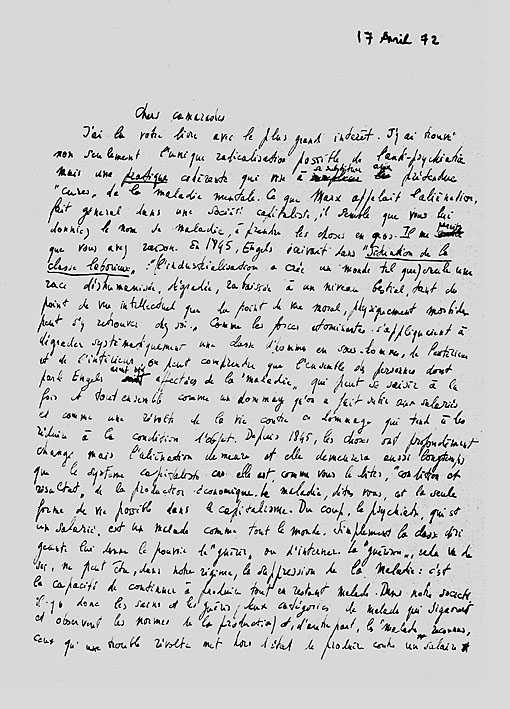
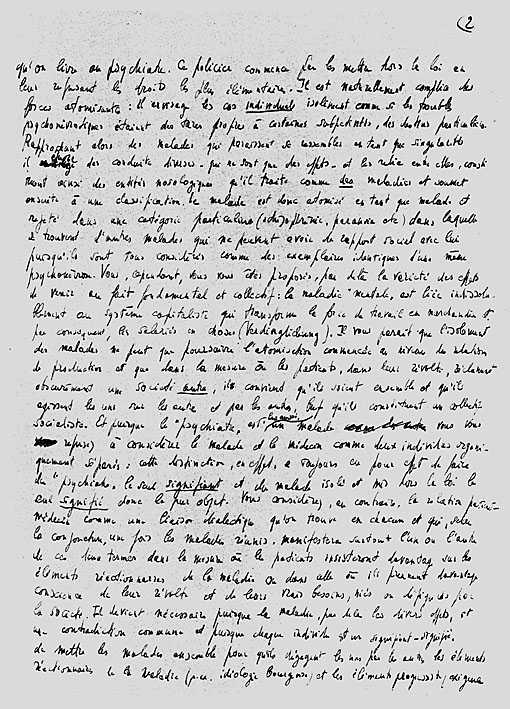
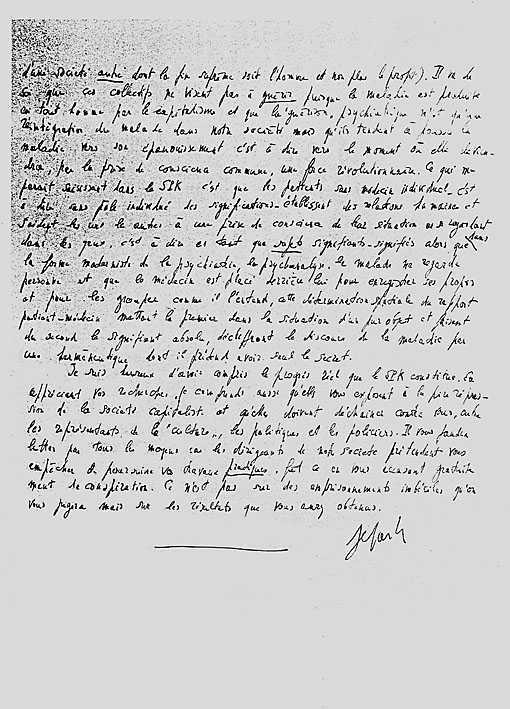
"Malgré ce boycott par la droite et par la gauche, la
grève de la faim a été menée collectivement
environ un mois et demi et s'est achevée par une conférence
de presse donnée à Paris dans les locaux de l'A.P.L. par les
avocats des prisonniers politiques, et par une manifestation devant
l'ambassade d'Allemagne avec la participation des membres des groupes
suivants:
A.R.M. (Association contre la répression médico-
policière),
Cahiers pour la folie,
G.I.A. (Groupe d'information sur
les
asiles), comités contre la torture envers les prisonniers
politiques
en R.F.A.,
I.Z.R.U. informationszentrum, Rote Volksuniversitât -
Heidelberg, The Mental Patient Union
(Grande-Bretagne)."
"Despite the" [publicity] "boycott by the right and the left,
the hunger strike was conducted collectively about a month and a half and
ended with a press conference given in Paris in the premises of the A.P.L.
by counsel [lawyers or advocates] for the political prisoners, and a
demonstration in front of the Germany Embassy [in Paris] with the
participation of
members of the following groups: A.R.M. (association against medico-
policiere repression), cahiers pour la folie, GIA (group information on
asylums), committees against torture against political prisoners in the
Federal Republic of [West]
Germany [République fédérale d'Allemagne], I.Z.R.U.
informationszentrum, Rote Volksuniversitat - Heidelberg,
The Mental Patient Union (Great Britain)."
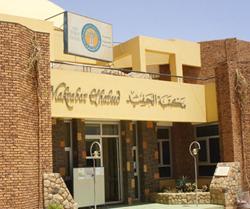
|
12.11.1991
Ahfad University College for Women celebrated the opening of its
new
library,
Maktabat El Hafeed.
This library, the most modern in the Sudan, was the first building to be completed at Ahfad's new campus extension, and was to serve as a focal point for academic life at Ahfad. |
1.1.1993 Publication of SPK: TURN ILLNESS INTO A WEAPON Socialist Patients' Collective. Translated from the German by Dr. W.D. Huber. Publisher: KRRIM (via AK Distribution) ISBN: 33926491175 (source)
Conference organised by the American Institute for Contemporary German Studies at The Johns Hopkins University on the reconstruction of German culture after 1945. Papers published 1996 as Revisiting Zero-Hour 1945 - The Emergence of Postwar German Culture (pdf) edited by Stephen Brockmann and Frank Trommler
16.5.1995 ruprecht Heidelberger student(inn)enzeitung article about the SDP and Wolfgang Huber
M. Gourevitch, (1995) "Les Annales Médico-Psychologiques sous Pétain". Perspectives Psychiatriques, 46, 27-31 (see above)

|
1995 Sudan National Council for Higher Education granted Ahfad University for Women full university status, based on the expansion of its curriculum and student body. |
12.1.1995 Colonial Psychiatry and the African Mind by Jock McCulloch. Cambridge University Press,
1.7.1998 First "Heathen World" archive on the SPK. One copy has "this article copyright 1996 by John Cheney".
|
July/August 1999
irren-offensive
deutchsland. A tour of sites connected with the Nazi
extermination of psychiatric patients. Includes a list of institutions from
which victims are believed to have come.
"In August 1999, the World Psychiatric Association held its international congress in Hamburg, the first to have been held in Germany. It provided an opportunity, bravely taken, to report on, and mount an exhibition of, the abuses of psychiatry during the Nazi rule between 1933 and 1945" (J.L.T. Birley, The British Journal of Psychiatry 2002)
See Irren
Offensive
|
11.7.2001 First web archive of German version of SPK list of dates. 25.12.2001 First web archive of the SOCIALIST PATIENTS' COLLECTIVE / PATIENTS' FRONT SPK/PF(H) List of dates. Reference in the document to "Today, 22 years later" (than 1971) suggest it was written in 1993
Sunday 24.11,2002 Zanzibar: Mental health case study BBC Live
| January 2002 Psychiatric Times "Psychiatry in Spain" by José L.G. de Rivera, M.D., FRCP(C). Available at http://psicoter.es/pdf/psyc_spain.pdf |
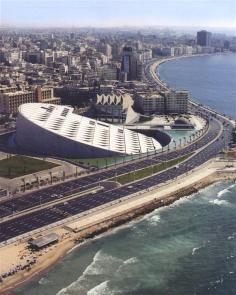
|
16.10.2002 The New Library of Alexandria (New Bibliotheca Alexandrina) in Egypt is "dedicated to recapture the spirit of openness and scholarship of the original Bibliotheca Alexandrina". |
5.4.2003 Madeleine Bunting Guardian "Passion and Pessimism" - A profile of Zygmunt and and Janina Bauman, including interview material.
14.6.2006 What appears to be the first Wikipedia article about the Socialist Patients Collective.
| November 2006 In Maranon week, Juan José Lopéz Ibor [Dressing] gave a paper on the foundation of the hospital at Valencia. This was developed and published in 2008. |
7.1.2007 to 7.2.2007. Field study trip on Mental health care through East Africa. (report - archive)
21.12.2007 First archive of
Terror begets Terror
A report of the assessment of the mental health system in Sudan using the World Health Organization - Assessment Instrument for Mental Health Systems (WHO-AIMS). Khartoum, Sudan 2009. Available online - (offline)
"The evolution of mental health services /counseling in Uganda" by Norman D Nsereko of Nkumba University, Entebbe, Uganda. Available on researchgate - (offline) - See Uganda
December 2013 Edward N. Snyder Work not Alms: The Bethel Mission to East Africa and German Protestant debates over Eugenics, 1880-1933 PhD Dissertation University of Minnesota. - (offline) - See Bethel, Lutindi
|
Salma Tatta Gasim 26.2.2015 on Facebook
In Sudan one of the most common and most asked questions: "What family are you from?". Replying "Badri", I am overwhelmed by their praises and comments. "You are the family that educated our girls and women". "Turned our young girls into strong, independent and successful women". "Badri women are strong and successful women". Hearing these words I can't help but feel proud! |
|
Summer 2015 Presentation: "State of Mental health in Uganda" by Samuel Maling of Mbarara University of Science and Technology. - (offline) - See Uganda


African and Asian asylums in 1900
1925: Hitler's Mein Kampf and Zygmunt Bauman
Everything has to start somewhere - So I have begun this page with extracts
from
Ackernecht's
(1959) Short History of Psychiatry
mad English
dol Dutch
fou French
mad people English
Irren German (plural of irre/irrer
mad house English
Irrenhaus German
"Dolhuis is een ander woord voor gekkenhuis" (Dutch)
mental patients English
Geisteskranke
German
Psychiatrische Krankenhäuser German
psychiatric hospital English
hôpital psychiatrique French