Index of English and Welsh Lunatic Asylums and Mental Hospitals
Based on a comprehensive survey in 1844, and extended to other
asylums.
|
|

|


|
|
The asylums index (on the right) lists asylums on this page (paupers in
1844) in yellow, and asylums on other pages in white. Some asylums outside
England and Wales are indexed in blue.
A B C D E F G H I J K L M N O P Q R S T U V W X Y |
4.13.TA Institutions with Pauper Lunatics in 1844
All County Asylums open in 1844 are listed and all Hospitals receiving paupers. Workhouses mentioned in the 1844 report are listed. The table lists all licensed houses receiving paupers in 1844 and shows which were commended and which severely censured in the 1844 Report.
In the 1844 Report, all asylums apart from workhouses are listed, but only some the workhouses with lunatic wards. This was because the Inquiry Commission did not systematically visit workhouses in the way that it did the other asylums.
| After the 1844 Report, legislation ensured that public asylums were provided for all areas of the country. These new public asylums are shown in white on green. |
| National Health Service Psychiatric Hospitals were classified as "Mental Illness" or "Mental Handicap". I am adding listings of the Mental Handicap ones (1970s) on yellow. |
| Some hospitals will appear on the green and the yellow, usually because they started as chronic asylums in the late nineteenth century. |
| There are some asylums in grey that do not fit in to any of the above categories, but are conveniently included on this page. These include hospitals not receiving paupers in 1844. |
The table is arranged geographically:
-
London,
South East England,
South West England,
Wales, Welsh Border and West Midlands away from Birmingham,
Birmingham and West Midlands
East Midlands and Lincolnshire,
Cheshire and Lancashire,
Yorkshire,
Northumberland and Durham.
before the administrative changes of the last half century
Hanwell (1st Middlesex) County Asylum
The address of
West London Healthcare NHS Trust is St. Bernard's Wing, Uxbridge Road
Southall, Middlesex UBI 3EU. 020 8574 2444. (Community services, Mental
health services)
Three Bridges
Regional Secure Unit St Bernard's Hospital,
Uxbridge Road, Southall, Middlesex, UB1 3EU established 1980s?
mid 1990s?
Corsellis Brain Collection moved to St Bernards?
Thomas Moule's 1834 map of Middlesex on Alan Stanier's web
(click bottom right to enlarge)
South East London History has a
map index for
Lambeth, Southwark, Lewisham, Greenwich, Bexley and Bromley
Area links on this site:
Brentford,
Camberwell (Surrey),
Chelsea,
Fulham,
Hackney,
Hammersmith,
Hayes,
Hoxton,
Kensington
[A Sarah Rutherford case study]
Built 1829 to 1830. Opened
16.5.1831
Architect: William
Alderson. Peter
Cracknell classifies it as
Corridor form.
Jacobi classifies it as a distinct form.
Landscape: Designer D. Ramsay
Built in what
was then country. Closest market town was Brentford.
Technically in Norwood Parish, but known as the Hanwell Asylum from the
beginning as it was much closer to the centre of Hanwell than to Southall
or Norwood. See
GENUKI (1868 National Gazeteer)
For the early history of
Hanwell see the biography of James Clitherow
Tessa
Speight's history
Superintendent January 1831 to early 1838:
William
Ellis. Matron, Mrs Ellis
Visiting physician from 1832:
Alexander Morison
1834:
The Hanwell Lunatic
Asylum
by Harriet Martineau
From about 1835 to about 1840,
George Peacock Button was house
surgeon. He
witnessed William Ellis's will in April 1839. He became
superintendent of the
Dorset County Asylum.
Extra wings added 1837/1838
Architect: William Moseley.
Superintendent April 1838 to 1839
Gideon John Millingen
Superintendent 1839 to 1844:
John Conolly, who
abolished mechanical
restraint.
"old mode of treatment" -
"new
methods"
October 1839 51st Report Visiting Justices
January 1840 52nd Report Visiting Justices
April 1840 53rd Report Visiting Justices
July 1840 54th Report Visiting Justices
January 1841 56th Report Visiting Justices
April 1841 57th Report Visiting Justices
July 1841 58th Report Visiting Justices: they had "been imperatively
called upon to annul the appointment of the Reverend Francis Tebutt as
chaplain to the asylum. His duties will cease on the 11th of the month, and
he will be succeeded by the Reverend Thomas Burt"
October 1841 The Fifty-ninth Report of the Visiting Justices of
the Lunatic Asylum of
Hunwell. The Resident Physician's Report, and the Report of the Chaplain,
. This formed the basis of
an extensive review in the a
New York newspaper on 2.4.1842
1844 to 1852 John Conolly visiting physician Hanwell).
Conolly
became the
proprietor of Lawn
House and
Hayes Park
1.1.1844: 975 patients. All pauper. 1844?
14.6% of
patients
epileptic
Superintendent: April to August 1844: John Godwin (not medical)
Visiting Physician: J. Conolly M.D.; House Surgeons: J. Beyley, M.D.;
Davies M.D.
1845
John Hitchman succeded Dr Nesbit in charge of the female
side. William Chapman Begley was (at about the same time) in charge of the
male side. They each had salaries of £200 a year.
15.1.1848 Full page illustration and short article
"Twelfth Night at the Hanwell
Asylum"
in the
The Illustrated London News
1850
John Hitchman became superintendent
Derby County Asylum
From about 1850 to about 1872, W.C. Begley was resident medical
officer (Annual Reports). William Chapman Begley had witnessed William Ellis's
will in April 1839.
A third floor added in 1859.
13.11.1861 Theodore Edward Edwards, a patient, killed himself.
An autopsy [inquest?] was carried out by
Thomas Wakley. Hospital records show that
Theodore was buried within the hospital grounds. A descendent would like to
know where were this is. We have located the burial ground on
an 1868 map. In the late twentieth century,
a Regional Secure Unit was built on these grounds.
July 1873 R R Alexander, MB, CM. appointed Assistant Medical
Officer in the place of J. Hawkes who went to
Westbrooke House Asylum in Hampshire.
Biography of a patient (Alfred Woodhurst) admitted 1877
1880 Large chapel (surviving) built to replace a smaller one.
The asylum now had nearly 2,000 patients.
1881 Census: Middlesex Lunatic Asylum,
Norwood, Middlesex. There are two medical superintendents: Joseph Pake
Richards (married, aged 40, surgeon) and Henry Rayner (unmarried, aged 39,
physician). Isabella Elizabeth Hicks is Matron.
Became a London County Asylum in 1889.
About 1894?: Robert Reid Alexander M.D. resident
medical superintendent; Rev. Robert Andrews MA. chaplain; James William
Palmer, clerk & Alfred Henry Larcome, steward.
Hanwell Mental Hospital from
1929 to 1937.
St Bernard's Hospital from
1938 to 1980. Uxbridge Road, Southall, UB1 3EU.
1953
Mary Barnes a patient
By 1960 known as St Bernard's, Southall. It had 2500 staffed
beds
Sometime before 1962, Andrew O'Brien visited his uncle in St
Bernard's Hospital. It was "like a small town in itself". There
was a church, a laundry, and a point on the Grand Union Canal
where barges brought the coal for the Hospital. He can remember
the tall Victorian wards and that there seemed to be many
patients in each ward, and white coated male orderlies who seemed
to spend some of their time lighting patients cigarettes. He
felt very sad and could not face going again after his second
visit.
In 1971 it had 2,039 beds,
189 in locked wards.
Mary Nettle a patient, for three months,
"in St Bernard's, a horrible Victorian asylum".
Two general hospitals: King Edward Memorial Hospital and Claypond's
(started as an isolation hospital) form Ealing Hospital between 1978
and 1980.
Ealing Hospital built adjacent to St Bernard's. A District General
Hospital "in the form of a multistorey concrete slab with lower blocks
around it"
(Scher, P. 1999)
[
Ealing
Hospital weblink]
By 1985, staffed beds reduced to 950
"Since then St Bernard's, a Grade II listed building, has become a
'wing'" [of Ealing Hospital], "albeit a large one, comprising the central
and eastern parts of the original, the western part having been sold for
redevelopment."
(Scher, P. 1999)
West London Mental Health Trust weblink
Stephen James, Head of Partnerships and Diversity, Ealing
Primary Care
Trust writes (26.8.2005) "There is a large range of [psychiatric] services
(including inpatient and forensic) provided by
West London Mental Health Trust (WLMHT)
at the site. There is
also a museum, which I understand the Trust cannot open regularly because
of lack of funds".
"
The
burial grounds were used for building the Regional Secure Unit
(RSU). Any human remains that were uncovered were removed and later re-
interned in the "Garden of Remembrance". This is the small upright
rectangle one can see in the
Google aerial photo
-
If you compare it to
your old map
you can make the match easily. The garden of remembrance is the above the
left hand canal lock and directly above the lock's left-hand gate. To the
immediate right is a parking lot with white hospital vans and the RSU is
the complex further the right with the semicircular crescent." (Paul
Champion, email 12.8.2006)
"Inner Space" by Peter Scher in Hospital Development
1.3.1999 has history and present development
2003
use: "Part luxury housing and part psychiatric hospital"
(external link history of Hanwell district)
(external link Boston House)
| Museum and Chapel of St Bernard's Hospital, Uxbridge Road, Southall. Georgian. Formerly the Middlesex County Lunatic Asylum. "Not suitable for under-16s". I can sadly confirm that the Hanwell hospital museum has permanently closed and the collection dispersed. Some of it went to the Gunnersbury Park Museum http://www.hounslow.info/gunnersburyparkmuseum (prior permission is required to view as it is not on display) and some to the Welcome Trust (I think this would have been the apparatus and other clinical hardware) and the London Metropolitan Archives took the records and papers. (Paul Champion, email 12.8.2006) |
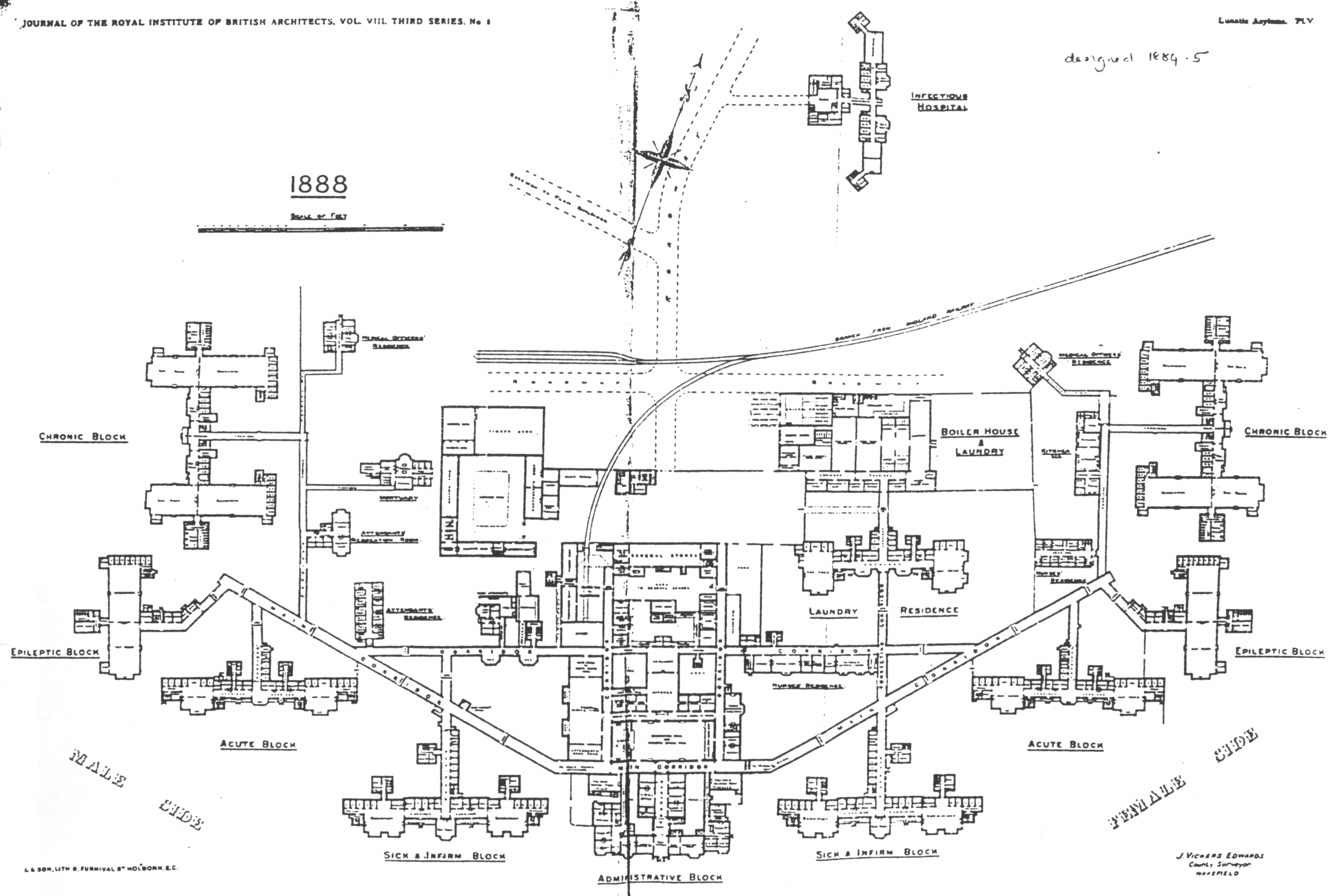
Surrey County Asylum
1956: 2,069 patients, 21% aged 65 or over. The Hospital's death
rate was 10.94%
(Lost Hospitals)
By the end of the 1950s the Hospital had been almost surrounded by urban
development. During the 1960s the number of in-patients began to fall,
(Lost Hospitals)
Springfield shown in a
1979 Directory as having 1,124 beds
31.12.1977.
Frank Bangay's
1985 poem "Food and
Shelter" (Naked Songs and
Rhythms of Hope pages 104-106) relates to experiences in
1976 to 1978 and "the revolving door system that we can get caught up in
once we enter the psychiatric system". The first three verses are:
So strange it is in this world today
Dumped in Victorian institutions so long ago
All we needed was food
Spring 1978 Springfield Words. A magazine produced in
Springfield Hospital, Tooting, South London by Kieran Brown, an
Occupational Therapist. Published
Frank Bangay's poem "Spring is Rising"
(written 1976). Frank was a patient at the time and helped Kieran with the
magazine. In 1979 Frank helped to organise a half-hour of poetry and songs
based round life in Springfield Hospital, featuring Kieran, Frank and Dave
Dorling. Dave was a patient who died in 1981. The event was staged at the
Troubadour and was well received. (Naked Songs and Rhythms of Hope
p.145)
1990
Sarah Wheeler admitted
1994 Springfield Hospital became part of the Pathfinder Mental
Health Services NHS Trust.
7.5.1998
"Trust guilty of abuse of power"
1999 Pathfinder Mental Health Services NHS Trust
changed its name to the
South West London and St George's Mental Health NHS Trust.
(Lost Hospitals of London)
Springfield, near Wandsworth
Nick Hervey says that the asylum was "in
response to the growing expense of farming out the county's chronic insane
to private licensed houses in the metropolis" and that "
Sir Alexander
Morison who was appointed as Visiting Physician before building
commenced,
carried out a survey of these patients".
"The site at Springfield Park, Wandsworth was bought from Henry
Perkins, a wealthy brewer and partner in the firm of Barclay and Perkins,
who had himself obtained the freehold from the 2nd Earl of Spencer"
1838 Building started
Architect: usually
stated to be
E Lapidge, but Nick says he was only one of the designers and
that it "was done to the design of
William Moseley, who was the County Surveyor for Middlesex and
had previously been working on extensions at Hanwell".
-
Corridor form
The present "Main Building", built around a lawn and fountain area
(See external link),
appears to be the centre of the original corridor. Some of the corridors
and main rooms (not all) have a pronounced slope, some running down towards
the south-west of the building. One (at least) main corridor slopes towards
the southeast. Does
anyone know why this is?
opened 14.6.
1841 Cost:
Total £85,366..19..1d. Comprised of Land: (97 acres)
£8,985..9..5 -
Buildings: £67,467..1..10 - Furnishings etc and preliminary expenses:
£7,514..19.3
(1844 Report p.222)
Nick Hervey says that 299 patients were
brought in on the day of opening, increasing to 385 in the first year. They
included 172 from
Peckham House, 51
from
Hoxton
and 54 from
Bethnal Green. However, patients may have moved in from these
asylums earlier as their movement was noted in
a report for the year 1.6.1840 to 31.5.1841.
1.1.1844: 382 patients. All pauper.
Superintendent: S. Hill, Surgeon
1844 At the time of the 1844 Report, Surrey was the most modern
county asylum. Its construction was generally approved of. "the house and
galleries generally are warmed by the circulation of steam, and the
introduction of hot air through apertures in the floor. The temperature is
regulated by stop-cocks, and kept between 56 degrees and 58 degrees. There
are open fires, with proper guards, in the several day rooms on the female
side; and it is proposed to adopt them also in the male division".
(1844
Report p.20)
1848-1858 Hugh Welch Diamond (1809-1886), photographic pioneer
(External links:
RSM,
Getty,
Leggat,
Pearl
Science and Society Picture Library), was
Resident Superintendent
of the Female Department. See
Lutwidge 1853 and
Millar 1853. He
appears to have left to set up his own, high class, lunatic asylum in
Twickenham
Until about 1857, Alexander Morison, Charles Snape and Hugh W. Diamond
were the medical officers connected with Surrey Asylum
About 1860 John Meyer appointed Resident Physician. William
Orange was Assistant Medical Officer
1863 John Meyer and William Orange move to
Broadmoor. James Strange Biggs became Resident Physician
1881
Census: James Strange Biggs, physician, aged 53, was asylum
head
1889 to 1912
Hugh Gardiner Hill medical superintendent. His son, Harold, a
family historian, was very proud of the way his father carried on
Robert Gardiner Hill's non-restraint work at Springfield. The
graves
of Hugh and his wife Rosie are in the Magdalen Road
Cemetery not far from Springfield
Transferred to Middlesex County Council after the 1888
Local
Government
Act, when it was known first as Wandsworth Asylum.
From about 1918 known as Springfield Asylum.
A detached annexe for 260 "low-grade mental
defectives,
180 children and 80 adults" was built under the 1913 Mental
Deficiency Act.
April 1916 A detached block of the main asylum used as
Springfield War Hospital for severe or protracted cases
for the care and treatment of soldiers and pensioners suffering from
neurasthenia or loss of mental balance
(Hansard 12.4.1920)
1919 Post Office Directory:
Middlesex County. Beechcroft Road, Upper Tooting,
SW17 and Garrat Green,
Burntwood Lane, Tooting SW17. Reginald Worth MB medical superintendent;
Gayton Warwick Smith, MD assistant medical officer; Rev William Parkinson
Iddeson, MA, chaplain; Thomas W. Beale, clerk to the asylum.
1926 Nurses were instructed to show kindness and forbearance
with "example being better than precept" (Regulations and Orders of
Springfield Mental Hospital, London).
(external link)
In 1939 "Springfield (Mental) Hospital" had 2,000 patients, 83 acres
of
farm land
and 14 acres of garden. There was close cooperation between Springfield and
Westminster Hospital.
Springfield Hospital, Glenburne Road, London, SW17 7DJ
The old people walk up and down with the shakes
It's part of their illness it is said
But there is a different explanation
They have been caught in an oppressive situation.
Through situations in living hat we know and ignore,
But psychiatric drugs are no solution to human needs
They just leave people to pace corridors
Broken and defeated.
All we needed was shelter
A roof above our head in hostile weather
A sanctuary to go to when times got tough
No, not these dark institutions
Tell me,
Do you know the true meaning
Of the word 'asylum?'
|
|
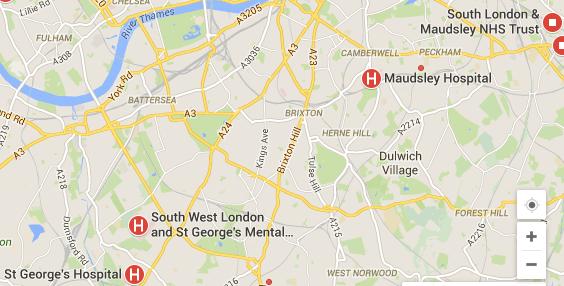
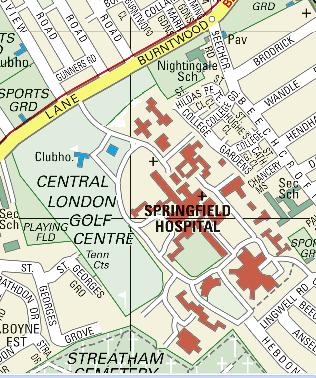
Springfield Hospital (external link), 61 Glenburnie Road,
London, SW17 7DJ.
Autumn 2002: Reported still open, or closed and empty (street map - multimap. Simon Cornwall: Was to close but parts have remained opened. 2005 Mental health research at St George's University of London. Note that South West London and St George's Mental Health NHS Trust provides "education, training and research" in partnership with St George's University, Kingston University, South Bank University, King's College, University of Surrey, Tavistock Institute and Brunel University. (source) |
"South West London and St George's Mental Health NHS Trust was formed in 1994. The Trust has, for over 160 years, provided mental health services. The Trust headquarters are at Springfield University Hospital in Tooting" (source)
Springfield University Hospital
The following image is from the internet 12.1.2006.
The following material is dated 13.10.2007
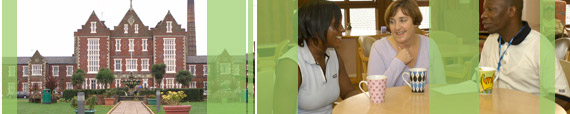
From the mid-1980s, Springfield Hospital (main building, above), now the Trust's headquarters, served only people from Wandsworth and Merton. Today, the Trust operates from 89 locations and is responsible for providing complete mental health and social care services to the communities of Kingston, Merton, Richmond, Sutton and Wandsworth, and more specialist services to people throughout the United Kingdom. |
"The hospital became part of the NHS in
1948 and the site continued to be developed up to
2005 when the Phoenix Unit (providing rehabilitation services)
opened."
A masterplan for the site was approved by the Trust Board in
2006, leading to the opening of the Wandsworth Recovery Centre
in 2009, the first of a new generation of acute in-patient buildings. When
Wandsworth Planning Committee gave consent for this building, it was made
clear that no further consents would be granted on the Springfield Hospital
site until there was outline consent for the redevelopment of the entire
site."
A planning application was submitted, but refused in March 2009.
Following a period of public engagement, the Trust developed an alternative
plan which sought to address the reasons given for refusal of its first
application. Wandsworth Council Officers recommended
approving the plan, but it was refused in December 2010.
June 2010 New Proposals offline pdf
18.7.2011 Archive
Springfield Regeneration Programme
13.4.2012 First internet archive of
The history of Springfield University Hospital
- The argument that "mental health services have been provided
at Springfield Hospital since 1841" was being used as a starting point for
the necessity of allowing a re-development plan.
Springfield regeneration news [To "Trust appeal upheld: June
2012"]
London Licensed Houses receiving paupers:
Warburton's, Bethnal
Green
Hoxton House
Peckham
House
later Surrey County
Asylums
SW17 asylums:
Springfield,
Tooting Bec,
Fountain
1.1.1844 562 patients. 336 pauper and 226 private.
COMMENDED IN 1844
1.1.1844 396 patients. 315 pauper and 81 private.
SEVERELY CENSURED IN 1844
REPORT
1.1.1844 251 patients. 203 pauper and 48 private.
SEVERELY CENSURED IN 1844
REPORT
London Workhouse Lunatic Wards -
Fulham Hospital -
Fulham Road Observation Ward -
St Clement's -
St Marylebone -
Westminster -
St Marylebone See Peter Higginbotham's site
First workhouse established in 1730, after the Workhouse Test Act. A local Act of Parliament, passed in 1775, enabled the Vestry to build a new workhouse. Under this, the administration of poor relief in the parish was conducted by Directors and Guardians of the Poor who included thirty parishioners appointed by the Vestry. The old building was used as an infirmary.
1792 new infirmary block for 300.
War led an widespread increase in pauperism and St Marylebone was over-full with 1,168 inmates in 1797. The Guardians resorted to out-relief without demanding entry into the workhouse.
1815: Lord Robert Seymour, a Director of Poor for the Parish of Saint Marylebone was "in the practice of visiting the insane poor of that parish at Mr Warburton's, Bethnal Green"
1844 Report page 87: "In the Lunatic wards of the Marylebone Workhouse there were admitted in the years 1842 and 1843, 190 paupers considered as insane. Some few of these, however, were stated to be only under temporary excitement. The overseers of this parish could obtain admission into the Hanwell Asylum for only twenty-seven of these 190 cases..."
Workhouse Masters:
1842-1850 James Jones
1850-1851 W Barlow
1851-1856
George Whelan
1856 Richard Ryan (the "woman flogger" of a London ballad)
1857 James Barnet
1847 approval for Marylebone workhouse to become a temporary asylum
for lunatics. (Hervey,
N.B. 1987)
On lists of licensed houses as "St-Mary-le-Bone. Workhouse":
30.6.1846: Licensed to Dr Boyd with
35 patients
30.6.1847: Licensed to Dr Boyd and T.
Jones, surgeon, with 68 patients
1.1.1849: 79 patients, 30 male, 49
female. All pauper.
London Workhouse Union
Westminster Union See Peter Higginbotham's site
Archives Metropolitan Archives contain Registers of patients maintained by the Union in imbecile asylums 1885-1895 (reference WEBG/WM/52/1) and 1896 - 1902 (reference WEBG/WM/52/2).
1885-1895 relates to Hanwell*; Banstead*; Colney Hatch*; Cane Hill*; Hoxton House*; Bethnal House*; Grove Hall, Bow*; Peckham House*; Salisbury, Fisherton House*; Kent County, Barming Heath*; Camberwell House*; Kent County, Chartham*; Moulsford nr. Wallingford; Bristol Borough; and Claybury*
1896-1902 relates to the ones marked with an asterisk (*) above, plus Exeter Borough, Heavitree; Surrey County, Brookwood ; Nottingham Borough, Mapperley Hill ; Dorset County; Glamorgan County; Dorchester; Northampton County, Berry Wood ; Wadsley nr. Sheffield; Warwick County, Hatton; Isle of Wight, Newport; Bristol City, Fishponds; Lancashire, Haydock Lodge; Bexley; Stone nr. Dartford; Manor at Horton; Lancashire County, Prestwich; Winson Green; Hertfordshire County, Hill End; Leicester Borough; Middlesex County, Wandsworth and West Sussex, Chichester
St George's Hanover Square
See Peter Higginbotham's site
Fulham Road Workhouse and Infirmary
See Peter Higginbotham's site
Observation Ward
"At least half of the cases admitted to the male mental ward, or
observation ward, ... between 1917 and 1923 were ex-servicemen". Less than
half of the ex-servicemen were sent on to an asylum. Most were sent home
after a few days.
There was a statutory maximum of 14 days. "The inmate was
usually put on a regimen of eggs, milk pudding and beef tea". Bromide and
paraldehyde were used and there was a padded cell.
(Barham, P. 2004, p.202)
Fulham Hospital
Wandsworth
Whitechapel
John Stow in A Survey of London.
An hospital for frensie people in Tower street ward.
"Hospital of saint Mary in the parish of Barking church, that was prouided
for poore priests, and others, men and women in the Citty of London, that
were falled into frensie or losse of their memory, vntill such time as they
should recouer, was since suppressed and giuen to the Hospitall of saint
Katherine by the Tower."
Stone House
John Stow, 'The Citie of Westminster', in A Survey of London.
Reprinted
From the Text of
1603, ed. C L Kingsford (Oxford, 1908),
pp. 97-124
Bedford house.; Parish church of S. Martin in the field.; An house
belonging to Bethlem.
From thence is now a continuall new building of diuers fayre houses, euen
vp to the Earle of Bedfords house lately builded nigh to Iuy Bridge, and so
on the north side to a lane that turneth to the parish Church of S. Martins
in the field, in the liberty of Westminster. Then had ye an house wherein
somtime were distraught and lunatike people, of what antiquity founded, or
by whom I haue not read, neither of the suppression, but it was said that
sometime a king of England, not liking such a kind of people to remaine so
neare his pallace, caused them to be remoued farther of, to
Bethlem without
Bishops gate of London, and to that Hospitall the said house by
Charing
crosse doth yet remaine.
O'Donoghue says (p.68)
The report of the commissioners in
1632 confirms the
story told by Stow :
He refers to a definite assertion made by those who searched the muniment
room at Bridewell
in
1632 that:
"There be also four other houses
situated near Charing Cross in the parish of St. Martin's in
the Fields, which have likewise time out of mind paid a small
rent of £3 per annum to the hospital, but when, or by whom,
given we find no record. Only we find by an ancient lease
made in the reign of
Henry VII that in the place where
these houses now stand was anciently an old house with
gardens and grounds thereunto belonging called the Stone
House, which Stone House we do likewise find, in a bill preferred
to the Exchequer in December of
9 James I
[1612] by
the mayor, commonalty and citizens of London against one
Agnes Garland, that it was sometimes employed for the
harbouring of mad and distracted persons, before such time
as they were removed to the present hospital of Bethlehem,
without Bishopsgate."
"When the hospital was first employed to the use of distracted
persons appeareth not. The first mention we find
of it to be employed so was in
the beginning of the reign of
Richard II"
| In the early nineteenth century, the City of London and its parishes had a diversity of institutional resources to call on to accommodate pauper lunatics. It controlled Bethlem Hospital. St Lukes was just outside its "square mile", as were the large private pauper asylums at Hoxton and Bethnal Green. Many of the parishes had their own workhouses and, in Hoxton and elsewhere, there were also several private workhouses (pauper farm houses). |
|
Bethlem Hospital
before - 1377 - City of London Bedlam - maps - 1676 - 1728 - 1730 - 1751 - 1764 - 1772 - 1792 - 1796 - 1804 - 1806 - 1815 - 1816 - 1819 - 1835 - 1843 - 1844 - 1845 - 1846 - 1850s - 1852 - 1930 - 1948 - 1997 (750 years) - Museum of the Mind - later 2015 |
1375-1378 (?). The patients of the "Stonehouse", Charing Cross, removed to Bethlehem Hospital. (O'Donoghue Chronology)
1377: the Bishopsgate Bedlam (St
Mary of Bethlem)
1377 "Earliest known date of the use of Bethlem as an
asylum." (O'Donoghue
Chronology) ["Known" is
overstating]
1380-1395 (about). A brotherhood of Skinners meet in the church
of St. Mary, Bethlehem, on Corpus Christi Day.
(O'Donoghue
Chronology)
2.3.1403
Henry 4th issued a commission to two of the royal
chaplains to investigate charges made against the management
of the hospital. Their report mentions six insane patients, the
instruments of their restraint, and the hospital property at
Charing Cross. (O'Donoghue
Chronology)
1403: visited: "during the 1403
visitation, the Porter stated that the Hospital then contained 'six insane
men and three others who were sick".
Andrews etc 1997
The History of Bethlem (Kindle Locations 2605-2606)].
| Compare Spain 1409 |
1437 Commission to the mayor and aldermen to inquire into abuses at the hospital.
1454 Hospital and its property farmed out by its master.
1457 John Arundell, doctor of medicine and royal physician, appointed master.
"If Bethlem was generally thought to be a madhouse as early as the 1460s, it was nearly a hundred years later before there is evidence that London's magistrates thought that only the mad should be admitted." [Andrews etc 1997 Kindle Locations 2857-2859].
1519 Date of a certificate of admission into the confraternity
of St
Mary of Bethlem. (O'Donoghue
Chronology)
1529 George Boleyn, brother of Queen Anne Boleyn, appointed
master. (O'Donoghue
Chronology)
1533
Thomas Moore and the beating of the frenzied heretic
1534 England breaks from Rome
1536 on: monasteries dissolved -
City
gets Bethlem
1543 The convocation of Canterbury denounces the "ungodly
celebration
of marriages" in Bethlem Hospital.
(O'Donoghue
Chronology)
1545 Peter Mewtys, the master of Bethlem, grants a lease of the
"Stone House, Charing Cross, recently converted into three
tenements" [now Trafalgar Square].
(O'Donoghue
Chronology)
27.12.1546 Deed of covenant between
Henry 8th and the city,
by which the king agrees to grant St Bartholomew's Hospital
to the city: "and the king further granted that the said mayor,
commonalty, and citizens, and their successors should be
masters, rulers, and governors of the hospital, or house, called
Bethlem." (O'Donoghue
Chronology)
13.1.1547 Letters patent, ratifying the deed of covenant,
granted
by Henry 8th, who dies seventeen days later.
7.9.1549 The court of aldermen order the chamberlain to repay
Sir Martin Bowes £113 6s. 8d., which he had expended for the
purchase of Bethlehem Hospital. (O'Donoghue
Chronology)
1550 The liberty of Bethlem merged into the parish of St
Botolph,
Bishopsgate. (O'Donoghue
Chronology)
26.6.1553 Bridewell Hospital incorporated by letters patent. (O'Donoghue
Chronology)
19.7.1553 to 17.11.1558
Mary, Catholic Queen
1556 Two aldermen and the chamberlain are to "examine the
accounts of the hospital as kept by the keeper."
(O'Donoghue Chronology)
27.9.1557 Bethlem placed under the same management as
Bridewell. (O'Donoghue
Chronology)
|
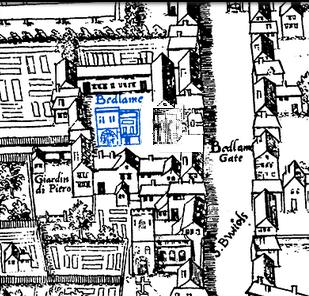
1559: Bethlem on oldest [Wyngrede] map of
London
[This image adapted from one used by the
1997 London exhibition]
Sketch
map position, red square
Daniel Hack Tuke (1882) described (p.512) the Wyngrede map as worthless for tracing the outline of Bethlem. His outline (p.61) was based on the "Agas" map. Civitas Londinum is a bird's-eye view of London first printed from woodblocks in about 1561. Widely known as the "Agas map," |
|
1562
Dickon of Bedlam one of the earliest of English comedies.
1569 Sir T. Roe, mayor, causes an acre of ground in Bethlem (now
part of Broad Street station) to be enclosed as a churchyard for
strangers.
(Stow 1603)
1575 Old church of monastery, after serving as a foundry, pulled
down, and a dozen houses erected in its place.
1603 John Stow's
A Survey of London.
1604
The Honest Whore
1606 The treasurer granted the revenues of eleven tenements in
Bethlem "in consideration of his devotion."
(O'Donoghue Chronology)
1609 The keeper to be paid sevenpence instead of sixpence each
patient per week "on account of the dearness of the times."
(O'Donoghue Chronology)
1612 Act of 9 James 2nd
1615 Oldest surviving written lyrics of the ballad
Mad Tom of Bedlam
1618 Helkiah Crooke (1576-1648), physician to
James 1st, non-
resident "keeper"
1619 Hilkiah Crooke, M.D., elected "keeper."
(O'Donoghue Chronology)
1620 Mr Slater's complaint about his
daughter's mistreatment
1620 Yelverton, the attorney-general, sent to the Tower for
corruptly
inserting in a city charter certain clauses granting the corporation
the custody of Bethlehem Hospital.
1630 Accounts of Bethlem first separated from those of
Bridewell.
(O'Donoghue Chronology)
1632 and 1633 Royal commissioners investigate scandals in
the hospital.
(O'Donoghue Chronology)
1633 An enquiry into the affairs of Bethlem Hospital led
to Helkiah Crooke's dismissal
From 1634 a resident steward was responsible for the
practical management. Also from the 1630s there was a (non-resident)
physician.
1638
Charles 1st confirmed the charter of the hospital.
(O'Donoghue Chronology)
1648.-Arbitration between hospital and its tenants in reference to
property at Charing Cross.
1656.-Daniel, Cromwell's porter, admitted as a patient.
1666.-The fire of London, which destroys Bridewell, spares Bethlem.
1674.-Suggested that hospital be removed to another site. Petition to
be presented to Charles II for his "approbation and allowance."
Lease of lands in Moorfields granted by the city corporation to
the governors for the erection of a new hospital.
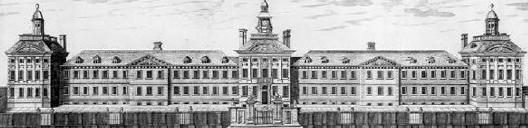
|
[A Sarah Rutherford case study]
Architect: Robert Hooke
The Bedlam page on Molly Brown's tour of Restoration London
1684 Edward Tyson (1650-1708) physician
1698-1770 Ned Ward's The London Spy - (archive)
1700 David Irish in Guildford advertised "good fires, meat, and drink, with good attendance, and all necessaries far beyond what is allowed at Bedlam"
1701 Henry Mackenzie The Man of Feeling - (archive)
1704 Swift's Tale of a Tub (archive)
1708 Death of Dr Edward Tyson
1725-1734 Wards for male and female incurable patients constructed. (O'Donoghue Chronology)
2.10.1728 James Monro appointed physician
1730s: wings for incurables added. These necessitated alteration to the airing courts.
1733 Edward Barkham, of The Close, Lincoln, left part of his Lincolnshire estates for the maintenance of incurable patients. (O'Donoghue Chronology)
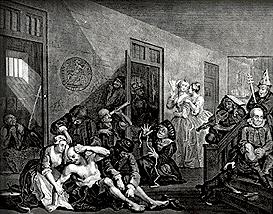
1732-1733 Hogarth paints "Bedlam" - the eighth scene of the "Rake's Progress" (O'Donoghue Chronology)
|
1735 The 1997 London exhibition included "this famous image of Bedlam painted by William Hogarth in 1735... sometimes ... thought to be a faithful reflection of conditions ... This is the last in a series of eight paintings illustrating 'A Rake's Progress', a morality tale of the 1730s. In the first scene the rake (a weak-willed hedonist) comes into some money. He spends it all on drink, debauchery and dissolute pursuits. Finally his wretched life drives him mad and the moral of the tale is that he ends up as a lunatic." |
1737 A General Committee of about 46 Governors appointed
to administer Bridewell and Bethlem on behalf of the (large) Court of
Governors
1740:
Susannah Wesley on
"that wretched
fellow Monroe"
24.7.1751 John
Monro appointed physician with his father
4.11.1752: death of James Monro. John sole physician.
From the 1750s a resident apothecary was appointed.
21.4.1764 Following holiday riots at Christmas, Easter and
Whitsun, it was ordered that constables and assistants be placed in the
galleries during the forthcoming holiday.
(Hunter and Macalpine 1963 p.427)
1766 The doors of the hospital to be locked on public holidays
against all visitors.
(O'Donoghue
Chronology)
John Monro's 1766 Case Book
1770 Admission of visitors henceforth to be only by ticket, and
accredited visitors to be accompanied by an attendant.
(O'Donoghue
Chronology)
1770 Visiting restricted to people with tickets
of admission from a Governor. By 1779, visiting was restricted to
Mondays and Wednesdays (by 1794, "between the hours of ten and
twelve o,clock in the forenoon". On 22.5.1779 it was ordered that
the number of visitors on one ticket be limited to the person who it was
made out to and three others, to curb the "great number of persons
admitted".
(Hunter and Macalpine 1963 p.428 + 429)
1772 John Gozna Apothecary to Bedlam.
1782 An act of parliament ratifies the union of Bridewell and
Bethlem, and settles the dispute between the common council
and other governors.
(O'Donoghue
Chronology)
1783 Thomas Bowen, An Historical Account of the Origin,
Progress , and Present State of Bethlem Hospital, founded by Henry the
Eighth, for the Cure of Lunatics, and Enlarged by Subsequent Benefactors,
for the Reception and Maintenance of Incurables. London: For the
Governors 1783,
1787: Thomas
Monro appointed assistant to his father
1791 Hannah Snell, the female marine, a patient.
(O'Donoghue
Chronology)
27.12.1791: death of John, Thomas Monro succeeds
1795: John Haslam (born London 1764, died July 1844) succeeded
John Gozna as Apothecary to Bedlam.
October 1796: Mary Lamb fearful of
being confined in Bethlem
"There are many persons now living who can remember passing the gates
of old
Bethlehem and hearing, as they passed, the cut of the lash and
the screams of its victims". (1849 memo on new style asylum)
31.12.1798 241 patients
1799 201 patients admitted
Bethlem on 1799 map of
London (sketch
map)
1800 Architect reports the hospital to be in an insecure
condition. (O'Donoghue
Chronology)
1800-1809 Negotiations about a new site.
(O'Donoghue
Chronology)
31.12.1799 243 patients
1800 235 patients admitted
31.12.1800 266 patients
1801 195 patients admitted
31.12.1801 237 patients
1802 185 patients admitted
31.12.1802 201 patients
1803 180 patients admitted
31.12.1803 220 patients
1804 150 patients admitted
"N.B: During this Year one of the Wings of the Hospital was taken down"
(p.390) [Probably refers to 1804, could be 1805]
1804 to 1806 Urbane Metcalf a patient for the first time. His
case note on his second stay (1817-1818) say "he is frequently engaged in
the occupation of a tailor.. but I am informed that he gets his living out
of doors as a hawker and pedlar." In 1817 he considered himself heir to the
throne of Denmark, and was suffering as much from depression as delusions.
He was discharged cured.
"I spent twenty-two months in that dreary abode, Old Bethlem Hospital; not more I believe than six weeks during that time I was incapable, through indisposition, of judging the occurrences that daily took place. From the supineness of the then physician, the cruelty of the apothecary, the weakness of the steward, and the uncontrolled audacity of the keepers [scenes took place that should have been discovered if only six humane people a year had visited] but what was the fact? it stood in the midst of the most populous city in Europe... was almost daily visited by some of the most exalted characters in the country, as well as by feigners. Part of the time, I occupied the next room to... Norris... the iron bar to which he was fastened stood at the foot of my bed." |
16.6.1804 Governors sign order that James Norris "be put in the iron apparatus, prepared for him" (p.382)
31.12.1804 186 patients
1805 44 patients admitted
Decline in numbers may have been due to deteriorating conditions of the building making some parts uninhabitable. [At some time] many pauper lunatics were moved to Warburton's in Bethnal Green
31.12.1805 127 patients
1806 64 patients admitted
1806: Transport Board responsible for naval maniacs. See description of relations with Hoxton House etc
31.12.1806 135 patients
1807 54 patients admitted
31.12.1807 126 patients
1808 85 patients admitted
31.12.1808 147 patients
1809 103 patients admitted
31.12.1809 143 patients
1810 92 patients admitted
31.12.1810 147 patients
1811 99 patients admitted
31.12.1811 148 patients
1812 88 patients admitted
31.12.1812 146 patients
1813 106 patients admitted
31.12.1813 143 patients
1814 93 patients admitted
31.12.1814: 119 patients.
1812-1815 Building the third Bethlem in St. George's
Fields, Southwark. (O'Donoghue Chronology)
25.4.1814:
Edward
Wakefield's
first visit
2.5.1814 Edward Wakefield's party visit the women's galleries
where they find a side room with ten chained patients clothed only in
blanket gowns. In a cell on the lower gallery they found William Norris, 55
years old, who said he had been confined about fourteen years. [Norris is
William in Wakefield's account (p.47 following) and James in the account by
the Governors of Bethlem (p.376 following).
7.6.1814: drawing
made of William Norris, in restraint
1815: St George's Field Bedlam
and
criminal lunatics. Patients transferred 24.8.1815. (O'Donoghue
Chronology)
Piddock, S. 2002:
Linear design:
wards over three full storeys and
an attic floor. Men and women accommodated in mirror wings on either side
of a central administrative section. Accommodation primarily in single
cells with a small spur ward on either side providing three cells for the
noisy.
Arlidge, J.T. 1859 "argued that most, if not
all, lunatic asylums were based on the design of Bethlem Hospital, itself
based on the monasteries which had provided the early asylums for the
insane".
1815 and 1816 Parliamentary inquiries into the treatment
of patients. (O'Donoghue
Chronology)
1816 Criminal blocks completed and occupied.
(O'Donoghue
Chronology)
July 1816:
John Haslam and Thomas
Monro not re-appointed, but Thomas succeeded by his son,
Edward Thomas
Monro and another (jointly appointed) physician,
Sir George
Leman Tuthill (born 1772, died
1835). Reforms in the
management
introduced
about this time included keeping case notes on patients. The British
Library Catalogue lists To the Governors of the Royal Hospitals of
Bridewell and Bethlem, etc. [Asking for support in his candidature for
the post of physician to the Hospitals] by Sir George Leman Tuthill,
London, 1816.
1.6.1817 to 12.11.1818 Urbane Metcalf a patient for the
second time. On his release he published a pamphlet The Interior of
Bethlem Hospital which he sold around London (3d a copy?).
"I... became again a patient in the New Bethlem Hospital, and am happy to be able to state that I found many alterations in the provisions, and in other things that greatly added to the comfort of patients, and to the honour of those governors through whom those alterations were effected. I found there were four galleries, and that the patients in one gallery had seldom access to those in another, except when in the green yard, and the establishment to be considerably larger, but not so many patients. I became Dr Tothill's patient, and was put in the upper gallery, Thomas Rodbird keeper. I wish to observe that I have read the printed rules of the establishment, and their principle is good, the comforts of the patients are secured in every respect, but these regulations are departed from and the keepers do just as they please."
Urbane arranges his complaint under sub-headings of
the keepers and officers names, attempting to show how the institution is
being run for their benefit, at the expense of the patients
|
October 1830: Dr E. Wright, Apothecary Superintendent, dismissed, having forfeited the confidence of the Governors. [Note that he calls it "the Royal Hospital of Bethlem"]
1830 Exchange of the "Trafalgar Square" estate with the Crown for property in Piccadilly. (O'Donoghue Chronology)
Consultant physician (with E.T. Monro) from 1835 to 1853: Alexander Morison
1837 Visitation by Mr F. O. Martin, a charity commissioner. (O'Donoghue Chronology)
1837 extensions to the building
1838 Front garden leased by city to hospital and road diverted. Foundation stone of new buildings laid. Frontage extended east and west, and southern wings lengthened. (O'Donoghue Chronology)
1840 Site of Barkham Terrace purchased.
| 1841 Census: (ages of adults are given to nearest five years) Nathanial Nicholls, Steward, 50. Hannah Nicholls, 45. John Thomas, Apothecary, 45. Mary Thomas, 35. Henrietta Hearn, Matron, 40. John Hearn, 20. William Brown, Porter, 50. Thomas Medley?, Gate Keeper, 40. Elizabeth Medley, 30. Mary David, Kitchen Maid, 30. Charles French, Cutter of Provisions, 30. Three Laundry Maids. Twelve male Keepers. Twelve female Keepers. William Howard, Gardener, 35. Mary Pandigrath, Housemaid, aged 15. Harriet Eliza Hunter, aged 15 (an officer's relative). Five female servants to officers and two male. 167 male patients. 166 female patients, 333 total patients. |
|
1844 Bethlem Hospital, St George's Fields, South London.
1.1.1844: 355 patients of whom 90 were criminals. Bethlem was outside the Metropolitan Commission's investigative authority. For statistical purposes: "In the absence of any specific information ... we have entered the Criminal Lunatics ... seventy Males and twenty Females, as Paupers. We have also assumed that the remainder of the Patients ... generally, are of Private class, although we have reason to believe that some of them are maintained, wholly or in part, at the charge of Unions or Parishes" (1844 Report p.186)" |
1844 First padded rooms constructed: workshops for patients completed. (O'Donoghue Chronology)
1844-1846 Chapel and dome built by S. Smirke. (O'Donoghue Chronology)
The Lancet 15.2.1845: Editorial comparing Bethlem unfavourably with Bicêtre and Salpétrière in Paris which are "open to all pupils and medical men, who have a right to follow the physicians in their daily visits to the wards". "The directors of Bethlem have, it is true, lately relaxed the extreme severity of their regulations, and distributed amongst the schools a few tickets of admission, for which we give them due credit, but this relaxation of former rules is by no means sufficient. Every facility should be afforded to students to acquire a familiar knowledge of insanity, and our hospitals ought to be freely open..."
1846: Dome, designed by Sidney Smirke, added
27.11.1846 Visit by John Thomas Perceval to Arthur Legent Pearce
1851: "the Commissioners in Lunacy... gained entry for the first time in 1851 on a Secretary of State's warrant to investigate complaints of maltreatment which had been laid before them"
28.6.1851 Visit of lunacy commissioners to inquire into allegations against the treatment of certain patients by their nurses. (O'Donoghue Chronology)
1852:: Critical Report
William Charles Hood became Resident Medical Superintendent
1.11.1853 Bethlem registered for periodical inspection by the lunacy commissioners.
1862 W.C. Hood became a Chancery Visitor. Succeeded as Resident Medical Superintendent by William Rhys Williams
1863: and 1864 criminal lunatics sent to Broadmoor (O'Donoghue Chronology)
1866 City of London Lunatic Asylum at Stone opened
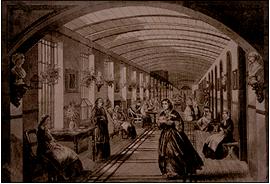
|
"This engraving shows the wards in the 1860s after efforts to make them more comfortable and cheerful. Patients were segregated and this engraving shows one of the women's wards. It was furnished with flowers, ornaments and bird cages. (1997 London exhibition). This picture was contrasted with Hogarth and described as "a more realistic illustration of the inside of the hospital 130 years later". |
1865-1870 The Liverpool Street estates of the hospital purchased by the Great Eastern and the Metropolitan Railway Companies. (O'Donoghue Chronology)
1870 First party of convalescent patients goes to Witley, Surrey. (O'Donoghue Chronology)
1878 William Rhys Williams became a Lunacy Commissioner. Succeeded as Resident Medical Superintendent by George Henry Savage.
| 1881 Census: "Bethlem Royal Hospital", St Georges Cross, Southwark - St George Martyr, Surrey. Resident Officer (Physician) George Henry Savage, widower, aged 38, born Brighton. His housekeeper and housemaid. A friend, Wilhelm Von Speyr (physician aged 28), from Basle in Switzerland was visiting. William Edward Ramsden Wood: Medical Officer (Physician), aged 31. His wife, children and servants. The Gate Porter and his wife. Under Storekeeper. Cutter of Provisions. Assistant Hall Porter. Edmund Smeeth, married, aged 63: Head Attendant Male Side and 15 male and 21 female "Attendants on Insane". A laundress. A housemaid. Another female domestic servant. About 255 patients, only about 94 of whom were men. There were also two "other" and one "visitor". The Gardener, Richard Whibley, and his large family, lived at St Edwards Schools in St Georges Road. Two of his daughters were training to be teachers. |
1892 Under the Dome (the hospital magazine) first issued.
1896 extensions to the building
1896 Recreation hall opened. (O'Donoghue Chronology)
1904 Hospital closed from February to October for re-drainage and repairs. (O'Donoghue Chronology)
1907 Fire causes some damage to recreation hall. (O'Donoghue Chronology)
1912 Pathologist and other specialists added to the medical staff. (O'Donoghue Chronology)
1914 Edward Geoffrey O'Donoghue The Story of Bethlehem Hospital from its Foundation in 1247 London: T. Fisher Unwin,
1923 Edward Geoffrey O'Donoghue Bridewell Hospital: Palace, prison, school Volume one: "From the earliest times to the end of the reign of Elizabeth"
1929 Edward Geoffrey O'Donoghue Bridewell Hospital: Palace, prison, school Volume two: "From the death of Elizabeth to modern times".
Under the Dome became Orchard Leaves when the hospital moved to Kent in 1930.
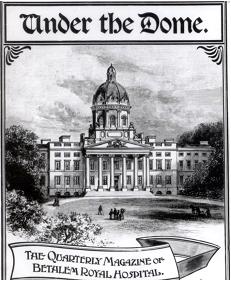
|
In the 1920s the Hospital's Governors concluded that "for a hospital for
the educated middle classes Southwark was not an ideal location", and began
looking for an alternative.
They found a 334 acre country house estate that straddled the boundary between Croydon and Beckenham, Kent that had remained unsold at auction in 1920. 19th century Bedlam and 20th century war: The patients' wings and most of the hospital at St George's Field were demolished in 1931 and 1932. The administrative block and dome, and parts of the 1837 and 1896 extensions remained as the Imperial War Museum, opened in this building on 7.7.1936. |
|
1930: Kent Bethlem Hospital
Location 4 |
See Jennifer Walke |
The new hospital was built on the 'villa system', with separate blocks for "administration, occupational therapy, refractory patients, convalescent patients, treatment and research, along with a nurses' home, chapel, reception hospital, mortuary, workshops and a laundry"
|
Bethlem Royal Hospital: Prospectus, 1932 pages 6-7
...admission to this Monks Orchard Hospital carries with it the "Hall Mark" of curability, and as such, whenever the word "Bethlem" is used, it means "curable"'. Accommodation is provided for 250 patients - 141 ladies and 109 gentlemen - each of whom must be of a suitable educational status. Patients who are eligible may be admitted either on a Voluntary, Temporary or Certified footing, but in all cases treatment in the early stage of illness is advisable and, in fact, desirable. Patients are thus graded according to their varying type of symptoms, and the separate units, or houses, provide appropriate care and treatment for their individual needs, which is further enhanced by the provision of separate bedrooms, whenever deemed necessary. |
about the 1930s "Bethlem kept a folder of marketing materials from other institutions across the country" (Jennifer Walke)
Bethlem graphs - before and after nationalisation
From
Jennifer Walke 27.5.2015
|
In-patient age distribution 1931 to 1947
|
"a rising tide of voluntary admissions from the 1930s coincided with the emergence of 'psycho-neuroses', a category in which women were over- represented. Women also outlived and outnumbered men" |
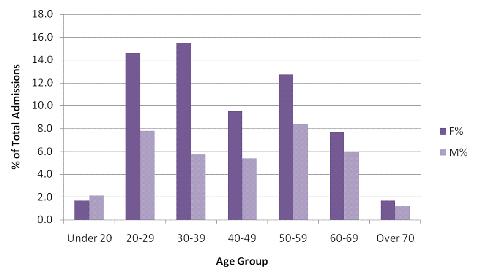
|
In-patient age distribution 1952 to 1983
|
Post war patients were much more evenly distributed between men and women. The main reason for this was probably that the hospital was no longer selecting fee-paying patients. |
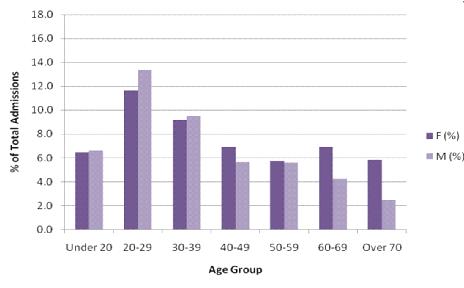
|
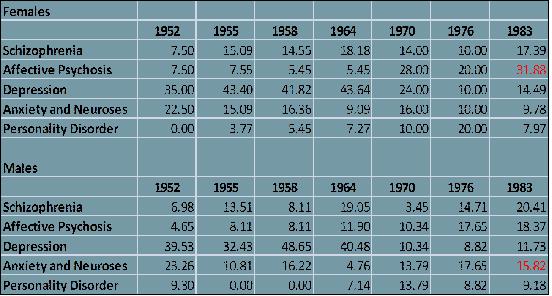
Distribution of key diagnoses 1952-1983
In the National Health Service, Bethlem increasing provided for patients of both sexes with a psychotic diagnosis.
|
1948: The
Bethlem Royal and
Maudsley Hospitals, London
[Same locations] Administratively, the two hospitals amalgamated as a
single postgraduate teaching
hospital in the new
National Health Service.
Claire Hilton in the
Dictionary of National Biography says
"Lewis
earmarked him to lead the proposed geriatric unit at the Bethlem Royal
Hospital 'I obeyed . to say without enthusiasm would be an understatement',
he later said (Post, 'In the beginning', 15). But within a few years any
reluctance to work with older people had been transformed into a
therapeutic optimism and a zeal for the specialism. His in-patient ward,
out-patient clinics, research, teaching, and the Gresham Club (a pioneering
after-care club for former in-patients) all flourished. But the medical
committee kept a tight rein on further developments, in particular not
permitting longer-term treatment of dementia within the hospital, much to
Post's chagrin"
After the war, Denis
Leigh
moved to the Maudsley Hospital from the neurological department of London
Hospital. He trained with Erich Guttman and C P Blacker and spent a year
at the Harvard Medical School. Returning to London in 1949, he was
appointed consultant at the Maudsley and Bethlem Hospitals. [Munk's Roll]
- "based primarily at the Maudsley; last Physician to the Bethlem"
(King's College archive)
1949 Wards for boys (17 beds) and girls (18 beds) established in
Tyson (Bethlem). "These were the first adolescent inpatient wards to be
established in England".
1951 Gresham (Bethlem) converted to a unit for patients over 60.
Fully operational by 1952.
Robert Frederick Hobson, psychiatrist and psychotherapist: born
Rawtenstall, Lancashire 18 May 1920; Physician, Bethlem Royal Hospital
1954-74; Consultant Psychotherapist, Manchester Royal Infirmary 1974-85;
Reader in Psychotherapy, Manchester University 1974-85, Honorary Emeritus
Reader 1985-99; married 1946 Marjorie Brett (two sons, one daughter); died
Stockport, Cheshire 13 November 1999.
1957 A summary listed 238 inpatient beds across 11 Bethlem wards,
plus '30-40' day hospital places. (Email from Jennifer Walke 12.7.2015)
1961 Denis Leigh's
The Historical Development of
British Psychiatry included photographs of items "from the
author's collection". King's College archive has "black and
white photographs of rare pamphlets and typescript drafts and preparatory
notes, [1960]" for the production of Denis Leigh's book. It seems likely
that Denis Leigh's collection contributed to
the museum.
1962 (Hospital Plan) "The postgraduate psychiatric
teaching hospital (the Bethlem Royal Hospital and the Maudsley Hospital) is
situated in" [the South-East Metropolitan Region]. It is estimated that 20
per cent of its beds are used by patients resident in the Region and the
rest by patients from other regions" (p.139)
1967 The Maudsley took over the management of the district
catchment
area service for the mentally ill.
1966
Aubrey Lewis retired
1968 Studies in psychiatry : a survey of work carried out in the
Department of Psychiatry of the Institute of Psychiatry, under the
chairmanship of Sir Aubrey Lewis, 1945-66 edited by Michael Shepherd
and D. L. Davies. London ; New York : Oxford University Press 1968
xi and 345 pages. Photographic portrait of Sir Aubrey Lewis forms
frontispiece.
1970 The Bethlem Museum established in small exhibition space
in the new building which housed the Bethlem and Maudsley Hospital archives
-
external link -
archive: "Originally
intended to display historical documents and the few pictures and artefacts
which had already been passed to the archives department for safekeeping,
it was first opened to the public as the Bethlem Historical Museum". See
2001 -
2015 Museum of the
Mind
1971 Bethlem and Maudsley Teaching Hospital. 405 beds. 338 resident
patients on 31.12.1971. 83% bed occupancy (low). No dormitories with over
30 beds. (Exceptionally) most beds were in "special in-patient units or
wards", listed as children 26 beds - mentally handicapped children 24 beds
- adolescent 35 beds - drug addiction 22 beds - alcoholic 12 beds -
security (locked ward) 17 beds - metabolic 8 beds - psychotherapy 19 beds -
behaviour therapy 12 beds - professorial unit 90 beds approximately
1974-1975? Charlotte Johnson Wahl's nine months as Maudsley patient?
One Good Year: Being an in-patient in the Charles Hood Unit, Bethlem
Royal Hospital, 1974 -1975 by Jackie Hopson,
1977 James Alexander Culpin
MacKeith (29.10.1938 - 5.8.2007) appointed consultant. Previously at
Brixton Prison and Broadmoor. He was given responsibility for developing a
new secure unit for offenders with mental disorders and after its
inauguration, in 1985, MacKeith continued to look after patients there
until he retired.
18.9.1980 "The opening of the Interim Medium Secure Unit
at Bethlem
in
1980 was preceded by discussions with local residents to allay fears.
Jimmy Savile OBE, television presenter, was invited to open the
unit, an event that, despite the bad weather, was regarded as 'a most
successful exercise in public relations'."
(
Andrews etc 1997
(Kindle Locations 2013-2006). - Opening of the Interim Medium Secure Unit
on Tyson West one ward, which was the predecessor to the
Denis Hill Unit.
A fifteen-bed interim secure unit at the Bethlem Royal Hospital has been
functioning since October 1980. During the first 14 months 23 patients were
admitted; 16 were males and 7 were females. All had committed dangerous
acts but very few had a long history of criminal behaviour. The most common
diagnosis was schizophrenia. Personality disorder was not a predominant
feature in the majority of cases. Generally the aim is not to provide a
full rehabilitation programme but rather to emphasize assessment and
treatment of 'problem behaviour' until such time as an individual could
properly be managed in an ordinary psychiatric unit in one of the local
specialized 'area clinics' (Gisli H. Gudjonsson and James A. C. MacKeith
on the first fourteen months)
1982
The Bethlem Royal Hospital and the Maudsley Hospital Special
Health Authority
1983
Jennifer Walke's research finishes at 1983. She chose to study
the period between two mental health acts.
1930 corresponds to the new location for Bethlem. 1983
corresponds with the
start of the period in which asylums were closed, but Maudsley
and Bethlem were in a special position as they are a teaching hospital and
maintain in-patient facilities for teaching purposes. 1983
does not have the special significance for the hospital that 1930 does.
1985 The Denis Hill Unit at the Bethlem Hospital opened.
1994
The Bethlem and Maudsley NHS Trust
1995 the management of
Croydon
mental health services, including Warlingham Park Hospital, was taken over
by the Bethlem and Maudsley NHS Trust.
Warlingham Park was closed in March 1999, and the archives passed into the
care of the Bethlem Royal Hospital Archives
and Museum.
1994 Conference held in the Maudsley Hospital for service users and
mental health professionals with the aim of trying to bring about a
dialogue between the two groups. (A service user initiative). From that
conference and a similar second conference, a group emerged which decided
to work on issues of concern to service users.
Communicate
1997 Bethlem Royal Hospital 750 years old
1999
South London and Maudsley NHS Trust formed
by the merger of
Bethlem and Maudsley NHS Trust, Lewisham and Guys NHS Trust and
the mental healthcare services of Lambeth Healthcare Trust - See
map
2001
South London and Maudsley NHS Trust -
web archive
2.6.2001 to 2.7.2007
2001
Service Users Research Enterprise (SURE) started.
2006
South London and Maudsley NHS Foundation Trust
16.11.2014 "Next month will be probably the last chance to visit an
old museum in the grounds of the Bethlem hospital before it closes for
good. For once, this is a good thing, for the rather small and tired old
museum is to be replaced with a much larger building, and also still within
the grounds of the hospital."...
"within a small room stand a few works of art with small detailed cards
explaining why they were chosen and the suffering of the person who created
them. A few bits of historic artifacts and a few boards explaining the
history of the hospital, and well, that's about it."
(Ian Mansfield's visit to the old
museum). This museum closed Saturday 13.12.2014.
Clues for getting to the Museum of the Mind and Bethlem (Art)
Gallery One way is to go to Eden Park railway station, which is 30
minutes from London Bridge station, and then walk (15 to 20 minutes) or
take a 356 bus (towards Shirley).
Walk: Turn left as you come out of the station and go past the petrol
station on your left (the road splits into two with the petrol station in
the middle). Go to the roundabout and go right onto Monks Orchard Road and
the hospital is on that road on your right.
The
Bethlem (art)
Gallery (website) also opened in the same building.
The museum is arranged thematically, beginning with a chronology of the
hospital sites and continuing through an introduction to "worth
a visit?"
Labelling and
diagnosis What are the differences in how a diagnosis is
made? What difference is there between medical and common English meanings
of illness terms? Is diagnosis
stigmatising?
Freedom and constraint How does physical restrain compare
with chemical restraint?
Heal or harm? "Bleeding, purging, vomiting and bathing were general
modes of treatment at Bethlem until well into the nineteenth century.
Originally conceived as strategies for restoring
the
body's four humours to their proper, healthful balance, they
continued
in use well
past the Renaissance alongside measures of physical restraint as means of
patient
management rather than of medicine.
In the nineteenth century, these gave way to the therapeutic optimism of
'moral
management' and non-restraint; which in turn gave way to twentieth-century
talking
and occupational therapies and a range of biological and chemical
interventions.
Were these intended as exercises in care or control; and, whatever the
intentions,
what were the outcomes?"
Recovery?
"To what extent does recovery exist in the eye of the beholder
- either individual or
society as whole? Is it the ability to live a meaningful life even though
symptoms may
recur and need treatment? Is recovery merely the ability to conform to what
society
regards as acceptable behaviour? Or is it the ability to manage without
drugs, reliance
on services etc.?
Is recovery measurable anyway, by what standards, using what evidence?
How is recovery represented and by whom?"
April 2015
Project started growing dyeing plants in the green house of the
Main Occupational Therapy Department at Bethlem Royal Hospital by
Magic Dye House. Art Workshops started on October 2015. These
led to an exhibition called
"Woad, Weld and Madder: from plot to palette"
from 24.2.2016 to 18.3.2016.
Plants grown in the hospital's Walled Garden. Patients harvest and prepare
pigments and then use them in the
Occupational Therapy art and textile studios to experiment with, colouring
fabrics, painting with watercolours and mark making.
external link to map with arrow pointing to present
site of Royal Bethlem. Notice the sites of several other asylums
in south London.
Kingsley Hall
Powis Rd, London, E3 3HJ
Kingsley Hall [Asylum]
8.4.1965 Philadelphia Association Limited incorporated as a private
company limited by guarantee without share capital. Company number
00845037. Registered as a charity (242475) 15.12.1965.
April
1965
(or earlier) The Philadelphia
Association founded by
Ronald Laing, Aaron Esterson and
David Cooper(psychiatrists), Sidney Briskin
(social worker and ex-patient of Laing's),
Raymond Blake (psychotherapist), Joan Cunnold (artist and ex-psychiatric
nurse) and Clancy Sigal (writer and political activist) (See
Coppock and Hopton 2000
Sidney Briskin
established the first Philadelphia
Association community by taking in young people who had been diagnosed as
schizophrenic into his home in Willifield Way, NW11. He steamed ahead with
the idea of a larger community when others (including Laing) waivered. He
found Kingsley Hall and participated in the
negotiations which resulted in the Lester sisters leasing it to the
Philadelphia Association at a peppercorn rent for five years.
Throughout the Kingsley Hall years (1965-1970) he was "a rock of stability
in turbulent times"
6.6.1965 Whitsunday. Over Whitsun,
Mary Barnes moved into a room in Kingsley Hall, on agreement of
Sidney Briskin "who had found the building"
(Barnes and Berke
1971/1973
p.104)
Mary Barnes: in
"Finale"
November 2000
About July 1965 to 1970 Kingsley Hall used by the
Philadelphia Association as a
therapeutic community.
September 1965 Joseph Berke moved into Kingsley Hall. He found Mary
Barnes was "like one of those half-alive cadavers that the Army liberated
from
Auschwitz
after the war" (p.243) - "... we did not want her to die ...
" (p.235).
mid-January 1966
Roberta Berke joined Joseph Berke and his life no longer centred
so much on Kingsley Hall. (p.272)
Spring 1966 "gathering social crisis". (p.259)
Aaron Esterson "moved out before the end of the summer" (Joseph Berks
p.279)
4.10.1966 Article on Kingsley Hall by Ruth Abel called
"Schizophrenia as a way of life" published in Tha Guardian.
"Catherine" in the article was Mary Barnes.
(source)
At some time (before Autumn 1967), Ronald Laing evicted
Robin Farquharson for non-payment of
telephone bills.
Morton Schatzman (psychiatrist) and Vivien Schatzman were resident in 1968.
"Once he joined the community, the internal politics of the place were
cleared up" (Joseph Berks p.367). "With the help of Vivien he got the
community back on its feet after it had gone through a period of collective
depression and chaos" (Joseph Berks p.279)
11.2.1968 Death of Muriel Lester. Kingsley Hall was painted for her
memorial service and Mary Barnes diverted some of the paint to create on
her door
"a tree with bare branches, and roots, stretching up to God and rooted in
God" (p.296)
Several efforts to evict Mary Barnes for non-payment of rent.
May 1970 Kingsley Hall closed as an asylum. Everyone left except
Mary Barnes, whose paintings "were got into store" but "I was
still alone in Kingsley Hall, I had not got anywhere to go". She found a
two
room attic flat near Hampstead Heath.
(Two Accounts, page 377 and Barnes and Scott 1989
p.13)
Unfortunately, given habits of residents in the 'no-holds barred '
experiment, to howl at night or walk into local pubs and finish all drinks
on the table, the local community was largely hostile to the Philadelphia
project.
Windows were regularly smashed, faeces pushed through the letter box and
residents harassed at local shops.
By 1970, after five years of the Philadelphia Association, named after the
ancient city of brotherly love, Kingsley Hall was largely trashed and
uninhabitable.
In the 1980s Kingsley Hall was the set for the film "Gandhi". During the
filming Richard Attenborough united with the Kingsley Hall Action Group to
raise enough funds to carry out an extensive refurbishing. Many of the
local community contributed their skills and commitment to bring Kingsley
Hall back into a usable community centre.
Kingsley Hall was reopened in February, 1985, and has since gone on to be
used for activities ranging from youth groups, holiday outings or arts and
photography workshops, to advice work, wedding functions and educational
projects."
"Leon Radler had got a little house that was condemned to carry on
Kingsley Hall work, and when that was eventually going to be
bashed down the local authority gave them these two houses in the Archway
area of London"
(Barnes and Scott
1989
p.21)
Joseph Berke was starting another group, Arbours, with Morty Schatzman. (Barnes and Scott
1989
p.22)
2.3.1985 A refurbished Kingsley Hall reopened as a community centre.
November 2007
F.E.E.L. - Friends of East End Loonies established. This
held it
large meetings at Kingsley Hall.
19.3.2010
"A Pageant of Survivor History -
Mental patients in poetry, story and song from the 18th to 21st
century" -
September 2012
The Residents tell their stories. The "residents" includes
psychiatrists and others who were not patients (inmates). Local people were
also interviewed. I am drafting an annotated list below
Joe Berke (psychiatrist): Resident 1965-1966 - Visitor/Resident
1966-1970
Noel Cobb Resident 1966-1968 - Visitor 1968-1969
Francis Gillet (inmate) Resident 1966-1970
James Greene (asylum administrator) Visitor 1966-1968 Resident 1968-1969
Dorothee von Grieff (helper) Resident 1965-1966
Adrian Laing (son of psychiatrist R.D. Laing) Visitor
1965
Jutta Laing (second wife of psychiatrist R.D. Laing) Resident
1965-1966
Pamela Lee (inmate) Resident 1966-1968
Joy Patience (lived near the asylum and still living in area)
Leon Redler (psychiatrist) Resident 1965-1966 Visitor 1966-1970
Morton Schatzman (psychiatrist)
Visitor
1965-1967
Resident
1968 and Vivien Schatzman
Resident
1968
Alex Stratton and Vera Stratton (lived near the asylum, but
moved away in 1970)
Criton Tomazos Visitor 1965-1966
Paul Zeal Resident
1966-1967
Visitor
1967-1970
November 2014
Bruce Scott analyses ex-residents stories
2015 Fifty years since
Mary Barnes opened the
Kingsley Hall Asylum by moving in.
Mary Barnes in Bow exhibition
Kingsley Hall has been proposed as a Survivor Heritage Site for two main
reasons. One that it was the home of the artist poet Mary Barnes and two
that it is where the large meetings of F.E.E.L. - Friends of East End
Loonies have been held.
Mary Barnes is a major creative figure of the survivor movement, but
very little effort seems to be made to preserve her work and legacy.
Why is there nothing on display at Kingsley Hall? Mary was the first
person to live in the Kingsley Hall Asylum (June 1965) and the last
person to leave (May 1970). Without what she did there, would people
now remember the asylum and the existentialist psychiatrists who
popped in and out and made reputations writing about her?" [Andrew Roberts
May 2017}
In response, Gordon Joly introduced himself to the Survivor History Group
as member of Kingsley Hall, as a volunteer guide
and organiser for London Open House for Kingsley Hall for more than a
decade. It was at the 2006 London Open House that the late Sid Briskin
donated a Mary Barnes painting.
Gordon pointed out that many people wanted a Blue Plaque for Muriel and
Doris Lester.
Kingsley Hall is not an open space, such a a library. Even if the
Kingsley Hall had material on display, it would only been seen at events
such as London Open House. There are many items held by David Baker at
Kingsley Hall relating to the Mary Barnes period (1965-1970).
Joe Berke has a large amount of Mary Barnes work, and he has worked with
Bow Arts in the past. There has also been events elsewhere. Joe Berke
maintains this website.
http://www.mary-
barnes.co.uk/
Other links provided by Gordon:
https://www.youtube.com/watch?v=ljpDsk8o7O0
https://en.wikipedia.org/wiki/Mary_Barnes
https://commons.wikimedia.org/wiki/File:Mary_Barnes_painting_(
detail).jpg
William Battie (1703-1776) was physician to
1764
1781
Samuel Foart Simmons (born 17.3.1750, died 23.4.1813)
became physician.
Alexander Robert Sutherland elected
physician:
1812
Samuel Tuke visited St
Lukes and compared ideas with Thomas Dunston. In a manuscript memorandum,
he wrote:
1813
Mrs
Foulkes
prosecuted for keeping lunatics without a licence in a house
owned by Thomas Dunston.
31.3.1829
After setting fire to York Minster, Jonathan Martin was found not guilty on the ground
of insanity. He was confined in St Luke's, where he
died 3.6.1838
1829:
John
Warburton MD elected physician
1906 Maurice Craig (1886-6.1.1935) physician for
psychological medicine to Guy's Hospital to 1926
external link -
(offline)
1926
Robert Dick Gillespie physician for
psychological medicine to Guy's Hospital
April 1944 York Clinic at Guy's Hospital set up by Robert
Gillespie.
21.8.1992 - 24.9.1992
Christopher Clunis a patient in Guy's Hospital.
Guy's discharged him with an aftercare plan described as "virtually non-
existent" and provided "wholly inadequate' information to Haringey social
services. When Christopher Clunis was arrested for murder, Dr Kamal Gupta
from Guy's declined to attend the police station as Guy's considered
the case was closed. ("The Clunis Case: Passing the buck carried on until
an innocent man died: The Independent's own investigation of events that
led to a random killing". Rosie Waterhouse and Rhys Williams. Sunday
18.7.1993)
2.10.1995
Peter Shaughnessy admitted to Robert Gillespie Ward, in Guys
Hospital, after punching a policeman.
Friern
Cemetery: In
1883 a memorial to an unknown pauper
lunatic was erected in the grounds of Colney Hatch Asylum. "2,696 inmates
of the asylum were buried here from 1851-1873. The inscription recording
the fact was removed after the advent of the Mental Health Act 1959 to
unburden the hospital of its past. From 1873 patients were buried in the
neighbouring Great Northern Cenetry 'where by a considerate arrangment of
the visitors, funerals are privately conducted, and not in forma
pauperis (Chaplain's report, CHA 1877) Hunter, R.A. and Macalpine, I.
1974 p.69)
1889 Became a London County Council asylum
Friern was developed into
Princess Park Manor by
Comer Homes
March 1999
You don't have to be mad to live here
November 2002
Barbara Taylor's third ex-patient visit: "more than two-thirds
of the flats had been sold, and business was brisk". "I'm sure I'm not the
only former inmate who has turned up at Princess Park Manor's sales office,
kitted out for normalcy, heart tip-tapping; although at least I had an
alibi, a book-in-prospect about the rise and demise of the British asylum
system."
2003
use: "Gated housing development"
8.5.2003
Eve Blake [Barbara Taylor]ú Diary: Friern Hospital
London Review of Books 8.5.2003
- "Last November I put on a new suit and went to view some luxury flats in
the North London suburbs. Princess Park Manor on Friern Barnet Road" .
Cheryl's manor Evening Standard 27.8.2014 - An item
noticed by
Joe Kelly. "Cheryl" is a pop-star who married an English
footballer, Ashley Cole, in July 2006. They presumably had flats in
the old asylum before that.
Two Metropolitan Asylum
Board
asylums were opened for chronic London
patients in October 1870:
Leavesden at Abbots Langley in
Hertfordshire and
Caterham
Asylum
in Surrey. Later asylums built by the Board were Darenth, Belmont and Tooting Bec.
"The Metropolitan Asylums Board, though established m 1867 purely as
a
poor-law authority for the relief of the sick, insane and infirm paupers,
has become a central hospital authority for infectious diseases, with power
to receive into its hospitals persons, who are not paupers, suffering from
fever, smallpox or
diphtheria. Both the Board and the County Council have
certain powers and duties of sanitary authority for the purpose of epidemic
regulations. The local sanitary authorities carry out the provisions of the
Infectious Diseases (Notification and Prevention) Acts, which for London
are embodied in the Public Health (London) Act 1891. The Board has asylums
for the insane at
Tooting Bec
(Wandsworth), Ealing (for children);
King's
Langley, Hertfordshire;
Caterham,
Surrey; and
Darenth, Kent.
There are
twelve fever hospitals, including northern and southern convalescent
hospitals. For smallpox the Board maintains hospital ships moored in the
Thames at Dartford, and a land establishment at the same place. There are
land and river ambulance services."
October 1870: Caterham Asylum opened
The third Middlesex County Asylum was opened at Banstead, in Surrey,
in 1877. See
Miniature city under medical mayor -
For "chronically insane pauper lunatics" - Also
Banstead Places
"Banstead Asylum was built and maintained by the Middlesex Justices prior
to 1889. It became the responsibility of the London County Council on 1
April 1889" (London Metropolitan Archives Catalogue), which is confirmed by
the following:
1900 89 year old patient's death certificate shows him as dying
from "chronic brain wastage" in "the London County Asylum, Banstead".
(information from Richard Seymour)
Middlesex asylums after 1888
In 1889 Middlesex lost much of
its population to the new London County Council. There was a massive
reorgansiation of London asylums, which I am still trying to work out.
Hanwell and Friern and Banstead became London
County Council asylums.
The
Surrey County
Asylum
at Springfield became the Middlesex County Asylum. It may have been
the only one until 1905
See Middlesex 1939
Claybury Asylum at Woodford Bridge in Essex was
opened in 1893. It was the fifth London
County Council asylum.
Built: 1889-1893
Architect:
George Thomas Hine
Peter
Cracknell describes as the first
Compact Arrow design.
There has been no appreciable decrease in the number of patients being
treated each year at Claybury Hospital which
I is costing more than £1 million a year to run.
More people needing psychiatric treatment are becoming willing to accept
early hospital admission where it is necessary
Mental disorders cost the National Health Service in England and Wales more
than £130 million a year, about one-eighth of the total cost of the
service, reveals a report issued by ~the Office of Health Economics.
Cost £109 million
The report states that together the 200,000 mentally ill and mentally
subnormal patients in hospital, along with those treated in out - patient
departments, cost about £109 million in 1963.
Between 1949 and 1960 the annual number of admissions to psychiatric
hospitals more than doubled from 55,000 to 114,000. Although the total
number of patients was rising until 1954 - the year which saw the
introduction of tranquillisers the number of in-patients declined since
then, from: 148,000 to 135.000 by 1960.
Claybury's admission rate' tended to follow the national trend.
Admissions nearly doubled between 1949 and 1960, from 861 to 1,587. The
overall number of in-patients between 1954 and 1960 declined from 2,217 to
2,121.
'Great - increase'
The fall in the number of inpatients since 1954 was not entirely due to the
development of tranquillisers. New methods of management of patients, new
rehabilitation, schemes and changed staff attitudes were equally important.
Last year there were 1.488 admissions at Claybury and 1.897 in-patients
were accommodated.
There has been a "great increase" in short-stay admissions since 1950. Many
more patients are now well enough to stay outside hospital with support,
which may include occasional short readmissions.
Once rehabilitation became available Claybury experienced a dramatic drop
in long-stay patients.
Claybury has a universal reputation for its therapeutic community methods
of treatment and practice and receives visits from people from all over the
world interested in how the work has been developed.
Rising' prices
The hospital has a staff of 2,027, including 19 doctors and 564 nurses, 451
of whom are full time. In addition to their duties at Claybury the
doctors do out-patient work in general hospitals.
Cost of running Claybury is increasing year by year due mainly to rising
prices and increases in salary scales. Other factors are the higher
standards being provided for patients and the increased number of short-
term admissions.
Problems are being experienced at the hospital due to staff shortages. Most
student nurses require residential accommodation and there is insufficient
available for them within the hospital. Also. those wishing to live outside
are faced with a shortage of suitable accommodation at. rents they are able
to afford.
Another problem is public transport. It is considered that the bus services
covering the hospital could be improved and made more reliable, making it
easier for staff to arrive on time for duty.
Goodmayes Hospital, Barley Lane, Goodmayes, Ilford. Essex. lG3 8XJ
(map)
Brookside Young People's Unit, Barley Lane, Goodmayes, Ilford.
Essex. lG3 8XJ (Same address as
Goodmayes)
Bexley Asylum at Bexley in Kent was opened by the
London
County Council in 1898.
(map link). Nigel Roberts has a set of
plans
for "the Heath Asylum Baldwyn's Park Bexley", with
the name of
"Geo T Hine 1896" on. The chapel was designed to seat 850
people. David
Cochrane speaks of a "striking similarity to the design" Hine
had used at Claybury
1890? London County Council bought all the land belonging to the
Manor of Horton in Epsom, Surrey, to develop a complex of asylums which was
to become the largest in Europe. The five hospitals built were
1925: The Branch Secretary of the Epsom branch of the
National Asylum Workers Union was Mr R.C. Baker, who lived at 20 Court Farm
Gardens, [Manor Green Road], Epsom [post code now KT19 8SL]. This is in the
back streets in the crook of Hook Road and Long Grove Road - south of the
cricket ground.
The Manor (which was a certified institution, not an asylum) had
its own branch..
The Manor Asylum (Epsom) or Manor House at Horton was
originally meant as a temporary asylum, whilst Horton Asylum was built.
Building may have begun in 1896. The asylum was opened in
1899. It consisted of the existing Manor House (restored) for staff,
and corrugated iron buildings for patients. The scheme was disapproved by
the Lunacy Commission, but approved by the Home Secretary.
The architect was William C
Clifford Smith, the Asylum Committee's chief engineer.
It was opened for 700 female patients of the "comparatively quiet and
harmless class". (Cochrane, D.
1988 p.257)
In addition to
the buildings on the main site, The Manor had a large annexe called
Hollywood Lodge on
the triangle of land between West Park Hospital, Horton
Lane and Christ Church Road."
Christine Lawes
Horton Farm The triangle of land south of the cemetery, bordered by
Hook Road, Long Grove Road and Horton Lane, has a building called Horton
Farm. It is possible that the whole triangle was the farm estate.
St Ebbas farm is on the other (west) side of Hook Road.
Long Grove and West Park had their own farms (below).
One website says each hospital had its own
farm.
Ewell
Epileptic Colony
(Epsom)
opened in 1903
Long Grove Asylum, at
Epsom built 1903 to 1907 and opened in June
1907. Tenth London County Asylum and fourth in the Epsom Cluster. It
became
Long Grove Hospital, Horton Lane, Epsom, KT19
8PU
(map)
1959
Richmond Fellowship founded.
Epsom Hospital
The London County Council Mental Hospital was opened in
1923.
Maudsley Hospital Medical School was opened in 1923
1.1.1925 Accomodation for 146 uncertified patients.
1933 Maudsley Hospital Medical School officially recognised by the
University of London.
1936-1948 Clinical Director Dr Aubrey Lewis
(writings)
April 1945 The British Postgraduate Medical Federation established
by the Senate of the University of London
1946 Aubrey Lewis became professor of psychiatry at the University
of London. (DNB)
March 1947 British Postgraduate Medical Federation incorporated by
Royal Charter. Became a school of the University in December 1947.
Designation of the Maudsley as the university teaching centre in the
British Postgraduate Medical Federation, with responsibility for research
and postgraduate training being vested in the Institute of Psychiatry.
(DNB)
The Maudsley Medical School renamed
Institute of Psychiatry.
[external link] -
Its Department of Psychiatry was under the chairmanship of
Aubrey Lewis
from 1945 to 1966 - See
1968
1948: Maudsley Hospital
amalgamated
with
The Bethlem Hospital.
National Hospital for the Paralysed and
Epileptic
British Hospital for Mental Disorders
Beaumont Street, St Marylebone (close to Harley Street) in 1901
(census)
and 1915 (trade directory) consisted almost entirely of nursing homes, some
of whose patients were psychiatric (but not certified lunatics).
Charlotte Mew died at 37 Beaumont Street in 1928.
The Medico Psychological Clinic operated from
14 Endsleigh Street from the autumn of 1913 and then from Brunswick
Square from July 1914 to 1923 -
Medico
Psychological was a contemporary term for what we would now call
psychiatric.
The Tavistock Clinic started in Tavistock Square in 1920. "In 1920,
under its founder Dr Crichton-Miller's leadership, the Clinic made a
significant contribution to the understanding of the traumatic effects of
'shell shock'".
[See
1929, when, as Tavistock Square Clinic, it joint sponsored a
conference on Mental Health]
"The Tavistock Clinic in London pioneered child guidance and
in 1931 set up the
Institute for the Scientific Treatment of Delinquency".
(Stewart, J. 9.2009, p. 414 referencing H.V. Dicks 1970, p.3
July 1932 Association for the Scientific Treatment of
Criminals renamed the Institute for the Scientific
Treatment of Delinquency
1933 The Psychopathic Clinic established as the clinical arm of the
Institute for the Scientific Treatment of Delinquency, its aims were
assessment, diagnosis and
research in this area".
(source) - See
75th anniversary history
1934 John Rawlings Rees
(25.6.1890 - 11.4.1969) Medical Director.
1937 ISTD and the Clinic moved into premises in Portman Street,
central London. Psychopathic Clinic became the Portman Clinic.
According to his British Medical Journal obituary,
Alfred
Torrie
was "associated with the Tavistock Clinic, the child guidance movement,
and the
NationalMarriageGuidanceCouncil
from their earliest days"
"Both clinical and consultancy work was carried out in the Tavistock Clinic
until it became part of the new
NHS in 1948, and the Institute was founded as a charitable
company".
"After the war Rees was instrumental in creating the new Tavistock
Institute of Human Relations. However, he resigned in 1947 in order to
devote his energies to the forthcoming
1948 International Congress on Mental Hygiene"
(Brody, E.B. 1998, p.23)
February 1946
John Bowlby joined the Tavistock
Clinic to set up the Children's Department to develop clinical services,
training and research. In 1948 he obtained a small grant
from the Sir Halley Stewart Trust to empirically study the effects of early
separation and deprivation. For this research, he "wanted to engage a
psychiatric social worker" and hired
James Robertson.
The Tavistock
moved to Malet Place. Then moved to Beaumont Street (where it was in the
1960s).
1950 Telephone Directory
Institute for the Scientific Treatment of Delinquency
Child Guidance Training Centre, 34 Osnaburgh Street, NW1. Euston 3611
1951 Institute for the Scientific Treatment of Delinquency renamed
the Institute for the
Study and Treatment of Delinquency
1952 The Child Guidance Training Centre was at 34 Osnaburgh Street,
near Goodge Street tube station.
In 1967 the Tavistock moved to Swiss Cottage.
"The Child Guidance Training Centre, founded as the
London Child Guidance Clinic in Islington in 1929, was housed in
the Tavistock Centre from 1967 until merging with the Tavistock Clinic's
Department for Children and Parents, to become the Child and Family
Department, in 1985. The Tavistock Mulberry Bush Day Unit was originally a
part of Child Guidance Training Centre."
1.1.1986 MBE in New Year Honours: Miss Eve Saville, General
Secretary, Institute for the Study and Treatment of Delinquency.
(Supplement to the London Gazette)
1970 H.V. Dicks Fifty Years of the Tavistock Clinic -
(Google books)
1977 Kelly's Post Office London Directory. "Tavistock Centre, 120
Belsize Lane, NW3" the address for the Tavistock Clinic, the Tavistock
Institute of Human Relations, and the Child Guidance Training Centre.
March? 1986 Eve Saville (1907-1986) died, aged 86
About 2003
MedNet, a confidential consultation service for doctors,
covering London, Kent, Surrey and Sussex founded with bases at the
Tavistock Centre
(Camden) and the
Maudsley Hospital (Camberwell). It is a self referral service.
10.1.2004
Internet Archive of web history, originally at
(external link)
St Thomas's Hospital, SE1
1919 "As the First World War drew to a close,
Maurice Craig
helped
to persuade Sir Ernest Cassel to fund a hospital for 'Functional and
Nervous Disorders' at Penshurst, Kent, to treat neuroses in the civilian
population"
(external sources)
"founded, at the end of the First World War, by Sir Ernest
Cassel, who had been horrified by the effects of trauma and war on
soldiers. The Cassel Hospital was set up to treat the civilian equivalent
of shellshock, and admitted its first patient in
1921".
Opened 23.5.1921: "Sir Ernest Cassel has devoted £225,000 for
founding and endowing a
hospital for the treatment of functional nervous disorders which will
be opened at Swaylands, Penshurst, Kent, on May 23rd"
The British Journal of Nursing
7.5.1921
The Cassel originally worked as an eclectic psychotherapeutic hospital.
Thomas Arthur Ross (1875-1941) was the first Medical Deirector
1926 Robert Dick Gillespie (1897-1945) working at the Cassel
Hospital. Also became Lecturer in, and Physician for, Psychological
Medicine, Guy's (post
Sir Maurice Craig)
(external source)
1927 First edition of
Henderson and
Gillespie's A Textbook of Psychiatry - R.D. Gillespie
described as "Physician for Psychological Medicine, Guy's Hospital, London
- Lecturer in Psychological Medicine, Guy's Hospital Medical School -
Assistant Physician, The Cassel Hospital, Penshurst, Kent - Pinsent-Darwin
Research Student in Mental Pathology, University of Cambridge - Formerly
Assistant resident Psychiatrist, The
Johns Hopkins Hospital, Baltimore.
1936 An Inquiry Into Prognosis in the Neuroses: By T. A.
Ross. Cambridge: University Press, 1936. 192 pages. Mainly
"a study of the long range results of psychotherapeutic treatment of the
neuroses at the Cassel Hospital for Functional Nervous Disorders. This
institution, called Swaylands, was founded in 1919, to furnish systematic
treatment for the psychoneuroses on the basis that these disabilities had
received too little organized attention and management from the medical
profession. The interest of the founder, Sir Ernest Cassel, was aroused by
the striking manifestations of neuroses among the soldiers in the world
war. Dr. Ross was, until a few years ago, the medical director and moving
spirit of the institution. Swaylands furnishes rather sumptuous physical
accommodations and care for some sixty patients, whose residence varies
from two to six months."
(external source)
1933 to 1949 Cuthbert H. Rogerson - of Guy's Hospital,
London, The Henry Phipps Psychiatric Clinic, The Cassel Hospital,
Penshurst, England and other addresses - in correspondence with Adolf
Meyer.
(external source)
Cuthbert H. Rogerson was the Medical
Director by 1940, when the full name was Cassel Hospital For Functional
Nervous Disorders [Swaylands, Penshurst, Kent.]
1940
Richard Crocket a locum psychotherapist
External link to
"The Cassel Hospital in Wartime" in the British Medical Journal
1941? Hospital moved to Derby - Richard Crocket joined the RAF
1946 Tom Main appointed Medical Director. He was undertaking
psychoanalytic
training and encouraged other psychoanalysts to work at the Cassel. It soon
developed a psychoanalytic tradition and a psychoanalytic underpinning of
the clinical work. Psychosocial nursing practice came to the fore as a way
of dealing with regression, associated with intensive individual
psychotherapy. The
therapeutic community practice evolved from this way of
working, and from the experiences of Tom Main at the
Northfields Military Hospital during the Second World War.
1949 First mother and baby were admitted. From that experience the
work of the Families Service evolved treating children and their parents.
The Families Service specialises in the assessment and treatment of
children and families affected by the impact of physical, sexual and
emotional abuse.
From about 1993 Cassel Adult Service has developed an integrated
package of care, combining six months inpatient treatment, with a further
two years of group therapy and psychosocial nursing for patients in Greater
London
1994 a separate Adolescent Service established
24.8.1939 to about 1945
Run by the Mental Hospitals Department of the London County Council for the
Ministry of Health, mainly for soldiers who had returned from the front
suffering neuroses. Using a converted public school at Mill Hill.
Psychiatrists from the
Maudsley Hospital were recruited. Led by W. S. Maclay as medical
superintendent and including
Aubrey Lewis, Eric Guttman and Maxwell Jones. Their goal was
occupational and social psychiatry. A 150 bed "Effort Syndrome Unit" was
set up under the joint directorship of Paul Wood, a cardiologist, and
Maxwell Jones.
(Edgar Jones 10.2004)
John Raven (1902-1970).workeded part-time at the Mill Hill Emergency
Hospital and part-time with the War Office Officer Selection Board's
Research Unit at Hampstead from 1941. Published the Mill Hill Vocabulary
scale and subsequently the Advanced Progressive Matrices in 1943
Belmont Asylum, Brighton Road, Sutton, Surrey was established by the
Metropolitan Asylums
Board in
the premises of the South Metropolitan District School (Poor Law), probably
in the first decade of the 20th century. It appears to have occupied
the
older part (boys school), whilst the girls school became Sutton and Cheam
General Hospital. In 1930, it presumably passed to the London County Council.
See
Peter Higginbotham on the schools
1939? During
World War Two,
Belmont ("Sutton") was one of the "two
evacuation centres" of Maudsley
Hospital. William Sargant (24.4.1907 -
27.8.1988)
and Eliot Slater worked there. One of
them (Sargant?) had conceived the idea of a book on physical methods of
treatment in psychiatry whilst working under Edward Mapother at the
Maudsley in 1937. Sutton "tested the principles we have absorbed, in
the hard school of work under pressure on the largest scale" (Preface to
the first edition of An Introduction to Physical Methods of Treatment in
Psychiatry by William Sargant and Eliot Slater 1944.
31.3.1964 Valerie Argent admitted to Belmont Hospital
A building next to
Belmont Hospital was the Industrial Neurosis Unit (renamed
the Social Rehabilitation Unit) in 1947, under
Dr Maxwell Jones as medical director from 1947. It was opened
with backing from the Ministry of Labour as a unit for rehabilitating
unemployed peopls.
It developed subsequently into a specialist facility for
treating
'psychoaths' with group and community methods. It became
Henderson Hospital in 1960, when it was made autonomous.
Whilst the Henderson was one of the birth places of the
therapeutic
community, Belmont was associated with the physical forms of
treatment favoured by Dr William
Sargant. Belmont is closed, but Henderson continues in new premises: 2
Homeland Drive, Sutton, Surrey, SM2 5LT.
See the
Henderson Hospital web site -
archive 2000-2006
About 1971
Peter Scott Blackman became a Henderson
patient. He described the experience as "like going to university" as he
learned to engage with society in a more meaningful way.
About 1995
Kati Turner a patient in Henderson.
1996 Advances in Psychiatric Treatment
volume 2, pages 202-210
"Management of difficult personality disorder patients"
by Kingsley Norton (FRCPsych) who "is Medical Director and Consultant
Psychotherapist, at
Henderson Hospital, 2 Homeland Drive, Sutton, Surrey,
SM2 5LT, and Honorary Senior Lecturer, Section of Forensic Psychiatry,
Department of Mental Health Sciences,
St. George's Hospital Medical School,
Tooting, London, SW17 ORE."
2006
Setting up New Services in the NHS: 'Just Add Water!' by
Kingsley Norton.
Lost Hospitals of London explains the death
of Henderson.
Surrey County Asylum at Brookwood, Knaphill, near Woking
Opened
as a
second
Surrey County Asylum in June 1867. 328 patients were received in
1867. On
an 1873 map it is on Knaphill Common, south west of "Woking Convict
Prison".
Edward Sackett (born 1840) was
admitted to the
[Workhouse] Infirmary, Russell
Street, Bermondsey on 14.11.1874, but moved to Brookwood Lunatic
Asylum a week later.
Surrey County Asylum at Cane Hill was opened in 1883. It was
originally the third Surrey County Asylum.
(map link) - Brighton Road, Coulsdon, near
Croydon, Surrey. "The hospital is located in Coulsdon, near Croydon, in
South London. It is just to the west of the A23 which runs from Croydon to
Brighton. Although it is so close to London, this is one of the points
where the land becomes less urban, Coulsdon being a small town, with downs
and farmland to the south. This is where the hospital is, on top of a hill
opposite the Farthing Downs"
Andrew Tierney
Hannah Chaplin was a vaudeville artist until her voice failed. After
that she lived in rooms in Kennington, in Lambeth workhouse, or Cane Hill
Asylum. Charlie Chaplin and his brother Sydney visited her in Cane Hill in
1912:
They moved her to Peckham House for a few years (until the money
ran
out).
Surrey County Mental Hospital at Netherne,
Now Netherne on the Hill - See
Simon Cornwall's tour on 14.1.2006
Tooting Bec Asylum, opened in 1903 by the Metropolitan Asylums Board, mainly for people with
senile dementia.
Fountain Asylum
Established as a fever hospital in 1893
Pauper lunatics from Croydon went to the Surrey asylum at Cane Hill, and this
continued
when Croydon became an independent County Borough in 1889. However, the
"Lunacy Visiting Committee" of the new "County Borough of Croydon" also
made arrangements for patients to be kept in the Isle of Wight County
Asylum (1897-1902), others may have gone elsewhere.
DEAR SIRS
In
his review of the history of some mental hospitals
(Bulletin, November 1982, 6, 195-7) the late
Dr Walk
omitted to mention the vital change that took place in 1903,
when the new Lunatic Asylum for Croydon was called the
Croydon Mental Hospital.
In January 1927 The Croydon Advertiser and Surrey
County Reporter published an obituary of my father, Dr
Edwin S. Pasmore, who was appointed the first Medical
Superintendent of that hospital before it was opened, and
attributed to him the origin of the term 'mental hospital'.
Furthermore the hospital was the first of its kind in the
country to have an operating theatre and X-ray department
to bring it into line with the general hospitals of the day. It
has since been renamed the Warlingham Park Hospital.
Hackney (East London)
All in-patient beds were at Long Grove Hospital, Epsom,
about 25 miles away on the other side of London, until the psychiatric unit
opened at
Hackney Hospital.
Date that outpatients clinics started at Hackney Hospital is not known. But
none listed in 1940. If the Duly Authorised Officer was summoned to a
crisis in Hackney in
1956-1957, the person might be taken by ambulance to
St Clements (or another London observation unit) or directly to
Long Grove.
1959
Psychiatric Rehabilitation Association (PRA)
started at
Longrove and in Hackney.
1962
Enid Mills'
Living with Mental Illness. A study in East
London published. Reports of the
Institute of Community Studies number 7. Published: London:
Routledge & Kegan Paul, 1962.
1962 Start of PRA research project to study mental hospital
admission and discharge rates for Hackney and
Tower Hamlets
and the
available community services, in relation to the national statistics.
[John Reed gave 1967 as the date some psychiatric beds opened at
Hackney Hospital. Before this there were out-patient clinics,
but the
in-patient beds were at Long Grove Hospital. However, the in-patient beds
at Hackney Hospital appear to pre-date 1967 - See below].
1966 All in-patients passing through Long Grove - St Clements - and
Hackney ("the main psychiatric hospitals serving East and North London")
were included in the PRA survey. "The total number of patients discharged
who were previously admitted from East London was 2061. 37% were discharged
from Long Grove, 52.8% from St Clement's Hospital, and 10.2% from Hackney
Psychiatric Unit"
(PRA1968, p.6)
1967 John Reed appointed Senior Lecturer in Psychiatry to St
Bartholomew's Hospital Medical College. Born 16.9.1931,
BA Cantab 1953 - MB BChir 1956 - MRCP 1958 - DPM 1964 - FRCPsych 1974 -
FRCP 1974 - Prior to working in the City and Hackney "went into psychiatry
and after a spell at Bexley Hospital worked at the Maudsley Hospital under,
among others, Professor Sir Aubrey Lewis and Professor Michael Shepherd".
Died 9.10.2009
1967
"A psychiatric Unit with 40 beds was opened in F Block in 1967, a small
part of a bustling whole"
(Rear Window)
February 1968 Publication of The Mental Health of East London
by the Psychiatric Rehabilitation Association.
1970 Publication of Mental illness in City and Suburb - A study
of the geographic distribution of psychiatric pateients discharged to
Aackney, Tower Hamlets, Haringey, Enfields and Waltham Forest by the
Psychiatric Rehabilitation Association.
April 1974 After this date, all hospital admissions for mental
illness were to units within the borough. (But existing patients remained
at Long Grove). St Lawrences,
Caterham, previously the catchment area hospital for mental
handicap, ceased taking Hackney patients in 1974
Friday 6.5.1974 First meeting of the
Hackney Hospital
Mental Patients Union
1980 and 1981 John Bligh's survey of patients in
hospitals outside Hackney revealed at least 80 mentally ill patients at Long Grove and about 200
patients dispersed in mental handicap hospitals in a ring around London,
including: St Lawrences:
161;
Farmfield: 2;
The Manor, Epsom: 13;
St Ebbas, Epsom: 2;
Darenth Park, Kent: 11;
South Ockendon,
Essex (the closest): 7; Harperbury, Hertfordshire: 1;
Leavesden,
Hertfordshire: 10. In 1980 Hackney's Director of Social
Services told councillors that mentally handicapped people were no longer
sent outside the borough "except in exceptional circumstances".
1981 There were 80 mental illness in-patient beds at Hackney
Hospital, 73 at the German Hospital and six at St
Bartholomews.
1981 BBC2 Soap/Drama
"Maybury" produced with assistance from
Hackney psychiatrists. Rumour suggested that the psychiatrist hero, Eddie
Roebuck, played by Patrick Stewart, was modelled on
John Reed. There are
clear similarities between F Block in Hackney Hospital and the psychiatric
block at Maybury General Hospital. On page 98 of
the book, for example, we
learn that at Maybury (and possibly only at Maybury" "we do it all without
any chronic units"... "we're trying to show that it can all be done in the
community".
March 1981 Psychiatric Intensive Care Unit, Hackney Hospital:
Interim report
Andrew Roberts and Tony Ward "Psychiatric Secure Units" The
Abolitionist No.10, Winter 1982 pp 18-19.
25.11.1982 and 26.11.1982 "Cinderella No More. A
Conference about the development of Comprehensive Psychiatric Services"
organised by the Community Psychiatric Research Unit, Hackney Hospital, at
Robin Brook Centre, St Bartholomew's Medical College. A paper by
John Reed "The elements of an 'ideal' service - The clinical
view" "describes and comments on experiences in City and Hackney as a
background to discussion of what might constitute an 'ideal' package"
Winter 1984/1985
Hackney Day Hospital Patients Committee established
Wednesday 25.6.1986 Dr John Reed's farewell party in the Academic
Centre, Hackney Hospital.
1986 Homerton Hospital opened, but geriatric and psychiatric wards
remained at Hackney Hospital
John Langdale Reed, Esq., M.B., B.Chir., F.R.C.P., F.R.C.P
sych., Senior Principal Medical Officer, Department of Health, appointed an
Honorary Physicians to Her Majesty for a period of three
years from 1st February 1990.
March 1994
Hackney Patients Council founded
1995
"Hackney Hospital Closure Under Way"
Robin Farquarson House
Mental Handicap Unit in Hackney
Eastern Hospital The Eastern Hospital, Homerton Grove, London, E9
6BY was demolished in 1982 to make way for the new Homerton
Hospital. Amongst its last residents were a group of severely disabled
children who moved to a hostel in Malpas Road, Hackney. The Eastern
Hospital had a long history as a fever hospital and as a hospital for
diseases of the skin. Its use as a home for children with learning
difficulties is not mentioned in the extensive historical notes on the
Hospital Database.
Mental Handicap Hospitals North East of London
South Ockendon Colony
Leytonstone House or Leyton House
St Faith's Hospital, Brentwood
Edmonton
St David's Hospital
Mental Handicap Hospitals North West of London 1971
Cell Barnes
Broomham and Fairfield Unit
Normansfield Idiot Asylum
Church Hill House
Click for Mental Handicap
Hospitals North East of London 1971
Mental Handicap Hospitals South of London 1971
Darenth Park Opened by the Metropolitan Asylums Board in 1878 as
Darenth Asylum and Schools, 1913: Darenth Industrial
Colony, 1920:
Darenth Training Colony. In 1930, passed to the London County Council.
Leybourne Grange
Eastry
Princess Christian's
Botley's Park Hospital
Murray House was the Chertsey Workhouse.
See Peter Higginbotham's site
Royal Earlswood
Farmfield Originally an inebriates reformatory
Mental Handicap Hospital South of London after 1971
Grove Park Hospital Greenwich
South East England
Hook Norton, Oxfordshire
Associated with:
A separate asylum for Berkshire County, and boroughs of Reading and Newbury
was planned in 1867/1868: Moulsford Asylum opened in 1870.
(external link to asylum history).
(archive copy).
Broadmoor Criminal
Lunatic
Asylum
was opened at Crowthorne, Berkshire, in 1863.
Buckinghamshire County Asylum opened 17.1.1853
Mental Handicap Hospitals
Borocourt
Certified Institution
for Mental Defectives
Bradwell Grove Hospital
Manor House Hospital
As well as the asylums below, see the two "London" asylums at Stone (City) and Bexley
Fort Clarence: Asylum opened
1819. "Fort
Clarence, Chatham, was opened in 1819, as a military asylum. There were
plans to build a new and larger asylum, but these were not fulfilled at the
time" (
Parry-Jones,
W.L.
1972 p.68) - The 1844 Report refers to "lunatic wards" at Fort
Clarence (and Haslar) as well as to a "military hospital". Opened "for the
reception of insane officers, soldiers, and women belonging to the army;
and in that year four officers, sixty-two non-commissioned officers and
privates, and two women were admitted into this hospital".
(Lockhart Robertson 1856)
In 1844 its principal medical officer was
Andrew Smith M.D., and it
had 70 patients, 21 of whom were commissioned officers.
"The Military Hospital at
Fort Clarence, near Chatham, is well situated.
The part of the fort which is appropriated to the residences of the
officers is very gloomy, and ill suited for a receptacle for insane
persons. Some of the sleeping-rooms for the private soldiers are
sufficiently good, but others are dull and cheerless. The exercising
grounds for the officers, and the yards for the soldiers, are cheerful, but
are not sufficient in number or size. The buildings and grounds admit of
great improvement; but we understand that the inmates of this hospital are
about to be removed to a new asylum."
(1844 Report p.31)
"Most general military hospitals included wards for the mentally ill. In
1847, about 20 mentally ill soldiers were transferred from Fort Clarence in
Rochester to a new house of detention or of observation at
Fort Pitt.
Morrison, K. 7.1996
The "new asylum" mentioned in the 1844 Report, "was to have
been erected between Maidstone and Chatham, with a sum
£60,000. A site was purchased but ultimately abandoned, and the Naval
Hospital at Great Yarmouth, Norfolk, selected to replace permanently for
the benefit of the insane patients of the army, that establishment which
the Commons had decreed should be built".
(Lockhart Robertson 1856)
Shorncliffe Barracks, Folkestone used as a temporary asylum. All
patients moved in one day of October 1846 to
Yarmouth
Inmates were transferred to the new Army lunatic asylum at
Netley in 1870, an attractive brick building now used as a
police training centre"
Morrison, K. 7.1996
Fort Pitt Built between 1805 and 1819 on the high ground of the
boundary between Chatham and Rochester. Became a hospital for invalided
soldiers in 1828, with an asylum added in 1849.
9.3.1855
Hansard £2,000 allocated to buildings
for military lunatics at Fort Pitt. "It seemed contrary to common sense
that a lunatic asylum for the whole army should be placed in the middle of
Fort Pitt, where unfortunate invalids were now experiencing comfort after
their return from the Crimea".
20.7.1855 House of Commons: Question about £60,000 allocated
"a few years since" for a military lunatic asylum. None had been spent (?).
"when military lunatics arrived at Chatham they were detained there,
pending an inquiry as to whether they were fit to be sent to their
respective homes, or to the military asylum". The accomodation being "very
imperfect... it had been determined to erect a separate house for the
temporary reception of the soldiers".
3.3.1856
Hansard: Masters Smith complained that "the lunatics, the moment
they were relieved from the discipline attached to the wards, were
permitted to have free communication in the area of the fort with the
invalided soldiers who had returned from foreign service... those lunatics
were subjected to no active surveillance". He was told that "a hospital had
been procured
near Southampton" were it
was hoped "a building would be erected there which would include a
hospital, invalid barracks, and a lunatic asylum".
Florence Nightingale
started the first Army Medical School there in 1860, but by the 1920s the
hospital was closed, and the site converted into a school. (John Bray
November 2003 Fortress UK) =
(archive source)
- (1867 List shows the Military Lunatic Hospital at
Fort Pitt).
"Admissions for psychological disorders at the Royal Naval Hospital,
Chatham, rose steadily throughout the First World War".
(Jones and Greenberg 5.2006)
Kent County Asylum
West Malling Place, Kent
April 1974 St Augustine's Hospital, Chartham Down,
near
Canterbury, Kent - A Critique Regarding Policy by Brian Ankers and
Olleste Etsello
25.5.1976 Christopher Price
asked David Ennals questions in the House of Commons.
Sometime in 1976 the Royal College of Psychiatrists received a
request from
The regional medical officer of the South East Thames regional health
authority saught advice from the Royal College of Psychiatrists on giving
ECT to non-consenting patients. Ths led to the
1977 guidelines
(Wikipedia)
Closed 1993.
Econ construction, specialist in asbestos
removal and
demolition, charged a quarter of a million pounds to destroy the complete
hospital complex of sixty acres, reclaiming of bricks, timber and slates
and recycling and crushing 6,000 cubic metres of concrete, employing thirty
demolition workers at the peak and completing on time in 1997 - on behalf
of Wilcon Homes.
From 1902, Canterbury Borough had its own Mental Hospital (later St.
Martin's Hospital). Prior to this, Canterbury Borough patients were
reported as being in various location including Fisherton House, Wiltshire
and in 1896 at
Derby County Asylum.
Sevenoaks Workhouse
The 1844 Report
estimated the pauper lunatics of Sussex to be 251 in 1842,
and reported the number chargeable to Unions in Sussex by August 1843 to be
278 (105 idiots and 173 lunatics. But there was no public or private asylum
in the county that received paupers. Several were in asylums outside the
county. Eight were in county asylum/s. [There is no column for "hospitals"
so this may have included St Luke's Hospital]. Eighty Five were in
licensed houses. Only 69 of those who remained in the county were in a
workhouse, the other 116 were "with their friends or elsewhere".
Sussex Asylum, Haywards Heath was being erected in 1858
[West Sussex County Asylum?]
[The new] East Sussex County Asylum opened in 1903
(see above)
External links
mechanised org tours derelict building and says "Further
Reading: Hellingly is one of the most documented of asylums- and the sites
below offer the most interesting interpretations.
Sub-Urban has a fascinating "Then and Now" section comparing the
hospital as it stands with images from the 1900s -
Exploration Station has reminiscences of former
staff, patients and local residents; also contains countless photos -
Urbex is the most accessible tour of the hospital;
an extended journey through all of the main points of interest
-
Abandoned Britain is a black and white tour that perhaps comes
closest to capturing Hellingly's calm and stillness"
(Mechanised Spring 2006)
Roffey Park Rehabilitation Centre (?) opened 1943
Maldon Lane, Witham, Essex
First World War: Patients received from
Norfolk and
Napsbury
Brentwood Mental Hospital
from about 1920 to 1953.
Severalls Hospital, Colchester
The
Save
Severalls Group website seems to have closed.
Visit the archive.
This says:
"dominating the site in the Northwest of the building there is a tall water
tower and chimney."
(picture)
[See Enoch Powell's
Water Tower speech]
David Wright, engineer at Severalls for 16 years, explains the tower:
"The tower at Severalls houses the lift pumps that abstract water from a
bore hole. The water is lifted to the cistern at the top of the tower and
supplies the Domestic Hot Water Supply and the Cold Water Downservice.
All drinking water is taken directly from the public main as are the fire
hydrants."
See also
Urbex (Simon Cornwall) map and photograph
index
Diana Gittins, 1998 Madness in its Place: narratives
of
Severalls Hospital, 1913-1997 London: Routledge, Memory and narrative
series. 12 pages introductory, 242 pages. Oral history from patients and
staff
Runwell Mental Hospital
5.3.1999
"Runwell lands big cash handout"
1939 -
1956 -
1957 -
1958 -
1959 -
1960 -
1961 -
1962 -
1963 -
1964 -
1965 -
1966 -
1967 -
1968 -
1969 -
1971 -
1974 -
1977 -
1986 -
1988 -
1991 -
1997 -
1998 -
1999 -
2000 -
2001 -
2002 -
2003 -
2004 -
2006 -
2009 -
2010 -
1939 St George's Hospital built.
(source)
July 1951 Twenty bed Neurosis Unit, (for
Brentwood Mental Hospital), set up in building previously used
as an Observation Ward
1954 Richard
Crocket (born 1914) appointed Consultant in Psychological
Medicine jointly to Oldchurch Hospital, Romford, Essex and St George's
Hospital, Hornchurch.
(Millard). He was Consultant in charge of the Ingrebourne Centre
to
1979
The
therapeutic community was established by the
Senior Hospital Medical Officer, Hamish Anderson, who was Crocket's full-
time assistant, from
1957. He and the Registrar (Ray) lived in the hospital
grounds.
(Millard)
The unit was, physically, very unlike a hospital ward. It was a
completely detached prefabricated quadrangular building in the grounds of
the hospital. The ground floor had bedrooms that each accommodated two or
three patients.
[See plan]
However, it was called "Ward G3" until Richard Crocket
changed the name to "The Ingrebourne Centre for Psychological Medicine".
1954 "In 1954 it became an independent psychiatric unit,
and came under the administration of the general hospital group in which
its buildings were situated. Under the new arrangements a strong interest
in psychotherapy and social methods of treatment developed, covering child
psychiatry as well as adult psychiatry..."
(Crocket 1965)
1955 Hospital began receiving day patients
(Crocket 1965)
About 1956
Bertram A. Miller became a patient. He wrote in 1963 "after
receiving four year's treatment at the Ingrebourne Centre, I have been
blessed with perfect serenity when facing a visit to hospital. My previous
psychiatric treatment included E.C.T., and I can assure my readers that an
injection of sodium pentothal to put one to sleep is nothing to worry
about". In
1960 he
was one of the first sheltered workers. "Bert" was a very active member of
the social committee. He helped for several years on the bar at the annual
party for the elderly patients in the main part of St George's Hospital.
The Neurosis Unit became independent of Warley and
was renamed the Ingrebourne Centre.
Anderson introduced large groups on his arrival, but, at first, other
clinical commitments were allowed to prevent him and members of the nursing
staff from attending regularly. Between July 1956 and April 1957 the
arrangements were re-thought so that staff attendance was regular.
(Millard)
1957
Rose Chamberlain became a patient. She was still a patient in 1963.
6.12.1958 Dr Crocket in The Lancet on
The cardiorespiratory syndrome of extreme obesity
1959
Miss Eileen Clarke (social worker?) joined the Centre "lots of mornings she
would sit with a large sheet of paper drawing the group circle, with each
member in his or her seat" (Rose Chamberlain)
31.3.1959 end of Ingrebourne study
1960 or late 1950s Ronald St. Blaize-Molony became
an
Ingrebourne doctor "initially as the SHMO in succession to Hamish
Anderson".
(Millard)
"Some time in 1960, I am not sure of the exact date, several of the day-
patients who had been receiving treatment at the Centre were directed to a
meeting in the office of Dr. Lewellyn-Smith. Miss Thuell, or Jennifer as we
called her, attended the meeting, also Arthur, Ken Wingrove, John Potter
and myself. Dr. Lewellyn-Smith explained to us that, as an experiment, the
hospital authorities were starting a new project to give certain patients
the opportunity of working for a few hours each week... We were given to
understand that we were to treat this arrangement just as if we were
working for an employer in the usual way, and to commence work punctually
and conduct ourselves generally as if we were working for an outside firm.
Our first contract was obtained from a plastic manufacturing firm and was
painting plastic globes. From a financial point of view, it was not very
successful..
(Bertram A. Miller M.M. One of the Sheltered Workers)
continued
19.6.1962
Series of items in
The Lancet on
"Doctors, Administrators and Therapeutic
Communities"
1961
February 1961 Three day
conference in London on "Hallucinogenic Drugs and Their
Psychotherapeutic Use". Richard Crocket and Ronald A. Sandison (the
consultant at
Powick Hospital near Worcester who "treated" 1,000 of his
patients with LSD over a period of 12 years) spent the next twelve months
editing the
Proceedings of this conference.
21.8.1961 to 26.8.1961
International Congress for
Psychotherapy
held in Vienna (Austria) with the theme "Psychotherapy and clinical
medicine" Drs Crocket and Molony gave a paper on
"Social ramifications of the therapeutic community approach in
psychotherapy".
December 1961
Incentive - early stages of the patient led community?
1962
19.6.1962 "We are now engaged in packing spare parts for a well-
known motoring manufacturing firm" [almost certainly Fords of Dagenham]
"and are paid a fair wage for our efforts. Many of our group who were
suffering from a neurosis are now back at industry. We hold a meeting once
a week under the guidance and supervision of Mrs. Garner, when we discuss
our little differences that may arise. We all have our disabilities; some
are handicapped and cannot lift heavy articles, and occasionally we are
very grateful for a helping hand in the loading and unloading of boxes by
resident patients who are physically fit, but generally speaking, working
as a team we get along very well.
We are very cramped for space and I understand there is a long waiting list
for this particular job, so I do hope the power that be will make an effort
to provide a larger workshop, as in my humble opinion, this kind of
treatment is very beneficial"
(Bertram A. Miller M.M. One of the Sheltered
Workers)
Tuesday 22.1.1963
Letter from "Dr D. Barker MB-BS Psychiatric
Registrar"
January 1963
Valerie Argent a patient. She did not attend the "major
therapeutic groups".
25.3.1963 Letter from Ronald St Blaize Molony to Dr Bartlett,
Education Department, County Hall. He was trying to get a place for her in
a boarding school.
28.5.1963
Ingrebourne Society -
Wednesday 3.7.1963 I stood at the door, looking on the
sunlit lawn,
and I felt the grass growing. My mind was still set on dying, but my heart
was responding to the grass. AR1963 Breakdown
Sunday 28.7.1963 Three Ingrebourne patients, Andrew Roberts, Robbie
Roberts and Jenny Humphrey, went to Brighton, on route for France. Jenny
and Robbie stayed in France for a week, Andrew for a fortnight. Andrew may
have
been discharged before the holiday and returned to work afterwards.
November 1963 Andrew Roberts' second stay in Ingrebourne. Incentive
(Ingrebourne Magazine) produced by Jenny.
Friday 8.11.1963 Farewell party for
Dr Barker organised by patients
at Sutton's Club, Station Lane, Hornchurch.
15.11.1963 Dr Barker leaving for Australia
Thursday 12.12.1963 Ingrebourne Christmas show in Main Hall.
Rehearsals had been in the Group Room every Wednesday at 7.30pm
Tuesday 31.3.1964 - Wednesday 27.5.1964 Valerie in Belmont
Saturday 16.5.1964 Valerie and Andrew's engagement
Wednesday 27.5.1964 Valerie escaped from Belmont
8.6.1964 Andrew became an Ingrebourne patient again
Friday 17.7.1964 to Saturday 8.8.1964 Andrew working in
Dorset
24.8.1964 to 29.8.1964
International Congress for
Psychotherapy held in London, with the theme "New development in
psychotherapy". Dr Crocket gave a paper on
"Authority and Permissiveness in the Psychotherapeutic Community:
Theoretical Perspectives"
Valerie staying with Romford Samaritan members
Sunday 6.9.1964 Andrew working in Islington.
End of September 1964? Valerie working in Old People's Home for a
fortnight. Then moved to Islington.
25.9.1964
Letter from Ronald St Blaize Molony, Senior Psychiatrist, to Dr
J.J. Fleminger at Guy's Hospital saying unable to take Valerie back as an
in-patient.
1965 "The Results of Treatment in a Psychotherapeutic
Community".
Richard W. Crocket, Glasgow University Thesis.
offline
extracts
Friday 29.1.1965 Valerie and Andrew married. (Just 17 other people
present, one of whom was Margorie Holbrook from Ingrebourne)
Tuesday 20.4.1965 Dr Crocket and Dr Brown (G.P.) saw Andrew and
Valerie together at Abbs Cross Lane.
Thursday 22.4.1965 to Tuesday 22.6.1965 (The day before she
went into the maternity hospital) Valerie a day patient at Ingrebourne.
Monday 17.5.1965 Andrew (and Valerie) in Ingrebourne
Friday 11.6.1965 Andrew Roberts' final discharge from Ingrebourne.
3.8.1965 Letter from Malcolm Heron, Assistant Psychiatrist to Dr.
Browne.
1966
Malcolm Heron was appointed as psychotherapist to the Outpatient Department
of Addenbrooke's
May 1967 "The 'therapeutic community' as an approach to
psychotherapy" by Harwant S. Gill [Ingrebourne Psychologist "Dr Gill"]
Psychotherapy: Theory, Research & Practice, Vol 4(2), May 1967, pp
87-91. Also reprinted as a pamphlet. "The nurse's role in a therapeutic
community is similar to the mother's role in a house..."
13.5.1968 - 15.6.1968 Richard Crocket's
diary of his trip to the United States.
September 1969 H. J. Tollinton, a psychiatrist at the Ingrebourne
Centre, published
"The organization of a psychotherapeutic community" in the British
Journal of Medical Psychology (Volume 42, Issue 3, pages 271-275)
Spring? 1971 Andrew and Valerie visited Richard Crocket at
Ingrebourne in connection with a possible academic placement for Andrew.
1974 Malcolm Heron's "untimely death from cancer".
Early 1977 Richard Crocket left Ingrebourne and became
locum medical director of the
Paddington Day Hospital.
1977? Dr Jeff Roberts became Medical Director of the Ingrebourne
Centre
About 1986 Alex Garriock became the Art Therapist
at the Centre
March 1988 AGM of the Association of Therapeutic Communities held at
the Ingrebourne Centre,
1991 Bill Murray
2004:
"I went to work at the Ingrebourne in 1991, having
just qualified as a RMN (Registered Mental Nurse).
During my training I had taken up the opportunity of
having a 12-week placement there. The whole set
up was incredibly different from that which I had
seen on the wards in Warley Hospital"
About 1997 Michael Smith became Manager of the Centre
December 1998
Newsletter 8 records that oral history
interviews with Richard Crocket had taken place.
December 1999
Newsletter 4
"On the more purely oral history front: We have recorded a series of
interviews with Dr. Richard Crocket, discussing his life and career,
focusing particularly on the Ingrebourne Centre of which he was the
founding Director, and, with Helen Spandler as the main interviewer, the
Paddington Day Hospital."
2000 Bill Murray
2004: "Perhaps it was inevitable that the
TC would reach the end of its life... as it
did sometime around October 2003. I left the service
in October 2000 and haven't been able to ascertain
the exact date of closure."
December 2000
Newsletter 5
August-December 2001 ATC Notes: "The ATC currently has 56 group
members, six of those being separate wings at Grendon Prison. We
welcome back Ingrebourne, one of the pioneering psychiatric therapeutic
communities - Ingrebourne's
founding Director Richard Crocket was part of the small group which set up
the ATC 30 years ago.
Among new group members are the Ashburn Clinic, in New Zealand, St.
Andrew's Counselling and
Psychotherapy Unit, in York, and the Ley Prison Community in Oxford, which
is featured elsewhere in
this issue." (joint newsletter 3) November 2001
22.7.2002 Officer Jane Coltman and David
Jones and "two lads from C Wing" at Grendon, "Devis" and John John James
Claxton, visited. Letters
(joint newsletter 6) November 2002
16.5.2003 ATC Steering Group meeting:the most upsetting item
discussed at this
particular Steering Group meeting was the apparently
imminent demise of the Ingrebourne Centre, one of
the founding members of the ATC. Michael Smith,
Manager of the Ingrebourne Psychotherapy Centre
for the past six years, and Alex Garriock, Art Therapist
at the Centre for the past seventeen years, attended
the Steering Group meeting and shared their
experiences of their organisation being run down,
"down-sized", demoralised, and now being closed. In
a meeting called without advance warning a fortnight
previously, they had been given two weeks notice to
close, extended by another two weeks following interventions
from trades unions and others. Senior
management "seemed to have no idea how we work
Group, you can email them at and how we deal with difficult patients".
Michael
and Alex had come to the Steering Group to warn
others about how quickly things can get out of hand
in these dangerous situations.
Steering Group members were horrified by the experiences
shared, and recognised how difficult this
must be for patients at the Ingrebourne and the staff
who are still attempting valiantly to keep patients'
needs in mind."
(joint newsletter 8) July 2003
December 2003
(joint newsletter 9) contains an article by
"Dr. Ronald St.Blaize-Molony M.B.,
Bch, B.A.O., M.R.C. Psyc., D.P.M., L.A.H.,
M.P.S.(1).
Consultant Psychotherapist (R.T.D.)
Harp's Oak Children's Home
Merstham
Surrey RH1 3BP"
April/Spring 2004 "Inspired by Dr. Richard Crocket's 90th birthday
on February 9th this year, Bill Murray reflects on
his time at the Ingrebourne Centre, a founding
member of the ATC, which left the Association last
year"
(joint newsletter 10)
August/Summer 2004 "A la Recherche du Temps Perdu.
A Memoir of Richard Crocket after his 90th Birthday
Dr. Ronald St. Blaize-Molony".
(joint newsletter 10)
3.12.2006 Death of Richard Crocket
25.9.2009
Pictures on the Wall by Steve Turner
published.
2010
Tom Harrison began his
Ingrebourne Research Project
Suffolk County Asylum
Belle Vue House, Ipswich, Suffolk
Eye workhouse
In
1700
Norwich was the second largest city in England.
Its population approached 30,000. Its closest rival,
Bristol, had a population of more than 20,000
Bethel Hospital,
Norwich
We whose names are herein Subscrib'd being appointed Trustees for the
Endowment of
Bethel do require you on Sight hereof to take and Receive into the
aforesaid House take
due care of and provide for A B belonging to the parish of C aged
about years He being Certify'd under the hand of our Physician to be under
Lunacy
and there being Security given for his maintenance by D_ _ E.. while he
shall
continue there to our Satisfaction.
To F G Robert Waller
Having this Day receiv'd an order from the Trustees for the Endowment of
Bethel
directed to the Keeper to Receive & take into the aforesaid House, take
care of & provide
for A.. B of the parish of C aged about years. In consideration
thereof we do hereby promise to pay to H J Treasurer of the aforesaid
Endowment or to his order the Summ of Four Shillings per Week and to pay
the Same
Monthly for so long time as he shall remain in the aforesaid House and also
to allow for all
Damages and Wasts that shall be committed by the said A B and to Supply
him with necessary Cloathing during his abode there, and if he shall dye
there, do promise
to remove the Corps or else to be at the charge of Burying him from the
aforesaid House in
witness whereof we now Set our Hand the Day and Year above written.
Norfolk County Asylum
Norvic Clinic, Yarmouth Road, Norwich
Norwich Infirmary Bethel
In 1859/1860 a new workhouse was built north of Bowhill Road, which
eventually gained an infirmary. The establishment of
Norwich Borough Asylum
appears to have followed the disappearance of the Infirmary Bethel.
Competition for the design of reported in
The Builder 1868 Volume 26, 7.11.1868
(Alan Longbottom on the Rossbret site)
1881 Census: "Norwich City Lunatic
Asylum, Sprowston, Norfolk"
"The naval hospital at Great Yarmouth had been constructed between 1809 and
1811 to treat the sick and wounded of the North Sea Fleet."
(Jones and Greenberg 5.2006) -
"It was completed in 1811 at a total cost of £120,000 and was built
to receive 198 wounded in the Navy during the war with France, but no naval
wounded ever arrived."
(Hansard 3.3.1931)
From Crisp's History of
Yarmouth (1877?) -
archive copy -
offline text
"It was next turned into a barracks but was rarely used as such".
(Hansard 3.3.1931)
St Nicholas Gatt, the seaway approach between sandbanks, became shallower
and unsafe for men at war. The Admiralty converted the hospital to a foot
barracks. (History, gazetteer, and directory of Norfolk, 1845)
April 1818 (passage written)
Excursions in the County of Norfolk "The most splendid
public ediface in Yarmouth is the royal barracks (originally intended for a
naval hospital) on the South Denes." - "Nelson monument now building on the
South Denes between the royal barracks and the haven's mouth" (page 117)
"In 1844 it
became a military lunatic asylum and was used for this purpose for ten
years."
(Hansard 3.3.1931)
1844 The Naval Hospital converted into a Lunatic Asylum.
"Taken over by
the army in
1844, it housed a 'Military Lunatic Asylum' until the outbreak
of the
Crimean War when the Admiralty re-acquired the building."
(Jones and Greenberg 5.2006)
"The hospital was inspected by Commissioners during the period it was used
as a military lunatic asylum-that is, in 1844 and 1845"
(Hansard 3.3.1931)
Dr Sillery was the staff surgeon initially in charge.
October 1846 Patients moved from
Shorncliffe
to Yarmouth
February 1847
Charles Alexander Lockhart Robertson (1825-1897) was
Asistant Staff-Surgeon for five years. Previously at
Dunston Lodge.
Appointed after a short service as
Assistant Surgeon in the Army. (1896 retirement notice)
18.5.1848 to 24.6.1852 Lunacy Commission Reports on the Royal
Military Lunatic Asylum, Yarmouth numbers 72, 73, 74, 75, 76 in the
National
Archives
at MH51/42
June? 1848 Volume seven of The half-yearly abstract of the
medical sciences
(January to June 1848)
, edited by William Harcourt Ranking (of Norwich), included, for
the first time, a "A Report on the Recent Progress of Psychological
Medicine".
This was written by
Charles Lockhart Robertson.
(offline)
["Assisted Dr Ranking, of Norwich, in
preparing his 'half-yearly abstract', in which his thorough knowledge of
French and German was of great service." (1896 retirement notice)
5.5.1849 Unsuccesful application by Charles Lockhart Robertson for
the post of Resident Physician and Superintendent in the
Glasgow Royal Lunatic Asylum
September 1851
Charles Lockhart Robertson resigned as he was
refused permission to continue working at the Yarmouth Asylum. He wrote to
the Secretary at War: " It cannot, I think, be "questioned by any competent
member of the medical profession, that the practice of frequently handing
over the insane patients of the army to the care of officers quite
unconversant with the practice of this special department of medicine, is
alike injurious to their interests, and to the scientific status of the
Military Lunatic Asylum." - "His tenure of office at Yarmouth
having expired, he resigned the Army service,
entered at Cambridge, graduated as M.B. in 1853, and practised as an
alienist physician for four years in London. In 1858 he was appointed
Medical
Superintendent of the
Sussex County Asylum, then in course of erection.
This post
he
held until 1870, when he was appointed
Lord Chancellor's Visitor."
(offline)
Towards the close of 1852 George Russell Dartnell (1799-1878), Army
surgeon in charge of the Military
Lunatic Hospital, Great Yarmouth. He had returned to Britain in 1843. By
1854 he was Deputy Inspector-General, Army Medical Department. After
retiring from the army in 1857, he operated Arden House Private Lunatic
Asylum at Henley-in-Arden, Warwickshire which he also owned from 1858 to
1876.
The
Naval Hospital Muster Books for Haslar finish in 1854
May 1854 "The Yarmouth Hospital ceased.. to be
"occupied as
a hospital for military lunatics, possession of it
having been resumed by the Board of Admiralty for the
purposes of a general hospital foi the sailors of the Baltic fleet...
The lunatic patients at Yarmouth consisted of
19 officers, 69 soldiers, and 5 women... The Secretary
at War having requested our opinion as to the best mode of
providing for those inmates, we named
Grove Hall, Bow, as
a well-conducted asylum, and capable of affording proper
accommodation for the soldiers and women; and ...
Coton
Hill Lunatic Asylum Hospital, (an
institution under good management, near Stafford,) for the
officers... But we trust the arrangements thus made are
"merely of a temporary character". (May 1850 report of the Commissioners in
Lunacy, quoted
(Lockhart Robertson 1856)
"On the outbreak of the Crimean War in 1854 the Admiralty claimed the
building. The military patients were removed and the place fitted to
receive wounded from the Baltic, but none ever came".
(Hansard 3.3.1931)
3.3.1856
Hansard: Colonel Henry Boldero "had minutely visited the
lunatic asylum at Chatham
some years ago, and was disgusted and horrified with what he saw. After
some considerable difficulty he had found a building, an unused barrack at
Yarmouth exactly fitted for the purpose; he had reported this to the
Government, who had sent down a medical officer, whose report was
unfavourable. He was not discouraged; he obtained leave from the Government
of the day to take down other officers, and at last he prevailed upon the
Government to have the lunatics transferred to that place. He was
astonished to find that they had been retransferred again to Chatham." Told
"that the reason was simply this. The buildings in question belonged to the
Admiralty, and as there was an expectation of a large number of invalid
seamen during the war, the Admiralty had reclaimed the property, and the
War Department had no choice but to give it up."
"When peace was
declared the War Office again took over the hospital and it was used by
them as a convalescent hospital for soldiers."
(Hansard 3.3.1931)
July 1858 Fifty-seven invalids, mostly Indian sufferers, arrived at
the Military Hospital on the South Denes from
Chatham -
(Crisp)
11.7.1859 Eighty invalids, mostly Indian sufferers,. arrived at the
Military Hospital on the South Denes from Chatham. -
(Crisp)
The
building was re-modelled in 1863, and 37 new wards added, by Mr. G.
Tyrrell. Eighty inmates were received the same year (September) from
Haslar, making a total of 169. [See
Netley]
"In 1863 the Admiralty again claimed the building, this time for the use of
naval lunatics. Various alterations were then made. The boundaries were
enlarged by taking in ground on the north and west sides and by the
purchase in 1865 of about ten acres from the Corporation of Yarmouth at a
cost of £10,982."
(Hansard 3.3.1931)
The eleven acres of ground on the east cost the Government
£11,000 in 1875.
The
Twenty Second Report of the Commissioners in Lunacy
(1867/1868) includes a "Report on Yarmouth Naval Lunatic
Hospital" (See Rossbret site)
1914-1918 "During the War arrangements were made for the admission
of a number of ex-naval patients chargeable to the Ministry of Pensions".
(Hansard 3.3.1931)
3.3.1931
Hansard Yarmouth Naval Hospital Bill - House
of Lords - Contains detailed history - "The hospital has been continuously
used by the Admiralty as a mental hospital since 1863 and is still so
used." - "The Ministry of Pensions are also anxious to increase the number
of patients they have under treatment at Yarmouth by removing them from
other institutions, and thus providing further accommodation for civil
patients". Currently 119 patients. About ten new naval patients a year
anticipated. Ministry of Pensions want to transfer between 100 1nd 130
patients. "There is normal peace accommodation for 213 patients, but this
number could be increased to 260".
Report of the Royal
Commission on the
Law Relating to
Mental Illness and Mental Deficiency. 1954-1957, paragraph
880: "The Yarmouth Naval Hospital Act, 1931 Under this Act special
procedures are laid down for the admission, detention and discharge of
patients in the Yarmouth Naval Hospital. Persons who may be admitted as
patients include officers of the Royal Navy or Royal Marines whether they
are on the active list or not, and certain other categories of persons who
are serving of have previously served in the Royal Navy, Royal Marines,
Royal Fleet Reserve, Royal Naval reserve or Royal Naval Volunteer Reserve,
and also other war pensioners already detained elsewhere under the Lunacy
and Mental Treatment Acts (except voluntary and temporary patients). The
procedures for the compulsory admission, detention, visitation and
discharge of patients in this hospital (other than voluntary patients)
differ in many ways from those which apply to certified and temporary
patients under the Lunacy and Mental Treatments Acts. We understand that
the future of this hospital is at present under consideration, and that
changes are contemplated which, if approved, would involve the abolition of
these special procedures. It seems to us desirable that the procedures and
safeguards which we have recommended for patients in other hospitals should
also apply to patients in this hospital.
Bedfordshire County Asylum
Bedfordshire County Asylum
became Bedford and Hertfordshire County
Asylum in 1847.
A Bedford, Hertfordshire and Huntingdonshire County Asylum at Arlsey
(Arlesey) was
being erected in 1858. It may have opened in 1860 and was known as the
Three Counties Asylum (until 1928) and then Arlesey Three
Counties
Hospital.
1795-1796 Bedford House of Industry, a three storey red-brick
building, erected on the south side of Kimbolton Road (National Grid
Reference: TL055504). Architect John Wing
1835 Bedford House of Industry let on a perpetual lease to the
Bedford Union Board of Guardians. Became Bedford Union Workhouse
Early 1900s A chapel added at the east of the workhouse
1914-1918 An infirmary (later the maternity department) built to the
north of the workhouse, and lunatic observation wards to the north
of the chapel
"Between 1929 and 1948, the former workhouse was known as St Peter's
Hospital. After the inauguration of the National Health Service it
became the North Wing of Bedford General Hospital. Almost all of the
later buildings were demolished in 2007 leaving only the original 1795 main
building, now known as as Shires House".
Leavesden Asylum was
one of two
asylums for chronic patients opened by the Metropolitan Asylums Board in
October 1870.
Probably 60% of the patients I dealt with (about 60-80 altogether I think)
would have been considered mentally handicapped by today's standards, but
not enough to be institutionalised, better dealt with in a special needs
educational class. There was one woman who was referred to as a "burnt out"
psychopath who had been transferred from
Rampton, and did have violent
tendencies. There were a few who had been caught for various kinds of
sexual misconduct when they were kids. and then there were a few who seemed
perfectly normal intelligence-wise, but just a bit "off" or easily
agitated. I think there was probably some truancy or what would now be
considered attention deficit and/or hyperactivity disorder. It was really
hard to tell, given that these people had been locked up for 40 years or
more.
By the way, "high grade" was a term used by the patients themselves. I seem
to remember some of the "high grades" reading the paper, and they were
certainly capable of carrying on a conversation, although often
repeptitive. Probably bored half to death!
I remember the staff doing the best they could mostly. Our patients didn't
get, or seem to need, much in the way of psychiatric help other than some
antipsychotics here and there, so the day was spent keeping an eye on them,
providing some sort of entertainment, three meals a day plus snacks, and
the bathing routine which involved three or four patients at a time, all in
very large bathtubs in a huge bathroom, and a lot of clothes-darning and
repair done by the staff. It seems really archaic looking back..."
1971 listed a
Mental Handicap Hospital with 2,164 beds,
111
in locked wards.
Hertfordshire County Mental Hospital
In 1939, Middlesex had three mental hospitals and two
institutions for mental defectives, all but the smallest of
these (Bramley House, Enfield)
were outside the county. The oldest was in Surrey. The others were in Hertfordshire: Napsbury, Shenley Mental
Hospital and
Shenley
Colony. Between
them they had "approximately 7000 patients, and the care of these
unfortunate people requires the services of a very large staff."
Napsbury Asylum, Hertfordshire opened in
1905.
It was a Middlesex
County Council Asylum from 1905 to
1948
Shenley Mental Hospital
Fulbourn Hospital, Cambridgeshire served Huntingdonshire after
1939. Cambridgeshire was slow to build an asylum. In 1852 they "counted up
the
lunatics in Huntingdonshire to try to bring them in". Then they tried to
combine with Bedfordshire, and were stopped by the Lunacy Commission.
Eventually, they began to build in 1856. The Pauper Lunatic Asylum for
the
County and Borough of Cambridge and the Isle of Ely - opened at
Fulbourn in
November 1858
See David Clark's "Fulbourn - The asylum
years". [A story of a Mental Hospital, Fulbourn is the
memoirs of a former Superintendent until 1983.
The following history of Cambridge psychiatry is taken
from the
Cambridge University psychiatry website:
"Addenbrooke's Hospital used to be situated in Trumpington Street: a
psychiatric clinic was established in the nineteenth century." In
1934 "a child guidance clinic was established at the previous
Addenbrooke's Hospital."
1960s: "Fulbourn rose to international prominence for its pioneering
therapeutic community under the leadership of Dr David Clark,
the last
holder of the title of Medical Superintendent and later Consultant for the
Cambridge Psychiatric Rehabilitation Service. Subsequently the early
community psychiatric work in Fenland and in general practice by Dr A R K
Mitchell became well known nationally. The psychiatric outpatient clinic
was established at 2 Benet Place on the edge of the old
Addenbrooke's site. 1966: The
Ida Darwin
Hospital
opened on an adjacent site to Fulbourn. Dr Gwyn Roberts was subsequently
appointed from it to become the first Professor of Mental Handicap in
Nottingham. 1970: Child and adolescent inpatient units were
established in Douglas House. 1970s and 1980s: The Hospital
gradually transferred to its new site on Hills Road at the southern edge of
Cambridge. 1989: The first psychiatric ward in Addenbrooke's (R4)
was opened by transfer of the Professorial Unit from Fulbourn Hospital.
1992: The outpatient clinic, the Psychotherapy Unit and Young
People's
Psychiatric Service moved to Addenbrooke's on the closure of Benet Place.
Further facilities have since been opened on the Addenbrooke's site.
Mental Handicap Hospital
Ida Darwin Hospital, Fulbourn, Cambridge, CB1 5EE
see above
South West England
Dorset and Hampshire
Dorsetshire County Asylum (Forston, near Dorchester)
A new hospital (Charminster) was opened in 1864, but both
remained
in operation. They were close to one another and were administratively
interrelated.
A hospital for private patients, known as Herrison was
opened in 1904.
Dorset County Mental Hospital from 1920 to about 1940
In 1844, the Poor Law Unions in Hampshire had more pauper lunatics in
licensed houses those of any other county apart from Middlesex.
The 1844 Report, appendix F shows 452 pauper lunatics and idiots
chargeable to Hampshire unions; 3 in county asylum/s; 199 in licensed
houses (compared to 245 for Middlesex); 135 in a workhouse and 115 with
friends or elsewhere. Appendix D makes an estimate of 43 pauper lunatics
not in unions, which it adds to 405 (yes) in unions to give 448 as the
estimated total. As far as one can tell from the figures, Hampshire paupers
were in Hampshire licensed houses and the Hampshire houses catered for
Hampshire patients.
The truly private Hampshire pauper houses were at Lainston, near Winchester, and Nursling, near
Southampton.
In the Portsmouth area and, across the Solent, on the Isle of Wight there
were smaller institutions connected with workhouses. Two of these, Carisbrooke and
Hilsea were licensed.
Portsea Workhouse was
not licensed.
Planning a Hampshire County
Asylum (in the Portsmouth area) did not begin until 1849. It
opened at the end of 1852. The pauper houses were no longer licensed in
1867.
Portsea Island and Portsmouth
In the 1830s, Portsmouth was the area now known as Old Portsmouth. Portsea
was the area around the Portsmouth Naval Base (previously the Dockyard).
Both areas were surrounded with massive wails, and gates, so that at that
time Portsmouth was the most heavily defended town in Europe.
(Terry Swetnam). See also
Tim Lambert's Brief History of Portsmouth
(archive of old site)
Jump to Potsmouth Borough
Asylum
Haslar Hospital:
"from its opening in 1753, the Royal Hospital at Haslar had admitted
psychiatric patients"
Jones and Greenberg 5.2006
Asylum part opened
1818
The Hospital Muster Books for "Haslar (Lunatics)" begin with a book for
1818 to 1819 (ADM 102/356) and continue to 1854 (ADM 102/373). Naval
lunatics were moved from
Hoxton House in 1818. However, there is also ADM 305/35
"Governor's orders; with (at back) list of Haslar lunatics 1813-1817".
Possibly a list of insane patients in the general naval hospital who had
not (yet?) been moved to Hoxton.
1822 William Burnett a member of the
victualling
board
as colleague
of
Dr Weir, then chief medical officer of the navy. Later he became
physician-general of the navy. In this capacity... he introduced a much
more humane treatment of naval lunatics at Haslar than had been previously
practised." (DNB 1886)
1826 Dr James Scott (1785-1859) apointed first medical lecturer at
Haslar. He resigned (as lecturer?) due to ill-health in 1838.
1828 Behind the south wing are the wards for the lunatics, with
large enclosures for their proper exercise, &c.: there are also baths for
patients with infectious diseases.
(Chronicles of Portsmouth by Henry Slight, Julian Slight. 1828).
National Archives ADM 305/102 is listed as Journal of lunatic
asylum
Covering dates 1830-1842.
Jones and Greenberg 5.2006 list as
James Scott, Journal of the Lunatic Asylum of the Royal Naval Hospital
Haslar, 11 Nov 1830 to 28 Feb 1842.
22.3.1838 Letter from Dr James Scott, LL. B., Surgeon and Lecturer
to the Royal Hospital at Haslar ; Licentiate of the Royal College of
Physicians of London ; Surgeon and Medical Superintendent of the Royal
Naval Lunatic Asylum ; President of the Hampshire Phrenological Society,
&c. &c.
(external link)
In 1844 Haslar's principal medical officer
was Sir W. Burnett, M.D., and it had 98 patients, 29 of whom were
commissioned officers. (Sir William Burnett (1779 - 16.2.1861) was a
Fellow of the Royal Society)
"The part of the Naval Hospital at Haslar which is
set apart for officers of the Navy and seamen afflicted with insanity, is
admirably adapted to its purpose. The rooms are lofty, spacious and airy;
and they command a view of the entrance to Portsmouth harbour. There are
excellent exercising-grounds between the hospital and the shore, and the
patients are frequently taken out in boats" (1844 Report pages 31-32)
The Haslar Muster Books
finish in 1854, which is when the hospital at
Yarmouth ceased being used for
military
lunatics. However, Yarmouth did not become a Naval Lunatic
Asylum until 1863
1863 to 1908 Not clear what provision Haslar made for
lunatics.
1905: Asylum at
Royal Naval Hospital, Stonehouse
1908-1910 "a purpose-built psychiatric unit, 'N [now G] Block', was
constructed at Haslar, comprising two wards of 12 beds and a padded cell. G
Block acted as an assessment centre and sailors who required long-term
treatment were transferred to a psychiatric unit at Great Yarmouth."
Jones and Greenberg 5.2006
During the interwar period the navy employed two regular psychiatrists -
one at Haslar and the other at Great Yarmouth. Their focus was on the
treatment of major mental illness.
Jones and Greenberg 5.2006
Principle Royal Naval Psychiatric Units To the Royal Naval Hospitals
at Haslar and Great Yarmouth (and later Lancaster) were added
Royal Naval Auxiliary Hospitals at
Barrow Gurney, Bristol
-
Kingseat, Aberdeenshire -
Knowle, Hampshire
- Cholmondeley Castle, Malpas, Cheshire
-
Wraxall Court, near Bristol, Somerset -
Jones and Greenberg 5.2006
Portsea
Workhouse, near
Portsmouth, Hampshire
Visited 28.8.1843:
1881 Census: Union Work House, Portsea
Island, Portsea, Hampshire. Master of Workhouse: John Quintrell
Peter Higginbotham's site:
The Isle of Wight had control over its own poor law administration under a
local Act of Parliament of
1771. It had the power "to manage the
poor
persons incapable of providing for themselves in the parishes of the
island; to let out poor to harvest work" and "to apprehend idle persons not
maintaining their families in the island". It did not adopt Poor Law Union
status under the
1834 Act until
1865. The
island's workhouse was to the
north of Newport
(see map). It was a large two-storey L-shaped building in red
brick.
Also see
Rossbret site
modern maplink Newport and
Carisbrooke
Eric F. Laidlaw's 1994 A History of the Isle of Wight Hospitals
(Newport: Cross, 207 pages: illustrated, with maps and plans) is currently
out of print.
See review on the
Isle of Wight Family History Society website.
It includes The
House of Industry -
Whitecroft (mental hospital) - Military and Naval hospitals -
and
Parkhurst Prison Hospital.
House of Industry,
Carisbrooke, Isle of Wight
[St Mary's Hospital, Newport, developed in three parts: The lower (south)
part, which is the House of Industry (later workhouse) discussed below. The
upper, north part, which developed from the infirmary of the House, and the
new buildings recently constructed between the two parts]
1990 Patients from
Whitecroft transferred to Newcroft.
Newcroft, although a modern building, did not allow staff to keep patients
under observation effectively and high levels of violence developed. A new
purpose built unit, Sevenacres, was designed to clinical specifications.
Building began in July 1999 and was completed in
22 months. The cost was
5.2 million pounds. Whilst attempting to get away from an "institutional
feel" and be "homely", the unit seeks a "balance of observation and
privacy". There is a central point (the doughnut) from which the staff can
see both wings (male and female). In the intensive care unit, staff can see
into bedrooms. There is a "seclusion room", although the design of the
building has meant it has not been used much. Patients have gardens and an
opportunity to garden. (Video about Newcroft
and Sevenacres)
Sevenacres appears to incorporate many design principles that would have
been approved by
Jeremy Bentham and
John Conolly. An analysis of the similarities and differences
between the ideal early 19th century model and the ideal early 21st century
model of a mental health unit would be interesting.
Archives at the Isle of White Record Office - See
access to records
Outpatient facilities
After
1932 a Mental Welfare Clinic, which also became a Child
Guidance
service, was established at the County Hall (Newport)
Shortly after the County Hall facility, a
weekly psychiatric out-patient clinic was established at
Ryde Hospital: the Royal Isle of Wight County Hospital,
West Street Ryde [PO33 2PD] which was established in 1849 as the
Royal Isle of Wight Infirmary (name changed 1905).
St Mary's, Parkhurst, with 327 beds, was mainly long stay. A psychiatric
unit had been planned for it (since 1962 or earlier).
Whitecroft had 327 beds. It had been planned to close it when
the St Mary's Psychiatric Unit was opened.
Ryde Hospital closed in 1992.
Longford Hospital
Castle View:
Mrs Weeks, The Limes, Cambridge Road, East Cowes and a
Lainston House, Winchester
Grove Place,
Nursling, near Southampton
Park Prewett Hospital, Aldermaston Road, Basingstoke
26.7.1866
Hansard question
As there were 195 male and six female military service lunatics
at Bow, would 60 places be enough at Netley?
The "building now being erected", for insane soldiers was
placed at Netley in "consequence of the Report of the
Committee that sat in
1863, on the removal of the establishment from
Chatham. It could hardly be called an asylum, because the
patients were only placed there for the purpose of observation, and would
after a short period be removed to their friends, or to private asylums".
1870 Asylum for insane soldiers opened: D Block.
1908 An extension built (E Block?)
1914 During the first world war the asylum had beds for 3 officers
and
121 others.
(external link).
Major
Charles Stanford Read (born 1871), Royal Army Medical Corps, was
the Officer in Charge of D Block for the greater part of the war. In 1920
he published
Military Psychiatry in Peace and War (London: H.K.
Lewis, 168 pages)
The average stay in D Block was five or six days. Soldiers were moved on.
Read, C.S. 1920 (preface) calls it a "Clearing Hospital" and
refers to "3,000 cases which were dispersed over various parts of the
United Kingdom".
Many went to the War Mental Hospitals at
Liverpool -
Napsbury -
Warrington -
Cardiff -
Paisley -
Crookston -
Perthshire -
Newcastle -
Nottinghamshire -
Belfast -
Dublin -
Read, C.S. 1920, page 42, says that in 1918 there were
4,470 War Hospital "beds available in the British Isles for mental cases.
These War Mental Hospitals were: The County of Middlesex, Napsbury (350
beds); Lord Derby's War Hospital, Warrington (1,000 beds); Welsh
Metropolitan War Hospital, Cardiff (450 beds); Dykebar War Hospital,
Paisley (500 beds), and Auxiliary Hospital at Crookston (350 beds); Murthly
War Hospital, Murthly, Perth (380 beds); Northumberland War Hospital,
Newcastle (100 beds); Notts County War Hospital, Nottingham (540 beds).
From the above Irish cases could be transferred to Belfast War Hospital
(500 beds) and Dublin War Hospital (300 beds)."
World War 2 D block, Victoria House at Netley treated over 15000
patients, including Rudolf Hess
1950 an E block was added and the army psychiatric facility was
renamed Albert House. It continued to treat army personnel with psychiatric
illnesses and alcohol dependency problems. From 1960 Navy personnel was
also treated at Netley.
1953 to 1983
Godfrey Dykes' naval service.
He says:
1958 Royal Victoria Military Hospital Netley closed - But not the
psychiatric hospital.
June 1963 Empty main hospital badly damaged by fire.
16.9.1966 Demolition of main building
4.8.1975
Hansard question about
closure
21.12.1976:
Hansard: Planned closures: Queen Alexandra's
Military Hospital, Millbank: 1.4.1977 - Military Hospital, Colchester: by
1.1.1978 -
Royal Victoria Hospital, Netley: by 1.2.1978. Functions of all three
to be transferred to the new Queen Elizabeth Military Hospital at
Woolwich, due to be commissioned on 1.4.1977.
1978 Closure of psychiatric hospital.
1970 Opened at the Royal South Hampshire Hospital
Alton Union Workhouse
1881 census shows 104 "inmates" of whom twelve are
recorded as "Idiot" and three as "Lunatic". The ages of those shown as
lunatic are 67 and 70.
1891 census
Harriet Warner shown as "lunatic, many
years". Her age is given as 84.
Mental Handicap Hospitals Wessex
Sherbourne House
Darlington House
Coldeast Hospital
Tatchbury Mount and White House 556 beds on
31.12.1971
Coldharbour Hospital
Wiltshire, Gloucestershire and Somerset
In 1720 the three largest towns in England were
London (half a million
people?), followed by
Norwich, followed closely by Bristol, each of which
had probably no more than 30,000 inhabitants.
(Cole, G.D.H. 1938
p.63). Public asylums developed early in Bristol and
Norwich. Bristol was still the sixth largest British city in
1801.
Bristol was the second port (after London) at the start of the 18th
century, but was eclipsed by
Liverpool during the century.
(See John Penny
.
"Is the Economic History
of the Bristol Region between 1780 and 1850 a Story
of Relative Decline?".
The roads between
London and Bristol,
were, therefore, amongst the busiest in the country. The roads passed
through
Wiltshire, which, although mainly rural (it had a woollen
industry), developed a number of large private madhouses receiving patients
from a
wide area. Following a line from Bristol to London (1844): Bristol itself
had
Fishponds and
Brislington, Bath had
Bailbrook, Box had
Kingsdown and mid-Wiltshire had
Belle Vue and
Fiddington. Further south in Wiltshire, the
Finch family had
houses near Salisbury which were linked with
houses in West London. Apart from the mid-Wiltshire houses, all
these asylums had a long history.
St Peter's Hospital, Bristol
"The hospital was handed back to the City of Bristol on the 28th February
1919".
"By 1921 the name was changed to the Bristol Mental Hospital,
originally
designed for 250 patients, it became very overcrowded, resulting in the
building being enlarged until its bed capacity reached 800. Many
improvements followed including, Out-patient departments, Pathology Dept.
Occupational Therapy, etc."
1938 New
Barrow Hospital
"..following the inauguration of the National
Health Service in 1948, the large 120 bedded wards were divided into more
manageable units, and an Industrial Therapy Unit was established.
It became Glenside Hospital, Blackberry Hill, Stapleton,
Bristol, BS16 1DD. [Name changed 1959]
April 2002
Report of Bristol Mind User Focused Research Project:
"Blackberry Hill has one acute psychiatric inpatient ward and is
based on a site that acts as a teaching campus for Health and Social Care
students, including nurses. The site used to be called Glenside and
was an old
Victorian asylum which was wound down and closed in the 1990s. The
site also has a forensic medium secure unit called 'Fromeside' and a
recently opened 'Low secure -rehabilitation unit'. There are extensive
plans to expand forensic services on this site in the near future. The site
also has several outpatient facilities specialising in substance misuse and
a more general psychiatric outpatient facility. The nearest shops are about
a 15-minute walk and the site is surrounded by new build housing
developments. It is serviced by local public transport."
Julius Herrstein - Wrington - I am the deputy chairman of Glenside
Hospital Museum and I spent the morning showing visitors round the museum,
in fact, this morning we had a lady from Göttingen, Germany.
Glenside Hospital was built in 1861 and served the city until 1994 when
apart from two wards and the forensic unit it, was passed over to
the
University of West of England.
What used to be the patients' chapel is now the museum and it is the latest
museum of Bristol. We are open every Wednesday and Saturday morning from
10a.m until 1.00 p.m depending how many visitors we entertain.
If we have no visitors then we close at 12.30
The museum is registered charity we have no admission charges but if
anybody is generous enough to put a pound or two in the box we give them a
few booklets to describe life in the hospital as it was experienced by
patients in the past. The museum is situated between Fishponds and
Stapleton, the entrance is opposite the Old Tavern
Barrow Hospital
Mental Handicap Hospital
Farleigh Hospital, Flax Bourton, Bristol, BS19 3QX, was the
Bedminster Workhouse from the 1830s to 1929. It then became Cambridge
House It closed in 1993, but the building remains as it is
listed.
Stoke Park Colony
Stoke Park Colony was
the first in the British Isles to be certified under the
Act of 1913 as an Institution for Mental Defectives.
1930 Harold Burden made financial provision for a
centre at Stoke Park for research
into the causes, treatment and prevention of mental deficiency.
He appointed Professor R. J. A. Berry as Director
of the Research Centre.
1938 Richard Berry's
A Cerebral Atlas
published
1981 Research at Stoke Park : mental handicap (1930-1980) : the
supplement to Stoke Park studies by J. Jancar. Bristol: Stoke Park
Hospital] 1981. x and 70 pages
"Historical publications from mental handicap hospitals
have not been numerous... The scope of the booklet,
however, gives the impressive list of research articles and
reports which have emanated from the group. There are,
besides, chapters on the lives of the founders, the Rev H. N.
Burden and the two Mrs Burdens, and of the two outstand
ing research directors, R. J. A. Berry and R. M. Norman, a
full history of the Stoke Park group of hospitals and of the
Burden Institute, and some delightful illustrated notes on the
various manor houses dotted around Bristol which constitute the group".
(Walk, A. 1982)
1989 Psychiatric Bulletin (1989), 13, pages 552-555
"Sketches from the history of psychiatry - The Burdens-pioneers in mental
health" by J. Jangar, Honorary Consultant Psychiatrist, Stoke
Park Hospital, Stapleton, Bristol BS16 1QU
Bath Union Workhouse
Kingsdown House, Box, Wiltshire
Fishponds, Stapleton, Bristol
Bailbrook House, near Bath
Wiltshire, Gloucestershire and Somerset
Fairford Asylum, Fairford, Gloucestershire
Gloucester Lunatic Asylum (Gloucester)
The County/City and Subscription parts of Gloucester Lunatic Asylum
separated in 1856 and the asylum became a
county asylum for pauper patients only. A
new
asylum
(Barnwood House)
was built for the private patients (opened
in
1860).
A second Gloucestershire County Asylum opened in
1884. It was
under the same management as the first, and had the same superintendent.
Click here
to see
what it looks like in 2003
See
Rossbret entry on Gloucestershire asylums
(archive of old site).
I have drawn heavily on this article, which comes from the Victoria
County History, Gloucestershire
Wiltshire was a major centre for madhouses, and the second largest centre
of the trade in pauper lunacy
after
London. The next largest
was
County Durham. The importance of Wiltshire is
related to
its position between London to Bristol. A large percentage of
the pauper patients in Wiltshire asylums (1844) came from outside the
county. Most Wiltshire parishes were in Poor Law Unions, but only 174 of
the 519 paupers in the houses came from Wiltshire unions. (1844 Report,
appendix A and F).
Wiltshire asylums receiving paupers in 1844
Kingsdown
House, Box, Wiltshire, is near Bath, and listed there.
Finch's Laverstock House, Salisbury, Wiltshire
Finch's Fisherton House, Salisbury, Wiltshire
Fiddington House, Market Lavington, Wiltshire
Somerset runs south from the river Avon, and Bristol and Bath, to Dorset
and Devon. Taunton is at the Dorset/Devon end of the county. [See
St Thomas's, Exeter.] Many unions in north
and east Somerset may have sent paupers to licensed houses in or near
Bristol, but across the Gloucesterishire border, or Bath, or further into
Wiltshire on the east. (See counties map)
In 1844 Somerset had almost as many pauper
lunatics as Devon
(1844 Report appendix D). The 1844 Report, appendix F shows 584 pauper
lunatics and idiots chargeable to Somerset unions; 12 in county asylum/s;
160 in licensed houses; 153 in a workhouse and 259 with friends or
elsewhere. All of Somerset was organised in unions, so the 572 (yes) total
in appendix D, compares with the estimated total of 611 for Devon.
Appendix D makes an estimate of 103 pauper lunatics not in unions, which
it adds to 508 (yes) in unions to give 572 as the estimated total.
Accommodation for paupers in licensed houses within Somerset is given as
73, so the majority of Somerset paupers in licensed houses were outside the
county.
Fivehead House, Taunton, Somerset
Fairwater House, Staplegrove, near Taunton, Somerset
Somerset and Bath Mental Hospital (Taunton) opened 1897
Devon and Cornwall
Devon
In 1844 no English County without a County Asylum had as many pauper
lunatics as Devon (1844 Report appendix D) and, unlike
Somerset, which had nearly as many, Devon
did not have easy access to licensed houses receiving paupers.
(See counties map)
Devon
County
Asylum was constructed during the Inquiry years, but was not opened until
July 1845. The 1844 Report, appendix F shows 547 pauper lunatics and idiots
chargeable to Devon unions; 25 in county asylum/s; 102 in licensed houses;
145 in a workhouse and 275 with friends or elsewhere. Appendix D makes an
estimate of 103 pauper lunatics not in unions, which it adds to 508 (yes)
in unions to give 611 as the estimated total. (Compared with 572 for
Somerset)
St Thomas's Hospital, Exeter, Devon
The Workhouse, Stoke Damerel, Devon
Plympton House, Plympton St Mary, Devon
Exeter City Asylum opened 1886
Plymouth Borough Asylum opened 1891.
One extra block of buildings was added in 1905 to house lunatics and
alcoholics. Block numbers were replaced with letters and names in 1924.
Within each block the wards were then numbered 1, 2 or 3. "The block for
housing the lunatics and alcoholics was apparently just known as K block".
(external source)
Cornwall
Cornwall County Asylum (Bodmin)
Redruth Union Workhouse, Cornwall
Wales, Welsh Border and West Midlands away from Birmingham
In 1844 Wales and most of its immediate borders had no County Asylum -
properly speaking
(see
Haverfordwest)
Most of the (few) Welsh pauper
lunatics in asylums were in
Haverfordest
(17),
Vernon
House (2),
Cheshire County Asylum
(12),
and
Haydock
Lodge
[Lancashire] (18). For others see
Welsh lunatics on
outdoor relief
For south east Wales: A joint Monmouth,
Hereford
(England),
Brecon and
Radnor County Asylum was opened in 1.12.1851 at Abergavenny,
Monmouthshire.
This was the Joint Counties Lunatic Asylum from 1851 to 1897
Newport Borough Mental Hospital opened in 1906. Developed
from Newport Union Workhouse (which became St. Woolo's Hospital - See
Peter Higginbotham's site). It became
St Cadoc's Hospital, Caerleon, Newport, Monmouthshire, NP6 1XQ
For south west Wales: In 1847 a union of
Glamorgan, Carmathen and Pembroke
was contemplated. This opened as
The United Lunatic Asylum for Cardigan, Carmarthen, Glamorgan and
Pembroke. [However, it does not seem to have opened by 1858, and may
only have opened
in the 1860s.]
Glamorgan County Asylum
Cardiff City Mental Hospital, opened 1908.
Swansea Borough Cefn Coed opened
1932.
Peter
Cracknell suggests the last
Compact Arrow design.
In 1858
Haverfordwest
had a borough asylum with 34 patients
and Vernon House contained 183 pauper patients.
Vernon House, Britten (or Briton) Ferry. Near Swansea,
Glamorgan, South Wales
From Lewis' Topographical Dictionary of Wales (1833), reproduced on the
Genuki site
1844 Pigot directory on
Genuki site had George
Amson , Keeper and George Millard, Surgeon, at Lunatic Asylum, St Thomas'
Green
In 1858 there was a
borough asylum
Mental Handicap Hospitals in Wales
Ely Hospital, Cowbridge Road, Cardiff. Established by Cardiff Poor
Law Union in grounds of Ely Lodge Children's Homes in 1903. An
asylum for mental patients that later specialised in mental handicap.
Hensol Hospital, near Pontyclun, South Glamorgan.
Llanfrechfa Grange. Llanfrechfa, near Cwmbran, Gwent, NP4 2YN
Gwynedd Health Authority (North West Wales) 1979:
Bryn-y-Neuadd Hospital, Llanfairfechan, Gwynedd, LL33 0HH
Hereford Lunatic Asylum
Millard's, Whitechurch, Ross, Herefordshire
Holme Lacey Hospital
Mental Handicap Hospitals in Herefordshire
Ross on Wye
What was the Ross Union Workhouse
(Peter Higginbotham's site)
is recorded as a subnormality hospital (1960) with beds for geriatric
patients as well (1977)
House of Industry, Morda, Oswestry, Shropshire
January 1841 Shropshire Quarter Sessions formed a committee to
provide a pauper lunatic asylum. Baldwin Leighton, a member of the
committee, was a magistrate for both Shropshire and Montgomery. He was
influential in selecting the site at Shelton, on the road west from
Shrewsbury (Diary 5.1.1841 and 3.4.1841). In August and September 1841 he
visited asylums throughout the country. In July 1842,
Leighton told Shrewsbury Quarter Sessions that Montgomery was willing to
share costs. "Initially, the motion failed primarily because of language
difficulties between English speaking staff and Welsh speaking patients ~
'Welsh patients would have been treated as one class'.
(Rosie Barnes 1998 p.3)
From 1851-1863, the addition of
Shrewsbury and Oswestry was made to
the county asylum's title. The county asylum, was a joint institution of
which the Counties of Shropshire and Montgomeryshire and the Borough of
Wenlock were owners and formed the management committee, while Shrewsbury
and Oswestry had the use of it on payment of a capitation rent. (Annotation
in Shropshire Archives)
Midlands
Birmingham and West Midlands
Birmingham (Parish) Workhouse
A Workhouse Asylum
Birmingham Lunatic
Asylum
opened in Lodge Road, Winson Green, in 1852.
A new workhouse was opened 9.3.1852 at the junction of Dudley Road and
Western Road, Winson Green. This appears to be just south of the asylum
site on Lodge Road. The Birmingham Workhouse Infirmary (1889-1920) became
Dudley Road Hospital, B18 7QH. See
Peter Higginbotham's site. The following
passage from a
local history with pictures relates the
construction of the prison, asylum, workhouse and infirmary:
Duddeston Hall, near Birmingham, Warwickshire
Haugh House, Packwood, Warwickshire
Warwickshire County Asylum opened
30.6.1852,
had 334
patients in 1858.
Winson Green Asylum, Birmingham,
Rubery Hill Lunatic Asylum
John Connolly Hospital
Hollymoor Lunatic Asylum
Location: Tessalls Lane, Northfield, near Longbridge, Birmingham,
Warwickshire.
Hollymoor served as an annex to Rubery
Hill and was linked to Rubery Hill in research ("Northfield experiments")
and "specialised treatment".
Northfield Military Psychiatric Hospital, Birmingham. Opened about
1917. Closed about 1919.
Highcroft Hospital (Mental Illness) Erdington, Birmingham B23 6AX
or B23 7JA is the former Aston Union Workhouse and Infirmary. In 1911, most
Aston parishes
became part of Birmingham Union. The buildings were developed into a mental
hospital under the National Health Service.
Mental Handicap Hospitals in Birmingham Area
St Margaret's and Daisy Bank Avenue
Monyhull and Agatha Stacey House
Chelmsley
Stallington and Bagnall
Lea Castle
Droitwich Lunatic Asylum, Worcestershire
Barnsley Hall
25.5.1880 Birth of Thomas Aldhelm Newsome in Birmingham,
Warwickshire,
England. His father, Thomas W Newsome (Channel Islands 1850-) was
Superintendant and Teacher of St Phillips Orphanage 11 Oliver Road,
Birmingham. His mother, Agnes Newsome (West Bromwich, Staffordshire,
1847), was the Matron. Entered St Mary's College, Oscott, Birmingham (Roman
Catholic Seminary) 6.9.1899 Ordained 28.10.1905
1915 Besford Court for sale. It was purchased by
Archbishop Isley of
Birmingham [Edward Ilsley 11.5.1838-13.6.1926] to be adapted as a Roman
Catholic institution for mentally
defective boys. Conversions of buildings made. "Ilsley's most notable
achievement was the establishment in 1902 of the
Birmingham Diocesan Rescue Society, which under its first
administrator, the energetic and innovative
George Vincent Hudson, burgeoned into a social care agency of great
complexity and size and embraced, among other institutions, a village of
residential care at Coleshill and a pioneering home and school for boys
with learning difficulties at Besford Court, Pershore." (DNB)
East Midlands and Lincolnshire
Northampton General Lunatic Asylum
The report of Saint Andrew's Hospital for Mental Diseases, at
Northampton, for the middle and upper classes from 1.1.1901 to
31.12.1901. Medical superintendent: Joseph Bayley. Chaplain: John
Cunningham. Chairman of Committee of Management: C. Smyth. Visiting Lunacy
Commissioners: G. Harold
Urmson,
E. Marriott Cooke and
F. Needham.
Includes photographs of Bryn-y-Neuadd,
the hospital's seaside house at Llanfairfechan, Wales
St Andrew's Hospital, Billing Road, Northampton, NN1 5DG
Leicestershire County Asylum (Leicester)
In its early days, the borough mental cases were also treated there, but
their great increase led to the opening, in 1867, of an Asylum for their
special benefit. This is known as The Leicester Borough Asylum, and
is situated near the village of Humberstone. It can accommodate 868
patients. Though lunacy in Leicester is considerably below the average, yet
621 of the patients belong to the parish of Leicester, as against 152 in
1869, so much has the town grown." (p.103)
Leicestershire County Mental Hospital
Leicester Union Workhouse
"Special Schools The Leicester Education Authority was the first in
the country, in 1892, to provide special instruction for backward
and weak-minded children. Under this provision, the education of the eye
and hand is made an instrument to lead up to a small amount of book-
learning, with the result that the children are made brighter, happier, and
more useful. The special school for mentally defective children occupies a
part of the buildings of the elementary school in Willow Street. At this
school, the most defective cases (about 40 in number) are taken in hand. In
addition special, or 'Standard O', classes are held at two of the
elementary schools fro cases of a less severe type than those in Willow
Street. After a period of treatment in these classes, the children
sometimes succeed in overcoming their backwardness, and are able to take
their place in the normal school. Children who are deaf mutes are educated
at a special school in Short Street, where there are about 30 scholars on
the registers. The method of instruction is the 'pure oral'."
(1907 pp 106-107)
Mental Handicap Hospitals in Leicestershire 1979
Leicester Frith Frith Hospital Glenfrith
Glengate Hospital, Desford, Leicester, LE9 9JJ
Mountsorrel Hospital, 240 Leicester Road, Mountsorrel
Stretton Hall Hospital, Oadby, Leicester, LE2 4RP
Kibworth Hall Hospital, Kibworth
Stoneygate Hospital, 58 Stoneygate Road, Leicester, LE2 2BN
The Billesdon Hostel, Uppingham Road, Billesdon, Leicester, LE7 9FL
Montrose Court, Thurmaston Lane, Leicester, LE5 0TG
Lincoln Lunatic Asylum
Every instrument of restraint without exception used in this Asylum be
ticketed and hung up in a place distinctly appropriated for each in some
easily accessible place when not in use." (quoted by
Judy McLoughlin)
1829: 72 patients. Death of a patient in consequence of being
strapped
to the bed in a straight-waistcoat during the night. Rule established that
an attendant must remain in the room whenever restraint was used at night.
This, in itself, led to a reduction in the use of restraint as it no longer
saved staff time.
16.7.1845 Mr Charles Simpson, medical officer,
reported that he had accompanied Jacob Freer to
Haydock Lodge and had
carefully inspected the establishment, but from defective ventilation etc
he could not recommend any other patients to be sent there at present.
He produced an account of his expences as under:
There are many more examples in the minute books.
St John's Pauper Asylum
at Bracebridge near Lincoln was opened in 1852 at which time
most of the
pauper lunatics were sent there from other asylums. I also notice you
mention
Peckham. This asylum was also used by some of the Lincolnshire
Workhouses, as was
Camberwell,
Hull refuge and others.
The
Lincolnshire Family History Society
has
published four books, so far, of all entries from PLU minutes where
paupers are mentioned by name, and transcribing continues.
Kesteven County Asylum, Lincolnshire was erected between 1899 and
1902.
Mental Handicap Hospitals in Lincolnshire 1975
Bourne Institution
Fleet Hospital, Fleet Road, Holbeach, PE12 7AY
Caistor Hospital, Kelsey Road, Caistor, Lincoln
Harmston Hall Hospital, Harmston, Lincoln
Nottingham General Hospital, (now Park Row, Nottingham, NG1 6HA)
opened in
1782
(external link). It had a rule that no
lunatics were to be admitted. Dr
John Storer, the first physician at the hospital, chaired a commissioning
committee to establish an asylum. (Dave Ogden)
The General Lunatic Asylum for the Town and
County of Nottingham
Dave Ogden:: "it is
still possible to see part of the original wall near Sneinton Market."
Administration archives go back to 1803 but the list of donations
in the sixth annual report starts in
1789. Substantial donations were made in 1791 and 1792.
Jeremy Waters visited Nottinghamshire
Archives to examine the original records of this asylum, the references
for which are:-
The asylum was first mooted in about 1803 by a group of doctors at
the
Nottingham General Hospital, which was prevented by its own
constitution from admitting the insane. A committee was set up to further
the
objective, and the Minute Books stem from this date to about 1840.
Originally the intention was to serve just the City, but by the time they
had raised the funds, found
the land [purchased in
July 1808],
designed the
building, etc, they had joined forces with the County of
Nottinghamshire on
a larger building to house some 60 patients. The
building had a formal opening on Thursday 10.10.1811,
although not yet fully furnished, and the first patient was admitted in
February 1812.
1809:
Dr Edward Fox of Brislington House consulted.
He advised privacy and so a screen of trees was planted.
Patients were divided into three classes:- First, persons of a superior
class and opulent means who should contribute in accordance with their
pecuniary ability, but not less than £10 per week; second, persons
in limited
circumstances who desire no aid from any parochial fund, who shall be
charged for maintenance and medical attendance according to their means,
but
not less than 18/- per week; and thirdly, persons being paupers sent to
the
Asylum by the Justices of the Peace pursuant to Acts of Parliament, for
whom
their parish pays 18/- per week. The criminally insane were not accepted,
nor were those deemed incurable.
1810 Richard Ingleman, architect, Southwell,
Nottinghamshire
provided A specification... of the work to be executed...
in constructing a General Lunatic Asylum, near Nottingham... according to
the intentions of the Committee of the Justices of the Peace, for the
county of Nottingham, and the committee of the voluntary subscribers.
On page one an Advertisement to builders: the plans and specifications,
will, on the 3rd day of April, be lodged with Mr Thompson, at the General
Hospital, for inspection.
31.5.1810 Foundation stone laid
In
1810 Sneinton was a
village about a mile outside of Nottingham town and high on a ridge
overlooking the valley of the River Trent.
1811 The articles of union... between the Justices of
the Peace,
for the County of Nottingham [and for].. the County of the Town of
Nottingham; and the subscribers to a voluntary institution... together with
the by-laws, rules, orders, and regulations... published Newark,
printed by S. and J. Ridge. Seventeen page introductory address to the
public [by Doctor John Storer] Articles of Union, pp 3-23; By-laws, pp 25-
75; Instructions for those who make application for the admission of
patients, pp 77-9; List of the officers [six pages]; Benefactors.[ten
pages]
Original asylum opened for about 60 patients, at a cost of
£19,819 and called The General Lunatic Asylum for the Town and
County of Nottingham.
In May 1811, the management committee of Visiting Governors
advertised in
the papers published in Nottingham, Lincoln and Stamford, and in The
Times, for
In
Trade Directories, Thomas Morris was shown as House Director and
Secretary and his wife as Matron from about 1812 to 1827.
[See below
6.10.1831]
Their life is
being researched by
Jeremy Waters. The Morris's previous home was Great Baddow,
Essex. We would
like to know what Thomas and Ann Morris did in Essex and
Hammersmith that
qualified them for this post]
10.10.1811 First patients admitted (One source)
Jeremy Waters:. There were, at that time,
similar institutions only
[not quite correct] in
York,
Manchester,
Liverpool
and
Exeter, and
Mr Morris was immediately sent to visit the York establishment where he
"acquired much useful information." He took up residence in the
Institution on 30.11.1811, where he remained until 1832.
1812 is usually given as the opening date.
There
may have been a formal opening on
Wednesday 12.2.1812.
Dave Ogden quotes the following extract from a
letter written by Rev. Orton, Vicar of Keyworth, 30.9.1812:-
1818:
Purchase of
additional land
1825: Physician: Dr Charles Pennington. Surgeon Mr Henry Oldknow.
House Director and Secretary:
Thomas Morris. Matron: Mrs Ann Morris
6.10.1831
Thomas Morris resigned - He had become a partner in
Green Hill House,
Derby
1.1.1844 177 patients. 125
pauper and 52 private.
Saxondale Hospital, Radcliffe on Trent, Nottinghamshire,
NG12 2JN was built to replace
Sneinton Asylum.
(map link to Saxondale) The foundation
stone
was laid on 25.7.1899. The new building was two stories high, cost
£147,000 and had accommodation for 452 patients (226 of each sex).
The 130 acres surrounding the hospital cost £6,800. It was officially
opened 24.7.1902 by Lady Elinor Denison.
(Dave Ogden and
A.D.M. Douglas)
Mental Handicap Hospitals in Nottinghamshire 1979
Balderton Hospital, Newark-on-Trent, Nottinghamshire.
Ransom Hospital, Rainworth, Mansfield
The main buildings of Rampton were built in
1910 as England's second
Criminal Lunatic Asylum.
It became known as The Broadmoor of the North. However, the 1913
Mental Deficiency Act required
state institutions for defectives "of
dangerous and
violent propensities, whether offenders or not". These institutions were to
be run by the Board of
Control, which took over Rampton for the purpose in
1920.
2010
Sweet Briar demolished.
1777 A workhouse (60 inmates) recorded for
Chapel en le Frith
1828 Details of all pauper lunatics in a county
required to be collected under the 1828 County Asylums Act. -
Used by Sylvia Wright
1828 - 1836 Pauper lunatics from parishes in High Peak Hundred
recorded in Manchester Lunatic
Asylum and
Chapel en le Frith workhouse.
(Sylvia Wright)
1839 Workhouse opened on Osmaston Road, Derby
Green Hill House, Derby
1844 Doctor Thomas Bent, Mr Oakes and Mr Clewes appointed
to enquire
about a suitable asylum. "the Derbyshire magistrates visited Conolly at
Hanwell together with
existing asylums at
Wakefield,
Nottingham
and
Gloucester. The importance of buying a larger farm than was
initially
required was urged, as an asylum farm was regarded as beneficial in
treating insanity."
(Sarah Rutherford)
"In the year 1850 a deputation from the committee of the Derby
County
Asylum visited Hanwell, and after going over the buildings and thoroughly
inspecting all the details of that large establishment, then considered
unique, a spontaneous offer was made by them of the post of superintendent
of the asylum then being built at Mickleover, near Derby." [to
John Hitchman]
British Medical Journal 1893 April 22;
1(1686): 856.)
Kingsway Hospital, Kingsway, Derbyshire, DE22 3LZ
(map)
November 1888
Derby Borough Asylum opened for 27 patients, transferred from
Leicester. Size 300 - Architect B.S. Jacobs of Hull
Not the Kingsway Hospital
18.8.2008
Construction of Derby's new mental health hospital nearing completion
Mental Handicap Hospital
Aston Hall Hospital, Aston on Trent, Derbyshire, DE7 2AL.
Addresses given as Shardlow Road and Weston Road. Postcode as DE72 2AL
(map)
Staffordshire
Staffordshire County Asylum (Stafford)
Sandfield, Lichfield, Staffordshire
The Coton Hill Institution for the Insane at Stafford
The Postgraduate Medical Centre Library at Staffordshire General
Hospital
is in the converted Chapel of
Coton Hill. Coton Hill remained until 1976 when, apart
from the
chapel and the lodges, it was demolished and the new District General
Hospital was built on the site.
Cheddleton County Asylum
Weston Hall
Weston Hall is about four miles from
Stafford near the River
Trent on the approaches to the village of Weston. Until 1947/1946 it was
owned by the Earl of Shrewsbury of nearby Ingestre Hall.
Cheshire and Lancashire
Cheshire County Asylum (Chester)
1743 Opening of Liverpool Infirmary.
Port Cities website has history
18th/19th/20th centuries, including Lunatic Asylum.
1779 Liverpool Infirmary Library founded (Later became Liverpool
Medical Institution)
Liverpool Lunatic Asylum
Brownlow Hill Workhouse
West Derby Workhouse
Manchester
Plate 53 in W. H. Pyne, et al, Lancashire Illustrated London,
1831. 1 print: line engraving with etching. Lettering: "The
Infirmary, Dispensary, & Lunatic Asylum, Manchester. To the President, the
Right Hon. the Earl of Stamford and Warrington and officers, this plate is
respectfully inscribed by the publishers". Line engraving by James Hey
Davies after Samuel Austin.
1831
High Peak pauper lunatics: "Sarah Wilson age 47 female
lunatic, moderate, disordered 2 years"
From about 1850: the
Lunatic Hospital at what is now 100 Wilmslow
Road, Cheadle
SK8 3DG.
Henry Maudsley -
Cheadle superintendent
George W. Mould -
Cheadle superintendent
John Allan Chisholm Roy -
Cheadle
William Victor Wadsworth -
Cheadle superintendent
Manchester Workhouse
History on Peter Higginbotham's site
Peter Higginbotham says:
"As well as Bridge Street, the former parish workhouse on Moston Lane at
Harpurhey seems to have continued in use as shown on the OS map of
1848.... A small lunatic asylum was located to its west."
"By 1930 the Manchester Union Workhouse had become known as
Crumpsall. It
was renamed Park House Hospital in 1939. When the National Health
Service
came into existence it was again renamed. This time it was known as
Springfield Hospital. The Infirmary later became known as
Crumpsall
Hospital.
In 1972 the Springfield Hospital, Crumpsall Hospital and the
Delaunay's Hospital amalgamated to form Manchester General
Hospital."
source
"The first meeting of the
Getting To Know
You
'core' group was held in
December 1982. It consisted of Judith Gray,
Nigel Rose
and Neill Simpson, a senior registrar in psychiatry, but was soon expanded
to include two more psychologists, a drama therapist and a senior hospital
social worker. Their tasks at this stage were twofold: to pilot the first
stage of Getting to Know You by carrying out some initial assessments and
to begin to sell the project to other staff members. In addition Neill
Simpson undertook a survey of all hospital patients to ensure that the
eventual sample would be representative. The aim from the beginning was to
involve as many staff as possible. Meetings designed too inform and
enthuse' were held across the hospital".
February 1983 Staff meetings held re Getting to Know You
April 1983 Getting to Know You assessments started
September 1983 First service design session
September 1984 Final report of "Getting to Know You" project put out
for consultation.
(Harrington, 2009, p.669
April 1985 Powell Street Community Mental Health Centre (1985 -
1994)
opened. See
Newbigging, Cadman and Westley 1989 and
Valerie Harrington 2009c
. See
Ruth Madden
Death of Judith Gray.
September 1985 Appointment of first members of core resettlement
team. [Harpurhey Resettlement Team]. Neil Harris was nurse therapist with
the team from 1985. He stayed with the team until it was disbanded in 1998.
March 1986 All members of core resettlement team in post. Douglas
Inchbold (a Manchester social worker) was as appointed as community
mental health worker on the core resettlement team in 1986 and went on to
become Team Leader of the Harpurhey Team in the early 1990s. He stayed with
the team until it was disbanded in 1998
September 1986 Edna Robinson starts as Sub Unit General manager for
Rehabilitation and Resettlement
29.9.1986 Alan Hartman to Andrew Roberts:
"The latest cuts down here is they are closing North Manchester Hospital
(psychiatric department). 300 patients being kicked out after 20, 30 years
of hospitalisation. £150 for cooker, £65 bed, £75 for
everything also! Day Centres are very good down here."
The Patients Association was a group run by service users, particularly
Vinnie [Vincent] Gillespie and John Banks. It was chiefly run as a social
centre for
the, then, large inpatient population. Vinnie went on to be employed by the
Harpurhey Resettlement Team, staying with it in its CMHT form until 1989.
John continued working with the user groups.
Norman Howard,
MindWaves 5/6. Autumn/Winter 1989/1990, p.10:
There are several themes which pervade the group meetings such as 1.
Stigma; 2. Finances; 3. The things needed in hospital; 4. The legal rights
of a patient; 5. Moving out of hospital; Services and treatment; 7. The
relations between the police and the mentally ill; 8. Work and trying to
get it; 9. problems in general; 10. Support; 11. Accommodation; 12. Crime
and the law.
One new concept that has arisen during the formulation of the User's Group
is
'advocacy'.
Summarised views in a booklet
The Patients' Case".
Valerie Harrington says that Douglas Inchbold was "responsible for setting
up a Users Forum. From November 1986, patients and ex-patients met
regularly, initially to discuss issues around the resettlement programme,
though the agenda broadened over time to cover many aspects of service use.
In
1987 they gave a presentation to the MIND conference, followed
by the
publication of a booklet,
The Patient's Case which described their experiences as
service users both inside and outside the hospital... This eventually
developed into the
North Manchester Users Group, which is still thriving to the
present
day."
Organised
Having a Voice conferences in 1989
Social Services Inspectorate, 1986. Inspection of services for mentally
ill- Manchester. Draft report for circulation within the authority, Mental
Health Services Archive, CHSTM, University of Manchester. On page 34
described Springfield as "one of the worst hospital sites they had visited
in the country"
(Harrington, 2009, p.668
1987 First group of community support workers started [would have
included
Mark Greenwood
- trip to
Trieste. Quotes from
Interview 5 (Mark Greenwood?)
From memory, the following people went to Trieste: Mark Greenwood, Steve
Hamer, Tracey Lackner, Mark Holland, Phil ?,
Neil Harris, (all
nurses)
Doug Inchbold, Helen Potts, Julie Gask (occupational therapists)
Anne Marie Hinde (social worker). There were no patients who went that
time.
June 1987 First patients move out of Springfield - Users Group
established.
We set up a small group that met every Wednesday - just the initial first
group of patients to be resettled into the community in Harpurhey. We
invited them to come for a supper at our offices (Harpurhey Health Centre);
Tony Riley was asked to facilitate this regular meeting with
them. It
lasted a few months before fizzling out.
21.4.1988
The Patients' Case
Views from experience; Living
inside and out of a psychiatric hospital Editors Neil Harris and Doug Inchbold.
List of Contributors: John Dockney - Beryl Bostock - Jack Denman -Maura
Grogan -
Alan Hartman - Alan Shatsman - Bill Wilson Smith - Joe Ellin -
Brian Young - Stan Pickard -
Vincent Gillespie
- Colin Wallis - Shanti Hutchinson - John Bridgewater - Roy Smith - Cath
Kovacs - Helena Davies.
August 1988 First
MindWaves Advocacy address list includes Powell Street Users
Group, 2 Powell Street, Manchester. Contact Liz Mullen
October 1988 First group of social services support workers
appointed with
Nigel Rose as
manager.
15.11.1988 Mike Bishop (Director of Social Services in Manchester)
visited the users group.
1989
Manchester Users' Support Group
March/April 1989
Having a Voice Conference
April 1989 Alan Hartman Vice-chair, Group Advocate,
Manchester Users' Support Group wrote about "Advocacy by a user" in
Asylum
"When socialising in hospital or out in the community, with other users,
people just talk about their problems... In general, I've gone with them,
and spoken for them and sorted out the problems, if they asked me to."
"I felt more nervous than when I took my driving test when I was taken into
ward rounds. It affects others in different ways. Self-advocacy can be
produced by self-help group meetings on a ward. It seems to help
communication and motivation to help yourself."
"I got involved with advocacy through the hospital user group, now called
the manchester Users' Support Group (MUSG). I was unanimously voted in as a
group advocate. We were then near the stage where I would be meeting
nurses, therapists, social workers, psychiatrists, head-on. It was strongly
urged by the group to drop advocacy except on welfare rights and general
advice, until I become recognised by all concerned, and get organised and
protected against prejudices which will obviously occur. I do, however,
make regular appointments with the Unit General manager, where I advocate
on behalf of individual users, and about group problems.
"We have discussed the needs of a hospital advocate at our meetings. A
phone and an office were most people's first request. In fact we were
offered to share with The Patient's Association. But this would have been
inadequate.
"The payment of advocates was discussed at this early stage - at least
therapeutic earnings, or money one is allowed to earn on top of benefits.
We feel this should be encouraged by professionals. Whether user or
professional, no-one can be expected to work continuously for nothing."
June 1989 Harpurhey Resettlement Team Report 1989 The final
day of the Having a Voice conference "has yet to be planned". "Recently the
group learned that funding is to be made available to appoint two paid
workers. Their job will be to facilitate and support initiatives in North
Manchester's Mental Health Services".
[The two workers appointed were
Altaf
Ramtoola
and
Tony Riley]
July 1989
Mark Greenwood, Harpurhey Health Centre, Rochdale Road, Manchester 8 a new
member of the Asylum editorial team, along with Paul Baker of Manchester
Mind.
1990 Last 'dowry scheme' patient moved out of Springfield
1990 Publication of Defining the Future and New Approaches;
beginning
of transition to Community Mental Health Team.
1990 Springfield was replaced by Park House, "a purpose built
acute unit, which complemented a range of community based services"
(Harrington, 2008, p.48
Autumn 1990
Asylum
Directory: Manchester Users' Support Group, c/o
Tony Riley, North Manchester General Hospital, Crumpsall,
Manchester M8 [Tony was based at the hospital for about a year. He then
moved out to the new
Having a Voice office at the Abraham Moss Centre.
The two staff, Tony Riley and Altaf Ramtoola, were initially accountable to
the Users Group. When this was found not to work, they became accountable
to a "steering group". They were employed by a
VCS umbrella organisation for a period and moved base to East
Manchester.
About 1991 Ruth Madden first met
Tony Riley. She was a service user
at
Powell Street. Tony (and Altaf?) would visit the Centre. Ruth
worked with Andrew Hughes and Tony in
DATA. She was involved in
Having a Voice in a voluntary capacity and
helped set up
Having a Voice Limited (April 1995)
and served on its Management, before becoming
an administrative worker and later coordinator.
2002 -
1992 Mark Greenwood left to take post as senior nurse manager
supervising final closure of long stay wards.
1994 Community Mental Health Team split in two: Harpurhey and East
Manchester Community Mental Health Teams.
1994 Closure of Community Mental Health Centre followed by the
compensatory funding and appointment of
Helen Spandler as a development worker with
Having a Voice.
1995 Last long-stay ward at Springfield closed.
1996 Piloting of primary care/home treatment teams
1998 Harpurhey, East Manchester and Cheetham and Crumpsall Community
Mental Health Teams disbanded.
Harpurhey, the worst place in England
(Manchester Evening News headline)
18.10.2005 Valerie Harrington's interview with Mark Greenwood:
Gaskell House - Withington Hospital
Gaskell House opened mid 1960s. A 21-bedded unit in an old house at the
back of Manchester Royal Informary, "which had been extended to provide an
out-patient department. For a number of years Gaskell provided the
University Department of Psychiatry's main clinical facilities and
continued to function as a teaching unit until the building was
condemned in 1991".
(Harrington, 2008, p.)"
31.12.1975 18 resident patients. 21 beds. 136 admissions in 1975,
including 62 first admissions. 12 day patients attending on a particular
day. 2,800 outpatient attendances in 1975.
Withington Hospital
1971 Day hospital and out-patients department opened
November 1991 HAS report published
2001 Closure
"Rowan ward was part of the Healey House unit on the Withington Hospital
site. Since the transfer of most clinical services to Wythenshawe Hospital
in 2001, Rowan Ward had been the only remaining psychiatric in-patient unit
on the Withington site (co-managed with the Brian Hore Unit, a day
treatment facility for alcohol dependence), and Rowan Day Hospital,
also based in Healey House. -
A commissioning decision was made in 1999 to re-provide the unit through
Anchor Housing in a new-build facility called Monet Lodge. This unit is now
open and the residents of Rowan ward were transferred there in July 2003
following a period of interim care on Cavendish ward, Laureate House,
Wythenshawe Hospital."
Manchester Mental Health and Social Care Trust
"Manchester Mental Health and Social Care Trust was formed in April 2002 as
one of only five mental health and social care NHS organisations in the
country."
(source)
8.5.2015 Letter to voluntary organisations from the Trust asking
them to return Trust identification badges and, in future, seek approval of
activities from Patrick Cahoon, Head of Patient Experience. Letter headed
"Themes and lessons learnt from NHS Investigations into matters relating to
Jimmy Savile
Lancashire County Asylum (Lancaster)
Opened
28.7.1816
- 4th County Asylum
built in England. Accommodation for about 160 patients
Situated at a junction of the
new railway
system
that allowed patients
to be sent from most parts of the country. A speculation of
Charles Mott
(ex-poor law officer) and
George
Coode
(Assistant Secretary to the Poor Law
Commissioners). George Coode's relationship with the project was
a secret.
Licensed
17.1.1844
Rainhill is between Liverpool and Warrington. It served Liverpool.
Prestwich is just north of Manchester.
Prestwich Asylum - see
above
1996 The final long stay ward closed. Part of the site remained,
with regional specialist services, expanded to include a unit for mentally
distressed deaf people and a high dependency unit, and the administrative
headquarters of the Mental Health Services Salford NHS Trust.
"A new superstore dominated the remainder of the land".
(Harrington, 2004, p.
PRESTWICH HOSPITAL "ASYLUM" By Terry Wilson
says that "The back of the hospital was once known as the
"annex", it then became
"Clifton House". It is now known as The Edenfield center."
(link)
"buildings of red brick and grey stone"... There are two
main blocks, each with its own grounds and bounded by a high stone wall...
the massive iron gates are always open". (p.55) [The photograph below of
part of Rainhill was taken by Nigel Roberts]
"The medical superintendent at Northtown said in conversation, 'I'm running
five hospitals - the male and female sides of the main building and the
Annexe, and the neurosis unit" (p.64)
There are 2,750 beds (p.56) -
There are 2,750 patients in the hospital (p.63)
Above, part of the Rainhill corridor from the video
Rainhill hospital 1992 The Empty Wards
After 1932 plans for special units for voluntary patients (all of the
County) were put in hand. "At Northtown, two small modern villas were
constructed, and a separate neurosis unit was planned, though this was not
completed before the outbreak of war in 1939" (p.56)
Although the neurosis unit has between 40 and 50 patients, it could easily
house twice that number (p.62)
"the total number of patients in the two villas and the neurosis unit does
not exceed 250" (p.63)
nearly 80% of patients in Northtown were "certified". "This may reflect...
the types of patient admitted. Many come from the dock areas of a large
port, and some are immigrants" (p.109)
A fourth Lancashire asylum, at Preston, was opened in 1873.
This
became
Whittingham Hospital, Preston, PR3 2JH.
(map)
Winwick Hospital, Winwick, near Warrington (postcode was WA2 8RN)
appears to have become a County Lunatic Asylum in 1897. Comparing
information from Rossbret and the
Hospital Database:
"In 1780 a new Maghull Manor was built near the site of the original, this
handsome building still stands preserved in the tranquil grounds of the
epileptic colony"
(external link)
"When it was founded in
1888, the Home for
Epileptics,
Maghull was the first such specialist care centre in England...
ParkHaven Trust is situated in extensive grounds... within walking
distance of... Maghull, a bustling suburb of Liverpool"
(external link)
(map)
Some of the following based on
Ashworth History (external link)
archive - Some based on
Barham, P. 2004)
(map)
Moss Side (Maghull, Liverpool)
Not clear Moss Side became a high security hospital for mentally
deficiency, but the Butler Report paragraph 2.2 suggests "provided in
1930s
", and the 1934 Report of the Board of Control has
Moss Side
State
Institution
listed (see
Bob Hayes site
Park Lane Hospital
November 1985
Ian Brady
transferred from Gartree prison to Park Lane
after being diagnosed a psychopath.
Ashworth Hospital (Moss Side and Park Lane combined)
19.2.1990 Ashworth Hospital formed by administratively uniting
the two hospitals on the site. The former Moss Side Hospital became known
as Ashworth South and Ashworth East and Park Lane Hospital
became Ashworth North
HSH Ashworth East, School Lane, Parkbourn, Maghull,
Liverpool L31 1HW. Formerly called Moss Side (opened about 1920). 9 wards.
Catchment: North England, Wales, West Midlands and North West London.
HSH Ashworth North, School Lane, Parkbourn, Maghull, Liverpool L31
1HW. Formerly called Park Lane. (opened in stages 1974AD-1984AD)
17 wards. Originally built to relieve overcrowding at Broadmoor. Catchment:
North England, Wales, West Midlands and North West London.
HSH Ashworth South (opened 1933, closed 1995)
Formerly part of Moss Side, the original hospital at Ashworth, which
comprised what is now Ashworth South and Ashworth East. Plans (1999) to
build a prison there. HSH Moss Side and HSH Park Lane merged in 1990 as HSH
Ashworth.
1996 Purchaser-provider split was introduced into the Special
Hospitals. The SHSA was disbanded; in its place appeared three Special
Hospital Authorities and their purchaser, the
High Security Psychiatric
Services Commissioning Board (HSPSCB)
The High Security Psychiatric Services Commissioning Board financed the
"Service Users' Roadshow" between August 1997 and January 1998. Howard
Davis of the HSPSCB co-ordinated events.
The Service Users' Roadshow was "an opportunity for national service users
groups to meet with individual service users in the high security
hospitals, and is part of a number of initiatives to encourage the
development of service user involvement" (official description). Groups
that took part included the Hearing Voices Network, Manic Depression
Fellowship, Mindlink, National Self-Harm Network, Survivors Speak Out, the
United Kingdom Advocacy Network, The All-Wales User Network and Wish. The
Patients Councils also had a stand. (See
Advocate
Christmas 1997
See
The Advocate
Mental Handicap Hospitals in Lancashire
Calderstones Hospital
Brockhall Hospital
(See Lancashire Asylums Board) was
approximately two miles from Calderstones
Hospital in the Ribble Valley. It opened as The Lancashire Inebriate
Reformatory in 1904. It became Brockhall Hospital for Mental
Defectives in 1915, Brockhall Hospital for the Mentally
Subnormal in 1959, and Brockhall
Hospital for Mentally Handicapped People in 1974. In 1971 it had an
average of 1,844 beds available and 1,800 resident patients. Steve Wright
worked there as a nurse from 1981 until 1985. During that time
there where still children at Brockhall and approximately
1000 people lived there in total. It became Brockhall Hospital for People
with Learning Disabilities in 1991, but closed in 1992. The
land was bought by
Gerald Shimon Hitman of Newcastle upon Tyne who erected a stone in the
patients' cemetery as a memorial. Jeff Jones, whose brother was a patient,
has created
a website about the hospital and its
cemetery - (archive of text) -
(other cemeteries)
Northern Counties Asylum for Idiots at
Lancaster
Epileptic Colony in Lancashire
Old Langho which was literally signposted as the "epileptic colony".
was approximately one mile from Brockhall Hospital and I think
closed in about 1979. (Steve Wright).
Langho
Colony,
near Blackburn, opened in 1905,
was the first to be established by a local authority: Manchester. In
1962 it had 454 adult patients, 225 men and 229 women.
(Jones and Tillotson pp 6-7)
Cumberland and Westmoreland Asylum near Carlisle was being erected
in 1858.
Yorkshire
Yorkshire: near York
York Asylum
Catherine Cappe (1743-1821), the wife of a York dissenting minister,
organised teams of
lady visitors for the female wards of York County Hospital and the York
Asylum. The visiting began at the hospital in 1814 and at the asylum in
1815. The lady visitors were appointed by the Board of Governors for three
month periods:
1815:
103 patients
The Retreat, a project of
William Tuke (born 24.3.1732, died
6.12.1822)
a Quaker tea and
coffee merchant, was approved by Quarterly Meeting in
March 1792
and
admitted its first patients in
June 1796.
Timothy Maude, a retired Quaker doctor with no psychiatric knowledge,
was the fist superintendent, but he died within three months of appointment
and William Tuke, himself, took over as superintendent until
1797,
and
continued as secretary, treasurer and general supervisor until he went
blind in
1822.
Katherine Allen (later Mrs Jepson) came from
Cleve Hill
as matron in charge of the female side and the following year
George Jepson was appointed superintendent of the male side.
William Tuke's eldest son, Henry Tuke (born 24.11.1755, died York
11.8.1814) became a minister of the Society of Friends about 1780, and was
concerned about the abolition of slavery, promoting the British and Foreign
Bible Society, and the internal discipline of the Society of Friends, a
concern continued by his son Samuel.
Samuel Tuke (born York
31.7.1784, died
York
14.10.1857)
took his grandfather William's place as unofficial supervisor
and general counsellor to
The Retreat in
1822. In
1804
Samuel had
corresponded with Dr Thomas Hancock on the
influence of joy in mental disorder. In
1809
he resolved to collect
all
information possible on insanity and in
1811
articles by him On
the
State of the Insane Poor and On the Treatment of those labouring
under Insanity, drawn from the Experience of the Retreat were published
in William
Allen's magazine the Philanthropist. At the same time he
began work, at his father's request, on a book, the
Description of the
Retreat, which was published in
1813.
William and Samuel Tuke
both became involved with a magistrate, Godfrey Higgins, in a controversy
over the government and methods of the
York Asylum,
and
bought their way onto the Board of Governors of that asylum in December
1813. These controversies were amongst the issues before the
Select Committee of the House of
Commons on Madhouses, appointed in April 1814.
At the request of the Visiting Magistrates who were planning the
West Riding Pauper Lunatic
Asylum, Samuel Tuke prepared in
1815: Practical Hints on the Construction and Economy of Pauper
Lunatic
Asylums: including instructions to the architects who offered plans for
Wakefield Asylum, and a sketch of the most approved design.
1881 Census: The Friends Retreat
Lunatic Asylum, Gate Fulford, York. William Banks, aged 65, assistant
medical officer
Gate Helmsley, near York, North Riding (Helmsley is sometimes spelt
Helmsey in the 1844 Report)
Dunnington, near York, East Riding (spelt Hunington at one point in
the 1844 Report)
Grove House, Acomb, near York, West Riding
Heworth, near York, West Riding
West Riding of Yorkshire
Wakefield Union Workouse
West Riding County Asylum (Wakefield)
(see maps)
Director 1910 to 1933: Professor Joseph Shaw Bolton DSC, MD,
FRCP, author (1928) of
The Evolution of a Mental Hospital - Wakefield
1818-1928
A. Lawrence Ashworth AHA was Secretary to the hospital from 1961
to 1973 (although, I believe he worked there from about 1953). In 1975 he
published
Stanley Royd
Hospital, Wakefield, One Hundred and Fifty Years,
A History.
In 1979 (and 1991) he was curator of the
Stephen G.
Beaumont
Museum, at
the hospital, which included a scale model of the original asylum, made by
Mr Ashworth using the original plans and drawings, a padded cell, and much
archival material.
Stanley Royd Hospital closed 1995. A housing development
occupies the site, but preserves the buildings. The hospital address in
1991 was Stanley Royd Hospital, Aberford Road, Wakefield, West
Yorkshire, WF1 4DQ
Pinderfields General Hospital, Stanley Royd and Fieldhead (mental handicap)
hospitals all appear to be part of the same complex of hospitals:
(see map). Clicking on the addresses for
each
will link to its map:
Sheffield Workhouse
Mental Health Services in Sheffield are now delivered by something called
the Sheffield Care Trust .
(Its website)
Menston County Asylum, Ilkley (South Wharfdale) (LS29 6AU)
(map)
(multi-map)
Storthes Hall Asylum, near Farnley Tyas, Huddersfield,
1893 National Archives MH83 "West Riding Asylum,
Menston, near Leeds:
purchase of site at
Scalebor Park, Burley in Wharfdale for proposed new asylum for private
class patients. Covering dates 1893-1897"
Scalebor Park, Moor Lane Burley-In-Wharfedale LS29 7AJ.
Original size 210 beds. Rate of maintenance 30/- a week.
"One initial disability was that, being classed as a county hospital, we
were unable to admit voluntary patients. This point was frequently
discussed and debated, but we had to await the passing of the 1930 Act for
the remedy of this very obvious defect."
(Gilmour 1938)
1909 Commissioners in Lunacy published report for 1909 said that
"since their last visit 155 people had been admitted; 110 discharged; 64 of
them on recovery, the remainder had died. There were 176 patients (61 male
and 115 female) with room for a further 118." At this time "the Medical
Superintendent was (a) Dr Gilmour. During this period of review, no use of
mechanical restraint or seclusion had been
recorded. Attendance at the Sunday services in the chapel was low compared
with 57% attending weekly entertainment's. Not more than 5% of patients
able to walk were wholly confined to the wards and airing courts. The
general health of the place was good and whilst the staff and attendants
numbers continues to be maintained at adequate strength we should like to
see a more lengthened record of service among the nurses".
(source)
1912 Claims that it
did not have a chapel
1.1.1927: 230 "insane", all of whom were private.
108 were men, 124 women. In 1926 the proportion of recoveries to
admissions was 32.1%. The proportion of deaths to the
asylum population was 14.7% - the highest for any mental hospital in
England and Wales. (Closest was 11.1% at
Nottingham County. The national average was 7.3%)
"Prior to 1927 we had a total of 164 deaths" [from
general paralysis] in twenty-five years. The figures of the
different lustra are so close that I have taken this as one period. This
is equivalent to a yearly average of 3.25 deaths to each hundred resident."
(Gilmour 1938)
The name was Scalebor Park Mental
Hospital (by 1929).
"With the coming of the voluntary system," [in 1930] "70% of the
patients are now their own petitioners."
(Gilmour 1938)
"In the past eleven years there have been only 4 deaths" [from
general paralysis]... Syphilis is being recognized earlier and
more efficaciously treated, and if
general paralysis subsequently develops, its treatment by malaria or
otherwise is being undertaken in the municipal or general hospitals. So far
as the low
rate patient is concerned, general paralysis is ceasing to be a mental
hospital illness."
(Gilmour 1938)
1938 John Rutherford Gilmour, Scalebor Park, Burley-in-Wharfedale,
Yorkshire was President of the The Royal Medico-psychological Association.
(source)
1939 James Valentine appointed medical superintendent.
(source) [Previous superintendent Dr Gilmour
(source)]
It became part of the National Health
Service in 1948.The name was Scalebor Park (by 1948) and
Scalebor Park Hospital from about 1974 to 1995.
There were originally eight wards, but a new building with four wards was
added in the 1960s or 1970s. In the early 1980s two bungalow type units for
older people (65+) were added. (Andrew Richardson)"
Became Moor Lane
Centre, Burley-In-Wharfedale.
Lynfield Mount Hospital Daisy Hill Lane, Bradford, BD9
25.8.1919 Frank Tottie, first resident, aged ten, admitted to
Meanwood Hall. He lived there for over 60 years to his death on 17.11.1979.
Monday 23.6.1941
New extension opened
Yorkshire: Hull area
Hull and East Riding Refuge, East Riding (Listed as Hull
Retreat on page 212 of the 1844 Report.
Hull Workhouse
Southcoates, Hull, East Riding (Sumercoates on page 242 of the 1844
Report)
Hessle, near Hull, East Riding (Sometimes spelt Heple in the 1844
Report)
Moor Cottage, Parish of Nunkeeling, near Brandsburton, (or near
Beverley) East Riding
"if someone became insane before 1847, when the
asylum for the North and East Riding (and
York)
was opened, where would the authorities
have placed him or her, assuming he or she was a pauper?" (Janet
Whitfield).
North Riding pauper lunatics and idiots before 1847
In August 1843, 153 lunatics and idiots were recorded.
13 were in a county lunatic asylum - not stated which, but possibly Wakefield
East Riding pauper lunatics and idiots before 1847
In August 1843, 183 lunatics and idiots were recorded.
33 were in a county lunatic asylum - not stated which, but presumably Hull Workhouse
East Riding Asylum opened in 1871.
Middlesbrough Borough Asylum
Northumberland and Durham
Durham licensed houses
County Durham was the third largest centre of the trade in pauper lunacy
after
London
and
Wiltshire. In
licensed
houses in 1843 there were 103
pauper lunatics chargeable to parishes in Durham Unions, but there were 239
paupers in the County's five licensed houses - which were licensed to
receive 297.
(1844
Report
Tables)
Some, presumably, came from parishes not
in Unions. Many must have been received from other counties and,
possibly, from Scotland. All the Durham pauper houses apart from
West
Auckland
were in or near Gateshead. The same five houses had been the
Durham houses since at least 1836 (Return 3.12.1842).
Bensham, near Gateshead, Durham
Wreckenton, near Gateshead (in parish of), Durham
Jonathan Martin was moved from
West Auckland to a
lunatic asylum in Gateshead sometime between 1817 and 1820. He
escaped from
Gateshead on 17.6.1820 and, again, on 1.7.1820. Remaining at large, he
continued his mission as a Methodist preacher until 1.2.1829 when he set
fire to York Minster. After trial (in York Castle) he was confined in
St Luke's, London.
(DNB)
Gateshead Fell, in parish of Gateshead, Durham
Dunston Lodge, Whickham, Durham
1817
Jonathan Martin (1783-1838), extremist
Methodist preacher from Northumberland, attempted to shoot a Church of
England Bishop in Durham Cathedral. "arrested and tried... he was reported
to be insane, and was confined in lunatic asylums in West Auckland
and
Gateshead
succesively."
(DNB)
West Auckland, Durham
Licensed House
Photograph of Dr Smith from Jack Turton's collection
Winterton Hospital archives at Durham County Record
Office
From
A Short History of Gateshead.
(Gateshead Metropolitan Borough Council 1998):
Gateshead Council sent patients to an asylum owned by Durham County Council
from 1856 but this agreement was ended in 1912. An estate was bought at
Stannington for
£9,221 and the hospital was opened in 1914."
24.1.2001
"Affinity Healthcare is to invest £4 million in a
new 20-bed private psychiatric unit at Trees Park Village near Darlington,
with the creation of more than 100 jobs. 8.4.2002 creating 20 new
jobs
"due to an increase in the range of care services on offer".
April 2001 Sycamore Unit
A General Adult Psychiatric Admissions Unit opened
September 2001 Rowan Unit: A Psychiatric Intensive Care Unit opened
July 2002 Pine Unit: A High Dependency Unit opened
"Hospital Services at Middleton St. George are lead by Consultant
psychiatrist Dr Richard Cawthra and Dr Steve Barlow"
13.5.2005 "seeking permission to build a new 72-bed psychiatric unit
on the site of the Middleton St George Hospital in Darlington".
20.2.2008 Former England footballer Paul Gascoigne admitted under a
section. "Gazza 'out of mental hospital'" Daily Express 8.3.2008
Mental Handicap Hospitals Newcastle (later Northern)
Prudhoe and Monkton
Aycliffe
Northgate and District
Dovenby Hall
Earles House
Northumberland
Newcastle
Newcastle Lunatic Asylum
Belle Grove Retreat opened 18.10.1766 as St Luke's Asylum. It closed
between 1855 and 1865. It was for private patients only. The house it
occupied is now called "Whiteknights".
(external link)
Newcastle Borough Lunatic Asylum, Jubilee Road, Gosforth, [NE3 3XT]
opened
in 1869.
© Andrew Roberts and all the
contributors 2001 - Click on the name to see all the things you can do with
it.
1979: The Hospitals and Health Services Year Book and Directory of
Equipment and Supplies 1979. The Institute of Health Service
Administrators. Date of data probably "(B)" Total bed compliment at
31.12.1977 (p.43)
Peter Cracknell Has recently (summer 2004) composed a
comprehensive
analysis of asylum forms and an interrelated database of
asylums. I am devising ways of incorporating his work into the asylum
index. The analysis was first pubished on the
Asylums Forum. Peter sent me the database
directly.
Christine Lawes, of Leatherhead, Surrey, previously worked at
The Manor,
Horton
and
St Ebbas. She now (August 2005) works at
Harperbury
Dave Ogden has a special interest in Saxondale Hospital (Nottinghamshire)
Bracebridge
(Lincolnshire).
Nigel Roberts (no relation, as far as we know) has an extensive
collection
of photographs, postcards and other material respecting asylums, and a
broad personal knowledge of several as a psychiatric nurse for many years.
He has shared this generously with me and with other asylum sites - We all
owe him.
Architects: I have taken the names of architects from Simon Cornwall's
list, from Peter
Cracknell's data and from
Sarah Rutherford's thesis. Dates for
architects often found in the
Incorporated Church Building Society's
database
William Alderson Quaker architect William Alderson (died about
1835). He designed
Stoke Newington Quaker Meeting House and
Hanwell Pauper Lunatic Asylum
Isidore Canevale Architect of the
Narrenturm in Vienna. Born in Vincennes, France, in 1730. In
1776 he became court architect under Emperor Joseph 2nd of the Austro-
Hungarian Empire. He died in Vienna, 2.11.1786.
Henry Duesbury Borough Architect of Derby from 1841 to about 1854.
Designed the Derby Guildhall (1842) as well as the
Derbyshire County Lunatic Asylum.
(Wikipedia)
Harvey Lonsdale Elmes 1814-1847 Asylums he designed include
Rainhill. "The original
building was designed by Harvey Lonsdale Elmes (the architect of St
George's Hall in Liverpool) who died in 1847, 4 years before the hospital
opened in 1851" (Liverpool Record Office)
William C Clifford Smith London County Council chief engineer. Full
name given by Simon Cornwall. Clifford Smith (David
Cochrane's name) wrote Notes of a Visit to Continental and
British Asylums
John Giles (died) 1900 may have been part of John Giles and
Biven
who built Highgate Infirmary (1869). Asylums this firm designed include
Leavesden and
Caterham (Both opened October 1870). He became partner with
Albert Edward Gough 1842/3 -
1908 in Giles and Gough [active 1879]. Asylums the firm designed
include
Chartham 1875 and
Coney Hill (1884). The
firm of
Giles, Gough and Trollope designed
Cheddleton (1893-1897), Tone Vale (1897), and an
extension to
Hereford County Asylum (1900). A firm of G. Gough and Trollope
of Craven-street, Charing Cross designed the Bethnal Green Infirmary in
1900.
Thomas Chambers Hine (1813-1899) Born London. Moved to Nottingham in
1848 where he designed the Nottingham Corn Exchange (1849-1850) and other
private and public buildings, including
The Coppice Hospital (1855?)
- external links:
papers (MS 575) -
1881 Census
George Thomas Hine (1841-1916). Son of above. Born Nottingham. See
Nottingham Heritage Newsletter 18.6.2003 and
Simon Cornwall on asylum architects
-
In partnership with his father from 1867 to 1890, when his father retired.
He then moved to London. In 1897 he was appointed Consulting Architect to
the Commissioners in Lunacy.
In 1901 he
lived in
the parish of St George, Hanover Square.
Charles Henry Howell (1824-1905).
See
Simon Cornwall on asylum architects -
Based at
Guildford, Surrey. The asylums he designed include
Brookwood (1862-1867) (He was County
Surveyor for Surrey) -
East Riding at Beverley (1868-1871) -
Moulsford, near Wallingford (1868-1870) and
Cane
Hill (Surrey) (1883: Simon Cornwall says that by this time
"Howell was the principle asylum architect in England and an advisor for
the Commission of Lunacy". At Cane Hill he used a radiating pattern for the
pavillion blocks)
- and
Middlesbrough (1893-1898). He and his family
lived at 39
Gloucester Place, London in
1881. "Between 1886 and 1897, Howell was
assessor for no less than seven large asylum competitions, and there was
some professional disquiet that
Giles, Gough & Trollope or
GT Hine always
seemed to receive the first two premiums - with the result that any new
ideas on asylum design were being stultified"
(external link)
Richard Ingleman 1777-1838 Active Southwell, Nottinghamshire.
Believed to be the architect who assisted Rev John Becher in the design of
Southwell Parish Workhouse. The son of Francis
Ingleman. The asylums Richard designed include
Nottingham 1810-1812
Lincoln (1819-1820)
and
Warneford (1821-1826)
Henry Edward Kendall 1776-1875
external link
Father of following. Great Grandfather of
Charlotte Mew. I do not think he designed any asylums.
Henry Edward Kendall 1805-1885: See
1881 Census
34 Burlington Road. Another source says address Bloomsbury: 33 Brunswick
Square. Architect of Essex County
Asylum (Opened 1853)
Sussex Asylum Haywards
Heath (1850s) and the
second Dorset County Asylum
(1864)
Edward Lapidge (son of Samuel Lapidge), born 1779, died
1860. London architect. Designed several churches. (An?) Architect of
Surrey County Asylum.
Nick Hervey says Mr Lapidge, "one of the designers of Surrey
County Asylum", suggested the idea of a permanent architect to the Lunacy
Commission in October 1845, through his friend Sir A Morison. (External
links to:
Twickenham museum -
waterways engineers -
Kingston Bridge -
much more about -
St Mary the Virgin, Wandsworth -
same, a listed
building
William Moseley Born about 1799. Died 1880. Surveyor to the
Middlesex Justices. He was succeeded by
Frederick Hyde Pownall.
William Moseley designed the 1837/1838 extensions to
Hanwell and is said to have been an architect of
Surrey County Asylum.
Richard Makilwaine Phipson (born about 1827 - died 1884)
Architect of the
Norwich Borough Asylum
1868 and
Norfolk County Asylum Annexe 1878 [Firm: Morgan (George) &
Phipson (Richard Makilwaine), Architects, Strand, 3 Dane's Inn, London.
Also at Ipswich] He was living in
Surrey Street, Norwich St Stephen, in 1881
Frederick Hyde Pownall 1832-1907. Active in London.
(See
biography on the web site of St Peters, London
Docks. He succeeded
William Moseley as Surveyor to the
Middlesex Justices and became
County Surveyor of Middlesex in 1888. He designed
Banstead Asylum (1877).
He also designed alterations and additions to Clerkenwell Sessions House in
1860 and a rebuilding of Coldbath Fields Prison.
Scott (George Gilbert) & Moffatt (William B) Architects
20 Spring Gardens, Trafalgar Square, London
George Gilbert Scott 1811-1878
Francis Stone 1770-1835. Norfolk county surveyor: Architect of
Norfolk County Asylum (1811-1814)
Wyatt (Thomas Henry) & Brandon (David) Architects
My referencing suggestion for any part of the Asylums Index is a
bibliography entry:
and references in your text to
The Asylums Index began as a table in
a book about the 19th century Lunacy
Commission - Click on the book icon to read the book.
[Originally published on the Middlesex University web, London]
1947 After army service, Felix Post (25.7.1913-23.3.2001) joined the
Bethlem
Maudsley Hospital, where he remained until he retired in
1978. The Felix
Post unit for older people is his memorial. There were many papers and
three famous books: The Significance of Affective Symptoms in Old Age
(1962), The Clinical Psychiatry of Late Life (1965) and Persistent
Persecutory States of the Elderly (1966)."
(source).
1954 Robert Hobson appointed physician to Bethlem. He worked there
until 1974. The Tyson West Two inpatient unit was a general psychiatric
ward incrementally requisitioned for psychotherapy purposes. It closed in
1972 when the Charles Hood unit opened.
"At the Bethlem, he directed for some 20 years an in-patient
unit, run on therapeutic community lines, for the treatment of patients
with long-standing personality disorders, whilst also supervising and
teaching widely as well as carrying his own caseload" David A. Shapiro
The Independent 29.11.1999
"It will be possible to reduce very considerably the size of non-
teaching hospitals for mental illness".
445 beds in 1960. Expected to have 445 beds in 1975.
No beds for mental subnormality in 1960. Expected to have 25 beds by
1975 (p.140)
"I suffered from depression and in 1974 ended up spending nine months at
the Maudsley Hospital,"
"It was awful and I don't want to go into it, but it would be fair to say
we did not make each other happy." Charlotte Johnson Wahl in the
Daily
Mail
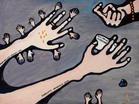
"The reputation locally was interesting. Because it didn't
serve the local community, nobody was really interested in
it...My take on it was the local community didn't seem to
get that interested in it until the Croydon services started
coming on site in the 1990s." (Current nurse quoted
Chaney, S. and Walke, J. 2015)
The Bethlem Gallery is a permanent exhibition space in the
grounds of the Bethlem Royal Hospital. The gallery was set up in 1997 to
provide opportunities for artists who have experienced mental health
problems.
March 1997 Psychiatric Bulletin "The Bethlem and Maudsley
NHS Trust will be celebrating its 750 Anniversary of the Bethlem Royal
Hospital, with many events during 1997 including a joint Royal College of
Psychiatrists and Maudsley Winter Meeting to be held in London in 1998.
Further details for events: The Anniversary Office, The Maudsley Hospital,
Denmark Hill, London SES 8AZ (Tel: 0171 919 2014; Fax: 0171 9192171)".
3.6.1997 All in the Mind BBC Radio 4: "Bedlam" Presented by
Professor Anthony Clare. Programme to mark the 750th anniversary. Wellcome
Film and Audio Collections shelf mark MFAC/HM/97.06.
source
22.6.1997 Family Spectacular "An open afternoon at
Bethlem on a
spectacular scale. We welcome the general public as well as staff, users
and carers. Shows will include jousting and medieval pageantry, a celebrity
raffle draw and the launch of 750 balloons, a wide range of activities for
all the family, a marquee with music and afternoon tea, and an array of
stalls with food, arts and crafts."
15.7.1997 BBC Radio 3 Broadcast: "A medical history". "Claudia
Hammond visits the Maudsley Hospital which this year celebrates
750 years of treating the mentally ill". National Sound Archive reference
H9034/2
source
4.9.1997 to 30.9.1997 The Arts and Our Users. An
exhibition of current art work on display at the Community
Centre, Bethlem Royal Hospital as part of the 750th - "A celebration of the
creativity of service users. We are having an artist-in-residence to
facilitate a range of exhibitions and activities. We are also publishing
and illustrated book of poetry written by users and staff"
9.9.1997 to 8.12.1997 Art and Psychiatry Exhibition at
the
Kunstforum in Vienna "Art from the Bethlem Archives will be
part of
this major international exhibition archive".
Kunst and Wahn (Art and Madness): Ausstellung, Kunstforum Wien,
5.9.1997 - 8.12.1997, edited by Ingried Brugger and others. 1997.
Subjects: Max Ernst (1891-1976) - Richard Dadd (1817-1886) and Jean
Dubuffet (1901-1985).
7.10.1997 to 15.3.1998 Exhibition on the History of Bethlem
at the Museum of London
The Museum of London website opened in 1997 - first
archive 28.1.1998 - The first digital
exhibition was
"Bedlam: Custody, Care and Cure". Museums were still charging
for admission.
Friday 10.10.1997 to
Sunday 10.10.1997 International Nursing Congress
Kensington Town Hall. Organised by Nursing Times in association with
the Bethlem and Maudsley NHS Trust. Included Eilleen Skeller lecture.
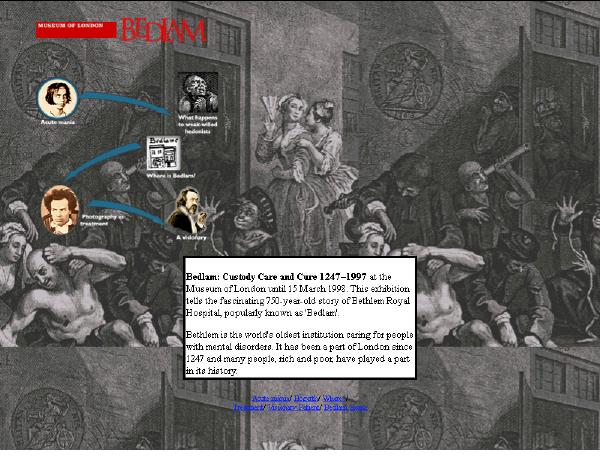
See Reclaim
Bedlam
10.10.1997 "Publication of a national collection of user's
poetry. The launch marks World Mental Health Day and National poetry
Day" [Original programme]. Collection was called
Beyond Bedlam: Poems written out of Mental Distress
18.10.1997
British Medical Journal review of "Bedlam: Custody, Care and
Cure".
Thursday 23.10.1997 Service of Thanksgiving at St Paul's
Cathedral 11am "Cardinal Hume will give the address".
Friday 24.10.1997 Launch of book,
The History of Bethlem
Hospital. Symposium at the Wellcome Trust. -
Google Books link
27.10.1997 to 29.7.1997 "Mental Health in the City" An
international conference hosted by the King's Fund and the Bethlem and
Maudsley NHS Trust
(source)
Wednesday 29.10.1997 The Maudsley Alumni Dinner
Thursday 30.10.1997 Institute of Psychiatry Symposium A
review of current and future research
15.11.1997 Survivors Poetry launch of
Beyond Bedlam: Poems written out of Mental Distress
December 1997 through April 1998 Exhibition of art from
the Bethlem Archives at the Science Museum, London.
20.1.1998 to 23.1.1998 Royal College of Psychiatrists'
Winter Meeting, London. Royal Lancaster Hotel, London. Joint meeting
with Maudsley to mark the 750th anniversary.
17.12.1998 First official meeting of
SIMBA
(Share In Maudsley Black Action), the Black
Patient/User/Survivor group in
the Maudsley Hospital, held in the Visitor and User Centre at the
Maudsley.

SIMBA was "one of a number of self-organised service user groups operating
in the trust"... "In the summer of 2000 we decided to focus on the black
service user's experience at the trust's annual general meeting in
September"... "Part of the trust's new way of operating is to organise
events or meetings so they feel more inclusive and open. The AGM was held
in a large open room, informally laid out with information stalls around
the edge. The only chairs were the half circle set out for SIMBA's use. The
formal business of the AGM took about ten minutes and we then turned our
attention to SIMBA's performance." (Mental Health Today August
2002)

January 2000 Zoe Reed became Executive Director Strategy and
Business Development, South London and Maudsley NHS Foundation Trust,
having previously worke for Camden and then Watford Councils. She
approached
SIMBA about participation.
"South London and Maudsley NHS Trust provides mental health and
substance misuse services to people from Croydon, Lambeth, Southwark and
Lewisham, and substance misuse services in Bexley, Greenwich and Bromley.
We also provide specialist services to people from across the UK.
Trust Locations: Many of our services are based at large sites,
including The
Maudsley,
St Thomas,
Guy's, Lewisham and the
Bethlem Royal hospitals.
Royal Bethlem Hospital Museum -
archive
other museums
Bethlem Royal Hospital Archives and
Museum
Monks Orchard Road, Beckenham, Kent BR3 3BX
2001: "The small museum displays a remarkable collection of pictures
by artists who have suffered from mental disorder, including Richard Dadd,
Vaslav Nijinsky and Louis Wain: also the statues of 'Raving and Melancholy
Madness' from the gates of 17th century Bedlam, and other material relating
to the history of psychiatry. The archives contain records of the Bethlem
and Maudsley Hospitals from the sixteenth century on."
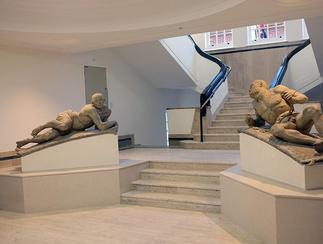
Wednesday 18.2.2015
Bethlem Museum became Bethlem
Museum of the Mind (website)
when it
reopened in a new location "a short distance away".
Notice the question marks. This is a
critical museum and there is a space for you to sit and contemplate the
questions it raises. Here are some questions:
"Worth a visit?" is a reminder that the Museum of the Mind is not the first
Bethlem exhibition as, for over a hundred years, the
Moorfields Bethlem
put lunatics on public display (for a fee). The following
sections are
labelling and diagnosis -
temperament -
freedom and constraint
-
heal or harm - and
recovery?
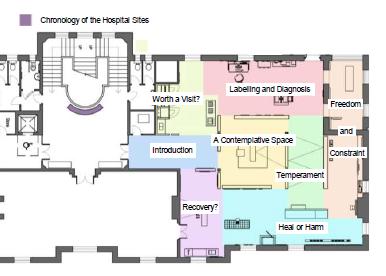
Temperament Feelings
(emotions) link diagnosis with
constraint and contemplation. Would you like to be in
a padded cell or in a garden?
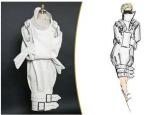
"With the evolution of
modern paints artists and textile makers no longer have to
manufacture their own pigments and the link between colours and their
origin is disappearing. The communal and healing experience of harvesting
and producing dyes from plant materials has also largely been lost from
western society."
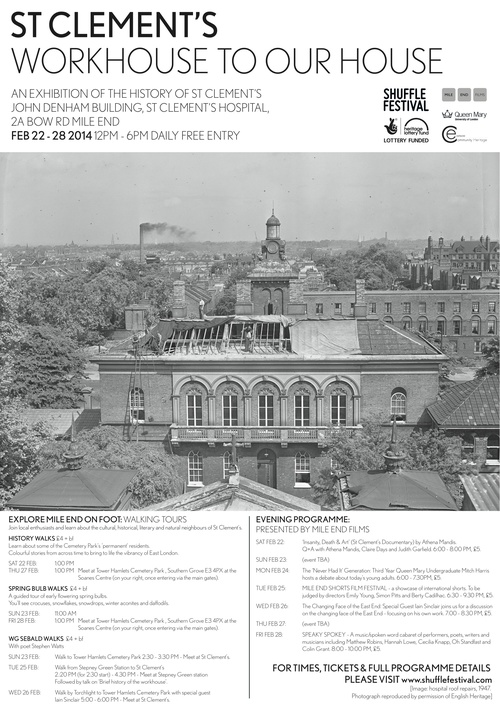
"Kingsley Hall was an intense heaven and the black depth of
hell. All that we had packed inside ourselves was there thrown into the
open. But we survived. Ronnie, Dr R D Laing, who died in 1989, was the
initial founder of it all and was the ultimate victim of his own genius.
"
"8. THE REHABILITATION OF KINGSLEY HALL
St Luke's Hospital
probably not receiving paupers in 1844
17.6.1750
Meeting in the King's Arms in Exchange Alley that
decided to found a hospital: Founders Thomas Crowe, physician;
Richard Speed, druggist of Old Fish Street;
William Prowing, apothecary of Tower Street;
James Sperling and Thomas Light, merchants of Mincing Lane;
and Francis Magnus
(250 year
history
booklet)
Opened
1751
Upper Moorfields, opposite Bethlem. (see sketch map). Took its name from the new
parish of St
Luke's
"The first patients were admitted in July 1751. In February 1753 the number
was increased to 57. From 1754 some incurable patients were readmitted and
for some time the numbers remained steady: 50 curable and 20 incurable
patients. The staff consisted of the keeper and his wife plus two male and
two female attendants." (250 year
history booklet)
"From this time... he devoted himself almost exclusively to the treatment
of insanity... he attained a high reputation and from it accumulated an
ample fortune."
1782
Thomas Dunston moved from being "senior basketman" at
Bethlem
1786
moved to Old Street. (New building designed by George Dance and erected
1782 to 1784?) Mr and Mrs Thomas Dunston became Master and
Matron from 1786, previously (from 1782) they had been head man
keeper and head woman keeper. Their son, John Dunston,
apothecary, married the daughter of
Thomas
Warburton
1810
Benjamin Rush refered to "Dr Dunston"
"physician of St Luke's Hospital... eminent for his knowledge of diseases
of the mind"
February
1811
Samuel Foart Simmons resigned as physician.
Appointed consultant physician. His son did not wish to succeed him, but
did wish his university friend, Alexander Robert Sutherland, to succeed.
One of the unsuccessful candidates was
George Leman Tuthill
"The House also for private patients at
Islington was consigned to Dr S. on certain
valuable considerations"
"There are three hundred patients, sexes about
equal; number of
women formerly much greater than men; incurables about half the number. The
superintendent has never seen much advantage from the use of medicine, and
relies chiefly on
management.
Thinks chains a preferable mode of restraint
to straps or the waistcoat in some violent cases. Says they have some
patients who do not generally wear clothes. Thinks confinement or restraint
may be imposed as a punishment with some advantage, and, on the
whole, thinks fear the most effectual principle by which to reduce the
insane to orderly conduct. Instance: I observed a young woman
chained by the arm to the wall in a small room with a large fire and
several other patients, for having run downstairs to the committee-room
door. The building has entirely the appearance of a place of
confinement, enclosed by high walls, and there are strong iron grates to
the windows. Many of the windows are not glazed, but have iron shutters
which are closed at night. On the whole, I think St Luke's stands in need
of a radical reform." (Quoted
Tuke, D.H. 1882 pages 89-90)
1816
Evidence of John William Rogers (a surgeon dismissed by
Warburton)
that Thomas Dunston received £500 a year from Warburton
for recommending patients. Mr and Mrs Dunston had a joint salary from St
Luke's of £150 and St Luke's, at one time, had 700 people on its
waiting list. Dunston was also said to board lunatics in single houses.
(Morris, A.D. 1958, apparently from 1816 Select Committee
Reports)
1816 Death of Mrs
Dunston, the Matron. Thomas Dunston's title became "Steward"
1830
Death of Thomas
Dunston, the Steward who had been in day to day charge of St
Luke's since 1782
From 1830 some attempt was made to separate patients according
to categories.
From
1833
recognised as important to provide some form of
occupational therapy for patients
"From 1833 it was recognised that it was important to provide some form of
occupational therapy for patients. This was another idea supported by Dr
Sutherland and also by John Warburton. Whilst this was a step forward they
nevertheless maintained some older forms of treatment such as the use of
occasional forcible restraint. This was said to be necessary because the
number of staff employed to care for the patients was relatively small, in
fact a ratio of 7 to 1."
(250 year history
booklet)
31.8.1833 Clementina and William John Stinton had a baby girl
who they christened Clementina Stinton at Saint Luke Old Street on
25.9.1833
1841 Census:
Henry Lambert, aged 24, Resident Apothecary.
William Jno Swinton, aged 37, Steward. Clementina Stinton, aged 39, Matron.
Eight year old daughter (same name as Mrs Stinton] and a second Matron
(Harriet Camerow?) aged
about 60. Apart from Henry Lambert, the above were all born in Middlesex.
Clementina Stinton, born Middlesex about 1834, was living in Lewes in
1881. The 1841 Census return was certified on
7.6.1841 by "Wm Jm Stinton, Steward of St Lukes Hospital for Lunatics".
1841
Alexander Robert Sutherland
retired as physician and was succeeded by his son
AlexanderJohn Sutherland
1842:
A chaplain was hired and a chapel was being built
1844:
Steward: Mr Stinton
1.1.1844: 93 curable patients, 84 incurable
Henry
Monro
was a physician from 1855 to 1882.
1860
AlexanderJohn Sutherland
retired as a physician to St Luke's
From
1871
the Governors began to
examine the possibility of acquiring a site for a second building in the
country which could be used for convalescent patients.
1881 Census: George Mickley
(Physician, unmarried, aged 37)
[May previously have worked at Wyke House], Resident Medical
Superintendent; Francis
William Edward Hinners (unmarried, aged 23) and Edgar Vivian Ayre Phipps
(unmarried, aged 24) Resident Clinical Assistant Surgeons. Steward: Thomas
Collier Walker, aged 72, born Scotland. Matron:
Charlotte Eliza Walker, aged 65, born Douglas, Isle of Man (presumably
husband and wife), living with unmarried and unoccupied son and daughter of
Steward, both born in Scotland: George Lyell Walker, aged 47 and
Margaret Jane Walker, aged 40.
1882
The practice of having a husband a wife as Steward and
Matron of the hospital ended. (250 year history
booklet)
In
1893
Nether
Hall, near Ramsgate, was taken over for the benefit of [convalescing]
female patients.
Initially the property was rented but in
1901
it was purchased by the
Hospital.
12.6.1904
to
5.11.1905
painted postcards from Edward O. Cole
(patient).
The research for most of the information from 1871 to
the present was carried out by Jean Cullen, present owner of these
postcards.
1910
the Hospital bought the Welders Estate near Jordans in
Buckinghamshire, with the intention of building a substantial convalescent
home. The project was never brought to completion, but an Encyclopedia
reference in 1922 refers to new buildings being constructed at
Gerrards Cross, Buckinghamshire.
"When St Luke's Hospital closed at the end of 1916,
all the remaining patients were either discharged to their homes or
transferred to other institutions. In 1922 it was suggested that a
psychiatric unit should be instituted by St Luke's in cooperation with a
General hospital. This led to the funding by the St Luke's charity of both
an out-patient clinic and a psychiatric in-patient ward at the Middlesex
Hospital.
This continued until the new St Luke's-Woodisde Hospital opened in
1930."
(Richard Morris to Jean Cullen)
1917? Site of Old Street St Luke's sold to the Bank of England.
Until later than 1958, the building was used as a printing works for Bank
of England notes.
1930
"Third St Luke's" opened in Woodside Avenue, Muswell Hill
after an "association with Middlesex Hospital" that began in 1923"
1930: Woodside Nerve Hospital
1940:
St Luke's Woodside Hospital for Functional Nervous
Disorders
1948
St Luke's Woodside, Woodside Avenue, Muswell
Hill,
London, N10 3HU
2001 250 year history booklet
Guy's Hospital Lunatic Ward
not receiving paupers in 1844
1.1.1844: 25 private patients
Batavia Hospital Ship
Moored in the Thames, off Woolwich, this ship received naval patients
from
Hoxton House when they were considered fit for convalesecence.
It also sent patients to Hoxton House and Bethlem.
A second Middlesex County Asylum, known as
Colney
Hatch Asylum, was opened on 17.7.1851. It had 1,293
patients in 1858.
Corridor form
1851 William Charles Hood (1824-1870), first medical
superintendent.
January 1862 Reference to
alleged murder of a patient by keepers
1862 W.C. Hood appointed to
Bethlem
1879
After-care Association for Poor and Friendless Female
Convalescents on Leaving Asylums for the Insane
1881
Census.
Household of Henry Hawkins
Became Colney Hatch Mental Hospital from
1918 to 1937. "The Cockfosters extension on the Piccadilly
line.. started at a ... slow pace. In
February 1934
Arnos Grove station had served only 500,000 passengers.The proximity of a
mental hospital, sewage farm and cemetery were blamed for hindering
development." Colney Hatch was renamed Friern Mental Hospital in
1937. But even in 1955, when my
grandfather
became a patient, it still had to be explained that the new phrase was
"mental hospital", and that this meant a different attitude to the one
perpetuated by we schoolchildren calling one another "Colney Hatch cases".
From 1959 it was Friern Hospital, Friern
Barnet Road, New Southgate, London, (N11 3BP)
(map).
1893: A small room was set aside "for microscopic observations" to
supplement gross anatomical findings by histological examination. See Claybury. In 1915 the
Board of Control reported "under consideration the provision of
a
laboratory for clinical and pathological research". In 1924 it
reported "a useful laboratory" staffed by a specially trained male nurse
and supervised by an assistant medical officer. Hunter, R.A. and Macalpine, I. 1974 pp.165-166
1958 Halliwick House opened in the grounds of Friern
1965 Lionel Kreeger appointed consultant psychiatrist and
psychotherapist at Halliwick Hospital. Worked with Pat de Mare to establish
a
therapeutic community culture employing small and large groups.
He moved to the
Paddington Centre for Psychotherapy in 1973
1967
Sans Everything
1968
Camden Association for Mental Health
November 1970
Janet Creswell in Friern on a section 60
following
an assault on her GP.
In 1971 Friern
Hospital, had 1,862 beds.
Hunter, R.A. and Macalpine, I. 1974,
Psychiatry for the Poor is a substantial history of the asylum from
1851 to 1973, and one of the best insights into asylum life.
1980 Friern 2000 "celebrating the hospital's
achievements and looking forward to the next millennium. LMA,
H/12/CH/A/30/6." (Barbara Taylor)
16.7.1981 Care in the Community Green Paper
North East Thames
closure plans
July 1983 "the hospital learned its fate from a televised
news
announcement" (Barbara Taylor)
1984
Camden Mental Health Consortium established in response to the
planned closure
of Friern
1985? John Hart's first period in Friern.
Testimonies Project
1987
Islington Mental Health Forum "now well established". They
"have started a Friern Interest Group which meets at the hospital".
1988 and 1989
Barbara Taylor's periods as an in-patient.
1989 "I entered Friern for the third time and
remained there for over six months. My stints in Friern came midway
through the closure process...
Most of the ward nurses had left and been replaced by agency staff.
The ward across the stairwell from mine was empty, having been burned
out in a major fire shortly before I arrived. Corridors were sealed off,
therapy rooms locked up, the old apple orchard was choked with weeds.
The kiln in the pottery workroom broke down and was not repaired; a
little pot that I left in the firing queue was thrown away.
Yet for me Friern was truly an asylum. I entered it on my knees:
I could no longer do ordinary life, and giving up the struggle was an
incalculable relief. My home in the hospital was a locked acute ward
with a deservedly violent reputation: a Dickensian barrack of crumbled
brickwork and peeling walls, reeking with fag smoke and teeming with
ghosts; but for me it was a sanctuary. I settled in quickly, got to know
people, acquired a lot of new survival skills... I was very
wretched most of the time, and often frightened, but I felt safe from what
I feared the most: myself. This was a huge plus, and I wanted to stay
forever... By the end of the
1980s, I was deeply embedded in the world of the chronically mentally
ill. I had lost my home, and was living in a psychiatric hostel. When I was
not in Friern, I was at the Whittington day hospital (later made notorious
by
Clare Allen in her bestselling novel
Poppy Shakespeare) or at the Pine
Street Day Centre in Finsbury. I still had friends and connections from
earlier days, but I spent most of my time with other mental health users
with whom I often felt more comfortable than with old chums"
(Barbara Taylor)
6.7.1990
Adjournment Debate House of Commons
23.1.1991 "After Friern": A meeting to discuss the health
authority proposals for re-accomodating Friern patients after 1993"
organised by Haringey Community Health Council Mental Health Forum.
Friern
closed in
April 1993. It is a listed building which has been
converted
into
luxury apartments.
At one time it was considered as a
site for Middlesex
University.
1.11.2006 Visit by Andrew Roberts to Princess Park Manor: A
billboard advertises
"Individually designed quality apartments set in thirty acres of stunning
parkland". The parkland is the ground in front of the asylum, which is
planted with trees. Barnet Borough have created Friern Village Park
out of the land in front of the west wing. This is open to the public daily
from dawn to dusk. The Middlesex coat of arms above the asylum says "East
Saxons"
The Lunacy Commissioners visiting in 1904 were:
Sidney Coupland,
H.F. Gifford,
F. Needham,
Harold
Urmson,
E. Marriott
Cooke, F. A.
Inderwick,
A. Hill Trevor.
The Metropolitan
Asylums Board was abolished in 1930, when its functions were transferred to
London County
Council
This extract from a 1911 encyclopedia shows how the
provision of "asylums" was only a small part of the Board's functions:
Architects:
Giles and Biven -
Dual Pavilion
May 1871 nearly 1,400 patients
1872:
Long report of a visit (on the Rossbret site)
Rossbret picture
1878 An outbreak of enteric fever in Caterham and Redhill did
not affect the asylum or the troops in Caterham barracks who were supplied
with water from the asylum well. (R.H.
Firth 1908 p.60)
1881
Census: Medical Superintendent: George Stanley Elliot, aged
36.Metropolitan District Asylum for Imbeciles, Caterham, Surrey. May
also have been known as Caterham Lunatic Asylum for Safe Lunatics and
Imbeciles. The names of patients are given in full, not just initials.
24.5.1920 "Ottington Street, Wolling Road, Camberwell. This is where
my life began. After I was born, my mother was in bed, my Grandma Brewer
heard a knock on the door... it was my dad coming home
from the army"
(Joseph Deacon p.13)
1920 Caterham Mental Hospital
1926 "my mother's life ended when I as six years old. My Auntie
Em took me over, and Grandma Deacon looked after me for a little while. And
my auntie had a lot of work to do... At seven years old, I went to
Carshalton Hospital for more treatment. They could not understand me when I
went to the toilet... Carshalton sent me away to Roehampton, Queen Mary's
Hospital for more treatment, and the nurses were very good to me... On 12th
February, 1928 my dad told me that I was coming to Caterham. On the
following Thursday, 16th February, I came to Caterham. I was first nursed
on the female ward"
(Joseph Deacon pages 14-15).
1941 St Lawrence's Hospital, Caterham, CR3 5YA
"The girls came to see me... They tried to speak to me but I could not
answer. My friends told the girls I could not speak. They said they knew,
my brother had told them... I was still working in the mat shop and in 1941
Mr Treece got two new boys from the female side. The boys were Ernie and
Victor. Mr Treece asked Ernie to help me sort out he wool. When I wanted
something or to tell him something I made some noises to make him
understand. It was not easy at first but Ernie did not give in. He tried
very hard until he began to understand me... [One] Sunday... my cousin Ann
and her friend came to see me... I wanted to talk.. There was nobody who
could understand me. I made signs and pointed to Ernie. Mr Harris
understood me and brought Ernie and I introduced him to my cousin. He
understood me. That's how it all began. This was the first time I started
to talk a little. We asked her how she liked the A.T.S. I was twenty-two at
the time. My cousin was very pleased that she could understand me. Ernie
was very good. When she went home she told Grandma how she was able to
speak to me through Ernie.
(Joseph Deacon p.21-22)
1950s Peter, a Hackney boy, was on a ward with 60 patients.
There were four rows of beds plus beds on the veranda. When the weather was
bad, they cleared the beds and kicked a ball around the ward. His mother
was horrified on her first visit at the thick chunks of bread plus chunks
of cheese which were served for tea - But the residents had a terrific
appetite. The "children" were taken out for walks in crocodiles. In those
days, staff had to rely on patients to help with bathing. At 3pm one round
of bathing started, at 7pm a second round. The residents wore old clothes -
"like Meths drinkers in the East End".
1971 listed a
Mental Handicap Hospital with 1,902 beds
1974 Tongue Tied by
Joseph John Deacon, a resident in
St
Lawrence's since 1928, published by the National Society for Mentally
Handicapped Children. "Joey Deacon has cerebral palsey, seriously affecting
all four limbs and his speech and Ernie Roberts is the only person who can
really understand him. But Ernie cannot read and write. So as Ernie
listened to Joey's story and then repeated it intelligibly to Michael,
Michael wrote it down. The handwritten version was then typed by Tom at the
rate of four to six lines per day".
10.6.1981: St Lawrence's and
Borocourt
featured
unfavourably in a television documentary Silent Minority
"St Lawrences in the 1970s became known as you say through
Joseph Deacon's
book and film
Tongue Tied, and from the documentary
Silent Minority.
Joseph lived in MC1 (Male C1) and spent a lot of his time on the cosy
verandah. Across the airing court was another long verandah where the
residents seen in Silent Minority spent their aimless days (MD1). MC1 was a
well run homely ward. MD1 was a stark place. Just 10 yards of court
separated them. And on the top floor above MD1 was MD3, the lock up ward.
Joseph would have heard the shouts from up there when one of the residents
went 'up the wall.' 'You'll be sent to D3' was a threat to patients from
other wards. Most of the time it was relatively calm. It was a lock up
ward, but many of the residents were let out unsupervised to go to work at
the concrete works - making slabs and gnomes." (Alastair Fear, who met
Joseph Deacon when working at St Lawrences in 1975-1976, and who also
worked there, for a while, about the time of Silent Minority)
Architect:
Frederick Hyde Pownall -
Dual Pavilion
Landscape Designer: Alexander MacKenzie
National Grid Reference TQ 263 613
Address Sutton Lane, Sutton, Reigate, Surrey
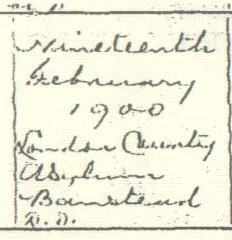
Database information that Banstead became a Surrey asylum is incorrect:
1897/1898 Cheam Parish Council: Water and sewerage file -
Correspondence re contamination of water supply from Banstead asylum burial
ground
1.1.1927: 1,976 patients of whom all but 142 were Rate
Aided.
845 were men, 1,131 women. In 1926 the
proportion of recoveries to admissions was 20.0%. The proportion of deaths
to the asylum population was 7.1%
In 1960s and 1970s (about), part of Kensington
and Chelsea and Westminster Area Health Authority (West London)
1982:
Plans for closure and concentration of
services on Horton
October 1986 Closed
Demolished
1989
"High Down and Down View, two state-of-the-art prisons, were built on
the site in the early 1990s"
Archive link
Edward Sackett
was transferred from Brookwood in September 1896, and died from heart
disease on 14.10.1899.
Joseph Stockton
died 20.10.1896
at
London County Lunatic Asylum, Ilford, which was also the name of the
asylum in 1900 (Registration District: Romford, Sub-District:
Ilford)
on the death certificate of Mr Hopson (55 years old), an upholsterer
formerly of 19 Bee Hive Brick Lane, Whitechapel, who died there. His
certificate was signed by the Medical Superintendent, Robert Youes (or
Young?) [information from Joan Robblee].
Journal of Mental Science, April 1900, 46, 393: At
Claybury Asylum provision is made for private patients who can claim a
settlement in the county of London at a charge of 30 shillings a week, and
for others at a charge of £2
(See 1890 Act)
The Central Pathology Laboratory Commissioners in Lunacy
1896 quoted
Hunter, R.A. and Macalpine, I. 1974 p.165: "Even
when the new Laboratory has been brought into use by the Specialist
Pathologist for the County of London
[Dr F.W. Mott at Claybury], there will
still remain much useful work of this nature to be done in the several
Asylums, for which due provision should be made". See
Friern
1899 Start of Archives of Neurology from the Pathological
Laboratory of the London County Asylums, Claybury, Essex Published:
1899-1907 and 1909-1934
1901 or 1902 Dr Macmillan, a medical officer at Claybury,
read a paper on The History of
Asylum Dysentery at Claybury to a meeting of the Southern
Eastern Division of the Medico-Psychological Association. Dr Macmillan,
himself, died of asylum dysentery soon after.
(source)
Report for the year ended 31.3.1902.
Dr Robert Jones: medical superintendent. 2431 patients: 1015 men - 1416
women. 426 admissions during the year: 131 men and 295 women.
16% of men admitted had
general paralysis. 14% of men and 9% of women were admitted
suffering from alcoholic insanity. 148 patients were discharched recovered
during the year, whilst 201 patients died. 50 died of
general paralysis of the insane - 25 of
tuberculosis - 24 of cardiac disease - 21 of
colitis
(asylum dysentery). "Asylum dysentery attacked 40 males and 81
females, and was responsible for 21 deaths, or over 10 per cent. of the
total deaths."
1901 A department of Experimental Psychology established at
Claybury with W.G. Smith (1866-1918) as director. Smith, a
philosophy graduate (1889) of Edinburgh University, studied for his PhD
(1894) under the pioneer of experimental psychology,
Wilhelm Wundt. He worked for several years in
the United States, including a period with
William James. Smith and
Mott were founder members of the
Psychological Society in the same year that the Experimental
Psychology unit was established at Claybury. In 1905, Smith became the
first lecturer in psychology at Liverpool University and in
1906, he became
the first Combe lecturer in General and Experimental Psychology at
Edinburgh University.
(external link to biography)
A 1911 Encyclopedia entry for
Ilford says "Claybury Hall is a
lunatic asylum (1893) of the London County Council".
1938 John Stuart Harris (born 13.10.1900, died 2.5.1986)
appointed physician superintendent of Claybury Hospital. Previously at the
Maudsley Hospital and then West Park Hospital.
His "outstanding contribution to psychiatry being adminstrative rather than
clinical". "He chose his staff carefully and supported them fully" (Munk's
Roll,
Volume 8, p.209). He retired in 1961.
"the difficult war years" (Munk's Roll)
About 1952:
Thomas Bewley's recollections of the
dysentery
wards
1955 Denis Vincent Martin appointed. John Sutton Pippard
(born 20.5.1919, died 21.12.2012) appointed.
Martin and Pippard, with the support of Stuart Harris "set about
transforming a hospital caring for 2,200 patients into a therapeutic
community in which there was a conscious effort to harness the potential of
all staff and patients in the overall treatment programme". Pippard's
"approach was eclectic but he saw the community, in which maladaptive
behaviour could be explored in terms of 'what does it mean' rather than
'how can we stop it most easily'". (Munks Roll)
16 page booklet printed in the occupational department at some time
An Introduction to Community Methods of Treatment and Ward Management in
the Psychiatric Hospital Claybury Hospital, Woodford Bridge, Woodford
Green, Essex. "an introduction to the ... methods... developed in the
hospital. This is a new and experimental approach... This booklet was
originally written for the guidance of nurses commencing training at
Claybury Hospital... As, however, all members of the staff have their part
to play in such a community, a copy is being given to all staff".
1961 Retirement of Stuart Harris.
1962 Denis Vincent Martin Adventure in Psychiatry: Social
Change in a Mental Hospital With an introduction by J.S. Harris
Oxford : Cassirer
More Patients Willing to go to Claybury
It's a Fact by Alan Symes
The [Ilford] Recorder, Thursday, March 11th 1965
""The number of beds is being decreased to allow better bed
spacing, but the number of patients being treated is not decreasing; the
group secretary, Mr Wilfred Mitchinson, informs me"
The causes of mental illness are complicated and there is still much that
is not understood. In some cases environment and the increased pace of the
20th century life plays a part.
May 1971 Information for Patients and Relatives "patients
and staff are members of a community. Each ward forms its own community and
its members, patients and staff, attend meetings, sometimes daily,
sometimes less frequently... In addition to the community approach, which
is a major part of treatment in many of the wards, there are specialised
methods of treatment appropriate to particular illnesses". Mentions
psychological methods, different medicines (usually tablets) and electrical
(ECT). "The Hospital Community... consists not only of patients, relatives
and staff, but of all those people in the community who contribute so much
to its work".
About 1972
Antony I. Garelick started work at Claybury
John Pippard worked briefly with patients with intellectual disability at
Leytonstone House after he left Claybury and then retired in 1979.
(Leonard Fagin and Peter Shoenberg)
1981
Unemployment and Health in Families by
Leonard Fagin
31.3.1994: 361 patients
1994 Antony I. Garelick "Psychotherapy assessment: Theory and
practice" published in Psychoanalytic Psychotherapy Volume 8, Issue
2, 1994. Author affiliation: Psychotherapy Clinic, Forest House, Claybury
Hospital Woodford Bridge , Essex, IG8 8DY. [Antony Garelick worked at
Claybury, for 25 years
(1972-1997?). He was the first Clinical Director at Claybury,
Claybury Hospital
closed in 1997. Its address was Claybury Hospital, Woodford Green,
Essex,
1GB 8BY.
(map). Records:
London Metropolitan Archives
Simon Cornwall:
Demolished and converted. Now Repton Park.
(Claybury Wood)
2003
use: "Gated housing development"
There is a book: A Hospital looks at itself - Essays from
Claybury
External map shows boundaries proposed in 1885 for the
new borough of West Ham
The building of a new lunatic asylum and the declaration of May 1st as
a public holiday are listed amongst its many achievements
(external link). 680 patients were
transferred from the
Essex County Asylum
in 1901. On 18.3.1920 a stampless viewcard of Calais was
addressed to West
Ham Mental Hospital. George
Jacomb
of Plaistow died 8.1.1931 at West Ham Corporation Mental
Hospital Goodmayes Essex. He left
£1,056 9s. 1d to be administered by
Ellen Mary Jacomb spinster. There was a stationary steam engine (derelict
in 1980) here that was
manufactured by Belliss & Morcom Ltd. of Birmingham in 1938.

In 1898, the first Labour controlled local council was elected -
West
Ham.
November 1969
Joan Martin's account begins
New adult acute mental health facilities were being built at Goodmayes
Hospital, to open March 2002, and "re-provide" 107 beds for people
living
in Redbridge - 62 for adults with acute mental illness, thirty beds
for the elderly mentally ill and fifteen psychiatric intensive care beds.
"Goodmayes is getting its first new facilities for seventy years". "The
unit will have all single bedrooms, some
with en-suite facilities, and has fully taken into
account Government guidelines on sex
segregation". "Patients will really feel the benefit of receiving their
services in a purpose built, modern and light unit." Mental Health
Matters North East London Mental Health Trust. Issue 9, July 2001.
"Mental Illness". Shown in a
1979 Directory as having 20 beds
31.12.1977.
Compact Arrow
Website (October 2006) on the history of Bexley Hospital
In 1907 a death certificate was
signed "London County Asylum, The Heath, Dartford, U.D."
(information from
Michael Ball). The
City of London
Asylum
at Stone was on the opposite side of Dartford. The Bexley Asylum became
Bexley Hospital, Old Bexley Lane, Bexley, DA5 2AW. It has now closed.
Between 2001 and 2007, Dartford Council plan to
build houses on it, plus a new primary school and the "retention of
community facilities" (Office of the Deputy Prime Minister).
Kingswood Ward
(archive)
was a rehabilitation
ward for adults with severe and enduring mental health problems. External
link to
Edenwood, Old Bexley Lane, Bexley -
(partial archive)
27.11.2002:
Bexley Water Tower comes down
(partial archive) -
See timeline. 5.5.2006 "I live in Bexley and the local
asylum was known as Bexly Mental Hospital,
it has now been demolished and is a vast estate of new houses which is
still growing. They have kept the main building, i think because it was
listed, and turned it into a fitness centre for the local residents"
Susan Hammond - Rootsweb archive
London County Council, established in 1889, inherited many asylums,
and built many more. The ones it inherited from Middlesex were
Hanwell,
Colney Hatch,
and Banstead
and the
project to build an asylum at
Claybury. From Surrey it inherited
Cane Hill and may
have
temporarily inherited Wandsworth. If so, Wandsworth (Springfield) was
passed on (sold?) to Middlesex. The ones it built included
Claybury,
Bexley and the five
Epsom
asylums (below). In 1930, it took over institutions from the Metropolitan Asylums
Board.
The Epsom Group
Simon Cornwall's tour of all 18.4.2003
This scan is from Barnett's Street Plan of Epsom and Ewell, purchased about
1973. The online Horton Country Park map (with history) shows the
area on the east of this map.
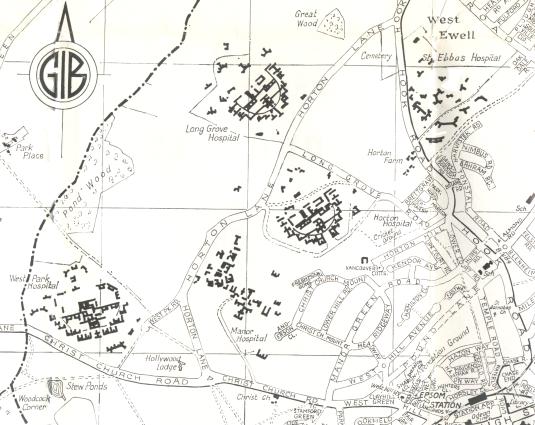
The usual approach to the institutions, when they were built, may have been
from Epsom station via Chase Road to Hook Road, then up Hook Road to Long
Grove, and so on. This is suggested by the houses along Hook Road going
north from the railway bridge. Dates and architectural features suggest
that many of these were built as homes for the staff. Near the bridge there
are several with the date 1896, when
the Manor was being built. Then there are
ones dated 1902, when
Horton was opened. These are followed by ones
dated 1903, when
Ewell Epileptic Colony was opened.
Common facilities David Cochrane (1988 p.258) says that water, gas
and electricity supplies were centralised for all of the estate. Sewage
disposal was centralised. Similarly,
the cemetery and the rail link to Ewell were for all the asylums.
Sports centre built round boiler-house.
David Lloyd Sports Centre, Epsom, website
The open land north of West Park, and circling
Long Grove on the south, east and north, is now
Horton Country Park (External Link).
(map) - See also
ride and drive web. This land (or part of it)
was farms for West Park and Long Grove. These became "surplus to
requirements" and were bought (1973) by Epsom and Ewell Council to
create
the park.
11.6.2002: Hansard: Commons debate on future of sites
- Mental Health Services (Mid-Surrey) - 1.29 pm - Westminster Hall
MP's latest news
Journal of Mental Science, April 1900, 46, 393:
Provision made for about 60 female private patients at a weekly charge of
about 15/- (not including clothes)
(See 1890 Act)
By 1901 approval was given for extra accommodation
for 110 male patients required for manual labour power.
(Cochrane, D.
1988 p.257)
Became
The Manor
Certified Institution
from 1921 to an unknown date.
1925: The Branch Secretary of the Nation Asylum Workers Union at
Manor (Epsom) was Mr George G. Galey who lived at 4 Percy Cottages,
Elm Road, Claygate (about three mile away in a straight line - perhaps he
cycled). The other four hospitals seemed to have been one branch (Epsom).
1930: Manor Certified Institution. Medical superintendent:
Edward Salterono Litteljohn. Assistant medical officer: Bridget Coffey.
Chaplain: Rev Edward John Hockly. Clerk: C.W. Poulton. House Steward: W.A.
Francombe.
(Kelly's directory)
Became The Manor, Horton Lane, Epsom, KT19 8NL.
1962 (Hospital Plan) 1,200 beds in 1960. Plans to rebuild
by 1971. By 1975 expected have 500 mental subnormality patients, and there
to be another 700 in St Ebbas (converted) and 500 in "Horton new hospital".
1971 The Manor, Epsom 1,067 beds, 1,034 patients on
31.12.1971. 16% in dormitories with over fifty patients.
(60% of adults sleeping in groups of less than 30. 93% of children sleeping
in groups of less than 20, but the other 7% of children in dormitories of
30 or more). 25 security beds in locked wards.
1979
Manor Hospital Mid-Surrey Health District's mental
handicap hospital with 800 beds
July 1998
efforts to stop development
March 2002
Progress report on redevelopment, and plans for other
sites.
Some ex-patients have been rehoused on Ethel Bailey Close. The rest of
the site has been entirely redeveloped into around 340 new houses & flats.
Re-development completed about 2000.
Peter Cracknell's photographic tour
2003
use: "Housing"
The Manor Farm In reponse to the question "was there a farm on the
land to the south?",
Christine Lawes wrote "There ... was a self-sufficient market
garden, worked by the
patients in times past.
It bordered
Horton Lane. Up to about 1994 it was still a thriving organic
market garden and sold fruit and vegetables to the public. After that date
it gradually became more difficult to maintain as the residents were being
moved out. At least up to a couple of years ago it had become more of a
garden centre, selling plants to the public from some specially converted
barns. I believe the garden centre is probably still there.
Horton Asylum, at
Epsom was opened in 1902.
Simon Cornwall:
Horton Asylum, Epsom, Surrey (Epsom Cluster number 2)
Originally: Seventh London County Council Asylum. Built: 1902
Architect:
George Thomas Hine (replica of
Bexley Heath
Asylum)
2,000 beds - 900 for men and 1,100 for women, although at first men
exceeded women.
1906 Dr Bryan, first Medical Superintendent, dismissed
1913 Horton Light Railway opened
Horton War Hospital (1915-1918);
Horton Mental
Hospital (1918-1939);
1920 John Robert Lord's
story and reflections on the war hospital
After the war, Horton was adapted to cater almost exclusively for
women.
1922 1,605 patients - 187 men and 1,418 women
1924
Malarial therapy unit opened.
May 1928
Alexander Walk, a medical officer at Horton, appointed by Lord
as his assistant editor on the Journal of Mental
Science. He was co-editor from 1930 to
1973 and thereafter served as associate editor until Easter
1982
1.1.1927: 1,941 patients of whom all but 190 (all female)
were Rate Aided.
Only 270 were men. 1,671 women. In 1926 the
proportion of recoveries to admissions was 23.2%. The proportion of deaths
to the asylum population was 5.3%
1930 John Robert Lord, medical superintendent - The assistant
medical officers were: William Drew Nicol, Frederick Oliver Walker, Gordon
Frank Peters, John Joseph Laws, and Miss Dorothy Preston Hytch. Miss Mary
Mitchell Thorburn was matron. Rev Edward John Hockley was chaplain, Sydney
Carter Boswell, clerk, and Alfred Henry Gwinnell, house steward.
(Kelly's directory)
9.8.1931 Lieut.-Colonel John Robert Lord, C.B.E., M.D.,
F.R.C.P.E., Medical
Superintendent, Horton Mental Hospital (L.C.C.) died at the hospital
(Nursing Times) -
Obituray in British Medical Journal
1931 William Drew Nicol Medical
Superintendent, Horton Mental Hospital to 1951
(Munk's Roll)
22.1.1935
George Pelham (Trimmer), patient
(archive)
to
28.8.1939, when he was transferred to Longrove, probably because Horton
became a general hospital serving the forces.
Death Certificate of George Trimmer
1939 to 1949: Horton War Hospital
1949: returned to Mental Hospital. It became Horton
Hospital, Long Grove
Road, Epsom.
1950
Henry Rollin medical superintendent [May be incorrect. His
obituaries says "from 1948
until 1975, he was the Deputy Superintendent of Horton Hospital". See
Epsom and Ewell History Explorer
1962 (Hospital Plan) 1,524 patients in 1960. Possible to
be closed by 1975. (But 500 beds in "Horton new hospital" for mental
subnormality)
In 1960s and 1970s (about), part of Kensington
and Chelsea and Westminster Area Health Authority (North East
Health District). At this time, someone with a mental crisis in an office
in West London, could find themselves taken to Horton, to the south of
London.
Paddington Day Hospital established for
rehabilitation.
February 1965 to 11.5.1965
Janet
Cresswell detained under section 25 of the 1959 Mental Health
Act. Her psychiatrist, Desmond Lorne Marcus McNeill (born India 1920. Died
22.12.2013) diagnosed paranoid schizophrenia.
Summer 1965
"Unfortunately, the doctor decided to send me to Horton Hospital for a
rest" -
(Joan Hughes)
1966 "I begged my GP to get me into hospital so as I could get
some care and help" Daniel
Morgan
1971 1,587 beds, 1,438 patients on 31.12.1971. 23% in
dormitories with over fifty patients. 17 beds in a specialist
psychogeriatric unit.
29.3.1976 Janet Cresswell stabbed
Dr Desmond McNeill (initially) in his buttock with a kitchen
knife. The surgeon who operated on him said there were about seven "stab
wounds to the legs, back, groin and buttock". The most serous was to "to
the abdoman whci punctured the abdominal wall some four inches and also
penetrated the wall of the bowel". There was severe internal bleeding and
the surgeon said that without prompt treatment Dr McNeill would have died.
(Trial transcript)
1979
1,203 beds
Autumn 2002: reported closed and empty
(map), but in good condition.
Redevelopment has now started. (See
Peter Cracknell's photographic tour (2003)).
The developers have renamed it Livingstone Park. This name is not
recognised by the council or the post office. A small modern enclave called
Horton Haven is used by about 50 ex-patients. 460 houses and flats and a
small retail store are planned for the rest of the site.
July/August 2003
fire
December 2003
Convenience store wanted for site
There is a book: Asylum, hospital, haven: A history of Horton
Hospital
"Horton Cemetery. In
memory of those buried in these grounds between 1899 and
1955". Words
in black on a simple white plaque fixed to the railings of a field
surrounded
by trees on Hook Road, near the junction with Horton Road.
It was a cemetery for patients from
all five institutions. "... a strip of
land in the elevated and well-drained north-east corner of the estate was
fenced off to serve as an unconsecrated burial ground for pauper patients".
(Cochrane, D.
1988 p. 258).
(See George Pelham).
The "burial ground ... was sold many years ago by the NHS
to a developer. All the headstones were removed ...
It has always been referred
to as
Horton Cemetery" (email 2004). Jane Lewis,
Surrey History Centre (email 27.10.2005) advises that
some burial records survive at the History Centre under reference
6336/1-2. They cover the dates 4.4.1902 to 29.3.1955. A burial plan of the
area does not seem to have survived and the removal of the headstones has
now made it impossible to try and find exactly where the original plots
were sited,
re-burying bones -
a more detailed report - This says the
last funeral took place in 1958. - but this may be a mistake - Each grave
"usually housed three or four bodies", Headstones were removed before it
was sold in 1983 by the North West Thames Regional Health Authority to
"Marque Securities, a development company in Kingswood". Its bids to
develop have been refused by the Epsom and Ewell
Council.
Simon Cornwall:
Built: 1903.
Architect: William C
Clifford Smith
(Epsom Cluster number three)
Dispersed form.
Charles Hubert
Bond was medical superintendent from 1903 to 1907.
Ewell (County of London) War Hospital or
Ewell Neurological Hospital
for the care and treatment of soldiers and pensioners suffering from
neurasthenia or loss of mental balance
(Hansard 12.4.1920)
1927 Not listed as a mental hospital, so presumably still Ewell
Epileptic Colony. This epileptic colony is not mention in
Jones and Tillotson's pamphlet on epileptic
colonies. They do mention that the Metropolitan Asylums Board established
units for epileptics at
Edmonton
and
Brentwood,
and that these were taken over by London County Council in 1935. The
conversion of Ewell Colony to a Mental Hospital may have taken place
as part of this process.
Became Ewell Mental
Hospital and then St Ebba's Hospital Hook Road, Epsom, KT19 8QJ
1962 (Hospital Plan) 865 mental illness patients in 1960.
700 mental subnormality patients expected by 1975. Later in 1962? it
ceased being a mental illness hospital and became a mental
subnormality hospital.
1971 611 beds, but 616 patients on 31.12.1971.
38% of adults in dormitories with over thirty patients. No dormitories
with
over fifty patients.
1979
St Ebbas Hospital was Sutton and West Merton Health
District's largest mental handicap hospital with 629 beds - (outside
District).
A Parents and Relatives Group was formed about 1987 to campaign
for retention of a village community. external weblink - August 2002
There is now (2004) a "village campus" with about 60 residents
in a mixture of old and new houses. The council has approved construction
of 280 houses and flats on the rest of the site.
St Ebbas Farm is now used by
Epsom Riding for the Disabled Association
Architect
George Thomas Hine. A replica of
Horton with differences to
make it (a little) more like a
Maryland, USA plan that was favoured. In the
design, 500 beds were moved from the main (zig-zag) crescent to autonomous
villas, each with its own unfenced garden.
Charles Hubert
Bond was medical superintendent from 1907 to 1912
March/April 1919?
Felix arrested in St Martin's in the Fields. He lived in
Shaftesbury Avenue. He was brought to Long Grove from the
City of Westminster Union
Workhouse, which was responsible for his expenses. See
procedures for emergency admission. Maria Jose Gonzalez is
researching Felix's history.
1.1.1927: 2,120 patients of whom all but 204 were Rate
Aided.
1,091 were men, 1,029 women. In 1926 the
proportion of recoveries to admissions was 24.0%. The proportion of deaths
to the asylum population was 5.3%
1930 Medical superintendent: David Ogilvy. Deputy medical
superintendent: James Ernest Martin. Medical officers: Ernest George
Thornton Poynder, John Reginald Madgwick,
Alexander Walk, Marjorie Elizabeth Frances Sanders, and Charles
Grant MacMahon Nicol. Clerk: Alfred J. Gibbs. House Steward: R.E. Dorrell.
Matron: Miss Elspeth MacRae. Inspector: Arthur Heath.
(Kelly's directory)
1941 Felix died
1958 John Denham appointed Consultant Psychiatrist to
Long
Grove Hospital.
1962 (Hospital Plan) 2,151 patients in 1960. 1,000
expected in 1975
1959:
Psychiatric Rehabilitation Association
formed. This provided links to
Tower Hamlets and
Hackney (on the other side of
London), where many patients came from. See
2001 archive about the PRA
1962
Enid Mills' study of patients published
1966 All figure (01 -) telephone numbers introduced for London.
Booklet (below) has old style (Epsom 26200) telephone for Long Grove and
new style (01-985-5555) for Hackney Hospital.
about 1967 Long Grove Hospital Epsom. Information for
Patients, their Relatives and Friends, a small booklet, produced by the
Kingston and Long Grove Group Hospital Management Committee. At the back,
it lists Out-Patient Clinics at
Hackney Hospital (Monday and Wednesday
2pm);
Kingston Hospital, Kingston upon Thames; Royal Hospital, Richmond; and
Surbiton Hospital.
1971 1,625 beds, 1,373 patients on 31.12.1971. 10% in
dormitories with over fifty patients. 36 beds in regional adolescent unit.
1979
1,183 beds. Kingston and Richmond [Surrey] Area Health
Authority's mental illness hospital (outside district).
(map)
April 1992 closed. Clarendon Park (developers' name - not
recognised by council or post office) housing development started in
1998. There is no housing for ex-patients. A portion of the "zig
zag" ward blocks and most of the outlying original villas
have been converted for flats and houses. (See
Peter Cracknell's photographic tour).
There are about 300 houses and
flats.
June 2002
re-development completed - facade preserved - interiors
gone
2003
use: "Luxury housing"
March 2004
why no affordable homes on site
Long Grove Farm (see Horton
Country Park map) was south of the asylum. The
Horton Park Children's
Farm is there now. However, the piggery of Long Grove was to the
north-east, so the Long Grove Farm may have stretched round the asylum.
David
Cochrane
says that London County Council replaced the
name "asylum" by "hospital" in 1918. If this is so, the first name
for West Park
(given below, from the
Hospital Database) was never used.
West Park Asylum at
Epsom
was opened in 1921. Referred to
by David
Cochrane as "the eleventh and the last great asylum built for
London's insane".
Simon Cornwall:
Architect:
William C
Clifford Smith. Built: 1912-1924. Eleventh
London County Asylum. (Epsom Cluster number five)
Dispersed form on an echelon plan
By 1929 it
was known as West Park Mental Hospital
1930 West Park Mental Hospital (LCC). Medical superintendent:
Norcliffe Roberts. Deputy medical superintendent: Edwin Lancelot Hopkins.
Clerk: L. Clerke. House Steward: J.J. Agar.
(Kelly's directory)
From about 1950,
West Park Hospital, Horton Lane, Epsom, KT19 8PB.
1962 (Hospital Plan) 2,045 patients in 1960. 1,000
expected in 1975
1971 1,724 beds, 1,580 patients on 31.12.1971. 39% in
dormitories with over fifty patients. (Only 8% of patients sleeping in
groups of less than 30). 20 beds in a regional alcoholic unit. 17 beds in a
specialist metabolic unit.
1979
Mid-Surrey Health District had its headquarters in the
hospital. West Park had 1,217 beds (mental illness and geriatric). Manor
Hospital was the local mental handicap hospital. Horton, Long Grove and St
Ebbas were not local hospitals.
Autumn 2002: reported closed and empty, but in good condition.
(map). The local council has produced its own
development brief for the site, which the NHS has yet (2004) to
approve. The site
will retain facilities for patients with challenging behaviour and the
cottage hospital, which is only about twenty years old.
Peter Cracknell's photographic tour
Peter Cracknell's new site
June 2003
sale of land, including West Park,
Horton and part of St Ebbas
4.7.2003
plans to vary transport
30.9.2003
fire
October/November 2003
consultation on plans
March 2004:
proposal for new hospital
West Park Farm
(see external link).
intensive care unit
Maudsley Hospital In 1907, Dr Henry Maudsley offered London
County Council £30,000 (subsequently increased to £40,000) to
help found a new mental hospital that would 1) be exclusively for early and
acute cases, 2) have an out-patients' clinic, 3) provide for teaching and
research
Buildings were completed in 1915 and an
Act of Parliament was
secured to make voluntary treatment possible.
However, the empty buildings were taken over as a military hospital.
Fourth London General Hospital
by early 1915 Neurological section established acting as a
clearing hospital for these cases.
(source)
By June 1918 known as Maudsley Neurological Clearing Hospital
After the war, the Ministry of Pensions continued to use it for the
treament of
shell shock
Hansard 12.4.1920 "The present status
of the Maudsley Hospital is that of a Ministry of Pensions Hospital, but it
is to be handed back to the London County Council in July next"
"The Maudsley Hospital: Design and Strategic Direction, 1923-1939"
by Edgar Jones, Shahina Rahman, and Robin Woolven. Medical
History 1.7.2007
Central London clinics and nursing homes
2 Beaumont Street, W1
Tavistock Clinic, Welbeck 5415
Institute of Medical Psychology, Welbeck 2915
Tavistock Institute of Human Relations, Welbeck 5415
8 Bourdon Street, Davies Street, W1. Mayfair 0632 or Mayfair 1087
Portman Clinic not listed under P.
Out-Patients Clinic in 1946
1948
William Sargant appointed consultant psychiatrist
Sleep room (Ward 5) established at Royal Waterloo Hospital?
See
6.4.2009
The Cassel Hospital
Originally at Swaylands in Kent.
Mill Hill Emergency Hospital
1948 William Sargant at
St Thomas's, after a period in the USA.
27.5.1964 Valerie Argent escaped from Belmont Hospital
1989 to 2006
Kingsley Norton Director of Henderson
Hospital.
Knaphill Asylum
National Grid Reference SU 961 581
Erected 1862-1867
Architect:
Charles Henry Howell -
Peter
Cracknell classifies it as
Corridor and
Pavilion.
Too large for Conolly's ideal
Landscape: Designer possibly Robert Lloyd; plants from Jackmans'
Nursery, Woking. (The asylum landscape designer Robert Lloyd was head
gardener here for thirty years and may have laid out the landscape when he
arrived). Archive at Surrey Record Office.
"The site was selected for cheap land and the Surrey Justices purchased 150
acres in 1860 for £70 per acre... The asylum was designed to be self
sufficient with its own gas works, sewage plant, a water tower with
reservoirs holding one million gallons of water, the four acre Home Farm,
and recreational areas. Occupational therapy was born and able patients put
to work on making items the asylum needed such as furniture, baskets, rugs,
tools, etc. and growing their own food. It was all commendably enlightened
for its time and with building extensions the number of inmates grew
steadily from 670 in 1875 to 1500 in the 1930s. Besides providing a great
deal of local employment for nursing and maintenance staff the hospital
became a major social centre for the district, organising fetes, shows,
weekly dances, sports events and fund raisers." (John Quarendon's Surrey
Walks: "Roots of Woking" downloaded from
WokingAlive.com, or later from
dirty boots is in the
international archive)
1881
Census: Edward listed as Henry Sackett.
Assistant
Medical Officers: James M. Moody (27 unmarried) and
James E. Barton (36 unmarried) who was being visited by George H. Barton
(aged 28), a stockbroker, and Thomas "Waklay" (medical student aged 29) who
is probably Thomas Wakley (1851-1886), grandson of Thomas Wakley founder of
the Lancet, who became joint editor with his father in 1886. Edward Sackett
was one of thirty patients moved to the
Berkshire asylum on 12.9.1882 to relieve
overcrowding at
Brookwood. His condition was described as "unimproved". Brookwood's
contract with Berkshire expired 31.3.1884, when Edward was moved to the new
asylum at Cane
Hill.
Between 1889 and 1909 it was the only Surrey County Asylum.
Edward Sackett returned to Brookwood on 1.5.1895, but was sent to the
London County Asylum at
Claybury,
Ilford in September 1896.
1909: From this point, Brookwood served the western half of
Surrey.
1929 Rules for the guidance of the nurses, attendants and
servants in the
service of the Surrey County mental hospitals at
Brookwood and
Netherne
It became Brookwood Hospital, Knaphill, Woking, GU21 2YP.
Closure planned from 1986, but did not take place until
1994. "The surviving buildings have now been converted into luxury
apartments". (Part of the site was developed
as housing Percheron Drive, GU212QY).
See
Woking's Villages
2003
use: "Luxury housing"
Cataloguing its records -
archive
Edward Sackett
was
admitted from Moulsford
on 31.3.1884, and moved back to
Brookwood on
1.5.1895.
 Click on the plan for a
picture of Cane Hill
Click on the plan for a
picture of Cane Hill
Architect:
Charles Henry Howell -
The ward blocks are arranged around a D shaped network of corridors.
Ian Richards
describes
it as an example of the
Pavilion Plan in which the wards where
housed in long thin ward blocks arranged around a central corridor. The
pavilion design was a development of the straight corridor plan
(e.g. Friern)
that led on to echelon plan asylums like
Severalls). The design was popular in the
second half of the 19th century and it was about this time
that the Recreation Hall and Water Tower became a standard feature of
asylums.
The picture here is from a 1960s
AtoZ reproduced on the urban explorations site.
London County Council Asylum, with provision for Croydon:
15.3.1889: Sub-Committees of the Provisional Councils of London and
Surrey met at Spring Gardens, London, to make suggestions about dividing
the relevant assets of Surrey (previously managed by the County Justices).
It was suggested that Cane Hill be taken by London, with one-eighth of its
accommodation reserved for the Borough of Croydon. (Information, with
references, from Margaret Griffiths for Surrey County Archivist). [Croydon
became a county borough in 1889, under
the same
legislation that created
County Councils for London and Surrey] By an agreement dated 25.3.1890,
backdated to 1.4.1889, London County Council agreed to "accommodate and
maintain" in Cane Hill "all such pauper lunatics of the county borough of
Croydon" for five years. Croydon
would meet all the costs of caring for its patients. "There are periodic
references in the minutes to lunatics being housed elsewhere although
the majority were at Cane Hill. Croydon appointed officials to regularly
inspect conditions." (Chris Bennett, archivist Croydon Local Studies -
Croydon Library, who provided above information, with references). Cane
Hill was probably used as Croydon's main asylum
until 1903, when
its own
asylum was opened. - [Surrey was left with only one asylum:
Brookwood -
Netherne was built to ease the overcrowding.]
"It was a depressing day, for she was not well. She had just got over an
obstreperous phase of singing hymns, and had been confined to a padded
room. The nurse had warned us of this beforehand. Sydney saw her, but I had
not the courage, so I waited. He came back upset, and said that she had
been given shock treatment of icy cold showers and that her face was quite
blue. That made us decide to put her into a private institution - we could
afford it now."
1915 George Lilly superintendent to 1949 in succssion to the first
superintendent, James Moody, who died in office 20.9.1915 after a
sudden illness.
1918 Cane Hill Mental Hospital
1937? Cane Hill Hospital
1948 Under the South West Metropolitan Hospital Board
1949
Alexander Walk medical superintendent in succession to
George
Lilly
who became a commissioner of the Board of Control.
1950s and/or 1960s See
Eric Irwin
1962 Alexander Walk retired
31.12.1971: 1,451 patients. In 1971 there were usually 1,750
beds
with 83% occupied. 66 of these were in locked wards. 18% were in wards with
30 or more beds, 3% in wards of 50 or more beds.
1974 moved from the South West Metropolitan Hospital
Board to the South East Thames Regional Health Authority (and
Bromley Health Authority)
1992 The main part of Cane Hill
Hospital closed. The surviving part is now Ravensbourne
Trust
Medical Secure Unit, Cane Hill Hospital, Cane Hill,
Coulsdon,
Surrey, CR3 3YL.
Summer 1998 Andrew Tierney's first explorations of the
Cane Hill site.
Preserved by Simon Cornwall. "Living in East Surrey means there
is a huge amount of these hospitals about... there are two very close to
me: Cane Hill and
Netherne... Well, the summer holidays were getting boring, so we
had to make a choice. Now, they're both about as big as each other. They're
both a fair distance from anywhere. They're both closed. I chose Cane Hill"
29.4.2002 Simon Cornwalls' walk around the perimeter of the Cane
Hill site.
13.7.2002 Simon Cornwalls' first exploration of the interior
of the Cane Hill site.
See Simon Cornwall's
The Cane Hill
Project on his
Urbex (urban
explorations) website -
Internet Archive
Simon Cornwall's site includes an archive of the
original Urbex explorations
(Andrew Tierney) -
Internet archive
Another web site was just called
Cane Hill Mental Hospital -
Internet archive - It is also preserved by
Simon Cornwall
2010 Cane Hill Hospital : the tower on the hill by Pam
Buttrey. South Croydon : Aubrey Warsash Pub. iii and 270 pages. ISBN
9780954958237 (paperback) -
Reviewed by T. Smedley
Netherne Lane, Hooley, near
Coulsdon, Surrey. Postcode was CR3 1YE.
On the London to Brighton route. Between
Croydon to the north and Reigate and Redhill to the south.
See 15.3.1889
1898 Surrey Council selected Netherne as the site for a new
asylum.
- The Netherne farming estate was purchased for £10,000
Founded: 18.10.1905
Simon Cornwall:
Architect: George Thomas
Hine
Built 1907-1909, at a cost of £300,000.
Another source founded 1907 -
"the asylum's opening date was even immortalised in stained glass at the
back of the hall: 1907."
Simon Cornwall
1.4.1909 A 960 patient hospital opened. "Four years later the
foundation stone was laid by builder John Bowen".
Netherne served the eastern half of Surrey and
Brookwood the western
Administered by a Standing Sub-committee of the Surrey County Council
Lunatic Asylums Visiting Committee.
December 1909 to March 1919
Private patients' registers exist for this period.
1914 Surrey County Council. Annual report of the
County Asylums at Brockwood and Netherne. [Wellcome Library
may have a series
of these]
First World War: took in large numbers of patients from
"neighbouring hospitals, which had been taken over by the military". Food
from the market garden contributed to national supplies and convalescent
soldiers and German [Prisoners of War] were bought in to assist."
1920 Surrey County Council. Annual report of the
county mental
hospitals at Brookwood and Netherne for the year ended 31st
December, 1919. With audited accounts for the year ended 31st March,
1919. 116 pages. Published Kingston-upon-Thames, 1920. Preserved in the
British Library
1922 Surrey County Council. Annual report of the
Lunatic Asylums Visiting Committee : in relation to the County
Mental Hospitals at
Brockwood and Netherne. [Wellcome Library may have a series of these]
1929 Surrey County Council. Annual report of the
Mental Hospitals Committee : in relation to the County
Mental Hospitals at
Brockwood and Netherne. [Wellcome Library may have a series of these]
1929 Rules for the guidance of the nurses, attendants and
servants in the
service of the Surrey County mental hospitals at
Brookwood and Netherne produced by Surrey County Council (42
pages). Copy preserved at King's College London.
Second World War Six wards and two villas
were used
for air raid casualties. The hospital "helped assemble electrical parts for
a nearby munitions factory and by the end of the war most patients were
employed in sustaining the war effort. Being close to targets such RAF
Kenley and a main road/rail link to London, several bombs fell in the
grounds including one in the nurse's home which failed to explode."
1946 Edward Adamson (died 1996) employed as Art Master to work
with the patients.
1948 Management transferred to the
National Health Service. Netherne continued to serve the eastern
half of Surrey and
Brookwood the western. Hospital management came under the
overall control of the South West Metropolitan Regional Hospital Board. the
hospital came under the direct control of the Netherne Hospital Management
Committee from 1948 to 1964.
Rudolph Karl Freudenberg was Medical Superintendent from the 1950s to
the 1970s
1958 Funding from the
Nuffield Provincial Hospital Trust
for a study of the value of active work in the
rehabilitation of mental patients
1960 Moyna Peters, aged sixteen, had had difficulty
keep her jobs. She saw Dr Freudenberg as an out-patient at Redhill General
and was
admitted to Netherne on 1.5.1960
1960-1968 Used, with
Severalls and
Mapperley in a study of
institutionalism and schizophrenia - Published 1970
1971 Film by Lionel Mishkin on The work of sculptor, Rolanda
Polonsky (born 1925 - died 1996?) interviewed at Netherne Hospital while
she was being treated there for schizophrenia. "We wish to thank Doctor R.
K. Freudenberg, Edward Adamson, and the Netherne and Fairdene Hospitals for
their help in making this film possible."
(source)
Hospital under the direct control of Redhill and Netherne Group
Hospital Management Committee - formed in 1964 on the amalgamation of the
Netherne Hospital and the Redhill Group Hospital Management Committees. The
latter body administered a number of institutions.
1970 Cherchefelle, a housing association, formed to provide
supported housing for people suffering with mental health problems in the
Redhill/Reigate area.
November 1972 "The Labour Exchange said I had to get some
psychiatric treatment or they could not continue paying me my benefits".
(Moyna Peters) Moyna
became a day patient. In
her life story, she lists some of the
changes between 1961 and 1972. "The hospital had become more
open and free, more normal, in fact".
August 1974
"Into the Community"
Became
Netherne and Fairdene Hospital about 1982. Later Netherne
Hospital, Coulsden, CR3 1YE
1984 Edward Adamson in association with John
Timlin, Art as healing published London by Conventure. 68 pages,
illustrated, chiefly in colour. Based on the Adamson Collection of
paintings by patients. ISBN: 0904575241
August 1986 Moyna Peters
moved from her family home to a house in Woodlands Road, Redhill
February 1991 Moyna Peters
left Hedgefield Villa to live in a house run by
Cherchefelle
1993 A pictorial history of Netherne Hospital, by John C.
Welch and George Frogley, published Redhill by East Surrey Health
Authority. 60 pages. ISBN: 0951648721 (paperback)
Simon Cornwall:
Closed in 1994. Redeveloped as housing.
Netherne hospital closed in Spring 1994. (Access to Archives note)
March 1995 "Netherne Hospital finally closed. It had been slowly
closing down for years past. The whole system went over to Care in the
Community where we would all be looked after in smaller units in
Reigate and Redhill, Merstham and Horley. Instead of the enormous hospital
we would all be in community homes and group homes. The acutely ill would
go into
Capel Ward at the East Surrey Hospital. - I feel that Care in Community
really works for me. (Moyna
Peters)
7.9.1995 Death of Michael James Raymond (born 1922), Consultant
psychiatrist, Netherne Hospital
KW- Raymond, Michael, 1922-1995.
1995 Moyna Peters her
Life Story
1996
Gleeson Regeneration submitted an outline
planning application to develop a new village with 520 homes, a retirement
complex, business centre, shop, public house and other facilities.
(another link)
About 1998
Andrew Tierney decided to explore
Cane Hill rather than Netherne.
17.5.1999 Andrew Tierney's first exploration of the Netherne
site
(Internet archive) The
site has had a
guard for many years, has new style connected phone boxes within the
grounds, as well as electrical power." "...large sections of the front of
the hospital have been entirely demolished (unfortunately this means the
boiler house etc...). The tower will remain for a while...it has cellphone
transmitters on it.... Many of the outbuildings have already been knocked
down, but the main building still stands....The architechture of the more
decorative buildings is gothic (take a look at the tower), but most of the
wards are of very simple design."
2000 Construction work on the village began and "shortly
afterwards" the first new residents moved in.
"43 of the 185 acres are being developed to provide housing and community,
commercial and sports facilities. The new village will have a mix of homes
ranging from large detached properties and luxury apartments to retirement
homes and social housing (25%)".
source
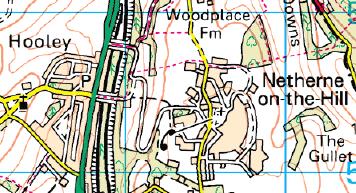
2003
use: "Luxury housing"
St Lukes Church
(see Moyna Peters' story) has been "redesigned internally" as a
leisure club with a swimming pool and gym exclusive to Netherne Village
residents.
2007 Netherne Community website
history page
January 2009 Moyna Peters told some of her story on Radio Four's
State of
Mind
See Peter Higginbotham's site
1903: Tooting Bec Asylum / descriptive notes by A. and C. Harston.
London : Avenue Press. 23 pages : illustrations. Held at Wellcome Library
1919 Post Office Directory: Tooting
Bec Asylum (Metropolitan Asylums Board), Tooting Bec Road, Upper
Tooting, SW17. Edwyn H
Beresford LRCP medical superintendent
It became Tooting Bec Mental
Hospital in 1924 and, in 1930, passed to the London County Council. In 1937 it became
Tooting
Bec Hospital. Address: Tooting
Bec Road, London, SW17 8BL
1974
An inquiry into the circumstances leading to the death of Mr. Daniel
Carey, at Tooting Bec Hospital on 2nd August, 1974 : report of the
Committee of Inquiry. South West Thames Regional Health Authority.
A copy at Birmingham University
1976
What the house physician prescribes for some common emergency
psychiatric admissions : based on the practice at Tooting Bec Hospital,
London by Regina Pustan, Published [London] ([2A St Paul's Rd, N.1]) :
[The author] 1976. 8 pages. illustrated.
Subject: Psychopharmacology. Crisis intervention (Psychiatry).
Copy: British Library
1995 The History of Tooting Bec Hospital
by Sue Simmons. 2 volumes. Includes photographs. Unpublished. Copy in the
London Metropolitan
Archives: City of London. Reference: H45/TBH/Y/01/002
Closed May 1995 demolished 1996/1997
Wednesday 2.12.2015
A Short History of Tooting Bec Asylum
by
Liz Sayce, who
says (email) "I explore this more in
From Psychiatric Patient to Citizen Revisited -
but this web link gives you a lot of the material".
1919 Post Office Directory: also
lists a private asylum:
Newlands House Mental Hospital. Tooting Bec Road SW17. J. Noel Sergent, MB,
BS London, proprietor and resident physician.
Architect: Thomas W Aldwinckle
1911: "the hospital was redesignated as a mental hospital and
became
used for the accommodation of the lowest grade of severely subnormal
children.
(Peter Higginbotham)
1919 Post Office Directory:
Metropolitan Asylums Board Fountain Asylum, Tooting Grove, Tooting SW17
Thomas Brushfield MA, MB, MRCS medical superintendent; Cedric Davis,
steward; Miss Flora Harris, matron.
In 1930, administration of the hospital passed to the London
County Council who retained it as a hospital for mentally defective
children.
The Royal College of Surgeons (England) has archived Case notes on c.
4000 children - photos, treatment, school work, clinical histories, post-
mortems, etc; photo album of staff, hospital, entertainments etc
from 1914-1927 (Hospital Database)).
In 1959 as a consequence of the Mental Health Act the children from the
Fountain Hospital were transferred to Queen Mary's Children's Hospital,
Carshalton.
(external link)
Closed 1963
The Fountain was demolished in the 1960s and the site is now
occupied by the St George's Hospital"
(Peter Higginbotham)
1894/1895 Purchase of site for Croydon Borough Asylum approved
by the Home Office. (MH 83 County of Surrey)
1897/1903 "Croydon Borough Asylum, Warlingham: architects
appointed for planning construction; plans approved by the Home Secretary."
(MH 83 County of Surrey)
16.3.1899 Thomas Percy Rees born in Carmarthenshire. When he became
a psychiatrist, he was generally known as T.P. Rees
Built at a cost of about £200,000 (Kelly's 1913)
26.6.1903 - Croydon Mental Hospital opened in
Chelsham
and
Farleigh, about a mile north east of the centre of Warlingham. The name
"Mental Hospital" was used from the begining, at the suggestion of Dr
Edwin S. Pasmore, who was appointed as the first medical superintendent
before it opened.
Croydon Mental Hospital: House Committee minutes 1904-1937 held
by Croydon Archive Service.
1910 "Three new blocks, consisting of five wards, were added at
a
cost of £33,000". (Kelly's)
Wednesday 5.4.1911 "Dr Pasmore, Medical Superintendent of the
Croydon Mental Hospital... said that it was now recognised that a mental
nurse should have medical and surgical training, and at Croydon one ward
was fitted up as a hospital ward." (British Journal of Nursing
15.4.2007)
1913 Kelly's Directory: Crodon Borough Mental Hospital -
Chelsham, Whyteleaf. Medical Superintendent, Edwin S. Pasmore MD London -
Assistant Medical Officers: William M. Ogilvie MB CM - Herbert M.
Barncastle MRCS LRCP - William Bertram Hill, MD BC - Clerk and Steward
Walter Brookfield Swain [All the other public ones in Surrey were listed as
Lunatic Asylum (or some variation) - This was the only "Mental Hospital"] A
structure of red brick ... available for about 650 patients".
The East Surrey Bus Routes called it Chelsham
Mental
Hospital from 1923 to 16.4.1930 when it became Croydon Mental
Hospital. On 1.1.1937 they changed it to Warlingham Park
Hospital. ("You'll end up in Warlingham" - Croydon children's
abuse in 1950s/1960s).
May 1925: The Branch Secretary of the Nation Asylum Workers
Union at Warlingham was "Mr E.F.Carter, County Mental Hospital,
Warlingham, Surrey"
1.1.1927: Croydon County Borough Mental Hospital
656 patients of whom all but 114 were Rate Aided. 206 were men, 450 women.
There was a very high proportion of women to men in comparison with most
asylums. In 1926 the proportion of recoveries to admissions was 67.6% (The
highest in England and Wales). The proportion of deaths to the asylum
population was 6.7%
January 1927 The Croydon Advertiser and Surrey
County Reporter published an obituary of Edwin S. Pasmore.
March quarter 1927 Death of Edwin S Pasmore, aged 62, recorded
Godstone (which includes the hospital)
1927
T.P. Rees moved from
Napsbury to be deputy
physician superintendent.
1935 T.P. Rees became superintendent. His "first act"
was to open the iron gates at the hospital entrance, after which they were
not shut again. Over the next few years, all ward doors were unlocked
during the day, while nearly all restraint and isolation of patients were
abolished. (DNB)
Warlingham Park Hospital Committee minutes 1937-1948 are
held by Croydon Archive Service.
9.6.1949 Thomas Percy Rees, MD, MRCP,
Medical Superintendent, Warlingham Park
Mental Hospital, awarded an OBE in the King's birthday honours.
World Health Organisation report on
The Community Mental Hospital -
T.P. Rees was one of the authors.
1954:
Introduced out-patient nurses.
4.2.1954 Thomas Percy Rees, MD, MRCP, OBE, a member of the
Royal Commission to inquire into the certification and detention of mental
patients
1956
Christopher Mayhew, MP spent a few days in
one of the wards in preparation for the television series The Hurt
Mind. "As I went in I felt a certain apprehension, but after a few
hours...
I felt completely at home". There was a "porter's lodge" where he booked
in. His legal status is not stated, but he presumably signed in as a
voluntary patient. His bed was in a ward "for light cases -
alcoholics and neurotics". This part appears civilised. In the morning he
sits in the living room of his ward and reads morning papers with other
patients. Later he has dinner with others in the dining room. He also
visited the sitting room of the "best women's ward", where one woman
arranged flowers, another played the piano and three others watched
television. Elsewhere in the hospital he visited a "dormitary crammed with
beds". This is the worst ward he has seen - dealing with the "hard core of
chronic patients".
Deputy Chief Male Nurse, Mr Relph (John Ralph, died 1972?), was
interviewed. He said that the
old hospital was like a prison and described how staff often had
to "retaliate" when patients became violent and often "hit back in self
defence". Drugs,
ECT,
insulin and "open doors" had put an end to all of
that. The Chief Superintendant (T.P. Rees) was interviewed. He described
the hospital's main successes as the removal of the rails around the
hospital and handing over of responsibility to patients.
During 1956. T.P. Rees left Croydon and started a private practice in
Harley Street. He was made a freeman of the borough.
Stephen MacKeith may have succeeded Rees at Croydon.
January 1957 Warlingham Park featured in "Put Away", the first
programme of
The Hurt Mind, the first BBC television documentary about
mental health.
22.12.1962 The Lancet "The Future of district psychiatry"
by A.R. May, A.P. Sheldon and S.A., Mackeith
2.6.1963 Death of
T.P. Rees
December 1965 Community Mental Health Journal "Change in
a British Psychiatric Service" by Alan Sheldon, formerly Registrar,
Warlingham Park Hospital. "Changes in the Croydon Psychiatric Service
consequent upon the adoption of a community mental health orientation are
described, and the effects of the initial phase of implementation are noted
in terms of data collected for a year preceding and following this phase.
The major effects are seen in reduction of readmission rates to the mental
hospital, and in a redistribution of patients among the wider range of
facilities"
March 1983 Letter in Psychiatric Bulletin from Stephen
Pasmore, Ham Gate Avenue, Richmond, Surrey, about his father,
Edwin S. Pasmore.
1995 the management of
Croydon mental health services, including Warlingham Park Hospital, was
taken over by the
Bethlem and Maudsley NHS Trust.
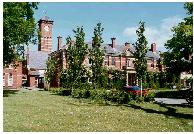
The Clock Tower,
described as hideous in 1908, is now a
Grade
two listed
building. The hospital was closed in February 1999, and demolished in
summer 2000, but the clock tower and many trees have been preserved. The
site is being redeveloped for housing. Postcode CR3 9YR
2003
use: "Water tower preserved as symbol of development"
Holloway Sanatorium
Virginia Water, Surrey
Opened as a private asylum in 1884
Closed
December 1980
2003
use: "Gated housing development"
Lingfield Training Colony
1894: Opened
Became St Pier's School, St Piers Lane, Lingfield, Surrey
RH7 6PW
19/23.3.2001:
pdf: Ofsted report
Latchmere Special Hospital for (Army) Officers
Latchmere, Ham Common, Richmond, Surrey.
A private house before the first world war. Taken over in
November
1915 with beds for 51 officers.
(external link and
another
). In March 1920, Mrs. M. J. Shepperd, Sister, Special Hospital
for Officers, Latchmere, Ham Common, Surrey, was awarded the Royal Red
Cross (Second Class), by the King, in recognition of her valuable services
in connection with the War
(British Journal of Nursing 27.3.1920, p.124 -
pdf-) ----
"MI5's Secret Interrogation Centre - Latchmere House - 'Camp 020' - at Ham
Common, Richmond",
After the Battle --- Latchmere House:
"The Prison Service took over the site from the military in 1948. As a
Prison Service establishment it has had several roles as a young offender
institution, remand centre, and a deportees prison. It became a
resettlement prison in 1992".
HMP Latchmere House, Church Road, Ham Common, Richmond, Surrey,
TW10 5HH Operational Capacity: 198
37 Mayola Road, Hackney
Established by mental patients for mental patients
Opened July 1973, closed August 1976
One of the residential houses set up by members of the Mental Patients' Union
Established 1849 for young inmates of
Royal Earlswood
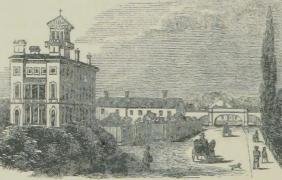
29.3.1843 Colchester railway station opened. This was the then
eastern terminus of the Eastern Counties Railway from London. The large
building is Essex Hall, intended to be the railway hotel. Instead it became
an asylum.
By 1858 all patients transferred to Earlswood.
1859: Eastern Counties Asylum
1.2.1868: Feature in The Builder about an infirmary
refers to Essex Hall Asylum for Idiots (See
Rossbret archive)
1894 Crossley House seaside home, at Clacton, acquired with
financial help from Sir Savile Crossley, of Somerleyton (Suffolk)
Royal Eastern Counties Institution for Mental Defectives
1918 Lexden House leased as a (residential) school for high
grade females. Lexden is about one mile west of central Colchester. This
addition brought the Institution's total beds to 630.
[See 1979]
1922 Greenwood school, Halstead, opened for 86 girls. Lexden
House become a hostel.
1923 Bridge Home, Witham, bought. Providing another 233 beds.
1935 Turner village, Turner Road, Mile End (village), outside
Colchester, opened with eight villas for male patients. Essex Hall and the
Peckover schools became female patients only. In its different centres, the
Institution now had 1,850 beds, including a boys' school at
Littleton House
(Cambridgeshire.) and a young women's home at Great West Hatch, Chigwell,
Essex. "By the time Essex Hall's "annex", Turner Village, was opened by the
then Duke of Kent in 1935, the institution had nearly 2,000 beds in centres
across north Essex". - See
Colchester Heritage Explorer
(archive)
1947 Handford House, Ipswich, acquired for 22 female patients,
and
Kingsmead
at
Lexden
for a girls' hostel. Kingsmead is on Straight Road, whick links Lexden and
Shrub End.
c.1948 - 1972 Royal Eastern Counties Hospital
1948
Cherry
Allfree,
Valerie
Argent and
Hilda Turner
born in Uxbridge (Middlesex), Bexleyheath (Kent), and Ipswich (Suffolk)
respectively.
Between about 1950 and the early 1980s Barker House, Clacton-on-Sea, was
used as a holiday home
1962 (Hospital Plan) Royal Eastern Counties Group, with
1,681 beds served North East Essex. Increase to 1,781 beds expected by 1971
due to "two additional villas for 100 patients at
Turner Village"
1962 In her
journal,
Valerie Argent (aged 14)
calls
this Essex Hall (the term she always used), whereas her psychiatrist writes
"Royal Eastern Counties Hospital, Essex Hall, Colchester"
17.4.1966
Hilda Turner admitted to Essex Hall. (aged 17). Her IQ has been
estimated at between 60-70
About 1966
Cherry Allfree (aged 17/18) admitted to
Kingsmead. Speaking of
her foster carer, Cherry said "She got in touch
with a social worker - who got in touch with a psychiatrist - a lady
psychiatrist - who, in fact was jointly in control of the Royal Eastern
Hospital Counties Group - and the psychiatrist gave me an intelligence
test. Although the test was good they still sent me to Kingsmead... A
'hostel' ... it was part of the 'bin' ... it was just like a 'mini-bin' ...
People were drugged up... I was there for two years ... the social worker
took me to
Lexden House
(Cherry
Allfree)
1967/1968 Cherry Allfree admitted to
Lexden House.
"I
was
already 19.. it was more like a bin than
Kingsmead... I was there
for twelve months... and from there went to
Essex Hall". She was moved there after running away from Lexden
House more than once.
(Cherry
Allfree)
2.3.1969 Cherry Allfree twenty one.
About this time admitted to Essex Hall from Lexden House. Speaks
of people being forcibly injected because they were 'high' and needed to be
kept under control. "injected with
paraldehyde and
Largactil
to keep them quiet. Saw people undressed and left with no clothes on
(sometimes all day) and hit with shoes. Patients sometimes tied to beds.
... punished by having to scrub the floors. - [From
Essex Hall] "We used to go to Turner Village to see some films.
They'd walk you there in twos - There would be a long file of us walking up
the street - 'There goes the people from Essex Hall' - the boy weren't
allowed to sit with the girls - because they thought you'd want to kiss and
cuddle".
(Cherry Allfree)
1972: Essex Hall - [Scandal mentioned]
2.3.1975
Cherry Allfree twenty seven.
About this time moved from
Lexden House to
Kingsmead. "They were
shifting people about. I don't know why. I got myself a job in an hotel
doing room-maid service )generally cleaning rooms) and also got a job in
the kitchen as well. I was able to get a room in the hotel that they
offered me. And I left Kingsmead. [After two years and
aged 28]
20.1.1977 Hilda Turner discharged. Responsibility for her
welfare passed from the National Health Service to the relevant local
authority
1979:
338 beds (Mental Handicap)
1986 (or 1985): Essex Hall closed and demolished. Its 12 acre
site sold in 1988. "Many patients had by then been moved out into the
community, some to group homes, and only 640 patients remained at Turner
village".
1990 Lexden House closed
1.12.2007 Sixty Years of Services for People with Learning
Difficulties: A Life in the Care of the State by Hilda Turner.
offline
-
archive link
Turner Village Hospital, Turner Road, Colchester, 476 beds
Lexden House, Lexden, Colchester, 78 beds
Brunswick House, Mistley, Manningtree, 43 beds
Severalls
Hospital
had 38 beds for mental handicap
"If the doctors thought you needed treatment... you'd be carted off to
Severalls to have electric shock treatment... Or if it was something worse
-- you'd be sent to
Rampton".
(Cherry Allfree)
Ramsey Lodge, Oakley Road, Dovercourt, Harwich, 37 beds
Hillsea, 10 East Hill, Colchester, 30 beds
Handford House, Queens Road, Colchester, 20 beds
Kingsmead, Straight Road, Colchester, 10 beds
Crossley House
Crossley House, Marine Parade, Clacton-on-Sea, 33 beds
"holiday?... the people who weren't allowed out... or weren't able to
visit their parents went to this house in Clacton... It was run by the
staff". "where everybody gets cross".
(Cherry Allfree)
Barker House,
Coppings Road, Clacton on Sea, 43 beds
Established 1932
Became South Ockendon Hospital, South Road, South Ockendon, RM15
6SB
1979:
724 beds (Mental Handicap)
Closed 1994
Hospital Database
says: See (i) Randal Bingley, 'South Ockendon:
Echoes from an Essex Hospital' (typeset, 1993); a copy is available at the
Essex Record Office, Chelmsford. (ii) Richard Harris, ' Preserving and
using archives', in Dorothy Atkinson, Mark Jackson and Jan Walmsley (eds)
Forgotten Lives: Exploring the history of learning disability (BILD
Publications 1997
2003
use: "Shops, supermarket"
Brentwood
London Road Brentwood CM14 4QP (Telephone was 01277 219262)
Previously:
An Industrial School for Shoreditch and Hackney
(possibly opened by Shoreditch in 1854) - Hackney Branch Institution
Brentwood Epileptic Colony (1916-1936?). For women.
Established by the
Metropolitan
Asylums Board
Taken over by London County Council in 1935. Probably renamed
St Faith's Hospital at this point. See Ewell Epileptic Colony
1962 (Hospital Plan): 332 beds in 1960, 303 of them for
epilepsy, plus 15 acute and 14 geriatric. "At present takes only female
patients" but "will be developed into the regional epileptic centre, thus
allowing St David's Hospital, Edmonton to be closed". Development to be
completed by 1971.
1979:
293 beds. "Chronic Sick (Geriatric and Epileptics)"
Demolished towards the end of the 20th century and replaced by "BT
Workstyle 2000" building.
Silver Street London N18
Previously:
"From 1849 to 1915, this site was the Strand Union's workhouse school.
It was then bought and converted by the Metropolitan Asylums Board and
operated as St David's Hospital for "sane epileptics" until 1971. (email
from Peter Higginbotham -
external link to his site)
Edmonton Epileptic Colony (1916-1936). For men. Metropolitan
Asylums Board
Taken over by London County Council in 1935. Probably renamed
St David's Hospital at this point. See Ewell Epileptic Colony
Hospital Database says it closed in 1947 - But it
was part of a survey in 1962
1962 (Hospital Plan): 271 beds in 1960, all for epilepsy.
St David's was a regional centre for epilepsy. It was planned to close by
1971 (see St Faith's above) and the site was to be used for a new, 400 bed,
hospital for mentally handicapped patients. Building the new hospital was
expected to start sometime between 1966-1967 and 1970-1971. [But,
by then, public
policy had changed]
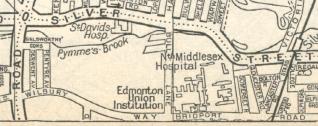
St David's, along with the Edmonton Union Institution and North Middlesex
Hospital, shown on a map printed about 1950
Kingston Road Teddington [TW11 9JH]
Founded 1868
1881 Census:
John L.H. Down
physician head of
Normansfield Idiot Asylum, Kingston Road, Middlesex.
Owned by the Langdown Down family until purchased by the National
Health Service in 1951. Its archives are the only ones for a private
asylum held in the London Metropolitan Archives. (email from Bridget
Howlett, Senior Archivist)
A voluntary institution until 1948, then part of the National Health
Service.
1948? Normansfield Hospital
1997 Closed
History website
Miriam Bruinsma's photographic gallery of Normansfield
2003
use: "Luxury housing"
1937:
Darenth Park
Hospital, Dartford, DA2 6LZ.
1949 Complaints about patients being conveyed to and from
outside work in open lorries during the severe winter.
8.3.1951
Norman Dodds
questions in parliament about use of open lorries in December
1950
8.3.1951 Minister of Health "The number of patients now resident
at Darenth Park Mental Deficiency Institution is 1,791 (1,084 male and 707
female patients). The nursing staff establishment provides for 148 male and
154 female nurses. At present, the male staff is 110 and the female staff
56 full-time and 66 part-time"
1980 Hackney
patients
November 1982
The only large mental handicap hospital planned to
close
"The closure of Darenth was driven by the
determination of learning disability managers locally to run an entirely
different service and the South East Thames Regional Manager responsible
plus the Chief Nurse called Audrey Emerton (now Baroness Emerton). It was
very visionary at the time. Clinicians were marginal in that case." (Elaine
Murphy email 17.5.2012)
Closed 1988
Guildford Rd Chertsey Surrey KT16 0QA
1765 Mansion
external link archive of a
history
Records include at Surrey History Centre include:
minutes of visitors 1914 - 1960
1929 Mansion bought by Surrey County Council
Management Committee Reports 1949 - 1950
Botleys Plc and Murray
House 1932 - 1933
Deeds re Porook House Hostel 1913 - 1949
Plans and contracts re construction 1930 - 1962
Chertsey Workhouse Records
Closed late 1997?
2003
use: "Business"
In 1930, the workhouse was taken over by Surrey County Council and
later became Murray House
Certified Institution
for the Mentally Defective
1847: Park House, Highgate
1849 See
Royal Eastern Counties
1855?: Earlswood Asylum for Idiots and Imbeciles
Brighton Road, Redhill, RH1 6JL
1858: John Langdown Down (external link -
archive)
medical
superintendent.
1868 See
Normansfield
By 1929: Royal Earlswood Institution (to 1959)
1995: Closed
2001:
Mental Disability in Victorian England: The Earlswood Asylum 1847-
1901 by David Wright.
External link to review
2003
use: "Luxury housing"
Pictures on the Old Redhill and Reigate
website -
archive - pictures not preserved, but may be recoverable
from Francis Frith Collection
"At an early date after the passing of the
Inebriates Act of 1898, the London County Council established a
reformatory at Farmfield, near Horley, for the reception of 100 female
inebriates. It soon became evident that more accommodation would be
necessary, and the Council accordingly contracted with the National
Institution for Inebriates for the reception of all female cases they were
unable to receive at Farmfield"
(Hansard 17.2.1908)
November 1915: "London County Council closed its reformatory at
Farmfield and transferred the 45 female inmates to Brentry before it
converted Farmfield to being a mental deficiency colony".
(source)
1926 London County Council institution for high grade defectives
with delinquent tendencies
1948 Part of the National Health Service. Organised by the South
West Metropolitan Regional Hospital Board to form part of the Royal
Earlswood Group.
November 1953 just over 250 patients when
Peter Whitehead transferred from
Rampton.
2.4.1954 Peter Whitehead working in a hotel in a Surrey country
town.
The terms of his licence included not being on the streets after 10pm,
not talking to a member of the opposite sex, not walking with a member of
the opposite sex and not frequenting dance-halls, public houses or similar
places. "These rules... are the inheritance of the
eugenics theories of fifty years ago"
(Roxan 1958 p.173)
7.8.1954 Peter Whitehead ran away to Dublin, where he would be
beyond reach of the mental deficiency laws. Unable to find work, he went to
Liverpool and then the Potteries. A priest found him work in Wolverhampton
and then he secured a better job on a farm near Newland Bridge.
14.9.1954 Jean Mary Townsend (aged 21) murdered in Ruislip, West
Middlesex. A nationwide search for possible suspects included questioning
Peter on the farm and, as a result, he was returned to Farmfield.
30.10.1954 Peter Whitehead protested about "working of the road"
(digging holes and filling them in) and then escaped. He went to his uncle
in Hammersmith and then to the National Council for Civil Liberties.
Recaptured 26.12.1954
Returned to
Rampton
11.1.1955
Early 1955 "Working of the road" discontinued at Farmfield.
1958 120 patients
Closed end of October 1989.
See
lost hospitals of London
Farmfield [Priory Group]
is a purpose built, 52-bed, low and medium secure hospital for men with
with "enduring mental illness, personality disorder and with mild learning
disabilities". "Treatment is targeted toward safe patient re-settlement in
the community where possible".
external link
2003
use: "Housing"
External link to
Oxford Health Archives
Hook Norton (1725?) -
Witney (1823) -
Warneford (1826) -
Littlemore (1846) -
Borocourt (1933) -
Bradwell Grove
(1948) -
Oxfordshire
present
Compare with
Cambridgeshire, the other English university county
Licensed House
The asylum at Hook Norton and the one at
Witney are the subjects of a special study by
William Parry-Jones (1972 chapter six). Page
numbers below are to this.
About 1725: opened. The village of Hook Norton is near the edge
of Oxfordshire, near to
Warwickshire
1815
list: Hook Norton: Harris
1.1.1844 ??
Closed 1854
Warneford Asylum, Oxford (Headington)
Warneford Hospital history in health authority
archives
not receiving paupers in 1844
Architect: Richard
Ingleman
Opened 1826
Before it opened (from 1821 to 1826) its was referred to as
Oxford Lunatic Asylum
1826: Radcliffe Asylum (1826 - 1843
1843 Warneford Asylum
1844: Superintendent: F.T. Wintle, MD
1.1.1844: 42 private patients,
1881
Census:. Warneford Asylum, Headington, Oxford. Medical
Superintendent: John Ward, married, born Leeds about 1844.
Warneford Hospital Warneford Lane, Oxford, OX3 7JX
1909
Leaflet in book
multi-map
Park Hospital for Nervous Diseases 1939 to 1958
Park Hospital for Children 1958 to Present
Oxfordshire and Berkshire County Asylum opened on 1.8.1846 at
Littlemore,
Oxford. This became the Oxford County Pauper Lunatic Asylum.
May 1918 Ashurst War Hospital, Littlemore. - 580 beds
(source)
"for the care and treatment of soldiers and pensioners suffering from
neurasthenia or loss of mental balance"
(Hansard 12.4.1920)
August 1920 Reverted to county asylum
By 1922 it was
the Oxford County and City Mental Hospital. It became Littlemore
Hospital,
Sandford Road, Littlemore, Oxford, OX4 4XN
1990
Oxford Survivors and
Libellus Dementum
2003
use: "Gated housing development, business"
Architect:
Charles Henry Howell -
Corridor form
1881 Census: "Berks County Moulsford
Asylum, Cholsey, Berkshire". Medical Superintendent (Physician)
Robert Bryce Gilland, unmarried, aged 42, born Scotland.
Under a
contract with Surrey, 30 patients, including Edward Sackett were
admitted from Brookwood
on 12.9.1882, and sent back to Surrey on 31.3.1884. 1885-1902
imbecile patients from Westminster
Fair Mile Hospital, Reading Road, Cholsey,
Wallingford, OX10 9HH, had 613 beds on 31.12.1977.
Autumn 2002: Reported
open, or closed but empty
(map)
English Heritage: Fairmile, Oxfordshire, built 1868-1870 as the
pauper asylum for Berkshire
BBC Profile -
Wikipedia
"designed by Major General Joshua Jebb, a military engineer who is said
to have based the building off two other hospitals - Wakefield in Britain
and Turkey's Scutari Hospital"
(BBC Profile) - Joshua Jebb (8.5.1793 -
26.6.1863) was Surveyor-General of Prisons. He made the design for
Pentonville
Prison, which acted as the model for many others. (Neil Sturrock
- email 7.12.2006)
1863 to 1948 Run directly by the Home Office
Dr John Meyer (died 1870) was the first Medical Superintendent. His
deputy was
William Orange (born 1833, died 1916). Both came from the
Surrey Asylum
1865: Report (HMSO) Superintendent: John Meyer, Chaplain:
J.T. Burt
1866 While kneeling at Communion Service, one Sunday, Dr Orange
was hit on the head by a patient with a stone hidden in a handkerchief.
July 1868 W.G. Maddox MRCS appointed Assistant Medical
Officer
in place of A J Newman, who had resigned
January 1970 D M'K Cassidy, MD, late Assistant Medical Officer
to the Northern District Asylum at Inverness appointed Assistant Medical
Officer
October 1870 W. Orange, MD Heidelberg, MRCP apponted Resident
Medical Superintendent in place of J. Meyer MD. deceased. Meyer's obituary
on page 311 of the Journal of Mental Science. William Orange had
been Deputy Superintendent and
W.Douglas MD, LRCS Edinburgh was appointed to that post in April 1871
1870: Report (HMSO 1871) Superintendent: W. Orange, Chaplain:
J.T. Burt.
October 1871 A.R. Gray, MD, MRCS Edinburgh appointed Assistant
Medical Officer
1873-1874 Series of articles by David Nicolson on "The Morbid
Psychology of Criminals" in the Journal of Mental Science
1873 David Nicolson expressed opinion that habitual
criminals
"possess an unmistakable physique with rough and irregular outline and a
massiveness in the seats of animal expression" while the accidental
criminal "differs little or nothing from the ordinary run of mortals"
1878 After dealing with the inmates of the asylum, David Nicolson no
longer believed most criminals differed physically from non-criminals.
(Flemming, R.
2000 citing
Weiner, M.J. 1990
)
1881 Census Broadmoor Criminal
Lunatic Asylum, Sandhurst, Berkshire. Some senior officers (see below) live
outside the asylum. Inside is John Baldwin Isaac, unmarried, aged 33, born
in Ireland a "Doctor Of Medicine (Civil Service)". The names of patients
are given in full.
1881 Census: Superintendent's House (William
Orange)
Thomas Ash (Chaplain) -
David Nicolson -
Robert Hazel
1887 Report of the Superintendent (W. Orange), plans of the
asylum, 1886 (men's division, men's division - blocks 1 and 6, women's
division and block plan of the complete asylum), report of the Chaplain
(Thomas Ashe), statistical tables, report of the Commissioners in Lunacy
and post-mortem records
1888 Report of the Superintendent - David Nicolson
1892 Superintendent still David Nicolson. Chaplain still Thomas
Ashe
12.12.1894 Letter from Robert Hazel (non-medical
superintendent at Broadmoor) to one of his daughters. He tells her about a
theatrical entertainment at the Asylum that was to happen the next day
(Friday 13.12.1894) Dr Lawless was
the stage manager. He goes on to say "The elections come off next week in
the School Room at Crowthorne, so it rather interferes with Mr Sharp's
concert. Other concerts are also under way." [Information from Fiona
Douglas. a descendent]
1896 "When there was a change of Directors at
Broadmoor around 1896 things became very tough in the Institution, and I
believe that is when Robert Hazle retired to Hanwell in Middlesex"
1901: Report (HMSO) Superintendent: R. Brayn, Chaplain: Hugh
Wood. Visiting Lunacy Commissioners: F. Needham and
C.S. Bagot
1917 David Nicolson "William Orange, CB, MD, FRCP,
formerly Medical Superintendent, Broadmoor Criminal Lunatic Asylum"
Obituary, British Medical Journal 1917, volume 1 pp 67-69
1903: article by George
Griffith
4.11.1919: Beth
Wood admitted. Dr Sullivan was Superintendent at this time. Beth
was conditionally discharged to the care of
her husband on 4.12.1921
1920
Rampton
10.9.1924
The Nation "W. C. Sullivan, Medical
Superintendent of the Broadmoor Criminal Lunatic Asylum in England, in his
recent book, Crime and Insanity"
26.2.1926 Death of William Charles Sullivan (1869-1926) sometime
superintendent at Broadmoor.
1939 Charles Kaye born
September 1944 First issue of
The Broadmoor Chronicle
1948
Criminal Justice Act section 62(3)
moved Broadmoor from the Home Office
to the Board of
Control. The name was changed to Broadmoor Special
Institution. All "criminal lunatic asylums" (1860 Act) became
"Broadmoor Institutions". The Board of Control could make "rules for the
care and treatment of patients detained in Broadmoor institutions", which
were laid before Parliament.
29.4.1952 John Straffen escaped from Broadmoor for four hours. Police
found the body of five-year-old Linda Bowyer the following morning.
17.6.1952 Scott Henderson (chair) Report of the Broadmoor
Inquiry Committee into security, appointed 12.5.1952, stated the rules
of staff conduct were last printed in 1908 and are out of print. It
recommended they should be brought up to date and that "every member of the
staff should have a copy of the Security Rules"
Broadmoor Institutions - Instructions for Guidance of Nursing and
Other Staff
[2014 government website classifies 1949 to 1989 as a period
when
Broadmoor reported directly to the Department of Health]
1957: See Percy
Report
1959 Mental Health Act
sections 97-98: Broadmoor,
Rampton
and
Moss Side
became Special Hospitals under the Ministry of Health.
Jimmy Savile called himself the "voluntary assistant
entertainments
officer" for Broadmoor. His involvement
as a volunteer probably began in the late 1960s or early 1970s. At
some
time he was given an office in the grounds of the hospital, a bedroom,
which he called his "cell", above it, and his own personal set of keys to
the hospital wards.
Esther Addley, Guardian
12.10.2012
1970 First Special Hospitals Research Report:
"Personality Types among Abnomal Homicides" by R. Blackburn. Principle
Psychologist, Rampton.
1971 Special Hospitals Research Reports 2,3, and 4
1972 Special Hospitals Research Report 5
1973 Special Hospitals Research Reports 6 to 9
2.3.1973 National Association of Mental Health Conference at
which Nathan Morris, secretary of "The Public Action Committee for
Broadmoor" was unable to put a question to Keith Joseph.
1974 Special Hospitals Research Reports 10 to 12
7.5.1974 Fire started in the day room of Ward 2 of Kent House.
Reported The Chronicle May 1974. At this time the editor was Barry
Stone and illustrations by Pete F.
June/July Chronicle. "Woman's View - 1" by Tweedy.
July 1974 Voice of Broadmoor number 3 from "The Defence
and
Aid Committee for Prisoners in Broadmoor" Number 4 date August 1974
1.8.1974 "Women's Lib is on the March at Broadmoor" Wokingham
Times
August 1974 Chronicle. "Woman's View - 2" by Tweedy. With male
responses to earlier article. "Womens Lib" cover by Pete F. of Dorset House
September 1974 Chronicle. "Woman's View - 3" by Tweedy. About male
responses to earlier article
October 1974 Chronicle. "Woman's View - 4" by Tweedy (last).
Letters defending responses of Pete F. of Dorset House.
20.7.1976
Janet
Cresswell
admitted to York 2 at Broadmoor
following conviction at the central Criminal Court on
24.6.1976 of wounding
with intent to do grievous bodily harm [To
Dr Desmond
McNeill].
1987
Orville Blackwood
sent to Broadmoor
In August 1988 shortly before the publication of a highly
critical report into its operating procedures, the entire management board
of Broadmoor secure psychiatric hospital was suspended by the Department of
Health, which at the time had joint responsibility for its direct
management.
(Guardian)
1988 to 1997 Alan Franey chief executive of Broadmoor.
1989 Special Hospitals Service Authority took over management.
Charles Kaye appointed the Chief Executive.
[2014 government website classifies 1989 to 1996 as a period
when
Broadmoor reported to the Special Hospitals Service Authority]
1992 The London Programme on LWT (London Weekend Television)
broadcast a 60 minute documentary "Inside Broadmoor", which is still
available as a video-recording from Figaro Films. "Patients, nurses and
medical visitors give their opinions about life inside Broadmoor maximum
security hospital. Modernised parts of the hospital are compared with those
parts that are still so inadequate that it is astonishing that any sort of
orderly regime can be preserved in surroundings so productive of stress.
The General Manager, Alan Franey, states his commitment to recovery,
rehabilitation and release rather than mere custodial care. There are some
very interesting interviews with patients, showing their different states
of awareness and responsibility, and a glimpse of a lively Broadmoor
variety show".
1993 to 1999 Kate Diesfeld Consultant to the Broadmoor
Patients' Council. England. Invited to conduct legal research and advocacy
for restricted special patients detained in psychiatric institution.
Attended annual general meeting of the Council 1993, 1994, and 1995.
Diesfeld, K. "Obtaining discharge from special hospital". Broadmoor
Patients' Council, Broadmoor Hospital, Crowthorne, England. October 1994
1994 Broadmoor Patients' Council: The first six months by
by Peter Lindley and Jennie Williams. University of Kent at Canterbury.
Tizard Centre.
The Chronicle - Broadmoor Community Magazine February/March 1994
"Talking about Race". Includes interview with Chandra Ghosh. consultant
psychiatrist for Dorchester and Windsor wards and Chris Hjarne (Personnel)
about their research.
1996 Purchaser-provider split was introduced into the Special
Hospitals. The SHSA was disbanded; in its place appeared three Special
Hospital Authorities and their purchaser, the
High Security Psychiatric
Services Commissioning Board (HSPSCB)
[2014 government website classifies 1996 to 2001 as a period
when
Broadmoor reported to the Broadmoor Hospital Authority]
23.2.1997 The Sunday Mail "Who's Running the Asylum".
Editorial concerns at Broadmoor about "the increasing power being given to
the ludicrously conceived Patients Council in the hospital".
(The Advocate. Summer 1997)
1998 Managing High Security Psychiatric Care Edited by
Charles Kaye and Alan Franey. Number 9 in the Forensic Focus series
published by Jessica Kingsley.
1999 See
The Special Hospitals: a Short History in
Ashworth Special Hospital Report
[2014 government website classifies 2001 onwards as a period when
Broadmoor has been part of the West London Mental Health Trust]
September 2007 Men only. Women moved to Southall, Rampton and
elsewhere
11.7.2012
Press release: The Department of Health is to invest in the
Victorian site at Broadmoor Hospital, which dates back to 1860, replacing
the old buildings with fit-for-purpose and secure facilities.
English Heritage: Broadmoor, Berkshire, built 1860-63 as the
state criminal lunatic asylum
HSH Broadmoor Hospital
The Terrace, Upper Broadmoor Road, Crowthorne, Berkshire RG45 7EG
freedom campaign prison list
Stone, Near Aylesbury (HP17 8PP)
Simon Cornwall:
Built: 1850-1853. Architect: TH Wyatt and David Brandon
Corridor form -
Close to Conolly's ideal
"Dr John Millar, Superintendant of the County Asylum close to Stone
Vicarage" was a photographic pioneer and friend of Joseph Bancroft Reade
(1801-1870)
(external link). Appears to have been
superintendent in 1855. A John Milar was proprietor at
Bethnal
Green by 1859. A John Millar wrote
a book about insanity in 1861
1853 to (about) 1930 registers of admissions and discharges in
Buckinghamshire Records, County Hall.
1919 Buckinghamshire Mental Hospital
1948 St John's Hospital
Associated Hospitals:
Manor House Hospital - Joint Management Committee
from 1954
550 beds in
1979
Buckinghamshire County Pauper Lunatic Asylum - St. John's
by John Lewis Crammer. Publisher: London: Gaskell, 1990 195 pages:
illustrated and indexed ISBN/ISSN: 0902241346
closed
Simon Cornwall:
Demolished. Site developed for housing. Only Chapel and some staff houses
remain.
A converted Victorian Mansion at Rotherfield Peppard, near Henley on
Thames, Oxfordshire.
(multi-map)
5.5.1933: first residents
Became Borocourt Hospital, Wyfold, Reading, RG4 9GD
Renamed Wyfold Court, it is being converted into
flats.
Maureen's story
2003
use: "Luxury housing"
Built as Transit camp for US troops in
World War two. Later used for casualty reception. Briefly used
as a Royal Marine School of Music.
Converted to a mental deficiency hospital about
1948
External link
includes history
Closed 1986
2003
use: "Zoo"
www.EasyWords.co.uk: the web-site for the
Oxfordshire Learning Disability Partnership Board
Blerton Road, Aylesbury, Buckinghamshire.
216 beds in
1979
Chalfont Colony opened
1894
The National Society for the Employment of Epileptics,
Chalfont
St Peter, Buckinghamshire
Doctors from the
National Hospital for the Paralysed and Epileptic
, in London, were amongst the people who established the colony.
It was run from London and visited regularly by doctors from the hospital.
(an external
link)
1905 Royal Naval Hospital, Chatham, opened
Barming Heath, near Maidstone
The term "barmy" (crazy) dates back to the 16th century, and was not
derived from this asylum.
Need for a county asylum first raised by the County Justices in
1825 (Administrative History)
7.7.1825 "a return made by order of the county magistrates
showed that there were 160 pauper lunatics and 50 dangerous idiots in Kent"
(Nick Hervey)
18.11.1828 Order made for its establishment. Committee of
Visitors established to oversee: "after difficulty had arisen over the
placement of a criminal lunatic from St. Augustine's prison". 37 acres site
bought from the parish of Maidstone, "situated at 200-300 feet above the
Medway on Barming Heath. The site overlooked a valley covered in hop
plantations and was faced by timbered and park-like hills".
(Nick Hervey)
Simon Cornwall:
Built: 1830-1833. Architect: John Whichcord Senior.
Corridor form "The first building consisted
of a central house of four stories, with two wings, or tiers of wards of
three floors, on each side. This front faced south, and at each end there
was a wing extending backwards at a right angle. There was an artificial
warming and ventilation system heated by a steam engine. The latter also
raised the asylum's water from a well".
(Nick Hervey)
Opened
1.1.1833
according to the
1844
Report and other sources. Built for 168 patients
First superintendant George Poynder MRCS LSA, previously at
Gloucestershire County Asylum
1836 Part added to asylum
1836 Richard Adams criminal
lunatic, recorded "Lunatic Asylum, Kent".
(HO 20/13)
August? 1836 Publication by Charles Dickens of the fictional
A Madman's Manuscript
1837 Part added to asylum
1838 William Deane, criminal
lunatic, recorded "Lunatic Asylum, Barming Heath, Kent".
(HO 20/13)
[Many other criminal lunatics listed for West Malling and the Lunatic
Asylum, Maidstone]
1842 Part added to asylum
1.1.1844: 249 patients. All pauper. 1844?
11.6% of
patients
epileptic
1845 Part added to asylum: Now room for 443 patients.
1846 George Poynder retired and was succeeded by
James Edmund Huxley MD MRCS LSA. (aged 25), also previously at
Gloucestershire County Asylum.
(Nick Hervey)
1847 Part added to asylum
1850 Additional buildings added the Chronic/Additional Building)
Annual medical report of the Kent County Lunatic Asylum, for the
year ending July 4th, 1853. Presented to the Committee of Visitors,
10.9.1853 and to the Court of General Sessions, 18.10.1853.
24 pages and folded leaf of plates. Consists of statistical tables,
remarks on the tables and report of the superintendent, James E. Huxley
(Wellcome Library catalogue)
1857: Wet beds and the
threat to the British Constitution
Sixteenth annual medical report : for the year 1861-1862
("Thirtieth year") Consists of statistical tables, the 15th and 16th annual
reports of the superintendent (James E. Huxley), including the report of
the Commissioners in Lunacy (W.G. Campbell, S. Gaskell). Last with James
Huxley as superintendent.
About 1862-1869 William P. Kirkman Superintendent
1867-1872 (Third Asylum/New Building).
Accomodation problems eased by the opening of
Chartham Asylum
1881 Census: Kent County Lunatic
Asylum Barming Heath, Maidstone. Francis Pritchard Davies (married, aged
38) Superintendent.
1885-1902
imbecile patients from Westminster
Asylum no longer there. Part of site occupied by new Maidstone
Hospital.
Oakwood Hospital, Maidstone (formerly Kent County Lunatic
Asylum,
Barming Heath), East Barming, Kent and Maidstone, Kent. 1829-1986 records
in Centre for Kentish Studies, County Hall, Maidstone.
Simon Cornwall:
Closed. To be converted to housing.
Licensed House
Established about 1770 by
William
Perfect
(1737-1809)
Lent 1830 Sarah Blunt
criminal
lunatic, recorded "Lunatic Asylum, West Malling, Kent". "felony"
(HO 20/13)
1.1.1844: 47 patients. 13 pauper and 34 private.
SEVERELY CENSURED IN 1844
REPORT
"Lunatic Asylum" shown near the remains of St Leonard's Chapel at St
Leonard's Street, on 1870 map.
From 1875 to 1948 there was a Malling Place Private Mental Nursing
Home, St Leonards Street, West Malling. Archives in Centre for Kentish
Studies, Maidstone.
1881
Census: St Leonard St Lunatic Asylum, West Malling, Kent.
Thomas H. Lowry, aged 63, born Maidstone, Kent, Physician. Elizabeth I.
Lowry, his wife, aged 50, born Chatham, Kent, and Mimie Lowry, there
unmarried daughter, aged 19, born West Malling
10.11.1912 William
Smart Harnett, a farmer, admitted under
certificate to Malling Place, West Malling, Kent, a licensed house owned
and managed by Dr George Henry Adam.
Hunter and McAlpine (1963) say that was "still in use"
Postcode ME19 6PD
(map to postcode)
The site of the asylum on old maps is close to the present Manor Homes
Elderly Residential Care at 96 St Leonards Street
Kent County Asylum at Chartham
East Kent Lunatic Asylum
Opened 1875.
Architect: Giles And Gough -
Corridor-pavilion
1885-1902
imbecile patients from Westminster
Kent County Mental Hospital, Chartham from 1920 to 1948.
Combined with
St Martin's Hospital Canterbury and Canterbury City
Mental Hospital in 1948. Then St Augustine's Hospital,
Chartham
Downs,
Canterbury.
"Drugs were given almost automatically to new admissions...ECT
(Electroconvulsive therapy) was sometimes used as a punitive
measure -
although it was not openly admitted. I have heard the term 'punitive ECT'
used in the hospital in reference to "that is what a patient needs". Some
psychiatrists had a certain faith in ECT and at times patients were
threatened with it" (page 14)
31.3.1976 Report of the Committee of Inquiry at St Augustine's
Hospital, Chartham, Canterbury - "Inquiry upholds complaints of grossly
bad care for mental hospital's patients" The Times, 31.3.1976.
"The consultants at St Augustine's readily admitted that they
gave priority to the patients who were acutely ill. These tend to be
younger than the chronic patients... the patients in the back wards often
have intractable illness.." (Dr Tony Smith The Times 1.4.1976)
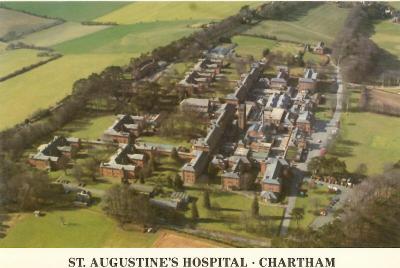
This aerial view was sent me by Brian Bradley. It is included on Chartham
Paper Mill's intranet as part of its heritage. Brian says that Canterbury
City Council have refused Wilcon Homes permission to knock down the old
hospital water tower (centre right in photo) as they consider it a
significant landmark that
could be turned into some sort of viewing tower. The photograph looks as if
it may have been a postcard.
Simon Cornwall:
Closed in 1992, demolished in 1997.
Peter
Cracknell: Admin block, villa, lodge, chapel and tower survive.
Rest of complex cleared by 1997.
St Martin's Hospital Canterbury
1994: 120 patients
website
Built in 1843 "The workhouse later became Sundridge
Institution catering for mental patients. Under the National Health
Service, it became Sundridge Hospital but this closed in the late 1990s.
The site is awaiting redevelopment".
Peter Higginbotham
July 1998 Closed
Known as Sussex County Lunatic Asylum from 1854 (when first
planned) to
1892
Architect: H. E.
Kendall Junior. See
Charlotte Mew Chronology
Corridor form -
Too large for Conolly's ideal?
1870: 800 patients, dining halls, a nurses home, farm and sports
ground
Sarah Rutherford: Built 1856-1859
National Grid Reference TQ 336 228
"The polychrome building is sited at the top of steep terraces
incorporated into the airing courts, with long views to the South Downs"
Archive at East Sussex Record Office
(Hospital database says "founded 1854")
Opened 25.7.1859 (St James Day).
Superintendent:
Dr Charles Lockhart Robertson (selected from 83
applicants). Annual salary £450
"It included
accommodation for
420 inmates plus offices, superintendent's apartments, chapel, lodge,
stable, gas house, engine and boiler room, boundary walls, gas works,
baths, showers, brewhouse and washrooms." An artesian well 217 feet deep
supplied water - and continued to do so until the hospital closed... The
first patients came from other (private?) asylums and included 82 from Bethnal Green
Asylum.
(On Call p.2)
1881
Census: Sussex County Lunatic Asylum, Haywards Heath,
Wivelsfield, Sussex. Medical Superintendent: Samuel Blutes D. Williams
(unmarried, age 41) Physician. Assistant Officer: Thomas Blair Worthington
(unmarried, age 32)
1891: Kelly's Directory: "The Sussex County Lunatic Asylum,
about one mile south-east from Haywards Heath railway station, but locally
situated in the in the parish of Wivelsfield, stands on an eminence in
grounds covering nearly 300 acres: it was opened 25 July, 1859, and is a
structure of brick, in the Lombardo-Venetian style, erected under the
superintendence of
Mr H. Kendall, jun. architect; additions were made in 1873 and
continued till 1885, bringing the entire cost ups to about £120,000;
there
is a chapel for the officials and inmates: the number of patients at the
present time (1890) is 848, and there is a staff of about 100
employees: the asylum is managed by a committee appointed by the County
Councils of East and West Sussex and the County Borough of Brighton, who
meet on the last Saturday of each month: William Henry Campion esq. is
chairman."
County Lunatic Asylum, Charles Edward Saunders MD, CM, resident medical
superintendent; Edward Brooking Cornish Walker MB, CM, junior assistant
medical officer; Richard John Fox MB, CM, junior assistant medical officer;
Rev Francis Frederick John Greenfield BA chaplain; Reginald Blaker Lewes,
clerk to the committee of visitors; Samuel Allen Mortlock, clerk to the
asylum; Mrs E. Woodhouse, housekeeper; William Thomas Buckle, head male
attendant; T. Lenton, storekeeper.
East Sussex County Lunatic Asylum 1894 to 1903
Brighton County Borough Asylum 1903 - when the new
asylum at
Hellingly
became East Sussex County Asylum
Brighton County Borough Mental Hospital 1919 to 1948
1925 picture
1.1.1927: 834 patients of whom all but 78 were Rate
Aided. 310
were men, 524 women (an unusually high proportion). In 1926 the
proportion of recoveries to admissions was 48.9%. The proportion of deaths
to the asylum population was 7.6%
St Francis Hospital 1948
1979:
St Francis Hospital had 612 beds
Princess Royal Hospital (from?), Lewes Road, Haywards Heath, RH16 4EZ
November 1995 "The life and work of St Francis Hospital 1895-1995":
Special edition of On Call, the hospital magazine.
"This magnificent yellow brick building has recently been transformed
into a luxury home development known as Southdown Park. The views from the
building are outstanding"
First floor, single bedroom flat
£157,500
Records from 1854 to 1983 of Princess Royal Hospital (formerly Sussex
County Lunatic Asylum and St Francis Hospital), Haywards Heath, East Sussex
in East
Sussex
Record Office.
There is a book: Sweet Bells Jangled Out of Tune: A History of the
Sussex Lunatic Asylum
4.1.1896 Contract for reception of 5 males and 5 females
in the Isle of Wight County
Asylum made by Visiting Committee of County of West Sussex
An asylum opened at Chichester in 1897
It became Graylingwell Hospital, College Lane, Chichester, PO19
4PQ
Graylingwell Hospital had 841 beds in
1979
Autumn 2002: Reported closed but empty
(map)
English Heritage: Graylingwell, Chichester, West Sussex, built
1895-1897 as the pauper asylum for West Sussex
Simon Cornwall:
Built: 1901-1903 Architect:
George Thomas Hine
Compact Arrow
Became East Sussex County Mental Hospital and then Hellingly
Hospital,
Hellingly, Hailsham, BN27 2ER.
6.6.1977
Andrew Voyce's view inside
Autumn 2002: reported closed and in a dangerous state of disrepair.
Simon Cornwall:
Closed in 1994. Standing derelict.
Targetted by arsonists? June 2002 -
It became Roffey Park Hospital, Horsham, Sussex and had 109 beds in
1979
Closed 1981
Licensed House
1.1.1844 ? patients. pauper and 17 private.
1834 Received
circular about cheap method of constructing an asylum
Michaelemas Session 1837: Q/SBb 529/47
Draft court order for [Thomas] Hopper [County Surveyor] to investigate
practicality and cost of providing lunatic asylum at Springfield.
1846 Great Dunmow, St. Mary the Virgin, Parish Overseer's
records: Circulars opposing erection of County lunatic asylum.
1849
County Lunatic Asylum: Treasurer's Account (Q/ALc 9). One volume
1849-1861
Diaries of Charles Gray Round of Birch Hall
(D/DR F68) 27.6.1849 - 3.7.1854, include consecration of St. Peter, Birch,
gift of C.G.Round, 25.10.1850; visit to Great Exhibition in Hyde Park,
London, 16.5.1851; laying of foundation stone of County Lunatic Asylum at
Brentwood, 2.10.1851, and appointment as chairman of Visitors,
16.1.1854.
Essex County Lunatic Asylum opened
23.9.1853 at Brentwood.
Probably
built
for 300 patients, it had 450 patients in 1858. -
Too large for Conolly's ideal?
Architect: H. E.
Kendall [Essex County Archives Catalogue has "Kendall and Pope"
as "architects". H.E. Kendall and R.R. Pope: See
initials in brickwork
[try again]
Simon Cornwall's
website: "It consisted of two main blocks orientated north to south and
facing east, with miscellaneous buildings dotted behind these to the west.
The use of red and black bricks, the stone mullion windows, and the use of
octagonal towers gave the hospital a medieval appearance."
Corridor form
31.12.1853 307 patients
31.12.1860 666 patients
1863 Three
"distinct houses with as much as possible the plain arrangment
of a country home" were opened. They were Blocks A, B and C.
1864 Extension added
1870:model for a
South Australian asylum
1870
Chloral hydrate tried as a sedative and ammonium bromide for
epilepsy
1870 Extension added
31.12.1870 932 patients
31.12.1880 932 patients
1882 Gradual withdrawal of beer from patients' diet was
completed by 1892. The brewery was converted into a laboratory and
mortuary.
1884 Typhoid epidemic (leak of sewer gas from old rains blamed)
1889 Typhoid epidemic (leak of sewer gas from old rains blamed)
1889 Extension added
31.12.1890 1376 patients
1894 37 patients and 5 staff suffered smallpox. Thirteen of the
patients died.
1895 Large outbreak of
diphtheria. Thirty three "true" cases
identified by bacteriological methods.
Typhoid epidemic in 1900 led to two deaths
31.12.1900 2081 patients
1901 680 patients transferred to
Goodmayes. All Essex patients "boarded out" in the asylums of
other counties returned to Brentwood, occupying most of the beds vacated by
the patients who went to Goodmayes. By 1913 there were several hundred more
patients boarded out.
1901 Screens used to separate parts of the galleries (day space)
of some wards as temporary dormitories. Some were still there in 1953.
31.12.1910 1875 patients
"Pathological work, in the investigation of possible organic structural
abnormalities as a cause of insanity, increased enormously from 1910 and a
great deal of research was carried out"
(1953 Centenary booklet)
May 1913 The second Essex County Asylum at
Severalls Hospital, Colchester opened. The boarded out patients
went there.
1913-1914 Verandas added to some wards for "open-air
treatment". [Not stated that this was for
tuberculosis]
"Rationing for patients was more severe than that for the general
public and, with the overcrowding and other factors, resulted in an
enormous death rate in the latter years of the war.
1917 525 patients died, only 10 less than the number of
admissions.
Typhoid epidemic in 1917: 82 patients and 55 staff affected. 21
patients and 9 staff died.
By 1919, deaths fell to 346.
1920 180 patients returned to Napsbury and the Norfolk County
Asylum
31.12.1920 1446 patients
"Although not legally abandoned until the
Mental Treatment Act of 1930, the name 'Asylum' was dropped from
1920 onwards and the term 'Mental Hospital' used with its indication of a
more hopeful outlook in the care and treatment of the insane."
(1953 Centenary booklet)
1926
Malarial treatment of
General Paralysis of the Insane introduced
1926 "Hydrotherapy became a vogue in 1926 that lasted
until the
war"
(1953 Centenary booklet)
1930 Sulphosin used in the treatment of
General Paralysis of the Insane
31.12.1930 1814 patients
1931 A weekly outpatients clinic established at Oldchurch
Hospital, Romford. Later, a fortnightly clinic in a house at Woodford and
at Orsett Lodge Hospital.
1932 A part time social worker supplied by the Mental
After-Care Association.
1932 Tryparsamide used in the teatment of
General Paralysis of the Insane - See
Time magazine, 11.6.1923
1933 Garden Villa, a 40 bed convalescent unit for men opened.
1933 Rose Villa, a 40 "slightly larger" convalescent unit for
women opened.
1934-1937
Runwell Mental Hospital for patients from Southend and East Ham
opened. [Patients from Brentwood Mental Hospital may have moved in 1936]
1937 Woodside Villa opened. This was a convalescent unit for male
patients. A unit for women was not built because of the war.
31.12.1940 1968 patients
1941
Electro-convulsive therapy introduced.
1946 [Sir] Geoffrey
[Slingsby] Nightingale (born 1904)
Nightingale became Physician Superintendent (to
1969). He was 15th Bt. - "I
remember Sir Geoffrey Nightingale - he was nice he was. We had old Powell
before that and he was horrible."
(mechanised website)
1946
Insulin Coma therapy started on the wards
1946 A neuro surgeon appointed. Two hundred
pre-frontal leucotomies had been performed by 1953.
31.12.1946 2035 patients
1950 special insulin unit opened
31.12.1950 2002 patients
July 1951 Neurosis
Unit at St George's.
31.12.1952 1978 patients
1953 "It can now be said that all modern forms of psychotherapy
and physical treatment are available, with the exception of Electro-
narcosis" (Centenary booklet p.37)
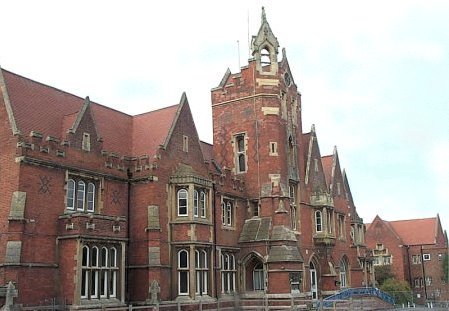
undated picture of Warley Hospital from
boredtown website - although I think it originally comes from
Simon Cornwall's site and was taken
18.10.2002.
1953
Centenary. Renamed Warley Hospital
1953 G.S Nightingale, Warley Hospital, Brentwood. The first
hundred years 1853 - 1953. Typed. Photocopy said to be available at the
Essex Record Office, Chelmsford. This may be related to "the 1953 centenary
commemorative booklet, printed by patients in the occupational therapy
department" quoted from in the
boredtown history. -
online copy on Warley Hospital website
-
April 1969 Date on
Geoffrey
Nightingale's update on the Warley history
Geoffrey Nightingale retired as (the last?) Physician Superintendent of
Warley in 1969
"From 1974 the hospital lay geographically within the Chelmsford
District of the Essex Area Health Authority, but in common with other
hospitals in Brentwood was administered by the Barking and Havering Area
Health Authority."
1979:
1,025 beds
Served people living in Brentwood, Havering and Barking and Dagenham.
1997 Year Joanna Moncrieff says the "long stay wards were
finally closed" and "most patients who could not be discharged were
transferred to a newly opened and staffed rehabilitation ward known as
Woodside Villa". "At its inception, Woodside Villa was
included
in a research project about the fate of patients discharged from the
asylums, the
TAPS project. Involvement in this project meant the unit was
staffed by a multidisciplinary team, including nurses, doctors,
occupational therapists, and psychologists. Social workers were involved on
a case by case basis". - As the first wave of patients were gradually moved
on, other, mainly younger patients were admitted, usually after prolonged
stays on the acute inpatient wards.
June 2001. Warley Hospital closed. Patients, staff and support
services moved into purpose built Mascalls Park accommodation.
2001 Joanna Moncrieff became consultant at Woodside Villa. This
was about the time that the
TAPS programme came to an end.
April 2009?
Woodside Villa due to close.
Addresses
Warley Hospital, Warley Hill, Brentwood, Essex, CM14 5HQ.
Mascalls Park; Mascalls Lane Great Warley, Brentwood, Essex, CM14 5HQ
Urbex (Simon Cornwall) map and photograph
index -
elements of Mascalls Park
Brentwood history at boredtown
Cofton Projects
(all archives, that is 14.11.2002 to 24.2.2005)
Now Clements Park, Warley, Warley, Essex, CM14 5UZ, and similar
postcodes.
Brentwood Borough Council Photo Album
Also in Brentwood: St Faith's
Hospital (epilepsy)
The second Essex County Asylum
(See first)
1903 Site bought
Opened May 1913 - planned to increase it, by stages, to 2,000
patients. The first patients were several hundred Essex people who had been
"boarded out" in the asylums of other counties.
Essex archives online:
1915-1916 Case Papers relating to James Keeble of Heybridge
Basin in Heybridge, removed from the London Lunatic Asylum at
Stone
near Dartford (co. Kent), to Severalls Asylum at Colchester on 15
July 1915
1920-1921 Case papers relating to Susan Mott a lunatic pauper
spinster confined in Severalls Asylum at Colchester
1929 Case papers relating to Constance Julia Hardy aged 43 years
a pauper lunatic and singlwoman formerly of 30 Stainforth Road, Seven Kings
[Ilford] and later of Wayside House, Stow Maries, and now in Severalls
Lunatic Asylum at Colchester
1929 Case papers relating to Henry Arthur Willett, born at
Burnham-on- Crouch 15 October 1895, and his wife Marion Blair Willett a
pauper lunatic now in Severalls Mental Hospital at Colchester
1960-1968 Used, with
Netherne and
Mapperley in a study of
institutionalism and schizophrenia - Published 1970
Last patient moved out 20.3.1997
"The main hospital complex is a good and externally largely
unchanged and intact example of an echelon plan hospital, The main hospital
complex is surrounded by a variety of villas, accommodation blocks which
were built between 1910 and 1935. This makes the site particularly
interesting as it represents the changing attitudes of asylum design in the
early 20th Century, away from the large hospital complexes so popular in
the 19th century to the more 'homely' Colony Style where the wards where
housed in smaller individual villas rather than large ward
blocks."
The chimney can be seen at the back of the tower. Originally
the stack was a third taller, but was reduced in the second world war
because it posed a threat to crippled US bombers landing at Boxted
airfield near by. The chimney takes the fumes from the oil and gas fired
boilers that
heat the water. There were four large steam boilers and one which was half
size. In
the event of electrical power loss to the hospital site, a large generating
set
made the site self sufficient if necessary.
Also in Colchester Health District 1979:
many mental handicap units
Runwell Chase, Runwell, near Wickford, Essex
opened
1934-1937
was one of the two last mental illness asylums to open, the
other being Shenley. It
was
a joint venture of Southend and East Ham boroughs, situated on the railway
line mid-way between them.
20.6.1934: Founded
Following the ending of contracts accomodating patients at the
Essex county's Brentwood mental hospital, joint facilities were
developed between East Ham and Southend-on-sea boroughs. A site was chosen
at Runwell Hall, to the east of the town of Wickford and an extensive
complex of buildings was developed utilising the colony plan. Considered
advanced amongst its kind".
(Peter Cracknell)
Architect: Charles Ernest Elcock and Frederick Sutcliffe, of London
Colony plan
First superintendent: Rolf Ström-Olsen
21.5.1936 First patients admitted
14.6.1937 Opened
1938 Dr Joseph Bierer, a refugee from Austria, was
appointed the first psychotherapist in a public mental
hospital (Runwell). He later (1946?) founded a
Social Psychotherapy Centre (Marlborough Day Hospital), in
London.
From 1944: Visits by
Kathleen Jones
1950 Dr J.A.N. Corsellis (1915-1994) "known as Nick" began his
collection of brains at the hospital.
About 1955 became Runwell Hospital,
Wickford, Essex, (SS11 7QE)
The first psychiatric hospital to "treat" me: As a boy (not long after
1955) I had the waves of my brain measured. I thought the lady might be
reading my mind, so had to be very careful.
1968 Dr Clive Joseph Bruton (18.9.1941-1.2.1996)
became a Senior Registrar at Runwell, working with Dr J.A.N. Corsellis. He
left for general practice in 1971, but retained his connection.
1979:
848 beds. Administered by Southend Health District.
Outside the District
1986-1994 Dr Bruton honorary consultant, Department of
Neuropathology, Runwell Hospital
the mid-1980s until 1995, the department of neuropathology at Runwell
had been largely funded by the Medical Research Council.
1993 Brain specimens number abot 8,000
When, in 1994, plans were announced to break up and re-distribute the
archive, Bruton was instrumental in ensuring that the custodianship of the
department and the material was transferred to Southend Community Care
Services NHS Trust, leading to his appointment as curator of the Corsellis
Collection brain bank".
1994-1996 Dr Bruton curator of the Corsellis Collection
The Corsellis Collection is now housed at
St Bernard's. "It is reputed to be the world's largest
collection. I believe it is kept down in one of the basements" (Paul
Champion, email 12.8.2006)
31.3.1994: 320 patients
13.12.1999
(Hansard) "Southend Community Care Services National Health
Service trust is preparing plans for the reprovision of all services
currently on the Runwell Hospital site, including the Medium Secure Unit"
June 2004
trip to Runwell by
"Mechanised"
August 2004
Runwell appendix by
"Mechanised"
September 2004
Runwell Research Labs on the
Abandoned Britain website
Due to close end of 2006?
Peter Cracknell: "Currently in use, closure
proposed for 2008"
See also
Obituary Clive Bruton - Isaac Report on
Corsellis Collection
Ingrebourne Centre in the grounds of St George's
Hospital, Suttons
Lane, Hornchurch, Essex, RM12 6RS
"Before the war" a building in the grounds was used as an Observation
Ward for mental patients.
"St. George's hospital, Sutton's Lane, Hornchurch, was built by
Essex county council and opened in 1939 as an old people's home called
Suttons Institution. (footnote 152:Information from St George's Hospital)
During the Second World War it was used to house airmen from R.A.F.
Hornchurch. In 1948 it was taken over by the Ministry of Health as a
hospital and was given its present name. It has over 400 beds, used mainly
for geriatric cases. The Ingrebourne Centre, which is an independent part
of the hospital, provides psychiatric treatment for 20 resident and many
day patients." From: 'Hornchurch: Economic history and local government', A
History of the County of Essex: Volume 7 (1978), pp. 39-45. URL:
http://www.british-history.ac.uk/report.aspx?compid=42811
"He saw an
acute general
hospital psychiatric unit evolve into a dynamic psychotherapeutic
community".
(external source)
"Until the introduction of psychotherapeutic community methods
the unit was organised on the pattern of a traditional short-term mental
hospital ward.
The medical staff ultimately consisted of one consultant [Richard Crocket]
nominally available for three half-days per week, but in practice attending
five half-days weekly; and a senior [Hamish Anderson] and junior [Ray...]
assistant whole-time each. (Senior Hospital Medical Officer and Registrar
respectively,) Other staff included an assistant matron, a nursing sister,
three staff nurses and four nursing assistants; a psychologist; a
psychiatric social worker; and an occupational therapist (who later changed
her role to social therapist)."
(Crocket 1965)
"I
had this .. Jungian picture ... of a centre with ramifications amongst
general practitioners and hospitals, and functioning as an exchange rather
like the telephone exchange"
(external source).
July 1956 "It was only with the appointment of a full-time
senior psychiatrist in July 1956 that the move to a full therapeutic
community approach developed".
(Crocket 1957) "the arrival from
Dingleton to a newly-
established SHMO post of a fellow Scot, Hamish Anderson, which stimulated
the addition of large group methods and the evolution over the following
few months of a fully-fledged therapeutic community".
(Millard)
"By 1957 twenty day-patient places had been added to
the
twenty beds".
(Crocket 1965)
February, 1957 Appointment of a full-time senior psychiatrist.
The two following years (1.4.1957 to
31.3.1959) are the basis of Richard Crocket's
1965 thesis
November 1957 address by Dr Crocket to the
Runwell Hospital Medical Society,
"The Therapeutic Community Approach in a Neurosis Centre",
December 1957 Romford Club? "A psychotherapeutic social club
which could be away from the hospital, and which could substitute for the
hospital as a source of support,"
(Crocket 1965)
"...I had no acquaintance with groups other than as an adjunct
to occupational therapy and no idea of the community as an all embracing
therapeutic concept. My personal analysis had barely got itself underway.
The community was in a state of huge bereavement (staff and patients)
subsequent to the departure of two much loved charismatics who were very
experienced and therapeutically deft. The transference was negative to the
point of critical hostility expressed in sullen silences and extravagant
acting out. Richard was ... alarmed. ... his was a very part-time
appointment, much of it taken up in administration. Thus his own attendance
at groups was sparse... Richard organised with the director of the
Tavistock Clinic for me to attend weekly behind a one-way screen at his
psychotherapy demonstrations with a therapeutic group. I profited immensely
and I like to think quickly." (Blaize-Molony quoted by
Millard)
13.8.1960 Richard W. Crocket (Article?)
27.8.1960 D.H. Clark, Fulbourne Hospital (Letter?)
17.9.1960 J.E. Duffield (Letter?)
Dr Crocket and Christine Hassall (research worker)
Treatment and
Results at the Ingrebourne Centre, St. George's Hospital, Hornchurch,
Essex. April 1st 1957 to March 31st 1959,
Report to the North-East London Regional Hospital Board
May 1962 Richard Crocket was chair of the Psychotherapy and
Social Psychiatry Section of the RMPA, and gave the chairman's address on
"Community Treatment and the boundaries of group and Individual Hospital
treatment",
February/March 1963 Ingrebourne started a group for adolescents,
which Valerie attended
June 1963
Incentive
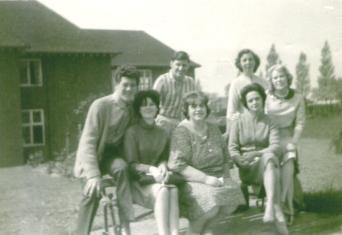
A group of patients outside the Ingrebourne Centre (in 1963?)
"we were closing the unit for in-patients so that we would get
the decorations completed as expeditiously as possible... not only are we
redecorating in terms of painting, but we are also undertaking structural
alterations and will have no beds for quite a lengthy period".
Melton, near Woodbridge
Previous history (1765-1827) House of Industry for Looes and Wilford
Incorporated Hundreds.
Peter Higginbotham says many
incorporated
Hundreds were set up in rural Suffolk in the 25 years after 1756
Asylum opened 1.1.1829
Suffolk County Lunatic Asylum to 1906
1.1.1844: 213 patients. 206 pauper and 7 private.
1881
Census
Suffolk District Asylum from about 1906 to about 1930
Also known, from about 1917, as St Audry's Hospital for
Mental Diseases
Became St Audry's Hospital, Melton, Woodbridge, IP12 1QT
1979:
530 beds
Now closed
External link to a nearby walk
Felixstowe Museum has a room devoted to
it
[other museums]
Archives in
Suffolk Record Office (Ipswich Branch)
Licensed House
Opened 1835
1.1.1844 32
patients. 20 pauper and 12 private.
Licensed to James Shaw (surgeon)
"Belle Vue Asylum, Ipswich Pleasantly situated on the Woodbridge
Rd, is a private establishment, for the reception of persons afflicted with
insanity. It was commenced in 1835, by its present proprietor, Mr James
Shaw, surgeon, & has accommodations for 40 patients". White Directory 1844
- p 84 Submitted by Betty Longbottom to
Rossbret
1870 Belle Vue House, Ipswich, Suffolk
licensed to Miss S A F Walter
Charles Mott, 1837:
"the man at Eye ate potato
peelings...because he was an idiot"
Also see
Peter Higginbotham on Eye workhouse
Ipswich Borough Asylum
Built: 1869-1870 Opened 1870.
Architect: WR
Ribbans
It became
Ipswich Mental Hospital about 1908, then St Clement's
Hospital, Foxhall Road. Ipswich, IP3 8LS, about 1947.
Autumn 2002: reported closed and empty, but in good condition.
Still open, no plans to close.
(Simon Cornwall)
[Following history based mainly on
Winston, M. 1994 "The Bethel at Norwich: an eighteenth-century hospital for
lunatics"
Established
1713.
The original house, known from its image on the seal of the Bethel and
from a written descnption, seems to have been a two-storey building with
two wings, set back from the road, then known as Committee Street.
8.1.1724 Death of Mary Chapman, founder of the Bethel.
1727: Six new wards
For the trustees:
City & County of Norwich January 1730
Keeper of Bethel
1747: Ordered that "Thomas Benning, Carpenter, do make a partition
in each story in order
that the Mens apartments may be wholly on one side of the Hospital and the
Womens on the other. And also that he make a new Window on the South side
of that Cellar where some of the Lunatics are lodged"
The Bethel at Norwich
For the applicants:
Norwch Janry 1730
1749 Existing bathroom to converted to a cell, and
strawroom to a "Cellar for the worst of the Lunatics to be put in", and a
new strawhouse, bathroom and wash-house were to be built.
The number of residents remained stable between twenty and thirty until
1750. There was then a steady increase which continued throughout
the decade. By 1760 numbers had risen to almost fifty.
1765 Trust incorporated and trustees became governors.
1762 Bequest of £1,000 by Bartholomew Balderston in order
that two persons from the Congregation of Independents in Norwich could be
kept "on the foundation" from time to time.
(archive) - Relates to
Congregational Church, Old Meeting, Norwich
(archive)
Patient numbers dropped
from between forty and fifty resident before 1780 to little more
than thirty in the early 1790s.
1792 - 1867 Members of the
Gurney and Birkbeck families, Quaker
bankers, amongst the Governors.
27.7.1807: Frederick Reeve Spalding criminal
lunatic, recorded "Lunatic Asylum". He had been
tried for a felony at Norwich and was held on the order of Warner & Richard
Car Spalding.
(HO 20/13)
1814 On the opening of the
County Asylum notice was given to parishes
that certain pauper patients would be discharged. The parishes arranged
their admission to the county asylum. For the next three decades, until the
Lunatics Act of 1845, the number of patients at the Bethel remained between
seventy and eighty, while those in the new asylum increased
1818 Letter from Samuel King, Bethel Hospital, Norwich, to
Thomas Stimson, Emneth, stating that patient John Marshall of Emneth would
be returned as the parish had ceased to pay for him - 'It will fall to my
Lot...to take him home in a Post Chaise'
(archive)
September 1828 Joseph John
Gurney (a visiting governor) visited with
his sister,
Elizabeth Fry. Two days later a Middlesex magistrate visited and
pronounced himself "much pleased"
June 1830
William J. Tuke
accompanied Gurney to the house and suggested that the galleries might be
opened up to
provide a variety of exercise for the patients.
1831: Uriah Baldwin criminal
lunatic, recorded "Lunatic Asylum, Norwich". He had been
tried at Norwich.
July 1832: Thomas Iveson criminal
lunatic, recorded "Lunatic Asylum, Norwich". He had been
tried for murder at Kings Lynn. He also spent time in
Bethlem
(HO 20/13)
Superintendent 1844: -- King.
1.1.1844 66 patients. "It is believed that some of these are
maintained partly at the charge of parishes"
(1844
Report
p.210)
1870 Superintendent C. M. Gibson
(surgeon)
1881 Census: "Hospital For Lunatics
Bethel" Bethel Street, Norwich St Peter Mancroft
1956 Sale of the five Bethel Hospital farms.
(archive)
[I think these were the source of investment income since the 18th century
-
But see national policy]
1962 (Hospital Plan) Grouped with
Hellesdon. Bethel had 122 patients in 1960 and was expected to
close by
1975
"the oldest surviving hospital in the country specifically
founded for the care of the mentally ill and currently the oldest building
in the UK to have been in continuous psychiatric use (though it has been
threatened with closure for some time) Since 1974 when the
in-patient
facilities were closed, it has continued as the Centre for Child and
Adolescent Psychiatry."
Medical Heritage
1979 The Bethel Hospital, Norwich, NR2 1NR (no beds) Child and
Family Psychiatry
2005: Bethel Child and Family Centre (Child and Adolescent
Services), Mary Chapman House, 120 Hotblack Road, Norwich, Norfolk, NR2 4HN
(NHS Direct)
Archives link
at Thorpe, near Norwich
one and a quarter miles east of Thorpe village church
third oldest county asylum.
[A Sarah Rutherford case study]
11.10.1808
Resolved at Norwich Quarter Sessions that the next
General Sessions "take into consideration the expediency and propriety of
providing a Lunatic Asylum..." under the provisons of the
1808 County Asylums Act
July 1809 committee appointed "for the purpose of making inquiry
into the number of idiots and lunatic paupers...". It reported that there
were 153 lunatics in the county.
October 1810: A committee of nine appointed to look into
the
best means. It reported that the asylum should be near Norwich and that the
County Surveyor had prepared a plan for an asylum capable of receiving 180
lunatics which could be enlarged to hold 300. The estimated cost was
£20,000.
April 1811: Committee reported purchase of five acres of
land at
Thorpe at for £600
The earliest part of the building is by
Francis Stone and was constructed between 1811 and 1814.
Opened
18.5.1814
It was built for 102 patients, but by 1820 had averaged only 80.
1814
First patient escaped over the walls
4.8.1815
Cemetery consecrated
1816 F.H. Stone, Ground floor plan of Norfolk Asylum
[whereabouts unknown, copy in
RCMHE
file 100458,
NMR, Swindon].
Summer 1821: Elizabeth Baldry criminal
lunatic, recorded "Lunatic Asylum, Norfolk". She had been
tried for a felony at Norwich.
(HO 20/13)
1825
a lengthy description
1828
Andrew Halliday's description
April 1828: John Kenney criminal
lunatic, recorded "Lunatic Asylum, Norfolk". He had been
tried for murder at "Norfolk".
(HO 20/13)
April 1829: Richard Scott criminal
lunatic, recorded "Lunatic Asylum, Norfolk". He had been
tried for murder at "Norfolk".
(HO 20/13)
March 1832: John Rudd Turner criminal
lunatic, recorded "Lunatic Asylum, Norfolk". He had been
tried at "Norfolk" for murder
(HO 20/13)
April 1832: Mary Ann Pycroft criminal
lunatic, recorded "Lunatic Asylum, Norfolk". She (was to be?)
tried at Wymondham, and was held for "want of Bail"
(HO 20/13)
1839: William Gathercole criminal
lunatic, recorded "Lunatic Asylum, Norfolk". He had been
tried at "Norfolk".
(HO 20/13)
Visiting commissioners stimulate changes
1.1.1844: 164 patients. All pauper.
1854
extra land
1857 Additions by John Brown, the County Surveyor.
(Peter
Cracknell) -
Sarah Rutherford
1858: 420 patients
1867/1868
Superintendent of Norfolk Thorpe near Norwich; Dr W.C Hills
April 1873
James Shaw (MD Queens) appointed Assistant Medical Officer in
the place of William Paynton, resigned
About 1878/1880:
an annex was designed by
Makilwaine Phipson:
Corridor-Pavilion?.
(Peter
Cracknell)
1881 Census: "Norfolk County Lunatic
Asylum, Thorpe Next Norwich, Norfolk". Superintendent William Charles Hills
Thorpe Lunatic Asylum 1891 census names
Served as a war hospital from 1915 to 1919. Some of the
patients went to Brentwood, in Essex.
1920 Patients returned from Brentwood
Was Norfolk Mental Hospital
from
1919 to 1923 and then St Andrews Hospital, Thorpe Road, Norwich, NR7
OSS.
"In 1939 340 beds were put aside for use by the Emergency Hospital
Scheme. On 30.6.1945 111 beds were handed back for normal use but the EHS
retained beds in St Andrew's Hospital until 1947"
Hospital database:
1953-1957 Cicely McCall Psychiatric Social Worker
1957 An Act of Parliament made the
Yarmouth Naval Hospital (re-named St Nicholas) a part of St
Andrew's.
1966
Norfolk and Norwich Association for Mental Health founded
31.12.1971: "St Andrew's and St Nicholas" 958 resident patients,
but 1,109 beds.
31.12.1975 "St Andrew's" 551 resident patients, but 646 beds.
31.12.1977 St Andrew's 647 beds. St Nicholas 211
It closed in 1998. The patients from the last ward to closed
moved to
Hellesdon
Looks intact. Grounds being redeveloped (Simon Cornwall)
Tuesday 20.6.2006 Radio 4 programme The Asylum Band by
violinist David Juritz. Traced the history of the asylum orchestra and
music in the asylum, back from the recovery of sheet music when the
hospital closed.
External link to archives
External link to online catalogue includes a
history
First purpose built
Regional Secure Unit
Built 1984. A two-storey building. "For some years prior
to 1998 it took patients primarily from the Norfolk, Suffolk
and Cambridgeshire Health Authority area".
"The Norvic Clinic (plus the associated rehabilitation units of
Meadowlands and Highlands) are the Trust Forensic service, providing a
local and Regional facility. They are situated on the east of Norwich,
close to the A47 southern by-pass, on the site of the former
St. Andrews Hospital, now the Broadland Business Park".
(source)
1993 David Bennet wrote to the nursing director pointing out:
"As you know, there are over half a dozen black boys in this clinic. I
don't know if you have realised there are no Africans on your staff."
30.10.1998
Death of David
"Rocky" Bennett
A Workhouse Asylum
"Wards exclusively appropriated to lunatics"
(1844
Report
p.10)
Norwich Incorporation of the Poor was established in 1712,
shortly before the
Bethel Hospital
"A separate infirmary, near St Augustine's Gate in the parish of St
Clement, accommodated up to 130 aged and infirm men and women aged 65 or
over. Adjoining it was a building erected in 1828, and enlarged in
1838, as an Asylum for Pauper Lunatics, with a ward for sick
patients.
Peter Higginbotham
1859 national
comparisons
Norwich Borough Asylum
1870
Norwich St Augustine's Gate: Superintendent Dr H,G, Stewart
Kellys Norwich 1883:
"The corporation of Norwich have built a Lunatic asylum for the
city, at Hellesdon, distant about two miles, to supersede the one formerly
used in
Infirmary Road: the new building was erected to hold 350
patients
and the administrative portion is large enough to work an asylum for 500 or
600 inmates: the plan is on what is known as the "block system" -- detached
buildings connected together by communicating corridors and surrounded by
airing courts -- and there is one peculiar feature in the arrangements
which has never been carried out in any other lunatic asylum: i.e. the
upper floors are entirely empty during the day, and the ground floor during
the night, thus giving perfect ventilation to each story every twelve
hours: the cost of the works has exceeded £60,000, including the
purchase
of the site and furniture: the architect is
Mr Makilwaine Phipson F.S.A.:
there are about 50 acres of land attached to the asylum, the cultivation of
which is entrusted to the patients, under direction, with very satisfactory
results: the building is lighted by gas supplied from the Norwich gas
works: the water is pumped up by steam from a well 100 feet deep on the
premises: there are about 100 single room, and the other 250 inmates are
associated together in dormitories containing from 4 to 16 patients each:
in 1851 a mortuary and stables were built near the entrance lodge, also two
semi-detached cottages for the artizans: the asylum was opened and
organised by the first and present superintendent, Dr. William Harris
FRCS."
Hellesdon Lunatic Asylum 1891 census names
During the first world war,
Norfolk County Asylum was used as a War
Hospital. Patients who should have been admitted to that Asylum were
temporarily admitted by the Norwich City Asylum.
Became
Hellesdon Hospital, Hellesdon, Norwich, Norfolk, NR7 OSS
During the second world war,
Bethel Hospital was closed and the Hellesdon Hospital admitted
patients on
behalf of that hospital.
Still seems very much alive. See
Jeremy Jones web, especially
inside Hellesdon Hospital
2005: Hellesdon Hospital, Drayton High Road,
Norwich, Norfolk, NR6 5BE
(NHS Direct)
Yarmouth - Norfolk - (South Denes)
Royal Naval Hospital Yarmouth - 1811
Royal Barracks South Denes (before 1818)
Yarmouth Royal Military Lunatic Asylum
- 1844
Crimea and
after - 1854
Yarmouth Naval Lunatic Hospital - 1863
Yarmouth Naval Hospital - 1931 (Act)
St Nicholas Hospital
- 1956
"Many military buildings have been built in Great Yarmouth over
the years. One of the most striking is the Naval Hospital, which was
originally for sailors wounded in the Napoleonic Wars. It then became a
barracks, but was
converted back to a hospital 40 years later
and was used
to
accommodate sailors who were mentally ill. Hence the navy slang
to
describe those sailors who are showing signs of mental wear and tear is
going to Yarmouth."
(online leaflet -
archive
The Royal Hospital or Asylum built by Government at a cost of
£120,000
Foundation stone laid by Admiral Rilly Douglas in 1809
The building was erected by Mr Peto (father of Sir Samuel Morton Peto)
from designs by H. Pakington, Esq., for a Naval Hospital. "The rooms in
front are 150 feet long, and the whole area within the Asylum is about
fifteen acres, and the interior arrangements are admirable, to say nothing
of the spacious court-yard to the north".
Opened 1811?
13.3.1812 The South Gate taken down and sold for £26 to
Mr.
Jonathan Poppy. It presented, two massive round towers, flanking a square
curtain, beneath which was the arch.
1815 600 wounded men from Waterloo lodged in the Naval Hospital
Queens Road, Great Yarmouth.
Simon Cornwall::
Originally: Naval Hospital/Barracks
Built: 1800-1811. Architect: Henry Pilkington.
Converted to housing.
Clive Baulch: This building opened 1876. Closed as a naval
hospital in
1956. Became NHS.
St. Nicholas' Hospital in Great Yarmouth, the former Royal Naval
Hospital, was attached to the
St Andrew's Hospital under the Yarmouth
Hospital Transfer Act 1957
1960 Hospital Plan 245 beds. Planned to close by 1975
31.12.1977 211 beds. Mental Illness
1803 Bedford General Infirmary, "on the Ampthill
Road"
erected "with funds bequeathed chiefly from Samuel Whitbread esq".
(See Rossbret site)
Samuel Whitbread (1758-1815) Only son of Samuel who died in
1796. He did not share his father's strict religious views. He
married, in 1789, Elizabeth, the eldest daughter of Charles (later 1st
Earl) Grey. Samuel Whitbread was Whig MP for Bedford. He was on the
1807 select committee on criminal and
pauper lunatics. A speech recorded in Hansard 14.6.1814 (A
governor of St Lukes)
On
1814-1816 Select Committee on Madhouses
, but
cut his own throat
6.7.1815, before the committee's third session.
He had three sisters including Mary his
step-sister who
married George Grey, the father of
the lunacy
commissioner.
William Henry Whitbread (4.1.1795-1867) The eldest son of Samuel
who
died in 1815, was MP for Bedford Borough from 1818 to the 1830s.
His votes recorded in the Annual Register for 1820 were radical.
Samuel Charles
Whitbread (1796 - 27.5.1879), the second son of Samuel who died in
1815,
was MP for Middlesex from 1820 to 1830.
Building commenced 1810
Architect: J. Wing.
Landscape designer unknown. "Limited grounds
reminiscent of earlier charitable asylums".
Archive at Bedfordshire Record Office.
Opened June or August
1812
Ampthill Road, Bedford from 1812 to 1860
National Grid Reference SP 047 485
Dr Grant David
Yeates, physician to the Duke of Bedford, helped to establish
both the
Bedford Infirmary and the County Asylum. He was the infirmary
physician and visiting physician to the County Asylum from 1813 to 1814. He
tried to convince the Bedfordshire magistrates that they should concern
themselves as much with the cure of asylum inmates as with their safe
custody. (Munk
and Scull, A.T.
1979 p.
155)
27.4.1812 William Pether and his wife appointed "the Governor
and Matron of the Lunatic Asylum".
May have provided for 52 patients at opening. Twice enlarged before
1844. The second enlargement being with a view to taking paupers from other
counties, to reduce the cost of the asylum to Bedfordshire.
1825:
Copied mounds in yards from Brislington House
1844 (and long before) Superintendent J. Harris,
Surgeon
1.1.1844: 139 patients. All pauper. It had accommodation for 180.
Weekly charge for paupers 7/6. For out-county paupers 8/6
Demolished in 1860
Corridor form -
Too large for Conolly's ideal?
From 1964: Fairfield Hospital, Stotfold, Hitchin, SG5
4AA. It
closed in 1999. The
Rossbret Asylums Website has history and
photographs under "Three Counties Asylum".
GenUK on Bedford has 1831 information
about
Bedford, including the asylum. The site has now been developed.
Architects:
Giles and Biven -
Dual Pavilion
May 1871: 1,600 patients
1915: Medical Superintendent: Frank Ashby Elkins
1920: Leavesden Mental Hospital
1937: Leavesden Hospital
As a student in the 1960s Liz Lane worked there in the summers and
winters with patents who were known as
"high grades":
"Leavesden was a grim place that looked like a Victorian workhouse, on
both sides of the main road with a tunnel going under so that people didn't
get run over.. I was on the easier side, away from the more secure part.
Address: Leavesden Hospital, College Road, Abbotts Langley,
Hertfordshire, WD5 0NU
(map to postcode --
multi-map)
Closed 1995
A pamphlet on its history of Leavesden Hospital should be
in both Hertfordshire Archives and the London Metropolitan Archives (Placed
there by Christine
Lawes).
Opened 1899
Simon Cornwall: Hill
End, St. Alban's, Hertfordshire. Built: 1896-1900. Architect:
George Thomas Hine
Sometimes known as
Hill End Hospital for Mental and Nervous Diseases and
Hill End Hospital and Clinic for the Prevention and Treatment of Mental
and Nervous Disorders.
Then as Hill End Hospital, Hill End Road, St Albans, AL4 0RB
1994: 153 patients
Closed 1997
Autumn 2002: Reported still empty
Simon Cornwall:
Closed in 1997, now looks totally demolished for housing.
2003
use: "Housing"
County of Middlesex War Hospital, Napsbury from
September 1915 to 1.8.1919, with 1600 beds, 350 of which
were for mental patients (no officers)
(external link) - Some of the
patients went to Brentwood, in Essex.
1920 Patients returned from Brentwood
It was known as
Napsbury Mental Hospital from about 1918 to about 1943.
1927 Dr Thomas Percy Rees moved to
Croydon
From about 1943 Napsbury Hospital, Napsbury, St Albans
(AL2 1AA).
1965
Mike Lawson
Autumn 1990 Home to
Survivors Speak Out editor
English Heritage: Napsbury, Herts, built 1902-1904 as the pauper
asylum for the county of Middlesex
"In
1994
proposals were made in the Mental Health Strategy for
Barnet that Napsbury Psychiatric Hospital, a Victorian 'asylum' in London
Colney be closed and patients be cared for in the Borough of Barnet. A
cornerstone of the agreement was that services be provided on both the East
and West sides of the Borough. Napsbury Hospital finally closed in 1999 and
in-patients have since been cared for at Edgware Community Hospital, where
an old hospital building was refurbished to create the Dennis Scott Unit."
(Barnet CHC)
2003
use: "Luxury housing"
Opened
1934. It was one of the two last mental
illness asylums to open,
the other being Runwell.
See Harperbury
Became Shenley Hospital, Shenley, Radlett, Hertfordshire, (WD7
9HB).
1973
"The last time I had a visitor was 1963"
2003
use: "Luxury housing"
Cambridgeshire
Middlesex Colony
Opened 1934 and known as that until 1949. Later known as Harperbury
Hospital, Harper Lane, Shenley, Radlett, WD7 9HQ.
See Shenley
"awaiting immediate development" in Autumn 2002
"Harperbury, previously Harperbury Hospital, is still in
existence, but with only about 60-90 residents on the site. They
live in purpose built bungalows on two locations called Bowlers Green
(beside the still-used bowling green) and Forest Lane. Other services on
the site include wheelchair assessment and continence services, but the
site is now largely used for training purposes such as IT training,
inductions, and postgraduate medical education. Owned by Hertfordshire
Partnership NHS Trust and previously by Horizon NHS Trust. There is a
booklet on the history of Harperbury in the possession of both
Hertfordshire Archives and the London Metropolitan Archives."
(Christine Lawes)
Corridor form -
Close to Conolly's ideal?
County Asylums website "Closed 1992, although
still operates on adjoining site"
1999
Consultation that could lead to full closure
External link:
Cambridgeshire Mental Health Hospital
Services
Dorset County Lunatic Asylum
National Grid Reference ST 667 953
Erection 1827-1832
Opened
1.8.1832
Sarah Rutherford:
"A small manor house was incorporated at the centre of a much larger
asylum bsuilding"
Reported in 1843 that patients had previously been subject to dysentery
"from the floors being damp". Patients admitted since the floors were
replaced had not suffered dysentery.
(1844 Report p.17)
1834: Circular letter from George Wallett medical superintendent
of Dorset County Lunatic Asylum promoting cheap method of constructing
Lunatic Asylums; with testimonial of
Suffolk Magistrates (29 November).
[In
Essex County Archives: Reference Q/SBb 518/79]
1.1.1844: 107 patients. All pauper.
Superintendent:
G.P. Button
Simon Cornwall:
Originally: Second Dorset County Lunatic Asylum. Built: 1859-1863
Architect: HE Kendall Junior
Corridor form - extended often.
1881 Census: "Dorset County Lunatic Asylum, Charminster"
Surgeon Medical Superintendant: Joseph Gustavus Symes, married, age 56,
born Crewkerne, Somerset.
1890: enlarged by
George Thomas Hine -
Compact Arrow
1895 New female annexe and Chapel added.
(Peter
Cracknell)
1900
"None of the doors were locked"
8.1.1902
Private Patients at Dorset County Asylum
(external link)
[About 1940? Herrison Hospital was adopted as the name for the whole
hospital]
1.1.1927:
902 patients, including 206 who were not Rate Aided.
365 were men, 535 women. In 1926 the
proportion of recoveries to admissions was 31.6%. The proportion of deaths
to the asylum population was 5.1%
1940? Herrison Hospital, Herrison, Dorsetshire, [DT2 9RL]
1962 (Hospital Plan) On 31.12.1960 there were 1,186
staffed beds. In 1975 there were expected to be only 860.
"Patients in Herrison psychiatric hospital in Dorset, which
opened in 1863,
were locked in at night and left unsupervised until morning. It closed in
1992, and is being redeveloped by Bellway Homes and Charlton Down
Developments, which has turned the three main buildings into luxury
apartments" (Anne Caborn, The Observer Sunday 18.8.2002)
1842-1844
Inquiry
link to other Hampshire asylum
1702
Sick and Hurt Board established
See naval lunatics summary
on
timeline
 This section of a
present day conservation map shows signs of the three
stages of Haslar's mental health history - The original boundary wall (mid-
18th century to keep all the sailors from escaping - The walls of the
lunatics airing grounds for the early 19th century asylum within the
hospital - The 1908/1910 mental hospital.
This section of a
present day conservation map shows signs of the three
stages of Haslar's mental health history - The original boundary wall (mid-
18th century to keep all the sailors from escaping - The walls of the
lunatics airing grounds for the early 19th century asylum within the
hospital - The 1908/1910 mental hospital.
[St Mary's Road]
A Workhouse Asylum
Portsea Island Poor Law Union was formed 18.7.1836. It include the two
parishes of Portsea and Portsmouth, population 1831: 50,389 (Portsea
- 42,306, Portsmouth - 8,083).
"26 Lunatics;
15 Females and 11 Males ... 7 were Epileptics and 2 Idiots. Many of the
Patients, although not strictly speaking, imbecile persons, were
individuals of
weak intellect. Some of them, however, were decidedly Insane, and
occasionally violent and unmanageable unless restrained, and some of them
were labouring under delusions."
(1844
Report
p.234)
There is a separate entry:
1881 Census: Portsea Island Borough
Lunatic Asylum, Milton, Portsea, Hampshire: Medical Superintendent:
William Charles Bland, married, surgeon, aged 33.
I think this is the separate building that became St James Hospital
(see below). St Marys, St James and the
Prison all seem to be in what was
the village of Milton. [See map. St Marys south of the prison. St James
to the east by the creek]
1898 Portsea Island Union Infirmary
1928St Mary's Infirmary
1930 St Mary's Hospital
by 1969 St Mary's General Hospital
by about 1980 St Mary's Hospital, Milton Street, Portsmouth, PO3
6AD
A
Licensed House
1844: Proprietor G.J. Scales (Surgeon) who appears to have
recently taken over, his predecessor having died as a consequence of a bite
from an inmate.
1.1.1844: 35 patients. 29 pauper
and 6 private.
Weekly charge for paupers:
9/- to 9/6 a week. "established
and carried on" in connection with a workhouse (not named) which sent
unmanageable patients and took them back when tolerably tranquil.
(See quotations from 1844
Report)
Hilsea was in the area of the
Fareham Union (not
Portsea Union)
(links are to Peter Higginbotham's
workhouse site).
Portsea had a workhouse asylum.
1868
Lunatic asylum in the hamlet of Hilsea mentioned in National Gazeteer
. However, Hilsea was not a licensed house
by 1867
(see Rossbret)
Portsmouth Lunatic Asylum
28.3.1868 The Builder 1868 Volume 26 p.235:
"Proposed Lunatic Asylum for Borough of Southampton - The
County Asylum
getting more crowded, pauper lunatics from Southampton and Portsmouth have
been removed from it, and the lunatic commissioners have intimated to the
Town Council of Southampton that they will require the borough to erect an
asylum of its own, or conjointly with Portsmouth. The estimated cost of the
new asylum is stated at £16,000." (Submitted by Alan Longbottom to
asylums.org
)
Simon Cornwall:
Built 1875
Opened 1879
Architect: George
Rake
Peter
Cracknell classifies it as
Corridor form.
First superintendent William Charles Bland
1880: Many patients moved back from
Fisherton House (Judith Kennerdale, email
14.7.2003)
see above for 1881 census
1896 Dr Bland retired and was succeded by Bonner
Harris Mumby as superintendent. Mumby was born in Alverstoke, Hampshire in
spring 1856. He had been Medical Officer of Health for Portsmouth since
1884 and was "appointed unanimously" to his new post by the Portsmouth
"borough county council".
1904 Postmark on fancy postcard - 02 in Stephen Pomeroy's
collection. This has more pictures than 01, but they are not labelled. They
include two group pictures of staff and pictures of the church. A used
postcard. No publisher details. "Used cards just say a view from nearby not
from an inmate!"
1905ish Unused postcards in Stephen Pomeroy's
collection: 03 is a front-view coloured - 04 is a black and white
photogarph labelled "Milton Asylum Female Side" (outside) - 05 is similar
to 03? but black and white.
Postcards (02?) and 03 are labelled
"Postsmouth Boro' Asylum. Milton" - 03 was published by Lawrence of Gosport
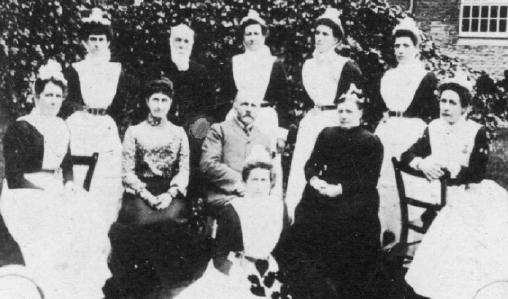
Bonner
Harris Mumby, in the centre.

1907:
picture postcard on
Stephen Pomeroy's web"Greetings from
Portsmouth Borough Asylum" - 01 in Stephen Pomeroy's collection
The Postcard 01 pictures are "Ward Three" - "Milton Asylum Laundry" - a
front view - "Ward 5" - "Milton Asylum Ball Room" - "Milton Asylum
Dormitory" - "Milton Asylum Kitchen" - It is a used postcard 1907, no
publisher.
1919 Post Office Directory: [out of
date - see below] Portsmouth Borough Lunatic Asylum, Asylum Road, Milton,
Portsmouth. Bonner
Harris Mumby MD medical superintendent; Frederick Ernest Stokes MB, Ch B.
Glasgow, DPH Cambridge and Edward Hope Ridley, MD Edinburgh, assistant
medical officers; Rev Joseph Fowler, MA, chaplain; Arthur E. Bone,
treasurer; Edward W. Rogers, clerk
29.4.1914 Bonner Harris Mumby, "medical superintendent of Milton
Asylum, Portsmouth" died (Journal of Mental Science obituary)
1914 Henry Devine appointed Medical Superintendent of the
Portsmouth Borough Asylum
Known as
Borough of Portsmouth Mental Hospital from 1914 to
1926.
an
external link
Dr Marjorie Franklin, "as a young junior medical officer in the Portsmouth
Borough Mental Hospital in the early 1920s, became intensely
interested in
the relationship between mental illness and the patients' environment. She
observed not only the often-noted improvements that occurred in response to
a cheerful, encouraging environment and sympathetic nursing but also, in
some cases, the dramatic improvement of the psychotic condition with the
onset of severe physical illness. The latter phenomenon she attributed not
only to a change in the location of the cathexis but also to the greatly
increased attention and care which the ill patient received. The
improvement was seldom maintained but Dr Franklin considered that with
skilful psychoanalytical intervention and support it might have
been"
1.1.1927: 866 patients of whom all but 184 were Rate
Aided. 331 were men, 535 women. In 1926 the proportion of recoveries to
admissions was 31.3%. The proportion of deaths to the
asylum population was 6%
After 1926:
uncertainty about its name until it became St James' Hospital in
1937.
By 1930 Thomas Beaton (1888-1964) had succeded Henry Devine
1946 "St James' Mental Hospital, Portsmouth" given glowing
praise by
Carlos Blacker (page 62) for its success in educating the local
population in removing fear. "Out-patient sessions are attended by all
social and diagnostic classes with as little qualms as might be provoked by
a visit to a Voluntary hospital". "Without an afterthought, parents bring
their children for advice and guidance"
1960s Postcard 06 in Stephen Pomeroy's collection is a black and
white aerial view labelled "St James' Hospital, Portsmouth" - not used,
no publisher.
6.12.1973
Portsmouth Mental Patients Union founded
1970s Stephen Pomeroy's postcard collection begun
The hospital was in Asylum Road until the name of the Road was changed
to Locksway Road, Portsmouth (PO4 8LD).
(map)
Simon Cornwall:
"Grounds preserved as city park. Some rebuilds and regeneration going on".
Peter
Cracknell: "Asylum building in NHS use"
Isle of Wight
1890s
maplink
1771 Act of Parliament authorising construction of a
House of
Industry. (Laidlaw p. 60)
1784 Two "cells" provided for lunatics.
By 1810 there were six cells for lunatics.
1820 Some female lunatics sent to Finch's
Laverstock House (Laidlaw p. 68)
By 1813 a separate building for lunatics. This was the west
side of the quadrilateral of buildings making the House. (see map below)
1822 lunatic wing enlarged
1830 lunatic wing enlarged
By 1831: the part of the workhouse containing lunatics and
idiots was licensed as an asylum.
(A Licensed Workhouse Asylum from 1832-1853)
1832 28 asylum inmates
1840 Some female lunatics sent to Finch's
LaverstockHouse (Laidlaw p. 68)
1.1.1844 27 patients all pauper.
Proprietor: Riches, Surgeon
Weekly charge for paupers not stated.
On 1844 list of best conducted:
reasons
commended
1853 ceased to be a licensed house. I think this would be due to
the opening of the
Hampshire County Asylum. In 1852 the
Guardians had resisted a comprehensive transfer of patients the new County
Asylum. In 1853, twenty women and several men were sent across the Solent
in a steamer specially commissioned (for seven guineas) from The Isle of
Wight Steam Packet. Some patients had been absorbed by the main workhouse
and the west wing was re-planned and re-built with male and female
receiving wards, an "Idiot Ward" and a residence for the chaplain.
(Laidlaw p. 69)
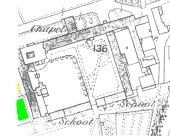
Union Workhouse on an 1862 map. The coloured areas are the imbecile airing
grounds. Yellow = female. Green = male. The imbecile wards are in the
adjacent building. This is the west wing of the House. Although many time
re-built, buildings on the west appear to have been used for mentally
handicapped people from the late 18th century through to the second half of
the twentieth.
1865
Poor Law Union
1867 35 insane, idiotic, and imbecile inmates. 16 men, 19 women.
1896 Opening of
Whitecroft
Known as Forest House, because it was in the forest of Parkhurst
1935 St Mary's Hospital (not a mental hospital)
Address
Parkhurst Newport
PO30 5TB (Since 1771)
Closed 1999 [Hospital database:, but I think that has to be wrong
- See below]
Woops!
new hospital - remedial work -
(archive)
"Sevenacres, which houses the Mental Health Unit, is also on
this site and is the base of the administration and management of the
Mental Health and Learning Disability Services. Also based here is the
Island Crisis Intervention Services and the Mental Health Assertive
Outreach Team. Other parts of this service are delivered from 17 properties
across the Island."
(The Isle of Wight Healthcare NHS
Trust)
April 1890 Isle of Wight County Council established
1896: Isle of Wight (County) Lunatic Asylum Sandy Lane
Newport
[PO30 3EB] See also modern
streetmap and
1890s
maplink
Architect: B.S.
Jacobs of Hull.
Peter
Cracknell classifies it as
Compact Arrow.
Harold Bailey Shaw, previously a medical officer at the
Hampshire County Asylum was appointed Medical Superintendent in
August 1895, but started in September 1896. He died in office
in 1914. Several other asylum staff, as well as patients, came from
Hampshire.
"In the first Annual Report by the Medical Superintendent, he indicated
that a block to hold 50
private patients would soon be ready". "Soon after
opening a private patient block was available with a billiard room. This
was the block near the main gate separate from the rest of the hospital;
later it became an admission ward, and was named Tennyson Ward.
(p.99)
1899 Kelly's Directory page ---:
"The Isle of Wight County Lunatic Asylum, erected in 1896 at a cost of
£60,000 (not including equipment), is a building of red brick,
pleasantly situated about the centre of the Island; there is a
separate block employed for the accommodation of private paying patients;
the building is capable of holding 310 persons, and there are at present
(1898) 260 inmates". page ---:
County Lunatic Asylum. Harold Bailey Shaw BA, MB, BC, DPH superintendent;
Patrick Taffe Finn LRCP + S. Edinburgh, assistant superintendent;
William Morgans, clerk
4.2.1899
Freda Mew admitted to the private block. Previously in
The Limes - Her
certificates were signed by "J. Groves, M.B. and S.Foster, LRCP.Ed,
Newport". Trade directories show: Joseph Groves BA, MD, London, FGS, FR
Met. Soc. Glen cottage. Physician and medical officer for the Isle of Wight
rural sanitary district. Stanley Foster, LRCP + S. Ed. (of Coombs and
Foster, surgeons, 6 + 10 High Street) Arreton District Medical Officer and
Public Vaccinator fro Whippingham District, who lived at 6 High Street. His
partner, Milbourne Lascombe Bloom Coombs, LRCP, LRCS Edin., surgeon and
medical officer for Newport and Whippingham district Isle of Wight union
and public vaccinator for Newport borough, lived at 104 High Street,
1898-1903 Contracts for the reception of patients from
Croydon made by Visiting Committee of Isle of
Wight County Council. Other contracts with
West Sussex and London County Council
1901 census: Isle of Wight County
Lunatic Asylum, Whitecroft. It is in the civil parish of Carisbrooke, but
the ecclesiastical parish of St John the Baptist. Also in Carisbrooke, but
the ecclesiastical parish of St Mary the Virgin, are the Isle of Wight
Union Workhouse Parkhurst, Parkhurst Prison Convict Prison and Parkhurst
Barracks. On the 1866 Ordnance Survey map, Albany Barracks is just south of
the prison and the workhouse south-east of that.
1901
Occupations of women in private unit.
1911 Kelly's Directory page 677:
"The Isle of Wight County Lunatic Asylum, erected in 1896 at a cost of
£45,000 (not including equipment), is a structure of red brick,
pleasantly situated, nearly in the centre of the island, and includes a
separate block for private patients; the building is capable of holding 330
persons, and there are at present (1911) 316 inmates". page 678:
County Lunatic Asylum. Harold Bailey Shaw BA, MB, BC, DPH superintendent;
Arthur Francis Reardon LMSSA London, assistant medical officer; James H.
Green, clerk
January 1919 380 patients, including 58 private
patients, 38 patients from outside the island and seven "service" patients.
8.12.1921 Letter stating annual cost of Freda Mew's
maintenance about £130 a year.
1925: The Branch Secretary of the Nation Asylum Workers
Union at
Whitecroft was "Mr L.B. Sykes, County Mental Hospital, Whitecroft,
Carisbrooke, Isle of Wight"
1.1.1927: 328 patients of whom all but 54 were Rate
Aided. 119 were men, 209 women. In 1926 the proportion of recoveries to
admissions was 43.5% (One of the highest). The proportion of deaths to the
asylum population was 8.6%
Became Isle of Wight (County) Mental Hospital by
1929
1932 Dr Erskine, Medical Superintendent since 1915,
retired. Dr
Charles Davies-Jones (from Oxfordshire) succeeded. Dr A. Wood joined him in
1933. About this time "the
private patient block was converted into
an admission block". (p.103)
[See national changes]
The following taken from the archives catalogue:
December 1933 'Programme of a mystery play in honour of the
Nativity of Our Lord' by Robert Hugh Benson
1937 Notes re arrangements for Christmas includes list of food
required.
Notes re arrangements for patients' holiday camps June 1937 and
July 1939
28.10.1937 Contrct to send some patients to
Basingstoke
11.6.1938 Contract to send some mentally defective from the Isle
of Wight to
West Hartlepool, County Durham
1938/1939 Plans and contract for a new nurses home
1939Papers giving details of arrangements for annual fete
1941-1943 Circulars and other papers re food rationing
1947 Correspondence and papers re Patients' Sports Day
1950 Whitecroft Hospital, Newport
1.3.1958 death of
Freda Mew, aged about 78
1960: 455 staffed beds, planned to be reduced to 170 by 1975
31.12.1975: 410 beds, only 270 of which were occupied. The 66% bed
occupancy was almost the lowest in England and Wales. 55 beds were in a
special "self care" unit or wards and 7 beds were in a rehabilitation ward.
1979:
327 beds
Closed 1990 "The few remaining patients were transferred to
a new ward, "Newcroft" at
St Mary's Hospital in Newport" (Andrew Crowther)
Gatcombe Valley -
OK - try one of these!
26.8.2004
Isle of Wight County Press
3.9.2004
Isle of Wight County Press
1979:
There were three acute general hospitals on the Island. Ryde
had 121 beds, Frank James (Cowes) had 31 beds and Shanklin had 33. No in-
patient psychiatric beds were planned for these hospitals, but they may
have had out-patient clinics.
Isle of Wight Mental Handicap
Havenstreet, Ryde, PO33 4DR
1979: 42 beds
52 Staplers Road, Newport, PO30 2DE
1979: 25 beds
The Limes, Newport In 1899, Freda Mew was admitted to the Isle of
Wight Lunatic Asylum from "The Limes, Newport". I have not been able to
identify in Trade Directories. There was a
Mrs Weeks, 85 Castle Road, Newport, IOW
zoom in on the house
The first map also shows Andover (north west), where the
Andover workhouse
scandal
took place.
(see Peter Higginbotham's site) and Alton
(north east) where Harriet
Warner and her family lived.
Licensed House
A mansion and outhouses
asylum
"A fine brick house of about 1700, with something older and something a
little younger"
(Pevsner's Buildings)
"There is a private lunatic asylum, situated in an ample
demesne of 40
acres, and approached by three avenues of trees. The house was built in the
reign of Charles 2nd, and was once the seat of Lord Bayning". (1868
Gazeteer)
1825 Leased to Dr Twynham - continuing so until 1847
(Pelham Warner citing a Sparsholt Village History book). [The
name is Twynam, without an h, in all original sources consulted - Apart
from one entry in the 1844 report as Twyman]
"From 1825-1846 Lainston was rented out as a lunatic asylum, Mr John
Twynham was the resident physician who lived in the house with his wife and
staff and about 80 patients were housed in huts around the grounds. Sadly
it was after this episode in the in the history of Lainston that when these
huts were being demolished, the workmen, using horses, pulled the roof from
the Chapel, which by now was in a bad state of repair - in order to sell
the lead."
(source)
2.10.1828 John Twynam of Bishopstoke, age 29, bachelor,
married Mary Read of St John cum St Lawrence, Southampton, aged 30,
spinster, at St Lawrence.
July 1831: Thomas Miles criminal
lunatic, recorded "Lunatic Asylum, Lainston House". He had been
tried for murder at Winchester.
(HO 20/13)
1836: John Marchant
criminal
lunatic, recorded "Lunatic Asylum, Winchester". He had been
committed from "Winchester".
(HO 20/13)
1839: William Fizzard
criminal
lunatic, recorded "Lunatic Asylum, Lainston House". He had been
committed from "Hampshire".
(HO 20/13)
6.6.1841
Census: John Twynam, aged 40 living at the Lainston House
Lunatic Asylum. Married to Mary, aged 50 [HO107 404 1/3 Page 2] 42 female
and 39 male "patients". Ten female and three male staff. The female staff
included four nurses, a kitchen maid, two house maids. The male
staff were two keepers (one also a cordwainer/shoemaker) and a
groom. (Information from
Pelham Warner).
SEVERELY
CENSURED IN
1844
REPORT
Dr Twynam was
unresponsive to national or local efforts to improve his house:
Friday 14.10.1842: First visit of the commissioners who found
the "buildings appropriated to the paupers consisted of stabling and
out-houses
converted to that purpose, and were quite unfit to be used as an asylum".
They
called attention to the urgent need for a county asylum.
No date given: "these evils were so manifest, that the visiting
commissioners expressed a hope that means would be found to put an end to
them, either by refusing the license, or otherwise"
Local magistrates visited the house several times
Tuesday 22.8.1843 Third visit:
1.1.1844: 94 patients. 84 pauper and 10 private.
Weekly charge for
paupers: 9/- including clothes.
Proprietor J. Twynam, M.D. (page 213) - J. Twyman (page 260)
April 1844 Another visit
1846/1847 Harriet Warner (aged 41) first attack of lunacy. Possibly
at this time that she was "previously confined at Lainston House"
(Knowle case notes)
. Information on Harriet from
Pelham Warner.
16.10.1846 Dr Twynam to quit Lainston House. He had offered it
to the visiting justices. (Lunacy Commission minutes Friday 9.10.1846)
Parry-Jones,
W.L.
1972 (p.254) says that Lainston House had closed by 1847
March 1849 quarter death of Mary Twynam recorded Winchester
1851
Census: John Twynam MD, aged 51, widower, 63 Nuhill Lane,
Bishopstoke,
Winchester. Head of household. Born Bishopstoke. Occupation: "graduate of
the University of Edinburgh as physician", so I am fairly certain this is
"our" John Twynam. Living with a cook and a groom. (Information from
Pelham Warner).
December 1855 quarter death of John Twynam recorded Winchester
Not a licensed house by 1867
(see Rossbret), although
1868 Gazeteer still mentions.
January 2009: Information from Pelham Warner that Hampshire Record
Office know little about Lainston House (now a luxury five star hotel)
apart from that it was, at one time, a private lunatic asylum. Pelham is
researching his Great Great Grandmother Harriet Warner (1806 to 1894)
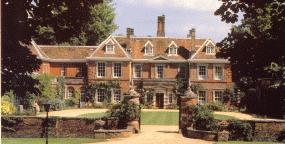
Lainston House is now a hotel. Its old
web site
-
(archive) -
did not discuss its history. The
new website does not seem to mention its
asylum history, but the proprietors provided material for
a website that does.
Licensed House
A mansion and outhouses
asylum
Present building probably erected between 1565 and 1576. It is on the
site of an older house.
"In 1831 the manor was bought by Dr. Edward Middleton who
transformed it into a lunatic asylum" But: Epiphany 1823 James
Banting,
criminal
lunatic, recorded "Lunatic Asylum, Grave Place". He had been
tried for assault and sent from "Hampshire".
(HO 20/13)
February 1832 Thomas Randall criminal
lunatic, recorded "Lunatic Asylum, Southampton". He had been
previously held in a "Lunatic Asylum, Dorset". He had been tried for
murder at Winchester.
1844: Proprietor Mrs H. Middleton.
1.1.1844: 72 patients. 53 pauper and 19 private.
Weekly charge for paupers not stated.
Severely censured in 1844
Report:
summary of
criticisms
Parry-Jones,
W.L.
1972 p.247: In 1853 "the Hampshire Visiting Magistrates
recommended the discontinuation of the licence granted to the proprietor of
Grove Place, Nursling, largely because of substantiated evidence of the
cruel and severe treatment of a patient.." (Eighth Report (1854) Lunacy
Commission, pp 19-20)
Parry-Jones,
W.L.
1972 p.88: In 1854 Dr James Baillie bought Grove Place,
paying a large sum of money for the good will. In their 1855 Report
(pages
20-21) the Lunacy Commissioners considered "A payment of this nature...
offers a strong temptation to those who purchase to curtail the comforts
and accommodation of the patients... in an attempt to reimburse themselves
out of the profits of the asylum". However, Parry Jones says "This
statement was contradicted in the next report and the licence was not
renewed". [I do not understand that]
"There is a private lunatic asylum, called Grove Place, which was
formerly a hunting-seat of Queen Elizabeth, and is approached by an avenue
of lime trees"
(1868 Gazeteer). In fact, it was not a
licensed house by 1867
(see Rossbret). The avenue of lime trees may
be the trees framing the top picture on the Grove Place Prep Schools site
(below)
used as a farmhouse from 1867
Now The Atherley & Grove Place Prep Schools, Grove Place,
Upton Lane, Nursling, Southampton SO16 0AB
Hampshire County Asylum
Situated near the hamlet of
Funtley
in the parish of
Fareham
[map] This being a little north of
Portsmouth and east of Southampton.
[map]
Hospital database: "The first minute book of the
Committee of Visitors for erecting a County Lunatic Asylum is dated 1849 -
1853 (18M93) but is not with the main collection". See 1842-1844
Inquiry
Simon Cornwall: Built: 1850-1852
Architect: J. Harris
Opened
13.12.1852
First Medical Superintendent: Dr Ferguson
20.8.1853 to 3.9.1861
Harriet Warner a
patient in Knowle Lunatic Asylum. Her case notes say she was
"previously confined at
Lainston House".
1868 Overcrowding had led to
the removal of Portsmouth and Southampton patients
1879
Portsmouth Borough Asylum opened
1881 Census: Hants County Lunatic
Asylum, Knowle, Fareham, Hampshire. Medical Superintendent: John Manley,
Physician, married, age 56.
1896
Isle of Wight County Asylum opened
1911:
A child born to RN Stoker of Hants Lunatic
Asylum
1919 Post Office Directory: Hampshire
County Lunatic Asylum. Knowle, Fareham, Henry Kingsmill Abbott BA, MD
superiintendent; William John MacKeown BA, MB, B,Ch, senioar assisstant
medical officer; Joseph William Rodgers, LRCS and LRCP Ireland, second
assistant medical offcer; Wilfred Metcalfe Chambers, LRCS and LRCP
Edinburgh, third assistant medical officer; Rev William Richard Williams
chaplain; John Railton Wyatt, clerk to the asylum and visitors; Frederick
Joyce, storekeeper; Miss Mary Heading, housekeeper.
Knowle Mental Hospital about 1923
1948: became Knowle Hospital
1976: R. Bursell, History of Knowle Hospital (Hampshire
County
Asylum), 1852-1884 Duplicated typescript. Southampton University
Library
Closed 1996
2003 Susan Margaret Burt: "Fit objects for an asylum" : the
Hampshire County Lunatic Asylum and its patients, 1852-1899 Thesis
(Ph.D.) University of Southampton, Department of Sociology and Social
Policy.
Simon Cornwall:
Proposals for conversion to housing. Probably all housing now.
weblink to plans for Knowle Village
Jess Knowles: "the old site is not quite all houses. Ravenswood
House, the
regional medium secure unit, is still there and thriving.
Originally the secure unit moved into Ravenswood Ward the one time
admission ward for Knowle Hospital. The medium secure unit has grown,
but the old building is still there in the middle of it all."
Simon Cornwall:
Park Prewett, Sherbourne St John, Hampshire.
Second Hampshire
County Lunatic Asylum. Built in
response to overcrowding at Knowle Hospital. The special committee to look
at the feasibility was appointed in 1898 and building work started
in 1910. Work had commenced in 1912 but the opening was
delayed due to World War.
Opened 1921
Architect:
George Thomas Hine
. Size: 1200
patients.
Peter
Cracknell classifies it as
Compact Arrow of the
later type with with open sided corridors and
ward blocks becoming further detached - a movement towards the "perceived
therapeutic benefits" of
the colony layout.
1930 Rooksdown House opened as
private patient block. During
Second World War Rooksdown House became plastic surgery hospital and
continued in this capacity till 1959
1939 Emergency Military Hospital. Patients moved to
Wells, Somerset
Closed 1996. Appears intact.
June 2004
Photographic tour of abandoned hospital -
archive
Photos spark review
Royal Victoria (Military) Hospital:
Southampton SO3 5GZ
Opened
1863
"Our mess-mates who had 'thrown-a-wobly' or who had witnessed
giant flesh eating monsters climbing onto their beds because of DT's, were
sent to Netley and not, emphatically not in naval speak terms, to BLOCK 'D'
or to Victoria House. Netley was the 'nut-house' and the butt of our jokes
and teasing. The word NETLEY was used in everyday speech by all sailors
and its applied meaning was universally understood."
Department of Psychiatry - Southampton
Sherbourne Road, Basingstoke
30 beds in 1979
2000+ Undated research findings
Social validation data on three methods of physical restraint,
Joanna Cunningham, University of Portsmouth, thanks "the carers and
service-users of Sherbourne House, Basingstoke"
1 Darlington Road, Basingstoke, RG21 2NY
20 beds in
1979
Not far from Sherbourne House
map
Sarisbury Green, Southampton, SO3 6ZD
854 beds on 31.12.1971
559 beds in 1979
Tatchbury Mount Hospital
Calmore, Southampton, SO4 2RZ
397 beds in 1979
White House Hospital
Westover Road, Milford-on-Sea, Lymington, Hampshire
35 beds in 1979
Coldharbour, Sherbourne, Dorset, DT9 3JU
Hospital Scandal
-
Bopcris
363 beds on 31.12.1971
309 beds in 1979
1: Near
Bristol or Bath
For the history of St Peters and Bristol Lunatic Asylum, visit the
Glenside Hospital Museum
(see also)
and
Peter Higginbotham's workhouse site and
Ray's Bristol History -
article on Glenside Hospital Museum
(archive of an old Glenside menu)
timeline
[other museums]
This 17th century building was destroyed by bombs in 1940. It stood
between St Peter's Church and the River Avon. The area is now Castle Park
Used as a workhouse from
1696.
Kathleen
Jones
says that "almost from its inception" the original building (The Mint) was
used for the "impotent poor" and other premises used as a "manufactuary".
An "early regulation" (Jones) recommended "the lunatic wards be floored
with planks".
Local physicians and surgeons attended patients without fee. In April
1768 a regulation said they should visit the "Frenzy Objects" once a week,
and also "such Objects as shall from time to time be brought in by Warrants
of Lunacy"
29.2.1814:
James
Cowles
Prichard a physician to to St Peters, which is described as
"having a
ward for lunatics"
1832 Due to overcrowding following cholera, most pauper patients moved
to Stapleton workhouse. Lunatics remained in Bristol.
Made a
"County
Asylum" under a local
Act (date not known, but before 1844)
1.1.1844: 72 patients. All pauper.
Treatment
praised
but
building criticised in 1844 Report
The Bristol Lunatic Asylum was opened in 1861 immediately to
the north-west
of Fishponds workhouse in Stapleton.
Corridor form -
Close to Conolly's ideal?
1960 1,150 beds, expected to fall to 800 by 1975
Late 1969 "My ... admission ... was a ... much more positive
experience." Judith Watson
31.12.1977 633 beds
20.8.1994 Main hospital closed. It now houses the Faculty of
Health and Social Care of the University of
West of England
Rossbret says closed 1992 - But I think this should be 1994
There is a book: The Lunatic Pauper Palace. Glenside Hospital
Bristol 1861-1994
This account of the
Glenside Hospital Museum is copied from the
Wrington
World Day -
Saturday, 21st June 2003 website
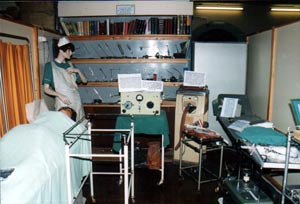
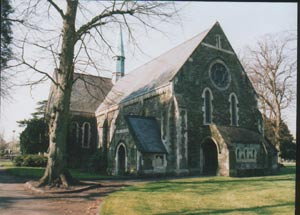
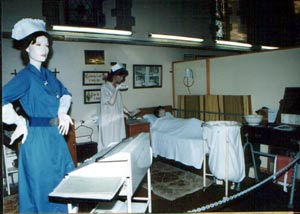
Barrow Gurney Bristol BS19 3SG
(map)
See
Glenside history
1930 Bristol City Council bought 260 acres of land at
Barrow Gurney, North Somerset, eleven miles from
Fishponds.
"landscaped grounds to purpose-built hospital, encompassing ancient
woodlands. Hospital built 1934-1937.
May 1938 Barrow Hospital received its first patients
Visiting Consultants were common to
Fishponds and Barrow Hospital
3.5.1939 Official opening by Sir
Lawrence Brock CBE, Chairman of The Board of Control
3.9.1939 Became a Royal Naval Auxiliary Hospital for the
duration
of the war
Autumn 1946 Returned to Bristol City, relieving overcrowding at
Fishponds
1948 Under the National Health Service
Fishponds and Barrow Hospital were run under joint management
1951 290 beds
1960 453 beds, expected to fall to 200 by 1975
May 1965 "9 p.m. on a Friday night was definitely the wrong time
to be admitted".
Judith Watson
31.12.1977 356 beds
"Among Returns of
Glenside Hospital"
External links:
Trees at Barrow Hospital
"to close"
April 2002
Report of Bristol Mind User Focused Research Project:
"Barrow is an old hospital site. Many of the wards are in need of major
refurbishment and have shared accommodation in dormitories. It is
situated about seven miles outside Bristol near the village of Long
Ashton. A hospital bus runs between the hospital and the Bristol Royal
Infirmary near the city centre. Barrow is surrounded by protected
woodlands and the wards are built around a horseshoe shaped driveway
about a mile all round. There are no local community facilities off site,
the village being about a 25-minute walk from the hospital."
The future of mental health services
15.12.2005
Apologies for dirt
Grove Road Psychiatric Hospital
Now Grove Road Day Service
Opened 1955
"We think it was the second Day Hospital to open in the country. It was
a crippled children's hospital in 1875 until about 1910.
1979:
The Day Hospital (Mental Illness), 12 Grove Road,
Redland, Bristol, BS6 6UJ
It is the 50th anniversary this year (2005) and
we would like to hear people's memories. (Trish - from the day
service)
See Peter Higginbotham's site: "The Bedminster
Union was renamed Long Ashton in 1899. Between 1929 and 1956, the workhouse
became Cambridge House, a mental deficiency colony run by Somerset County
Council. It subsequently became known as Farleigh Hospital, which was the
centre of a scandal in
1971 when two members of the nursing staff spoke out
about the appalling treatment being meted out to the vulnerable patients.
The former hospital site has now been redeveloped for other uses although
much of the original building has been preserved."
The Burdens were the family behind
Stoke Park Colony and other "Institutions for Persons
Requiring Care and Control". There were three of them:
Rev Harold Nelson Burden (1859-1930)
Mrs Katharine Mary Burden (1856-1919)
Mrs Rosa Gladys Burden (1871-1939)
26.9.1888 Harold Nelson Burden married Catherine Mary Garton at
St John, Hoxton.
1895 Harold and Katherine Burden opened The Royal Victoria Home,
near Horfield Prison, Bristol, for the care of inebriate women and girls in
moral danger - After the passing of the
Inebriate Act of 1898
they founded the Brentry Certified Inebriate
Reformatory for men and women, which
became the 'Brentry
Certified Institution' within the meaning of the
Mental Deficiency Act of 1913 and 1919 on 3.1.1922.
In 1901 Harold (aged 41) and Katharine (aged 43) were in charge
of the
Home for Inebriates at Brentry, Westbury on Trym, Bristol. One of the
officers was
Gladys Williams, store keeprer (clothing) aged 32, born Cumberland.
1902 Harold Burden founded the
National Institution for
Persons
Requiring Care and Control
1904 Harold Burden appointed to the Royal Commission
enquiring into
the care of the feeble-minded.
1909 Harold and Katherine Burden opened the
Stoke Park Colony and later acquired Heath House and
Grove
Beech House, followed by Hanham Hall and Leigh
Court and Whittington Hall, Chesterfield.
1911 Gladys Rose Williams, born about 1874 in Whitehaven,
Cumberland, was
living with Harold and Katharine as their "adopted daughter" at 34
Westbourne Gardens, South Paddington West.
25.9.1919 Katherine Mary died in
Bristol. She bequethed £4,256 14s 2d to Harold.
1920 Harold N Burden's
marriage to Rosa G. Williams was registered in
the April-June quarter at St George Hanover Square, London.
15.5.1930 Harold died and Rosa was appointed Warden in his
place.
September 1939 The death of Rosa G Burden born about 1871, aged
68, was registered
in Weston-super-Mare, Somerset. Rosa Gladys died Clevedon
Hall, Clevedon,
Somerset on 17.9.1939 leaving an estate of £165,164 1s 7d.
founded 1909 by Rev
Harold Nelson Burden (1859-1930)

1933 Stoke Park monographs on mental deficiency and other
problems of the human brain and mind. No.1 The Burden memorial volume :
dedicated to the memory of the late Reverend Harold Nelson Burden /
edited... by Richard James Arthur Berry (1867- ) Stoke Park Colony
(Bristol) London: Macmillan 1933. xix and 249 pages [Later volume issued in
1961 by the Stoke Park Hospital with title: Stoke Park studies; mental
subnormality, second series]
A Workhouse Asylum
"Wards exclusively appropriated to lunatics"
(1844
Report
p.10)
Visited 20.10.1843
(1844
Report
p.233)
"...there were
twenty-one insane persons, of whom one female was constantly under
restraint; another was under excitement, and secluded in a cell; and one
man had been in the house four months without any medicine, although his
case appeared susceptible of benefit from medical treatment."
(1844
Report
p.98)
Licensed House
may have been a madhouse since about 1615 as it was claimed in
1815 that there had been a madhouse in Box for 200 years. (map showing Box)
On
1815 list
Place: Kingsdown. Name: Changworthy (Langworthy?)
1.1.1844 137 patients. 101 pauper and
36 private.
Weekly charge for
paupers: 8/- to 9/-
SEVERELY CENSURED IN 1844
REPORT
Proprietor 1844: C.C. Langworthy M.D.
The proprietor, Dr R.A. Langworthy, became a patient in Fishponds
(below) on 23.3.1847. In May 1848 it was alleged to the Lunacy Commission
that the interested motives of his wife were keeping him there, although he
had recovered. (MH50
3.5.1848)
1881
Census: Kingsdown Asylum, Box.
Charles Knight Hitchcock, aged 32, born Market Lavington
see Fiddington
House, Physician and his wife, Alice, aged 25, born Bottisham,
Cambridge, with six month baby son, Humphrey K., born Market Lavington.
Matron of Asylum (Hospital), Jane Elliott, unmarried, born Box.
Visitor: Harriett Elliott, widow, aged 59, also born Box. All but one of
the inmates are described as "Insane Patient". M. W., unmarried famale
born Warminster, Wiltshire, is described as "Boarder"
Early 20th century:
external link to photograph -
archive
"The postal address of Kingsdown, Box, Chippenham, Wiltshire for at least a
hundred years have been known almost world wide For Kingsdown House became
one of the very best nursing homes for the very rich people of the land
that had mental trouble. In fact Kingsdown House was called an asylum and
it was run by a Doctor Mac Bryant who had a large staff of high-class
nurses of both male and female also doctors on hand, and of course, there
were a very large staff of servant girls and the very best cooks and
kitchen maids" (from The Kingsdown Memories of Victor Painter (born 1906, died
2002)
archive. See
part eight
archive)
Asylum remained open until November 1947
Wiltshire and Swindon Record Office have patient records
for
Fiddington House, Market Lavington,
Laverstock House and
Kingsdown House, Box. However, the catalogue is marked "Not to
be produced before 2006" Reference A1/565
Licensed House
Originally (1738) opened as Mason's Madhouse by
Joseph
Mason in Stapleton, it moved to Fishponds in 1760.
1779 Death of Joseph Mason, the founder
Until 1788, Mason's married daughters, Elizabeth Cox and Sarah
Carpenter, continued the asylum.
1787 A birth in the Bompas family who worshiped at
Broadmead Baptist Church, Bristol. George Gwinnett Bompas senior
and his wife
(born Selina Carpenter in 1767, died 1809) had a daughter, Sarah, who died
in 1810.
6.6.1789 Birth, in Bristol, of George Gwinnett Bompas(s)
(junior), who became a doctor and Superintendant of Fishponds Lunatic
Asylum. He died in 1847.
1788 Joseph Mason Cox (1763-
1818), a grandson of Joseph Mason, took Fishponds over. His Practical
Observations on Insanity in 1806 propounded the theory that
insanity can be cured by inducing the symptoms of severe physical illness
in patients.
15.2.1791 Birth of Charles Carpenter Bompass (Son of George
Gwinnett senior and Selina). He became Serjeant-at-Law and is thought to be
the inspiration for Charles Dickens's Serjeant Buzfuz in Pickwick Papers.
Henry Mason Bompas was his son.
2.6.1793 Birth of Joseph Cox Bompass, later Joseph Cox Cox,
Physician of Park St Bristol, who died in 1851. (Son of George Gwinnett
senior and Selina). Not long before he died, he took over Fishponds from
his nephew.
About Spring 1806 the Baptist minister Robert
Hall became a patient of Dr Cox. He spent about a year here,
before returning to his relatives in Leicestershire. Robert Hall spoke his
mind. He would speak openly of the necessity of ameliorating the condition
of the insane. At a large party he showed people the scars on his head to
illustrate his point, saying "for these are the wounds that I received in
the house of my friends". His biographer thinks they were the result of a
blow from a keeper. However, Cox in 1806 recommended shaving a patient's
head and rubbing in a powder that produced a "crop of eruptions, very
similar to those of small-pox...Blisters, issues, setons etc"
By 1812: George Gwinnett
Bompas(s), surgeon, Superintendent of Fishponds Lunatic Asylum. He was the
cousin of the proprietor, Joseph Mason Cox, and took over Fishponds after
his death. He was
married to Frances Henrietta Smith (daughter of Joseph Smith) who was born
in 1792 at Bath Easton, and died in 1863.
6.9.1812 Birth of George Joseph Bompas (died 23.6.1889), (eldest
child?) of Dr George Gwinnett junior and Frances. He became MD and
Schoolmaster in Fishponds House.
4.10.1816 Birth of Mason Cox Bompas, another
son of Dr George Gwinnett junior and Frances.
1818 Death of Joseph Mason Cox
24.1.1823 Birth of Joseph Carpenter Bompas (died 1855), another
son of Dr George Gwinnett junior and Frances. He became MD and proprietor
of Fishponds. He married Ruth Conquest Bompas (born about 1823), who was
head of a school in Middlesex in 1881.
19.4.1835 Birth of Charlotte Shay Bompas, a daughter of Dr
George Gwinnett junior and Frances.
By
1881 she was a patient in
the
Warneford Lunatic Asylum, Oxford
1.1.1844 49 patients. 1 pauper and 48
private. Proprietor G.G. Bompas MD.
1847 Death of George Gwinnett Bompas senior
1848 Gloucester JPs Inquiry: Proprietor, Dr Joseph Carpenter
Bompas accused of numerous misdemeanours such as receiving patients without
certificate.
Evidence presented of harsh and neglectful treatment.
The evidence taken on the inquiry into the management [by J.C.
Bompas] of the Fishponds Private Lunatic Asylum Ordered by the last
Court of Quarter Sessions to be printed, and sent to every acting
magistrate in the County of Gloucester. 1848. 139 pages. It included
illustrations.
Dr J.C. Bompas was
eventually prevented from holding a licence and the asylum was managed by
other members of the family, including Dr J.C. Cox "late of Naples". Joseph
Carpenter Bompas died in 1855 "late of Adelaide, Australia".
1851 Death of Dr Joseph Cox Cox
1852 Fishponds taken over by Dr J.D.F. Parsons, previously
proprietor of
White Hall House, near Bristol
1859 Closed. Parry-Jones, (1972) (p.277) links the closure to
the opening of Bristol
Borough Asylum in the Fishponds district of Bristol
1871 The Best Means of Evangelising the Masses, a paper read
at the annual meeting of the Baptist Union by Henry Mason Bompas.
An 18th Century Mansion designed by John Everleigh
Opened as an asylum in 1831
Licensed House
1.1.1844 94 patients. 66 pauper and 28
private.
A mansion and outhouses
asylum
A Registered Mental Nursing Home under the 1959 Mental Health Act?
Now a Conference Centre: Bailbrook Road House, London Road West, Bath,
BA1 7JD
2: Away from Bristol
Licensed House
external link to history by Shelagh Diplock
Daniel Iles was a yeoman farmer of Kempsford
12.3.1792 Daniel and Ann Iles christened a son, Alexander Iles,
at Fairford.
Alexander Iles worked in asylums in London
28.9.1816 Mary Anderson married Alexander Iles at Spitalfields
Christ Church, Stepney, London
26.5.1815 John Hitchman born Northleach, Gloucestershire. He
learnt Greek and Latin, but had to go elsewhere for English and
Mathematics.
about 1818 Mary Ann Iles born Hackney
19.9.1819 Alexander and Marianne Iles christened a son, Daniel
Iles, at Fairford.
23.9.1819 Charles and Anne Cornwall christened a son, Charles
Philip Durell Cornwall, at Fairford.
22.10.1820 Charles and Anne Cornwall christened a son, James
Cornwall, at Fairford.
5.3.1823 Alexander and Mary Iles christened a son, Alexander
Iles, at Fairford.
1823 Alexander Iles obtained a licence for ten patients and took
patients into his own house.
1827 Thirteen patients
1829 Forty patients
1832 John Hitchman was apprenticed to Dr Charles Cornwall of
Fairford for five years to learn his profession. Shelagh Diplock says that
Charles Cornwall was the first physician to the asylum.
1834 Poor Law Amendment Act "increased the intake of pauper
admissions and Alexander quickly started to build to accommodate them."
Before 1835? John Hitchman married Mary Ann Iles
September 1836 John Hitchman "went to London and gained some
qualifications (MRCS, LSA)"
(source)]
1838 John Hitchman obtained the diploma of M.R.C.S. and the
L.S.A.
"He then returned to Fairford to act as assistant to his former master, and
shortly afterwards became the resident medical officer of the Fairford
Lunatic Asylum, now known as 'The Retreat'.
1841 census over 119 patients
1.1.1844 140 patients. 119
pauper and 21 private.
ON 1844 LIST OF BEST CONDUCTED.
Commended, along with
Fiddington House and
Belle Vue, in Wiltshire,
and Dunston Lodge, in
Durham, because it had a farm.
1845 John Hitchman at
Hanwell
1850 Fairford Retreat (Lunatic Asylum) Fairford --- Messrs
Alexander Iles & Sons, proprietors and managers ; Mr James Cornwall,
resident surgeon.
Slater's Directory of Gloucestershire
1856 Alexander Iles died. Succeeded by his eldest son, Daniel
Iles and his wife Susan. [Their eldest son also Daniel. Younger son Albert,
married to Ellen Matilda.]
1859 national
comparisons - 77 patients: 25 paupers and 52 private.
1861 49 patients.
Albert Iles moved back to Fairford from his doctor's practice in
Cirencester. He bought Croft House and had hoped to join Dr Charles
Cornwall's practice.
July 1863 Albert Iles killed in an accident, leaving Ellen
pregnant with their eighth child.
1864 Daniel Iles junio qualified as a surgeon and joined the
family businees shortly afterwards.
Before 1870 Ellen Matilda Iles set up a small female private
asylum in Croft House.
1872 Retirement of John and Mary Ann Hitchman from
Derby County Asylum. "Leaving Mickleover, he went to reside at
Cheltenham for a short period" (BMJ Obituary)
1875 "for family reasons" John and Mary Ann Hitchman moved to
Fairford.
1881
Census "Fairford Retreat Lunatic Asylum". Daniel
Iles (age 62) Proprietor of Fairford Retreat - Farming 215 acres and
Employing 9 Men, 4 Boys and 2 Women. Susan, his wife, age 65, is the
matron.
1881
Census for Daniel Iles surgeon
1881
Census for Ellen Matilda Iles
1881
Census for John and Mary Hitchman in retirement
1881
Census for Charles Cornwall
March 1884 Death of Mary Ann Hitchman, aged 66, registered
Cirencester
1883 Death of Susan Iles
1887 Death of Daniel Iles
Wednesday 5.4.1893 Death of John Hitchman, aged 77, at his home,
the Laurels, Fairford. Registered Cirencester in June 1893.
22.4.1893 John Hitchman's
Obituary in British Medical Journal
1901 The Retreat sold to Dr A C King Turner
1944 The Retreat closed. Building later became
"Coln House School - a special school with fifty five... pupils with
behavioural, emotional and social difficulties, aged nine to sixteen."
Gloucester Public Asylums and Hospitals
A
County/Subscription Hospital
Originally planned (1793) as a Subscription
Hospital by the governors of the Gloucester Infirmary.
In
1806,
one of those involved, George Onesiphorus Paul, gave evidence about the
pressure on County funds of the
1800 Criminal Lunatics Act, and the need for asylums that would share
costs. This was made possible by the 1808 County Asylums Act, under which
the asylum was eventually opened.
A union of the county, city and subscribers was agreed in 1813,
for the
purpose of building the asylum.
Opened
24.7.1823
Original accommodation for 120: 30 of each sex, private and pauper.
The first asylum became Horton Road Hospital, Horton Road,
Gloucester, GL1
3PS.
[External link to position
of Horton Road
Hospital Annex on modern map]
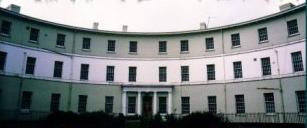
Horton
Road Hospital.
Samuel Hitch was resident medical superintendent from 1828 to
1845.
Rev. F.T. Bayly as Chaplain and S. Hiteth? (Hitch?) as Surgeon and
Superintendent of the Lunatic Asylum in Pigot's Directory for 1830
1841 As "the treatment is the most successful, the diet is
generous and nutritious, and the patients live as much as possible in the
open air", William Farr used to provide a
statistical "natural" death rate.
1844 accommodation for 261 (actual numbers below): 95 of each
sex,
paupers. 32 male and 39 female private patients.
1.1.1844 257
patients. 189 pauper and 68 private. Superintendent: Samuel Hitch, M.D.
Weekly charge for
paupers:: 9/- including clothes
Samuel Hitch was the founder of the asylum doctors' association in 1841. He was
a loud
campaigner on behalf of Welsh lunatics.
Statisticians used the
Gloucester Asylum death rate as the "natural" death rate for
lunacy - on the basis that Gloucester patients were well cared
for.
See below for history after 1844
First Gloustershire County Lunatic Asylum
1881 Census:
Gloucester County Lunatic Asylum, Wotton St Mary, Gloucester,
England. Assistant Medical Officers (both unmarried surgeons): William
Kebbell, aged 29, and Edward George Thomas, aged 27.
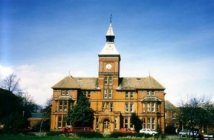
The second asylum became
Coney Hill Hospital, Coney Hill, Gloucester, GL4 7RQ.
[This external link should show Horton Road Hospital ringed
and position of Coney Hill Hospital]
Architect: Giles and Gough -
Broad Arrow
1971 Hospital Statistics group Coney Hill with
Horton
Road. The combined hospitals had 1,251 beds and 1,114 patients.
In
1979, Horton Road had 353
beds and Coney Hill had 467 for mental
illness. The Twyver Unit at Coney Hill had 60 beds for mental handicap.
Horton Road, the original asylum, closed in 1988. It is a listed
building. For plans to develop, see
Redrow developers
Coney Hill Hospital closed in the mid 1990s
Barnwood House Hospital for the Insane
Barnwood Road, Gloucester
A Hospital.
Opened 1860
1881
Census: Superintendent:
Fredrick Needham
Barnwood House Hospital for Mental and Nervous Diseases from an
unknown date to about 1948
Barnwood House Hospital
Hospital closed 1968
Manor House Nursing Home (Barnwood House Trust)
Closed 1977
Click here for the asylums in South West England that
did not.
Some of these will have received paupers at other
times.
The Finch family had asylums in
London and Wiltshire
William Finch
William Finch (surgeon), grandson of above, took over Laverstock in
1799. His name is on an advertisement of 26.12.1807
Entry in Fellows list of the R.M.+C.S. 1843: "elected 1841, William
Finch, M.D., F.L.S., Laverstock-hall, Salisbury."
William Corbyn Finch (born about 1800? died 7.1.1848, at some time
owned Laverstock
External Link: William Corbyn Finch -
archive
William Corbyn Finch (eldest son of above) was born 1833 in
Kensington and christened 17.1.1840 in
Fisherton Anger, Wiltshire.
Licensed House
Opened before 1779
1810 Female paupers from the
Isle of Wight
On
1815 list
Place: Laverstock. Name: Finch
1823 Laverstock House Lunatic Asylum, near Salisbury : for
the
reception of insane patients, under the immediate superintendence of
William Finch, M.D. Three page Prospectus written by Finch. Printed by
Brodie & Dowding, Sarum. [Cambridge University Library]
1825: 103 patients. Only provincial house apart from
Droitwich
with over 100.
1828:
Resident medical officer required by law
1831: 120 patients.
1840 Female paupers from the
Isle of Wight
1.1.1844 126 patients. 35 pauper and 91 private.
Proprietor: W. Finch MD.
Weekly charge for
paupers: 7/6d to 8/- (including clothes)
1860 Our holiday at Laverstock House Asylum; how we visited
Stonehenge, and what we learned there by John Stevenson Bushnan. 67
pages. London: Churchill
1870: Licensed to Dr S L Haynes
1881 Census Henry John Manning, age
45, born St Pancras, Middlesex. Medical Superintendent MRCS, and Ellen
Frances Manning, his wife, age 36, born Marylebone, Middlesex. Daughters
born Laverstock: Grace Ellen
(age 12) and Mary Agnes (age 9), plus their Governess,
Inez Uhlhorn, aged 20, born in Hanover. Mary Haynes, Mother In Law, age
63, born St Giles, Middlesex, and Jane Adela Haynes, Sister In Law
(unmarried), aged 28, born Marylebone, Middlesex.
1955: Closed.
Not shown on 1815 list, although claims to have been founded
1813
Open by 1826
Licensed House
1.1.1844: 112 patients. 90 pauper and 22 private.
Proprietor W.C. Finch M.D.
Weekly charge for
paupers: 8/- (including clothes)
1850 One of three licensed house
outside London named as especially defective in the Lunacy Commission's
Report. The other two houses named were
Belle Vue and
Kingsland Workhouse
.
(Parry-Jones, W.L. 1972 p.255)
"Largely because of the overcrowding of the Bethlem criminal lunatic buildings, official
arrangements were made in 1850, for the reception in special wards
at
Fisherton House, of a number of harmless criminal lunatics from Bethlem and
from asylums in other parts of the country"
Parry-Jones, W.L.
1972 p.66)
1859 national
comparisons
1870: 616 patients, 502 of them paupers (Parry-Jones Table
6)
1870: Licensed to W C Finch (surgeon)
and Dr J A Lush M.P.
Reception of criminal lunatics had ceased by 1872
1877-1878
Dr Lush a member of the Select Committee of the House of
Commons inquiring into the operations of Lunacy Law so far as regards
security afforded by it against violations of personal liberty
"During the period 1878 to 1890, Fisherton House was
licensed to receive 672 patients, including 542 pauper or criminal
lunatics, making it
the largest private licensed house ever known in this country"
Parry-Jones, W.L.
1972 p.43)
1880 Patients from Portsea Island moved to the new
Portsmouth Lunatic
Asylum
1881
Census Fisherton House Asylum, Fisherton Anger, Wiltshire.
Two Medical Officers, both unmarried, both born London, Middlesex, and both
Surgeon MRCS ELSA: Henry Baskcombe Harrison, aged 32 and Henry Joseph
Hind, aged 28
1885-1902
imbecile patients from Westminster
1911 Rules for the attendants at Fisherton Asylum,
Salisbury 28 pages. Bennett Bros. Salisbury
1913 Charles Stanford Read, MB London, MRCS, LRCP (born 1871),
was Assistant Medical Officer. He went on to be Officer in charge of
D Block, Netley, for the
greater part of the war.
1920 Charles Stanford Read, Physician, Fisherton House Mental
Hospital, Salisbury published
Military Psychiatry in Peace and War
Taken over by the Ministry of Health in 1954. It became the
Old Manor, Wilton Road, Salisbury, SP2 7EP
(map)
Opened 1718
Licensed House
On
1815 list
Place: Fonthill. Nane: Spencer
1.1.1844 4 patients. 1 pauper and 3 private.
The mid-Wiltshire asylums. Belle Vue and Fiddington were considered
by the Metropolitan Commissioners in 1844 as amongst the best outside
London. Both had large farms which
provided employment for their pauper
patients. The proprietors were non-medical men, but the houses had
"resident physicians or apothecaries" (1844 Report p.41). Both provided a
good diet for their pauper patients, and the commissioners commended their
dormitories, saying they had "seldom seen any sleeping rooms for paupers
more comfortable, and more cleanly or better ventilated, than some of the
dormitories in the licensed house at
Bethnal Green,
Fairford, Devizes and Market Lavington".
(1844
Report pp 12-13)
Belle Vue, Devizes, Wiltshire
Licensed House
1.1.1844 156 patients. 148 pauper and 8 private.
The provincial licensed house with the most pauper patients, but not
many more than
Fiddington House
ON 1844 LIST OF BEST CONDUCTED.
HAD A FARM.
Proprietor: T. Phillips (Surgeon) [This is given on page 213 of the
1844 Report. Page 41 (see above) says the proprietor was non medical]
Weekly charge for
paupers: 8/- (including clothes)
1850 One of three licensed house
outside London named as especially defective in the Lunacy Commission's
Report. The other two houses named were
Fisherton House and
Kingsland Workhouse
.
(Parry-Jones, W.L. 1972 p.255)
1853 Commissioners recommended closure of the pauper department,
but the justices re-licensed it. .
(Parry-Jones, W.L. 1972 p.255)
Licensed House
1.1.1844 180 patients.
144 pauper and 36 private.
Proprietor: R. Willett
Weekly charge for
paupers: 8/-
ON 1844 LIST OF BEST CONDUCTED.
HAD A FARM.
William Charles Hood, a resident physician at Fiddington House, became
medical superintendent of the second Middlesex County Asylum in June 1851,
then superintendent of Bethlem, then Lord Chancellor Visitor in Lunacy.
1851 Census
Worthy Dunford
(christened Great Cheverell 3.7.1825, died 1885, married Mary
Watts, 1.11.1849 in Great Cheverell) was Assistant at Lunatic Asylum
(Fiddington Parish. Wife and baby Benjamin at home in Great Cheverell). By
1861, he was a millwright in Great Chervil. In 1881, he and daughter Emily
are at Great Cheverell, but his wife Mary is a patient in Devizes Lunatic
Asylum.
1870: Licensed to Dr C Hitchcock
(See Kingsdown House)
1881 Census Fiddington House,
Lavington West:
Charles Hitchcock, widower, age 69, born Bushton Clyffe Pypard, Wiltshire,
Physician MRCL FSA RCP. Elizabeth Watts, House Keeper, widow, age 46, born
Market Lavington. Hospital Matron. George Gusdale Hicks, Boarder, age 45
Coberley, Gloucester, Clergyman Without Cure Of Souls. Other inmates are
entered as Patient.
Wiltshire County Asylum, Devizes opened 19.9.1851. In 1858 it had 350
patients. Became Roundway Hospital, Devizes, Wiltshire.
1881 Census:. "Wilts County Lunatic Asylum"
Devizes St James, Wiltshire. Medical Superintendent
Edward Marriott
Cooke, physician aged 29, born Gosport, Hampshire, living with
his wife,
Mary Anne Henrietta
Cecil Cooke, housewife aged 30, born Reading,
Berkshire, and two local women as cook and housemaid. The patients in this
asylum are listed by names not just initials.
There is a book: Down Pans Lane - Wiltshire County Asylum, Roundway
Hospital
1815: Proprietor "Mr Gillett" (presumably
Joseph Gillett)
who Edward Wakefield told the 1815
Select Committee "bragged of having been a keeper at
Bethlem, and was sent from that hospital to
Exeter Asylum, from whence he came to keep
this house for himself"
Succeded as proprietor by W.E. Gillett
1828 Business moved to Fairwater House
Parry-Jones,
W.L.
1972 p.80)
Licensed House
1830 Pigot's: William Edward Gillett Fairwater house lunatic
asylum
1.1.1844 52 patients. 6 pauper and 46 private.
Proprietor: W.E. Gillett, surgeon
It seems the buildings are now part of Taunton School. See Ben
Grove's web site, which says:
"Originally Taunton School was an asylum but later it became a small
school. Founded in 1847 ... it was originally in houses in Wellington Road.
The present school opened in Fairwater House in 1870"
Somerset County Asylum for Pauper Lunatics opened 1.3.1848 at
Wells. Built for 400 patients, it had 416 in 1858. Situated close to
Wells.
Architect: Scott &
Moffatt. Later additions by
Hine
Corridor form
Became Somerset and Bath Asylum about 1880 (named used by
next asylum from 1897)
Wells Mental Hospital by 1929
Photo: "The Mental Hospital Wells December 1933" Stage performance
Photo: "The Mental Hospital Concert Party December 1934" Violinist
Joseph Hall.
21.10.1939: Bosley family move to Mendip. Soon after "with
already approximately 950 patients of its own,
Park Prewett Hospital, Basingstoke, was converted into a
military hospital, so all the patients (but without the staff) were
evacuated to Wells. There were now 1,300 patients"
1960s? Pantomimes: "The pantomime was held in the Hall
throughout the week bordering January and February. Three nights were for
patients from Mendip,
Tone Vale (near Taunton),
Fishponds and other
hospitals including the Priory Hospital in Wells, and for the Darby and
Joan clubs, Coaches came from quite a distance"
Mendip Hospital, Bath Road, Wells, BA5 3DJ
Closed 1991 "Now sympathetically restored" (Peter
Cracknell)
2000Memories of Mendip Hospital by Josie Bosley,
published by Gerald
Burton
The website of the Friends of Mendip Hospital Cemetery contains some
history
Architect:
Giles, Gough and Trollope
Compact Arrow design.
Until 1948 known as Tone Valley Hospital or Tone Vale
Hospital
1960s
Pantomime trips to Mendip
Tone Vale Hospital, Norton Fitzwarren, Taunton, TA4 1DB
Now closed. The building is to be redeveloped as apartments. (Autumn
2002: reported developed)
The website of Cotford St Luke's Residents Association has pictures
. The stonework on the front of the clock tower has 1896
engraved on it.
Durham University researched the transition from asylum to community care
.
The hospital
appears to have served
Dorset,
Somerset,
Devon and
Cornwall
Bowhill House purchased in
1801
for use as an asylum.
Cost about £2650, including the cost of the furniture & repairs.
Joseph Gillett as Director was recommended by
John Haslam of Bethlem.
Mrs Gillett was housekeeper.
By 1815 Mr Gillett had
established his own asylum.
July 1817
answers enquiry about religious provision
1823 Paupers confined to the 15/- class, wheras previously they
could be in the 10/6d class, now reserved for poor non-paupers.
(Hervey,
1980, p.18)
1824 Under influx of parish applications for pauper admissions,
Governors complain that the county ought to have a county asylum
(Hervey,
1980, p.6)
1830
Stoke Damerel opened
1835
Plympton opened
1.1.1844 48 patients. 1 pauper and
47 private.
Superintendent: Luke Ponsford, Surgeon
Weekly charge for paupers 15/-
July 1845
Devon County Asylum opened. Pauper lunatics
removed from St Thomas's "as the majority were incurable" Nick Hervey
(1980
p.58). Nick says that before 1845, St Thomas's "took as many paupers as
their finances could sustain, and as many as their parishes would support"
Became Wonford House Hospital
Simon Cornwall:
Wonford House built: 1865. Architect: WF Cross
In
1979: Exe Vale Hospital (Wonford Branch), Dryden
Road,
Wonford, Exeter, EX2 5AF
1979:
110 beds
Hervey, N.B. 1980
Bowhill House. St Thomas's Hospital for Lunatics. Asylum for the Four
Western Counties. 1801-1869
Simon Cornwall:
Leased to a mental health trust. Not expected to close.
Opened 1830?
1.1.1844 23 patients, all pauper.
A Licensed Workhouse Asylum
Licensed House
Opened 1835
A mansion and outhouses
asylum
1838: Thomas Harpur,
criminal
lunatic, recorded "Lunatic Asylum,
Plymouth"
1839: William Arnold, criminal lunatic, recorded "Lunatic
Asylum, Plymouth"
1844 Proprietor: R. C. Langworthy,
surgeon.
1.1.1844 83 patients. 66 pauper and 17 private.
Admission
charge for paupers:
£1..1/-. Weekly charge for paupers 10/6d
excluding clothes. The same as
Cornwall County
Asylum). Apart from
St Thomas's (15/-) the only known
higher charges in England were
Hereford
and the charges of some County
Asylums for paupers from outside the county.
SEVERELY CENSURED IN 1844
REPORT
Conditions in 1842-1843 and the commission's efforts to
improve them
29.12.1845 Mr Richard Langworthy authorised by the Lunacy
Commission to "retain as servants two female pauper patients still insane",
given they were discharged first, entirely free from restraint or control
as patients and their employment would be of advantage to them and not
injurious to other inmates.
1870 Plympton House, Plympton, Devon
licensed to S Langworthy (surgeon)
Devon County Asylum opened July
1845
Simon Cornwall:
Built: 1842-1845.
Kensington Taylor website (has picture)
"Charles Fowler, the architect of Covent Garden Market", designed
it on concept "of radiating wards around a central administration and
service block"
Peter
Cracknell classifies as
Radial design.
About 1875 G. Symes Saunders was Superintendent
Became Devon Mental Hospital by 1929 and Exe Vale Hospital
(Exminster Branch) by 1973 until 1981 when it became Exminster
Hospital, Exminster, near Exeter, EX6 8AB.
1979:
784 beds
Closed 1985
Simon Cornwall: Sold
in late 1980s, roofs stripped, appears now to be housing.
web link to Kensington Taylor architect
Became Exeter City Mental Hospital by 1929. Digby Hospital from
1949 to 1961). Exe Vale Hospital, Digby Branch (1962 to 1982/1986),
then Digby Hospital, Woodwater Lane, Exeter, EX2 7EY
1979:
301 beds
at Ivybridge
Became Plymouth Mental Hospital in 1918, and then Moorhaven
Hospital Ivybridge, (PL21 0EX)
map shows position on edge of moors
Closed 1993 and developed into Moorhaven Village (housing)
(external link -
archive)
Royal Naval Hospital, Stonehouse
A
County/Subscription Hospital
It appears (below) that subscriptions for an asylum commenced before
the decision to construct a county asylum
The archives for R Rogers and Son, Solicitors in Helston (Lands End end
of Cornwall) include
correspondence from September 1807 to February 1808 re committal of John
Cornish, resident at East Stonehouse (Plymouth, Devon), chargeable to
Helston, to
Exeter lunatic asylum ("seized with a down right madness in his
brain")
Administrative records from
1809. "Foundation Year: 1815" The following
from Cornwall Quarter Sessions Records Order Books [reference QS/1]
catalogue of Cornwall Record Office:
Bodmin: 2.10.1810: Following
Act to deal with maintenance of pauper
and criminal lunatics, notice to be given in local newspapers
that
consideration to be given at next sessions at Lostwithiel on
15.1.1811 for providing a lunatic asylum. Bodmin:
8.10.1811: Four magistrates to form committee to consider the
proposal. Robert Walker, clerk. To report proceedings at an
adjournment of the sessions at St Austell on 26.11.1811.
Lostwithiel:
14.1.1812: Resolved unanimously to establish lunatic
asylum in county to provide for number of lunatics, not to exceed seventy.
Also resolved "with the view of extending the benefits of such an asylum to
Lunatics of a Higher Class who are not objects of the Poor Rate" to
continue the voluntary contribution already in existence. Committee of nine
Visiting Justices appointed to superintend building and management of the
asylum. Committee of five JPs appointed to confer with committee of
subscribers for benefit of "Higher Class" lunatics. Chairman requested to
tell Lord Warden of the Stannaries of the court's appreciation of the fact
that the
Prince Regent [Duke of Cornwall, a large part of whose income
came from the County] had agreed to be patron of the intended asylum.
Opened
1820.
Accommodation
for 102
Radial and
Corridor form
1.1.1844: 153 patients. 133 pauper and 20 private.
Weekly charge for
paupers: from outside Cornwall: 10/6. (Cornwall
paupers: 5/6d)
[Notice that Plympton
House, in Devon, charged the same for paupers as Cornwall County
charged for paupers from outside Cornwall]
Became St Lawrence's Hospital, Westheath Avenue, Bodmin, PL31
2QT
Autumn 2002: Reported closed, empty building fire damaged.
A Workhouse Asylum
"Wards exclusively appropriated to
lunatics"
(1844
Report
p.10)
Visited 6.10.1843
(1844
Report
p.232)
41 Insane paupers (of whom six were idiots), but also "5 others of weak
intellect, and unable to take care of themselves" who had not been included
in the return of lunatics made to the Clerk of the Peace in 1842.
"Several of them were violent, and at times required restraint"
(1844
Report
pp 98 + 232)
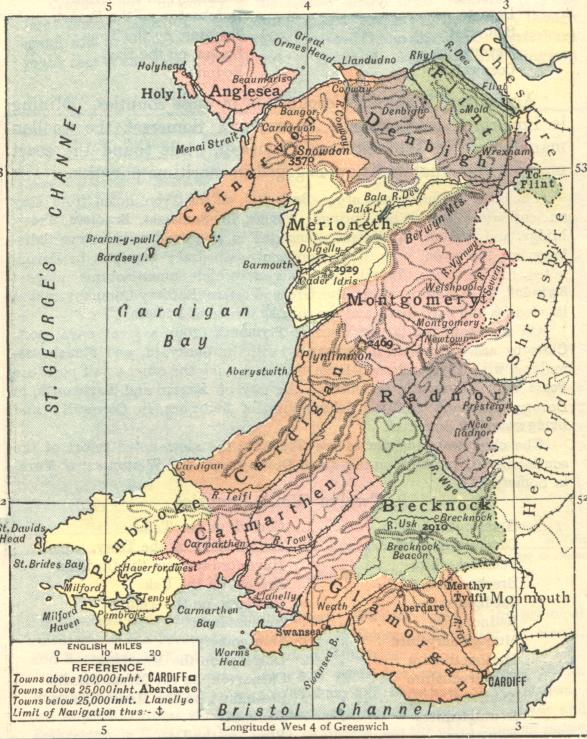
For central Wales: An adequate
Shropshire Asylum (England) offically opened
on
28.3.1845.
An
earlier proposal (July 1842) that Montgomery and
Shropshire
should share
the costs had fallen through mainly because of the constraints of
two languages. "Welsh patients would have been treated as one class".
Agreement was eventually reached between the English and Welsh counties in
April 1846. Joint provision meant an additional wing had to be
built.
Shropshire and Wenlock Borough Lunatic Asylum (1845-1846)
Shropshire and Montgomeryshire Counties and Wenlock Borough Lunatic
Asylum (1846-1851)
Shropshire and Montgomeryshire and Wenlock Borough,
Shrewsbury and
Oswestry Lunatic Asylum (1851-1863)
Lunatic Asylum for the Counties of Salop and Montgomery, and for the
Borough of Much Wenlock (1864-1911)
1881
Census: Pauper Lunatic Asylum, Bicton Heath, Shrewsbury
(Shrewsbury St Julian) Shropshire. Physician Superintendent: Arthur
Strange (aged 37, married)
"In 1911 the agreement between Salop and Montgommery was dissolved.
resulting in 149 Mongomershire patients being transfreed to other asylums"
[Note Mid Wales] "and releasing more places for Salopians."
--
The history continues below --
begining of 1844
Haydock used
Summer 1844
Welsh lunatics on outdoor
relief
1845 Like a thief in
the night
12.6.1846
Petition of Owen Owen Roberts
Corridor form
22.7.1873 Archives XQA/G/170 Letter from Mr Robinson (Clerk to
the visitors, the North Wales Counties Lunatic Asylum) to Mr T. Poole,
Esq., Clerk of the Peace, Caernarfon, stating that the rate of payment, for
Pauper Patients will be increased from 8/2d to 8/9d per week.
1881
Census: North Wales Counties Lunatic Asylum, Denbigh,
Denbigh, Wales. The Medical Superintendent, William Williams (aged 35,
unmarried) was being visited by his cousins, Hermina Eleanor (aged 13) and
Elizabeth Maude (aged 11) Williams on census night.
1900 Archives X/POOLE/825 Circular letter from the Clerk of
Caernarfonshire County Council re the proposals for an Act for the
dissolution of a Joint Counties Union for the North Wales Counties Lunatic
Asylum
1.1.1914 Archives ZQS/H.1914/9 List of Pauper Lunatics in the
North Wales Counties Lunatic Asylum, Denbigh. Attached: Note from the
Asylum's Clerk with tables showing the number of patients. Attached: Table
showing the Quota of Patients for Denbigh, Flint, Anglesey, Caernarfon and
Merioneth [Meirionnydd], also the number of Patients belonging to each
county resident in the Asylum.
1914 Hilary Archives ZQS/H.1914/34 Report of the representatives
appointed by the County Council to attend a conference, convened by the
Committee of Visitors of the North Wales Counties Lunatic Asylum at Denbigh
on the steps to be taken to administer the
Mental Deficiency Act, 1913.
1925: The Branch Secretary of the Denbigh branch of the
National Asylum Workers Union was Mr T. Hughes, who lived at 1 Brynnffynon
Terrace, Denbigh
1.1.1927: 1,078 patients of whom all but 126 were Rate
Aided.
541 were men, 537 women. In 1926 the
proportion of recoveries to admissions was 40.2%. The proportion of deaths
to the asylum population was 7.8%
December 1927 Name given as the North Wales Counties Mental
Hospital on a patient's death certiicate
By 1948 the North
Wales Hospital for Nervous and Mental Disorders.
1974 Article by M.R. Olsen "Founding of the Hospital for the
Insane Poor, Denbigh" in Denbighshire Historical Society
Transactions volume 23 (1974), pages 193-217.
From about 1981) the North
Wales Hospital, Denbigh, LL16 5SS. (LL16 5SR locates site)
map
Closed 1995
Autumn 2002 information: "architecturally superb remains
standing
although neglected whilst its fate is undecided". External link
Visit Denbighweb.
CLick Buildings/PLaces for pictures of the asylum.
North Wales Hospital Historical Society
Hospital records are at Gwynedd Archives, Caernarfon Record Office
Archon Code : 219.
(website)
1881 Census: Joint Counties
Lunatic
Asylum, Abergavenny, Monmouth, Wales. Medical Superintendent not recorded.
Assistant Medical Officers: James Glendinning, (unmarried, aged 34, born
Scotland) and
William F. Nelis (unmarried, aged 34, born Victoria, Australia).
The census gives the full names of patients in this asylum, not just
initials as is usual with asylums.
just Monmouthshire Lunatic Asylum from 1897.
1901 Census William F. Nelis M.D.(Durham), L.R.C.P.(Edin.),
County Lunatic Asylum, Old Monmouth Road
It was Monmouthshire Mental
Hospital from 1916 to 1923. Pen-Y-Val Hospital until 1950, and then
Pen-Y-Fal Hospital, Old Monmouthshire Road, Abergavenny, NP7 5YY
County Asylums website
Compact Arrow
Architect: Alfred J.
Wood FRIBA, of London
photograph during construction on
Caerleon.net
1934
John's Directory of Caerleon on
Caerleon.net "NEWPORT ASYLUM. - Accommodation is provided for
368, with administrative offices sufficient for 500 patients. Dr. Magnus
Mackay, resident medical officer; and Mr. J. Bass, clerk"
1949/1950
Christmas Party photograph on
Caerleon.net
1971: 462 beds
31.12.1977: 402 beds
Hospital website
County Asylums website
[Help from Terry Williams 19.10.2006]
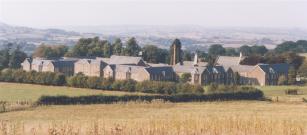 In 1903 a
Mid Wales Counties Mental Hospital opened at Brecon (also
called
Brecon and Radnor Asylum). ["Talgarth, Brecon and Radnor Asylum was
opened around 1900 (1901 over the door) It closed about April 2000."
(geomancer - asylums forum)]
In 1903 a
Mid Wales Counties Mental Hospital opened at Brecon (also
called
Brecon and Radnor Asylum). ["Talgarth, Brecon and Radnor Asylum was
opened around 1900 (1901 over the door) It closed about April 2000."
(geomancer - asylums forum)]
Compact Arrow design.
Now Mid Wales Hospital,
Talgarth,
Brecon, LD3 ODS.
31.12.1977: 422 beds
1979 Listed under Powys Health Authority. The only mental
illness hospital. Powys appears to be
the old
Brecknock, Radnor and Montgomery
"A small welsh county asylum". Considered surplus to
requirements about 1994, put on the market in 1997 and sold in 1999,
It was considered as a Prison or for Asylum Seekers, but rejected for both.
Owned by
PRYA, various businesses are located there. The picture was
taken by Nigel Roberts. (map) -
(multimap).
Powys Tourist Board has a map
Corridor form -
Too large for Conolly's ideal
1865: Carmarthen, Cardigan and Pembroke County Asylum
Jonathan Marsden, Vicar of Llanllwch
(SA31
3HB) from 1869 to 1922 was chaplain to the "Joint Counties Asylum".
by 1929: Joint Counties Mental Hospital
1881 Census: Joint Counties
Asylum,
Carmarthen, Carmarthen St Peter, Carmarthen, Wales. Medical Superintendent:
George Jonathan Hearder (age 41, married)
1948: became St David's Hospital, Jobs Well Road,
Carmarthen
(Caerfyrddin) SA31 3HB.
map.
1956-1958 "Nurses
did far more than
they were paid to do... but.. the fear of going back is
strong"
It had 940 beds
in 1971.
Was expected to close in 2003, but in Autumn 2002 reported to be
already closed, but standing empty.
Opened at Angleton, Bridgend, 4.11.1864 (Renamed
Glanrhyd
by or in 1948)
map
1881 Census: Glamorgan
County Lunatic
Asylum, Near Bridgend, Newcastle Higher, Glamorgan, Wales. Henry Turnbull
Pringle (married, aged 40) was the Physician Superintendent. His wife doe
not appear to have been at home on census night and a nurse was caring for
his one year old son.
1887 An additional hospital, Parc Gwyllt opened nearby.
(renamed Parc by or in 1948)
map (Angleton can be seen on the west
border
of the map)
Known as Angelton and Parc Gwyllt from 1887 to 1922
Known as Glamorgan County Mental Hospital from 1922 to 1948
1901 There is an entry for Glamorgan County Lunatic Asylum,
Higher Coyty in the 1901 Census
1905 civil parish of Bridgend formed out of portions of the
parishes of Newcastle and Coity.
1911
Encyclopedia Britannica:
Bridgend (Welsh name Penybont-ar-Ogwr) is a market town straddling the
river Ogwr. 1901 population of urban district: 6,062. "Just outside the
town at Angelton and Parc Gwyllt are the Glamorgan county lunatic asylums."
1934 Penyfai, a new hospital for admissions, opened on
the Glanrhyd site
1948: Glanrhyd and Parc and
Penyfai
became Morgannwg Hospital
In
1979, Morgannwg
Hospital consisted of Glanrhyd Hospital (416
beds) and Penyfai (161 beds), both at Bridgend, CF31 4LN, Mid Glamorgan,
and Parc Hospital (845 beds), Bridgend, CF35 6AP
Parc and Penyfai are closed. Glanrhyd Hospital is active
(website)
Compact Arrow design.
(Welsh Metropolitan War
Hospital from 1915 to 1919).
(Whitchurch Emergency Hospital 1939 - 1945)
Cardiff City Mental Hospital (1945 - 1948),
Whitchurch Hospital 1948.
Whitchurch, Cardiff, CF4 7XB
Autumn 2007 Start of
Whitchurch Project
Licensed House
AN
A mansion and outhouses
asylum
Opened 1843
(1844
Report
p.200)
1.1.1844: 3 patients. 2 pauper and 1 private. In 1858
209 patients. 183 pauper and 26 private.
1859 national
comparisons
1870: 120 patients, 54 of them paupers (Parry-Jones Table
6)
1881 Census: "Asylum", Briton
Ferry,
Glamorgan, Wales. Charles Pegge (aged 47, married) Surgeon and Asylum
Proprieter.
Haverfordwest, Pembrokeshire, South Wales
Made a
"County
Asylum" under a local
Act in 1822
Formerly a small gaol for the criminals of the town. No
addition or alteration was made to the building when it was taken over for
the confinment of pauper lunatics. The corporation contracted with a
private individual to supply all food and other necessities and employed a
husband and wife at £20 a year as the asylum staff.
"The borough gaol and house of correction, a modern building situated on
St.
Thomas' Green, in the upper part of the town, is now, by a recent
act of parliament, devoted to a lunatic asylum, as well for Pembrokeshire
as for
Haverfordwest; and by the same act the common gaol and house of correction
for
Pembrokeshire, to the purposes of which the remains of the ancient castle
have
been assigned, are appropriated for the reception of prisoners both for
Pembrokeshire and Haverfordwest: the buildings are well calculated for the
classification of prisoners, and comprise eight wards; two work-rooms, one
for
males and one for females; eight day-rooms and eight airing-yards, in one
of which
is a tread-mill."
1844 Report: Superintendent: G. Hampson. 1.1.1844 17 patients. All
pauper.
Today, a
"former lunatic asylum"
has been identified.
Hospital Scandal
-
Bopcris
Closed 1996. Address was Ely Hospital, Cowbridge Road West, Cardiff,
CF5 5XE.
Still active.
(website)
Opened 1948
Still active
(website)
A house, built about 1667, was demolished in 1858 and rebuilt in 1858.
St Andrew's Hospital, Northampton owned
the
house from about 1900 to the early nineteen sixties, and provided care for
middle class residents with mental health problems. The house was
demolished in August 1967 and the site used to construct the last
National Health Service mental handicap hospital to be built - (see 1971 change of
policy). It opened in 1971. People were moved into the
hospital
from Oakwood
Park, near Conway, and
Garth
Anghard near
Dolgellau. Bryn-y-Neuadd has villa style accommodation in wooded grounds.
There were 233 patients on 31.12.1971, and it carried on growing. But
resettlement from the hospital began almost as soon as it opened, as, in
the 1970s, adults with low dependency moved into the community. There were
350 beds on 31.12.1977. By the mid 1980s all children, except one, were
found successful placements in the community. But on 30.9.1989 there were
still 208 people living there long-term. 102 still lived there in January
2001. They came, originally, from a wide area: Ynys Mon, Gwynedd, Conwy,
Denbighshire, Flintshire and Wrexham will all be involved in finding them
new homes by 2005/2006.
access to consultation document
Licensed House at one time a
Hospital.
Founded
1797
under the auspices of the governors of Hereford Infirmary (founded
1776) with funds raised by voluntary contributions. Fund to set up asylum
was begun in 1777, but took until 1792
to collect enough money to begin work. A two-storey building, in
the grounds of the Infirmary, designed by John Nash and built by Mr
Knight. The resident superintendents
suite of rooms was at the front of the building. 20 patients could be
accommodated.
In 1802 licensed to a
physician and surgeon who were to run it jointly as a private house. The
building was still owned by the infirmary's governors. It was extended in
1838.
History to 1839
1839 Select Committee
of the
House of Commons Hereford Lunatic Asylum
Proprietor (1844) J. Gililand (Surgeon).
1.1.1844 35
patients. 28 pauper and 7 private.
Weekly charge for
paupers: 10/- to 12/-
excluding clothes. [Highest recorded for a private pauper house at this
time. See Plympton House,
Devon]
Following the 1845 County Asylums Act, it was decided that the counties
of Herefordshire, Monmouthshire, Breconshire and Radnorshire, plus the city
of Hereford, would form a union to build a joint asylum at
Abergavenny. This opened 1.12.1851 "and the last patient was
discharged from the Hereford asylum in January 1853, and it was
demolished soon after".
Licensed House
1.1.1844 18 patients. 9 pauper and 9 private.
Later Portland House
1859 national
comparisons
From 1851, Hereford county shared the joint
Monmouth,
Hereford, Brecon and Radnor County Asylum at Abergavenny
By 1864, Abergavenny was overcrowded, and Hereford city and Herefordshire
decided to build their own asylum.
The Builder 21.3.1868 Competition for
Hereford Lunatic Asylum (work began in 1868)
Hereford County and City Lunatic Asylum
Burghill, three miles north of Hereford [HR7 4QN]
opened in 1871
see Historic Hereford Online
Architect:
R. Griffiths of Stafford.
Corridor form -
Small enough for Conolly's ideal
1875: The fourth annual report of the committee of visitors
of the Hereford City and County Asylum at Burghill, near Hereford
Printed at the "Hereford Times" offices, 1876, 50 pages. Consists of a
list of committee members, the report of the committee of visitors (Archer
Clive, chairman), report of the Commissioners in Lunacy (Charles Palmer
Phillips, John D. Cleaton), report of the medical superintendent (T.
Algernon Chapman), the report of the chaplain (C.H. Bulmer), statistical
tables and financial statements
(Wellcome Library catalogue)
1881 Census: Thomas A. Chapman,
Medical Superintendent (married), living with his mother and sisters. [I
have not found the asylum. They are living in a separate house]
1900 Extension by
Giles, Gough and Trollope
In
1901 census: Hereford County
and City Asylum. Note ecclesiastical parish is
St Mary.
St Mary's Asylum
1.1.1927:
509 patients of whom all but 33 were Rate Aided. 206
were men, 303 women. In 1926 the
proportion of recoveries to admissions was 33.3%. The proportion of deaths
to the asylum population was 5.7%
31.12.1960 "Burghill" 655 beds. Expected to reduce to 231
by 1975
Became St Mary's Hospital, Burghill, near Hereford, HR7 4QN
31.12.1977: 327 beds
Closed 1994
Herefordshire MIND and Logaston Press published a book of the memories
of ex patients and staff in 1995, entitled, "Boots on! Out!
Reflections on life at St. Mary's Hospital." The interviews cover a period
of more than forty years.
See external link
Public Health in Herefordshire in the 19th
Century
Archives believed to be in Hereford Record Office
Holme Lacey, near Hereford
Two archives in Hereford Record Office:
1934: architectural plans
1950-1975: staff registers, Burghill and Holme Lacy Hospital
House committee minutes
31.12.1960 106 beds. Expected to close before 1975
about 1978 100 amenity (section 4) beds for mental illness
31.13.1960: Alton Street: 127 beds
31.12.1977: Dean Hill Hospital: 112 beds "Mental Handicap and
Geriatric"
1997 Building demolished to make room for Ross Community
Hospital.
(Ross Town Walk)
House of Industry, Kingsland, Shrewsbury, Shropshire
History on
Peter Higginbotham's website
"The local workhouse (House of Industry) for Shrewsbury was situated in
Kingsland and is now the main building of Shrewsbury School. Kingsland
Lunatic Asylum was attached to the workhouse in the early 1830s and was
possibly paid for by individual subscription" Rosie Barnes 1998 p.1
A Licensed Workhouse Asylum
1.1.1844 90 patients. 79 pauper and 11 private. Sometimes
received Welsh paupers
(1844 Welsh
Report p.5)
1850 Kingsland Asylum, Shrewsbury, one of three licensed house
outside London named as especially defective in the Lunacy Commission's
Report. The whole establishment was considered unsuitable for the reception
of lunatics. The gutters, privies and airing-courst were dirty and
offensive, the drainage deficient, the walls damp and the clothing and
bedding filthy and inadequate. The other two houses named were
Fisherton House and
Belle Vue House in Wiltshire.
.
(Parry-Jones, W.L. 1972 p.255)
History on
Peter Higginbotham's website
A Licensed Workhouse Asylum
1.1.1844 15 patients. 13 pauper and 2 private.
Shropshire County Asylum opened in March 1845, becoming
Shropshire and Montgomery County Asylum in 1846. It was
the first county asylum provided for part of
Wales and continued as a jount English/Welsh asylum until 1911.
Its history from 1845 to 1911
is outlined above.
Shropshire and Borough of Wenlock Lunatic Asylum
(1911 to 1921)
In 1911 -
765 patients were resident - 332 male and 433 female
which included 28
private class, and 7 criminals.
(Rosie Barnes 1998 p.13)
Salop Mental Hospital (1921-1948)
Copthorne and Shelton Emergency Hospital (1940-1941)
Shelton Hospital (1948-)
26.2.1968 Fire kills 24 patients.
(external BBC link)
Rosie Barnes 1998 (pages 47-48): The fire on
Beech Ward brought the highest hospital death toll in Britain for 14 years:
24 dead and 11 seriously injured. The evidence suggests that the fire began
with a lighted cigarette smouldering in a chair for some time before
igniting it. Patients were not killed by the flames, but by toxic fumes..
Beech Ward was a locked (closed) ward. Due to overcrowding, beds were 'top
to tail' along the window wall. All the patients sleeping in those beds
died of asphyxia and carbon monoxide poisoning. The fire was reported in
local and national newspapers, on radio and television, and as far away as
America. As a result, many of the fire procedures in hospitals throughout
the country were evaluated and updated.
September 1975 Retirement of the last
Medical Superintendent. Dr
Littlejohn
The
hospital is now the Royal Shrewsbury Hospital (Shelton), Bicton
Heath,
Shelton.
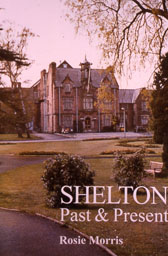
"Wards exclusively appropriated to lunatics
(1844
Report
p.10)
Visited 29.9.1843
(1844
Report
p.234)
"there were
seventy-one insane persons, subject to insanity in various forms; several
of them being epileptics, liable, after their paroxysms of epilepsy, to
fits of raving madness, during which they were usually excessively violent,
and some of them under great excitement, and furiously maniacal."
(1844
Report
p.98)
"The land around Winson Green was unsuitable for agricultural use and was
deemed a favourable location for the public institutions that a developing
city required. In the early 19th century Birmingham was having to send its
prisoners to the County Gaol at Warwick. In 1844 the council resolved to
build a gaol within the borough. Mayor Thomas Philips laid a foundation
stone at Winson Green on October 29th 1845 but the prison took four years
to complete. Built on the Pentonville model, Winson Green Prison cost some
£60,000. The first inmate was interned on October 17th 1849. The gaol
was
followed by the Borough Lunatic Asylum which opened the following year.
Construction had started in 1847 to the designs of D.R.Hill who was also
the architect for the prison. The Corporation resolved to erect the
Birmingham Union Workhouse next to the gaol and asylum. Designed by John
Jones Bateman, the building was opened on March 29th 1852. Bateman worked
on a number of Birmingham Gothic buildings, notably the Unitarian Church of
the Messiah in Broad Street. By the mid-1880's much of the workhouse was
given over to sick wards and in 1890 a dedicated infirmary had to be
constructed to meet the needs of the sick. The concentration of public
buildings inevitably led to the urbanisation of the local area. This was
compounded by the arrival first of the canal and later the railway.
"
Licensed House
opened 1835 for 18 paupers (closed 1865) "formerly the villa of
a banker, in the suburbs of Birmingham" .
Parry-Jones, W.L. 1972 pp 58 + 176 + 190
Number of patients admitted 1835-1841 (seven years): 353. Outcome of
treatment: discharged cured 112; discharged improved 24; discharged not
cured 83; died 56; remaining under treatment 78.
This from an handbill advertisement issued by the proprietors which
also contrasts with
Hanwell: for last three
months of 1841, average patients in Hanwell 992 of whom four were
discharged cured and two improved. Duddeston Hall, same period, average
patients 88 of whom seven were discharged cured and two improved
Parry-Jones, W.L. 1972 p.205 (Handbill:
Warwickshire County Record Office, QA.24/a/I/5)
1842: Licensed for 99 patients.
Parry-Jones, W.L. 1972 (pp 40-43) suggests
this was to avoid the requirement for a
resident medical officer
About 1842 Rules and Regulations for the Male and Female
Keepers and Servants, at Duddeston Hall Lunatic Asylum (Warwickshire
County Records Office, Quarter Sessions lunacy records), reproduced
Parry-Jones, W.L. 1972 pp 190-192)
1.1.1844 80 patients. 60 pauper and 20 private. Weekly charge for
paupers 10/- including clothes.
Proprietor (1844) Messrs Lewis.
A mansion and outhouses
asylum.
"established and
carried on" in connection with
Birmingham Workhouse
which sent
unmanageable patients and took them back when tolerably tranquil.
(1844
Report
p.42)
1867 Became
St Anne's School, Devon Street - external
link to www.heartlandshistory.co.uk, where it is explained that there were
two Dudeston Halls. The asylum was not the
Vaux Hall one
Licensed House
1844 Proprietor Mrs M. Gibbs
1.1.1844 4 patients. 1 pauper and 3 private.
Weekly charge for
paupers:
not stated.
Hospital database says "founded 1846", which I take
to be the year a committee was appointed to plan the asylum under the
1845 County Asylums
Act
1881 Census: "Lunatic Asylum" Hatton,
Hatton, Warwick. Head: William Henry Parsey, Physician, aged 60, born
Chelsea, Middlesex. Married to Julia, aged 58, born Pinner, Middlesex.
Daughter, Julia Mary Parsey, unmarried, aged 27, born in Hatton.
It became Warwick County Mental Hospital in 1930 and Central
Hospital, Hatton, Warwick, CV35 7EE about 1948.
1994: 95 patients
See Rossbret
information and
photographs. The hospital is closed and
has
been redeveloped as expensive residential accommodation.
2003
use: "Luxury housing"
Archive catalogues:
1 -
2 -
3 -
4 -
5
Birmingham Asylums
Try Birmingham City Archives for records
See County Asylums website
Opened in 1850. The foundation
stone was laid by Robert Martineau, the Mayor of Birmingham, on 29.9.1847.
It was built on the same area as the
prison and workhouse
The asylum was called
Birmingham City Asylum by 1902 and Birmingham City Mental Hospital
by 1929.
It became All Saint's Hospital, Lodge Road, Winson Green,
Birmingham, B18 58D. [The postcode is not now used, but "All Saints House,
280 Lodge Road,
Hockley, Birmingham" has the postcode B18 5SB
All Saints Hospital had 721 beds in
1979
Closed 12.4.2000. A listed building. It is now used by the prison
authorities.
2003
use: "Prison"
Rossbret Asylums Website had
photographs (lost?)
The records are in Birmingham City Archives
See
County Asylums website which says "founded
1876"
Opened 4.1.1882 as the second
Birmingham Asylum.
Cock Hill Lane, Rednal, nr. Rubery Hill, Birmingham, Warwickshire
Architects: William Martin & John Henry Chamberlain.
Layout:
Pavilion Plan
1896 "At Rubery Hill there is but little for Dr. Suffern to make
note of, since his patients are almost entirely chronic. He
can report, however, two recoveries after seven and twelve years'
illness". (offline)
It is shown on a 1904 map as City of Birmingham
Lunatic Asylum (Rubery Hill)
Maps were on the
Rossbret Asylums Website - but now seem to be
lost)
It became Rubery Hill Hospital, Bristol Road South, Birmingham, B45 9BB
See Joan
Hughes'
1965 and 1967
It had 638 beds in
1979
John Connolly Hospital, with 105 beds, was the same address.
Closed 1993
The records are in Birmingham City Archives
Designed and built as a specialist mental hospital in 1965,
Built as a modern 90 bedded unit, it also had out-patient and day
patients departments.
Nagy Riad Bishay was Senior Registrar at the John Connolly Hospital
from 1976 to September 1979
It was closed and demolished in 1996.
See County Asylums website
Construction of Hollymoor Hospital, Rubery,which says it was
built after 1900, largely completed by 1904 and officially
opened on 6.5.1905
Date closed:
Architect: William Martin & Martin
Layout: Compact Arrow
City of Birmingham Lunatic Asylum (Hollymoor) is shown on a 1904
map (See
Rossbret Asylums Website). It is just to the
east of Rubery Hill. It may have opened in 1905, but there are
administrative records from 1899.
the so called "Northfield Experiments" took place at the Hollymoor
Hospital, Northfield, with as important proponents, J. Rickman, W.R. Bion
(Northfield I) and S. Foulkes,
Tom Main and H. Bridger (Northfield II) from
1942 to 1948.
By 1949 it was a distinct hospital from Rubery
Hill. (Hospital database)
Became:
Hollymoor Hospital, Tessal Lane, Northfield, Birmingham, B31 5EX.
In 1959 it had 511 beds. The patient numbers fell slowly to 490 by
1984, and then rapidly to 139 by 1994.
31.3.1994: 185 patients
Closed July 1994 (Other source says 1995)
2003
use: "Theatre, community centre"
The records are in Birmingham City Archives
There is a book: The History of Hollymoor Hospital
The Rubery Hill and Hollymoor Hospital site has been redeveloped as a
Business Park.
1979:
853 beds
"The former workhouse buildings are scheduled for refurbishment but are
currently derelict and inaccessible"
Peter
Higginbotham
By 2000, "the large imposing building was closed and Mental
Health
services administered by the newly formed North Birmingham Mental Health
NHS Trust. New purpose built units have been provided to take health care
forward and the Grade II listed Highcroft Hall is to be sold and converted
into residential accommodation"
Rossbret Workhouse Website
6.7.1951
Mary Betteridge admitted. See
Hansard
28.2.1955 Kathleen Bradley - personal case
Hansard
"Kathleen Bradley who had been detained for 20 years. At the age of 19,
recovering from rheumatic fever, her local authority had been unable to
find anyone to look after her. Though she had been in the top class at her
school and had no record of being a delinquent she had been certified as a
'mental defective'. A campaign to release her included questions in
Parliament and appeals to the Board of Control. She was released in 1955."
1971: 1,404 beds
Monyhull Hall Road, Birmingham, B30 3QB
1908 Monyhull Colony opened
Dispersed form.
Charles James Cecil Earl medical superintendent of of Monyhull Hall
Hospital, Kings Heath, Birmingham, from 1940 to his retirement in 1953.
July 1946? Dr Earl examined
Peter Whitehead at
Besford Court and recommended that he be sent to Rampron.
1948? Became Monyhull Hospital?
1971: 777 beds
1979:
590 patients
Closed 1998?
1971: 706 beds
Blythe Bridge, Near Leek, Stoke on Trent,
Staffordshire, ST11 9QL.
1928: Opened. Patients transferred from The Cloughs
1971: 661 beds
1979: 482 patients
Patients were transferred from Loppington House when that closed
1997: Closure
1971: 658 beds
Opened 1791
Licensed House
On
1815 list
Place: Droitwich. Name: Ricketts
1819: 102 patients. The only provincial house with over 100.
1825: 112 patients.
Laverstock the only other provincial house
with over 100.
1828:
Resident medical officer required by law in houses with
over 100 patients
Proprietors (1844) Messrs
Ricketts and Hastings, surgeons.
1.1.1844: 80 patients. 54 pauper and 26
private.
Weekly charge for
paupers: 9/- including clothes.
ON 1844 LIST OF BEST CONDUCTED
1870: Droitwich Asylum. Proprietor:
F.I. Bennet (surgeon)
"Don't you think a short visit to Droitwich would do you good, Ellin?"
cried Tod, which was our Worcestershire fashion of recommending people to
the lunatic asylum. (Mrs Henry Wood, 1814-1887, from her short
story A Mystery
I have not been able to find in the 1881 Census
Worcestershire County Asylum, for 200 patients, opened
11.8.1852 at Powick
It had 365 patients in 1858.
1873: Edward Marriott
Cooke assistant medical officer
about 1878 Edward Elgar appointed bandmaster of the attendants'
orchestra.
(Powerful Medicine by James Bartel)
1881
Census: Worcester Pauper Lunatic Asylum, Powick, Worcester,
England: Frederick Hurst Craddock, Superintendant, unmarried surgeon aged
30 (BA Oxford MRCS England), born Lindley Grange, Leicester. Richard
Atkinson, Assistant Medical Officer, unmarried surgeon aged 32 (BA
Cambridge MRCS England), born Carlisle, Cumberland, England, Eliza
Giddings, Matron, unmarried, aged 61, born St Peters, Guernsey, Channel
Islands
1881
Census:: James Sherlock, aged 53, born Ireland, Physician &
Surgeon, living with his wife Emily Sherlock, aged 52, born Newport, Isle
of Wight, Hampshire, and unmarried daughter, Emily E.A. Sherlock, aged
21, born Powick and a cook and other domestic servant in Doctors House,
Powick, Worcester.
In 1881 Edward Marriott
Cooke became Superintendent following the death of Dr Sherlock
1881
Census: Charles Hubert Bond, aged ten, living with his
father, the chaplain to the asylum
In 1881, Edward W. Elgar, professor of violin,
was living as a lodger in Chestnut Walk, Claines, Worcester
Later known as Powick Hospital. Now closed.
2003
use: "Luxury housing"
Stourbridge Road Bromsgrove B61 0EU
Foundation year: 1903
Compact Arrow form
By 1929 Worcestershire Mental Hospital
"In 1929 the hospital had a nominal capacity of 638, and employed 50
male and 54 female attendants to oversee a daily average of 703 patients.
The average weekly cost per patients was 21s, recovered from the 22s 7d
charged per week, paid quarterly in advance. Private patients were charged
35s per week, also paid quartery in advance. By the time the hospital
closed in 1996 the number of beds had shrunk to 45."
(Hospital database)
1948 reference Barnsley Hall Mental Hospital
1949 Barnsley Hall Hospital for Nervous and Mental
Diseases
1966 Barnsley Hall Hospital, Bromsgrove
Closed 1996
Besford Court, Defford, Worcestershire
See
Welcome to Besford Court School
Monsignor "Thomas Aldhelm Newsome, founder in 1915 of the Besford Court
Mental Welfare Hospital for Children, died just before Christmas, 1942"
(The Tablet)
1.4.1916 The Tablet The Diocesan Rescue Society' annual
income was £4,846 6s. in 1915. The expenditure being £4,851
19s. 2d. During the year 416 fresh applications were dealt with. Of these,
137 were distributed in one or other of the homes at Coleshill or Nazareth
House, Rednal, or other Poor Law Schools, St. Vincent's Home for Working
Boys, &c. Of the remainder, 110 were dealt with at the Children's Court, 29
emigrated to Canada, 47 were referred to other homes or societies, and 93
were withdrawn as being outside the scope of the society. A valuable
property has been acquired at Besford, Worcestershire, to serve as a home
for Mentally Deficient Children. The new school at St. Edward's, Coleshill,
was completed last October, at a cost of £2,000, the whole of which
has been received.
1917 opened under he supervision of Monsignor Newsome. He
was
was
helped by the Sisters of Charity of St Paul until 1924. "Throughout his
period of office, Thomas Newsome not only abhorred physical violence - "it
corrodes the soul of both the giver and the receiver" - but saw it as a
positive deterrent to progress. An Important Notice to all members of
Staff" was printed. 'The administrator warns all members of staff that
corporal punishment of any kind given with or without an instrument is most
rigidly forbidden by the Managers'.
1918
Special certification for 76 boys and 46 girls.
The institution was both Besford Court Special School approved
by the Board of Education (boys under 16 ranging from defective to merely
backward) and
Besford Court Mental Deficiency Institution approved by the Board
of Control (idiots and imbeciles up to the age of 40 years and more).
1920 School recertified with no limits set.
1923 Board of Education report that boys in special
schools
needed entirely male supervision and should be taught on specialised
industrial lines for some type of work when they left at 16.
August 1923 Rev Patrick F. M. McSwiney went to St. Patrick's
Stafford, from Newcastle-under-Lyme.
15.12.1924 St Joseph's Special School,
Sambourne, Astwood
Bank, near Redditch (or near Studley), Worcestershire opened as a junior
branch of Besford. "For twenty five years. Sambourne was to provide the
base upon which Besford built. until Croome Court was Bought, and the boys
transferred there in 1949."
In
1925 a combined total for Besford and St Joseph's was set at
179.
4.6.1927 Maria Montessori visited, accompanied by her niece.
1927
The Story of Besford Court by the
Right Rev. Monsignor Newsome
(Administrator), Birmingham: The Herald Press. (From 907 - Only last two
pages deal with the present day):
"Boys at Besford Court are high-grade defectives. In ordinary schools
they would learn nothing. They would grow up with an anti-social grudge, a
feeling of hopeless inferiority successfully preventing them using such
slender natural gifts they had to any good purpose. Soon after school age,
unless their parents can afford to maintain them, they would have to be
taken over by some State institution for life. Mental defect renders a boy
quite incapable of profiting by any ordinary system of education. Such a
boy must be educated by different methods. Training must take the form of
manual work, learning by doing things. Efforts must be concentrated on
training abilities, moulding and strengthening character. The physical
wreck must be set up in strength and build up into a healthy child in an
atmosphere of intense kindness and of perfect sympathy.
"All these boys have most attractive personalities. Indeed, if they
thought with their faces, many of them would be highly intelligent. No
visitor can fail to be struck by their charming candour and friendly ways.
Watch them at work and play - you will see how happy they are and what a
joy it is to them to be able to do things like other people. They do not
quarrel with each other like children... Both they and we are here for one
object - that each of them will be able to leave the secure haven of
Besford Court and set sail bravely and safely in the great ocean of Life.
If by chance you pass them, dip your flags to them."
Thomas Newsome celebrated the silver (25th) Jubilee of his
ordination in November 1930
1933 School recertified with no limits set.
1.6.1935 CLERICAL APPOINTMENTS.-The Rev. Patrick F. M. McSwiney,
rector at St. Patrick's, Stafford, has been appointed assistant
administrator at Besford Court, Worcester. The rectorship at St. Patrick's
is to be filled by the Rev. Murtagh Dempsey, from St. Chad's Cathedral,
Birmingham. (The Tablet)
7.6.1935 Father Patrick F.M. McSwiney arrived at Besford as
Resident Manager
and Thomas Newsome's successor.
14.6.1935 Thomas Newsome left Besford. He lived at Beaconsfield
for seven years until his death in 1942. He was first buried at Olton -
and then under the trees at Besford, facing the front door of the house.
26.1.1937
Peter Whitehead (aged 8) moved from the Nazareth House
(Catholic orphanage) in Southampton to St Joseph's [Sambourne].
25.8.1941 Peter Whitehead (aged 13) moved from St Joseph's to
Besford Court. "After the nuns at Sambourne, he was bewildered by this
man's world of harsh commands and rough voices... punishments at Besford
Court weer much harsher. A leather strap was in constant use, inficted on
hands or backsides".
(Roxan 1958 p, 36).
Just befor Christmas 1942: death of
Monsignor Thomas
Newsome
1943 "Just before his fifteenth birthday he experienced a
prolonged bout of depression"
(Roxan 1958 p, 41).
1944 Peter Whitehead: "At the end of term in which he
attained the age of 16
years,
viz June
30th, 1944, he was discharged from the Special School and admitted on July
1st, 1944 to the Besford Court Certified Institution as "in a place of
safety" on the authority of the Medical Officer of Health, Southampton.
From that date he became the responsibility of the Southampton Mental
Deficiency Committee.
27.1.1944 Peter Whitehead examined by two GPs
(Roxan 1958 p, 63).
"His
I.Q. was fixed at about 78"
(Roxan 1958 p, 68).
6.12.1944
Peter Whitehead certified under Section 6 of the
1913 Act (Board of Control to Dennis Whitehead
3.2.1955).
(Roxan 1958 p,225).
"Whitehead was certified as a feeble-minded person under the M.D. Acts
1913-38 on
December 6th, 1944. He was transferred from Besford Court
Certified Institution on August 7, 1946". (Rev. W.A. Warner, Resident
Manager 1955, quoted
(Roxan 1958 p.228)
1945 W.A. Warner Resident Manager
14.1.1946 Peter Whitehead working in
Canning Town
6.8.1946 Peter Whitehead (aged 18) moved from
Besford Court to
Rampton
About 1946 Nine year old Jimmy McEvoy went to Besford Court
About 1948 12 year old Davey Hooper flogged for running away
About 1948 Danny Lavelle went to Besford Court
1955 Now
solely an ESN. school dealing with some eighty education authorities,
Besford Court decided to close the school throughout August, providing all
boys with a holiday.
(Roxan 1958 p.40)
About 1955 Ten year old John Connolly went to Besford Court. "He
says if anyone tried to run away from the school they would be punished -
they would have to kneel on marbles or their head would be held under
water."
(Northern Echo)
1956
Father Warner still Resident Manager at Besford Court: "many of us greatly
liked
Peter [Whitehead]. During all the years he was in Rampton he
never forgot to send me a Christmas card and he wrote to several members of
staff".
(Roxan 1958 p.88)
1969 Major fire at Besford Court.
8.8.1969
Catholic Herald "Besford Court, a Catholic residential school
for educationally sub-normal children in the Birmingham diocese. A fire has
put Besford Court out of action"
1969 John Connolly left Besford Court (age 17?)
1986
BBC Doomsday "Besford Court is a special school run by the Roman
Catholic Church for boys with a variety of learning problems. There are 51
staff including the gardener, chef and launderette attendants. The staff
mainly live in their own houses off the grounds, but the Headmaster, Deputy
Head and caring staff live on site. The children start the school at the
age of 8 and leave at 16 unless they want to stay on until 18. The school
has many amenities such as a playing field, swimming pool, sports hall and
self care flats. The children like going on trips and doing the gardening.
They have a standard curriculum with the exception of modern languages. The
children seem to prefer living in the country to living in the towns from
which most came.
(L.Cooper, K.Ledbury, J.Jackson, A.Finch)
2001 Coverted into eight houses
Besford.org
A Hospital
Opened 1.8.1838
Robert Vernon Smith, a Metropolitan Commissioner in Lunacy, was
MP for Northamton Borough.
The
Lancet
for 14.9.1844 states Dr [T.O.]
Prichard "has been six years at the head of the asylum". His title by 1841
was "physician superintendent"
1840 The statutes and rules of the Northampton General
Lunatic Asylum 20 pages.
From 1842: Home of
John Clare, until his death.
1.1.1844 231 patients.
181 pauper and 50 private.
12.6.1844
Pageant: John Clare's The Nightingale
26.6.1844 A new patient, Mrs Lindsay, wife of John Lindsay of
Coates, was found dead. A post-mortem by Mr Marshall, the house surgeon,
revealed a ruptured ileum. Surprise was expressed that a serious state of
inflammation, leading to rupture, could have existed without Mrs Lindsay
noticing, but
The
Lancet commented "A lunatic will sometimes be
attacked with the most severe malady without its existence being manifested
by any of the ordinary symptoms. The action of the brain is too much
disturbed for it to appreciate morbid phenomena." There were charges that
Dr Prichard had been negligent in not attending Mrs Lindsay. He was ill,
but the illness was not severe; and there were allegations (which The
Lancet dismissed) that his illness was due to intoxication. The committee
of Governors criticised Dr Prichard. "It appears, from what was stated at
the meeting, that Dr Prichard is rather a self-willed man, and that he has,
in more instances than one, incurred the displeasure of the committee". On
the motion of Sir George Robinson, the committee adopted a resolution
recommending the appointment of "some medical visitor or visitors , who
shall have authority independent of the superintendent of the asylum, to
inquire into the practice of the said superintendent, and the general
treatment of patients, and report from time to time thereupon to the
committee of management".
"In the 1860s the Hospital had problems with the mix between private and
pauper
patients, and the number of the latter declined, with the last ones leaving
for a new
county asylum in 1876. This change led to the title of the Northampton
General
Lunatic Asylum for the Middle and Upper classes being adopted. The asylum
was
renamed St Andrew's Hospital in 1887"
1860 George S. Robinson chairman and William Smyth, vice chairman
of the Committee of Management. Edwin Wing medical superintendent.
Halford R. Burdett chaplain. Report contained an engraving of the cottage
for the reception of lady patients (with conservatory attached)
1864: John Clare died
1866: Joseph Bayley medical superintendent.
1869: Visited by W. G. Campbell and John D. Cleaton
1870: Visited by R. W. S. Lutwidge and John D. Cleaton
1871: Visited by W. G. Campbell and James Wilkes
1.1.1903 to 31.12.1903 report. Visiting commissioners the
same except F. A.
Inderwick instead of Cooke.
"After the Second World War St Andrew's sought for exemption from the
National
Health Service, and was one of four Registered Hospitals allowed to
function
outside the NHS, maintaining the charitable status it still enjoys
today."
weblink to its own history site
Northampton County Lunatic Asylum
Opened 1876
Was at Berrywood
Later Northampton Mental Hospital
Then St Crispin Hospital, Duston, Northampton, NN5 6UH
Autumn 2002: Reported closed but empty. "Berry Wood Asylum later became
St Crispins Hospital which is now a huge yet mainly derelict series of
buildings in the Duston area of Northampton." Bookseller's notice Autumn
2002.
(map)
Northampton Asylum Conservation Area
Leicestershire and Rutland Asylum
A
County/Subscription Hospital
Succeeded the Leicester Lunatic Asylum, which was opened in
1794
in the
grounds of Leicester Infirmary (Founded 1771). Thomas Arnold (1742-1816)
was joint physician. He was also the owner of
a private
asylum
in Leicester
"In 1794 a Lunatic Asylum was added to the Infirmary, 14 patients being
received at first and more later on. Each patient made a small money
payment. This department continued in existence until 1837, when the County
Asylum was built and the patients removed there, a sum of £1,558
being paid over with them."
(1907 p.102)
The new County Asylum opened
10.5.1837,
its
costs partly defrayed by the sale of "Old Institutions", buildings etc.
From 1837 to 1909 at: Victoria Road (now University Road) Leicester.
Link to map showing position in what is
now
the University
First accommodation for 104: 52 of each sex
1.1.1844 131 patients. 104
pauper and 27 private.
October 1869 J C Compston, M.D. appointed Assistant Medical
Officer to Leicestershire and Rutlandshire Lunatic Asylum, Leicester
1881 Census: The
Superintendent
(William H. Higgins) had his own house (now College House, Leicester
University) with a cook and a groom
[External link to College House History]
1907: "The Leicestershire and Rutland asylum, or, as it is commonly called,
the 'County Asylum', is situated on the Victoria Road, adjacent to the
Victoria Park. It was erected in 1837. It is, however, far too small to
meet the requirements of the district, and a new Asylum, standing on an
estate of 184 acres, and designed to receive 912 patients, is now in course
of erection at Narborough.
Replaced the Victoria Road (University Road) asylum. It was
"built astride the parish boundaries of Narborough and Enderby, two
villages about eight miles from the centre of the city of Leicester.
(Andrew Crowther)
"In 1908, the patients were moved to a new asylum in Narborough"
"Pick, Everard, Keay and Gimson, civil engineers, Leicester -
Many notable local undertakings and buildings have been engineered and
designed by the firm during its long history. The Leicestershire and
Rutland Lunatic Asylum at Narborough (Carlton Hayes Hospital), The
Leicester Technical and Art Schools (Leicester Polytechnic), and the former
County Council offices (Grey Friars) are worthy of mention"
"In 1914 the name of the new asylum at Narborough was modernised
to
become the Leicestershire and Rutland Mental Hospital"
In 1939 the name "was changed again to Carlton Hayes
Hospital. The
hospital continued to be administered by the two County Councils and the
Charity until it became part of the National Health Service in
1948."
Carlton Hayes Hospital, Forest Road,
Narborough, Leicester, LE9 5ES. Also known as "CHH".
1971: Average of 786 available beds. 701 patients.
Woodlands Day
Hospital, for people with mainly neurotic disorders, was attached.
1994: 249 patients in Carlton Hayes
Carlton Hayes "due to close down" on 1.3.1996 "as a result of
the policy of
caring for mental patients in the community. Patients will begin to leave
in Autumn 1995 and the site is gradually being taken over by the Alliance
and Leicester Building Society.
Carlton Hayes Hospital closed in 1996.
Now the Alliance & Leicester plc. Registered Office: Carlton Park,
Narborough Leicester LE19 0AL. (information from Lynn Barnes, following
earlier information from Andrew Crowther)
A Workhouse Asylum
"Wards exclusively appropriated to lunatics"
(1844
Report p.10)
Visited 6.10.1843
(1844
Report.p.233)
(read about it)
Leicester Borough Lunatic Asylum opened in 1869, just outside
the village
of Humberstone. (Now part of Leicester: (map) -
(another map)
1881
Census: Superintendent: John Edward Montague Finch
(appointed October 1869)
Became Leicester City Mental Hospital
It became Towers Hospital in 1948
Gipsy Lane, Leicester, LE5 OTD.
1971: Average of 746 available beds. 662 patients.
Closing 2002?

Opened 1914
402 beds in 1979
Groby Street, Leicester, LE3 9QF
(map)
56 beds in 1979
91 beds in 1979
157 beds in 1979
38 beds in 1979
22 beds in 1979
18 beds in 1979
24 beds in 1979
John Conolly was
born 27.5.1794 in Market Rasen, Lincolnshire, but went to school in
Yorkshire from the age of six. His family moved to Yorkshire before he was
13.
A Hospital
Union Road, Lincoln
originated by a bequest (1803) of £100 by Paul Parnell, surgeon.
(White)
Architect: Richard
Ingleman
Administrative records from 1817
instituted 4.11.1819
25.3.1820 "opened for the reception of patients". Or
Opened 20.4.1820 with accommodation for 50 patients
Edward Parker Charlesworth visiting physician from 1820. He
worked for the reduction of mechanical restraint.
Thomas Fisher was Director (resident medical officer - house surgeon) for
10.5 years. His wife, Charlotte, was matron. In 1820 they were both in
their mid 30s
(1841 census - Derby)
He was succeeded by
Henry Marston -
Samuel Hadwen - Robert Gardiner Hill -
William Smith -
William Graham -
Francis Delavel Walsh
and
Arthur P. Russell (a physician)
2.5.1828 Lincoln
petitions the House of Lords to be exempt from the provisions of
the Madhouse Bill
13.10.1828 Letter from Charlesworth to the Board urging
improvements:
"That the flagrant abuses
lately brought to light before
Parliament such as foul offensive unventilated apartments,
personal
uncleanliness and neglect, brutal means of restraint, harsh and unfeeling
demeanour in the attendants and above all improper association in
convalescence be effectively prevented without a full and free inspection
by Governors and strangers officially introduced. Lincoln Lunatic Asylum is
a public institution and
not a private establishment.
abdot 1830 Thomas Fisher a partner in
Green Hill House, Derby
28.3.1831 Seventh Annual Report mentioned a
"new director" who
D.H. Tuke (1882, p.529) identifies as Mr Henry Marston
Early 1834? Samuel Hadwen
succeeded Henry Marston
In August 1834 it was reported that no patient had been in
mechanical restraint of any kind for many successive days.
Robert Gardiner Hill was born Louth,
Lincolnshire, 26.2.1811. Whilst
medical officer at Lincoln General Dispensary he was persuaded by Dr
Charlesworth to apply to be
resident medical officer at the asylum. He
started in July 1835.
8.7.1835 Governor's Memorandum Book: "Resolved - That this
Board, in acknowledging the services of Mr Hadwen during the period of
fifteen months that he held the situation of house surgeon of this
institution, feel called upon to express their high approbation of the very
small proportion of instances of restraint which have occurred amongst the
patients under his care." (Quoted
Tuke, D.H. 1882, p.529-530)
1837: 130 patients. In the 1837 Report it was reported that
Robert Gardiner Hill thought it possible to manage an asylum without "any
instruments of
restraint whatsoever" and had conducted the male side with only one
instance of restraint for sixteen months.
21.6.1838 Lecture on
Total abolition of
personal restraint in
the treatment of the insane
given by Robert Gardiner Hill to
mechanics institute. (Published 1839)
May 1839
John Conolly
visited Lincoln Asylum. "conversations
and correspondence with Dr Charlesworth and Mr Gardiner Hill... strongly
inclined me to believe that mechanical restraints might be safely and
advantageously abolished in an asylum of any size."
See
timeline
1840 Robert Gardiner Hill retired to private practice after
controversy over non-restraint. He received private patients in his home,
Eastgate
House,
Lincoln, had an interest in
Shillingthorpe House, near Stamford, Lincolnshire and
was joint owner of
some London
houses
William Smith
resident medical officer.
1841 Census: 25 staff, 101 patients (male 55, female 46).
90 born in Lincolnshire. The
1841
and
1861
census has the name of the Lincoln Asylum patients. The
1851
census has names of staff, but only initials of patients, their
'condition' (married, unmarried), rank, profession or occupation, where
born, and whether they were blind, deaf or dumb.
(Judy
McLoughlin)
1842 Report: Robert Gardiner Hill
chairman. William Smith House Surgeon.
7.1.1842 William Smith reported that Lincoln was also
experimenting with abolishing seclusion (solitary confinement) and had not
used it since 14.9.1841
William Graham resident
medical officer
27.12.1843
Inquest opened at the asylum on "the body of Maria
Hull, a pauper, of Caistor, who had been found dead in bed in the morning".
No cause being evident, a postmortem examination was reported to an
adjourned inquest on 1.1.1844. "Exhaustion", which had been rumoured, was
ruled out because she was "remarkably fat". The organs revealed no defects,
so "a general verdict of found dead" was returned.
The inquest was held by
"Mr Hitchins" and, like the others recorded below, reported in
the Lincoln, Rutland and Stamford Mercury on a Friday. Details from
Anne Cole
1.1.1844 103 patients. 73 pauper and 30 private.
Monday 15.4.1844 "...
inquest... on the body of a
patient named John Parkinson Footitt, of Butterwick, who had been for some
time out of health, and who whilst putting on his trousers on Sunday
morning fell down and died without a sigh or groan. Verdict, died from
nervous exhaustion".
16.10.1845 James Hitchins of Lincoln, appointed as coroner for
the City of Lincoln in 1836 and the County of Lincoln in 1838, appointed
Edward Farr Broadbent of Lincoln, surgeon, to act as his deputy. [The
inquests at the asylum, recorded here are all under Mr Hitchins]
Boston Union (Lincolnshire) minutes. Many people from
this Union
were sent to Haydock Lodge:
28.9.1844. It was unanimously agreed that subject to the approval
of the Poor Law Commissioners the whole of the paupers now in Lincoln
Asylum chargeable to parishes in this Union be removed therefrom to the
establishment kept by
Mr Mott at Haydock Lodge near Manchester and the
clerk was ordered to communicate this resolution to the Poor Law
Commissioners and also to Mr Mott. [Page 348]
9.11.1844. Resolved and ordered that Thursday next be fixed for
removal of the several lunatic paupers mentioned in the following list
from Lincoln asylum to the Haydock Lodge establishment. That the clerk do
write to the Secretary at the Lincoln asylum and to Mr Mott informing them
thereof and do arrange with Mr Coupland to go over to Lincoln and thence
to Haydock Lodge to superintend the removal and do prepare the necessary
forms and papers for re-admission of the patients. [Page 356 and 357]
Name - Age - Parish
Desforges Edward Sibsey
Parsons Henry 52 Boston
Burkitt Robert 34 Boston
[Later stated that
Burkitt remained at Lincoln]
Bradshaw James 64 Boston
Dulston Thomas 54 Boston
Parker Samuel 38 Boston
Rogerson William Skirbeck
Turner Mary 24 Kirton
Bettison Mary Ann Leverton
Warsap Ann 44 Boston.
[See also
names of paupers from minutes:]
Stamford Union, South Lincolnshire, minutes:
2.7.1845 Case of Jacob Freer. Jacob Freer, an inmate of the
workhouse
belonging to Wansford was also reported to be insane. He was examined by
the Board and made some very incoherent statements.
Both the above cases were fully discussed, and as notice had been given
that no more patients could be received at
Northampton, it was ordered
that Jane Stanton and Jacob Freer be sent to
Mr Mott's asylum at Haydock
Lodge near Warrington under the care of Mr Simpson, the medical
officer,
and Mrs Clarke, one of the nurses at the workhouse. [page 82]
For Jacob Freer £2
His own expenses £4..3/-
Sub-total: £6..3/-
Loss of time; 2 days at 2 guineas: £4..4/-
Total: £10..7/-
A check was drawn for the £10..7/- and ordered to be charged as
under:
To the parish of Wansford £6..3/-
To Establishment £4..4/-
[Page 88]
Lincolnshire FHS Publications Manager
9.6.2006
In November
1845, William Graham complained about the treatment of a Lincoln
patient at Haydock Lodge.
Early March 1847
Inquest on the body of William Barton, who died after a fit of
epilepsy.
Monday 19.4.1847
Inquest on the body of William Cheetham.
"Verdict, apoplexy. The jury requested that it might be represented to the
authorities of the Asylum that they wished for arrangements to be made so
that in future they might be enabled to take their view unobserved by the
patients".
Monday 17.5.1847
Inquest on the body of Thomas Richardson. "He
had been an inmate for 14 years. Verdict, died from congestion of the
lungs".
Thursday 10.6.1847
Inquest "on the
body of Ann Gates, who had been found dead in bed the same morning. She
had been very violent on the previous evening".
13.8.1847 John Cottingham became a patient. The
asylum surgeon at
this time was Francis Delavel (Deleral?) Walsh, who was still House Surgeon
in
1870.
19.8.1847 John Cottingham complained of the attendant Smith.
20.8.1847 John Cottingham complained that Smith had broken his
ribs. Francis Walsh examined him "and found that he had not any ribs
broken...Deceased had subsequently an attack of dysentery, from which he
recovered; and since his recovery he had been subject to daily emaciation
and exhaustion, which the witness attributed to his maniacal restlessness".
Tuesday 5.10.1847 Death of John Cottingham. On postmortem,
Francis
Walsh found John Cottingham to have "four ribs broken, adhesion of the
pleura, aneurism of the aorta, and a brittle state of the bones. From the
appearance of the ribs, they must have been broken a short time before
death". Before the postmortem, Francis Walsh "entered in his book
that the death of the deceased was from maniacal exhaustion, and he
retained the same opinion since the post mortem examinations"
1851 Census: 25 staff, 127 patients (male 60, female 67).
65 born in Lincolnshire. (Judy McLoughlin)
1852
The new County Asylum at Bracebridge being opened, the
pauper patients left and the number of private patients was seldom more
than 60 in the 1850s
31.1.1853
Lengthy entry in the hospital Case Book by
Edward Parker Charlesworth as visiting
physician. He saw every patient. It was his last visit. He died on
21.2.1853. (Judy McLoughlin)
14.3.1853 Death of
Edward Ffrench Bromhead
(external peerage link)
12.7.1854 John
Conolly unveiled a statute to Dr Charlesworth.
1857 Approximate date of extracts from White Directory on the
Rossbret Asylums Websit
1861 Census: 25 staff, 78 patients (male 36, female 42).
53 born in Lincolnshire. (Judy McLoughlin)
Francis Deleral (Delavel?) Walsh (born about 1811), the House
Surgeon, was still
in charge in 1870, but had retired by
1881.
1881 Census: Lunatic Asylum, Lincoln.
Arthur P. Russell:
"Super (Head)" unmarried, aged 27, born Lancashire,
Physician. Graduate of Edinburgh University and Member of College of
Physicians (Hospital). Susan M. Munro, Matron, unmarried, aged 40, born
Scotland. "Matron of Lunatic Asylum (Hospital)". James Marshall, unmarried,
aged 26, born Wadsworth, Surrey. Head Attendant...
1889 Kelly's Directory: The "Lawn" Lunatic Asylum is at
Lincoln. The
original building was opened 25.8.1817; the present hospital, erected in
1870, is a spacious building, 260 feet long, with a nobel front and
portico of the Ionic order: the average number of resident patients in 1887
was 66- 31 males and 33 females; the total number under treatment being
83... George Mitchinson MKQCP Ireland and William O'Neill MD, physicians;
Thomas Sympson LRCP Edinburgh C. Brook, surgeons; Arthur Pickston Russell
MB resident medical superintended; Richard Hall secretary; Coningsby C.
Sibthorp treasurer; Richard C. Carline and George Vickers auditors; Miss
Munro, matron
1905-1921 Lincoln Lunatic Hospital
1926: Known as The Lawn.. "present hospital.. 26 feet
long with a noble front and portico of the Ionic order" (Kelly's
Directory)
1948 The Lawn became a National Health Service hospital
1969 Beatrice Louise Melton: One hundred and fifty years at
the Lawn a 24 page history.
31.12.1977: 129 beds
Closed 1985
Smith. L.D, 1995 "The Great Experiment: The Place of Lincoln in the History
of Psychiatry", Lincolnshire History and Archaeology, Volume 30
1995, pages 55-62
Can you afford to marry there?
Take a pleasant walk for free
Lincolnshire County Asylum, Bracebridge Heath, was opened
9.8.1852. The
land for it was purchased in
1846. It had
300 patients in 1858 and was enlarged in 1859, 1866, 1881, 1902, 1917 and
1928. It was built in the "Italian style".
Architect: Hamilton
and Thomas Percy -
Close to Conolly's ideal
1881 Census: Physician: Edward
Palmer,
aged 64
1889 Kelly's Directory: The County Lunatic Asylum is situated at
Bracebridge, near Lincoln, on an eminence, on the high road to Sleaford; it
is a plain building, erected in 1852, in the Italian style, and had room
for 250 patients, but has since that date been considerably enlarged, and
will no hold upwards of 680 patients: The ground belonging to and occupied
by the asylum consists of 120 acres, cultivated chiefly by the spade
husbandry of the inmates. The sewage is disposed of by irrigation over ten
acres of land about a mile from the asylum, quite inoffensively and
profitably. The recreation grounds, which are tastefully laid out, with
flower beds, shrubs and trees, occupy about six acres. A chapel was erected
in 1869 to seat 450: there is also a cemetery of one acre on the
estate,
with a mortuary chapel. The Viscount Oxenbridge, chairman to the committee
of visitors; Robert Toynbee, Lincoln, clerk to the visitors; Alexander H.
Melville, treasurer; John Wilford Marsh, medical superintendent; George
Parsons Torrey BA, LKQCP Ireland, assistant medical officer; Rev Charles
Christopher Ellison MA chaplain; George Kirkup, steward and clerk to the
asylum; Miss E. Sollit, housekeeper; Robert Runacres, head male attendant;
Mrs Sophia Peek, head nurse.
In 1926, "Bracebridge Mental
Hospital" on the "high road to Sleaford" had an "estate of 160 acres,
cultivated chiefly by spade husbandry of the inmates". (Kellys Directory
of Lincolnshire, 1926, page 107) (See also extracts from (1857?) White
Directory on the
Rossbret Asylums Websit
Became St John's Hospital, London Road, Bracebridge Heath in
1961.
31.12.1977: 944 beds
Simon Cornwall: Closed
in 1990, appears redeveloped by housing.
Grid reference for Lincoln County Lunatic Asylum on
1889/1890 Ordnace Survey map is 498179,367657. The same grid
reference on a
modern map shows no sign of St John's
Hospital. (same area on
multimap)
Became Rauceby Mental Hospital, Rauceby, Sleaford [NG34 8PP]
in
1934.
31.12.1977: 509 beds
Urbex (Simon Cornwall) map and photograph
index and
the virtual asylum
English Heritage: Rauceby, Lincs, built 1899-1902 as the pauper
asylum for the county of Lincolnshire
Opened 1910
Became St Peter's Hospital, St Peter's Road, Bourne, Lincolnshire
31.12.1977: 129 beds
Founded 1820? [I think this must be 1910]
31.12.1977: 190 beds
Closed 1991
Administrative records from 1930 to 1990
31.12.1977: 202 beds
External Link: Caistor Hospital: From
House of Industry to Caistor Hospital 1802 - 1990
Administrative records from 1930
31.12.1977: 380 beds
Nottinghamshire County Asylum
Sneinton, near Nottingham
(map link to Sneinton)
(upmystreet)
(multimap)
Picture
A
County/Subscription Hospital
[A Sarah Rutherford case study]
Architect: Richard
Ingleman
Early form, later adapted to corridor.
Located on Carlton Road in Sneinton. Replaced on closure by
Saxondale (1902).
(Peter
Cracknell)
"If the Sneinton Asylum, Nottingham was the institution at the top of
Dakeyne Street, off Carlton Road, then its
buildings survived until the
1960s, though not for mental health purposes. In the late 1950s and 1960s
the
building was used by the Oliver Hind Boys Brigade Company. I remember being
told that in the basement the building still had its padded cells! I think
the site was demolished in the mid-1960s after a new Oliver Hind Club had
been constructed by the Boys Brigade." (Tim Watkinson 2.1.2004)
SO/HO/1/1/1: Meetings minutes with related copy letters,
reports,
financial statements etc concerning purchase of land and
establishment of Lunatic Asylum, 1803-1810
SO/HO/1/2/1-2 Visiting Governor's meetings minutes,
1810-1845
SO/HO/1/3/1-2 House Committee meetings minutes, 1811-1836
SO/HO/1/9/1 Medical Superintendent's case books, giving details
of diagnoses and treatment, 1824-1829
SO/HO/1/31 Ledger of lunatic asylum, 1812-1824
and
DD 177/1
.
This is Jeremy's summary of the asylum's establishment:
A
County/Subscription Hospital
"a Director to execute the duties of Apothecary, Secretary and
Principal Superintendent and also a Matron to regulate the female
department in the Institution."
An Emergency General Meeting of the
Visiting Governors on the 4.9.1811 elected Mr Thomas Morris,
aged
40, Surgeon and Apothecary of Grove Place,
Hammersmith, to the post at a salary of £100 a year and
furnished
apartments within the building, board and washing, and his wife Mrs Ann
Morris as Matron at a salary of £30 a year.
Thursday 10.10.1811: formal opening although not yet fully
furnished.
(Jeremy Waters).
"Gentlemen, it is a painful task for me to enumerate the evil
qualities of anyone but the conduct of Mr George Simpson has been so very
inconsistent when at liberty that it is a fortunate circumstance that there
are such places of safety for such outrageous characters similiar to your
asylum. He has been under the care of Dr Arnold of Leicester for nearly 18 years though
his friends every two years give him a trial of his liberty. At those times
whenever an opportunity occurs he could not refrain from getting inebriated
and in these fits he has attempted the lives of both his sisters and
demolished their windows, selling his clothes from off his back and
returning to his home forlorn and naked. That if he can be returned under
your care it is certainly a charity to this man and a relief to the
apprehensions and anxiety of his friends."
Superintendent: T. Powell, surgeon
Private patients were moved to
The Coppice Hospital, Nottingham in
1855
and the asylum became the County and Borough of Nottingham Lunatic
Asylum [
A.D.M. Douglas says The Coppice was opened in
1855 and all private patients moved there in 1873]
1873: All private patients removed
[to the Coppice] from
Sneinton
(A.D.M. Douglas)
1880:
The
asylum only served the county, and city patients were moved to the new
asylum at Mapperley
Top.
July 1869: H C Gill, MRCS.E and LSA, from Bethlem, became
Assistant
Medical Officer, but moved in October to the same post at the North Riding
Asylum. He was replaced by Joseph Hume Smith, M.B.
About 1871 to 1880:
Dr Alexander McCook Weir was Assistant Medical Officer (If any one has
further information about,
please mail
me)
about June 1876 Edith Oldknow married Alexander McCook Weir in
Notingham.
8.2.1880 Report of the acquital of Alexander McCook Weir on a
charge of wounding his wife Edith Weir with intent to do grievous
bodily harm.
1881 census:
Superintendent: William Phillimore (Widower) born
1821. The census gives the full names of patients in this asylum, not just
initials as is usual with asylums.
Alfred Aplin (Physician, unmarried, aged 26,
born Exeter) Assistant Medical Officer. Marion Oldknow (aged 43 unmarried)
was housekeeper. Note
Henry Oldknow above
1881 Edith Weir
living with her parents
1884 William Phillimore shown as superintendent on annual report
1885 Alfred Aplin shown as superintendent on annual report
1895:
Alfred Aplin, Physician and Superintendent
Rev. W. H. C. Malton, Chaplain
F. Gell, Clerk
See Rossbret
"In the early 1900s the asylum was superseded by the new asylum at
Saxondale, and was closed and demolished. The grounds were reused as King
Edward Park."
(Sarah Rutherford)
Architect: EP Hooley
1913: Extensions made for 148 patients, which cost £29.833
25.7.1919: Notts County War Hospital
1932: Two further blocks erected, each to accommodate 50 female
patients
1939: F.A. (born 1887) died in Saxondale Hospital, after
spending most of his adult life in
Basford County Institution, Nottingham
-
Register
codes
1953 Supplied milk and
food by Balderton -
about here open doors
1955 Two further villas built, one to accommodate 36 females and
the other 36 males
(A.D.M. Douglas)
9.1.1974 A.D.M. Douglas, Chairman, Medical Staff Advisory Committee,
advised me (letter) "we have the original records of the first county
mental hospital,
Sneinton Asylum, and it would be fair to assume that we
have most of the available material from the period 1810 to 1850 although
the early clinical notes, unfortunately are missing... At the moment these
very valuable records are in the hands of the bookbinders." A.D.M. Douglas
did not know of any published material specifically on the history of the
asylum. He sent me a two paragraph synopsis of its history.
1986
Nottingham Patients' Council Support Group active in the
hospital.
Closed in 1987, partly demolished, new housing stands around.
(Simon Cornwall)
County Asylum website
Coppice Hospital
This hospital is not listed in the 1844 Report, which suggests that the
Hospital Database
statement that it was founded in 1789 refers to
The General
Lunatic Asylum for the Town and County of Nottingham, which
took pauper and private patients until the 1850s.
Lunatic Hospital, Coppice New Road, Nottingham St Mary, Nottingham,
England. [The Coppice was a Nottingham source for timber. Coppice Road
was
constructed through it in 1837. Later, it was renamed Ransom Road.
Ransom Road, Mapperley, Nottingham, NG3 5HL
1855 The Coppice Hospital opened according to
A.D.M. Douglas
(Also see))
Simon Cornwall
says: Built: 1857-1859
Architect: Thomas
Chambers Hine
1873: All private patients removed [to the Coppice] from
Sneinton
1881 census:
Medical Superintendent: William B. Tate, MD. married, aged 54. The census
gives the full names of patients in this asylum, not just
initials as is usual with asylums.
1895:
See Rossbret
A voluntary hospital that became part of the National Health Service
1979:
116 beds (58 "amenity" (private) beds)
Closed in 1986, converted to flats (Simon Cornwall)
Nottingham City Asylum was opened (unfinished) on 3.8.1880.
[Porchester Road,
Nottingham, NG3 6AA.
(map to postcode).]
Simon Cornwall: Built:
1875-1880
Architect: George Thomas
Hine.
Corridor form
"Occupying 125 acres. It had its own farm, bakery and butcher, along
with a church and recreation hall. It was designed by local architect
George Thomas Hine, son of TC Hine, the designer of the
Coppice Hospital.
Previously,
both Town and County patients were accommodated at
Sneinton"
(1881 Census data on Sue Kaye's site)
Male annexe and large hall/chapel added in 1887 - now converted
to flats. (Peter
Cracknell)
"In 1889 a new wing was added ,but only 12 months later was
found to be
already overcrowded ,with only 44 patients. In 1896, drawings were produced
for further extensions to the wings and a further two storeys were added to
the Male Epileptic Dormitory. The female wing was to have electricity
installed. In order to persuade the Asylum Committee to consider electric
lighting throughout the hospital, Hine encouraged them to visit the
Dorsetshire County Asylum in 1900, part of which he had
designed. Here, they were surprised that none of the doors were locked,
noting that this would hardly be safe at Mapperley. In fact, the locked
door practice remained until the arrival of Dr Duncan Macmillan, the
medical supervisor from 1942-1966. He was famed for his policy of unlocking
the wards to create an open hospital."
John Foster's site
It became
Nottingham City Mental
Hospital about 1927
1.1.1927: 898 patients of whom all but 74 were Rate
Aided.
412 were men, 486 women. In 1926 the
proportion of recoveries to admissions was 48.9%. The proportion of deaths
to the asylum population was 8.1%
Later Mapperley Hospital
Two printed schedules issued by the
Board of Control are
attached to the inside front cover of a medical register for Mapperley
Hospital dating 1931-1947:
Duncan Macmillan,
medical
supervisor from 1942 to
1966, unlocked the doors, establishing an open-door policy. Under
the
National Health Service, he pushed
for equal resources with hospitals for physical illnesses and pioneered
community care. See
Timeline.
1948 1,310 in-patients
1956 1,060 in-patients
6.3.1957 Out of a total of 1,054 in-patients, only one was
certified. (Edith Summerskill, Hansard, 8.7.1957)
1962 (Hospital Plan)
879 beds in 1960 (with annexes)
By 1975 expected have 750 beds
1960-1968 Used, with
Severalls and
Netherne in a study of
institutionalism and schizophrenia - Published 1970
1971 Mapperley and St Francis: 775 beds, 655 patients on
31.12.1971. 85% bed occupancy. No dormitories with over 30 beds. Special
in-patient units/wards for children (20 beds) - adolescent (16 beds) -
alcoholic/drug addiction (regional) (33 beds) - psychogeriatric assessment
(20)
The hospital closed for mental illness in December
1994. The site has now been developed.
Original block in use by NHS as Duncan Macmillan House
(Peter
Cracknell)
External link -
(archives)
Archives are mainly in
Nottinghamshire Archives
Basford Workhouse
Balderton Hall (built 1840) was bought by Nottinghamshire County
Council for conversion to a hospital in (or soon after) 1930. Building
started in 1936 but was suspended, and the Hall used to house officers
based at nearby Balderton airfield during the second world war.
"Part of the Balderton mental colony - begun by Nottinghamshire
County Council and abandoned in 1942 - will be completed 'in the near
future,' said Sir Basil Gibson, chairman of Sheffield Regional Hospital, on
Monday.
The whole scheme is for 986 beds. The colony was built at a cost of
£250,000. It is a self contained community, with its own farm, which
at present supplies
Saxondale Hospital with food and milk."
(Newark Advertiser 14.1.1953)
The post-
war economic situation and difficulties connected with transfer to
Sheffield Regional Health Board meant the first (male) patients were not
admitted until October 1957. The hospital was officially opened by Enoch
Powell, the Minister of Health, in
April 1961.
380 beds on 31.12.1977
"One was always aware that the admin' building had at one time been a
very special grand house, with intricate ornate covings and lovely thick
heavy doors.A stark contrast to the bare 'H' block design of the older ward
buildings which some dared to say was the patients' 'home'". (Polly
Roughan, who trained there as a nurse 1979-1983. Polly provides the
following notes on the plan shown on the online map.)
Not all the wards are on this plan. There were three newer bungalow type
buildings plus a hospital block with another ward attatched. These were the
childrens/'mental handicap' wards and were situated in the lower grounds
near to the admin block. These were Plumfield, Dovedale, Rosefield and
Springfield. Also the Mortuary, known as 'Rose cottage' is not shown.Moving
up there were two detatched houses situated next to each other 1)
Independent living (preparation for hospital closure and 2) Autistic unit.
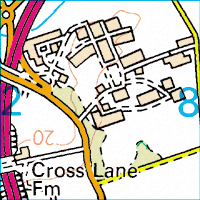
At the top end of the hospital grounds on the left hand side - one building
is shown. This is the area where the 'H' block type buildings were. There
were three along this side Camdale, Bedale and Ainsdale. On the right hand
side there was at least one more 'Moorfield'. My memory tells me there may
have been another one. There was then the Nursing School and staff houses.
In the center there were Laundry buildings, the Kitchens / Staff canteen /
Club and to the left of these were the day care buildings.There was also a
small farm.
Balderton closed 1993 with plans for housing on the site
map link to the site at
NG24 3JR
External link to history of Balderton House
60 beds on 31.12.1977
Rampton
1920: Rampton State Institution
About 1920 Arthur, an epileptic child, admiited aged five. He
was 30 in
1946 and still a patient in
1958 (Roxan 1958 p.102)
In
1932,
Dr William Rees Thomas, "previously medical
superintendent, Rampton State Institution" was appointed commissioner at
the Board of
Control
16.7.1939
Edith Haithwaite detained in Rampton
In
1940
Dr George W. Mackay resigned as commissioner at the
Board of Control to become medical superintendent of Rampton State
Institution
1946 National Health Service
Act section 49(4) moved the ownership of Rampton
and
Moss Side to the Ministry
of Health but left their management with the Board of Control.
Rampton about 1946: "accommodation is designed as three rings. The
inner ring is made up of the refractory centres:" D1 and D2 for the men.
(women "Iso Block" - isolation). D2 is a half way house above D1.
(Roxan 1958 p. 109). "Rampton's middle ring consists of the five
large blocks, the buildings built originally to house the criminal
lunatics. A and B Blocks house the women; C. D. [above] and E [E1
admissions] the men. They contain
the new patients, the recalcitrant, the rebellious, and those who refuse to
give a promise to the doctors that they will not try to escape.
(Roxan 1958 p. 111) Villas: Moss Rose (about 20 children 5 to
16 years
old) - Sweet Briar (old men) - Other men's villas: Cedars (young men mostly
under 25), Hawthornes (encephalitics), Firs, Elms, Beeches, Willows, and
Acacias . Women's villas: Poplars, Oaks, Maples and Laurels.
(Roxan 1958 p. 112)
6.8.1946
Peter Whitehead transferred from
Besford Court to Rampton: "I thought that a stupid mistake must
have been made, and that as soon as it was realised, they would let me out.
It never entered my head that the doctors might think a mistake hadn't been
made."
(Roxan 1958 p. 106). "Besides receiving new patients, E1 also
contained a number of sick patients who could not be accommodated in the
hospital ward" (Roxan 1958 p.95). New patients kept isolated in
bed for three days with nothing to do. (Roxan 1958 p.100).
"Peter spent three months in E1, the usual period for a new patient". Having
finished ward cleaning by mid-day "he passed the time reading, enjoying
Edgar Wallace and
Peter Cheyney (Roxan 1958 p.105).
January 1947 Peter
Whitehead moved from
E3 to the
Cedars 7.1.1947 "I hope, please God,
to keep out of trouble as I have been doing since I have been here. I am
getting quite used to being here, and feel quite cheerful"
(Roxan 1958 p. 129)
December 1946 First Board of Visitors' review of Peter
Whitehead's case. "The future years were to teach him the bitter truth that
a man inside Rampton, fighting for his liberty, can achieve nothing by
himself. He is lost without outside help and outside pressure"
(Roxan 1958 p. 125)

Between January and September: Peter told that his mother had died.
September 1947 Peter
Whitehead joined Rampton's Boy Scouts (Roxan 1958 p. 134)
By Christmas 1947 Peter
Whitehead had been visited by Larry Morris and by his uncle Dennis
Whitehead. Dennis Whitehead lived in Hammersmith. His member of Parliament
was the Labour politican (and barrister)
Thomas Williams (22.9.1915 - 28.2.1986). who acted for Peter.
1948? Rampton Hospital
14.11.1948
Noele Arden taken to Rampton from an unnamed "mental hospital"
in Somerset
4.2.1950
Peter
Whitehead "I have started to live in fear of never being free. These people
who say they want to help me would sooner hold a person than give him a
chance. My uncle tells me he is up against a brick wall, trying to get me
out of here." (Quoted
Roxan 1958 p. 155)
1953: A five year old boy admitted to Rampton
November 1953 Peter Whitehead transferred to
Farmfield to be nearer
his uncle.
about 1954 Noele Arden moved to
Moss Side for a period
about 1955 "While I'd been away at Moss Side the
A block
wards had
been enlarged and modernized, and we were moved... When I went on to the
new ward, the doctors had started giving a form of treatment to about three
girls. This was the drug
largactol. It was new, and I suppose a start in
the right direction, and was the only drug apart from
Paraldehyde that I
saw given. The doctors never seemed to analyse the girls, like they do
today. You only saw a doctor if you asked to, or if your privileges were
stopped." (Noele Arden
1977 p. 76)
11.1.1955 Peter Whitehead returned to Rampton from
Farmfield
August/September 1955
Albert R.N., film released October
1953, shown as the Rampton weekly film. Peter Whitehead suggested to others
that they make a dummy in the tailoring shop as in the film where it was
used as a cover for escape from a prisoner of war camp. The dummy being
discovered, Peter was sent to
D2 in the middle of September.
(Roxan 1958 p.220)
21.2.1956
Kathleen
Rutty
discharged from Rampton by the High Court
December 1956
Peter Whitehead discharged from Rampton whilst writ of
habeas corpus before the High Court.
19.12.1956 First
Rampton questions in House of Commons from
Norman Dodds
25.12.1956
Peter Whitehead's review under the
1913 Act [See
inside and outside struggle] would have fallen due. The date was
important because the weeks just before the Board of Visitors met were the
"high tide for escaping" as the Board only had "three month's grace in
which to review a patient's detention for another five years"
(Roxan 1958 p.238)
10.4.1957 Edith Haithwaite discharged from Rampton by the
High Court
about April 1957
Noele Arden discharged from Rampton on licence
May 1957: See Percy
Report
2.12.1957 On 14.11.1957 "there were thirteen boys and three
girls, of whom one boy was five years old on admission" in Rampton. Since
1.1.1950 "eleven boys and three girls have been admitted, of whom the
youngest was the boy of five years".
Hansard
19.12.1957
Hansard: Debate on Rampton
Investigation into Rampton Hospital and insanity laws. London. Pathe
News: Unissued / Unused material. Various shots people round table, left to
right: James Stanton, Peter Whitehead, Robert George, Frank Haskell,
Elizabeth Allan, Dr Donald Johnson and Norman Dodds. CU Stanton and
Whitehead voting. Various shots Dodds talking.
1958
Sentenced without Cause - The Story of Peter
Whitehead by David Roxan. Frederick Muller Limited, London.
1959 Mental Health Act
sections 97-98: Broadmoor,
Rampton
and
Moss Side
became Special Hospitals under the Ministry of Health.
27.4.1959
Question in Parliament about compensation for Edith
Haithwaite
1970s See
Essex Hall
1977
Child of a System by Noele Arden, Quartet Books.
May 1979 The Secret Hospital Yorkshire TV Two-part
film about Rampton
hospital. 22.5.1979 "Rampton - The Big House" - 23.5.1979
"Eastdale - The Way Out". "Part 2 centres on Len Harding, locked up for 18
years, and his first tentative steps of freedom. (Followed up in 1986 by
Len Harding: Born a number).
Late 1996 Decision to set up a Patient Assembly and Patient
Council. See
(The Advocate Autumn1998
28.11.2011
A BBC film crew was allowed into Rampton Hospital for the first time in 18
years
HSH Rampton Hospital
Flemming Drive, Woodbeck, Retford, Nottinghamshire, DN22 0PD
400 Patients. Planning/Building an extra high-security wing for 70
more.
freedom campaign prison list -
new website
400 Patients. Now has an extra high-security wing for 100 more with
"Personality Disorder". Also house's the Women's Directorate, a precursor
to a new national resource for all female people under psychiatric
jurisprudence.
Derby and Derbyshire
north east
midlands
1767 forty-two Derbyshire parishes (some of whom would later
form
part of the Chesterfield Poor Law union) voluntarily formed themselves into
the Ashover Union. The Union bought a large former bath-house at Ashover
for use as a joint workhouse. "By 1809, 61 parishes were subscribing
to the support of 38 paupers". The union covered a larger area than many
of the post 1834 unions. Ashover Poor House closed when the Chesterfield
Workhouse opened in 1838.
The following list, based on
Sylvia Wright's CD, gives the names of
those given in the 1828-1836 returns of lunatics and idiots, in order of
the stated or possible (?) admission to Ashover:
1780? "Saml. Binney age 48 male lunatic, dangerous, disordered 48
years, confined"
1792?
Ellen Riggott (36 in 1828) "female idiot, not dangerous,
disordered
from infancy"
1794? Sarah Hartley (34 in 1828) "female idiot, not dangerous,
disordered
34 years, confined"
October 1803 Peter Bollington (62 in 1831) male lunatic, not dangerous,
not
confined
February 1809 James Rawson (50 in 1828) "male lunatic, dangerous at
times,
disordered 19 years"
1811 Sarah Adkin (51 in 1828) female lunatic, not dangerous, "supposed
disordered 18 years", not confined
1813 John Mitchell (43 in 1828 and 1831. 44 in 1836!) male idiot, not
dangerous, disordered 15/18/23 years, confined
1818? Hannah Sellars (52 in 1828) "female lunatic, dangerous,
disordered 20
years, confined"
June 1818 Maria Beastal (72 in 1828) "female lunatic, not dangerous,
disordered 12 years"
1819 Joseph Robinson (54 in 1828) male lunatic, dangerous, confined
August 1824 Sarah Raines (70 in 1828) female lunatic, dangerous,
disordered
27 years, confined
19.8.1824 John Wetton (26 in 1828) "male lunatic, dangerous, disordered
about 6
years,
confined". "Dangerous and requires to be kept under close confinement"
(surgeon)
1826? Joseph Boam (55 in 1828) "male lunatic, dangerous at times,
disordered 2 years" "not dangerous" in 1831
1.9.1827 Mary Ashmore (60 in 1828) "female, insane, not dangerous...
confined". In 1836 "age about 70 female lunatic, not dangerous, disordered
upwards of 20 years"
16.9.1828 Francis Flint (37) "male lunatic, not dangerous, disordered 4
days". Still dangerous in 1831
about 1829 Anne Hardy (31 in 1831) "female lunatic, dangerous,
disordered 5
years, confined at Ashover about 2 years" "her confinement indispensable"
(surgeon). In 1836 she had been "disordered sine 1837". On 25.8.1836 she
had resided for about year "with her uncle J. Burton at Winster, is a
lunatic but is quite harmless" (a different surgeon)
1829 Joseph Fletcher (25 in 1831) "male idiot, not dangerous,
disordered 1
year"
about 1830 Mary Clarke (25 in 1831) "female idiot, not dangerous,
disordered from birth, confined in Ashover Workhouse about a year"
about 1833 Edwd. Wright (54 in 1838) "male lunatic, not dangerous,
disordered 3 years"
about 1834 John Keeton (81 in 1836) "male lunatic, not dangerous,
disordered about 2 years"
30.1.1834 George Bower (32 in 1836) "male idiot, not dangerous,
disordered
9 years"
29.5.1835 Charles Peal (42 in 1836) "male lunatic, dangerous,
disordered 3
years" confined. "Subject to fits, not likely ever to be better" (medical
certificate)
1828 - 1836 Pauper lunatics from parishes in most of the other
Derbyshire Hundreds recorded in
Nottingham Asylum, occasionally
Staffordshire County Asylum, and 1836 Green Hill House,
Derby. Many in
Ashover Poorhouse.
See Peter Higginbotham's site for workhouses
Derby and
Burton on
Trent (which includes
Mickleover.
A mansion and outhouses
asylum - The paupers were kept in
"what had been the coach-house and stables".
about 1820 Green-Hill House built Cross Lanes, Derby, at the
junction of Green Lane and Macklin Street.
about 1830 purchased by
Thomas Morris (wife Anne) of the
Nottingham Asylum and
Thomas Fisher (wife Charlotte) of the
Lincoln Asylum. Thomas Morris would have been about 60 years old
and Thomas and Charlotte Fisher about 45.
1829/1831 Advertisement in Glover's The History and Gazetteer
of the County of Derby for a "Private Establishment for the Insane,
Green Hill House, Derby. Under the superintendence of Mr Morris and Mr
Fisher, surgeons etc" - "Mr and Mrs Morris superintended the General
Lunatic Asylum, near Nottingham, for twenty years and Mr and Mrs
Fisher also superintended the Lincoln Lunatic Asylum for more than ten
years."
(Sylvia Wright)
6.10.1831 Mr Morris, Surgeon, resigned his post at
Nottingham
1835 Thomas Fisher, Lunatic Asylum, Green Hill, listed as a
surgeon in Pigot's Trade Directory. Under Public Buildings, Offices etc
"Asylum for the Insane, Green Hill House. Thomas Fisher superintendent"
1836 "Hanh. Bunting age 35 female lunatic, dangerous,
disordered 9 months, confined in Derby Lunatic Asylum since 25 Mar 1836 at
9s 0d per week." "Mary Bown age 25 female lunatic, dangerous,
disordered 4 or 5 months, confined in Derby Lunatic Asylum since 17 May
1836, at 9s 0d per week" (Both from Matlock) - "Thomas Buxton age 28
male lunatic, dangerous, disordered for some time before being confined, at
Derby for the last seven months at 9s 0d per week" (Bakewell) - "Elizabeth
Marple age 35 female lunatic, dangerous, disordered 4 months, confined in
Derby Asylum (Mr. T. Fisher) since 5 May 1836 at (s )d per week exclusive
of clothes" (Curbar) - "Samuel Chadwick age 50 male lunatic, confined in
Derby Asylum" - "Joseph Leam age 38 male lunatic, confined in Derby
Asylum. Certified by John Wright, Surgeon" (Both Crich) - Francis Calladine
age 50 male lunatic, dangerous, disturbed for 8 weeks, confined in Derby
Asylum at 9s 0d per week (Denby) - "John Hind age 40 male lunatic,
dangerous, disordered 2 years, confined at Mr. Fishers from March 14 1835
(Green-Hill House private asylum, Derby) at 9s 2d per week." (Markeaton) -
"Daniel Greatorex age about 50 male lunatic, dangerous, disordered about 9
months, confined at Derby since Aug. 10 1836 and previously at
Stafford and
Ashover, parish expense 9s 0d per week". "Mary Poyser age 44
female
lunatic, dangerous, disordered 3 years, at Derby since Aug.10 1836 and
previously at Derby,
Nottingham and
Ashover, parish expense 9s 0d per
week" (Wirksworth)
1841
Census: Thomas Fisher, Resident Surgeon and Charlotte
Fisher, Matron, both given as 55 years old. Elizabeth Fisher, 75 years old.
Six other people who are not patients and 21 patients. Three clearly not
paupers are not born in Derbyshire. The other patienst are all born in
Derbyshire and may be paupers.
November
1841 Local clerk unable to make a national return as his
papers had been lost in the Town Hall fire.
Visits by Metropolitan and County Visitors
21.10.1842
First visit of the Metropolitan Commissioners: They released a
lady confined without certificates since May. Beds were in a disgusting
state and visiting justices had not visited for about a year.
10.11.1842 Metropolitan Commissioners wrote
to Derby Borough and County magistrates. The County had sent most of the
paupers in Green Hill House.
1843
1.1.1844 28 patients. 19 pauper and 9 private. Weekly charge
for
paupers 9/-
excluding clothes.
SEVERELY CENSURED IN 1844
REPORT
"This Asylum has lately been transferred to another
Proprietor". - "...the present proprietor of the Derby Asylum,
is about to discontinue the Pauper part of his establishment"
(1844 Report)
Proprietor (1844) Brigstocke, M.D.
"forced to close in 1844 due to the murder of a resident and extremely
poor living conditions."
(source) [incorrect?]
1848 The Lunacy Commission asked the Lord Chancellor to enforce
the non-renewal of the licence of Green Hill House, Derby, after the death
of a patient there, killed by his room-mate. This action followed several
previous requests for the asylum to put an end to the prcatce two patients
sharing a bedroom together. A circular on the subject was issued the
following year.
(Hervey, N.B. 1987) (References
MH50/3, 7.12.1848 and 21.12.1848 and
MH51/236, Circular No.28, 4.1.1849
3.1.1849 On behalf of the Lunacy Commissioners, Simpson, Frear
and Simpson, Derby solicitors, served on Dr Brigstocke, personally, a
notice of an application for prohibition of the renewal of licence.
(MH50/3 4.1.1849 pp 265-266)
9.10.1849 and 4.1.1850 Applications for new licences for
Green Hill House, Derby, by Dr. W. H. Ramsay. No. 2886
MH51/43 National
Archives
"Green Hill House continued as a private asylum until 13 July 1853.
The proprietor at that time was Henry Brigstock, who acquired it in the
late 1840s".
"In 1914 Green Hill House was demolished and the Hippodrome Palladium
was built."
1844 Report on the proposed Pauper Lunatic Asylum for the County
of Derby (Derby: for the Committee, 1844).
24.9.1845 Letters
about plans at the Lunacy Commission
1.1.1845 Henry Duesbury, the architect, attended the Lunacy
Commission, which had been selected after public competition from about
eighty. For the purposes of this asylum he was associated with Mr Peterson
of Derby.
January 1845 modified plans reported to Quarter Sessions.
8.10.1845 Henry Duesbury again attended the Lunacy Commission
and "stated... that the working drawings were complete, nearly the whole
expense so far as regards Architects assigns etc were concerned had been
already incurred, that the Visiting Justices did not consider themselves
bound in law, but voluntarily submitted the plans to the commissioners"
4.6.1846
Plans submitted to Elms for consideration
23.7.1846
Disapproval of Derby County Asylum Plans
28.11.1846 HO34/7, Letter from Lord Grey to the Lord Chancellor
concerning expense of proposed Derby asylum
(Hervey, N.B.
1987)
11.2.1847
18.2.1847
29.3.1847 Deputation from Derby seeing Lunacy Commission? (Hervey, N.B.
1987)
1847 John Conolly reproduced the (original) plan of "Messrs.
Paterson and Duesbury for the Lunatic Asylum at Derby" in
The Construction and Government of Lunatic Asylums and Hospitals for the
Insane as his first example of one "in almost every material
point accordant with the principles maintained" in his book. Points on
which, Conolly said, the Lunacy Commission had disagreed with the plan were
- that it was planned to accommodate 360 patients when only 216 lunatics
had been identified in the county (p.11) - that bedroom windows were too
high because of the special corridor that allowed people to move round the
asylum without going through wards (p.19) - that there was an
"unnecessary" proportion (two-thirds) of single rooms (p.25).
Derbyshire County Asylum
Corridor form -
Close to Conolly's ideal
[A Sarah Rutherford case study]
1849 Work started in on Derbyshire Pauper Lunatic Asylum.
Designed by
Henry Duesbury - Warming and ventilation with assistance of Mr
Sylvester, engineer. Contractors Messrs T. and W. Cooper of Derby. Building
time: two years.
1849 The history and directory of the Borough of Derby by
Stephen Glover. Fourth edition.
"The New County Lunatic Asylum now building at
Mickleover near Derby"
1851 to 1893 registers and case books in Derbyshire Records
Office
1851 Medical Superintendent:
John Hitchman - until 1872.
(Previously Resident Medical Officer of the female side of
Hanwell). His wife, Mary Ann, was matron, and they had a joint
salary of £400
Two rooms furnished for Dr. and Mrs Hitchman who took up residence on
21.5.1851
10.7.1851 Mr Langley, the Steward, his wife and family arrived at
the asylum. Two horses were purchased by Sir Seymour Blane, Bart for the
use of the
asylum farms, also harness for three horses, a plough and
a
"scuffler". Two pigs purchased at £5 for the use of the asylum.
Vincent Morris, the farming man, and Attendant Trevett (at £25
increasing £1 per year up to £30) entered upon their duties.
The Committee authorised the purchase of bagatelle boards, magic lanterns,
draughts boards and books for the amusement and instruction of the
patients.
(Sylvia Wright)
Unidentified says that Mr and Mrs Hitchman
and staff "lived in houses around the farmyard and the doctor devoted much
of his to the farm which had to be self-supporting. He became an excellent
vet, developing cures for animal illnesses and was a cattle and stock
breeder of repute"
Thursday, 21.8.1851 first patient
(Jabez Jackson) admitted. His death was recorded in the district
of
Burton in the June quarter of 1852. (Most of the information about Jabez is
from
Sylvia Wright. Family information from online searches)
21.8.1851 Opened with 300 beds in 12
wards and had
patients coming from all over Derbyshire to be treated. "Its building had a
profound effect on the people of Mickleover and provided much work for the
local population" (Derby online
about Mickleover -
archive). See also
map
Unidentified says that "soon after the
opening of the asylum, patients were taking part in village activities".
John Hitchman "formed a patients' brass band which played at village fetes
and other events". "Female patients were encouraged to attend Bible classes
in the village and the men played cricket matches against both Mickleover
and Findern teams".
30.10.1851
Ellen Riggott and Mary Clarke admitted from
Haydock Lodge, chargeable to Chesterfield Union, that asylum
being compelled to close in consequence of two county asylums for Lancaster
opening. Both in a deplorable state when admitted, thinly clad and very
dirty. Not curable, both imbecile. Ellen Riggot epileptic.
The asylum casebook (1851-1858) records a picture of Ellen as "requiring
constant attention and care". She had a "great enlargement of the thyroid
gland" and walked "slowly and with difficulty". She had "no power to
communicate her wants by articulate tongue, being a congenital idiot of the
lowest degree". Between 1851 and 1853 she had "severe epileptic attacks
which will probably prove suddenly fatal." On 7.6.1853 "This patient died
suddenly this morning in a paroxysm of epilepsy. Post mortem, 'Died of
natural causes'"
(Sylvia Wright)
28.12.1852 Architect's Report for first Annual Report (pages
5-17). The First Report of the Derbyshire County Lunatic Asylum 1853
contains the report of the Committee of Visitors (chairman,
Francis Hurt), presented 4.1.1853, the architect's report (Henry
Duesbury) and asylum plan, the report of the Medical Superintendent (John
Hitchman), the chaplain's report (Joseph Sowter), financial statements and
various statistical tables.[Used by
Sarah Rutherford]
Sarah Rutherford says the asylum was not completed until
1853.
The Second Report... 1854 contains reports of the Committee of
Visitors (chairman, Sir Hugh Seymour Blane) presented 4.1.1854 and
John Hitchman, statements and tables.
The Third Report... 1855 contains the Visitors' report presented
2.1.1855, reports from John Hitchman, and the Chaplain (George
Fritche), statements and tables.
The Fourth Report... 1856 contains reports of the Committee of
Visitors (chairman, Sir Hugh Seymour Blane; reporter, Charles Clarke)
presented 2.4.1856 and John Hitchman and George Fritche, statements
and tables.
1856 John Conolly's
Treatment of the Insane without Mechanical Restraints
praised
Henry Duesbury and John Hitchman.
[In "1858 legislation was passed that doctors
had to follow a proper course for a degree and be licensed by the General
Medical Council. Dr Hitchman and many other doctors of the time had to
apply to the University of St Andrews, provided testimonials and
certificates and were then were awarded a degree."
(source)]
1860 John Hitchman led a group of landowners and farmers
in forming the Derbyshire Agricultural Show.
Unidentified says that John Hitchman was its
first chairman and drew up the rules of the society,
1861 census shows Linus and Jane Hubble as attendants at the
Derbyshire Lunatic Asylum.
(Douglas Poulter)
1869 chapel erected
1871 County asylum refused to accept new patients from the
borough of Derby
1872 Lindsay J M, M.D., LRCS.Ed. appointed Physician
Superintendent of the Derbyshire Lunatic Asylum, Mickleover, vice, J
Hitchman resigned.
(source)
1872 John Hitchman retired due to ill health. He and Mary
Ann went to live in
Fairford.
James
Murray
Lindsay succeded as Superintendent Physician.
July 1872: E Maguire Courtenay, AB, MB, TCD. late Clinical
Assistant
West Riding Asylum to be Assistant Medical Officer Derby County Asylum
October 1873: S F Conolly, LRCP.Ed., MRCS appointed Assistant
Medical
Officer to the Derbyshire Lunatic Asylum, Mickleover, vice Courtenay,
appointed to Limerick Ireland.
1876-1877 Great Northern Railway arrived: Village expansion has
continued ever since, apart from a break during the second world war.
1881 Census: Medical
superintendent:
James Murray Lindsay, aged 47
1879 a water tower erected
1886 Last annual report. James Murray Lindsay still Medical
Superintendent.
November 1888 Derby
Borough Asylum opened.
May 1891 Kelly's Directory
[source]:
County Lunatic Asylum, about one mile
south-west from the village [Mickleover] and 2 miles from the Great
Northern Railway station is a building in the Elizabethan style,
constructed of red brick, with portions of blue Staffordshire brick and
stone dressings, standing on rising ground and has a southern aspect,
overlooking the valley of the Trent, the Charnwood hills, Needwood and
portions of Nottinghamshire and Staffordshire and is surrounded by an
estate of 101
acres; the building contains 16 wards and is available for 477 patients,
there being at present (1891) 456. The asylum includes a large
entertainment room and dining hall, capable of seating 250 persons: the
east of the building, opened 21.8.1851, was £84,107 19s. 9d.: the
chapel, erected in 1869, is an edifice of stone, consisting of chancel,
nave, transept and a tower with north porch & spire : the east window is
stained and there are also four vitremaine windows, placed in the church by
Mrs Murray-Lindsay, and 300 sittings. In 1879 a water tower was erected,
capable of holding 20,000 gallons. George Crompton, treasurer; James Murray
Lindsay M.D. superintendent physician; Richard John Legge M.D. assistant
medical officer; Rev. Reginald Canning Bindley M.A. chaplain ; Benjamin
Scott Currey, clerk to the committee ; Harry Langley, clerk ; Frank Barton,
storekeeper ; Alexander McWilliams, resident engineer ; Miss Ada Martha
Rawlings, housekeeper; Harry Bird and Miss Mary Withers, chief attendants
April 1918 "William R....admitted to the Mickleover
Lunatic
Asylum"
Became Derby County Mental Hospital (Mickleover)
1937 Journal of Mental Science (1937) 83: article
on
"Mental Observation Wards: A Discussion of their Work and its
Objects" by E. U. H. Pentreath, Deputy Medical Superintendent
Derby County Mental Hospital, Mickleover and E. Cunningham Dax, Assistant
Medical Officer
Leavesden Hospital, Hertfordsire.
1948
Became Pastures Hospital, Mickleover, Derbyshire
1953 The Pastures Hospital Mickleover 1851-1953
Sheffield Regional
Hospital Board, Derby Area No 3 Hospital Management Committee. (8 pages?)
1959 William R. spent "the last five years of his life in a
villa in the grounds called 'The Woodlands'"
1962 (Hospital Plan) 1,345 beds in 1960, although this
included annexes. Building improvements were expected to start before 1966.
A reduction to 900 beds by 1975 anticipated. As new psychiatric units
developed (presumably the one at Derby City hospital in particular)
Pastures would be one of three (out of 14) large mental illness hospitals
in the Sheffield area to close.
1964 "William R. died in the Pastures Hospital"
(Barham, P. 2004, p.358)
1971 George H. Gordon, a nursing offocer at Pastures,
wrote a
"History of the Pastures Hospital" as a series in the hospital magazine
The Gateway
Copies at the
Wellcome Library and Nottingham University
Autumn 1973 I was shown round the hospital by a friend's
mother,
who was a senior nurse. I had a plan of the original asylum which we
compared with the then hospital. At this time it had about 1,100 patients.

Picture of front of the hospital (overlooking valley) taken by
Douglas Poulter
in 1999. It shows the administration
unit between the male (right) and female (left) wings. To the right, one
can see how the original airing court has been built on the provide an
extra ward.
"The front of the asylum overlooks the valley of the Trent...
The old building is furthest away from the road and was extended backwards
[1880-1910?]. Since then villas have been built between the road and the
asylum. The wards of the old building have been gutted, abolishing the
single rooms and replacing with dormitories". At the front of the original
asylum there had been a gallery that provided a generous day room for
patients, overlooking the airing courts and the valley. This was backed by
single rooms (cells). In time, the single rooms were replaced by wards (F4
- F6 - ), the gallery became a ward (M1), another ward was added at the
front (F1), originally for
tuberculosis patients. At the time I visited, the downstairs
wards at the front were occupied "entirely by geriatric" patients. Upstairs
were "female chronic schizophrenics and a few subnormals" and (in F4 and
F6) by "long stay patients with nowhere else to go, many of whom would be
suitable for hostels"
Artist
Niall Young "began working at Pastures Hospital in Mickleover in
1989 and worked there until its closure in 1993."
1991 Looking Back An anthology of writing from the
Pastures Hospital and Looking Forward an anthology from after the
Pastures, published by East Midlands Shape.
(Chronology of Disability Arts)
Unidentified: Chapter Six The Pastures Hospital
Date of final closure 1994:
County Asylums website
1999 The building was empty when Douglas Poulter took
the photograph of the front that I have copied from
his web history of the Hubble family. To find his book about the
family enter "Hubbles" in the book search at
Lulu. Douglas
has given me considerable assistance with the
construction of the history of this hospital.
2002 Douglas Poulter took a picture of the front after it had
been
converted to flats.
2003
use: "Luxury housing"
2005
Andy Savage photographs
2008
aerial photograph of front of asylum
converted into flats
archive
Kingsway, Rowditch, Derby, Derbyshire
Kingsway Hospital (formerly Derby Borough Asylum),
[Mickleover?]: records
1888 - 20th cent (D5874)
(national archive)
(external link to
history) -
County Asylums website
1863 Recommendation that the borough build an asylum for 200
1871
Leicester,
Mickleover and
Burntwood asylums refused to accept new Derby patients
1899 to 1902 Erection of a separate building for
private female patients (Later Albany House).
 .
.
The farm buildings at Derby Borough Asylum, photographed by
Peter
Cracknell for the County Asylums website. Maxwell Craven
describes the asylum as "provided with
an avenue of trees and wide verges, with a ... cricket ground on its south
side. Each part ... separated ... by sweeping lawns and ... beyond the
cricket ground, was a model farm on which selected patients could work.
1924 Thornhill House and gardens acquired
1929 Thornhill House opened for 40 female mental defectives
1932-1933 new nurses' home built.
1935 Thornhill House housed 40 female child patients under the
care of the matron, Miss Kathleen McGrenery, and Dr John Bain.
1938 Kingsway House built on the north edge of what had been
Thornhill's gardens. Intended as an
an admission block". "Kingsway House is an art deco
architectural tour-de-force". (Maxwell Craven)
1953 Farm "reduced to a remnant ... after the Second World War,
when
farm work was no long considered therapeutic." - Half the farm
buildings were demolished, leaving the rest for storage.
1962 (Hospital Plan): 864 beds in 1960. Expected to fall
to 600 by 1975.
May 1966 Fire damage to Thornhill House. Sometime after it
became a day centre.
1979: 535 beds
A Col W. Winterbottom bought Aston Hall in 1889 and much enlarged in 1907.
He died in 1928 when the Hall was bought by Nottingham Corporation.
(Aston on
Trent)
1930 Opened as a home for people with learning difficulties
(then mental defect)
1979 478 beds
Listed in
Hospital Database
as closed 1993, but internet sources
show it as currently being closed.
Rossbret pictures - Asylums - Stafford Asylum
Opened
1.10.1818
Architect:
Joseph Potter.
Early form, later adapted to corridor.
Accommodation for 120, but only 65 patients in 1820
Superintendent 1841 to 1855: James Wilkes
Reported in 1842 that an improved system of warming and
ventilation had
been introduced. Previously, dysentery had been prevalent, but no cases had
occurred since.
(1844 Report p.17)
1.1.1844 245 patients. 183 pauper and 62 private.
1851 Subscribers' representative
Thomas Salt
1854
Coton Hill opened
1864
Burntwood opened
1879 Extended
1881 Census: The County
Lunatic
Asylum, Hopton and Coton, Stafford. William Thompson Pater (unmarried, aged
46, surgeon) Superintendent
1884 Extended
1898
Cheddleton opened
1898
Weston Hall rented as an annexe
Stafford Mental Hospital by 1929 to about 1948
Became St George's Hospital, Corporation Street, Stafford, ST16
3AG
1994: 147 patients
(map)
Something closed in 1995 (but something still has a website)
Steve Pick's undated website for something that is closed
website for something that is open
Licensed House
1.1.1844: 36 patients. 32 pauper and 4 private.
for Private Patients of the Middle and Upper Classes
A Registered
Hospital
Opened 1854,
1854 Nineteen officers moved to Coton Hill from the
Military Luntic
Asylum at
Yarmouth on the recomendation of the Lunacy Commission
1881 Census: John Dale Hewson,
MD
Superintendent
66 male patients include nine from the army (if one includes "Hospital
Assistant Her Majesty's Service") - Four over 70 - Six of the officers on
"half-pay" - the other two "retired"
. 74 female patients. Total 140
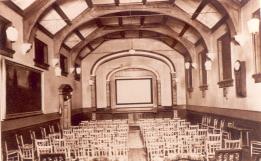
"In 1890 a theatre and recreation room was erected, where concerts
and
dramatic performances are frequently given." This picture is from
a brochure, probably dating from the 1930s, sent by
Jim Foley
1896:
(see Rossbret - Kelly's Directory 1896)
Coton Hill Institution
Robert William Hewson, Superintendent.
Rev. James Henry Theodosius, Chaplain.
John Jackson, Clerk and Steward.
Miss Ada Bailey, Ladies' Matron.
1930s See
brochure
Burntwood
Stafford County Asylum (Burntwood)
Opened 20.12.1864
(see Rossbret)
Rossbret pictures - Asylums - Burntwood
Asylum
1881 Census:
Burntwood County Lunatic Asylum Burntwood Edial & Woodhouses,
Stafford. Medical Superintendent: James Beveridge Spence (married, aged 31)
Burntwood Mental Hospital by 1929 to about 1948 - Although it was still
known both as Burntwood Mental Hospital and as Stafford County Asylum in
1940.
St Matthews Mental Hospital from 1948 to about 1955
St Matthew's Hospital, Burntwood, Walsall, WS7 9ES
Closed 1995
Near Leek, Staffordshire
Designed and built between 1893 and 1897 by
Giles, Gough, and
Trollope "leaders in the design of lunatic asylums". (English Heritage link). The water tower is "the
highest structure in Staffordshire Moorlands".
(map)
Opened 1898?
Peter
Cracknell describes as
Compact Arrow design.
Rossbret pictures - Asylums - Cheddleton
Asylum
Became Staffordshire Mental Hospital in 1948
St Edward's Mental Hospital, then
St Edward's Hospital, Cheadle Road, Cheddleton, Near Leek,
ST13 7ER or ST13 7EB
1979: 908 patients
Memoirs is a collection of four books (Repetition,
Resistance', Reminiscence and Recollection) based on
this hospital, with photographs and writings of Sharon Kivland, maps and
drawings by patients and references to the rules and regulations which
apply to staff. (August 2001)
There is also a book: The History of St Edward's Hospital
There was a Nursing History Museum in Ward 4
(other museums)
Autumn 2002: empty for a year
development plans to "combine refurbishment and new-build homes,
offering a selection of executive detached homes, mews style properties,
apartments and townhouses in a beautiful woodland setting."
(Redrow developers)
The Earl of Shrewsbury and Stafford Council agreed to
the use of Weston Hall as a Pauper Lunatic Asylum for two years from
24.6.1898 at 150 pounds per year payable half-yearly.
The
agreement also included the land adjoining comprising 2 acres and 3 rood
and 35 perches. In 1905 a further lease was agreed for a period of seven
years from 28.3.1904.
Kelly's 1908 Directory of Birmingham, Staffordshire,
Worcestershire and Warwickshire, states that Weston
Hall is temporarily rented by the Committee of Visitors of the
Staffordshire Lunatic Asylum (branch) that it will hold 45 female
patients and that Miss Fanny Dukes is the nurse in charge.
1911? Ceased being an asylum?
1947/1948 The parents of Kevin Godwin bought Weston Hall from
the Earl of Shrewsbury.
"My father told me the Hall had once been a mental hospital and that
when he bought it all the doors had double locks meaning the key had to
be turned twice to open or lock a door. One or two locks required the
key to be turned backwards in the locks to confuse any inmates who might
get hold of a key." (Kevin Godwin)
Opened August
1829. See
Rossbret site for some history
Cheshire County Lunatic Asylum 1829 to 1855
Originally built for 96, 10 private of each sex and 38 pauper of each
sex. To each a separate sleeping room.
Superintendent 1844 J. Leet. Surgeon.
1.1.1844 155
patients.
146 pauper and 9 private. In 1844 most paupers were sharing a room.
"The sleeping rooms in the pauper galleries are 10 feet by 8 feet and from
11 feet 3 inches to 12 feet in height, and two beds are now, for the most
part, placed in each room, providing present accommodation for 152"
1844?
11% of patients
epileptic
Weekly charge for
paupers: from outside Cheshire: 10/- (Cheshire
paupers: 4/1d, not including clothes).
(1844 Report) Contained 12 Welsh paupers on
23.7.1844
(1844 Welsh
Report pp 5-6 and 47)
Cheshire Lunatic Asylum 1855 to 1870
Cheshire County Lunatic Asylum
1870
to 1921
1881 census: may be Chester County Lunatic Asylum, Chester St
Mary On Hill,
Sometimes known as West Cheshire County Asylum
About 1918, an Annexe built
County Mental Hospital 1921 to 1948
Upton Mental Hospital 1948 to about 1955
Deva Hospital about 1955 to about 1965 [About 1970
suggested by
another source. Local people still know the hospital as "The Deva" in 2002]
In the 1950s Moston Hospital (Upton-by-Chester, CH2 4AA), an ex-
military hospital about two miles away, was used for patients from the
Wirral area. Its buildings were "wooden military style"
West Cheshire Hospital about 1965 to 1984
About 1972, a Maternity Unit was opened on what had been part of
the hospital farm. This was the first stage of the development of the
extensive grounds into a group of hospitals in a park.
About 1976 a Psychiatric Unit was added to the Clatterbridge
(General) Hospital Bebington, Wirral, L49 5PE, and took the acute
patients from Moston. Others went to West Cheshire or were found homes in
the community.
The 1979 Hospital
Year Book lists: West Cheshire
Hospital
as "Long-stay psychiatric and geriatric" with 997 beds;
West Cheshire Hospital Maternity Wing, with 141 beds, at the same address,
and Moston Hospital, 272 beds as "Mental
Illness". Moston Hospital was demolished not long after it was vacated, and
reverted back to army use.
About 1983 a new District General Hospital opened in the grounds
of the West Cheshire, called the Countess of Chester Hospital. The whole
site was renamed The
Countess of Chester Health Park, but the mental health unit retained
the name West Cheshire Hospital and was managed by a different
health trust: The Wirral and West Cheshire NHS Trust
The original 1829 Chester Asylum Building was
converted into Health Authority and Ambulance headquarters around
1990. "A handsome brick structure, with noble centre & wings".
"superb, and listed". The other admin block on the mental health site is
now trust
headquarters for the newly formed Wirral, and South Cheshire Partnership
NHS Trust. The mental health services (acute wards, cafe, staff dining
room recreation hall, admin offices etc) are now in the Annexe. It provides
the acute in-patient facility for the districts of
Chester and Ellesmere Port, as well as some wards for the functional
elderly mentally ill. A new mental health unit is to be built on the site
of the former staff home and social club
1994: 179 patients
[Some addresses: Countess of Chester Hospital, Liverpool Road,
Chester, CH1 2BA. Countess of Chester NHS Trust, Countess of Chester
Health Park, Liverpool Road, CH2 1UL]
(map)
[My main source for much of this history has been Nigel Roberts who
worked as a psychiatric nurse at West Cheshire Hospital from 1973 to 1984.
For his photographs see "Northern Asylums" on
Gordon Tozer's site].
There is a book: Insane but not daft - Opening the door on Chester's
Mental Hospital Semi fictional story of a male nurse at Chester in the
1960s. Written much later.
Cheshire County Asylum (Macclesfield)
Opened 1871
Corridor form
1881 Census: Principle Officer:
Dr
John H. Davidson, unmarried, aged 50. The asylum appears to be next to the
workhouse. The address is Chester County Lunatic Asylum, Upton in
Macclesfield, Cheshire, England.
Known as Cheshire County Mental Hospital from about 1920
Parkside County Mental Hospital (1948 reference)
Then Parkside Hospital, Victoria Road, Macclesfield, SK10
3JF.
Autumn 2002: Reported closed but empty
"the County Lunatic Asylum (Parkside) at Upton Macclesfield is now
the Parkside Hospital, also on the east of the site, where the Macclesfield
Union Workhouse was, is Macclesfield General Hospital. It's very confusing
as there was also a County Lunatic Asylum at Upton
Chester, which is now the Countess of Chester Hospital
(Stan Mapstone) [A
fever hospital is shown as part of the workhouse on an 1882 map]
(map)
From 1732 to 1922 the poor law in Liverpool was administered by the parish.
A Liverpool Select Vestry was established in 1821. See
The 19th Century Poor Law in Liverpool and its Hinterland:
Towards the Origins of the Workhouse Infirmary by Mike Royden.
Also
Peter Higginbotham's site
A
Hospital
Opened
1792.
See University of Liverpool's history of foundation by James
Currie
(archive)
The asylum was built in the gardens adjoining the Liverpool Infirmary.
It had 80 beds. The first Keeper and Matron were brought from St. Luke's
Hospital London. The first Governor was Mr John Davies.
Superintendent 1844
G. Tyrell. 1.1.1844 73 patients. 36 pauper and 37 private. Weekly
charge for paupers: 12/- including clothes Sometimes received Welsh
paupers (at 12/- a week)
(1844 Welsh
Report pp 5-6).
Closed about 1889 to make room for new building of the Liverpool
Royal Infirmary.
1831 "The second Liverpool Lunatic Asylum was built on Brownlow
Hill with four acres of grounds. It was part of the Liverpool Infirmary and
had beds for 64 "insane people"".
1834 "This institution formed for the truly benevolent purpose
of affording relief to one of the most dreadful of human afflictions was
originally opened in the year 1789 near to St John's Church but was
recently removed to the present commodious and neat stone building situate
in Ashton-street, Brownlow Hill".
(source)
In 1882 University College, Liverpool, opened in a disused lunatic
asylum
1895 "in the grounds of the Victoria Building where part of
Brownlow Hill's old vacated lunatic asylum still stood and which housed
some of the College's departments."
(source)
"In 1790 the population of Liverpool was 55,732. It already had an
Infirmary and a Workhouse. The Infirmary, built in 1745 stood on what is
now St. Georges Plateau, and Brownlow Hill Workhouse, built in 1770, stood
on the site of the present Metropolitan Cathedral."
(University of Liverpool's history)
Not mentioned in the 1844 Report
On list with lunatic wards MH50 5.2.1849
8.12.1849 Liverpool Journal Report of a vist to Brownlow
Hill Workhouse "an extensive clump of buildings, ranging in the wall, which
extends from Mount Pleasant to Brownlow Hill." Includes a visit to "the
lunatic asylum" where "poor pauper lunatics are kept here till there is a
vacancy at Lancaster". "Four adult men [in a room above] and seven women
are confined." "I was surprised that the poor fellows who guard the
lunatics, were paupers themselves and were given no extra remuneration."
(Source:
Old Mersey Times)
1858 The Magistrates responsible for
Rainhill agreed to the
transfer of some chronic patients from Rainhill to the Liverpool workhouse,
to make room for curable cases. The Lunacy Commission said the magistrates
should satisfy themselves:
1. That a sufficient staff of responsible paid nurses and attendants
should be employed.
2. That a fixed liberal diet (to be sanctioned by the medical
superintendent of the asylum) should be allowed.
3. That the clothing and bedding should be warm and good.
4. That the rooms should be rendered much more cheerful, and be better
furnished than at present.
5. That the present small flagged yards should be enlarged and planted
as gardens.
6. That the patients should be frequently sent out to walk in the
country
under proper care.
7. That the patients should have the benefit of regular daily medical
visitation ; and that the register of admissions, discharges, and deaths,
and also the
medical journal required to be used in asylums (by the Act 16th and 17th
Victoria, cap. 97, Schedules 1, 2, 3,) should be kept by the medical
officers who shall visit the patients in the workhouse."
1.11.1858
A description in a letter from Procter, who had visited
Liverpool Workhouse to see "the preparations that they were making to
receive patients".
Peter Higginbotham's site
West Derby - an area surrounding Liverpool
Lunatic Asylum
workhouse
- became Springfield - North Manchester Geeneral
Prestwich
Gaskell House
Withington
Hospital
Manchester Mental Health and Social Care
Trust
Manchester Lunatic Asylum
not receiving paupers in 1844
Opened
1766
Hospital Database says at an "unknown location"
from
1763 to
about 1850. However, a common picture
(see below) suggests it was the same
site as the Infirmary, which was in Manchester Picadilly from its
foundation in 1752 to 1909
Much of the following detail is from the
Wellcome Library catalogue
1792: An Extract from a sermon preached in the Collegiate
Church of Manchester, March 4, 1792, before the governors of the Infirmary,
Dispensary, Lunatic, Hospital and Asylum, for the benefit of those
charities by C. Bayley. 10 pages
1804: A letter to the trustees of the Manchester Infirmary,
Dispensary, Lunatic Hospital, & Asylum by James Jackson. Manchester:
R. & W. Dean. 48 pages.
1828 Pauper lunatics from the Hundred of High Peak in
Derbyshire are shown as patients. "Samuel Smith age 22 male
lunatic,
dangerous, disordered 2 years" - "William Hyde age 52 male lunatic
dangerous, disordered about 5 years" - 11.3.1828 "Anne Hardy age 29
female lunatic, dangerous, disordered about 3 years, confined ... at 10s 6d
per week." - July 1828 "Isaac Hall age 28 male lunatic, dangerous,
disordered since July last" was confined by October (probably earlier) -
1836
High Peak pauper lunatics: "Charles Bradbury age 23 male
lunatic, dangerous, disordered for some time before being confined. At
Manchester Lunatic Asylum for 9 months at 10s". Charles Bradbury was later
moved to Green Hill House
Derby - "John Whalley age 30 male lunatic, dangerous,
disordered 2 years and upwards" - "William Hyde age 40 male lunatic,
dangerous when disordered" - "Joseph Mellor age 34 male lunatic, dangerous
when disordered, disordered about 2 months" -
Report of the state of the Manchester Royal Infirmary Dispensary,
Lunatic Hospital and Asylum Two volumes: 24.6.1837-24.6.1838 and
24.6.1839-24.6.1840
1.1.1844: 36 private patients
In 1849 Manchester Infirmary was bounded by Piccadilly, George Street
Parker Street and Portland Street
June 1851: Report of the Manchester Royal Lunatic Hospital,
situate in the township of Stockport Etchells near Cheadle, Cheshire : this
institution is in connexion with the Manchester Royal Infirmary
Consists of the report of the general committee (Salis Schwabe,
Treasurer) including reports of the Commissioners of Lunacy
(S. Gaskell,
J.W. Mylne, W.G. Campbell, T. Turner), report of the medical
officers (R.F. Ainsworth, F. Renaud, Thomas Dickson) and an engraving of
the south east front of the asylum
Second annual report of the Manchester Royal Lunatic Hospital,
situate near Cheadle, Cheshire, for the year from June 25th 1851 to
June 24th 1852. Salis Schwabe, chairman. Medical Superintendent:
Thomas Dickson.
1852/1853: Canon Clifton (R.C. Clifton) Treasurer. R.C. Clifton
later (1857/1858) shown as chairman of the Committee of Management.
Late 1858
Henry Maudsley
became superintendent and remained for
three years. He recommended George Mould as his successor.
1861 Census Henry Maudsley, unmarried, aged 26, born
Giggleswick, Physician shown as Superintendent of the Hospital. Completion
of records may be defective. For example, instead of listing patients,
there is a table of "female patients" showing number in each age range:
15:1 - 20:3 - 25:3: 30:6 - 35:6: 40:3 - 45:3 - 50:3 - 55:2 - 60:0 - 65:2
- 75:2. [Total is 34]
1870:
G. W. Mould (surgeon) was superintendent of "Manchester Royal Lunatic
Hospital, Cheadle".
George Mould President of the
Medico-Psychological
Association
1871 Census George W. Mould, aged 35, born Sudbury, Derbyshire,
"Medical Superintendent and Landowner". Caroline Mould, wife, aged 40.
Children: Gilbert E. Mould (4), Mabel R. Mould (3), Phillip G. Mould, (1)
1881
Census: "Manchester Royal Lunatic Asylum"
Census Place Stockport Etchells, Cheshire, England. Caroline Mould Wife
aged 50 born Whitton, Suffolk. Occupation Lady. [Caroline died 1882 aged
"52"]
Mabel Rebecca
Mould, Daughter aged 13 born Stockport Etchells, Cheshire, Scholar.
Philip George Mould Son
aged 11 born Southport, Lancashire, Scholar
1888:
Marriage of Mabel Rebecca
Mould to Charles Tilbury Street
1891 Census Cheadle Royal Asylum: George William Mould, Medical
Superintendent. Walter Scowcroft (36) and Arthur J. Barnard (30), his
assistants.
1901 Census Cheadle Royal Asylum and St Annes Hospital: Walter
Scowcroft (36) "Deputy Medical Superintendent". John Sutcliffe (47) and
Philip J. Mould (31), his assistants.
End of July 1900 Rachel Grant Smith admitted as a boarder to
Cheadle Royal Asylum
October 1902 Rachel Grant Smith moved to "Musgrove" (a
pseudonym).
1908 Dr John Allan Chisholm Roy (1878-7.5.1954) Assistant Medical
Officer Cheadle Royal Hospital
1922 Chisholm Roy superintendent to 1951.
Manchester Royal Mental Hospital (by 1929 - 1947)
Cheadle Royal Mental Hospital (1949 reference)
1951 Chisholm Roy retired and was succeded as superintendent by
his deputy William Victor Wadsworth (4.4.1920 - 4.9.1983.
BSc Manchester (1941) MB ChB (1944) DPM (1948) MRCP (1960) FRCP (1965)
FRCPsych (1971.) who carried on "the Cheadle Royal tradition of lavish
entertainment... Many people in Manchester, both lay and medical, remember
with nostalgia the Cheadle Royal parties of those day. He also "steered it
through the changes which occurred in psychiatry in this period, discarding
locks on doors and using drugs, ECT and insulin coma therapy, but later
more and more discarding the physical treatments for psychotherapeutic
ones."
(Munks Roll)
1955 Introduced the features of the "therapeutic community" as
outlined by
Maxwell Jones.
(Jones and Sidebotham 1962 p.34)
"He was a pioneer in two developments: industrial therapy and day
hospitals, helping to build up the very successful industrial unit Cheadle
Royal Industries, which virtually became a paper hat making factory,
selling to firms such as Woolworths. At this time he wrote a number of
papers on the rehabilitation of schizophrenic patients by industrial
therapy".
(Munks Roll)
14.9.1957 Lancet (4; 273 (6994): pp 533-534.)
article by
W.
V. Wadsworth, W. L. Tonge and L. E. Barber "Cost of treatment of affective
disorders; a comparison between three mental hospitals."
William Lawton Tonge, born 1925, was Deputy Medical Superintendent at
Cheadle Royal
[The idea for the research (1958-1959) that lead to Mental Hospitals
at Work (1962) originated with Dr Wadsworth.
(Jones and Sidebotham 1962 p.ix). They
describe the study by Wadsworth, Tonge and Barber as "A pilot
survey of three hospitals" (Jones and Sidebotham 1962, p.166)]
25.10.1958 Lancet (25; 2 (7052): pp 896-897.
article by W.V. Wadsworth, R.F. Scott, and W.L. Tonge "A hospital
workshop".
R.F. Scott, B.A. London, Diploma Psychology was Industrial Director at
Cheadle.
"In 1959 he [Wadsworth] invited Gordon Cross to come from the
Bristol Day
Hospital to open a similar one at Cheadle. This developed as a therapeutic
community and in association with the industrial unit helped in the
rehabilitation of both neurotic and psychotic patients."
(Munks Roll)
9.9.1961 Lancet (Volume 278, No. 7202, pp 593-595)
article by W.V. Wadsworth, R.F. Scott, and B.W.P. Wells "Employability of
long-stay schizophrenic patients". B.W.P. Wells, B.A. Bristol was
"Research psychologist" at Cheadle.
"Crown Lodge" in
Jones and Sidebotham 1962. See
June 1958 to June 1959
1967 Cheadle Royal Hospital A Bicentenary History by
Nesta Roberts published by John Sherratt and Son Ltd of Altrincham. Ten
introductory pages, 189 pages and 24 plates, including 4 in colour.
External link to Affinity Healthcare website -
archive

December 2004 Duke Street acquired Affinity. "Affinity
operated 248 beds in two hospitals: Cheadle Royal Hospital in Cheadle,
Cheshire, and
Middleton St George Hospital in Darlington, County Durham.
Affinity also operated a community home based in Darlington. With 3% of the
independent psychiatric care beds in the market, the company was
particularly strong in the North of England."
"There were 32,000 psychiatric care beds in the UK, 7,600 of them
provided by the independent sector. In 2005 the independent sector
market was worth about £800 million. Continued growth was expected,
because the need for more specialised services and the NHS's focus on
community services meant services being increasingly contracted out to the
independent sector."
January 2010 Duke Street sold its stake in Affinity to the
Priory Group
The Priory Hospital Cheadle
Royal
[Nigel Roberts' photograph see "Northern Asylums" on
Gordon Tozer's site].
English Heritage: Cheadle Royal, Manchester, built 1847-1849 as
a private asylum for the middle and upper classes
14.2.1793 Bridge Street Workhouse opened
1843 Bridge Street Workhouse enlarged
1844:
A Workhouse Asylum
"Wards exclusively appropriated to lunatics"
(1844
Report
p.10)
1848 map on Peter Higginbotham's site shows
"Lunatic asylum" as part of the New Bridge Street workhouse
1848 John Sutton, age 49, was Master of Manchester Workhouse.
1852
John Sutton became the owner of the Haydock Lodge private asylum
November 1986 Meeting of patients and ex-patients from North
Manchester General Hospital hosted by the
Patients Association, at the
request of Harpurhey Resettlement Team. Met regularly on Wednesdays in M
Block in the Social Therapy Department from 1.30p to 3pm. Usually attended
by at least a dozen people and often invites good guest speakers.
Representatives from other organsations who have attended include
Mind,
Unit Management, the police, Welfare Rights, and the Community Health
Council.
"... for the first week of the new team... we all went off to
Trieste. So we were a new resettlement team, newly sort of enthused, went
over to Trieste, spent an incredible week... having our minds blown... and
came back with ... an emotional reaction against the things that we had
witnessed and experienced in the hospital institution with a much ... more
robust kind of ideological understanding of the process of
deinstitutionalisatio... There was an element of
evangelising.."
"... we were very intrigued by it and basically wanted to keep
up te link and continue the set up. We actually set up a Trieste fund. I
was thinking it out, and we got a little logo and we set up [name], which
was, the purpose was to set up educational exchanges in
effect."
"This group included
Vinnie Gillespie, above.
This stage of recruitment was significant in that it allowed us to
recruit local people with a wide range of local contacts, varied
experience and an understanding of how best to help people moving out of
hospital make best use of local informal support networks" Douglas
Inchbold
"I was helping and representing patients long before I
understood the word 'advocacy'. No-one asked me or told me to do it. It was
entirely spontaneous"
"Speaking personally, I felt that there were three currents,
three strands that were going. One was the 'Survivors Speak Out' stuff, so
it's actually service users' autonomous voice work that was coming. The
second one was very much our strand, which was the resettlement programme,
because it wasn't just us, it was happening across the UK. And then the
third one is the legacy of people like Laing and so on, Cooper, so people
who had set up alternative, counter-therapy type .. therapeutic
communities. And it was that melange of the three that I felt ...heady
days."
(Harrington, 2009, pp 201-202
"Manchester psychiatry was dominated by the University
Department of Psychiatry and its relatively new academic units at Gaskell
House in Central Manchester and Withington Hospital in South. These
espoused a model of acute, district general psychiatry within a fiercely
competitive and academic environment (Kessel,1973; Harrington,2008)- a far
cry from the back-wards of Springfield.
(Harrington, 2009, p.667)"
"Known as 'The Maudsley of the North', Withington Hospital Psychiatric
Unit, which opened in 1971, was attached to a large district general
hospital (DGH). It had a dual role: to provide a local service for the
people of South Manchester and to provide teaching facilities for doctors,
nurses and social workers" (Val Harrington)
Architect: Thomas
Standen
Peter
Cracknell classifies it as
Corridor form, although the logic of his
analysis might suggest
Early form, later adapted to corridor.
Simon Cornwall: says
1840 Architect unknown: which suggests some re-building or new
building.
Superintendent 1844:
Samuel Gaskell. Surgeon
(Became a Lunacy Commissioner).
1.1.1844: 611 patients. All pauper. 1844?
10.3% of
patients
epileptic
Weekly charge for
paupers:: 6/-
including clothes. Sometimes received Welsh paupers. The charge for
them was 10/6 a week
(1844 Welsh
Report pp 5-6).
House Surgeon from about 1850:
John Davies Cleaton
1858 Report 181 patients had been refused for want of
room
1881 Census: County Lunatic Asylum
Lancaster, Lancaster Moor, Lancaster, Lancashire. Assistant medical
officers (both physicians): James Cunningham Russell, aged 37, and
Alexander Hanbrison, aged 32. Matron: Charlotte Stacey, aged 37 and
Assistant Matron: Ann Smith, aged 48 (all unmarried).
Picture of County Asylum Lancaster (no date) on Rossbret
site (archive)
Peter
Cracknell: Extended 1882 by A.V. Kershaw (architect).
Peter
Cracknell:
1889 D. M. Cassidy, M.D., Lancaster, Superintendent of the
County Lunatic Asylum.
Peter Dutton, Lancaster, Clerk and Steward of the
County Lunatic Asylum.
25.10.1904
Postcard from Lancaster of the County Asylum Annexe Lancaster
Ridge Lea annexe opened in the 1920s.
Lancaster County Mental Hospital by 1929. Then (from 1948?):
Lancaster Moor Hospital, Quernmore Road, Lancaster, LA1 3JR
(map, showing closeness to prison)
Autumn 2002: reported closed and due for development in spring 2003. "A
very well preserved site. Neo Gothic style architecture" (Nigel Roberts
1.12.2002) [Nigel Roberts' photograph see "Northern Asylums" on
Gordon Tozer's site].
"half the site is
now executive housing/flats, although the large neo-gothic buildings
across the road remain standing, and are in good condition. Ridge Lea
Hospital, which is just across a road behind the main buildings of
Lancaster Moor... is essentially a small asylum as it was built around
1920's as an annexe for the Moor Hospital." (Nigel Roberts
28.11.2002)
Moor Hospital site in Gregson's Photo Gallery
of Lancaster has pictures of what is going and what is staying dated
Summer 2000
See British Academy aerial photograph with part
demolition Lucy says this is "of the buildings which were
adapted the main building is still there in the top right corner of the
picture"
Lancaster Moor Hospital, UK, 17 June, 2004
"The hospital closed in about 2000. Whilst the premises to the south-west
of Quernmore Road have been partially demolished and redeveloped as a
housing estate, the main building, built as a psychiatric hospital in 1882,
remains"
2.1.2005
email from Louise Wade in Rootsweb archives
Haydock Lodge, Winwick, near Warrington
Licensed House
A mansion and outhouses
asylum
Grid reference: SJ580980 (358027,398076). To the west of Lodge Lane,
just south of what became Haydock Race Course. (1849 map)
(modern map)
(multi-map)

Table of patients in
Haydock Lodge, from January 1844
Summer 1848: 380 patients. Proprietor C.F. Jenkins (surgeon)
1.1.1851: 402 patients (359 pauper). Proprietor "Miss Coode and Eli
Lawrence Sup."
closed in late 1851?
re-opened in 1852 by Mr John Sutton, formerly master of the Manchester
Workhouse.
1.1.1853:
32 patients, all private
1.1.1855: 89 patients (53 pauper)
1870:
250 patients (170 pauper)
In
1872
it was burnt down but rebuilt immediately afterwards.
1881: 215
patients (122 pauper)
1891
1901
Records exist to
1969. It
closed about
1970
Tuesday 10.2.1846: A special meeting of the Lunacy Commission to receive a
deputation, headed by Brotherton, the Salford MP, putting the case for two
new asylums: one
near Manchester
and the other near Liverpool.
Two new Lancashire County Asylums (the 2nd and 3rd) opened at Rainhill and
Prestwich on 1.1.1851.
Before 1847: Designed by
Harvey Lonsdale Elmes
1.1.1851 Opened: "built to accommodate 300 patients and opened
with approximately 220" (Liverpool Record Office)
Known as County Lunatic Asylum, Rainhill,
Corridor form
"By 1852, the committee was having to admit 400 patients and
from then onwards was constantly reporting that the asylum was
overcrowded."
About 1853 to April 1858: Superintendent
John Davies Cleaton
It had 400 patients in 1856.
1856 Report: " the asylum has been full throughout the
year, and patients have only been received as vacancies occured by death
and discharges." - The preponderating cause of death was
general paralysis.
Of 42 deaths, 16 were general paralytics. [The proportion was higher at
Prestwich]. The other main cause was
pulmonary consumption.
It had 400 patients in 1858.
1859? Temporary (?) removal of some chronic patients to
Liverpool Workhouse
"In 1859, additional wards were built to house another 228
patients and 32 single rooms were added to existing wards, along with a
recreation hall and new workshops. In 1860 it was decided that the hospital
should purchase the farm on the opposite side of the road, for
£2100." (Liverpool Record Office)
"In 1877, the Medical Superintendent, Dr Rogers, started a
crusade for a new asylum. He decided that if land were available, it would
be an advantage to expand Rainhill Asylum, rather than build a separate
establishment, and to split the site between chronic and acute cases."
(Liverpool Record Office)
"In 1878, the county authorities purchased land for the building
of the annexe. It was designed by G E Grayson to house around 1000 patients
and was opened in April 1887; it was used for patients whose
conditions had seriously deteriorated."
1881
Census: Physician head: Thomas Lawes Rogers
Annexe (Asylum Annexe, Eccleston, Prescot?) built 1881 to
1887
(opened). Enlarged to take 200 patients in 1898. Annexe demolished 1900.
1889 Thomas Lawes Rogers, Rainhill, Superintendent of the County
Lunatic Asylum at Rainhill.
1900 Total patients: 2,029
December 1911 Total patients: 1,990. 975 men and 1015 women
1913 Joseph Wiglesworth, Medical Superintendent
Became County Mental Hospital, Rainhill.
1936 Total patients: 3,000
1946 Benedict Finkleman (1906-1966) appointed deputy medical
superintendent, having previously (from 1936) been on the staff at
Winwick.
1948? Became Rainhill Hospital
Benedict Finkleman appointed superintendent.
See
June 1958 to June 1959
1962 (Hospital Plan) 2,750 staffed beds on 31.12.1960.
1,240 expected in 1975
9.10.1966 Death of Benedict Finkleman
Address Rainhill Road, Prescot, L35
4PQ.
1979 Total
patients: 1,768
1984 Scott Clinic, "one of the first purpose-built medium secure
units" opened.
1986
BBC Domesday "Rainhill Hospital was built as a lunatic
asylum for long-term patients. The building is in two parts:
Avon wing and
Sherdley wing. The latter has newly built Scott Clinic, a secure
building for dangerous patients such as murderers. The Benedict Clinic is
for the cure of alcoholics. Once a patient shows signs of
recovery they are allowed to re-enter the community. They can live
in flats near the hospital and return each day for special medication.
Their part of the hospital is called Elton Vale. There, Occupational
Therapy is attempted by providing instruction in life-skills such as
cooking, shopping and handicrafts. On
occasions, depressed patients kill themselves in the area. Some disturbed
patients wander into the village where
they sometimes frighten children.
1991 closed
1993
Psychiatric Bulletin article
replaced by a Business Park
2014 Scott Clinic to close
(source)
See
The Colonnade which is all about Rainhill.
There are many interesting photographs on this site, including
a selection by Nigel Roberts
"The land chosen for the Hospital is in an area first known as
Prestwich Wood in 1652. The land was owned by Thomas Compton until his
death in 1776, when Nathaniel Milne bought the land, which then came into
the possession of his son, Oswald in 1847. The Hospital was opened in
1851 to accomodate 500 patients, and originally built to face West
with the main entrance on Clifton Road".
It had 500 patients in 1856.
1856 Report:
" Each
year the difficulties of receiving patients have increased, and
numerous applications for admission have consequently been
refused." Out of 58 deaths, 31 were general paralytics. [See
Rainhill]
It had 510 patients in 1858.
"In 1863 it was extended to accommodate afurther 560 patients"
1881 Census: Medical officers
were
Herbert
Rd Octavius Sankey, Henry George Murray and Benjamin Russell Baker (all
surgeons)
1884 "the Annex was built. The Annex was built to house 1,100
patients and was served by bus due to it's distance from the main Hospital
Site."
1889
Henry Rooke Ley, Prestwich, Superintendent of the County Lunatic
Asylum at
Prestwich.
"By 1903 the site could handle 3,135 patients from Salford,Manchester
and South Lancashire, of which 50 per cent recovered and 6.57 per cent
died."
1917-1919 Montagu Lomax assistant medical officer. Published
The experiences of an
asylum doctor in 1921. "He stated that the patients were
poorly fed and poorly clad; that they were closely confined...that the
nurses were mostly unqualified, unsuited to the nature of their work". He
instanced specific cases of open cruelty to patients.
(Jones, K.
1960 p.100)
by 1929 Lancashire County Mental Hopital
1949 Prestwich Hospital
See
June 1958 to June 1959
1962 (Hospital Plan) 2,837 staffed beds on 31.12.1960.
1,000 expected in 1975
early 1975
Manchester Mental Patients
Union and Prestwich Hospital
20.11.1977 Minutes record aproach from Manchester Mental
Patients Union about access.
6.12.1977 Manchester Mental Patients Union show film
5.4.1978 minutes record some continuing concern about Mental
Patients Union access.
1986
BBC Domesday:
"PRESTWICH HOSPITAL The present area covered by the Hospital on its
two sites is 58.54 hectares, and it employs 1421 people, making it one
of the biggest hospitals of its type in Europe. The main
Hospital is divided into four main groups ACUTE
SERVICES- short term assessment, treatment and rehabilitation.
REHABILITATION-
support for domestic and social skills. ELDERLY
SERVICES-
care and assessment REGIONAL SPECIALITIES- secure unit Special units
are Adolescent Secure Unit a unique service for 20 referred young
people. McGuiness Unit- Full time education with a staff of five
teachers. Alcohol Treatment Unit. Kenyon House- Regional drug
dependence Unit. Industrial Therapy Unit which produces items for sale.
Since 1994: It is
now the Mental Health Services of Salford, Bury New Road, Prestwich, M25
7BL. (map)
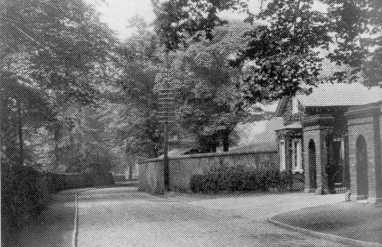
"Clifton Lodge Entrance" photograph (undated) from
Prestwich Asylum link
(archive) -
Current site.
Northtown in
Jones and Sidebotham 1962 is either
Rainhill
or
Prestwich
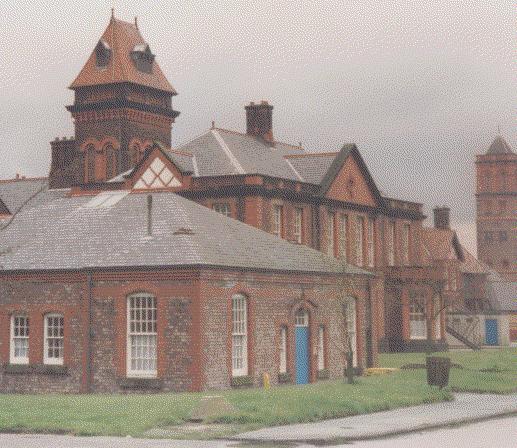
The Annexe "block, which is devoted exclusively to the care of long-stay
patients, is the biggest in the hospital. It houses 1,700 patients, male
and female. in wards which stem off from a rigidly straight main corridor.
A visitor may stand at one end, and look down successive receding arches to
the door at the other end, exactly a quarter of a mile away. Every bed is
occupied and there are very few discharges except by death, so that the
population is very nearly static" (pp 59-60)
Too large for Conolly's ideal
April 1872 J. Holland, FRCS.E. appointed Medical Superintendent
of the Lancashire Lunatic Asylum, Whittingham near Preston
1881
Census: Lancaster County Lunatic Asylum, Whittingham, Near
Preston, Lancashire. Physician:
John Augustus Wallis
aged 35
1889 John A. Wallis, M.D., Whittingham, Preston, Superintendent
of the County Lunatic Asylum at Whittingham.
See 1972 Whittingham Hospital Report -
Bopcris
18.6.1973 The inaugural meeting of
Mid Lancashire Association for Mental Health was held to
coincide with the centenary of the hospital. Christopher Mayhew, Chair of
Mind, described it as "a phoenix rising from the ashes of the Whittingham
Report". "It aims to dispel Whittingham's image of being a blot on the
horizon and prepare the public for accepting its patients back into the
community" (Mind Out Autumn 1973 page 15)
Autumn 2002:
"it is half and half of a site. The St Mary's site has been
demolished, although the St Luke's
site is still standing and empty. Estates buildings are still in use, as
well as a single storey unit for Huntingdon's patients. Market garden also
on site. A new multi million pound 150 bed MSU is also on site. A few
cottages in the grounds are also being upgraded for move on accommodation
for the MSU. Superb church in the grounds, and the social club - the heart
of any asylum - is still going strong." (Nigel Roberts 1.12.2002)
Urbex (Simon Cornwall) photographs
The new Whittingham Hospital Website
Lancashire Asylums Board
"The Lancashire Asylums Board was
established in 1891, by the
county council and all fifteen of the county boroughs. Ten years later the
Lancashire Inebriates Acts Board was established, but the County Borough of
Oldham did not participate.
The Inebriates Acts Board built a reformatory at Brockhall (in the Ribble
Valley, but its function gradually changed and by 1920 it was a
certified institution
for mental
defectives. 1925 saw the dissolution of the Inebriates Acts Board and the
Asylums Board became the Lancashire Mental Hospitals Board."
(Bob Hayes
20.12.2003 Bob has now added a page to
his website with fuller details).
Winwick Hall was a boys school in the 18th century, and became
an Asylum in 1897. It was known as Winwick Hall from 1897 to
1915.
Dual Pavilion?
In 1910:
Attendants formed National Union of Asylum Workers.
Used as
the Lord Derby War Hospital from 1915 to 1920.
for the care and treatment of soldiers and pensioners suffering from
neurasthenia or loss of mental balance
(Hansard 12.4.1920) -
C.S. Read lists this as, by far, the largest of the War Mental
Hospitals, with 1,000 beds in 1918.
Known at some time as Winwick
Asylum. Became
Lancashire County
Mental Hospital, Winwick.
In 1921 Alexander Simpson, C.B.E., M.A., M.D., CM.Aberd., was
Medical Superintendent of the County Asylum, Winwick and
Frederick Millar Rodgers M.D., Ch.B.Vict., D.P.H., was Senior Medical
Officer. In 1922 A. McM. W. Segerdal was Assistant Medical
Officer
Several patients admitted between January 1923 and September
1926,
mostly with
general paralysis, received
malarial therapy and were studied over a ten year period by John
Ernest Nicole (1894-1963) and others. In 1927 Nicole (L.M.S.S.A.
London) was Senior Assistant Medical Officer to the hospital and John P.
Steel, M.D. Edinburgh was Assistant Medical Officer.
1930 First edition Psychopathology. A survey of modern
approaches London, 1930 by
John Ernest Nicole.
F.M. Rodgers was Medical Superintendent in 1936
1936 Benedict Finkleman (1906-1966) joined the staff of Winwick.
He moved to Rainhill in
1946, so it is not clear if he was at Winwick when Gwyn and Kathleen Jones
arrived.
Late 1940s to 1955 Gwyn Jones (ex-army) and
Kathleen Jones (his wife, wanted to "do something useful in a
mental hospital setting". He was appointed chaplain at Winwick. "It was a
huge hospital of over 3000 beds, like a small town. It had its own
fire-engine and its own farm. It was very hierarchical. The medical
superintendent had the largest house, with a long corridor connecting it to
his office, so that he need not talk to anyone on the way. We had the next
largest house, because under the 1890 Lunacy Act, the chaplain was
designated as the second officer of the hospital. The salary did not match
the status - we could not even afford to curtain all the windows. Then came
the Residences: for the deputy medical superintendent, the hospital
secretary (who had not yet given himself a grander title) and the engineer.
After that, the Villas came next in the pecking order, then the Houses; and
the patients came last. That worried us"
John Ernest Nicole
was medical superintendent. Kathleen
Jones said: "He was very progressive for the time. Everything
was therapy. We had music therapy, sports
therapy, education therapy, work therapy, social
therapy... hymn singing therapy".
Jones and Kennedy 1996
1951 Kathleen Jones appointed a research assistant at the
University of Manchester.
1960 Kathleen Jones dedicated
Mental Health and Social Policy 1845-1959 "for Nick and
Mrs Nick, in affection"
5.1.1963
John Ernest Nicole of 17 Buckingham Mansions, Bath Road,
Bournemouth, died, leaving £7,203.14s. Probate to Ethel May Nicole
widow.
Winwick Hospital closed in March 1997 after celebrating its
hundredth
birthday.
(external weblink
archive). The hospital was
demolished. Its "tower" was to have been preserved, but was also
demolished. The Winwick Tower was a famous landmark, and could be seen from
the Thelwall Viaduct coming north on the M6 (Nigel Roberts)
Patients
came from Liverpool, Southport and Formby, as well as the Warrington
district. The 1986 Guiness Book of Records has it as the largest hospital
of any kind in England, with 1,352 staffed beds. Previously it had been
Europe's largest mental institution, with more than 2,000 patients.
Records are held at both Cheshire and Lancashire record offices, with
Cheshire holding details of plans of the building
Winwick Hospital remembered
Maghull, Liverpool
Built in the 1830's by the Merchant Harrison family. Sold in
1872 (when Thomas Harrison died) to the
Liverpool Select
Vestry
First used as a convalescent home for children from the Liverpool
workhouses
1878
plans being prepared to turn it into accommodation for 60
men and 120 women of
"the epileptic harmless lunatic type", but these were
not finalised until about 1908
About
1908
, plans for a new 300-patient hospital. Building began
in
1911 [Peter Barham says that Moss Side was "built upon
the
villa pattern"
July 1914
the whole estate (a large country house, two farms and
a large unfinished hospital) sold to the
Board of
Control, which intended to use the hospital as a
State Institution
December 1914 Board of Control handed over to the military
authorities. (Barham p.44)
Used as a Military Hospital: the Military Red Cross Hospital, Moss
Side, treating
shell
shock. Also known as Maghull Military War Hospital
7.12.1914 "received 20 shell-shocked
patients - the first of 3,500 to be treated there during and after the
war."
"Major Ronald Rows and his team at Maghull Hospital" (Barham p.85)
"All nurses were members of the Red Cross and wore that organisation's
uniform but in July 1915 all the male staff were enlisted into the Royal
Army Medical Corps. As the war continued more men were urgently needed at
the front so in 1918 the hospital was urged to use women to the fullest
possible extent to release men for the war effort. To ease the staff
crisis, and for its therapeutic value, some patients were allowed to work
on the hospital farm and were paid 2d per hour."
(Ashworth history
February 1915 Ernest Mantle transferred from
Netley. Considered fit to return to light duties after a few
weeks (Barham
p.54)
1920
closed as a military hospital, but requisitioned by the
Ministry of Pensions, it continued to treat soldiers.
1946 National Health Service
Act section 49(4) moved the ownership of Rampton
and Moss Side to the
Ministry of Health but left their management with the Board of Control.
Ashworth History (above): "Moss Side, along with its sister
institutions of Broadmoor, Rampton and Carstairs [Scotland], became
hospitals in
July 1948
with the creation of the National Health Service" [This is not correct
respecting "Broadmoor Institution"]
about 1954 Several
Rampton patients, including
Noele Arden, moved to
Moss Side. "It is much smaller than Rampton, having only three wards for
women. Also it has no high walls around it, and no bars on windows, and no
dreaded isolation block... I... was soon in trouble and put in a room and
drugged. However, not a hand was laid on me, and all the time I was there,
I saw no ill-treatment in any form... they were a bit heavy-handed with the
dope." (Noele Arden
1977 p. 64)
1957: See Percy
Report
1959 Mental Health Act
Started in the 1970s because of overcrowding at Broadmoor. Therefore,
mainly concerned with mental illness, not mental handicap.
1974 opened in two former Moss Side wards with the administration
offices in portakabins.
50 acres of farm land, part of the original Moss Hill estate, and to
the north of the hospital, were used for building the new, Park Lane
Hospital. Building began in 1976 and was fully completed in
1984
Parkbourn, Liverpool, L31 1HW
Mitton Road, Whalley, Clitheroe, BB7 9PE
Opened 1915: by
Lancashire Asylums Board, but
used during world
war one as Queen Mary's Military Hospital
Dual Pavilion
1921 Calderstones
Certified Institution
for Mental
Defectives
Or Whalley Asylum (Mental Defectives)
Calderstones Hospital (by 1929 - 1993)
In 1971 it had an average of 1,710 beds available and 1,631 resident
patients.
Calderstones
Reunited puts people who have worked there, or have connections,
in contact with one another. (Now back on line) - Not no (no archive)
Calderstones NHS Trust
Calderstone News
(no date a pdf file) contains history and pictures. (Lost? no archive)
Principal Architect: Edward Graham Paley
Layout: Corridor plan
Northern Counties Asylum for Idiots and Imbeciles, instituted at Lancaster,
Dec. 21 1864. Reports of public meetings at Liverpool and Leeds
1865
Northern Counties' Asylum for Idiots : instituted at Lancaster, Dec.
21, 1864. Address of the committee, list of subscriptions, and reports of
public meetings at Lancaster, Liverpool, and Leeds. Lancaster: [1865?].
xiii and 45 pages.
Northern Counties' Asylum for Idiots and Imbeciles, instituted at
Lancaster, Dec. 21 1864. Reports of public meetings at Liverpool and
Leeds. Lancaster: [1865] 16 pages
Following the first 2 annual reports (January and December 1866), the
Northern Counties' Asylum for Idiots and Imbeciles was called the Royal
Albert Asylum. (Wellcome Library catalogue)
1868 opened
See Rossbret website -
archive
Reports for 1866-7, 1867-8, 1868-9, 1869-70 and 1870-71 largely concern
the construction of the hospital and its finance.
Royal Albert Asylum from 1867 to 1909
1869 Annual report for 1868 Royal Albert Asylum for the
education and training of idiots and imbeciles belonging to Lancashire,
Yorkshire, Cheshire, Westmorland, Cumberland, Durham and Northumberland :
fifth annual report. by the Royal Albert Asylum for Idiots & Imbeciles
of the Northern Counties (Lancaster, England). 13 pages, 1 unnumbered leaf
of plates
December 1871 First admissions
Annual report. 1874
April 1876 Royal Albert Asylum for Idiots and Imbeciles of the
Northern Counties, Lancaster : supplementary report. 22 pages.
Consists of a list of central committee members, a supplementary report
of the central committee (E. D. de Vitreï, chairman), the report of the
Commissioners in Lunacy (Greville Howard, James Wilkes), items from local
newspapers about the asylum, statistical statements and a summary of
contributions (James Diggens)
1876 The Illustrated London News See
Wicked Fish
2014
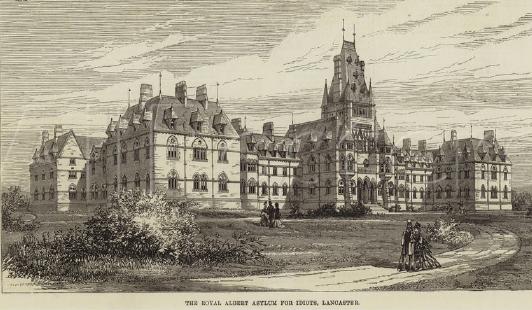
1884 Annual report for 1883 Royal Albert Asylum for the
care, education, and training of idiotic, imbecile, and weak-minded
children and young persons, belonging to Lancashire, Yorkshire, Cheshire,
Westmorland, Cumberland, Durham and Northumberland : twentieth annual
report.
Royal Albert Asylum for Idiots and Imbeciles of the Northern
Counties (1896 reference)
1900 Annual report for 1899. Dated October 1900. The Royal
Albert Asylum, Lancaster : a training institution for the feeble-minded
belonging to Lancashire, Yorkshire, Cheshire, Westmorland, Cumberland,
Durham and Northumberland, thirty-sixth annual report. 102 pages, 4
unnumbered leaves of plates.
Royal Albert Institution 1909 to 1948
1910 Annual report for 1909. Dated October 1910. The Royal
Albert Institution, Lancaster : for the feeble-minded belonging to
Lancashire, Yorkshire, Cheshire, Westmorland, Cumberland, Durham and
Northumberland, forty-sixth annual report. 72 pages, 24 unnumbered
pages of plates.
1923 The Royal Albert Institution, Lancaster: origin and
present position by W.H Coupland. 7 pages
18.7.1924
James Ollier and collective action
1948 Annual report for 1947. Dated June 1948 The Royal Albert
Institution, Lancaster : for the feeble-minded of Lancashire, Yorkshire,
Cheshire, Westmorland, Cumberland, Durham and Northumberland, eighty-fourth
annual report. 20 pages, 1 unnumbered leaf of plates. Consists of a
list of presidents, officers and committee members, the report of the
central committee (Sefton, chairman), the report of the medical
superintendent (D. H. H. Thomas), a statistical statement and a view of the
institution.
Ceased being a voluntary institution in 1948 when it became part of the
National Health Service.
Royal Albert Hospital, Ashton Road, Lancaster LA1 5AJ
Together with Deep Cutting Hostel, Ashton Road, the
Royal Albert Hospital had 1001 beds on 31.12.1977
Planned closure March 1996. Original building (listed) to be
converted into a school for Moslem girls and other parts of the site to be
used for private housing.
(Lancashire Evening Telegraph, Thursday
8.2.1996 [not archived]
Photograph and some information
website of Jamea Al Kauthar
2.5.2014 to 13.7.2014 "From There to Here - The hidden history
of People with Learning Difficulties in Merseyside",
an exhibition at the Museum of Liverpool by Wicked Fish.
1846 Cumberland magistrates contracted for the care of all their
pauper lunatics at Dunston
Lodge
1846 or 1847 Westmoreland magistrates entered into a
similar contract.
Such contracts
(under section 29 of the 1845
County Asylums Act)
had
to be approved by the Home Secretary and could only last for five years.
1862 (Simon Cornwall: Built: Peter Cracknell: Opened)
Architect: Thomas
Worthington
Corridor form -
Close to Conolly's ideal?
1868 map Cumberland and Westmoreland Lunatic Asylum is
shown
at
coordinates 343369,553908, at "Garlands". [2000: Garlands Hospital,
Carlisle, Cumbria, CA1 3SX at the same coordinates]
1925:
Nurse dismissed from "Garlands Mental
Hospital"
Garlands Hospital has now closed. For some reason it is not
listed in the
Hospital Database.
Closed 1997, looks partially demolished (Simon Cornwall).
Move north to Scotland
A Hospital.
7.8.1772:
Advertisement York Courant about "the
deplorable situation of many poor lunatics in the county" was followed by
an appeal for funds 27.8.1772
Opened 1777
Originally designed for fifty four patients
Known as York Lunatic Asylum from 1777 to 1904
Alexander Hunter (1729-1809), MD Edinburgh, FRS was instrumental in
founding and its first physician. He was consulted about
Leicester Asylum and
Liverpool Lunatic
Asylum.
1790
Hannah Mills sent to the asylum. At the request of her
relatives, Quakers in York attempted to visit her, but were refused. Hannah
later died. The Quakers founded the
Retreat
1809?
Dr Hunter succeeded by Dr Best
1810 Benjamin
Rush advised his son to visit Catherine Cape and
Alexander Hunter.
1813
Godfrey Higgins, magistrate, sent William Vickers to the
asylum. Later, he visited Vickers at the request of Mrs Vickers and found
him filthy, sick and verminous, with lash marks on his back. Unable to
obtain a satisfactory explanation from Dr Best, Higgins published a
statement, with extracts from the letters, in the York Herald on
27.11.1813. Higgins and local Quakers made themselves Governors of the asylum. A fire on
26.12.1814 killed four patients and prevented effective
investigation of the asylum.
10.1.1814
A letter in the York Herald, from Godfrey
Higgins said he was satisfied with conditions at the asylum, but, in March,
Higgins was again complaining and an acrimonious dispute followed in the
paper.
The House of Lords recorded a petition against the
Madhouses
Bill
from the Governors of York Asylum on 18.7.1814, and one in favour
from Godfrey Higgins on 26.7.1814
August 1814 Dr Best resigned and the asylum staff were
dismissed.
"They have a book, in which they note down any abuses... shown
from time to time to the gentlemen's committee. Their observations, in the
lunatic Asylum, extend to the apparel and cleanliness of the female
patients as well as to their humane treatment and the decorous demeanour of
the nurses and keepers" (On the Desirableness and Utility of Ladies
Visiting the Female Wards of Hospitals and Lunatic Asylums by Catherine
Cappe. 15 pages. York 1817.
1818
County Asylum opened, but this is not considered to have
significantly reduced the number of pauper lunatics in York Asylum.
1823
Matthew Allen was apothecary and superintendant of the
Lunatic Asylum, Bootham
1.1.1844:
157 patients. 52 pauper and 105
private.
1847 Asylum for the North
and East Riding opened. A contract between the county
authorities and York Corporation provided that it should also serve York,
and pauper patients were removed from York Asylum to the new asylum. For
several years, York Asylum only served private patients.
1858-1874
Frederick
Needham was Medical Superintendent
early 1860s Asylum for the
North and East Riding full. Contract made by York Corporation
with York Asylum to accomodate pauper lunatics in newly built separate
wings. This arrangement continued until 1906.
1881
Census York Lunatic Hospital, Bootham, York
(York St Giles In Suburbs). Ella Amanda Gill, 36 year old wife of surgeon,
was looking after her three children. Thomas Kirsopp, Surgeon M.R.C.S.
L.S.A., aged 24, was a visitor.
1904 Became Bootham Park Hospital, Bootham, York, YO3
7BY. Private
and
Voluntary hospital until 1948. Then NHS.
1906
York City Asylum opened and paupers removed from Bootham Park.
History in Anne Digby, From York Lunatic Asylum to Bootham Park
Hospital (University of York, Borthwick Paper no 69, 1986), and another
to be included in a guide to hospital records at Borthwick Institute by K
Webb (in progress 1999)
"a very attractive building (inside as well as out)" Now the
administrative centre for York Health Services Trust, as well as providing
in and out patient care for people with mental illness.
Main archives are at
York University, Borthwick Institute of Historical Research: Bootham Park
Hospital
. Use
Access to Archives to find extensive records
"Friend's", in Friend's Retreat relates to the Religious Society of Friends
or Quakers
Friend's Retreat, York is listed as an asylum receiving paupers in
1844, but none are recorded:
1.1.1844: 98 patients. All private.
Its address (2002) is
The Retreat, 107 Heslington Road, York, YO10 5BN
(map)
"Thee has had many wonderful children of thy brain dear
William, but this one is surely like to be an idiot"
Esther Tuke to her pig-headed husband who wanted to build
a refuge for lunatic Quakers

Licensed House
1.1.1844 71 patients. 41 pauper and 30 private
Proprietor 1844: James Martin
"in its interior, commodious and well adapted for an asylum, having
been built expressly for the purpose. The yards, however, are extremely
gloomy and confined" (1844
Report p.43)
Gate Helmsley Retreat
1859 55 patients. 28 pauper
1859 national
comparisons
Licensed House
1.1.1844 35 patients. 28 pauper and
7 private.
1859 44 patients. 19 pauper
1859 national
comparisons
1870 Dunnington House, near York Licensed to R H Hornby
Sometimes called Grove Hall
Licensed House
1.1.1844 26 patients.
14 pauper and 12 private.
1859 23 patients. 7 pauper
1859 national
comparisons
1870 Grove House, Acomb, nr York licensed to Mr Robert Pearson
1881
Census: Grove House, Acomb, York. Private Asylum (Hospital).
Proprietor: Jane E. Cooney, unmarried aged 44, born Bulmer, York, her
widowed aunt, Mary Pearson, aged 70, born Sigston, York "Retired Private
Asylum" in the household. Patients name in full. (male and female. probably
none paupers)
Licensed House
1.1.1844 26 patients. 13 pauper and
13 private.
(map)
York City Asylum opened 1906,
Architect: A Creer
Became
York City Mental Hospital in 1927. Naburn Emergency Medical
Services Hospital (1940-1948) was built in huts in its grounds. After being
a military hospital it was a prisoner of war hospital. The City Mental
Hospital became Naburn Hospital in 1948. Fulford
Hospital and the Maternity Hospital evolved from the military
hospital. The Maternity Hospital succeeded Acomb Maternity Hospital.
Fulford had a mixed use, including geriatric, and temporary
psychiatric from 1976 to 1983. Naburn Hospital was closed 1988. Address was
Naburn Lane, York, YO1 4RJ "A short history of the hospital to be included
in forthcoming guide to hospital records at the Borthwick Institute (in
progress 1999) by K Webb"
Closed 1988, demolished 1988 (Simon Cornwall)
external link
Opened
23.11.1818
Architect:
Watson & Pritchett of York.
Early form, later adapted to corridor?.
Described as
H Form at the time
Superintendent and matron 1818 to 1831:
William and Mrs
Ellis - Previously at
Hull, afterwards went to
Hanwell.
Superintendent and matron 1831 to 1853: Dr C.C. Corsellis and
Mrs Corsellis
1834:
The Hanwell Lunatic
Asylum by Harriet Martineua describes the Ellis regime
1.1.1844 433 patients. All pauper. 1844?
9% of patients
epileptic
Director 1853 to 1858: Dr John Septimus Alderson MD, previously
Medical Superintendent of
York Asylum.
Matron 1853 to 1867: Mrs Zillah Paige
Temporary assistant 1857: Mr Henry Maudsley (born 1835, died
1918). This was Maudsley's first asylum post. He moved on to Brentwood and
Cheadle and later took
over Lawn House.
Director 1858 to 1866 John Davies Cleaton, previously superintendent of
Rainhill, Lancashire,
afterwards a Lunacy Commissioner.
Director 1866 to 1876: Dr James Crichton-Browne MD
(born 1840, died 1938), who once
wrote "Education is no doubt essential, but feeding comes before education
and
breeding before that". Previously assistant medical officer at
the Devon,
Derby and
Warwick county
asylums
and superintendent of
Newcastle City. He lectured at the Leeds School of Medicine
and founded and edited the annual West Riding Lunatic Asylum Medical
Reports. "These reports, which were the first of their kind in this
country", contain contributions from J.Hughlings Jackson,
T.C.Allbutt and T.L.Brunton. He was co-editor of
Brain
from 1878 to 1885.
(external link about his period at Wakefield)
-
(archive)
In 1876 he was appointed a Lord Chancellor's Lunacy Visitor
1872
South Yorkshire Asylum opened
1872 Plans for the establishment of a lower middle-class
hospital that, thirty years later, materialised as
Scalebor Park.
Director 1876 to 1884: Dr Herbert C. Major MD, previously
Assistant Medical Officer since 1872. Developed histological research.
1881 Census: "West Riding Pauper
Lunatic Asylum" Stanley Cum Wrenthorpe, York, England.
Herbert C. Major, Medical Director (Physician), unmarried aged 31,
living with E. E. Major, his sister (unmarried) aged 40. Both born St.
Helens, Jersey, Channel Islands
Director 1884 to 1910: Dr William Bevan Lewis LRCP, MRCS,
previously Assistant Medical Officer since 1876. Devoted to histological
research.
1888
Menston opened
1891 Census: staff list
1904: Murrays Handbook Yorkshire p.502:
"The Prison at the bottom of Westgate, is one of the
largest in the kingdom. It is conducted on the radiating principle, the
wards converging to a common centre; 2000 prisoners can be accommodated.
The West Riding Pauper Lunatic Asylum, on the Stanley-road, is a
vast building, with large grounds and a good modern church. The Cattle
Market in the Ings, first held in 1765, has weekly a larger show of
beasts and sheep than any other market out of London."
[map showing prison and asylum
(hospitals)]
2.6.1904 Storthes
Hall
opened
1925 Became West Riding Mental Hospital
1948: Became Stanley Royd Hospital
About 1948 a report on Wakefield was made by a medical officer to
the new
Leeds Regional Hospital Board. It describes conditions which C. Ham says
were confined mainly to Stanley Royd,
Menston and
Storthes
Hall,
the three hospitals controlled (before 1948) by the "powerful" West Riding
Mental Hospitals Board:
"The old gaol-like buildings at Wakefield are gloomy and depressing and the
galleries where many patients aimlessly spend so much of their time are
deficient in natural lighting. The accommodation can best be described as
austerely pre-Dickensian, falling far short of usually acceptable
standards, and ... there is still created in the mind of the observer an
undeniable impression of miserable discomfort and overcrowding which cannot
long be tolerated under enlightened administration"
"The Stephen Beaumont Museum of Mental Health was in the Stanley
Royd
Hospital at Aberford Rd. When the hospital closed in 1995, the museum was
moved to Fieldhead Hospital in Ouchthorpe Lane
(external link to map).
The museum depicts the
story of the Asylum and contains restraining equipment, a padded cell, and
medical and surgical equipment documents. (The treatment record books are
in the County Record Office.) There is also a scale model of the original
1818 building and photographs dating from 1862."
other museums
Fieldhead Hospital, Ouchthorpe Lane, Wakefield, WF1 3SP;
Pinderfields Hospitals, Rowan
House, Aberford Road, Wakefield, WF1 4EE;
Stanley Royd Hospital, Aberford Road, Wakefield, WF1 4DQ
A Workhouse Asylum
"Wards exclusively appropriated to lunatics"
(1844
Report
p.10)
South Yorkshire Asylum
Built: 1869-1872 Opened 1872,
Architect: Bernard
Hartley
Corridor form
April 1872 S. Mitchell M.D. Medical Superintendent and
formerly Assistant Medical Officer at the West Riding Asylum Wakefield has
been appointed Medical Superintendent of the South Yorkshire Asylum
Wadsley, Sheffield.
Became West
Riding
Asylum, Wadsley from
1890, West Riding Mental Hospital, Wadsley from 1930, Middlewood
Hospital,
Middlewood Road, Sheffield (S6 ITP) from 1948. Possibly always known as
Wadsley by local people.
(map)
1,189 staffed beds 31.12.1975
Closed 1999
Mostly demolished, some wards, chapel and clock tower remain. (Simon
Cornwall)
Architect: Vickers
Edwards
Built: 1884-1888. Opened
8.10.1888
to provide for the northern end of the county.
Peter
Cracknell describes it as probably the best example of the
Broad Arrow form.
1888 plan published in Royal Institution of British
Architects (Simon Cornwall's website)
1893
Scalebor Park proposal
11.2.1898 Lunacy Commission complain that the planned church has
not
been built. "Menston still remains in the miserable position of being the
only asylum in England and Wales without a building set aside for the
worship of God. The room in which a dance is held on Saturday, becomes the
house of prayer on Sunday. The numerous patients here professing the Roman
Catholic faith have no opportunity afforded them of attending Mass
excepting two or three times a year at the highest festival of the Church"
See 1912. A chapel was not provided until 1967.
11.2.1898 "42 males and 38 females are private patients". If
they were "sent away" "many would only have to return here as paupers".
16.11.1900 "There are today on the books the names of 1594
patients of whom 746 are males and 848 females. The private patients number
75"
1902
Scalebor Park opened
1925: The Branch Secretary of the Nation Asylum Workers Union at
Menston was Mr George Vernon, "West Riding Mental Hospital, Menston,
near Leeds, Yorkshire"
1.1.1927: 1,807 "insane" of whom all but 199 were Rate
Aided. 873 were men, 934 women. In 1926 the proportion of recoveries to
admissions was 34.7%. The proportion of deaths to the
asylum population was 9.5%.
Became Highroyds
Hospital in
1963.
1963
Start of nurses story
continued on Refractory Ward
Derek Hutchinson's story (Part of Guardian
article)
1,152 staffed beds 31.12.1975
Autumn 2002 reported due for closure
Closing 2003. Maybe February. Site for sale. (Simon Cornwall)
The final tour
Patients from last five wards to be transferred to the Mount Hospital,
Clarendon Road, Leeds, on 25.2.2003
English Heritage: High Royds, West Yorkshire, built 1884-88 as
the pauper asylum for the West Riding of Yorkshire
Records in West Riding
Archives.
Hospital Records Database
Highroyds history website
Fourth West Riding Pauper Lunatic Aslum
1900 Plans presented. Lunacy Commission insisted on a chapel
11.1.1900 Resolution of West Riding County Council agreeing to
provide a chapel.
Opened
2.6.1904 to cover the western end of the county.
(map)
Peter
Cracknell: For Patients from Dewsbury, Huddersfield, Halifax and
Saddleworth districts.
Architect:
J.Vickers-Edwards
Compact Arrow design.
1912 1,634 patient and 210 attendants
ultimately contemplated to have about 2,250 patients.
1912
No Asylum Chapel
1923 to
1932 National Archives has, under
Ministry of Pensions Hospitals and Convalescent Centres (WORK 12/72/73),
"Kirkburton, Acute hospital and two convalescent villas, Storthes Hall:
lease of portion of Storthes Hall Asylum; lease of land for agricultural
and recreational purposes; surrender of premises"
1924 Ministry of Pensions Mental Hospital at
Kirkburton opened at Storthes Hall - There are now two Storthes Halls:
The main asylum and the Ministry of Pensions hospital.
1.1.1927: "Storthes Hall": 1,652 patients of whom all but
73 were Rate
Aided. 771 were men, 881 women. In 1926 the
proportion of recoveries to admissions was 23.4%. The proportion of deaths
to the asylum population was 9.5%
1.1.1927: "Storthes Hall (MoP)": 268 "private" patients,
all men. In 1926 the proportion of deaths
to the asylum population was 0.4% - Recovery rate not stated.
By 1929 Storthes Hall Mental Hospital
1931 Ministry of Pensions Mental Hospital closed.
1939 West Riding Mental Hospital
1948 Storthes Hall Hospital
1,416 staffed beds 31.12.1975
Autumn 2002: due for closure
Peter
Cracknell: Now part converted to Halls of Residence for
Huddersfield University.
2003
Storthes Hall Remembered, 135 pages, by Ann Littlewood
"Scalebor Park Hospital was built on the site of the old
Scalebor Hall by West Riding County Council at a cost of £126,000 for
210 paying patients, 105 of each sex. The property covered 120 acres. It is
currently being partly demolished and the remaining building and land will
be re-developed for housing." (Burley History Trail - 2002 -
original website -
archives -
new website)
(Simon Cornwall says Built: 1895 Architect: Unknown)
July? 1902 Formal opening.
Sir James
Crichton-Browne, Sir Frederick Needham, Sir Thomas Clifford
Allbutt, Dr
Bedford Pierce, Dr Major and Mr Urmston present.
"The old hospital had lovely honey coloured stone and from
various upstairs wards you looked out onto the moor... It had an insect
room which had carvings in the wooden panels. When Scalebor first opened
there was the idea of
curing General Paralysis of the Insane by injecting patients with
malaria and a small unit was built for this
purpose". (Andrew Richardson)
"The Low-Rate Private Patient and Some Changes" - The Presidential
Address Delivered at the Ninety-Seventh Annual Meeting of the Royal Medico-
Psychological Association, Held at Ilkley, 6.7.1938
(offline) - See
Social Science
History and Mental Health History.
"The hospital was situated in amazing countryside between
Burley and Ilkley moors. It was at the top of the village on the road
leading up to the moor just across the road from the railway station. High
Royds was about three miles away or one stop on the train.
"Moordale" in
Jones and Sidebotham 1962. See
June 1958 to June 1959
Closed 1995, currently being demolished. (Simon Cornwall)
2001
Pictorial history of early re-development
2005
Re-development commended
Built in 1910 as Daisy Hill Workhouse - a new Bradford
workhouse.
See Peter Higginbotham's site. Became a NHS
Hospital in 1948.
Meanwood Park Colony
Tongue Lane Meanwood Park Leeds LS6 4QB
3.6.1920 Official opening by
Sir William Byrne Chairman of the Board of Control.
4.6.1920 Report of the ceremony in the Yorkshire Post
Patients later increased to 103. 87 in the Hall and 16 in a nearby
block.
Licensed House
Founded
by Dr John Septimus Alderson in 1814.
Parry-Jones, W.L. 1972 pp 78-79)
Known as
Sculcoates Refuge from 1814-1840. Address: Cannon Street, Sculcoates
near
Ancaby Road, East Yorkshire.
1842: Licensed for 99 patients.
Parry-Jones, W.L. 1972 (pp 40-43) suggests
this was to avoid the requirement for a
resident medical officer
Proprietor
(1844) Richard Casson (Surgeon)
1.1.1844: 106 patients. 93 pauper and
13 private.
Weekly charge for
paupers: 8/- excluding clothes.
ON 1844 LIST OF BEST CONDUCTED
In 1847 the Hull JPs were negotiating to buy
this as an asylum for the borough. They also proposed to buy more land.
(1847 Report (B) p.44) It became Hull Borough Asylum on 1.6.1849.
(Address Londesborough Street, Hull - This building closed 1882?
1883: New building: Architect: Smith & Broderick
Hull
City and County Asylum, Hull City Mental Asylum, finally De
La Pole Hospital, Willerby, Hull, HU10 6ED.
Closed 1997, new road building current, looks intact. (Simon Cornwall)
Made a
"County
Asylum" under a local
Act in 1823 or 1824
In 1844 the Commission had only just found out that this was an asylum.
(1844
Report
p.210)
They give no other information about it.
Licensed House
1.1.1844 6 patients. 2 pauper and 4 private.
Licensed House
1.1.1844 9 patients. 6 pauper and 3 private.
Licensed House
Proprietor (1844) Jos Beall. The
1844
Report
on page 213 says it
had 9 private and 1 pauper patient on 1.1.1844. In the Return of
3.2.1842
it is shown with 29 patients (pauper and private). In 1844 (p.242) it is
shown as licensed for 20 paupers - so perhaps the 1 on p.213 in 1844 is a
miss-print for 11 or 21.
Weekly charge for
paupers: not stated.
SEVERELY CENSURED IN 1844
REPORT
47 were in a licensed house/s. Most of these would have been in
Gate Helmsley (north
of York)
35 in workhouses
57 with their friends or elsewhere
52 were in a licensed houses. Houses in East Riding were licensed for
more than 52 paupers. (1844 Report p.212). With the number of paupers they
were licensed for in 1842, they were:
Nunkeeling (20),
Hessle, near Hull (24);
Hull Refuge (96);
Southcoates, near Hull
(3);
Dunnington, near York (30)
55 in workhouses
43 with their friends or elsewhere
East and North Riding and York Yorkshire County Asylum, opened on
7.4.1847. Located at Willerby.
Architect:
Scott &
Moffatt. At some time extended by George Fowler-Jones
Corridor form
It had 472 patients in 1858. It became the North Riding
County
Asylum in
1865.
1881
Census: North Riding of Yorkshire Pauper Lunatic Asylum,
Clifton in York, York.
From 1948: Clifton Hospital, Shipton Road,
York, YO3 6RD.
Closed 1994 sold to property developers 1995, looks partially
demolished (Simon Cornwall).
(map)
Architect:
Charles Henry Howell
1881
Census
It became Broadgate
Hospital, Walkington, Beverley, HU17 8RN
Demolished 1991
(demolition website)
[A Sarah Rutherford case study]
National Grid Reference NZ 508 179
Built 1893-1898
Architects:
Charles Henry Howell and
A. J. Wood -
Compact Arrow
Landscape: Designer
Robert Lloyd
Nigel Roberts has plans of Middlesbrough
Asylum that were produced as a supplement to a Commissioners in
Lunacy report of July 1896. Plans for Winwick and Bexley were produced in the same supplement,
which, given they opened shortly afterwards, suggests the same for
Middlesbrough.
Become St Luke's Hospital, Middlesbrough.
Closed 2000?, new road being cleared to side of side, otherwise intact.
(Simon Cornwall)
Botton village: (external weblink)
Danby Whitby North Yorkshire YO21 2NJ
(Camphill Village
Trust Limited)
(map)
Licensed House
Open 1799 to 1868
"Bensham Asylum.. was one of three private asylums in Gateshead to
claim 'the benefits of the clean air and healthy situation of the suburbs'.
Bensham Asylum expanded rapidly and the majority of pauper lunatic patients
were sent there from 1836 in addition to private patients. The asylum
appears to have closed between 1865 and 1868, when patients were
transferred to
Dunston Asylum. Part of the building still stands in Sidney
Grove."
(Gateshead Bensham Guide)
Proprietors (1844) F. Glenton and P.
Glenton (Surgeon)
1.1.1844: 67 patients. 50 pauper and 17 private.
Weekly charge for
paupers: 8/- including clothes.
ON 1844 LIST OF BEST CONDUCTED
1854: 160 patients, of whom 139 were paupers
1855 or later contract to receive Newcastle pauper lunatics.
1857 Durham pauper patients removed to
Bath Lane
1859: 95 patients, of whom 73 were paupers
1859 national
comparisons
1859
On the prevention and treatment of mental
disorders published by George Robinson, MD (1821-1875) the
owner of Bensham Asylum.
1864: Newcastle's contracts with Bensham, Gateshead Fell and the
Durham County
Asylum expired. The "now disused" licensed house at
Bensham was rented for Newcastle's pauper lunatics until the
Newcastle
Borough Asylum opened in 1869.
(Parry-Jones, W.L. 1972 p.62)
1870 Newcastle-upon-Tyne (County
Asylum) listed at Bensham near Gateshead. F. Sutton (surgeon) the medical
superintendent.
1870
Robinson's book in America
1875 Death of George Robinson, aged 55
Wrekenton Lunatic Asylum (1851 advertisement)
Open 1825 to 1855
1825: Established by "Mrs Gowland and her late husband"
Licensed House
Proprietor (1844) Jacob
Gowland 1.1.1844 36 patients. 5 pauper and 41 private. Weekly charge
for paupers 7/- to 8/- including clothes.
SEVERELY CENSURED IN 1844
REPORT
Gowlands' house at Wreckenton and the
Eales' house at West Auckland
seem to have been no more than fairly ordinary large houses.
(See quotations from
1844 Report)
1851: Proprietress: Mrs Gowland
Superintendent of the male department: Mr John Gowland
Superintendent of the female department: Mrs Fleck
(advertisement reproduced Parry-Jones, W.L.
1972 p.110)
Closed by 1858
Licensed House
Open 1817 to 1860
About 1843?
escaped epileptic killed wife and daughter
Proprietor (1844) S. Kent.
1.1.1844 86 patients. 80 pauper and 6 private. Weekly charge for
paupers 8/- including clothes.
1855 or later contract to receive Newcastle pauper lunatics.
1859: 94 patients, of whom 88 were paupers
1859 national
comparisons
1862 map shows Gateshead High Fell Lunatic Asylum
on
Sourmilk Hill, near Sheriff Hill House.
Also described as "near Gateshead"
Shown on 1862 map as "Dunston Lodge (Lunatic Asylum), just to the west
of the village of Dunston.
Licensed House
Opened 1831. Purpose built as an asylum
Proprietor (1844) J.E. Wilkinson.
(Probably John Etridge Wilkinson, whose son married Isabella Gustard
Garbutt, daughter of Cornelius Garbutt and brother to another Cornelius
Garbutt and a William Garbutt - see below)
27.8.1839 Birth of William Garbutt (Christened Gateshead
9.10.1839) to Winifred and Cornelius Garbutt
1.1.1844 100 patients. 77 pauper and 23 private. Weekly charge
for paupers 8/- including clothes.
ON 1844 LIST OF BEST CONDUCTED.
Commended, along with
Fiddington House and
Belle Vue, in Wiltshire,
and
Fairford Asylum, in Gloucestershire, because it had a farm.
September 1845
Charles Lockhart Robertson "Resident Medical Officer in the
Cumberland County Lunatic Asylum at Dunston Lodge"
September 1846 Charles Lockhart Robertson resigned as appointed
to the
Royal Military Lunatic Asylum at Yarmouth. (letter 5.5.1849)
1846/1847 By contract with the
Cumberland and
Westmoreland magistrates, Dunston Lodge became, in effect, the
temporary County Asylum for those counties.
1847 Report of the Cumberland Lunatic Asylum at Dunston
Lodge, Gateshead-on-Tyne, for ... 1847 Gateshead (England). Cumberland
Lunatic Asylum Publisher: Edinburgh : Neill & Co., pr., 1847
24 pages; 21 cm. Copy in the rare books collection of Cambridge University
Library. The only report of the asylum in the
COPAC catalogue.
In 1851, a male pauper bit the arm of J.E. Wilkinson. He was
placed in
a straight jacket, then flogged and secluded. Later, his two upper incisor
teeth were removed by the medical attendant. An inquiry was held by the
Visiting Magistrates of
Cumberland and
Westmoreland
and then taken up by the Lunacy Commission. J.E.
Wilkinson was found guilty "of the most flagrant cruelty" and the renewal
of his license prohibited by the Commission.
1853: License transferred to Mr Cornelius Garbutt (born 1806,
died 1865)
(Parry-Jones, W.L. 1972 p.247)
1858: 151 patients. 119 pauper and 32 private
1859 national
comparisons
1865 Cornelius Garbutt's son, William, took over management of
the asylum. William Garbutt was proprietor of Dunston Lodge Lunatic Asylum
from 1865 to 1900. J.E. Wilkinson was his daughter's father-in-law
16.5.1866 Jane Thornton Garbutt, daughter of Mary Elizabeth and
William Garbutt, christened Whickham, Durham. Jane was the second of their
eleven children (4 sons and 7 daughters). The three oldest daughters all
married young doctors employed by William Garbutt as Medical
Superintendents. One son and six grandchildren became doctors.
1870 The licensee was "W. Garbutt", who had just become sole
licensee
(Rossbret site)
About July 1871: T O Wood, LRCP.Edinburgh, MRCS.Edinburgh,
the
Medical
Superintendent of Dunston Lodge Asylum, was appointed Lecturer on
Psychological Medicine in the Newcastle College, Durham University, in
place
of Dr Hugh Grainger Stewart, the Medical Superintendent of the
Newcastle
Borough Asylum, who had died.
(Rossbret site)
June 1874: George C. Harrington, aged
50, hanged himself in Dunston Lodge Asylum.
(Chester
Ward
Coroner)
1881 Census: Dunston West Lodge and
Lunatic Asylum, Dunston Lane, Whickham, Durham. William Garbutt, aged 41,
born Gateshead "Insane Asylum Proprietor Forms Attached A/79 B/5 C/17"
living with his wife, Mary Elizabeth Garbutt, aged 39, born Wooler,
Northumberland, and daughter, Jane Thornton Garbutt, aged 14, born Dunston,
Scholar. William Marshall Taylor Medical Superintendent: unmarried, aged
26, born Newcastle On Tyne, Surgeon M.D. Edinburgh - M.R.O. England
1884 A Day in a Private Lunatic Asylum by George Herring,
London/Newcastle. Originally published as a series of articles in the
Tyneside Echo, this is a very favourable account by a journalist who
got himself "admitted" as a "new inmate" for a day. There were 44 inmates
at the time of his visit. The "chief male attendant" was John McDougall.
The "matron" was Miss Mary Wilson, and the medical superintendent was still
Dr Taylor. The medical visitors were Dr Hume and Dr Embleton of Newcastle.
Geoffrey Allen's grandmother (see below) appears as a toddler.
1894
Whellan's Directory of Durham, 1894, pages 1239-1240:
"Dunston Lodge Private Asylum was established in 1830 and has been
in the hands of the family of the present proprietor for many years. The
grounds are extensive and a farm of 100 acres surrounds the house, which
occupies a pleasant situation west of the village. The recoveries have been
much above the average. Lord Ravensworth is chairman of the visiting
committee"
March quarter 1901 Death of William Garbutt aged 76 recorded in
the Gateshead district. Dunston Lodge Asylum does not appear in the 1901
census.
[Some family information on the Wilkinsons and Garbutts provided by Ann
Adams. A substantial part of the history (not all entered yet) has been
provided by Geoffrey Allen, whose grandmother (1882-1954) was the youngest
daughter of William Garbutt]
Proprietors (1844) J. Eales and
sister.
1.1.1844 35 patients. 27 pauper and 8 private.
Weekly charge for
paupers: 6/- to 7/- excluding clothes.
SEVERELY CENSURED IN 1844
REPORT
The Eales' house at West Auckland and the
Gowlands' house at Wreckenton
seem to have been no more than fairly ordinary large houses.
(See quotations from
1844 Report)
Closed by 1847
Durham County Asylum was built but "not yet open" in 1858.
Foundation year: 1858
Architect: Joseph
Howison. Peter
Cracknell classifies it as
Corridor form.
Became Winterton Hospital, Sedgefield, Stockton on Tees, TS21
3EJ
map
multi-map
External link on the organ
Durham
records
include
this:
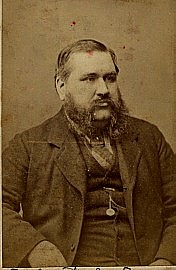
"The first medical superintendent, Dr Smith, was appointed in June
1857,
at first on a temporary basis. Some county patients were transferred from
Bensham Asylum,
Gateshead,
to temporary accommodation in
Bath Lane. By
January 1858 Dr Smith had received 131 patients, of whom 19 had been
discharged. In April 1858 he requested that some patients should be
moved
to the new asylum as soon as possible as the Bath Lane Asylum was
overflowing. They could help, he thought, in putting in seeds and preparing
the grounds. Between twelve and twenty could be accommodated in the
steward's house which was then complete, and more patients could be
transferred when other rooms were ready. Building work continued during the
summer, while patients were being moved in, and was complete by the autumn.
By October 1859 there were 237 patients (131 male and 120 female);
72 of
these had been admitted since June, including 44 from Newcastle. The
committee reported 'The admission of so many patients at once has caused a
difficulty as to the furniture and clothes which are in great measure made
in the asylum and which therefore are not at present supplied
sufficiently'"
1881 Census At No 3 Asylum Cottages,
John Nichel and his family
1889 Extended by William Crozier (Architect)
3.11.1893 Death of Jack Nichol "for eighteen years chief
attendant" -
(external link to story)
1925 Durham County Mental Hospital
The
Rossbret site has a history that appears to
date from 1920, and includes staff in 1920. There is a link from
there to
Durham Record Office web site which has more history.
1940 Winterton Emergency Hospital (to 1948)
1949 Winterton Hospital (Mental Hospital)
about 1955: Winterton Hospital
1969 to 1972
Peter Barham's
research group with Joseph, Arthur, Terrence, Eric, Henry (and others?)
Listed as closed 1996, but (Autumn 2002) reported to be in very partial
use.
"The decision to close Winterton was made around 1990 and the
vast majority of patients and staff were gone by 1998. Demolition
started in 2000" But "a part of Winterton is still in operation
today" (Jack Turton)
1998 Behind the Wall: The life and times of
Winterton Hospital by Adam Lamb and Jack Turton
12.4.2003
Transcription of inscriptions in Winterton Asylum
Cemetery
July 2002. Sedgefield Community Hospital, Sedgefield, TS21
3EZ opened on part of the site.
Gateshead became a County Borough in 1889
External link to index of A Short History of
Gateshead (1998)
Gateshead Borough Asylum
At Stannington
Built: 1912 Opened 1913
Architect:
George Thomas Hine &
Carter Pegg
Compact Arrow
Became Gateshead County Borough Mental Hospital in 1920
St Mary's Hospital from 1948
Stannington, NE61 6AA
Closed 1995. Planning submitted 1999, refused. Site still
looks intact.
(Simon Cornwall)
English Heritage: St Mary's Stannington, Northumberland, built
1910-1914 as the pauper asylum for Gateshead
"St Mary's Hospital at Stannington serves the town's present needs for a
mental hospital. Previously, mentally ill patients were catered for at
private asylums situated at
Wrekenton
(1825-55),
Sheriff Hill
(1817-60) and
Bensham
(1799-1868). Part of the latter building can still be seen on
Sidney Grove.
1888: Sunderland became a county borough
Sunderland Borough History
Sunderland Borough Asylum
At Ryhope
Conceived about 1891?
Architect: George Thomas
Hine
Compact Arrow
Became Sunderland Mental Hospital?
Became Cherry Knowle Hospital, Ryhope, Sunderland, SR2 0NB?
January 2004 Photographic Journal
(map)
(multimap)
Middleton St George Hospital near Darlington.
Dispersed form.
1,559 beds on 31.12.1971
Prudhoe Hospital
Prudhoe, Northumberland, NE42 5NT
1330 beds in 1979
Monkton Hospital
Jarrow-on-Tyne, NE32 5NN {Annexe of Prudhoe Hospital)
74 beds in 1979
680 beds on 31.12.1971
533 beds in 1979
Aycliffe Hospital, Heighton, near Darlington, DL5 6QA
680 beds on 31.12.1971
728 beds in 1979
Northgate and District Hospital, Morpeth, Northumberland, NE61 3BP
400 beds on 31.12.1971
400 beds in 1979
Dovenby Hall Hospital, Near Cockermouth, Cumbria, CA13 OPH
370 beds on 31.12.1971
340 beds in 1979
Earles House Hospital, Durham City, DH1 3RE
Proprietors (1844) N. Smith, M.D. and D.
McIntosh M.D. 1.1.1844 80 patients. 59 pauper and 21 private.
ON 1844 LIST OF BEST CONDUCTED
LICENSED
HOUSES.
A LICENSED HOUSE/HOSPITAL.
Opened
1767
as a Subscription Hospital for patients from Newcastle, Northumberland
and Durham. It soon after became a private house in which Newcastle
Corporation maintained a financial interest. When the proprietor died in
1824 the Corporation took possession, spent £4,390 on re-construction
and installed a medical superintendent as proprietor. It accommodated the
City's pauper lunatics until
1855.
Parry-Jones, W.L. 1972 pp 61-62)
St John's Poor House, in Bath Lane, was "adjoining the Lunatic Asylum"
in 1831.
"in 1827. At the Newcastle-upon-Tyne Lunatic Asylum, which received up to
eighty patients who were largely paupers, the staff comprised the
superintendent, three male keepers and five 'matrons', who were assisted by
convalescent women patients. However, at Belle Grove Retreat, Newcastle,
which accommodated no more than eight or nine patients of
each sex, the staff comprised three experienced male keepers, a matron,
four female servants and a housekeeper"
Parry-Jones,
W.L.
1972 pp 61-62)
Northumberland Asylum, at East Cottingwood, was being erected in
1858
Built:
1853-
1859
Architect: Henry
Welch and T. Robson
Landscape designer Unknown
National Grid Reference NZ 202 870
Classical-style building with airing court walls sunk as ha-has
flanking the main entrance.
(Sarah Rutherford)
Records 1859-1994 of St George's Hospital (formerly Northumberland
County Lunatic Asylum), Morpeth, Northumberland, in Northumberland Record
Office.
Closed 1999? (Simon Cornwall)
Architects: WL
Moffat (1864), JW Dyson (1892)
Newcastle-upon-Tyne City Asylum
Northumberland War Hospital
It became St Nicholas Hospital in 1948.
St Nicholas's, Coxlodge, Newcastle-Upon-Tyne, Tyne And Wear
Closed 1996?, appears demolished. (Simon Cornwall)
"In 1863 a Special Committee of the Justices of the Borough of Newcastle
upon Tyne was set up under the provisions of the 1853 Pauper Lunatics Act
to consider what provision should be made for the pauper lunatics of the
Borough. The Committee decided that Newcastle should build a new asylum and
a site was purchased at Coxlodge. The Newcastle Borough Lunatic Asylum,
Jubilee Road, Gosforth opened in 1869. The Asylum was supervised by the
magistrates until 1871 when Newcastle City Council took over this
responsibility. From 1915 - 1920 the hospital was turned into a military
hospital and the mental patients were dispersed to other institutions. In
1948 the hospital came under the control of the newly created National
Health Service"
(Hospital Database)
Berwick on Tweed
See Rootsweb
Amongst the many sources for the information on this page are the
individuals who have sent me information over the internet. I have
attempted to credit this where I use it. Credited or not, I am grateful for
all the information users send. Thank you.
Mr Elmes was appointed consulting architect to the Lunacy Commission in
1846
In 1841 Post Office Directory Architects:
Marked thus + are surveyors:
+Elmes, Harvey L. 11 Park Street, Westminster
+Elmes, J. 9 St Brides Avenue, Fleet Street
"In 1887, after winning the competition for the enormous new LCC (London
County Council) at Claybury, Essex, he established his practise in London.
Hine specialized in asylum architecture, and his paper to the RIBA in 1901
still provides a valuable review of asylum design and planning. This was
strengthened by his experience as Consulting Architect to the Commissioners
in Lunacy - a post which he held from 1897. He was a frequent entrant for
asylum competitions, winning his first, for Nottingham Asylum in 1875.
During the 1880s and 1890s he entered ten asylum competitions - winning
five - and was assessor for four others. He designed and saw completed four
major LCC asylums housing over 2000 patients each (Claybury, Bexley, Horton
and Long Grove), and his prolific output included new county asylums for
Hertfordshire, Lincolnshire, Surrey, East Sussex and Worcestershire, as
well as extensive additions to many others. His concentration on this one
building type reflected his own perception of asylum architecture as an
"almost distinct profession in itself"."
(external link)
The asylums he designed include
Mapperley (1880) -
Dorset (1890?) -
Claybury (1893) -
Horton (1894) -
Bexley (1898) -
Hill End (1899) -
Rauceby (1899-1902) -
Long Grove (1903-1907) -
Hellingly (1901-1903) -
Netherne (1909) -
Park Prewett (1910-
1921) -
Gateshead (1912-
1913) -
Barnsley Hall, Bromsgrove -
Isle of Wight ??) -
Belfast -
Mr Moseley was appointed consulting architect to the Lunacy Commission in
1846
In 1841 Post Office Directory Architects:
Moseley Andrew 21 Lincolns Inn Fields
Moseley Wm 53 Great Ormond Street
William Bonython Moffat 1812-1887
Mr Moffat was appointed consulting architect to the Lunacy Commission in
1845
Asylums the firm designed include
Clifton 1847 and
Somerset County Asylum 1848.
William Moffat designed
Royal Earlswood
1855
77 Great Russell Street,
Russell Square, Bloomsbury, London
In 1841 Post Office Directory Architects:
Wyatt and Brandon, 75 Great Russell Street, Bloomsbury
Citation suggestion
Referencing
Asylums Index 2001 - Index of Lunatic Asylums and Mental Hospitals
<http://studymore.org.uk/4_13_TA.htm>
(Asylums Index 2001: name of place, asylum or hospital)
For example:
(Asylums Index 2001: Runwell)

All Saints Hospital, Birmingham
Ayres'
Durham
Exe Vale
(three hospitals)
Eye workhouse
Fulham Road Observation Ward
Guy's Hospital Lunatic Ward
Huntingdonshire
Isle of Wight
John Thompson
Jackson
Lynfield Mount
map of England and
Wales -
maps of the Hoxton
madhouses -
map of Wales
Mapperley Hospital, Nottingham
Northumberland House, Stoke Newington
Oakwood
Oswestry Workhouse
Priory
Runwell
Southampton Department of Psychiatry
Swansea
Twyver Unit
Upton Mental Hospital
Wyke House
Yorkshire: North Riding
Click for:
Birmingham (Winson and Rubery)
Brighton
Canterbury
Cardiff
Croydon
Derby
Exeter
Gateshead
Hull
Ipswich
Leicester
London City
Middlesbrough
Newcastle
Newport
Norwich
Nottingham
Plymouth
Portsmouth
Sunderland
West Ham
York
Bethlem
Bow (Grove Hall)
Cardiff -
Coton Hill
Chatham
Crookston
Dublin
Haslar (naval)
Latchmere
Liverpool (Moss Side)
Napsbury
Netley
Newcastle
Nottinghamshire
Paisley
Perthshire
Warrington
Yarmouth
Yarmouth (naval)



| Have you tried the ABC Study Guide? |

|
| or ABC Study Links? |
| Click the spider for general weblinks about asylums and hospitals |

|
|
Some asylums and areas have their own websites:
Some have museums
You can
write to Andrew Roberts about asylums. You can also
join the
Rossbret workhouse and hospitals (including asylums)
mailing
list
|
|
Hospital Records
I am adding links to archives. Patient records are closed for 100 years, but access for relatives may be possible under the 1990 Access to Health Records Act |


 Click coloured words to go where you
want
Click coloured words to go where you
want

.jpg)