
|
 Social Science Time Line 1776
Mental Health History Time Line
Social Science Time Line 1776
Mental Health History Time Line
|


|
| American History Timeline |
Between about 100,500,000 and 93,900,000 years ago: early Late (Upper) Cretaceous (Cenomanian). Deposition of the sediments began that would become the Dakota Formation. See Wikipedia and Meek and Hayden 1853. This deposition marked a reversal from millions of years of erosion.
| "What were eastern Nebraska and Kansas like 100 million years ago? In the Central Plains, the Dakota rocks run in a band from southwestern Minnesota, southeastern South Dakota, northwestern Iowa, and eastern Nebraska (Dakota City to Lincoln and Fairbury) to central Kansas, northwestern Oklahoma and northeastern New Mexico. The sediments that became the rocks of the Dakota Group were eroded from Precambrian rocks to the north and east and from Paleozoic rocks to the south. They were deposited in the channels and on the banks of streams that flowed into the lagoons, swamps, estuaries and beaches of an ancient inland sea. This sea, at its greatest extension, reached from the Gulf of Mexico to the Arctic Ocean; it covered most of central to western Nebraska and Kansas during the mid-Cretaceous. This enormous version of the Gulf of Mexico was also the home of the Loch Ness monster-like sea reptiles (plesiosaurs) whose bones are the Central Plains substitute for dinosaurs." (Bolick and Pabian 1994) |
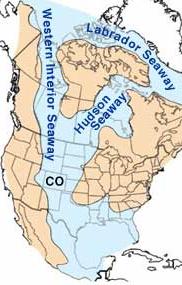
CO = Colorado. To its east, Kansas, Nebraska, South and North Dakota are stacked on top of one another to the Canadian border |
Argentina 2001 - Mamíferos del Cenozoico Argentino (Argentinian mammals of the Cenozoic. - Four stamps at 75c. in sheet: Megaterio - Gliptodonte - Macrauquenia - Toxodonte

|
Macrauchenia [Wikipedia]: Late Miocene - Late Pleistocene South America
Megatherium [Wikipedia]: Late Pliocene - Pleistocene South America, Central America
Doedicurus [Wikipedia]: Pleistocene South America
17,000 years ago is 15,000BC
The Paleo-Indian period spans from approximately 15,000BC to the end of the Pleistocene Ice Age about 7,000BC. (Belize Institute of Archaeology)
Archaeological evidence has shown that systems similar to the quipu were in use in the Andean region from about 3000 BC. (Wikipedia) Quipu: an ancient Inca device for recording information, consisting of variously coloured threads knotted in different ways.
From beginning of fifteenth century at latest, Iroquois Confederation formed according to Engels. See "Iroquois Confederacy" in the Encyclopedia of North American Indians. See below 1607 - 1634 - 1675 - 1776 - 1787 - 1791 - 1832 - 1851 -
1428 to 1521 The Aztec Empire
1438 to 1533 The Inca Empire
1492
Columbus's first voyage to
America.
In December, he visited an island, part of which the Indians called Haiti -
the place of the mountains. The Spanish colonised the island and called it
Hispaniola. It was the first place occupied by Europeans in the Americas.
Spain took what gold it could and the Indians died out. In 1679, the French
took the western part of the island and called it Saint Dominigue.
Sugar,
indigo and
black slaves made Saint Dominigue the richest colony in the
world by 1789.
1493 Pope Alexander 6th
gave the Americas to
Spain, on condition it converted the natives to Christianity.
1494 Christopher Columbus claimed the island now called Jamaica for
Spain after landing there in 1494. The English, led by Sir William Penn and
General Robert Venables, took over the last Spanish fort in Jamaica in
1655. This William Peen was a naval officer and the father of the William
Penn who became a
Quaker.
|
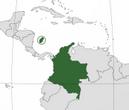
The region of north east South America now knwon as Colombia bridges the Carribaean and the Pacific, the Amazon and the Andes. Spanish explorers arrived in 1499. Santa Fe de Bogotá (Bogotá), the capital of present day Colombia, was founded by the Spaniard Gonzalo Jiménez de Quesada in 1538. See 1717 - 1819 - 1948 - 1957 - 1966 - 1978 - 1988 |
1500 Pedro Álvares Cabral, from Portugal, discovered Brazil on the South American coast.
| At some point in their exploration of Brazil, the Portuguese encountered an animal they called bicho-preguiça (lazy animal or animal sloth). (Portugese Wikipedia). The French called it Paresseux and the Spanish Perezosos or Pereza (lazy). The English called it a Sloth. This animal figures in the mythology of some native South Americans as an ancestor of the human species, or as an animal a human is changed into as punishment. (Claude Lévi-Strauss, the jealous Potter, and Luis Sepulveda, the old man who read love stories). (French Wikipedia). See 1558 - 1613 - 1681 - 1735 - 1812 - 2001 - |
|
1501 First sugar, harvest happened in Hispaniola. Sugar mills had been constructed in Cuba and Jamaica by the 1520s.
22.1.1510 King Ferdinand of Spain authorised a shipment of 50 African slaves to be sent to Santo Domingo. Start of the trans-atlantic slave trade from Africa - In the preceding two decades, native Americans had been shipped to Spain as slaves.
1511 First Spanish settlement on Cuba.
1527: earliest records of
sugar production in
Jamaica.
1540:
first of the Indian Wars?
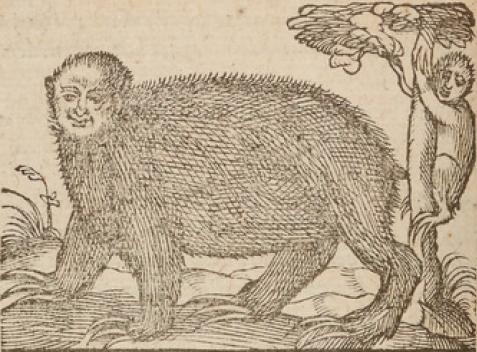
| 1558: Les singularités de la France antarctique, autrement nommée Amérique, et de plusieurs terres et îles découvertes de notre temps by André Thévet. (online 1 - offline 1 - online 2 - offline 2) |
|
An animal
named Haut or Hauthi -
Chapter 52, D'une beste assez estrange appellée Haut about page 100 (diiferent prints) |
| Buffon says the native name for the three toed sloth in Brazil comes from the plaintive "a, ï" that it often repeats. Thévet represents this as Haut or Hauthi, others as hay. Buffon incorporated it into the name Bradypus ï. In the Amazon, the native name for the two toed sloth was Unau, hence Bradypus Unau |
North Atlantic colonies
The thirteen European colonies that combined against the British to form
the United States of America at the end of the 18th century, were mostly
founded by the English and Dutch in the 17th century. The southern
colonies, such as
Virginia, were mainly
founded
by orthodox members of the English church with royalist sympathies. The
northern states (New
England)
were founded by their puritan critics. In between were
New York and New
Jersey, originally settled by the Dutch, and
Pennsylvania, a
Quaker colony
from 1682.
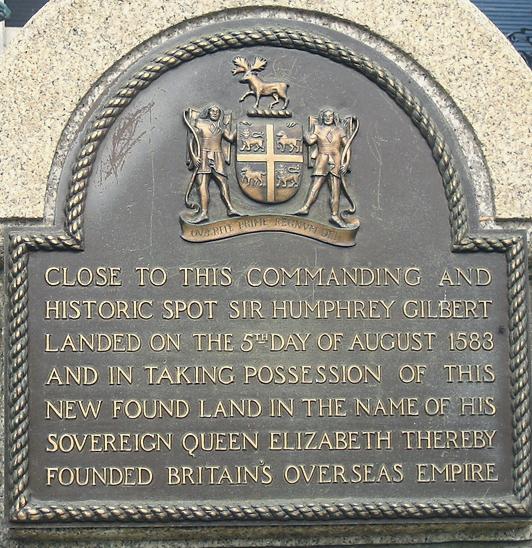
1583
1600
1607
Virginia
The first permanent English colony on mainland America was founded by the
Virginia Company of London and called "Jamestown, Virginia" (External
link:
Wikipedia article). See 1619: legislature and
African slaves -
1749: Augusta Academy -
1773: Public Hospital for Persons of Insane and Disordered Minds
-
1774: Virginia Conventions -
1818: University -
1870: Death of Robert Edward Lee
Captain John Smith first encountered
Iroquois in Chesapeake Bay
1614
New Netherlands
The Dutch West India Company explored and began to settle an area north of
Virginia in 1614. Peter Minuit and other Dutch settlers settled an island
which they bought from the local Indians for 60 gilders worth of goods. He
named this New Amsterdam, and the Dutch holdings in the area were
collectively called New Netherlands. New Amsterdam was granted self
government by the Dutch in 1652. It was captured by the English in
1664, given to the king's brother (the Duke of York), and renamed
New York. This name has also been given to the state of the USA in
which
the city stands.
1619
30.7.1619 Virginia established the first legislative assembly in
America.
First
African slaves
in North America brought to Jamestown, Virginia, by a
Dutch ship.
1620
New England
In 1616, Captain John Smith had published A Description of New
England, describing the land that later became the
north-east states of
the USA. On 6.9.1620, the Mayflower sailed from
Plymouth,
England,
with 102 men and women from a calvinist separatist community seeking a
place in the new world to practice their religion. The "Pilgrims" landed on
6.9.1620 and founded Plymouth Colony in
what became Massachusetts, the first New England colony. They remained a
small group. Puritans, from the Church of England, founded a
colony at Massachusetts Bay in 1629/1630. They came in large numbers.
Maine
settlers
came under the jurisdiction of the Massachusetts Bay Colony in 1652. A
confederacy,
formed in
1643, of
Connecticut,
New Haven, Plymouth and
Massachusetts Bay was called the United Colonies of New England. It
was governed by a theocracy till
1693.
Plymouth and
Massachusetts Bay combined to form
Massachusetts in 1691. In
1820,
Maine became
an independent member state of the United States.
| 1627 Captain Henry Powell landed English settlers on the West Indian island of Barbados. The British colony developed a sugar, plantation economy using slaves brought in from Africa. - 1639 - 1655 - 1663 - 1671 |
In 1628, about sixty Puritans under John Endicott migrated to Salem
in what
is now Massachusetts. John Winthrop later led about 1,000 Puritans to
settle in Boston and other towns. They used a commercial charter to
establishe their jurisdiction. Between 1629 and 1639, about
20,000 Puritans came to New England.
1631 The first "General Court" of the Massachusetts Bay Colony
established. Made up of the governor and freemen, it had full legal
authority. The franchise was limited to regenerate church members, and the
church was supported by public taxes. By 1636 the
General Court gave power over the church to the magistrates and, later,
control as to who preached what and where.
1634
27.3.1634 The Werowance (chief) of the Yoacomoco Indians having
agreed
to sell a village to Leonard Calvert in exchange for gifts, trading
guarantees and protection from their enemies, the Susquehannock and
Iroquois
Indians, the village became the English settlement of St Mary's
City. The beginning of
Maryland.
See
Maryland State Archives
1636 Harvard College, the first institute for higher education in a
north American colony, established at Cambridge in Massachusetts -
1637 Boston trial and banishment of Ann Hutchinson at the climax of
the Antinomian Controversy. Anti-nomian is against-law. Ann Hutchinson did not hold
that the redeemed are above the law. She did hold that her own certainty of
salvation was sufficient and that it was not subject to testing by the
Massachusetts' Ministry. The spirit of God speaking directly to her soul
was her authority and she questioned the suitability of all but two of the
Ministers. Given that the Ministers decided who was entitled to vote by
virtue of being truly saved and one of the elect, Ann's religious views
were politically disruptive. [See interpretation: 1966]
1611
Bible: Psalm 76 [note: A declaration of God's majesty in his
church] "In Judah is God known: his name is great in Israel. In
Salem also is his
tabernacle,
and his dwelling place is Zion". See
theocracy above and
below
"To advance learning and perpetuate it to posterity; dreading
to leave an illiterate Ministry to the Churches." (External
link:
Early history of Harvard University)
by Rachel Buckingham 1995)
|
1639 -
Barbados's first
parliament, the House of Assembly, held its
first meeting.
|
1639 Dorothy Talbye hanged in Salem, Massachusetts for killing her three year old daughter because God told her to do so
1643, Connecticut, New Haven, Plymouth and
Massachusetts Bay formed the United Colonies of New England. John
Davenport, the founder of Connecticut, is quoted as saying:
An early use of American as an ideal
1647 Nathaniel Ward, Massachusetts lawmaker, having returned to
London, published The simple cobbler of Aggawam in America
under the pseudonym Theodore de la Guard. It contains the phrase "an
Article of our American Creed". The suggested article is that people should
not leave heir own country (England in this case) but "upon extraordinary
cause, and when that cause ceaseth, he is bound in conscience to return if
he can"." See
Un American
1650
1652 to 1684: One Peter Esprit Radisson journeyed amongst the
Iroquois. His handwritten
journals passed through the hands of Samuel Pepys and others and finally
arrived in the British Museum and Bodleian Libraries.
Gideon Scull transcribed them and they were published in Boston
by the Prince Society in 1885. (Publications of the Prince Society, 16)
(Project Gutenberg Catalogue)
 1642
English Civil
War
Notice declaration (1644) of Baptists that men must be allowed to obey
their own conscience and understanding, and the
Quaker following of the
inner light. This spirit was contrary to the New England theocracy where
the church had responsibility for monitoring the beliefs and behaviour of
the people. The church in New England appears to have been aware of the
disruption that Quakers and Ranters had caused in England, and prepared to
repel them if they arrived.
1642
English Civil
War
Notice declaration (1644) of Baptists that men must be allowed to obey
their own conscience and understanding, and the
Quaker following of the
inner light. This spirit was contrary to the New England theocracy where
the church had responsibility for monitoring the beliefs and behaviour of
the people. The church in New England appears to have been aware of the
disruption that Quakers and Ranters had caused in England, and prepared to
repel them if they arrived.
[external link about the Ranters]
"The Theocracy, that is, God's government, is to be established
as the best form of government. Here the people, who choose its civil
rulers, are God's people, in covenant with him, they are members of the
churches; God's laws and God's servants are enquired of for counsel"
1656 Efforts by Quaker missionaries to convert the people of Massachusetts were met with punitive sanctions against them and their converts. The first Quaker missionaries (Mary Fisher and Ann Austin) were stripped and searched for marks of witchcraft and their books burnt in the market place. A law of 1656 prescribed fines or whippings. A law of 1657 increased the punishments for second and subsequent offenses to removing one or both ears and tongue boring with a hot iron. A law of 1658 said Quaker disorders were punishable by banishment "on pain of death". The first executions took place in 1659. [See interpretation: 1966]
1660 French and English agreed that Dominica and St. Vincent should
be left to the indigenous Caribs. However, the attraction of timber
prevailed and the French established permanent settlements in 1690. The
English took possession in 1763.
Carolina
1663 Charles
2nd
granted a charter to own and exploit the lands
south of
Virginia
and north of Florida to six men who had helped in the
restoration of the monarchy. The territory was called Carolina in honour of
Charles 1st ("Carolus" being the Latin form of "Charles"). The first
permanent European settlements in
these lands had been made about 1650 by people from
Virginia. (external history link)
| 1663 - Barbados was made into a British crown possession. |
1664
Charles
2nd made a grant of land later named New Jersey.
1669
Deborah Wilson, the
Quaker wife of Robert Wilson, had at one time
walked naked through the streets of
Salem as a spiritual
testimony. For this she had been "sentenced to be tied at a cart's tail
with her body naked downward to her waist, and whipped". She was brought
before the court in 1669 for "frequently absenting herself from the
public ordinances", but the case "was dismissed, court being informed that
she is distempered in her head".
(Erikson, K.T. 1966
pages 122
and 132)
1670
1670 Charles Town (honoring King Charles 2nd and in
Carolina) founded in 1670
at Albemarle Point on the west bank of the Ashley River (now Charles Towne
Landing). Moved in 1680 to a new site, where it became the fifth-largest
city in North America within ten years. Eventually renamed Charlston.
1670
English
Madhouses
| 1671 An epistle from the Quakers to the Governor of Barbados |
1672 Two Quakers, Henry and Hannah Phelps, had settled in the Albemarle region of Carolina, but there was no organised Christianity when the Quaker missionaries William Edmundson and (later in 1672) George Fox came to preach the gospel. When Edmundson revisited in 1676, Quakerism was still the only Christian faith in the area and, at this time, this was the only area of the colonial North American coast where Quakers were not persecuted. Two Quakers who arrived there from England were John and Agnes Trueblood, who arrived about 1682. Before they died, in 1692, they acquired land, wealth and a family of four children. All American Truebloods are said to have descended from one of their two sons. (Gordon Trueblood)

|
Piney Woods Friends Church (Meeting House) in Perquimans County, North Carolina is not far from where Edmundson and later Fox preached. Its worshippers include descendants of the first Trueblood settlers. |
1675
At the height of its power, about 1675, Iroquois Confederation conquered wide stretches of the surrounding country. Engels
1676
New Jersey divided into two. The western part was owned by
Quakers,
including
William Penn
1682
Pennsylvania
In 1681, the land now called Pennsylvania (Penn's woodlands)
was granted to the English
Quaker, William Penn, in payment of a debt the
English monarch owed his father. The first Quaker colonists arrived in
1682. The woodlands were, of course, already occupied by the
"Indians", and also by Dutch colonists who had taken it from the Swedish
(in 1655), before it was taken by the British (in 1664) and granted by
Charles 2nd to the Duke of York. Sweden had colonised in 1643. Many
historians say that Penn made fair exchanges with the Indians for their
land. Others that he deceived them and "effectively" stole it. Whatever the
truth, the land was settled peacefully and a "holy experiment" started.
1682 Penn laid out the street plan for Philadelphia: The
City of Brotherly Love
13.7.1685
Jean Gignilliat received 3000 acres from the Lords Proprietors of
South Carolina because he was the first Swiss to arrive.
(source)
1691 About 1691, George Keith established Christan Quakers in
Pennsylvania. He was disowned by Philadelphia Yearly Meeting in 1693 and by
London Yearly Meeting in 1694. See
Quaker beliefs
about 1702.
1692 Witch hunts in
Salem, Massachusetts.
19 "witches" hanged.
External chronology. The local trials were
stopped by the Governor of the colony, Phips, who ordered that reliance on
spectral and intangible evidence should not be allowed in trials and
dissolved the local Court of Oyer and Terminer on 29.10.1692. On 25.11.1692
the General Court of
the
colony created the Superior Court to try the
remaining witchcraft cases. There were no convictions when they came to
trial in May 1693. [See interpretation: 1966]
1693:
College of William and Mary, Virginia, Chartered by King William 3rd and
Queen Mary 2nd (external link to history)
17.1.1706 Birth of Benjamin Franklin. See:
1724 -
1728 -
1736 first Weber quote -
1737 -
1740 -
1747 first electricity work -
1748 -
1751 -
1756 -
1757 -
1759 -
1764 -
1774 -
died 17.4.1790
1700
1703
"In 1703, 42 percent of
New York's households had slaves, much more than Philadelphia
and Boston combined. Among the colonies' cities, only Charleston, South
Carolina, had more." (source). See
John Marrant.
1715 Dr Israel How came to Andover (then called South Parish),
Massachusetts. He
was its first physician. When he died in 1740 he was succeeded by his son,
Dr Daniel How. In the middle of the eighteenth century, Daniel How's
practice was especially in treatment of the insane. [The name is also spelt
Howe in some sources]. (Charles
Outwin) See 1761
1688
English Bloodless
Revolution. The works of
John Locke, published after the revolution,
made
the case for knowledge based on reason and science, the separation of
political and religious authority and a society tolerant of a variety of
religious views.
England hanged its last
people
accused of witchcraft in the early 1680s
|
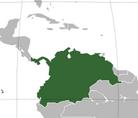
The Viceroyalty of New Granada (Spanish: Virreinato de la Nueva Granada) was the name given on 27.5.1717 to the jurisdiction of the Spanish Empire in northern South America, corresponding mainly to modern Colombia , Ecuador, Panama, and Venezuela. The territory corresponding to Panama was incorporated later in 1739. |
1718 Collegiate School, Connecticut, (established 1701 and in New Haven from 1716, changed its name to Yale College, in honour of a benefactor, Elihu Yale. (External link Yale history). Yale College established a Medical Institution in 1810, Divinity School in 1822, Law School in 1843, Graduate School of Arts and Sciences in 1847 and School of Fine Arts in 1869. In 1875 it began the first sociology course in the USA and in 1887 it became a University. - See Sumner - Murdock - Erikson
| 1724-1726 Trainee Philadelphia printer, Benjamin Franklin (1706-1890), working in London |
|
Benjamin Franklin opened his own printing office in Philadelphia, becoming sole owner in 1729 and publisher of the Pennsylvania Gazette
In Africa, Ukawsaw Gronniosaw was sold into slavery, taken to the United States, and purchased by a Dutch Reformed minister named Theodorus Jacobus Frelinghuysen (spelled "Freelandhouse" in the text), who lived in New Jersey. Gronniosaw stayed with the family for over twenty years and was emancipated upon Frelinghuysen's death. He continued to work for the minister's widow and sons for several years, before later working as a cook on a privateer during the Seven Years War. He eventually enlisted in the British armed services to obtain passage to England. - married Betty - book 1770 - death
Benjamin Franklin's short "Necessary Hints to Those That Would Be Rich" which was quoted by Max Weber as examplifiying the spirit of capitalism
"New York State's first publicly supported institution for dependent people was opened in New York City in 1736 and was called "The House of Correction, Workhouse and Poorhouse". It housed the poor who refused to work, the poor who were unable to work and the poor who were willing but unable to find work" (L. Jane Tracy: The Onondaga Hill Poorhouse Story)
12.3.1736 Peter Collinson in London to John Bartram in Philadelphia (both are Quaker botanists):
"Most things were made for the use and pleasure of mankind ; others, to raise our admiration and astonishment; as, in particular, what are called fossils, being stones, found all the world over, that have either the impressions, or else the regular form of shells, leaves, fishes, fungi, teeth, sea-eggs, and many other productions. That thee may better apprehend what I mean, I have sent thee some specimens, in a packet of paper for specimens of plants for Lord Petre, with some seeds, and a pocket compass. Captain Savage has promised to take care of the parcel. In the course of thy travels, or in digging the earth, or in thy quarries, possibly some sorts of figured stones may be found, mixed or compounded with earth, sand, or stone and chalk. What use the learned make of them, is, that they are evidences of the Deluge. "
1736 Mary, a ship owned by James Brown 2 (1698-1739), sailed from Providence, Rhode Island. Brown traded in rum, molasses, slaves and other merchandise. The Mary sailed to Africa, exchanged cargos and sailed to the West Indies, exchanged cargos and returned to Providence. Considered the start of the Rhode Island (and New England) Triangular Trade. "It was apparently the first slave ship ever to sail from Providence, but did not yield much profit. No other slave ships sailed from the town until 1749, and the Brown family remained out of the trade until 1759". (Rhode Island Historical Society) - See also Dictionary of American History - slavery in Rhode Island
"First Great Awakening" (period of Protestant Christian revival)
1730s to about 1743,
February 1736
John and Charles Wesley arrived in America.
(external link) - See
Methodist
Hymns
Benjamin Franklin appointed Postmaster of Philadelphia
1738
George
Whitefield spent three months in Georgia on
his first voyage to America, See
1740 -
1745 -
1751 -
1754 -
1763 -
1770 -
1740-1741 George
Whitefield's second voyage to America, in which he established
Bethesda Orphan House and preached in New England.
Working-class Methodists in Philadelphia wanted to build a great preaching
hall for the English evangelist,
George
Whitefield. It was also to be a
charity school. The University of Pennsylvania claims this as its
foundation. A deed of trust was formed, but funding fell through. In
1749,
Benjamin Franklin named a board of trustees, with himself as
president. The Academy opened in 1751 and was chartered in
1755. External link
to Wikipedia article.
1745-1748 George
Whitefield's third voyage to America. In poor health.
Benjamin Franklin's first writings on experimenting with
electricity. In
1748 he sold the printing office and retired from business
1747 or 1748 Death of Theodorus Jacobus Frelinghuysen in
Franklin Township, Somerset County, New Jersey. His slave,
Ukawsaw
Gronniosaw, was freed, but continued to work for Frelinghuysen's
widow.
1748
Benjamin Franklin's letter "To my friend A.B."
"Advice to a Young Tradesman" from "An Old Tradesman" which was
quoted by Max Weber as examplifiying the spirit of capitalism
Augusta Academy opened in Lexington, Virginia. Became Washington and Lee
University. (External link to
timeline)
1751-1752 George
Whitefield's fourth voyage to America.
| 1751 Benjamin Franklin's Experiments and Observations on Electricity published in London. In June 1752 he is said to have tried the suggested experiment of attaching a metal key to a kite and flying it in a thunderstorm to see if it picked up an electrical charge. Issue related to his founding fire insurance and fixing lightning conductors. |
|
1752
Pennsylvania Hospital admitted mentally disturbed patients from 1752.
1754
1754 George
Whitefield's fifth voyage to America.
King's College, New York founded. Later Columbia University. "the oldest
institution of higher learning in the state of New York and the fifth
oldest in the United States".
(external history link) - First Ph.D in
1875 - see
following - 1890 -
1927 -
1936 -
1941 -
1946 -
about 1754 Hannah Jenkins Barnard born. See
1800-1801. Died
1825
15.6.1755 John Marrant born
New York.
A free black?
-
biography
-
writings
1785 and 1790
(died 15.4.1791)
Resignation of ten
Quakers from the Philadelphia Assembly put the Quakers
in a political minority in Philadelphia for the first time.
| 29.1.1756 Benjamin Franklin of Philadelphia elected a Fellow of the Royal Society |
|
| 1757-1762 Benjamin Franklin in London as representative of the Pennsylvania Assembly |
|
1758 to 1761 Anglo-Cherokee War
|
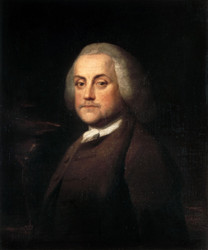
"The earliest of the three important images of Benjamin Franklin (1706- 1790) in the White House, this portrait is the first of countless likenesses of Franklin produced abroad. . . . ". . . Franklin commissioned [this] likeness in 1758. . . . It shows a bewigged middle-aged gentleman, slightly fleshy but vigorous, with a firm mouth and a direct gaze. Wilson conveys a strong personality through the forceful structure of the head, especially in the modeling of the nose and eyes. It is an even-tempered, alert, unpretentious, and commanding presence. |
1760
Before
John Marrant was five years old my mother removed from "New-York
to
St. Augustine, about seven hundred miles from that city. Here I was sent to
school, and taught to read and spell; after we had resided here about
eighteen months, it was found necessary to remove to Georgia, where we
remained; and I was kept to school until I had attained my eleventh year.".
St. Augustine was in La Florida (Spanish territory), but was
ceded to Britain in 1763.
1761
sensory deprivation:
1762
4.1.1762 Britain declared war against Spain. From March to August
1762 British forces besieged and captured Havana (Cuba) from the Spanish.
Under 1763 Treaty of Paris, Spain exchanged La Florida (now southeastern
United States) for the return of
Havana. Florida (east and west) returned to Spain in 1783.
1763-1765 George
Whitefield's sixth voyage to America. He travelled the east
coast.
"In 1761, the Reverend John Wiswall (1731-1821) of Falmouth, Maine suffered
what we would probably now call a "nervous breakdown". He
continued out of his mind for nine months, after which he was
referred to
Dr Daniel Howe
(born 1.5.1717, died 1.11.1797), a doctor in
Andover, Massachusetts, who
prescribed confinement to "a dark chamber". Cure was obtained in a few
weeks." (Charles
Outwin)
| 1764 Benjamin Franklin in London |
|
1764
College in the English Colony of Rhode Island and Providence
Plantations. At some time became Brown University.
1767
1768
1769
1770 George
Whitefield's seventh voyage to America. He wintered in Georgia,
then travelled to New England where he died
| 1772 |
|
Death of John Woolman (1720-1772), an American (New Jersey) Quaker whose life and writings had a profound effect (inside and outside the Quakers) in Britain, as well as America. There is an online text of his Journal at Bartleby.com John Woolman died of smallpox at York, Yorkshire, England on 7.10.1772.
| 1773 |
|
British passed a Tea Act, which aroused strong opposition in the American colonies.
16.12.1773 "Boston Tea Party". Colonials tip 342 chests of tea into the sea.
Public Hospital for Persons of Insane and Disordered Minds, the first in what became the United States, opened at Williamsburg, Virginia. [External link]
| 1774 Benjamin Franklin in London |
|
British closed the port of Boston in response to the tea party
Virginia Conventions began, leading to the First Continental Congress (meetings of the American colonies) which met in Philadelphia from 5.9.1774 to 14.10.1774, when it passed the Declaration and Resolves of the First Continental Congress.
| 1775 |
|
April 1775 to 1783: War between the British and their rebellious
American colonies. The armed rebellion began at the Lexington and Concord
Bridge, and spread. The rebel army was led by George Washington.
14.6.1775: The Provincial Congress of Massachusetts passed the
following resolve:
"Whereas the committee are informed that
Dr How of Andover
is
prepared to receive insane patients and is well skilled in such disorders,
resolved that Daniel Adams, a lunatic now at Woburn, be carried to the town
of Andover and committed to the care of Doctor How and the said Dr How be
hereby desired to take proper care of the said lunatic at the expense of
this colony."
| 1776 |
|
Philadelphia Yearly Meeting of the Society of Friends (Quakers) disowned members who persisted in owning slaves.
January 1776 Common Sense, written by Thomas Paine, published anonymously.
12.6.1776 Virginia Declaration of Rights; written by George Mason
29.6.1776 Virginia State Constitution adopted. This became a model for all the rebel colonies as they formed themselves into states.
11.7.1776 Chiefs of the Iroquois visited and addressed the Continental Congress that was discussing independence from Britain of the colonial states. external link
4.7.1776 Declaration
of Independence, drafted by Thomas Jefferson, formally adopted
at the Second Continental Congress by all rebel states. In June, the
Congress had adopted a resolution that:
"these United Colonies are, and of right ought to be, free and independent
states."
| 1777 |
|
The Continental Congress adopted the thirteen stars and stripes as the flag of the independent states acting in combination. "Articles of Confederation" were drafted, but did not come into operation until 1781 - when Maryland agreed to ratify them.
| 1781 |
|
Articles of Confederation came into operation, providing for the common defence of the states and some pursuit of common aims.
| 1783 |
|
Independence of "these United States" recognised by the Treaty of Paris
The separate states adopted distinct constitutions, allowing for more democracy than under their colonial constitutions.
|
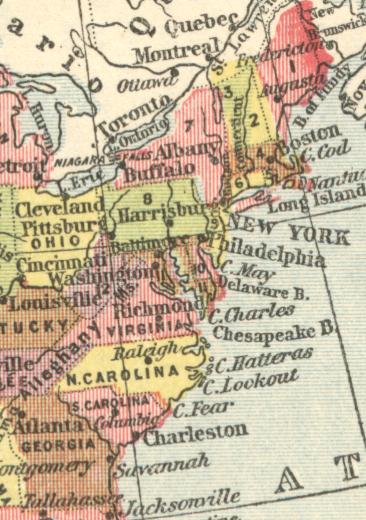
The rebel 13 are only a small part of the present USA. On this Victorian
map, the original thirteen are:
New Hampshire (2)
click on this map for the full
map of the USA
|
| 1784 |
|
25.12.1784 Conference of Methodist preachers started at Baltimore, at which Thomas Coke and Francis Asbury were elected superintendents, and the Church was constituted as an independent body under the name of the Methodist Episcopal Church.
| 1787 |
|
25.5.1787 to 17.9.1787: Constitutional Convention in Philadelphia.
17.9.1787 The Constitution of the United States adopted by the Constitutional Convention
Preamble: We the People of the United States, in Order to form a more perfect Union, establish Justice, insure domestic Tranquility, provide for the common defence, promote the general Welfare, and secure the Blessings of Liberty to ourselves and our Posterity, do ordain and establish this Constitution for the United States of America.
"The ratification of the conventions of nine States shall be sufficient for the establishment of this Constitution between the States so ratifying the same."
27.10.1787 First of eighty-five anonymous articles (pseudonym
Publius) in New York newspapers. Collected together as a book, in
1788, these became known as The Federalist or The
Federalist
Papers. Their authors were Alexander Hamilton, James Madison, and
John
Jay.
John Adams' A Defence of the Constitution of Government of the United
States includes discussion of
Iroquois forms of government. [See
external link]
1788
New Hampshire was the 9th state to ratify the Constitution, which then
became the law.
The Union as a Safeguard
Against
Domestic Faction and Insurection
Dictionary:
Pluralism
|
Presidency of
George Washington
1789 to 1797
|
1789 Drax Free School established. The "free" meant it was for
people who were not slaves. In 1902 two separate names
schools became Jamaica College. The school sought to train potential
university students.
17.4.1790 Death of
Benjamin Franklin
1791
9.9.1791 Washington District of Columbia on the Potomac River
between
Maryland and
Virginia
named, after
George
Washington, as the capital city of the United States of America.
15.12.1791 First ten Amendments to the Constitution
("The Bill of
Rights") adopted
Printed in London, for the author, John Long (known to be alive 1768-1791)
Voyages and travels of an Indian interpreter and trader: describing the
manners and customs of the North American Indians; with an account of the
posts situated on the river Saint Laurence, Lake Ontario, &c. to which is
added, a vocabulary of the Chippeway language, names of furs and skins, in
English and French, a list of words in the
Iroquois, Mohegan, Shawanee, and
Esquimeaux tongues, and a table, shewing the analogy between the Algonkin
and Chippeway languages (See Durkheim on
totemism)
|
Pacifying native Americans
The new United States of America extended its borders and fought to establish a monopoly of the legitimate use of physical force in its territory. Native americans, who were tribal rather than territorial, resisted. They were not finally defeated until 1890. After independence, groups of euro-americans moved west. They were protected from Indian tribes by the United States army. Little Turtle led warriors of the Miami, Shawnee, and other tribes against the US army, north of the Ohio River, in 1790 and 1791. The Indians were defeated in the Battle of Fallen Timbers in 1794. Shawnee chief Tecumseh tried to forge a grand alliance of tribes west of the mountains, but was defeated at the Battle of Tippecanoe in 1811. He was killed in battle in 1812. Native americans in the south were defeated at the Battle of Horseshoe Bend (present-day Alabama) in 1814. In the 1820s the USA Government developed a policy of moving native american tribes away from the east to territories west of the Mississippi River. |
1797
Spring Grove Hospital,
Maryland
1799
| Presidency of Thomas Jefferson 1801 to 1809 |
1800
1804
6.2.1804
Joseph Priestley died Northumberland, Pennsylvania, USA. He was
buried in the
Quakers' burial-ground.
1808 New York Lunatic Asylum, previously in the cellar of the
north wing of New York Hospital, moved to its own building. Renamed
Bloomingdale Asylum in 1821. Moved to White Plains in 1894.
(external link:
archive of old location and
new location)
1810
| Medical Inquiries and Observations upon the Diseases of the Mind, by Benjamin Rush, Professor of medicine in the University of Pennsylvania and physician to the Pennsylvania Hospital, included details of his Tranquilliser, an 1811 picture of which is very well known: |

|
22.3.1812 Stephen Pearl Andrews born. (Wikipedia) - Author of The Science of Society (1851), The Sovereignty of the Individual (1853), Principles of Nature, Original Physiocracy, the New Order of Government (1857), The Pantarchy (1871), The Primary Synopsis of Universology and Alwato: The New Scientific Universal Language (1871), The Basic Outline of Universology (1872), The Labor Dollar (1881) Died 21.5.1886
1813
1816
28.12.1816 Birth of
Elizabeth Parsons Ware who married Theophilus Packard on
21.5.1839. See
Manteno -
1859 differences of opinion -
18.7.1860
Illinois State Asylum -
discharged
1863 -
Packard v Packard
-
1867 -
1868 -
1872 Iowa
1817
"The University of Michigan was established in 1817 by the
Michigan Territorial legislature as one of the United States' first public
universities on 1,920 acres (8 kmý) of land ceded by the Chippewa, Ottawa,
and Potawatomi people "_for a college at Detroit." The school moved from
Detroit to Ann Arbor in
1837, only 13 years after the latter city had been
founded."
(Wikipedia)
|
Friend's Asylum, Philadelphia opened. Modeled on
York Retreat
Friends Hospital website The Early Years of Friends Asylum 1817-1820 Isaac Bonsall's Diaries 1817-1823 15.5.1817 The Asylum for the Relief of Persons Deprived of the Use of Their Reason founded by Philadelphia Yearly Meeting of Friends. Claimed to be the first private mental health hospital in the United States. Built on a 52-acre farm. The Quakers wrote out their philosophy in a mission statement for the hospital: "To provide for the suitable accommodation of persons who are or may be deprived of the use of their reason, and the maintenance of an asylum for their reception, which is intended to furnish, besides requisite medical aid, such tender, sympathetic attention as may soothe their agitated minds, and under the Divine Blessing, facilitate their recovery." |
1818
Lewis Henry Morgan born. See
1851
1868
1871
1877
1880
1881
1882
1883
1818
Thomas Jefferson founded what became The University of Virginia.
External
links:
Wikipedia article
- Short
history by Susan Tyler Hitchcock -
details of her book.
"Jefferson, with his friend Joseph Cabell, managed to get the Virginia
Assembly to agree to fund a state university - Virginia is considered
the first of all of them". (Susan Tyler Hitchcock - email)
1818 (or 1817) First identified use of un American
Morris Birkbeck Notes on a journey in America, from the coast of
Virginia to the territory of Illinois Re-printed 1818. Dublin. (First
printing 1817) says (page 28) "Ninety marble capitals have been imported at
vast cost from Italy,..and shew how un-American is the whole plan."
See American and
un American 1938 -
1945 -
1947 -
[Investigations] -
1948 -
[Red Scare] -
[Korean War] -
1951 peak and
definition -
[Billy Graham
1952] -
[Joe McCarthy]
-
[commie smasher]
-
Pete Seeger 1955 -
[degradation ceremonies
1956] -
Paul Robeson 1956
-
1959 -
1960 -
| The independence of New Granada from Spain was won in 1819, but by 1830 "Gran Colombia" had collapsed with the secession of Venezuela and Ecuador. |
1819 An American Geological Society founded at Yale College. Ceased in 1828. (Kraus 1921)
|
Indian Territory
In the 1820s, the USA government began moving what it called the "Five Civilized Tribes" of South East America (Cherokee, Creek, Seminole, Choctaw, and Chickasaw) to lands west of the Mississippi River. The 1830 Indian Removal Act gave the President authority to designate specific lands for the Indians (native Americans). The 1834 Indian Intercourse Act called the lands Indian Territory and specified where they were: all of present-day Oklahoma North and East of the Red River, as well as Kansas and Nebraska. But, in 1854 the territory was cut down when Kansas and Nebraska territories were created. White settlers continued to invade the West and half the remaining Indian Territory (West Oklahoma) was opened to whites in 1889. In 1907 Oklahoma became a state of the USA, and Indian Territory was no more. (external link).
First nations site has detailed history
of how these issues related to the
Iroquois
|
|
Gill's Geography map has "Indian Territory" shown east of "Oklahoma". 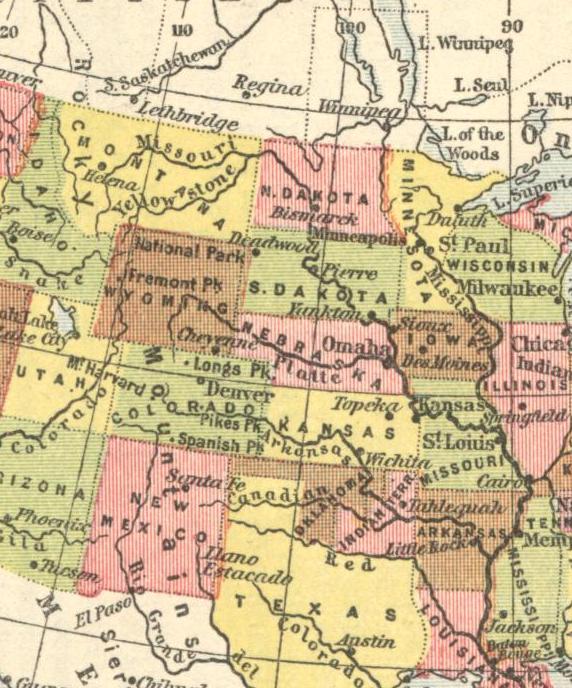
|
22.6.1822. British born, John Sherren Bartlett (1790-24.8.1863) established The Albion, or British, Colonial and Foreign Weekly Gazette in New York. He edited it until 1848. The paper continued until 1856. It specialised in providing recent news from Britain to British emigrants living in the new world.
Connecticut Retreat for the Insane. built in 1823, was opened to admissions in 1824. It had several changes of name, but was knowns the Hartford Retreat. See John Butler - Clifford Beers
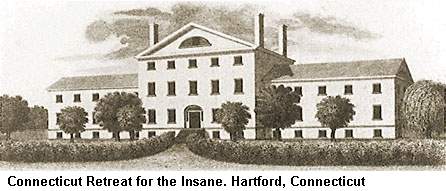
11.8.1823 Ship Columbia arrived in New York from Liverpool carrying Anna Braithwaite. [Age three years out]
21.1.1824 Meeting of Anna Braithwaite and Ann Shipley with Elias
Hicks at the house of Elias Hicks.
March 1824 Second meeting of Anna Braithwaite and Ann Shipley with
Elias Hicks
\Monday 11.8.1824
Joseph John Gurney spied Anna Braitwaite through a telescope as
her ship, Canada, came into the Mersey. He met her that evening. "she seems
to have indeed gone forth in the needful hour, to detect the secret places
of infidelity, and to proclaim the truth with boldness. I should conceive
from her statements, that divine truth is gradually regaining ascendancy
among our transatlantic brethren". (Memoirs p.278)
27.9.1824 Elias Hicks to Edwin A. Atlee in response to accounts by
Anna Braithwaite of her interviews with him. Published as The
Misrepresentations of Anna Braithwait: In Relation to the Doctrines
Preached by Elias Hicks, Together with the Refutation of the Same, in a
Letter from Elias Hicks, to Dr. Atlee of Philadelphia
13.10.1825 Ship arrived in New York from Liverpool carrying
Anna Braithwaite and Isaac Braithwaite
A Letter from Anna Braithwaite to Elias Hicks on the Nature of His
Doctrines: Being a Reply to His Letter to Dr. Edwin A. Atlee; Together with
Notes and Observations Anna Braithwaite
1825 - 26 pages
13.12.1825 Robert Anthony Beers born Buffalo, New York.
Married
Ida Cooke in
1863. 53 years old when
Clifford Beers born.
Ida died
22.9.1914.
Robert died
15.4.1916.
Robert described
as "a merchant; member of firm of S. E. Merwin & Company, wholesale
provision dealers" [Family: see this
family bible)
1.4.186 The Telescope
Early in 1827 there was division at the Philadephia Yearly Meeting of the
Society of Friends (Quakers) over whether Jonathan Evans or John Comly
should be chosen as Clerk of the Yearly Meeting. What became the Orthodox
(minority,
Gurneyite, Evangelical) group favoured Jonathan Evans. He was
chosen on te basis that he had the support of the weightier Quakers. The
"Hicksites" wanted John Comly. They walked out and formed their own Yearly
Meeting with headquarters at Fifteenth and Race Streets. The Orthodox
Yearly Meeting continued to function at Fourth and Arch Streets in
Philadelphia. The division spread throughout the United States and the two
groups were not re-united until 1955. - Meanwhile the
English Quakers had their own troubles.
5.6.1827 Ship Canada arrived in New York from England carrying
Anna Braithwaite and Isaac Braithwaite, Merchant.
16.6.1829 Anna Braithwaite and Isaac Braithwaite sailed from New
York to England at the end of Anna's third visit.
"There is now a general commotion and overturning among the
once peaceful people called Quakers. Within a short period two rival
parties have arisen in the society. The division seems mostly to have
originated in a difference of sentiment, maintained and strenuously
enforced by two noted preachers of that order, viz.:
Elias Hicks, and
Anna Braithwaite. The old party adhere to the tenets of the
latter, and are denominated "Orthodox," while the new party adhere to the
sentiments of the former and are denominated "Reformers," or "Hicksites."
The Orthodox side maintain that they themselves hold the principles of the
founders of the society, and that the other party are rank Socinians, and
no better than deists. On the other hand the Reformers accuse them of
intolerance, bigotry, and desire "to lord it over God's heritage;" and thus
a constant warfare is maintained; each trying to gain the ascendancy.
"
| Presidency of Andrew Jackson 1829 to 1837 |
1829
23.10.1829 First part of Eastern State Penitentiary Pennsylvania, in
Cherry Hill/Fairmount, opened.
(external link to museum website timeline) -
[See Separate
System]. It replaced the original
Walnut Street Prison -
[External link to illustrated website relating both prisons to
Foucault.]
1829-1833 First publication of Encyclop‘dia Americana: "A
popular dictionary of arts, sciences, literature, history, politics and
biography, brought down to the present time; including a copious collection
of original articles in American biography; on the basis of the 7th edition
of the German Conversations-Lexicon
(Wikipedia)
27.2.1830 Death of
Elias Hicks
April 1831; Gustave de Beaumont and
Alexis de Tocqueville (25 years old)
left France for the United States on a government mission to inspect
American prisons. They returned to France in 1832.
1832 Worcester Insane Asylum, the first in
Massachusetts,
opened.
In 1834, just a year before the Geological Survey of Great Britain was
established, Congress authorized the first Federal examination of the
geological structure, mineral resources, and products of the public lands
by permitting the Topographical Bureau of the U.S. Army to use $5,000 of
its appropriation for geological investigations and the construction of a
geological map of the United States.
(US Geological
Survey History)
New York State commission established 1836 to build a lunatic asylum,
purchased land (Utica) in 1837. The asylum opened in
1843.

Launch of penny newspapers in New York.
Tom Standage
dates the age of
mass media from here.
| Presidency of Martin Van Buren 1837 to 1841 |
1838 Ohio Lunatic Asylum established at Columbus, Central Ohio.
23.9.1838 Brunel's Great Western Steamship arrived in New York on its first journey from Bristol, England. It had sailed on 8.4.1838. The return voyage left from New York on 7.5.1838 and arrived Bristol 22.5.1838. The vessel ran for nine seasons - lying up in winter. (external link)
1839 The Missouri Legislature passed the Geyer Act to establish funds for a state university. This was the first public university west of west of the Mississippi River.
1839 Boston Lunatic Asylum opened at South Boston, County of Suffolk, Massachusetts, (taken over by the state in 1908)
Mount Pleasant Female Prison opened at Sing Sing (New York State) with women being transferred there from Bellevue and Auburn. In 1877, this prison closed and women were sent to county penitentiaries until the new women's prison at Auburn was opened in 1893.
| New York City Asylum | Blackwell's Island Asylum on Asylum's Projects |
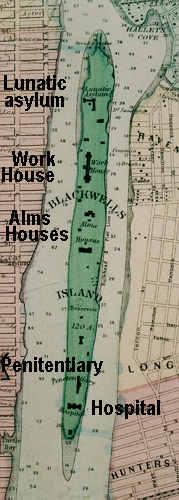
|
Later renamed Welfare Island. Now Roosevelt Island
See timeline
1839 New York City Lunatic Asylum on Blackwell's Island opened. (Architect: A.J. Davis, 1835-1839). It was designed as a copy of Hanwell. It was the largest mental hospital in the United States during its time. As New York City's pauper asylum, it was overcrowded from the start, and completely overwhelmed by the Irish famine immigration. "Foreign born" patients generally made up about 75 percent of its population. The asylum, run by the City's Almshouse Commission, was never adequately funded, and was mired in political infighting from inception. The new Ward's Island Asylum opened in 1871. Alterations were made to the Blackwell's Island Asylum by archtect Joseph M. Dunn in 1879. The asylum was closed in 1895. Part of the 1839 building survives and is now called the Octagon. (Information mainly from Diane Richardson) - See 1892 New York City Asylum |
21.5.1839 Theophilus Packard married Elizabeth Ware Parsons
Cuban Slavery ship Amistad captured by its black cargo (2.7.1839). Arrested of New York (26.8.1839). Subsequent trials etc a focus for anti-slavery agitation. External link: The Amistad Revolt
10.9.1839 Charles Sanders Peirce born in Cambridge, Massachusetts. External link to biography
2.4.1840 First meeting of the "Association of American Geologists". Held in Philadelphia. Meetings were held annually and in 1843 the Transactions of the Association, of American Geologists and Naturalists appeared. In 1847 this became the "American Association for the Advancement of Science". (Kraus 1921). See Science
12.6.1840 World
Anti-Slavery Conference opened in
London. British slaves having been
freed in the
1830s, the emphasis of the conference was on the liberation of
United States slaves.
Six delegates from the United
States were women.
14.10.1840 Maine State Hospital for the insane opened. Superintendent Cyrus Knapp. 30 patients by 31.12.1840.
From about 1840 Ward's Island, New York used for "everything unwanted in New York City". (Wikipedia). In 1848 Wards Island was designated the reception area for immigrants. In 1871 a Kirkbride Plan style building was built. The immigration entry moved to Ellis Island in 1892, New York State took it over from Manhattan in 1899 and expanded it even further. At the time, it had 4,400 beds and was the largest psychiatric hospital in the world.
| Presidency of William H. Harrison 1841 |
| Presidency of John Tyler 1841 to 1845 |
In 1841 Dorothea Lynde Dix (1802-1887) taught a Sunday school class in the East Cambridge (Massachusetts) jail. She was disturbed that insane people were in the prison. She spent eighteen months touring Massachusetts institutions where the mentally ill were confined, and reported to the Massachusetts legislature in 1843
University of Michigan opened at Ann Arbour (external link)
1841 The first asylum in Ontario "for the reception of insane and lunatic persons" opened. "After many changes evolved into the present Queen Street site of the Centre for Addiction and Mental Health in Toronto" (source)
"The first Provincial Lunatic Asylum opened with seventeen patients in 1841, and was originally situated i n the county gaol on Toronto Street. There was not enough space however, so branch facilities were set up in a house at the corner of Front and Bathurst Street5 and i n the east wing of the Parliament Buildings. In January, 1850, a new insane asylum located three miles west of downtown Toronto, at 999 Queen Street West, received its first patients." (Geoffrey Reaume 1997)
American Ethnological Society begun in New York City (External link to history on its website)
11.1.1842 William James born New York. External link to a William James website and its biography. - 1898 - Pragmatism - Clifford Beers 1906
17.1.1842 Charles Dickens arrived in Newfoundland, and from there travelled to Halifax and Boston. He left America for England on 7.6.1842 and, on 18.10.1842 published his controversial American Notes. These included accounts of his visits to prisons, asylums and other institutions. Of the State Hospital for the Insane, South Boston he wrote:
"admirably conducted on those enlightened principles of conciliation and kindness , which twenty years ago would have been worse than heretical, and which have been acted upon with such success in our own pauper Asylum at Hanwell. 'Evince a desire to show some confidence and repose some trust, even in mad people' said the resident physician as we walked along the galleries'"
asylums in 1842 England
and
Wales
Dorothea Dix in England and
Scotland (1854)
external links to a biography, another her childhood
Saturday 2.4.1842 edition of The Albion contained an editorial and comprehensive report, with statistics about the Hanwell Pauper Lunatic Asylum", in London. Brad Edmondson is investigating the possibility that this relates to the establishment of the New York State Asylum
1842 Pennsylvania Hospital for the Insane opened
The Oregon Trail began in 1842 when, for a few years, many people left the Missouri river region [See Missouri] in large group of horse drawn wagons heading westward, over the mountains, to Oregon, the land bordering the Pacific in the Columbia River area. They came into conflict with the British in the Hudson Bay Company, who shared this area with the United States. In 1846, this conflict was resolved by drawing a national boundary at the 49th parallel. The first wagon train arrived in the Puget Sound, the large inlet of Pacific water into what is now Washington State, in 1845. It was led by Michael Simmons and George W. Bush, a free Black. Oregon Territory (from the 42nd parallel to the 49th) was created in 1848, but divided into Oregon Territory and Washington Territory in 1853. Oregon became a state in 1859. Washington became a state in 1889
1843: Dorothea Dix's Memorial to the Massachusetts legislature , in which she argued that the 120 beds in the Worcester State Asylum were not enough for all the lunatics she found in Massachusetts poorhouses and prisons. The asylum was expanded to 320 beds.
1843 New York State Lunatic Asylum at Utica completed - external link to history on Rootsweb site, which describes it as "one of the earliest structures to incorporate progressive theories on the treatment of mental illness". The first superintendent was Amariah Brigham. An abstract of a description from the American Journal of Insanity July 1847 has been made available online by the Disability Museum.
1843 The first permanent colony in what is now British Columbia was established (in present-day Victoria) by the British in 1843
One of the slogans of the 1844 USA presidential election was "Fifty-four forty or fight", meaning the British should be made to withdraw north of the 54.40"North latitude on the Pacific coast, by force if necessary. The issue was resolved, without war, by dividing the Columbia river region between the USA and British Columbia at the 49th parallel. (map) British Columbia website
1843 The McNaughton Rules, with modifications, were adopted by most American states. In 1998, 25 states plus the District of Columbia still used versions of the McNaughten rules to test for legal insanity.
"The legal system of each state in the U.S. is initially based on the common law, and theerfore, so far as leagal insanity is concerned, on the McNaughton Rules. But many states have broken away from the McNaughten rules in two ways: (a) by takking a much more flexible view of the doctrine of precedents, i.e. by adapting the common law; and (b) by statute" Clyne, P. 1973, p.130
(a) See irresistible impulse
17.7.1843 Ida Cooke born. She had 5 sisters and 1 brother. Married Robert Anthony Beers in 1863
1843 Geological Survey of Canada created. Europe "had just discovered the Old Red Sandstone" and Richard Owen coined the term "dinosaur". In 1842 Abraham Gesner, New Brunswick's first Provincial Geologist, was exploring for coal in Quebec when he discovered the fossil-rich site at Miguasha. See 1972
External link: Dorothea Dix in New Jersey (archive)
1844 First volume of the American Journal of Insanity. The title changed to American Journal of Psychiatry with the July issue of 1921.
| Asylum doctors: |
asylum doctors in the
UK
|
|
16.10.1844 A meeting in Philadelphia of the following thirteen, formed the American Association of Medical Superintendents, which later became the the American Medico-Psychological Association and then the American Psychiatric Association:
Samuel White (1777-1850), who inaugurated the Hudson Lunatic Asylum in New York (??) Thomas Kirkbride (1809-1883). Superintendent of the Pennsylvania Hospital from 1840 to 1883. Creator of the Kirkbride model of an asylum which was used throughout the United States.
Amariah Brigham (1798-1849). Superintendent of the
Lunatic Asylum at
Utica, New York State.
Isaac Ray (1807-1881). Superintendent of the State Hospital at Augusta, Maine. Pliny Earle (1809-1892). Superintendent of the Bloomingdale Hospital, New York Luther Bell (1806-1862). Superintendent of the McLean Asylum in Somerville, Massachusetts Wilson Awl (1799-1876). Organiser of the Ohio State Asylum Nehemiah Cutter (1787-1859). Organiser of a private hospital: the Peperell Asylum, Massachusetts. Francis Stribling (1810-1874). Superintendent of the Western Lunatic Asylum of Virginia. John Butler (1803-1890). Superintendent of the Boston Lunatic Asylum and later (after Brigham) of the Hartford Retreat. John Galt (1819-1862). First superintendent of the Williamsburg Asylum. (??) Charles Stedman (1805-1866). Superintendent (after Butler) of the Boston Lunatic Asylum |
|
22.10.1844 Jesus did not return to earth in his second coming as had been predicted by the followers of William Miller. The disappointment is now part of Seventh Day Adventist history. See The Ellen G. White Estate - The official Ellen G. White website (positive) and The Ellen White Research Project (critical). The article on Millerite Insanity is on the critical site.
| Presidency of James K. Polk 1845 to 1849 |
Dix, D. L. and YA Pamphlet Collection (Library of Congress) (1845). Memorial. To the Honourable the Senate and General Assembly of the state of New Jersey. Trenton,.
Dix, D. L. (1845). Memorial soliciting a state hospital for the insane. Philadelphia, I. Ashmead printer.
1847 Ralph Waldo Emerson's Poems included Astraea - (See mythology) -
" I saw men go up and down
In the country and the town,
With this prayer upon their neck,
"Judgment and a judge we seek."
Not to monarchs they repair,
Nor to learned jurist's chair,
But they hurry to their peers,
To their kinsfolk and their dears,
Louder than with speech they pray,
What am I? companion; say.
And the friend not hesitates
To assign just place and mates,
Answers not in word or letter,
Yet is understood the better;-
Is to his friend a looking-glass,
Reflects his figure that doth pass.
Every wayfarer he meets
What himself declared, repeats;
What himself confessed, records;
Sentences him in his words,
The form is his own corporal form,
And his thought the penal worm."
1847 Illinois State Hospital for the Insane, Jacksonville, opened
On the Construction, Organisation, and General Arrangements of Hospitals
for the Insane, with some remarks on Insanity and its Treatment by
Thomas Kirkbride.
Dix, D. L. (1847). Memorial soliciting enlarged and improved
accomodations for the insane of the state of Tennessee. Nashville, B.
R. M'Kennie printer.
1.12.1847 The Butler Hospital for the Insane opened in Providence,
Rhode Island.
1848 Indiana Hospital for the Insane opened about three miles west
of Indianapolis. It started with just five patients. Many people moved to
Indiana in the next half-century and, by 1900, the hospital had an average
of 1,800 patients. In the meantime, other Indiana hospitals for the insane
had opened, and this one was renamed Central State Hospital for the
Insane. From 1929 it was just Central State Hospital. It closed
in 1994, but the Pathology Department building was preserved
and now houses the Indiana Medical History Museum. (external
link)
15.5.1848
New Jersey Lunatic Asylum at Trenton opened. The first to
be built on the
Kirkbride plan.
(Rootsweb, which has pictures) - See
1907
| Presidency of Zacharey Taylor 1849 to 1850 |
Dix, D. L. and Alabama. General assembly. House of representatives 1849. [from old catalog] (1849). Memorial soliciting a state hospital for the insane. Montgomery, Office of the Advertiser and gazette.
| Presidency of Millard Fillmore 1850 to 1853 |
Spring 1850: Convention of Women in Ohio.
23.10.1850 - 24.10.1850 Women's Rights Convention,
Worcester, Massachusetts. Worcester was a centre of anti-slavery agitation,
out of which the Women's Rights Movement in the United States developed.
See
The Enfranchisement of
Women
8.4.1850 Birth of William Henry Welch. (Wikipedia) - 1878 - 1908 - Died 30.4.1934
1851 Lewis Henry Morgan, League of the Ho-dé-no-sau-nee, or Iroquois Rochester; New York: Sage & Brother: M.H. Newman & Co.; and others. Included a folding map and a "Schedule explanatory of the Indian map," arranged in three columns giving the corresponding English and Indian names of the localities, stream, etc., with their signification.
1851 The Science of Society. no. 1. The true constitution of government in the sovereignty of the individual as the final development of protestantism, democracy, and socialism by Stephen Pearl Andrews published. New York, W. J. Baner, 1851. 70 pages. Available in the Internet Library
1851 A preparatory school founded in the then territory of Minnesota that became the University of Minnesota in 1869. The school closedduring the civil war, but re-opened in 1867.
15.2.1851 Illinois' lunacy law
"AMENDATORY ACT.
Session Laws 15, 1851. Page 96.
SEC. 10. Married women and infants who, in the judgment
of the Medical Superintendent, [meaning the Superintendent of the
Illinois State Hospital for the insane] are evidently insane or distracted,
may be entered or detained in the Hospital on the request
of the husband, or the woman or guardian of the infants, without the
evidence of insanity required in other cases."
1852 Second Massachusetts Hospital for the insane opened at Taunton.
20.2.1852 Harriet Beecher Stowe: Uncle Tom's Cabin (book
form) -
(Wikipedia entry)
"Uncle Tom's Cabin had a very decided effect on the question of slavery of the negro race": Clifford Beers 1905
| Presidency of Franklin Pierce 1853 to 1857 |
1853 Washington Territory was established with Isaac Stevens as its first territorial governor. The medical superintendent of a large English lunatic asylum governed as many people as Isaac Stevens in 1853, but by 1860 the territory's population had multiplied tenfold to 11,500. In 1854 the first session of the territorial legislature adapted a poor law with provision for care of insane. "Counties" were delegated this responsibility and, in 1855, King County presented a bill for $1659 for caring for Edward Moore, a "non-resident lunatic pauper". As the entire annual income of the territory was $1199, the bill was declined, and Edward Moore returned by sea to Boston, his home. (Kathleen Benoun)
1853 Fielding Bradford Meek and Ferdinand Vandeveer Hayden's geological exploration of the badlands of Dakota. See 1856 - 1858 - 1859 - 1861 - Lesquereux 1874 -
1853 The New York Clearing House Association, the first and largest bank clearing house in the United State, created. Wikipedia
Henry David Thoreau's Walden - Or Life in the Woods told the story of his period of simple living in Massachusetts in 1845. (external link to a copy). (See Skinner's Walden Two)
Birth of Albion Woodbury Small (died 1926) - External link: Chicago archives - biography
14.2.1854 Birth of George Hunt (died September 1933). Worked for Franz Boas as informant and translator, supplying artifacts and stories from 1888 (external link)
1854 Phineas Taylor Barnum held what is said to have been the first modern American beauty contest. It was closed after public protest. (Wikipedia)
21.6.1854 Proclamation of a treaty with the Omaha Indians
by which all their land west of the
Missouri river except the "Omaha Reservation," containing
310,000 acres, was ceded to the United States, "and thus the land that
constitutes Dakota county was
opened for settlement".
7.3.1855 Dakota county organised by an Act of the first
territorial legislature of Kansas. "So fierce has been the mighty conflict
between advancing civilisation and the wild aborigines of the West, that
for many years these border lands were one vast graveyard, strewn with the
bleaching bones of unburied heroes. Behold the wonderful changes wrought by
the resistless arm of Time since the advent of the pioneers to Dakota
county!" - "Dakota county has been visited by a number of
eminent geologists, because of its peculiar geological
formation, and the
"Dakota Group" was so named from
the fact that these stratums of different grades of sandstone
were first discovered in this county along the
bluffs east of Homer which was once the bed of a sea, and this group was
formed by sedimentary deposits".
Warners History of Dakota County, Nebraska from the days of the
pioneers im first settlers to the present time, with biographical sketches,
and anecdotes of ye olden times, by M. M. Warner. 1893.
(Internet Archive -
offline)
|
Government Hospital for the Insane
Washington DC
later St. Elizabeths
Hospital for the Insane Washington DC
In 1855 The Government Hospital for the Insane Washington DC began operations. It was founded in 1852. Charles H. Nichols (1820-1889) the first medical superintendent, collaborated with Dorothea Dix "to establish a model institution in the capital city". (source) "During the Civil War , the property was also used to house wounded soldiers. A reluctance of the soldiers to write home stating that they were recuperating at the Government Hospital for the Insane gave rise to the use of the name St. Elizabeths, the historic name of the old royal land grant of which the campus was a part. Thereafter, the institution was informally referred to as St. Elizabeths for decades until the name was formally changed by Congress in 1916. " (source)
See 1884 - 1886 - 1903 - 1907 psychology and psychotherapy - 1937 Overholser - 1955 Goffman |
The Age of Fable, or Stories of Gods and Heroes by Thomas Bullfinch, published 1855, was combined with other books by him as Bulfinch's Mythology in 1881. His stories are based on the poems of Ovid and Virgil.
1856 Meek and Hayden "Description of new species of gastropods from the Cretaceous formations of Nebraska". Proceedings of the Academy of Natural Sciences of Philadelphia, 1856
| Presidency of James Buchanan 1857 to 1861 |
Gold discovered in the Fraser Valley and thousands of people came in search of instant wealth. To help maintain law and order, the British government established the colony of British Columbia in 1858. The colony of Vancouver Island joined British Columbia in 1866.
1857? "Reverend Theophilus Packard came to Manteno, in Kankakee county, Illinois, seven years since" [1864], "and has remained in charge of the Preabyterian Church of that place until the past two years".
1858 Third Massachusetts Hospital for the insane opened at Northampton. - external link to Tom Riddle's website
1858 Meek and Hayden "Remarks on the Lower Cretaceous beds of Kansas and Nebraska, togethcr with descriptions of some new species of Carboniferous fossils from the valley of the Kansas River": Proceedings of the Academy of Natural Sciences of Philadelphia, 1858. volume 10, pages 256-260.
9.7.1858 Franz Boas born in Germany. Died 21.12.1942. Anthopologist working with native Americans. See 1885: fieldwork - 1889: Clark University - 1892: Field Museum Chicago 1893: Chicago World's Fair - 1895: New York - 1896: Columbia University - (Wikipedia - collections - Columbia)
 15.4.1858
Emile Durkheim born.
15.4.1858
Emile Durkheim born.
His last lectures (1913/1914) included a comparison of his sociology with that of pragmatists, such as Dewey.
In 1859, for the first time, the value of the products of U.S. industry exceeded the value of agricultural products. In that same year, gold was discovered in Colorado, silver was discovered at the Comstock lode in western Nevada to begin the era of silver mining in the West, and the first oil well in the United States was successfully drilled in northwestern Pennsylvania.
1859 Meek and Hayden "On the so-called Triassic rocks of Kansas and Nebraska" Amer. Jour. Sci. and Arts, v. 27, p. 31-35. F. Hawn in 1858 had supposed that Dakota strata belonged in the Triassic. Others, later, suggested they were Tertiary . Meek and Hayden persisted with allocating them to the Cretaceous, and this was shown to be correct. Meek and Hayden commented (1859) that the Dakota fossils "belong to a higher and more modern tvpe of dicotyledonous trees...".
| 20.10.1859: John Dewey born | See Chicago timeline 1859-1952 |
"In the winter of 1859 and 1860, there were differences of opinion
between Mr Packard and Mrs Packard, upon matters of religicm"
"Natural Selection not inconsistent with Natural Theology; or, a Free
Examination of
Darwin's Treatise on the Origin of Species, and of its American
Reviewers." by Asa Gray, M.D., Fisher Professor of Natural History in
Harvard University. Atlantic Monthly for July, August and October,
1860. Afterwards reprinted as a 55 page pamphlet in Boston and London.
18.7.1860
Reverend Theophilus Packard committed his wife,
Elizabeth Parsons Ware
Packard to the
Illinois State Asylum at
Jacksonville.
| 6.9.1860 Jane Adams born (died 21.5.1935) | See Chicago timeline 1859-1952 |
21.10.1860 Birth of Caroline E Dudley. Daughter of Eliza W. Beers (10.8.1834-10.12.1900) and George Bull Dudley. Born Buffalo, New York. Living New Haven, Connecticut in 1923. Supported Carl Beers (cousin) in hospital after George's death and by a trust fund after hers. [Note Caroline E. Dudley Fund was established to support Yale School of Architecture in 1935]
20.12.1860 South Carolina became first state to secede from Union
| Presidency of Abraham Lincoln 1861 to 1865 |
8.2.1861 Confederate States adopt Provisional Constitution
1861
Joseph Damase Pagé born in St. Casimir, Quebec. Graduated
in medicine from Laval University in 1887. Established a practice in
Waterloo, Quebec, where he remained for sixteen years. In 1904, he was
appointed medical superintendent of the Immigration Hospital at the Port of
Quebec. Named chief in 1905. Served with the Canadian military forces at
the port of Quebec during World War I, working among returned
soldiers. In 1920, with the creation of the federal Department of Health
and the transfer of Immigration Medical and Quarantine Services to this
department, Dr. Pagé was appointed Chief of these divisions. Due
largely to his initiative the Overseas Immigration Medical Service was
established, enabling the physical and mental status of prospective
immigrants to be determined prior to embarking. Prime Minister Sir Wilfrid
Laurier said that: "Dr. Pagé has the scientific spirit of a searcher
after truth, association with unusual perseverance, intelligent direction
of his energy, and the highest moral qualities." Dr. J.D. Pagé was
awarded CPHA's Honorary Life Membership in 1934." (Canadian Public Health
Journal, Vol. 25, 1934). Retired 1932. Died Iberville, Quebec 30.11.1938.
1861
Meek and Hayden
"Descriptions of new Lower Silurian
(Primordial), Jurassic, Cretaceous, and Tertiary
fossils collected in Nebraska Territorv. by the exploring expedition under
the command of Capt. Wm F.Reynolds, U.S. Top. Engineers, with some
remarks on the rocks from which they were obtained":
Proceedings of the Academy of Natural Sciences of Philadelphia
volume 13, pages 417-432. Available at
Hathi trust
1.3.1861 Iowa State Hospital for the Insane at Mount Pleasant, Iowa,
finished.
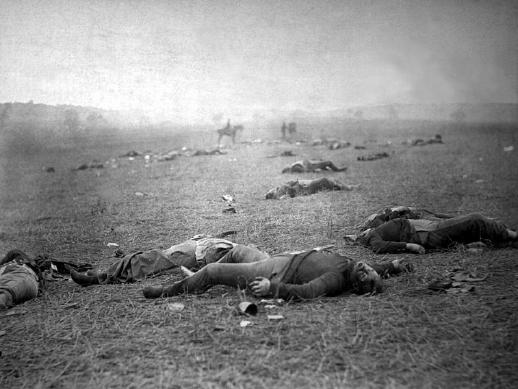
The Laguna Honda Hospital and Rehabilitation Center, San Francisco was opened. For many years the "inmates" were expected to work in exchange for care. It then became a we'll-meet-all-your-needs place. By 2002 it had become a 1,000 plus bed long-term care government run hospital. Believed to be (now) the only large facility of its kind in the United States.
1866 legislation enacted establishing a hospital for the insane in Connecticut. - (history and archives) - 20.5.1867 - Henry Noble 1901
27.5.1866 George Merwin Beers born - See Clifford - He looked after Clifford in 1900. George was the oldest of Clifford's older brothers (apart from Robert, who died in infancy). He was followed by Samuel and William. Carl was younger than Clifford. He was Clerk in the Treasurer's Office of the Sheffield Scientific School, Yale University, living at 130 Cottage Street in 1913/1914. He married Mary Louise Hart (born 26.12.1866 - 9.3.1950). See Yale 1931 He drowned himself 23.6.1932
13.9.1866 Adolf Meyer born in Niederwenigen near Zurich, Switzerland. The son of Rudolf Meyer, a minister, and Anna Walder. He studied medicine in the university of Zurich. Graduating in 1890, he continue his research in neurology. Emigrated from Switzerland to the United States in 1892 in the hope of good career prospects. At first he took an unpaid post in university of Chicago, and maintained himself through general practice before appointment in 1893 to the department of neurology and as a pathologist to Illinois Eastern Asylum (Kankakee State Hospital), aged 26. - Ajay Kumar says Meyer "started getting fame" in 1895 with a "presentation to the American Medico-Psychological Association". - Worcester State Hospital, Massachusettes (1895) - "He was given leave to study in Europe, where he met Kraepelin" (Ajay Kumar) [1896] and represented Clark University at the 450th anniversary celebration of the University of Glasgow in June 1901 - the Pathological Institute at Ward's Island in New York City (latter Manhatten State Hospital) (1.5.1902) - Professor of psychopathology at the Cornell University Medical College (1904) - 1906 - He met Clifford Beers in 1907 - 1908 "The Role of Mental Factors in Psychiatry" - 1908-1911 and 1912-?? David Henderson from Glasgow working with Meyer - September 1909 - 1910 Henry Phipps Psychiatric Clinic and "the nature and conception of dementia praecox". - "Meyer remain in charge of the clinic till his retirement at the age of 74" - Phipps Clinic dedication - 1913: "The treatment of paranoic and paranoid states" 1928: "Thirty-five Years of Psychiatry in the United States and Our Present Outlook". Died 17.3.1950
Mother: Anna Meyer - Father: Rudolf Meyer - Spouse: Married Mary Potter Brooks Meyer 15.9.1902 - Children: One daughter, Julia Lathrop Meyer born 14.2.1916
British North American Act created the Dominion of Canada
USA bought Alaska from Russia for 7.2 million dollars
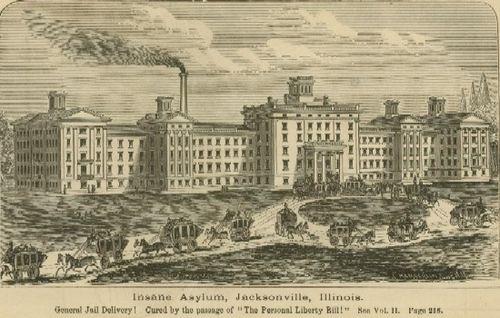
Elizabeth Packard "in the winter of 1867, I came alone, and at my own expense, from Massachusetts to Illinois ... trying to induce the Legislature to ... pass ... a Bill for the Protection of Personal Liberty
5.3.1867 By Elizabeth Pacckard's Personal Liberty Act
"no superintendent, medical director, agent or other person, having the management, supervision or control of the Insane Hospital at Jacksonville, or of any hospital or asylum for insane and distracted persons in this State, shall receive, detain or keep in custody at such asylum or hospital any person who has not been declared insane or distracted by a verdict of a jury and the order of a court"
20.5.1867 cornerstone laid in Middletown for the General Hospital for Insane of the State of Connecticut - 1874: name changed to Connecticut Hospital for the Insane - By 1879, referred to as Connecticut State Hospital. See Clifford Beers 8.11.1902
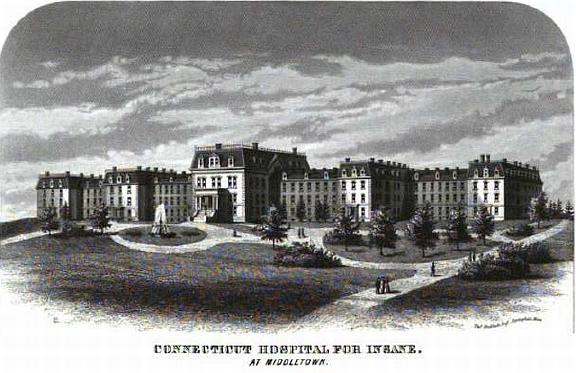
The pictureis of the main building, from 1878 annual report.
(source)
Lewis Henry Morgan, The American beaver and his works. J.B. Lippincott & Co.
1868 Alcatraz designated a long-term detention facility for military prisoners. It became a federal civilian prison in August 1934. "It has been considered a prototype and early standard for a supermax prison". Supermax = super-maximum security. (See Wikipedia)
|
Judi Chamberlin says
"The ex-patients movement began approximately in 1970, but we can trace its history back to many earlier former patients, in the late nineteenth and early twentieth centuries, who wrote stories of their mental hospital experiences and who attempted to change laws and public policies concerning the "insane." Thus, in 1868, Mrs Elizabeth Packard published the first of several books and pamphlets in which she detailed her forced commitment by her husband in the Jacksonville (Illinois) insane Asylum. She also founded the Anti-Insane Asylum Society, which apparently never became a viable organization (Dain, 1989). Similarly, in Massachusetts at about the same time, Elizabeth Stone, also committed her husband, tried to rally public opinion to the cause of stopping the unjust incarceration of the "insane."" (Chamberlin, J. 1990)
At the conclusion of The Prisoner's Hidden Life, Elizabeth Packard proposed that influential readers might circulate the following and send names to her: CONSTITUTION OF AN ANTI-INSANE ASYLUM SOCIETY. Since it has become self-evident from the facts before the public, authenticated by the Illinois Legislative Committee, that our present system of treating the Insane, is a gross violation of the principles of Christianity, and of mental pathology, and therefore, can not receive the sanction of the enlightened and conscientious ; and knowing that it takes a long time to revolutionize such popular institutions, sustained by State's power; we can not submit to pass off the stage of action, without leaving our protest against them. Therefore, while the present system exists, we, the undersigned, do hereby pledge ourselves, 1st. That we will never consent to be entered into such Institutions as patients. 2nd. We will never consent to have any relative or friend of ours, entered as a patient. 3rd. If we, or our relatives or friends, should become insane, they shall be taken care of by their friends, in their own homes. 4th. This Society pledge .themselves that such shall be kindly and appropriately cared for. 5th. That if. the relatives of the unfortunate one are not able to provide for, and bestow suitable treatment upon them, this Society shall furnish them with the means for doing so. 6th. This fund for the protection of the unfortunate, shall be bestowed by a committee of this Society, as their judgment shall dictate, after having thoroughly investigated the whole case.
MRS. E. P. W. PACKARD.
I (Andrew) would note both that it is not an association of ex-patients that was being proposed and that an informal association of women patients had already formed to create the book. |
| Presidency of Ulysses S. Grant 1869 to 1877 |
Birth of Henry Chandler Cowles' (1869-1939). See 1895 - 1898 - 1901 - 1913 -
Samuel R. Beers born about 1869 - See Clifford - 1894 - early death 1900
12.10.1870 Death of Robert Edward Lee, Confederate General and then (from 1865) the President of Washington University, Virginia. On the work table in his office there was a copy of On the prevention and treatment of mental disorders published in 1859 by George Robinson, MD (1821-1875) the owner of Bensham Asylum, near Gateshead, in the north-east of England. [Source: Jeptha Greer] External links Washington and Lee Chapel - Washington and Lee University Timeline (archive)
26.11.1870 First patient admitted to Nebraska State Asylum at Lincoln.
1870/1871
Lewis Henry Morgan,
Systems of consanguinity and affinity of the human family
Smithsonian contributions to knowledge volume 17. (Smithsonian
Institution, Washington)
1871 The Primary Synopsis of Universology and Alwato : the new
scientific universal language by
Stephen Pearl
Andrews was published in New York by D. Thomas in 1871
(Internet archive). His The Basic Outline of
Universology
(Internet archive)
was published in 1872 by the same publisher. The
scientific universal language was a development of
Auguste Comte's belief that universal principles for all
sciences
should be sought, lifting them above empiricism. Andrews argued that "the
Religious Sentiment of the
World should, for the present, be concentered on the comprehension,
acquisition and
criticism of the New Universal Science or
Science of the Universe" (Basic Outline p.lv). What he called
Scientology
was
Universology "developed in the spirit of the exact sciences" (The
Primary Synopsis p. 37). The concept of
scientology was picked up by
Ron Hubbard in the 1950s.
The Lost Dinosaurs of Central Park
| 1871 Washington Territory's first Lunatic Asylum established from a closed Army post called Fort Steilacoom. Now Western State Hospital, Washington. The second state hospital was opened in 1888 The picture below shows Western State Hospital in the 1940s, at about the time that the film star Frances Farmer became a patient. Her autobiography Will there really be a morning? generated a lot of unwelcome publicity for the hospital in 1978. (Kathleen Benoun) |
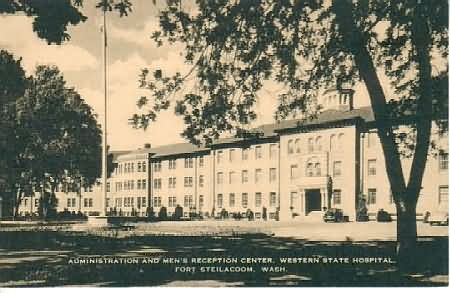
|
| New York City Asylum on Ward's Island | Ward's Island Asylum on Asylum's Projects |
Map of 1879
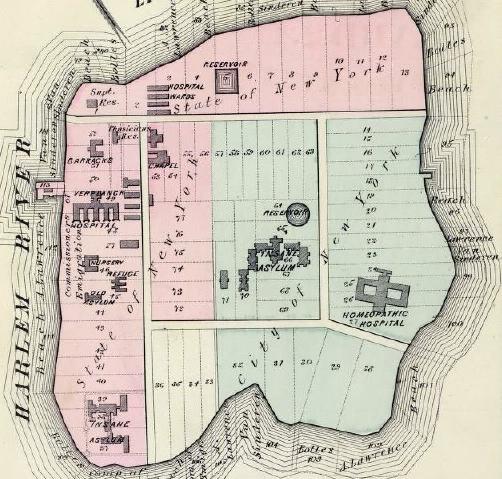
|
1872
Under Elizabeth Packard's influence,
Iowa
passed a
similar bill to
Illinois. Other states followed suite.
3.4.1872 Boston Daily Advertiser (Supplement) "The law school
affords ... lectures ... on what the French call
'criminology', or the science of penal legislation".
5.9.1872 William Cooke Beers born - See
Clifford Beers -
1892 -
1895 -
1899 -
1903: first marriage -
1906 law -
1910 -
1914 -
1915: second marriage
1917 -
1920 -
1928 -
Died
27.8.1930
1873
Vanderbilt University, Nashville, Tennessee, founded.
Wikipedia
Birth of Abraham Arden Brill (died 1948), the
first major translator of the works
of
Sigmund Freud from German into English. The New York
Psychonalytic Society was founded under his chairmanship in 1911. In 1920
he was "PH.B., M.D. Clinical assistant, Department of Psychiatry and
Neurology,
Columbia
University; Assistant in Mental Diseases, Bellevue Hospital;
Assistant
Visiting Physician, Hospital for Nervous Diseases"
Birth of Charles Christopher Adams (1873-1955).
"Arriving from Harvard at
the
University of Chicago
in 1899, Adams studied
under
Charles B. Davenport,
Henry C. Cowles, and Charles Otis Whitman. He worked
as a
curator at the University of Michigan's Natural History Museum while
completing
his Ph.D., awarded in 1908. From 1908 to 1914, he served as a professor in
animal ecology at the University of Illinois". 1913 Animal Ecology
"In December 1914, he
participated
in the initial organizational meeting of the Ecological Society of America"
1874
1874 Clara Louise Jepson born New
Haven, Connecticut. Married
Clifford
Beers in
1912. After Clifford's death
in
1943 she continued to be active in mental health organizations,
particularly the American Foundation for Mental
Hygiene and the World Federation for Mental
Health. See 1955.
Died
8.9.1966
(source)
10.8.1874 Herbert Clark Hoover born. See
Hoover research. Died 20.10.1964.
16.9.1874
Frederic Edward Clements born, (died 26.7.1945) See
1905 -
1916 -
1917 -
1925 -
[Wikipedia]. Clements argued that plant
communities develop thorough stages to a climax community.
9.11.1874
Missouri State Lunatic Asylum Number 2 at St
Joseph's. In 1968 George Glore, a worker at the hospital, created models to
illustrate the history of psychiatric treatment in the USA. From this
developed a museum now known as the
Glore Psychiatric Museum. Now in its own
modern building, the museum has outlived its hospital and is a major
tourist attraction. Curator, Scott Clark. -
Museum link -
Roadside America link
Christmas 1874
The Lambs New York formed. A gentleman's club
for actors. It was the twin of the
London Lambs Club.
The Journal of Nervous and Mental Disease, founded
in 1874, claims to be "the world's oldest independent scientific monthly
in the field of human behaviour". It started (1874) as the Chicago
Journal of Nervous and Mental Disease (first two years). The first
years of the journal balanced neurology and psychiatry. -
See History of Chicago Neurology
Leo Lesquereux's "Cretaceous Flora of the
Dakota Group" was
published by
Dr. Hayden in 1874
1875
20.5.1875 Mary Lincoln, widow of Abraham Lincoln, was committed to
Bellevue Place, a private asylum in Illinois, following procedures under
Elizabeth Packard's
Personal Liberty Act. She was released on 11.9.1875 and
officially declared sane in a Chicago court on
15.6.1876
(source)
14.12.1875: New England Psychological Society formed at
Worcester, Massachusetts. Pliny Earle, superintendent of the Northampton
Lunatic Hospital, elected president. The name was changed to the New
England Society of Psychiatry on 26.3.1907. (see
words)
The first
Columbia PhD was awarded in 1875
1876 Johns Hopkins University, Baltimore,
Maryland, opened.
"the first university in the Western Hemisphere founded on the model of the
European research institution, where research and the advancement of
knowledge were integrally linked to teaching".
(external link)
[What did the others do? - Does this mean that John Hopkins was the first
USA institution that a European would have recognised as a university? See
Yale]
Johns Hopkins University: See
1883 (Psychology laboratory) -
Dewey1884 (John Dewey) -
1889 (Hospital) -
1890 (women) -
1910 (Adolf Meyer) -
1913 (John B. Watson) -
1920 (Rosalie Rayner -
Phyllis
Greenacre - Curt Richter) -
1926
(Gillespie) -
1995 (Germany)
30.3.1876 Birth of
Clifford Whittingham Beers in New Haven,
Connecticut. His parents were
Ida Cooke and
Robert Beers. They lived at 30 Trumbull Street, New Haven,
Connecticut.
The Beer brothers
were Robert H. (died in infancy)
George Merwin (suicide June 1932) -
Samuel Ruggles (early death 4.7.1900)
-
William Cooke (suicide in a mental hospital in 1930) -
Clifford (died in a mental
hospital 9.7.1943) -
Carl (died in a mental
hospital
November 1935 - p.283) - See
1880 Census
18.5.1876 Birth of Henry Andrews Cotton in Norfolk, Virginia. See
1909 -
4.7.1918 -
October 1918 -
18.1.1926 -
Wikipedia - Obituary
New York Times 9.5.1933
-
Gilbert Honigfeld
2009
See external link:
Darwin's Impact: Social Evolution in America, 1880-1920
(archive)
and
History of Economic Thought Web, which
describes Sumner as a "Social Darwinist, American counterpart of the
British evolutionary theorist, Herbert Spencer. Defended radical laissez-
faire as being justified by laws of evolution".
"Although colleges devoted to the instruction of future
clergymen, other professionals, and members of the upper strata have
flourished in America since the colonial period, the first full-fledged
American university, Johns Hopkins, opened its doors only in 1876.
Four
years later
Columbia College began to develop into a national
university.
The universities of Michigan and Pennsylvania followed soon after. In
1891
large endowments from private benefactors led to the creation of two new
major universities, Stanford and the
University of Chicago. Others soon
followed."
(Lewis Coser) -
archive
| Presidency of Rutherford B. Hayes 1877 to 1881 |
|
Lewis Henry Morgan,
(1818
-1881) Ancient society, or, researches in the
lines of human progress from savagery, through barbarism to
civilisation Chicago : C.H. Kerr.
See Marx and Engels Origin - - Engels footnote Durkheim on totemism Fison and Howitt |

|
Richard L. Dugdale, 1877, The Jukes: A Study in Crime, Pauperism, Disease and Heredity, New York, G.P. Putnam. offline book
Webster's 1913 Dictionary included the following entry:
"Jukes, The: A pseudonym used to designate the descendants of two sisters, the Jukes sisters, whose husbands were sons of a backwoodsman of Dutch descent. They lived in the State of New York, and their history was investigated by R. L. Dugdale as an example of the inheritance of criminal and immoral tendencies, disease, and pauperism. Sixty per cent of those traced showed, degeneracy, and they are estimated to have cost society $1,308,000 in 75 years."
9.11.1877 Mary Potter Brooks born Newburgh, Orange County, New York, USA - Hull House - 1895 - married Adolf Meyer 15.9.1902 - Died 12.1.1967 Baltimore City, Maryland, USA
1878
In 1878,
William Welch established the first pathology laboratory in the
United States at Bellevue Hospital in New York and shortly after T. Michell
Prudden started one at the College of Physicians and Surgeons. Although
these laboratories were designated as pathology laboratories, bacteriologic
research and teaching were part of the program."
(W. L. Mallmann 1974) -
(archive)
January 1878
Charles S. Peirce
"How to Make Our Ideas Clear" in
Popular Science Monthly 12, pages 286-302.
9.1.1878 Birth of
John Broadus Watson - See
Chicago University -
Rosalie Rayner -
1901 -
1907 -
1913 Psychology as a
Behaviorist Views it -
Rosalie Rayner
1919 -
Watson and Rayner
1920 -
Skinner 1927
1879
Bureau of
Ethnology established by an Act of Congress. Later re-named
Bureau of
American Ethnology.
(Wikipedia)
February 1879 The
Anthropological Society of Washington founded,
"government-sponsored anthropology centered in Washington - in the earlier
days largely at the Smithsonian Institution" (External source:
pdf of Records, including history
-
html)
July 1879 Charles Taze Russell began the magazine
Zion's Watch Tower and Herald of Christ's Presence stating we live
in "the last days" - "the day of the Lord" - "the end" of the Gospel age,
and consequently, in the dawn of a "new" age." The magazine became The
Watch Tower and Herald of Christ's Presence in 1920 and has been The
Watchtower Announcing Jehovah's Kingdom since March 1939. The group
publishing this magazine have been known as Jehovah's Witnesses since 1931.
See Psalm 37
Carl E. Beers born 1879 - See
Clifford -
Carl Beers 1908 -
1917 -
1920 -
died
November 1935
"Although there were many
pathology and bacteriology
laboratories in Europe prior to 1875, none existed in the United States.
Why no laboratories were established in the United States before 1875 is
difficult to understand because biologists and teachers in the universities
and medical schools were familiar with the researches of
Pasteur,
Koch and
Lister.
|
Under the provisions of the act approved March 3, 1879, amended by the act
approved April 20, 1880, a census of the population, wealth, and industry
of the United States is to be taken on, or of the date, June 1, 1880. The
period of enumeration is by law limited to the month of June, and in cities
having 10,000 inhabitants and over, according to the census of 1870, is
still further limited to the first two weeks of June.
New Haven, New Haven, Connecticut, United States
|

|
25.10.1880 Oregon State Legislature authorised the construction of the first state lunatic asylum. The State Insane Asylum at Salem, Oregon was opened in 1883 with 320 patients. Before that, Oregonian lunatics were cared for in a private asylum in Portland at state expense. (Rootsweb, which has pictures)
25.11.1880 New York Times "New Doctrines on Insanity. Scope and aims of the American Association for the Protection of the Insane - Reforms in Treatment and Jusisprudence proposed" (offline)
Lewis Henry Morgan, A Study of the Houses of the American Aborigines; with suggestions for the exploration of the Ruins in New Mexico, Arizona, the valley of the San Juan, and in Yucatan and Central America.
|
Presidency of James A. Garfield (Republican)
1881
Presidency of Chester A. Arthur (Republican) 1881 to 1885 |
1881
Lewis Henry Morgan, Houses and house-life of the American aborigines This was part of the original manuscript of Ancient Society It was published as volume four of Contributions to North American ethnology Department of the Interior. U. S. Geographical and Geological Survey of the Rocky Mountain Region.
1882
The life and works of Lewis H. Morgan. An address at his funeral by
Joshua Hall Macilvaine. [Rochester, N.Y.]
22.5.1882 Edwin Maria Katzenellenbogen born in Stanislau. He died
after 1950.
1883
The first laboratory of psychology in America is established
at
Johns Hopkins University
Memoir of Lewis H. Morgan of Rochester, N.Y. etc. by
Charles Henry Hart. Philadelphia
Robert Henry Lowie born, Vienna, 1883. Died 1957.
(Wikipedia)
1.12.1883 Birth of Henry Joel Cadbury in Philadelphia.
Life story - died 9.10.1974, in Bryn Mawr,
Pennsylvania.
1884
The superintendent of
St Elizabeth's Hospital for the Insane, W.W. Godding, appointed
Isaac W. Blackburn as head of the first
pathology laboratory established in a lunatic asylum in the USA.
In 1884,
John Dewey published "Kant and Philosophic Method" (April), was
awarded his Ph.D by
Johns Hopkins University (June) and was appointed instructor in
philosophy at
University of Michigan (July). One of his students at Michigan
was
Robert E. Park.
[see autobiographical note]
Dewey taught at Michigan from 1884 to
1888 and again from
1889 to 1894.
Robert Park worked as a journalist from 1887 to
1898
[see autobiographical note]
1884
George Herbert Mead wrote to a friend
Some of Mead's later work in social psychology expresses in secular
(naturalistic) theories ideas previously expressed in
theological terms.
See, for example soul in
Mind, Self and Society
"I have no doubt that now the most reasonable system of the
universe can be formed to myself without a God." (See
Aboulafia 2008)
| Presidency of Grover Cleveland (Democrat) 1885 to 1889 |
1885
Roderick Duncan McKenzie
Roderick Duncan McKenzie born (died 1940). See
1923 -
1925 -
1929 -
1933 -
Boas emigrated to the United States, to "assume an editorial
position with the journal Science"
(source) - "From 1885 to
1896,
Boas conducted fieldwork under the auspices of several museums
on the North Pacific Coast of North America"
(source) - "In 1886, he embarked upon
... what would become his most famous
ethnographic project, working among
the Kwakiutl (Kwakwaka'wakw) Indians of the Northwest Coast, after which he
secured his first academic position in
1889
(source)
6.4.1885 Birth of Clarence Meredith Hincks in St Mary's, Ontario,
Canada. First "attack":
1901 - See
1913 -
1917 -
1918 -
Died
1964
1.10.1885 Birth of
Louis Untermeyer (died
18.12.1977) "Schools used his
Modern American and
British poetry books widely, and they often
formed students' introduction to poetry"
(Wikipedia) - "Louis Untermeyer was most noted for the
anthologies of poetry which he compiled and edited. Some of these works,
first published in the 1920s, continued to be used as high school and
college textbooks well into the 1970s"
(Biographical note, University of Delaware)
1886
Of 1,588
paretic patients
admitted to
St.
Elizabeth's Hospital between 1886 and
1924,
1,198 died in the
hospital.
15.5.1886
New York and
Liverpool (England) described as "world cities" in relation to the
International Exhibition of Navigation, Commerce and Industry in Liverpool.
16.5.1886
Ernest Watson Burgess born. See 1921 -
1925 - 1945
29.6.1886
William Fielding Ogburn born. See
Hoover's research committees Died 27.4.1959
1887
Yale College became Yale University
1887 USA Laboratory of Hygiene started. It grew and was reorganized
in 1930 by the Ransdell Act into the National Institute of Health.
(Wikipedia)
November 1887 The American Journal of Psychology founded
by G. Stanley Hall.
1887 Birth of Walter R. Bloor. Worked for a while at Berkeley
California. See Bloor and
Brody
-
Eugene Bloor Brody. Died 1966.
Autumn 1887
George Herbert Mead began his MA in philosophy at
Harvard. During this academic year, he tutored the children of
William James.
1888
27.1.1888 National Geographic Society founded in
Washington DC. The
National Geographic Magazine started in September/October 1888.
[external link to website]. The
Royal Geographical
Society in Great Britain was founded in 1830.
New York investigative reporter Nellie Bly disguised herself as a mental
patient, then wrote Ten days in a Mad House
In Washington State
there is a lake so full of salts that it is known as
"Medical Lake". The lake was exploited commercially by an English
immigrant, Stanley Hallett (1851- ) who owned much of the land. Hallett
persuaded the legislature, of what was then Washington Territory,
to construct the
second
State Lunatic Asylum there in 1888. It is now Eastern State Hospital
(Washington) (Kathleen Benoun's
timeline says it opened in 1891)
external
link
Autumn? 1888
George Herbert Mead went to Leipzig, Germany to study with
Wilhelm Wundt, from whom he learned the concept of "the
gesture," Mead "studied in Germany from 1888-1891, taking a course from
Wilhelm Dilthey and immersing himself in Wilhelm Wundt's
research."
Aboulafia 2008
See
1920 visit of Siegfried Sassoon -
1921
letters - 1922 -
April 1922
-
11.12.1924 visit to Charlotte Mew -
1925 -
1930 -
1936 -
1939 -
1970
"The original Kirkbride
building at Medical Lake is long gone,
but the building that replaced it has an approximation of a Kirkbride floor
plan, with male and female wings extending from a larger center wing.
Originally just a mental hospital, the complex now houses mental health
patients, chimpanzees, juvenile criminal offenders, and bats, as the mental
hospital has downsized and different uses have been found."
(Rootsweb, which has pictures)
| Presidency of Benjamin Harrison (Republican) 1889 to 1893 |
1889
Foundation of Hull House, Chicago:
(visit the museum) - It was at Addam's Hull
House that the Chicago School of Civics and Philanthropy flowered. The
principles of active occupation and adaptation promoted by Dewey and
adopted by Hirsch, Lathrop and Addams were taught there to its students
Eleanor Clarke Slagle and
Mary Potter Brooks [later] Meyer. It was at Hull House that the
Faville School of Occupational Therapy was established, and Slagle later
taught, a school founded and supported by the Chicago Mental Hygiene
Society"
(source)
12.6.1889 Charter of the Grace Hospital Society, approved by the General
Assembly (of?). Grace Hospital was founded as a homeopathic and eclectic
medical institution. All 31 incorporators listed in the charter were
members of the Connecticut Homeopathic Medical Society and the Connecticut
Eclectic Medical Society.
(source)
11.11.1889 Washington
Territory became Washington State, the 42nd
state of the USA
1889
Boas secured his first academic appointment which was at Clark
University in Worcester, Massachusetts.
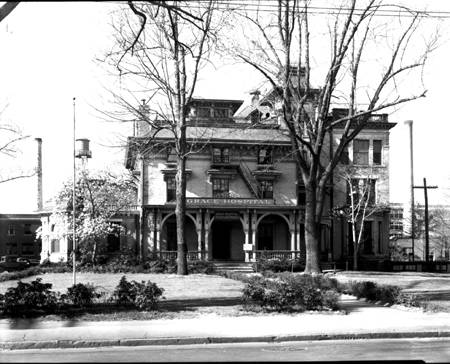
|
A Kodak Camera advertisement appeared in the first issue of The
Photographic Herald and Amateur Sportsman, November, 1889 with the
slogan "You press the button, we do the rest".
"Kodak Transparent Film for use in the Kodak Camera with 100 negatives". Celluloid film on sale in the autumn of 1889. |
1889 Johns Hopkins Hospital opened
1889 The creation of a [New York] State Commission in Lunacy
1890
University of Chicago founded:
external link to brief history.
See John Dewey -
1874 -
Hull House 1889 -
Department of Sociology 1892
- Dewey and Mead
1894 - American Journal of
Sociology 1895 -
A Womens Fund Committee was started to raise funds on condition that
women were admitted to the medical school at Johns Hopkins University Between 1890 and 1907 the
whole University gradually became co-educational (staff and students). It
has been suggested
(Broadhurst, P.L. 1967)
that concern for the moral welfare of students made it particularly
sensitive to sexual scandal. About 1908, James Mark Baldwin, its leading
Professor of Philosophy and Psychology, was arrested in a brothel and
subsequently dismissed, creating the opportunity
for his junior, John B.
Watson,
to take his position as editor of the
Psychological Review.
In 1920
Watson himself was dismissed when his affair with his female colleague
resulted in divorce.
Columbia University "When Seth Low became
Columbia's president in 1890, he vigorously promoted the
university ideal for the College" -
"For nearly forty years after Columbia University's re-founding as a
research university in the 1890s, Franklin Giddings was Professor of
Sociology"
(source)
1890 New York State Care Act. The state assumed responsibility for
all the insane in the state with the exception of those in Monroe,
Kings and New York counties (which could opt in to state provision). Other
legislation formally changed the names of all state "lunatic asylums" to
"state hospitals." See 1896
8.2.1890 Birth of Samuel Brody in Lithuania. Emigrated to Canada in
1906. In the seminar of Agnes Fay Morgan (1884-1968), Berkley, California
in 1916. -
Chemical Warfare Service in World War 1 -
Bloor and
Brody -
In 1920 he
married Sophie Edith Dubosky. Died 6.8.1956 Eccles Hall, Columbia
University
6.10.1890
Sophie Edith Dubosky born in California.
[See 1940]
She graduated from Berkley, California. Married Samuel Brody in
1920. Gave
birth to
Eugene Bloor Brody on
17.6.1921 and to Arnold Jason Brody in
1923. "Dr
[Eugene] Brody's landmark book, which has remained in publication since
being published in 1952 Psychotherapy With Schizophrenics
[See 6.12.1950]
was motivated
by his mother's personal struggle with mental illness. She was psychotic,
which began in his childhood and continued until her death at age 96. He
wrote that life with his mother conflicted with much of what he was taught
about mental illness in medical school.
"With patience and love, as well as increasing knowledge, it was possible
to learn her language and teach her mine," he wrote. "I learned that no one
is unreachable or incomprehensible 24 hours a day, or 60 minutes an hour."
The experience left an indelible mark on him because, as he wrote, when it
came time to treat his first psychotic patient, he "knew how to talk to
such a person."" Died
April 1987
28.10.1890 Arthur Chester Ragsdale born in Aurora, Missouri.
B.S.
University of Missouri in 1912. M.S. University of Wisconsin
1925. Taught at New Jersey College of
Agriculture and the University of West Virginia. Joined the University of
Missouri faculty in 1916. Professor and chairman of the Department of Dairy
Husbandry from 1919 to 1961.
[Papers]. See
Bloor and Brody - Died
22.7.1969
1891
Autumn 1891
George Herbert Mead employed by the
University of Michigan, where he met
Charles H. Cooley and
John Dewey,
16.12.1891 Birth of
Joseph Ward Swain (died 1971), translator of Durkheim and an
American historian. Born at Yankton, South Dakota, the eldest son of Henry
Huntington and Myra (Olmstead) Swain. Paris (with Durkheim and Mauss)
1913-
1915.
Dr Amos Givens came to Stamford in 1891 or 1892 and started out in a Summer
Street building which was soon outgrown by the number of his resident
patients. He bought property along Long Ridge Road north of Bull's Head and
developed what became "Dr. Givens Sanitarium for the Treatment of Nervous
and Mental Diseases, Opium and Alcoholic Habitues," also called
"Stamford
Hall,".
(source)
1892
1892
American Association of Medical Superintendents became
the
American Medico-Psychological Association to allow assistant physicians
working in mental hospitals to become members.
21.2.1892 Birth of Harry Stack Sullivan, in Norwich, New York. He
14.1.1949, in Paris, France.
July 1892 The American Psychological Association (APA) founded.
(external link to
archives)
11.10.1892: For the four hundredth anniversary of
Christopher Columbus crossing the Atlantic, children throughout
the United States took part in a ceremony which included reciting together
"I pledge allegiance to my Flag, and to the Republic for which it stands:
one Nation indivisible, With Liberty and Justice for all". After the
celebrations it became a popular national custom in schools.
In 1942 it became official.
1892
Adolf Meyer emigrated from Switzerland
to the United States.
"In 1892 the [New York] City Asylum consisted of four divisions or
departments, one each on
Blackwell's,
Ward's and Hart's islands, and one at Central
Islip, L. I. , 40 miles distant from New York City, having a total
population of 7478 patients. In 1886 Dr. MacDonald, the general
superintendent, was appointed by the commissioners executive and
administrative officer and each institution was placed in immediate charge
of a local medical superintendent, subordinate to the general
superintendent: Dr. E. C. Dent, the superintendent of the female division,
Ward's Island; Dr. William A. Macy at the male division, Ward's Island; Dr.
H. C. Evarts at the Central Islip division, and Dr. G. A. Smith at the
Hart's Island division." See
1894
Autumn 1892?
William Beers began
the Electrical Engineering
Course in the Sheffield Scientific School at Yale University. He was a
"member Berzelius and Triennial Committee". Graduated 1895.
"In my earliest days of contact with him, as he returned from
his studies in Berlin forty years ago, his mind was full of the
problem
which has always occupied him, the problem of individual mind and
consciousness in relation to world and society.... When I first knew him he
was reading and absorbing biological literature in its connection with mind
and the self"
(John Dewey
1931)
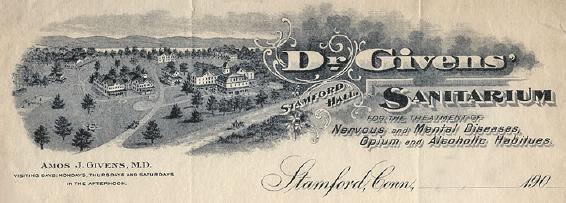 - The American Sociological Society
was founded in 1905
- The American Sociological Society
was founded in 1905
| Presidency of Grover Cleveland (Democrat) 1893 to 1897 |
1893
1893 Adolf Meyer appointed Honorary Fellow and Docent in Neurology at the University of Chicago and Pathologist at the Eastern Hospital for the Insane, Kankakee, Illinois
1.5.1893 to 31.10.1893 "World's Columbian Exposition, Chicago" or "Chicago World's Fair". [Celebrating 400 years since Columbus arrved in 1492]
Franz Boas constructed life group displays (now commonly called "dioramas") to bring the cultures of Native Americans to the general pubic at the Chicago World's Fair. He also "as part of his argument that racial distinctions among humans are not valid"... "exhibited skulls of various peoples to demonstrate the irrelevance of brain size". (external source)
Congresses held at the same time as the exhibition included te World's Parliament of Religions (the largest) and ones dealing with anthropology, labour, medicine, temperance, commerce and finance, literature, history, art, philosophy, and science.
22.7.1893 Karl Augustus Menninger born - See fish image 1930 - Died 18.7.1990
| 1894 | New Woman |
James Mark Baldwin (Princeton University) [external link] and James McKeen Cattell (Columbia University) founded The Psychological Review which became the leading publication in American psychology.
1894/1895 Economist Charles Horton Cooley began to teach sociology at Ann Arbour University, Michigan. See 1909
|
Chicago
University 1894
John Merle Coulter (1851-1928) appointed to lead the newly established Department of Botany at Chicago University .
Department of Philosophy founded with John Dewey as its first chairman from 1894 to 1904. Succeded by James H. Tufts, and subsequently George Herbert Mead. The "Chicago School of Thought" sought to furnish a reformulation of the basic commitments of pragmatism on a strict logical basis. (source) |
April, 1894 New York City: 2000 patients were brought to Ward' s Island from Blackwell's Island, which was abandoned as unfit for habitation, and in 1896 Hart's Island, with its so-called pavilions of hemlock boards, built for the sheltering of soldiers, was abolished and its 1555 patients transferred to Ward's Island.
last week of June 1894 "An event then occurred which ... was the direct cause of my mental collapse six years later... An older brother [Samuel Beers], was stricken with what was thought to be epilepsy. Few diseases can so disorganize a household and distress its members..." (Clifford Beers - A Mind that Found Itself)
1895
1895
Adolf Meyer appointed Pathologist, at
Worcester State Hospital
for the Insane, Worcester, Massachusetts and Docent in
Psychiatry at Clark
University.
1895
Mary Potter Brooks, a social worker, introduced a systematic
type of activity into the wards of a state institution in Worcester,
Massachusetts. She was also the first social worker to provide a systematic
program to help patients, their families, and the physician.
(source)
In 1895, the president of the New York State Commission in Lunacy, Carlos
F. McDonald, proposed the establishment of a central
pathology
laboratory to process and coordinate the pathology work of the state
hospitals. In 1896,
Ira Van Gieson was appointed as the first director of the
"Pathological Institute of the New York State Hospitals for the Insane".
the original Pathological Institute rented offices on Madison Avenue in New
York City. Van Gieson's vision was an institute for "the study of the
causes and conditions that underlie mental disease."
He was dismissed in
1901 after
apparently claiming the discovery of a "germ of insanity" would
make asylums superfluous.
Adolf Meyer, who was consulted about the issue in 1901, succeded
van Gierson in
1902.
1895-1898
William Beers was "Draftsman for Black Manufacturing Company of
Erie, pennsylvania, manufacturers of Tribune bicycle, and traveling
salesman for the company in the United States and Canada". He "spent the
winter of 1898-1899 in selling bicycles in Europe".
The Female Offender by
Cesare Lombroso and Guglielmo
Ferrero, with an introduction by W. Douglas Morrison, Her Majesty's Prison,
Wandsworth. Illustrated. New York. D. Appleton and Company. 1895
1.1.1895 Birth of John Edgar Hoover in
Washington DC -
See 1919 -
1924 -
1935
- Died
2.5.1972.
| July 1895: First edition of the American Journal of Sociology published by the University of Chicago Press. It has continued bimonthly since. Journal web site. At this time, Chicago and Bordeaux were two of the main centres generating "sociology". See Andrea Nagy. |
|
Ecology: "When Henry Cowles arrived at the University of Chicago for graduate studies in 1895, Eugenius Warming's Plantesamfund had just been published. [Cowles' tutor] John Coulter introduced the Danish scientist's theories to his students in classroom lectures, and Henry Cowles was so fascinated that he learned Danish so he could read Warming's entire text in its original language" (external source)
3.10.1895 Birth of George Andrew Lundberg (died 14.4.1966). See 1943 - 1947 - 1953
1896
Beginning of Springfield,
Maryland, on the cottage plan. See
external link and another
Maryland weblink -
Maryland weblink (or try
one of these) - . In England, the
London County Council's Asylums Committee had appointed a
working party to
study asylum design in Scotland, continental Europe, Canada and the USA.
The group reported in 1902, favouring the design of the Maryland State
Asylum "where autonomous 200 bed ward blocks were positioned to look
inwards on to large rectangular gardens. The units were connected by
walkways, covered only overhead".
[See colony or villa system]
1896
John Dewey: Evolution and Ethics. In 1896, John Dewey and
his wife, Alice Chipman Dewey, founded the
Chicago Laboratory School
(external link)
External link: Photograph of
"The Chicago Philosophy Club 1896", shows,
amongst others,
George Herbert Mead and
John Dewey
Louis Viereck (1851-1921) and his family emigrated to the United States in
1896 The son of Berlin actress, Edwina Viereck, and possibly the
illegitimate son of Wilhelm 1 of Prussia, he became a friend of Karl Marx.
His wedding, in 1881, was attended by Frederick Engels. His son (George)
Sylvester Viereck was born in Munich on 31.12.1884. See
Sylvester Viereck
- 1934 -
Peter Viereck
"In 1896,
Boas moved to New York and was appointed Assistant Curator of
Ethnology and Somatology at the American Museum of Natural
History, and
Lecturer at
Columbia University. Three years later, Boas became the first
Professor of Anthropology at Columbia."
(source) - "Boas began to teach classes at
Columbia University in 1896, where three years later he was appointed
Professor of Anthropology. For the next 37 years, Boas ruled the
anthropological roost at
Columbia..."
Columbia)
1896
Adolf Meyer
took a five-month leave of absence for a
visit to Switzerland and Germany. He spent
six weeks with Emil Kraepelin at his
small hospital in Heidelberg.
20.2.1896 Through legislation, the New York City Asylum for the
Insane became the Manhattan State Hospital for the Insane. In 1900 each of
the three departments was made a distinct hospital. The hospital for men
became Manhattan State Hospital East, under Dr. A. E. MacDonald; that for
women, Manhattan State Hospital West, under Dr. E. C. Dent; and that at
Central Islip, the Central Islip State Hospital, under Dr. George A. Smith.
In 1904 Dr. A. E. MacDonald resigned to retire to private life.
| Presidency of William McKinley (Republican) 1897 to 1901 |
|
12.2.1897 A speech by Adelaide Hoodless stimulated the formation of what became the Women's Institute of Saltfleet Township. |

|
11.5.1897 George Peter Murdock born Meriden, Connecticut. - See 1928 - 1941 - 1949 - died 29.3.1985 (aged 87) Devon, Pennsylvania.
28.8.1897 Louis Wirth born in Germany. (Died 10.5.1952) - external link - See 1925 -
1898
In a lecture on "Philosophical Conceptions and Practical Results",
William
James talked about a new philosophy of
pragmatism which he said had
been developed by
Charles Sanders
Peirce
Robert Park studied Psychology and Philosophy for an MA at
Harvard 1898-1899.
William
James was one of his tutors.
autobiographical note
Henry Chandler Cowles' (1869-1939) PhD Thesis: The Ecological
Relations
of the Vegetation on the Sand Dunes of Lake Michigan
(Chicago
University) - See
ecological succession -
(external source) -
(external source). The idea of a natural
climax to the succesion of vegetation was developed by
Frederic Clements
1899
William Edward Du Bois The Philadelphia Negro Philadelphia
University Press
Wikipedia
1899
Thorstein Veblen's The Theory of the Leisure Class.
In 1899
Robert Park travelled to Germany where he studied at the
University of
Berlin with
Georg Simmel. He spent a semester studying at the University of
Strasbourg,
followed by a few years spent at the University of Heidelberg studying
philosophy and psychology. He took his Ph.D at Heidelberg and returned to
the United States in 1903 -
autobiographical note
1899 USA based United Fruit Company formed from the merger of
Minor C. Keith's banana-trading concerns with Andrew W. Preston's Boston
Fruit Company.
Spring 1899 William
Beers "brought back from France a six horse-power
automobile
and ran it in Erie much to the 'amusement' of the people.
Tried to organize a company to build them, but capitalists
had no faith in the 'horseless' carriage nothing doing"
June 1899 Newspaper article based on an interview with
Ira Van Gieson
claimed that asylums would become superfluous due to the discovery of the
"germ of insanity". Controversy led to Van Gieson's dismisal. (Dowbiggin)
4.7.1899 Emerson Peter Schmidt born Tavistock, Ontario, Canada. A
Canadian citizen, Schmidt taught economics in United States universities at
Marquette (Jesuit, Wisconsin), Wisconsin, Oregon, and
Minnesota. At Minnesota
(1937) he edited Man and Society: A Substantive Introduction
to the Social Sciences. From 1943 to 1976 he was director of economic
research for the United States Chamber of Commerce. He died 8.4.1976.
1899 Having failed to establish automobiles, William
Beers was representative for the Winchester Repeating Arms
Company of New Haven in seven states from October 1899 to 1903.
He organised the Tribune Trap and Target Company in Erie in 1903 and served
asits secretary, treasurer, and general manager until 1906;
1900? Birth of Rosalie Rayner. See
1919 -
1920. On 31.12.1920 she married
John Broadus Watson and had two children. She died
19.6.1936.
7.3.1900
Herbert Blumer born. See
1925 -
1930 -
1933 -
Payne Fund Studies -
1936 -
1937 -
1937 -
1939 -
1941 -
1952 -
1969 -
about
1996 -
6.6.1900 Samuel Andrew Stouffer born -
1930 -
1948/1949 -
1949 -
General Statement
-
1955 -
(Died 24.8.1960)
February 1900 First Kodak Brownie camera.
23.6.1900 Clifford
Beers attempted suicide, convinced that he suffered epilepsy
(See
Samuel ) - A Mind that Found Itself). He was admitted
to
Grace Hospital , where bars were put on his windows, for his
protection.
4.7.1900 Death of
Samuel Beers. "The
doctors finally decided that a tumor at the base of the brain had caused
his malady and his death".
(Clifford Beers -
A Mind that Found Itself
11.8.1900 Clifford
Beers admitted to
Stamford Hall,
Stamford, Connecticut. -
A Mind that Found Itself)
| Presidency of Theodore Roosevelt (Republican) 1901 to 1909 |
| So called progressive era in USA politics from 1901 to 1917 (Or 1890s to 1920s) - Reclamation of arid land - Enforcement of anti-trust laws: Roosevelt sued 45 companies under the Sherman Act. Taft sued 75 - Establishing federal regulations for the meat-packing and drug industries. - Unsuccessful attempts to restrict child labour - "white slave traffic" control - - Also constitutional amendments: 16th - 17th - 18th - and 19th amendments to the constitution. Social science: anthropology - eugenics - sociology - ecology - pragmatism - looking glass self - psychoanalysis - behaviourism - |
The Physiographic Ecology of Chicago and Vicinity; A Study of the Origin, Development, and Classification of Plant Societies by Henry Chandler Cowles - [See ecology]
1901 In 1901, Watson married Mary Ickes, whom he had met at the University of Chicago. They had two children together, Mary and John. Watson graduated in 1903 with a Ph.D. in psychology, but stayed at the University of Chicago for several years doing research on the relationship between sensory input and learning and bird behavior.
6.4.1901 Clarence Hincks sixteen. In his sixteen year he had the first attack of sudden indifference to life, lasting about two weeks. Such attacks recurred almost annually until 1957, the year he retired.
1.5.1901 New York Times "Institute's Faculty Resigns - As a result of action by the Legislature removing Director Ira Van Gieson of the Pathological Institute, depriving the institute of quarters and in other ways curtailing it work, the entire Faculty have tendered their resignation to take effect today, when Mr Van Gieson goes out of office. Dr Van Gieson stated yesterday that he had instructed hi lawyer, John Lineham, to apply to the Supreme Court for an injunction restraining the State Commission in Lunacy from interfering with specimens and other property of the institute." (original)
17.5.1901 Adolf Meyer was "at present abroad working in Switzerland and Germany". He would represent Clark University at the 450th anniversary celebration of the University of Glasgow from 12.6.1901 to 15.6.1901. Science 17.5.1901
11.6.1901 Clifford Beers admitted to the Hartford Retreat - A Mind that Found Itself)
25.10.1901 Oliver Cromwell Cox born Port of Spain, Trinidad. See Wikipedia - 1948. He died 4.9.1974
American Anthropological Association founded (External link to brief history on its website)
1902 Thomas Dixon's "Trilogy of Reconstruction" began with The Leopard's Spots in 1902. The Clansman appeared in 1905, and The Traitor in 1907). The Clansman was the basis of the silent film The Birth of a Nation in 1915.
1902 Harold (Dwight) Lasswell born. See 1936 - 1948 - Died 1978
1.5.1902 Adolf Meyer began duties as Director of the Pathological Institute of the New York State Hospitals. In December 1902 Meyer moved the institute to a building near the Manhattan State Hospital on Ward's Island. "Dr. Meyer also perceived the need for academic affiliation, which led to the formation of an advisory board whose members represented the medical schools of Columbia, Cornell, and Bellevue". (source)
17.6.1902 "An Act Appropriating the receipts from the sale and disposal of public lands in certain States and Territories to the construction of irrigation works for the reclamation of arid lands".
15.9.1902 Mary Potter Brooks, of Newburgh, New York. married Adolf Meyer
8.11.1902 Clifford Beers admitted to the Connecticut Hospital for the Insane - A Mind that Found Itself)
13.12.1902 Talcott Parsons born in Colorado Springs, Mid-West USA. See 1920 - 1928 - 1930 - 1931 - 1933 - 1937 - 1942 - 1948 Stock take - 1949 Family - General Statement - 1951 System and Towards a General Theory - 1970 - 1973 - 1979
Robert Park returns to Harvard - autobiographical note
1903 to 1937 William Alanson White (fourth) superintendent St Elizabeth's Hospital, Washington, DC. See 1907
18.6.1903 Marriage of William Cooke Beers to Miss Annie McCollum Tracy, daughter of Daniel Tracy, banker, of Erie, Pensylvania. She died in Erie 11.10.1904. They had one child, Daniel Tracy, born 17.3.1904. William was married again on 18.2.1915, in Danbury, to Julia May, daughter of John William and Julia Maria (Snell) Green. They had no children.
10.9.1903 Clifford Beers freed from hospital - A Mind that Found Itself)
Eugenics Record Office established by biologist Charles Davenport at Cold Spring Harbor, Long Island (New York). (Wikipedia)
1904 Adolf Meyer Appointed Professor of Psychiatry, Cornell Medical College
Professor W.I. Thomas (University of Chicago) made written criticism of Patrick Geddes' theoretical approach to the sociology of the city.
"From the standpoint of its applicability to new countries like America, Professor Geddes' programme is inadequate because of its failure to recognise that a city under these conditions is formed by a rapid and contemporaneous movement of population, and not by the lapse of time. p. 136 The first permanent white settler came to Chicago precisely one hundred years ago, and the city has a population at present of about two and a quarter millions. It is here not a question of slow historic development but of the rapid drifting towards a certain point, of a population from all quarters of the globe, and the ethnological standpoint therefore becomes of more importance than the historical."
1904 to 1930 (when he retired), John Dewey was professor of philosophy at both Columbia University and Columbia University's Teachers College.
15.1.1904 Birth of Newton J. T. Bigelow - "joined the [New York] Department of Mental Hygiene in 1929 and was commissioner from 1950 to 1954, when he resigned to return to Marcy State Hospital as its director, a post he had previously held". He retired in 1973 - died 30.1.1991
20.3.1904 Birth of Burrhus Frederic Skinner (1904-1990). Read Pavlov and Watson and went to Harvard to study psychology in 1927. 1938 The Behavior of Organisms. 1945 Walden Two written. 1948 Walden Two published. 1954: programmed learning. 1969: National Medal of Science
4.1.1904 Birth of George Eaton Simpson. (Died 13.12.1998). B.S. degree from Coe College in 1926. M.A. degree from the University of Missouri in 1927. Taught at Temple University from 1928 and Pennsylvania State University from 1934. Ph.D. from the University of Pennsylvania in 1934. The Negro in the Philadelphia Press 1936. At to Oberlin College as a Professor of Sociology and Anthropology from 1947 to 1971.
23.6.1904 Birth of Carleton Stevens Coon - Died 3.6.1981. See 1939 and 1954.
End of 1904 Clifford Beers "From a matter-of-fact man of business I was transformed into a man whose all-absorbing thought was the amelioration of suffering among the afflicted insane." A Mind that Found Itself)
12.12.1904 Birth of Nina Ridenour in Vincennes, Indiana. Gained Bachelors in psychology from Radcliffe College (then a women's college, now a part of Harvard University); Masters in sociology from Colorado College; and a doctorate in educational psychology from New York University, finishing in 1941. Whilst studying, she worked as a psychologist and administrator. In August 1941 she married Maximilian Arnold Boll, but continued to use her maiden name for professional purposes. Director for the division on world affairs of the National Committee for Mental Hygiene from 1947-1949 and executive director of the International Committee on Mental Hygiene. Organised the International Congress on Mental Health in London in 1948. (source)
1905
The Carnegie Foundation for the Advancement of Teaching was founded by
Andrew Carnegie in 1905 and chartered in 1906 by an act of the United
States Congress. See 1911.
1905 Henry Phipps endowed the Phipps Tuberculosis Dispensary at
Johns Hopkins Hospital in Baltimore, Maryland, under the
direction of William Osier (1849- 1919).
Frederic Edward Clements Research Methods in Ecology,
which became a standard textbook for ecologists. Clements was Professor of
botany at the University of Nebraska from 1905 to
1907. Arthur Tansley's textbook was
published in 1923
11,9.1905 Ceremony to mark the start of building the Grand Trunk
Pacific Railway
(Wikipedia) which, when completed, ran from
coast to coast across Canada - approximately 3,600 miles. Sometime before
winter 1908/1909, Bertram A. Miller emigrated from London, England to
Canada. He began work on the railway in April 1909, writing a two page
account of his experiences in Incentive June 1963. In the summer of
1917, Bertram A. Miller "was discharged from the Mile End Military Hospital
after a spell of fourteen week's treatment for a shell wound". He was
married on the same day. About
1956, Bertram was admitted to the
Ingrebourne Centre, Hornchurch, Essex, England.
"Together with the
Institut International de Sociologie, and
the
Sociological Society of London, the American Sociological
Society bears witness that a few men and women, in full possession of their
senses, are convinced that something is lacking in methods of interpreting
human experience, and that the most effective means of supplying the lack
must be sought without rather than within the older sciences of
society."

|
April 1906 William
Beers worked for the Cadillac Motor Car Company of Detroit until
the autumn, when he returned to New Haven and enrolled at Yale Law School.
In the picture a "Runabout" ($750) demonstrates how strong it is by repeatedly leaping the gap without damage. |
30.6.1906: Federal Meat Inspection Act effective.
30.6.1906: Pure Food and Drugs Act effective: An Act for preventing the manufacture, sale, or transportation of adulterated or misbranded or poisonous or deleterious foods, drugs, medicines, and liquors, and for regulating traffic therein, and for other purposes.
1.7.1906 Letter from William James to Clifford Beers encouraging him to publish his autobiography - (A Mind that Found Itself)
Pragmatism: A New Name for Some Old Ways of Thinking: Popular Lectures
on Philosophy by William James was published in London and New York in
June 1907, but consisted of lectures delivered in November and
December 1906, and again in January 1907. Contents, The present dilemma in
philosophy - What pragmatism means - Some metaphysical problems
pragmatically considered - The one and the many - Pragmatism and common
sense - Pragmatism's conception of truth - Pragmatism and humanism. The
lectures were reprinted twice in July and again in October 1907
"Fundamental Conceptions of Dementia Praecox" by
Adolf Meyer.
Autumn 1906
William Beers studied
in Yale School of Law from 1906 to 1909 (LL.B.
June 1909).
Indiana passed the first USA
sterilisation law - See
Wikipedia USA sterilisation
Oregon State Institution for the Feeble-Minded founded
for feeble-minded, idiotic, and epileptic people. (Became Fairview
Hospital and Training Centre in 1933 and Fairview Training
Centre in 1979. The State Board of Eugenics was created
in 1917. This examined "institutionalised individuals who could produce
offspring inheriting inferior or antisocial traits" and made orders
directing the superintendent of the institution to perform sterilisation.
It became the State Board of Social Protection in 1967 (with
restrictions on its powers) and was transferred to the Health Division in
1971. It was not abolished until 1983.
Frederic Edward Clements was chair of the Department of Botany
at the
University of Minnesota from 1907 to
1917
1907 A psychology laboratory under Shepherd Ivory Franz, Ph.D., and
the first psychotherapy department in a mental hospital under William
Kempf, M.D. established at St
Elizabeth's Hospital, Washington, DC.
1907 John B. Watson
(aged 29) appointed professor of psychology at
Johns Hopkins University
Late September 1907 First meeting of Clifford Beers with Adolf Meyer and
Mary Meyer. Apolf helped Clifford make a
thorough revision of A Mind that Found Itself, one more acceptable
to medical (psychiatric) opinion.
(Dain 1980 , pages
79-83)

|
Henry Ford's Model T automobile. External link - See assembly line. The first Ford factory outside the USA opened near Manchester in 1911 |
1908 Birth of George Simpson, translator of Durkheim, according to Library of Congress catalogue. See 1933 - 1953 - 1954 - 1950
1908 "The Role of Mental Factors in Psychiatry" by Adolf Meyer. American Journal of Insanity 65. pp 39-56. [Possibly from this that Henderson and Gillespie (1927 p.186) take the quotation "we must consider mental illness, not in terms of clean-cut groups, but of reaction types"]
From 1908 to 1911, David Kennedy Henderson worked with Meyer at Ward's Island. He met Margaret Mabon whilst he was there. In 1911 he went to Munich to study with Kraepelin and Alzheimer and then to London to study with Mott, but returned to work with Meyer in 1912. source
March 1908 Clifford Beers published the first edition of his autobiography A Mind that Found Itself. See Survivors timeline.
Wednesday 6.5.1908 Clifford Beers founded the Connecticut Society for Mental Hygiene, which Time magazine in 1923 described as "the first organization of its kind" and said "similar bodies have since been initiated in more than 20 states". See 1909
May 1908: "Henry Phipps, a Philadelphia steel magnate and one-time partner of Andrew Carnegie, had been a major benefactor to Hopkins, establishing the Phipps Tuberculosis Dispensary in 1905. On a May 1908 visit to the Hospital to see how his TB clinic was operating, Phipps asked William Welch (Dean of the School of Medicine) if any other projects needed funding. Welch promptly handed him a copy of A Mind That Found Itself. He pointed out that it had been published with the help of Adolf Meyer, a Swiss-born and -trained pathologist who then was a professor of psychiatry at Cornell, as well as the worlds' first psychobiologist, intent on determining whether biological factors and mental problems were inseparable. Welch liked Meyer's thinking and told Phipps that Hopkins needed to become a leader in this new field of psychiatry, too. Within a month, Phipps agreed to donate $1.5 million to fund a psychiatric department and clinic." (source)
Sunday 31.5.1908 New York Times report on applicants for admission to the "Acute Hospital for the treatment of persons who fear they may become Insane" due to open in July/August in the grounds of the Hudson River State Hospital for the Insane. " Observation hospitals similar to this one have been tried with beneficial results in Germany. There is one in this country at Ann Arbor, Michigan, and one of the general hospitals at Albany has established a ward for the same purpose. Institutions similar to the one at Poughkeepeie will be opened soon at Binghamton, Middle-town, and Utica"
Thursday 4.6.1908 or Saturday 6.6.1908 The Connecticut Society for Mental Hygiene's objects were "(a) to protect the mental health of the public at large; (b) to improve conditions among those actually insane and confined; (c) to encourage and aid the study of nervous and mental disorder in all their forms and relations and to disseminate knowledge concerning their causes, treatment and prevention" (Minutes of second meeting quoted Dain, N. 1980, p. 117 and endnote 5, p.354 have different dates).
Sunday 14.6.1908 New York Times Clinic for study of cure of mental diseases: BALTIMORE, Md., June 14. -- William H. Welsh of the Johns Hopkins announced to-night that Henry Phipps of Pittsburg and New York, just prior to sailing for Europe yesterday, arranged for a large gift to the Johns Hopkins Hospital and University for the founding of a Psychiatric Clinic on the lines of well-known similar institutions in Europe [Heidelberg Clinic? - Munich?] ......
Autumn 1908 Carl Beers taken seriously ill. After residence on a farm and then in a physician's establishment, he was sent to a private sanitarium in New Haven and in 1910 to the Hartford Retreat. Transferred to Bloomingdale Hospital a year and a half later where he was diagnosed with "dementia catatonia" (Dain, N. 1980 p.136)
| Presidency of William H. Taft (Republican) 1909 to 1913 |
National Association for the Advancement of Coloured People founded by W. E. B. DuBois
California passed sterilisation law. (External link to Jonathan Gottshall's 1995 article The Cutting Edge: Sterilization and Eugenics in California, 1909- 1945)
1909 Henry Cotton appointed Director of the New Jersey State Hospital at Trenton
1909 First National Conference on City Planning in Washington, D.C. "From that and subsequent conferences, the organized planning movement emerged". American City Planning Institute incorporated 1917, renamed the American Institute of Planners in 1939. The American Society of Planning Officials was incorporated in 1934. On 1.10.1978 the two organisations merged as the American Planning Association. (source)
John Dewey How We Think - External link to History of Education
Charles Horton Cooley. Social Organization: A study of the larger mind - "A social self... might be called the reflected or looking-glass self ... in imagination we perceive in another's mind some thought of our appearance, manners, aims, deeds, character, friends, and so on, and are variously affected by it." (Chapter five) - See Emerson (1847) Astraea
1909 George Herbert Mead "Social Psychology as Counterpart to Physiological Psychology"
Thursday 11.2.1909 Clifford Beers founded the National Committee for Mental Hygiene - became the National Association of Mental Health in 1950 and the National Mental Health Association in 1979 - Chamberlin 1990
June 1909 William Beers a bond salesman for Halsey and Company in New York for a year 1909-1910.
September 1909 Sigmund
Freud and Carl Jung lectured on
psychoanalysis
at Clark [College] University, Worcester, Massachusetts. The lectures were
given in
German, but, the following year, they were printed in English as
The Origin and Development of
Psychoanalysis.
G. Stanley Hall (1844-1924) also invited
Adolf Meyer - Who met Freud and
Jung there.
22.9.1909 Birth of David Riesman, author of
The Lonely Crowd (1950) and
- Faces in the Crowd (1952).
Time Magazine cover 1954 -
reviewed 1961 -
Died 10.5.2002,
USA Congress Chapter Chapter 395 - "An Act to further regulate interstate
commerce and foreign commerce by prohibiting the transportation therein for
immoral purposes of women and girls, and for other purposes". Otherwise
known as "The White Slave Traffic Act" or the "Mann Act".
External link to full text -
Wikipedia - See, below,
1918
First edition of Abnormal Psychology by Isador H. Coriat published
New York: Moffat, Yard, 1910. Published in London by William Rider in 1911.
329 pages. [Dictionary
abnormal]
5.7.1910 Birth of
Robert King Merton - See
1927-1931 -
Harvard Sociology 1931 -
1937 -
1938 -
1939 -
Columbia 1941 -
1942 -
1949 -
1957 -
1994 -
2003
1910
Adolf Meyer appointed professor of psychiatry at
Johns Hopkins University and director of its Henry Phipps
Psychiatric Clinic.
28.12.1910
Adolf Meyer's resignation from the
National Committee for Mental Hygiene "became final"
(Dain, N. 1980 p.151)
"The nature and conception of dementia praecox" by Adolf
Meyer, The Journal of Abnormal Psychology, Vol 5(5), December-
January 1910-1911, pp 274-285.
|
1910
William Beers
"returned to New Haven and organized United States
Aeronautic Company, of which he was president and treasurer;
spent the year 1910-1911 abroad studying the progress of
aeronautics"
June 1910 Wiliam Beers was at the Quindecennial. The book's preface was signed August 1911. "as president am 'flying' some now and have great faith in this new and fascinating industry. I have just returned from a two months' trip through England, Germany and France, where I made a careful study of the progress being made in aeronautics. We will soon be able to deliver 1912 models to '95 Sheff, and members wishing a ride may correspond with, yours truly."
|
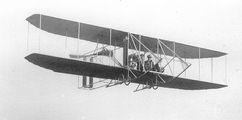
Heredity and eugenics : a course of lectures summarizing recent advances in knowledge in variation, heredity, and evolution and its relation to plant, animal and human improvement and welfare by William Ernest Castle, John Merle Coulter, Charles Benedict Davenport, Edward Murray East, William Lawrence Tower Given at the University of Chicago during the summer of 1911. Published 1912 by The University of Chicago Press,
Criminal Man, According to the Classification of Cesare Lombroso Briefly summarised by his daughter, Gina Lombroso Ferrero, with an introduction by Cesare Lombroso. New York and London
Franz Boas The Mind of Primitive Man a course of lectures delivered before the Lowell Institute, Boston, Massachusetts, USA and the National University of Mexico, 1910-1911.
1911 Carnegie Corporation of New York established by Andrew Carnegie "to promote the advancement and diffusion of knowledge and understanding," - Wikipedia. This is the grant making organisation often called the Carnegie Foundation. See 1905
17.6.1911 "The man farthest down: child labor and the sulphur mines" by Booker T. Washington in The Outlook pages 342 to 348. Then, in 1912, a book The man farthest down; a record of observation and study in Europe by Booker T. Washington (1856-1915) with Robert E. Park. "A sulphur mine in Sicily is about the nearest thing to a hell that is conceivable in my opinion."
Summer 1911 Returning from Europe, William Beers organised the Aero Club of Connecticut and served as its first vicepresident; granted a license by the club and purchased the first privately owned Wright machine; also received the first aeroplane license granted by State of Connecticut.
| 1912 |
|
"The feebleminded are a parasitic, predatory class never capable of self-support or managing their own affairs. The great majority ultimately become public charges in some form. They cause unutterable sorrow at home and are a menace to the community. Feebleminded women are invariably immoral... Every feebleminded person, especially the high-grade imbecile, is a potential criminal needing only the proper environment and opportunity for development and expression of his criminal tendencies." [Quotation taken from Segal 1967: p.43 - Hopefully correctly matched with original source]
26.6.1912 Clifford Beers and Clara Louise Jepson married in New Haven.
"One crucial issue on which Clifford and Clara Beers agreed was not to have children... Clifford felt strongly that, because of the mental illness in his family, all the Beers brothers must remain childless... As of 1912 Sam had died of a neurological ailment and two others, Clifford and Carl had had serious breakdowns from which Carl showed little sign of recovering" (Dain, N. 1980, p.164)
September 1912 The Kallikak Family: A Study in the Heredity of Feeble-Mindedness by Henry Herbert Goddard, Director of the Research Laboratory of the Training School at Vineland, New Jersey, for Feeble-minded Girls and Boys. (External link to copy on Christopher Green's site) - offline book
|
SUMMARIES OF LAWS RELATING TO THE COMMITMENT AND CARE OF THE INSANE IN THE
UNITED STATES Prepared by JOHN KOREN FOR THE NATIONAL COMMITTEE FOR MENTAL
HYGIENE
Published by: THE NATIONAL COMMITTEE FOR MENTAL HYGIENE, 50 Union Square, New York, 1912, Publication No. 3 Price: One Dollar, Postpaid [Copy on the internet was a complimentary copy apparently sent to the University of Toronto "PLEASE KEEP US ON YOUR MAILING LIST FOR EXCHANGE OF REPORTS. REPRINTS. ETC."]
President: DR. LEWELLYS F. BARKER
MEMBERS
The Chief Objects of The National Committee for Mental Hygiene are: To work for the protection of the mental health of the public; to help raise the standard of care for those threatened with mental disorder or actually ill; to promote the study of mental disorders in all their forms and relations and to disseminate knowledge concern- ing their causes, treatment and prevention; to obtain from every source reliable data regarding conditions and methods of dealing with mental disorders; to enlist the aid of the Federal Government so far as may seem desirable; to coordinate existing agencies and help organize in each State in the Union an allied, but independent Society for Mental Hygiene, similar to the existing Connecticut Society for Mental Hygiene, Inquiries regarding the work and requests for publications issued or distributed by the organization should be addressed to Clifford W. Beers, Secretary, The National Committee for Mental Hygiene, Room 1914, No. 50 Union Square, New York City, or to Dr. Thomas W. Salmon at the same address.
|
| Presidency of Woodrow Wilson (Democrat) 1913 to 1921 |
1913-1914 George Merwin Beers shown as Clerk in the Treasurer's Office of the Sheffield Scientific School, Yale University
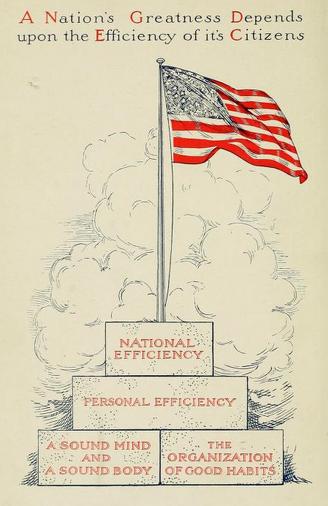
|
Hand Book of the Mental Hygiene Movement and Exhibit
Published by the National Committee for Mental Hygiene, 50 Union Square, New York City - 1913 - Illustrated - Publication No. 5. Price at Exhibits - 15 Cents or Postpaid - 20 Cents The first three items of the mental hygiene programme are "eugenics" in the forms of educating people for responsible parenthood and "legislation denying the privilege of parenthood to the manifestly unfit" - "education" including the "development of good mental habits" and a "frank attitude toward sexual matters" - and "social service" providing "assistance in securing adjustment of social and family difficulties". |
John B. Watson of Johns Hopkins University published Psychology as a Behaviorist Views it calling for mentalistic concepts of consciousness to be excluded from psychology in favour of external observations of an organism's responses to controlled stimuli.
"Psychology as the behaviorist views it is a purely objective experimental branch of natural science. Its theoretical goal is the prediction and content of behavior. I feel that behaviorism is the only consistent and logical functionalism." (Watson, J.B. 1913)
Guide to the Study of Animal Ecology by Charles Christopher Adams published New York: Macmillan. 183 pages and plates. [See Burgess 1925]
3.2.1913 16th Amendment made clear the Federal power to raise income
taxes.
March 1913
George Herbert Mead read a paper on
"The Social
Self"
at the Annual Meeting of the Western Philosophical Association,
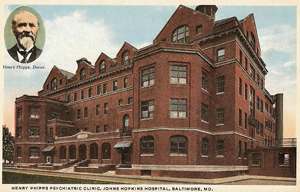
|
16.4.1913 Formal dedication of the Phipps Psychiatric Clinic - See
a hundred years of the Henry Phipps Psychiatric Clinic
(2013) and
New York Times.
1913 "The treatment of paranoic and paranoid states" by Adolf Meyer in Modern Treatmentof Nervous and Mental Diseases William Alanson White and Smith Ely Jelliffe, Lee and Febiger, 1913. |
13.5.1913 17th Amendment brought in direct election of the Senate.
July 1913 to September 1913 International Phytogeographic
Excursion in America led by
Henry C. Cowles.
Arthur George Tansley was a member of the
expedition.
[
External source]
25.8.1913 to 30.8.1913 Fourth International Congress of
School Hygiene held in Buffalo.
Clifford Beers and
Clarence Hincks
both attended. 26.8.1913 Toronto Star news report from
Buffalo, written by Hincks, praised Clifford Beers and A Mind that Found
Itself
Autumn? 1913
Joseph Ward Swain left for Europe, where he remained until 1915.
In the winters of 1913/1915 he studied in the "Section des Sciences
Religieuses" at the Ecole Pratique des Hautes Etudes, where Marcel
Mauss was chair in the 'history of religion and uncivilized peoples'. As
well as preparing a translation into English of
Emile Durkheim's (1912)
Les Formes élémentaires de la vie
religieuse: le système totémique en Australie,
Swain prepared his own dissertation on
"Hebrew and Early Christian Asceticism".
The Woman Rebel a periodical edited in New York by Margaret Sanger,
had a heading The Birth Control League, which may have been the
earliest use of this term for contraception. [See External link to an article by
Miriam Reed which explains why Margaret Sanger was opposed to compulsory
sterilisation]
The
Mental Health of the School Child: the psycho-educational clinic
in relation to child welfare, contributions to a new science of
orthophrenics and orthosomatics. Main author: J.E. Wallace Wallin.
Published: New Haven : Yale University Press, 1914.
|
1914
George William Hunter's
A Civic Biology, Presented in Problems.
Chapter 14 "Division of Labor, the Various Forms of Plants and Animals" covered evolution. It concludes: "The beginnings of civilization were long ago, but even to-day the earth is not entirely civilized... At the present time there exist upon the earth five races or varieties of man, each very different from the other in instincts, social customs, and, to an extent, in structure. These are the Ethiopian or negro type, originating in Africa; the Malay or brown race, from the islands of the Pacific; the American Indian ; the Mongolian or yellow race, including the natives of China, Japan, and the Eskimos ; and finally, the highest type of all, the Caucasians, represented by the civilized white inhabitants of Europe and America."
Hunter's five races are the same as
Blumenbach in 1775. Hunter's textbook was the
one used in Tennessee in
1925
Chapter 17 on "Heredity, Variation, Plant and Animal Breeding" called for "personal hygiene, selection of healthy mates [eugenics], and the betterment of the environment [euthenics]" as means to improve "the health and vigour of the future generations". On eugenics it (the science of being well born) it called for "freedom from germ diseases which might be handed down to the offspring", notably tuberculosis, epilepsy and feeble-mindedness. It was largely for "parasitic" families that poor houses and asylums existed. Humanity would not allow us to "kill them off" but we "have the remedy of separating the sexes in asylums or other places and in various ways preventing intermarriage and the possibilities of perpetuating such a low and degenerate race. Remedies of this sort have been tried successfully in Europe and are now meeting with success in this country." |
February 1914 Opening of the Saskatchewan Hospital, North Battleford, (Canada). Saskatchewan's first mental hospital. The second was opened in 1921. (external link)
June 1914 to April 1916 William Beers "acted as representative in Western Pennsylvania (at Erie) of Massachusetts Mutual Life Insurance Company of Springfield"
22.9.1914 "Died: Beers - Entered into rest at New Haven, Conn., Sept. 22 1914, Ida Cooke , wife of Roberts A. Beers, aged 71 years 2 months. Funeral services will be private. It is requested that no flowers be sent". New York Times 25.9.1914. "now William was displaying signs of a breakdown. According to friends this was to much for their mother, Ida Beers, who 'lost initiative and gave up her worries" about her four troubled sons. She died in 1914 at the age of seventy-one. Ninety-year-old Robert Beers followed his wife to the grave two years later" (Dain, N. 1980, p.171)
Robert Park was at the University of Chicago from 1914 to his retirement in 1933. He was lecturer in sociology until 1923 and then a professor.
November 1914 to April 1916 Volume 43 of St Nicholas. An illustrated magazine for young folks availaible in the Internet archive (offline) -
January/February 1915 Release of three hour silent film The Birth of a Nation, which had originally been called The Clansman after the novel of Thomas Dixon on which it was based. See Erin Blakemore on JSTOR Daily 4.2.2015
18.2.1915 William Beers married Julia May, daughter of John William and Julia Maria (Snell) Green, in Danbury. They had no children
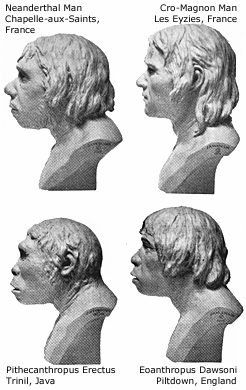
|
Reconstructions of
Java Man (Pithecanthropus),
Piltdown
Man, Neanderthal
Man,
and
Cro-Magnon Man
were created in 1914 by
Columbia University physical
anthropologist James Howard McGregor (1872-1954) for the American Museum
of Natural History.
Photographs of these appeared in Henry Fairfield Osborn's Men of the Old
Stone Age in 1915.
(Internet Archive
offline)
The four models were key display items in the museum's "Hall of the Age of Man", a project of Osborn's that was opened in 1921, having been in preparation since 1915. See also Pictorial Encyclopedia of 1952. (Text book history - strange science net) See Rutot and Mascré and 1939 |
Arthur Estabrook The Jukes in 1915, Washington, Carnegie Institute
1916 Lewis Terman published the Stanford Revision of the Binet-Simon Scale
1916 The Boston Medical and Surgical Journal (174 528/2) included a heading "After-care of mental patients".
1916 John Dewey Democracy and Education - External link to review at History of Education
Frederic Edward Clements Plant Succession - See McKenzie 1925
1916 Anselm Strauss born. See grounded theory
28.6.1916 Birth of Carl Harvey Jackins, founder of Re-evaluation Counselling. - 1952 - 1973 - Recovery and re-emergence 1977 - 1993 - He died 12.7.1999, and was succeeded by his son.
28.8.1916 Charles Wright Mills born Waco, Texas - See 1946 - 1956 - October 1957 - 1959 - 1962
1916/1917 Henry Mills Hurd (1843-1927) and others The institutional care of the insane in the United States and Canada Baltimore, Maryland. The Johns Hopkins Press, 1916-1917. Four volumes. Offline: volume 1 - volume 2 - volume 3 - volume 4 (Canada)
United States ended its neutrality and entered the First World War on the side of France, Italy, the United Kingdom, Russia etc. The USA had been providing supplies for the anti-German/Austrian forces which caused Germany to attack USA ships with U-Boats, eventually provoking the USA entry in the war on 6.4.1917 until the war's end on 11.11.1918.
Frederic Edward Clements was a researcher at the Carnegie Institution of Washington, Tucson from 1917 to 1925
| "Jazz is based on the savage musician's wonderful gift for progressive retarding and acceleration guided by his sense of 'swing'" Sun (New York) |
|
1917 "Carl's condition, diagnosed as manic-depressive by experts whom Clifford consulted, seemed to be hopeless: he did not even have lucid intervals. As for William, by 1917 he was in Bloomingdale Hospital, where Clifford visited him and was impressed with his progress, but a year later he still had not recovered" (Dain, N. 1980, p.188)
Autumn 1917 Clarence Hincks in New York, where he met Clifford Beers
Winter 1917-1918 "The Inquiry." Academics meeting in 155th Street and Broadway in New York City to prepare a brief for Woodrow Wilson about options for the postwar world. See history of the Council on Foreign Relations.
1918: Norman Dain 1980 p.208) argues that Clifford Beers' dream was of "world wide" reforms and that in 1918 "the time had come to start".
1918: Anna Harkness founded The Commonwealth Fund (external link) - See 1926 - 1931
|
26.2.1918 Clifford
Beers spoke in Toronto
27.2.1918 Toronto Globe report that the "Canadian National Committee for Mental Hygiene" was launched. 26.4.1918 Canadian Medical Association Journal June 1918; 8(6): pages 551-554. ... there was organized in Ottawa, on April 26th, a Canadian National Committee for Mental Hygiene. Dr. C. K. Clarke, the Medical Director of the Committee, stated the aims of the new organisation, which will deal with the vexed problems of crime, prostitution, pauperism, and un-employment; problems in which mental factors are of primary importance. It is hoped also that this organisation will be able through its influence to be of assistance to the country in solving some of the difficult problems connected with the return to civil life of the mentally abnormal soldiers, as well as those raised by immigration.... ... the secretary, Dr Clarence M. Hincks of Toronto University whose perception of the national necessity, and indefatigable efforts have done so much to coordinate the efforts of others ... Major Pagé, respected and beloved by French and English alike in Quebec, has long been dissatisfied with the inadequate medical examination of immigrants. On the public platform he has time and again deplored the fact that through loose methods at our ports we have been allowing thousands of insane and feeble-minded aliens to enter the Dominion....
[J. D. Pagé , M.D., MAJOR, C.A.M.C. was Chief Medical
Officer, Port
of Quebec. - Director of Immigation Port of Quebec.
We need additional hospitals for the insane, farm colonies for the feeble- minded and psychiatric departments attached to our, general hospitals. Canada would do well to build and equip several institutions similar to the Phipps Institute at Baltimore where research in connexion with mental diseases could be carried on. Our knowledge concerning many of the psychoses is indeed meagre, and if we would prevent mental breakdowns, if we would check early cases of dementia priecox for example, then more time and thought must be given by the medical profession to psychiatry, and the interest of intelligent men and women must be directed to the conservation of the mental health of the race by developing the qualities of foresight and judgement.
|
13.4.1918 New York Times "Couple Arrested in Hotel - University of Chicago Professor Found with Army Man's Wife" - "CHICAGO, April 12. - Hinton G. Clabaugh, Chief of the local bureau of the Department of Justice, today announced that his agents last night took into custody Dr. William Isaac Thomas of the Faculty of the University of Chicago, know as an authority on sociology, and a woman said to be the wife of a Texas man, now in France with General Pershing."
The arrest of William Thomas under the 1910 Act prohibiting taking women across state borders for immoral purposes had an adverse effect on his academic standing, even though he was acquitted. (See Wikipedia)
28.6.1918 The United States Chemical Warfare Service (later the Chemical Corps) officially formed, encompassing Gas Service and Chemical Service Sections. (Wikipedia). Samuel Brody, who had joined the USA Air Force where he served in both the aviation and chemical warfare service until the end of the war.
In 1918 Thorburn Brailsford Robertson (1884-1930) moved from Berkeley to the University of Toronto, Canada. At Berkley, he was succeded by Walter R. Bloor, who moved to the University of Rochester in 1922. Samuel Brody was an assistant biochemist in the University of California Medical School. In 1920 he was nominated by Walter Bloor for a position on the staff of the Department of Dairy Husbandry at the University of Missouri. The appointment was made by Professor Arthur Ragsdale, who remained as administrator and colleague to Brody for the 36 years that Brody spent on the Missouri campus.
4.7.1918 Letter from Henry Cotton to Adolf Meyer - (reproduced Honigfeld 2009 pages 12-13).
October 1918 Height of the flue epidemic in USA. Abated November. Worldwide the influenza epidemic killed up to 40 million people. Encephalitis lethargica followed it.
October 1918 Letter from Henry Cotton to Adolf Meyer - (reproduced Honigfeld 2009 pages 14-16).
October 1918 "Manitoba Survey - Conducted by the Canadian National Committee for Mental Hygiene" [Appears to be a typescript] The invitation to make the survey was received in July 1913.
7.11.1918 Birth of Billy Graham in Charlotte, North Carolina [Full name William Franklin Graham, Junior]. See 1943 - 1946 - 1952 - 1955
The Little Town, especially in its rural relationships by H. Paul Douglass (1871-1953) The Macmillan Company, New York. (External link to copy) - See McKenzie 1925
Louis Untermeyer editor: Modern American Poetry; An Introduction New York, Harcourt, Bruce and Howe, 1919. xviii introductory and 170 main pages. - Copy at Bartleby
Thursday 16.1.1919 Ratification of the 18th amendment to the United States constitution, prohibiting the manufacture, sale, or transportation of intoxicating liquors, with the amendment taking effect on 17.1.1920. (Repealed by the 21st amendment in 1933)
|
January 1919 "The Right to Marry. What can a democratic civilisation
do about heredity and child welfare?" by Adolf Meyer. Mental Hygiene
January 1919. Reprinted in the Canadian Journal of Mental Hygiene
Volume 1, No. 2 in July 1919
"If I felt that I had to conceal the fact that my own mother had two attacks of melancholia from which she recovered, I should thereby tacitly corroborate the false efforts at concealment of many others who could not conceal the fact of mental diseases in their family if they tried. "Why am I able to speak freely to my own progeny about it? Because I have a conviction based on experience and on facts that many a mental disorder is much less ignominious than more than fifty per cent, of the other diseases for which people have to get treatment; that many a nervous or mental disorder is the result of struggling honestly but unwis. ely; that many a former patient becomes a wiser element of the community when restored than the luckier, possibly thoughtless, fellow."
|
Tuesday 4.2.1919 International Committee for Mental Hygiene (ICMH) formed by key members of the American and Canadian Committees for Mental Hygiene, and others, including Clifford Beers [and Clarence Hinks?]. (Dain, N. 1980) p.209). Planned an international network of national mental health associations devoted to "the protection of the insane". La Ligue Française de Prophylaxie et d'Hygiène Mentale formed independently in France in January 1921 - Ralph Noble communicated between France and Clifford Beers. (Beers to Noble 19.5.1922 - Noble to Beers 8.6.1922) - La Ligue Nationale Belge d'Hygiène mentale formed 1922 - National Council for Mental Hygiene in Great Britain formed on the American model in 1922 - See 11.12.1922 - See Clifford and Clara's tour of Europe 1923 - la Lega italiana per l'igiene mentale and Der deutsche Verband der Psychohygiene formed in 1924 - Paris 1927 - The International Committee was reorganised in 1930 with the First International Congress of Mental Hygiene.
Sunday 9.3.1919 Birth of Douglas Merritte to Arvilla Merritte. Douglas was probably "Little Albert"
April 1919 Canadian Journal of Mental Hygiene (offline)
August 1919 John Edgar Hoover, previously head of the Alien Enemy Bureau, became head of the Bureau of Investigation's new General Intelligence Division established by Attorney General A. Mitchell Palmer. The Intelligence Division compiled files on more than 60,000 known or suspected radicals which were the basis of the "Palmer Raids" on 7.11.1919 and in January 1920. After the November raid, 249 aliens were deported to Russia. The January (and subsequent) raids resulted in the arrest of several thousand communists and suspected communists. (Mandelbaum 1964 p.97)
Sunday 14.9.1919 The New York Times refered to "personality disorders" which "produce a greater degree of ineffectiveness than insanity". This is the Oxford Dictionary's frist recorded use of the term personality disorder.
Autumn? 1919 Rosalie Rayner graduated from Vassar and came to Johns Hopkins as a post-graduate student. She collaborated with Watson on the Little Albert study of conditioned emotional responses in 1920.

|
1920 The Flapper a 1920 American silent comedy film
in which 16-year-old Genevieve 'Ginger' King gets into trouble
|
1920 [United States] National Bureau of Economic Research founded
1920
Talcott Parsons went to Amherst College, Massachusetts with
an interest in biology and medicine. However, he became interested in
economics and, like Max Weber, sought to study this in its full social
context. From 1924, he
studied in Europe. In 1926 he returned
to Amherst College to teach economics
February 1920
John B. Watson and
Rosalie Rayner of Johns Hopkins
University published
Conditioned Emotional
Reactions in which they reported their pioneer behaviour
modification experiments making baby
Albert B terrified of a tame rat,
other animals, and cuddly toys by banging a steel bar behind him.
(Journal of Experimental Psychology Volume 3. issue 1 February 1920,
pages 1-14)
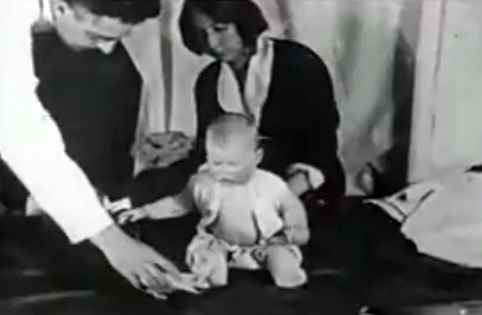
"Abstract: If the theory advanced by Watson and Morgan (in 'Emotional Reactions and Psychological Experimentation,' American Journal of Psychology, April, 1917, Vol. 28, pp. 163-174) to the effect that in infancy the original emotional reaction patterns are few, consisting so far as observed of fear, rage and love, then there must be some simple method by means of which the range of stimuli which can call out these emotions and their compounds is greatly increased. Otherwise, complexity in adult response could not be accounted for. These authors without adequate experimental evidence advanced the view that this range was increased by means of conditioned reflex factors. It was suggested there that the early home life of the child furnishes a laboratory situation for establishing conditioned emotional responses. The present authors present their experimental findings of conditioned fear responses in a male infant beginning at 11 months of age." Mary Ickes Watson discovered her husband was sexually involved with Rosalie (who he later married) and divorced him. The divorce ended Watson's academic career and he subsequently wrote his psychology in a more popular style. "The immense popularity of behaviourism among the general public in America in the 1920s and 1930s may in part be attributable to the appeal of Watson's popular writings" (Broadhurst, P.L. 1967) - Curt Richter succeded Watson and the Psychology Laboratory was renamed the Psychobiology laboratory. [Curt Richter had married Phyllis Greenacre in the spring of 1920] April 1920 Mr and Mrs Watson separate as a result of his affair with Rosalie Rayner. October 1920 Watson asked to resign. 24.12.1920 The Watsons' divorce finalised. 31.12.1920 Rosalie marries John. |
26.8.1920 Women gain a vote under the 19th amendment to the United
States constitution
Autumn 1920 Carl Beers by now in the Connecticut State Hospital at
Middletown, where Clifford occasionally visited him. George took care of
Carl's interests.
"William was also still hospitalised, but his wife presumably
took care of his affairs" (Dain, N.
1980,
p.200)
15.4.1920
Thomas Szasz born Budapest, Hungary.
Died 8.9.2012 (aged 92)
20.12.1920
"The future of mineralogy in America" by
Edward H. Kraus of the University of Michigan. Address of the retiring
president, read at the Chicago Meeting of the Mineralogical Society of
America, Published American Mineralogist Volume 6, pages 23-34, 1921
Louis Untermeyer editor: Modern British Poetry New York,
Harcourt, Bruce and Howe, 1920. xxv introductory and 234 main pages.
Contains biographical sketches of authors. "This collection is obviously a
companion volume to
Modern American Poetry ... Modern British poetry covers the
same period (from about 1870 to 1920), follows the same chronological
scheme, but it is more amplified and goes into far greater detail than its
predecessor." (Introduction, quoted Library of Congress catalogue) -
Copy at Bartleby - A combined volume was
brought out in 1922 - The
title of the second to fifth editions was "Modern British Poetry: A
Critical Anthology, edited by Louis Untermeyer". From 1950 the words "A
Critical Anthology" were dropped. The second revised edition
was in
1925, the third in
1930, the fourth in
1936, the fifth in
1942.
| Presidency of Warren G. Harding (Republican) 1921 to 1923 |
Introduction to the Science of Sociology, by Robert Ezra Park and Ernest W. Burgess - Howard Odum says that "Park and Burgess" became the "best known pair of American sociologists in the textbook world". It became the "Bible of Sociology" for Chicago graduates - See dictionary ecology
Warder Clyde Allee became assistant professor of zoology at the University of Chicago in 1921. From 1925 to 1927 he was dean in the colleges and from 1928 to 1950: professor of zoology. Keith Benson (2002) links his name to that of Robert Park (above), arguing that, under Allee
"the Chicago school of ecology... began to emphasize studies of community structure ... adopting a sociological spin... sociologist, Thomas [Robert] Park, brought to ecology his own bias for studying the role of community structure. The influence of Park was noticeable and immediate, especially in Allee's early animal aggregation work, published in 1927 and 1931 (Allee, 1927, Allee, 1931). Missing was the traditional emphasis on physical factors, now replaced by the interactions of the organisms making up the community. Then Thorsten Gislen published his influential work in what he called "marine sociology", noting the plant-animal communities characteristic of marine community structure (Gislen, 1930, 1931). Gislen first characterized the nature of the physical environment he was investigating, then provided the ‘‘associations’’ that inhabited that specific environment."
1921 Journalist Edward W. Scripps founded Science Service with the goal of keeping the public informed of scientific achievements. California zoologist William Emerson Ritter was the first scientific director. Now known as the Society for Science and the Public. Its Science News-Letter was renamed Science News in 1966 and has been online since 1996. (source)
4.2.1921 Betty Naomi Goldstein born. Later Betty Friedan. See 17.2.1963 - 10.3.1968 - Died 4.2.2006.
|
Herbert Hoover's's research groups
Herbert Hoover was United States Secretary of Commerce from 5.3.1921 to 21.8.1928. Then President of the United States from 1929 to 1933. Believing in the power of scientific data and data-gathering, he promoted research into business and industrial topics. 1921 Hoover appointed a committee of the President's Conference on Unemployment which, in 1923 produced a study of business cycles and unemployment. The aim was to stabilize the economy and help prevent a recurrence of the post- World War one business slump of 1920-1921. 1929 Publication of Recent Economic Changes in the United States As President, he initiated the sister study, Recent Social Trends in the United States. This was not published until 1933. "the most comprehensive mirror that the 1920s held up to itself" (source) 1929 President Hoover instituted a Research Commission on Urban Problems. One of the participants was Roderick McKenzie - (source: Italian Wikipedia) William Fielding Ogburn was research director of President Herbert Hoover's Committee on Social Trends from 1930 to 1933. |
1921 American Medico-Psychological Association became the American Psychiatric Association
17.6.1921 Sophie Brody gave birth to Eugene Bloor Brody. Shown in the 1940 Census as born in Missouri. "Dr Brody was born and raised in an academic environment in Columbia, Missouri". He obtained a master's degree in experimental psychology in 1941 from the University of Missouri - He met Marian Holen - marriage - army - January 1948 - 1957: Maryland Medical School - In 1950s and 1960s on boards of Maryland and National Mental Health Associations - 1967 to death: Editor-in-Chief Journal of Nervous and Mental Disease - 22.11.1980 - 1981: President World Federation for Mental Health - 1981: Edith Morgan - Judi Chamberlin - Kerstin Nilsson - 1983WFMH - From 1983: voluntary Secretary General World Federation for Mental Health - Died Saturday 13.3.2010
See Walter Bloor - Ragsdale AC, and Samuel Brody's "The effect of temperature on the percentage of fat in milk. A first report." was published in the Journal of Dairy Science in 1922
This picture is without a dust cover. Another bookseller describes a copy as "pale gray paper covered boards, dull green cloth backstrap, with decorative green and blind-stamping design to front cover, in a dull gray paper dustwrapper printed in green". The price asked for that copy was $425 (£218..23) |
June 1921?
Charlotte Mew's Saturday Market published by Macmillan
in the United States. Click on the cover to go to a bookseller's
web page that says:
"First edition. Sara Teasdale's copy with her signature, dated June
1921, on the front flyleaf. She signs using her married name, Sara
Teasdale Filsinger. Teasdale married Ernst B. Filsinger in 1914, and moved
with him to New York in 1916. They divorced in 1929. Tragically, both
Teasdale and English poet, Charlotte Mew, committed suicide. Mew, a
Bloomsbury native with a family history of mental illness, went into a
severe depression following the death of her sister. She took her life in
1928 by drinking disinfectant. After suffering from a severe case of
pneumonia which left her an invalid, Teasdale overdosed on barbiturates in
1933"
Restricted to just 250 sets of imported sheets of the UK (Poetry Bookshop) edition - Consequently now expensive
|
|
Introductory blurb:
Saturday Market by Charlotte Mew
In Saturday Market there's eggs a plenty
But there is more than this in Saturday Market; there is tragedy, just as in the great market of the world. The poems of this young Englishwoman are Saturday market poems: there are farmers, there are forest roads, quiet country houses and country children, and through the beauty and dancing rhyme of their simple stories runs one and another tragedy which cuts through with a hint of drama. |
23.7.1921 Louis Untermeyer's review of Saturday Market in The New York Evening Post. The article was expanded to become an introductory essay to Charlotte Mew's poems in the 1925 edition of Modern British Poetry [Falkenberg 2005 p.36]
22.9.1921 - 22.10.1921 The Second International Exhibition of
Eugenics held in the American Museum of Natural History, New York. The logo
of the exhibition declared that "Eugenics is the self-direction of human
evolution. Like a tree, eugenics draws its materials from many sources and
organises them into a harmonious unity". The sources listed are:

(in alphabetical order) anatomy, anthropology, anthropometry, archaeology,
biography, biology, economics, ethnology, education, genealogy, genetics,
geography, geology, history, law, medicine, mental testing,
physiology, politics, psychiatry, psychology, religion,
sociology,
statistics,
surgery,
Exhibit depicting the states with compulsory sterilisation legislation in the United States in 1921.

December 1921 Opening of the Saskatchewan Hospital, North Battleford, (Weyburn). Saskatchewan's second mental hospital. The first was opened in 1914.
John Dewey: Human Nature and Conduct. See also (external link) 1922: Walter Lippmann and John Dewey debate the role of citizens in democracy
Two anthologies with poems by Charlotte Mew
Louis Untermeyer editor: Modern
American and
British Poetry Published
New York, Harcourt, Brace and Company [copyright 1922]
xxv introductory, 371 pages. - See
Charlotte
Mew - See
1923. There was a revised and enlarged
edition in 1928 (496 pages) In 1944 a "Modern American and British poetry
... by Louis Untermeyer" was brought out as two volumes (American and
British) for the American Armed Forces. It was a "combined edition of the
sixth revision of Modern American poetry and fifth revision of Modern
British poetry"
The Bookman Anthology of Verse 1922, edited by John Chipman Farrar
(1896-
), New York, George H. Doran company. The preface is dated
September 1922. The Library of Congress Catalogue says there is a
series, copyright 1922 onwards, finishing 1927. "1922-1927 Bound volumes:
Inventory in progress"
About 1922 Marian Elizabeth Holen born Illinois. See
1940 census -
She
earned an undergraduate degree in psychology from the University of
Missouri, where she met her future husband, Dr.
Eugene B. Brody, who was to
become chairman of psychiatry at the University of Maryland School of
Medicine.
She moved east to be closer to her fiance and became an instructor for a
Navy program at
Brown University in Providence, R.I., where she also
received a master's degree in experimental psychology. -
marriage -
January 1948 -
Died March
2008
11.6.1922
Erving Goffman born in Manville, Canada. See
Angelica
1929
-
Shetland Islands 1949-1951
-
Angelica 1950 -
Paris 1951 -
Chicago 1952 -
married Angelica -
11.12.1922 "International Mental Hygiene" revised verbatim report of
the informal talks at the luncheon-meeting of the Organising Committee of
the
International Committee for Mental Hygiene (in process of
formation), New York City. Attendance included
Auguste Ley from Belgium as
well as representatives of the USA, Canada and Brazil. Auguste Ley said
that if
Clifford Beers could
"come to Europe as General Secretary of the Organizing
Committee to speak to various people it would be very important for the
preparation of the Congress and also increase interest in the International
Committee's plan"
(Dain, N.
1980,
pp 219 and 369)
"Margaret Mabon Henderson, ex-'16, is now living at 17 Whittinghame Drive, Glasgow, Scotland. Her husband is a doctor and she is the proud mother of two children. (Bryn Mawr Bulletin January 1922)
| Presidency of Calvin Coolidge (Republican) 1923 to 1929 |
1923
(George) Sylvester Viereck interviewed Sigmund Freud. He also interviewed
Adolph Hitler "a widely read. thoughtful and self-made man" who, "if he
lived, would make history"
The neighborhood : a study of local life in the city of Columbus,
Ohio by
Roderick Duncan McKenzie published by the
University of Chicago Press. [Published also as his Ph.D. thesis
by the University of Chicago in
1921 "Reprinted from the
American Journal of Sociology, volume 27,
September, 1921; November, 1921; January, 1922; March, 1922; and May,
1922."
Lynn Thorndike, (1882-1965) A History of Magic and Experimental
Science Volumes 1 and 2, The first thirteen centuries of our era
[See
Park, R.E. 1925/7
1923: Advertisers find a
media to work in: In Advertising and Selling, by 150
advertising and sales executives edited by Noble T. Praigg (Garden
City, New York: Doubleday, Page and company for the Associated Advertising
Clubs of the World. 483 pages) S. M. Fechheimer provided an article "Class
appeal in mass-media" and wrote about "The several million readers of a big
mass medium". G. Snow in the same book (page 240) said "Mass media
represents the most economical way of getting the story over the new and
wider market in the least time."
17.6.1923
Sophie Brody gave
birth to
Arnold Jason Brody. Her two sons were
Eugene and Arnold. Sophie's psychosis began in their childhood.
She was at home in the
1940 Census.
Louis Untermeyer editor: Modern American and British
Poetry. With suggestions for study by Olive Ely Hart Published New
York, Harcourt, Brace and Company [copyright 1923]
xxv introductory pages, 403 main pages, Bibliography: p.399.
2.5.1923 to July 1923
Clifford and Clara Beers tour of Europe: Gheel in Belgium -
Paris - London. See
International Committee for Mental Hygiene
|
Monday 19.11.1923 Time magazine
article about
Clifford Beers
Mental Hygiene Fifteen years ago there was no organized effort in any nation to combat mental disease and defect. Conditions in institutions for the insane and feeble-minded had advanced little since the time when "Bedlam" was first contracted from "St. Mary's of Bethlehem," an English asylum. The idea of forestalling and preventing the development of mental disorders was a novelty. About 1900 a young man not long out of the university had an attack of amnesia (loss of memory occurring in some forms of insanity) and wandered about the country" [appears to be a Time magazine fantasy.] suffering harrowing vicissitudes for three years. In time he recovered and returned to his family and to normal life. But he retained a vivid memory of his experiences, set them down in a manuscript, resolved to turn them to account for human welfare. William James and a few other far-sighted gentlemen encouraged him. The young man was Clifford Whittingham Beers; the book, his graphic autobiography, A Mind That Found Itself. In 1908 Mr Beers founded the Connecticut Society for Mental Hygiene, the first organization of its kind. Similar bodies have since been initiated in more than 20 states. Mr. Beers has devoted his life and resources to the movement, has raised hundreds of thousands of dollars. In 1909 he founded the National Committee for Mental Hygiene, of which he has been Secretary ever since. He was instrumental in starting a correlative agency in Canada. Other countries followed suit. Four years ago, Mr. Beers took the first step toward world-wide cooperation in mental hygiene. In 1925 in Manhattan will be held the First International Congress on Mental Hygiene. The participation of the great European countries has been promised and Mr Beers has secured the personal approval of King Albert of Belgium, Cardinal Mercier, Georges Clemenceau (once a physician in a Paris insane hospital), David Lloyd George, Sir Eric Geddes, Sir Maurice Craig (of Guy's Hospital, London) and other leaders. Dr. William H. Welch, Dean of the School of Hygiene and Public Health of Johns Hopkins University, Baltimore, was elected President of the National Committee for Mental Hygiene at its annual meeting last week, succeeding Dr. Walter B. James, professor of clinical medicine at Columbia. Dr. Welch is the most distinguished pathologist and bacteriologist in the United States. Now 73 years old, he has been since his interne years at old Bellevue one of the most versatile and influential figures in the American and world public health movements. Among other officers of the Mental Hygiene Committee are Dr. Charles W. Eliot, President Emeritus of Harvard, and Dr. Bernard Sachs, of New York, Vice Presidents, and Otto T. Bannard (Manhattan banker), Treasurer. The Medical Director is Dr. Frankwood E. Williams, successor to Dr. Thomas W. Salmon, who is now Medical Adviser. The Committee's chief accomplishments : 1) Collection and standardization of statistics from state institutions throughout the U. S. 2) Publication of a high-class Journal, Mental Hygiene. 3) Establishment, in cooperation with the Commonwealth Fund and other agencies, of a "Joint Committee on Prevention of Delinquency," which conducts child clinics and demonstrations in Dallas, St. Louis, St. Paul, Minneapolis and other cities, as well as in foreign countries. [REST OF ARTICLE NOT AVAILABLE] |
Institution Statistics According to Official Figures On January 1, 1923, patients in public institutions of the United States numbered: insane hospitals, 290,457; psychopathic wards of general hospitals, 1,842; institutions for feeble minded, 46,722; institutions for epileptics, 9,153. In addition there were confined in federal penitentiaries, 2,010; in state prisons, reformatories, etc., 19,518; in county and city jails, workhouses, etc., 147,489; in institutions for juvenile delinquents, 29,385. Rather disconcerting figures have been assembled by H. M. Pollock, statistician to the New York State Hospital Commission. From 1880 to 1920 the number of insane patients of institutions in the whole country has increased from 40,942 to 232,680 and the ratio of patients in institutions to 100,000 of populations from 81.6 to 220.1. This, of course, does not mean a proportionate increase in insanity as a much larger percentage of insane patients now is confined in institutions... One important principle is that the rate of mental disease is greater among inferior stocks than among superior stocks. This is difficult to demonstrate by census statistics which take no account of the quality of family stock. The general birth rate in late years has markedly declined and it is generally believed that the decline has been greatest among superior stocks. If this trend continues, the people of the future will become more and more susceptible to mental disease... The rates of dementia praecox and manic-depressive psychosis are both increasing, and if nothing is discovered to curb these diseases, while new discoveries continue to be made in the realm of bodily disease, then mental disease will supersede physical disease as the paramount social problem in the not distant future. |
10.5.1924 John Edgar Hoover promoted to Director of the Bureau of Investigation in succession to William J. Burns.
1925 An Act prohibiting the teaching of the Evolution Theory in all the Universities, Normals and all other public schools of Tennessee, which are supported in whole or in part by the public school funds of the State, and to provide penalties for the violations thereof. (external link - archive
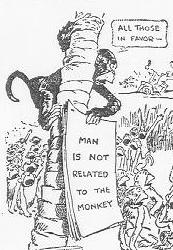
|
July 1925 Trial of John Stopes for teaching evolution in
contravention of the Tennessee Act. The book he used was the required
school text book: George William Hunter's
A Civic Biology, Presented in Problems.
In
The Last Temptation (April
2018 Michael Gerson discusses the Scope's trial in relation to
Evangelical thought in the United States from the 19th century to 2018.
The cartoon (part) by Carey Orr (1890-1967) was published in the Chicago Times |
The City by Robert E. Park, Ernest W. Burgess, Roderick D. McKenzie and Louis Wirth. published by University of Chicago Press. See City.
1925 Herbert Blumer teaching and studying at Chicago
Frederic Edward Clements was a researcher at the Coastal Laboratory, Santa Barbara, California from 1925
Louis Untermeyer editor: Modern American Poetry; A Critical Anthology Third Revised Edition. New York, Harcourt, Bruce and Howe, 1925. xxix introductory and 621 main pages. "A selected bibliography": p. 603.
Louis Untermeyer editor: Modern British Poetry; A Critical Anthology Revised and Enlarged Edition. New York, Harcourt, Bruce and Howe, 1925. xx introductory and 388 main pages. "A companion volume to Modern American Poetry" (Preface).
Encyclopedia Britannica article on "mass production" over the name of Henry Ford (although he did not write it). The term began to supersede "Fordism" as the popular term for the process using assembly lines. (external link). The term Fordism regained currency through the writings of the Italian marxist Gramsci
1926 Waldo Semon and the B.F. Goodrich Company developed a method in to plasticize PVC by blending it with various additives. The result was a more flexible and more easily processed material that soon achieved widespread commercial use. (Wikipedia)
1926 George Catlin published his doctoral thesis: The Science and Method of Politics
1926 Robert Gillespie Robert Dick Gillespie returned to Scotland from the Phipps Clinic where he had been studying under Adolf Meyer
18.1.1926 Letter from Adolf Meyer to Joseph E. Raycroft reporting a meeting of himself, Henry Cotton and Phyllis Greenacre at which Phyllis Greenacre's report on Henry Cotton's work was discussed - (reproduced Honigfeld 2009 pages 149-151).
January 1927: Paul Robeson's singing tour of Kansas and Ohio
Eugenic legislation upheld as constitutional by USA Supreme Court in 1927.
1927
Rockland State Hospital
constructed. Opened 1928
It was about 1927 that
Burrhus
Skinner (1904-1990) read
Pavlov
and
Watson. (external
link). He went to
Harvard to study
psychology in autumn
1928 and, whilst there, invented
Skinner's Box.
1927
George Herbert Mead's course in Social Psychology on which
students based
Mind, Self and Society
1927 Robert Morrison MacIver professor of social science at
Columbia University
1927 John Dewey
The Public and its Problems
Contemporary Sociological
Theories
by Pitirim
Sorokin published.
1928 Margaret Mead's Coming of Age in Samoa, followed by
Growing Up In New Guinea 1930, The Changing Culture of an
Indian Tribe 1932, Sex and Temperament in Three Primitive
Societies 1935, And Keep Your Powder Dry: An Anthropologist
Looks at America 1942 and Male and Female 1949
George Eaton Simpson taught at Temple
University from 1928 to 1934, and at Pennsylvania State University from
1934 to 1947,
Robert Merton was at Temple
University from 1927 to
1931 and acted as Simpson's research assistant.
George Peter
Murdock was a member of
Yale University from 1928 to 1960.
His Ph.D. from Yale was in the field of Sociology, as Yale at that time did
not yet have a Department of Anthropology. He was chair of the Department
of Anthropology from 1938 to 1960.
IBM card In 1928, IBM redesigned its punch card to hold 80 columns,
almost twice what it previously held. This became known as the "IBM card"
and that phrase was frequently used for punched cards that put data into
machines.
1928 "Thirty-five Years of Psychiatry in the United States and
Our Present Outlook" by
Adolf Meyer
American Journal of Psychiatry 8: pp 1-31.
1928 William
Beers "obliged to give up active work on account of ill health".
He had been "engaged in investment
securities business in Danbury, Connecticut, and New Haven and
acted as broker for several New York firms".
1928 Canada: Alberta introduced the Sexual Sterilization Act which
promoted the surgical sterilization of "mental defectives". This policy
remained in effect in Alberta until
1972 and in British Columbia until
1973. See
Leilani Muir 1996
6.2.1928
Wallace Carothers, a gifted organic chemist who suffered from depression,
began working at the DuPont Experimental Station where he sought to create
large
polymers. The main eventual commercial result of his work was
Nylon, which DuPont began to produce in 1938. Wallace Carothers had killed
himself on 28.4.1937. See
British Nylon Spinners
-
nylon day 1940 -
When the
Nylons Bloom Again -
nylon day 1946 -
1949
13.6.1928 Birth of John Forbes Nash, Junior. See
1998 -
2001 -
24.5.1928 The American Foundation for Mental Hygiene was
incorporated in Delaware. Its function was to receive and disburse funds
for projects of the National Committee for Mental Hygiene. The first major
project was the International Congress on Mental Hygiene, planned for
April 1929. The congress actually was delayed until May 1930.
18.4.1928
Howard Becker: "I was born in Chicago, Illinois on April
18, 1928. (I will just mention that this is the date of the Great
Earthquake and Fire in San Francisco in 1906. Make what you will of that.)"
(Howie's page). See 1966
"Whose Side are We
On?" - 1996?
Howie's Home Page
- publications
20.9.1928 Release of Helen Kane (1904-1966) single I wanna be
loved by you from the musical Good Boy
"'Capitalism' in Recent German Literature: Sombert and Weber" by
Talcott Parsons published in The Journal of Political
Economy in December
1928 and January 1929
"I wanna be loved by you
just you and nobody else but you
I wanna be loved by you - alone.
Boo boo bee doo"
| Presidency of Herbert Hoover (Republican) 1929 to 1933 |
1929 to 1932 13 studies financially supported by The Payne Fund to examine movies and their effects on children. See 1933.
1.1.1929 Angelica Schuyler Choate born Boston, USA
15.1.1929 Birth of Martin Luther King. See 28.8.1963 - June 1965 - 4.4.1967 - 4.4.1968
|
20.4.1929
LONDON CHILD GUIDANCE CLINIC
Letter from Barry C. Smith (New York) Director of the Commonwealth Fund published in the Journal of the American Medical Association "In THE JOURNAL, February 16, in the London letter, is a statement with the subheading "Psychoanalysis for Children" which refers to a child guidance clinic about to be established in London which the Commonwealth Fund is supporting. This statement is a duplicate of an article which appeared in an English newspaper and is entirely erroneous in its statement that children are to be psychoanalyzed in this clinic. The child guidance clinic in London will be conducted along precisely the same lines as similar activities financed by the Commonwealth Fund in this country. Psychoanalysis will have no part in it. . . .
|
14.6.1929 Betty, later Falkenberg, born Jacksonville, Florida.
October 1929 Wall Street Crash. Bank and stockmarket crashes precede the Great Depression in the USA and economic recession world wide.
First volume Carl Murchison (editor)'s A History of Psychology in Autobiography New York: Russell and Russell, 1930
Talcott Parsons' translation of The Protestant Ethic and the Spirit of Capitalism
1930 Barney Glaser born. See grounded theory
1930 Martha Weinman Lear born born in Boston. She later graduated from Boston University. See 10.3.1968
About 1930 Priscilla Allen born. See President's Commission on Mental Health
March 1930 A Code to Govern the Making of Talking, Synchronized and Silent Motion Pictures adopted by The Association of Motion Picture Producers, Inc. and The Motion Picture Producers and Distributors of America, Inc.
5.5.1930 to 10.5.1930: First International Congress on Mental Hygiene, Washington DC. [See Lord. J.R. American Psychiatry] - The second congress was held in Paris in 1937
27.8.1930 William Cooke Beers took his own life at Bloomingdale Hospital where he had been a patient for over two years. Buried in Wooster Cemetry. Survived by (second) wife, son by first wife, and three brothers George, Carl and Clifford. (Yale obituary)

|
8.9.1930 First Blondie Boopadoop comic strip by Murat Bernard "Chic" Young (1901-1973). One of his flighty flappers she dated playboy Dagwood Bumstead, son of the millionaire, J. Bolling Bumstead, a railroad magnate, along with several other boyfriends. (Sara W. Duke - Library of Congress) - Blondie reveals her urge to seduce her boyfriends' fathers |
|
| Blondie married and took up mental health counselling in 1950 |
Herbert Blumer was the secretary treasurer of the American Sociological Association from 1930 to 1935.
1930 Samuel Stouffer PhD in sociology from the University of Chicago: "An Experimental Comparison of Statistical and Case-History Methods of Attitude Research".
1930 George Herbert Mead's course in Social Psychology on which students based Mind, Self and Society
December 1930 Over three days, George Herbert Mead gave the Carus Lectures at a meeting of the American Philosophical Association in Berkeley
External link Dewey criticises the practices of progressive educators
Torsten Gislen, 1930. Epibiosis of the Gullman fjord. 1. A Study in Marine Sociology
|
"A trout rising to a fly gets hooked on a line and finds
himself unable to swim about freely, he begins a fight
which results in struggles and splashes and sometimes an
escape. Often, of course, the situation is too tough for
him."
"In the same way the human being struggles with his environment and with the hooks that catch him. Sometimes he masters his difficulties; sometimes they are too much for him. His struggles are all that the world sees and it usually misunderstands them. It is hard for a free fish to understand what is happening to a hooked one." [Opening lines of?] The Human Mind by Karl A. Menninger, M.D. New York: Alfred A. Knopf. 1930 - See the Fish pamphlet 1973 |
James Truslow Adams in The Epic of America coined the term "the American Dream" for
""that dream of a land in which life should be better and richer and fuller for everyone, with opportunity for each according to ability or achievement"
Sunday 26.4.1931. Death of George Herbert Mead - John Dewey's obituary. This is most of what Dewey said at Mead's funeral in Chicago on 30.4.1931
1931 Sociology department established at Harvard University under Pitirim Sorokin. Talcott Parsons became an instructor at Harvard. Robert Merton was a postgraduate student and teaching assistant from 1933 to 1936 and then a tutor and instructor from 1936 to 1939.
$61,000 spent on the "English Mental Hygiene Program" by the Commonwealth Fund for 1931-1932. This rose to a peak of $86,6000 in 1933-1934, remained between $52,000 and $68.000 for the rest of the 1930s, but declined rapidly during the Second World War. (Stewart, J. 9.2009, p.413
1931 "George had been depressed and anxious in recent years and had been in communication with various psychiatrists and heads of metal hospitals; his wife also suffered from 'nervous exhaustion'. Yale University granted George a leave in 1931 so that Louise and he could travel, the ancient remedy for melancholia. In George's case it was ineffectual; he remained depressed and talked of suicide" (Dain, N. 1980, p.262)
3.2.1932 Stuart Hall born, Kingston, Jamaica. His father was a business executive with the United Fruit Company. His mother (previously Hopwood) "was brought up in a beautiful house on the hill, above a small estate". Her relatives included a doctor and a lawyer trained in England. Her uncle was "local white" (almost white) and that side of the family were fairer and of a higher class than his father's side. His grandfather on his father's side kept a drugstore in a poor village. His family was "ethnically very mixed- African, East Indian, Portuguese, Jewish". Stuart was a student at Jamaica College. Stuart moved to England in 1951 on a Rhodes Scholarship.
23.6.1932 George Beers body found in the Housatonic River, near Stockbridge, Massachusetts. He had killed himself. [George had been supporting Carl, financially, in hospital. After his death, their cousin Caroline took over the support]
15.7.1932 Leonard Roy Frank born, New York. See Wikipedia
24.9.1932 in Brooklyn, New York, Julius and Rosalie Bernstein Goldenberg had a daughter, Joanne, She graduated in anthropology and English literature from American University, Washington, D.C. and also studied at the Universities of London and Colorado. From 1948 through 1951, she was treated for schizophrenia by the psychoanalyst Frieda Fromm-Reichmann. The two women planned to write a book, but Frieda died suddenly death in 1957. In 1955, Joanne married another analyst, Albert Greenberg. Her first book, The King's Persons (1963), was is a historical novel exploring the causes of the conflict resulting in the 12th century massacre of Jews in York. It was followed by I Never Promised You a Rose Garden (1964) published as "Hannah Green".
|
Presidency of Franklin D. Roosevelt (Democrat) 1933 to 1945 |
1933 Vinyl Composition Tile (VCT), invented in the 1930s, was first presented in the Vinylite House at Chicago's 1933 Century of Progress Exposition.
Motion Pictures and Youth. The Payne Fund Studies included Movies and Conduct by Herbert Blumer and Movies, Delinquency, and Crime by Blumer and Philip Hauser.
The Metropolitan Community by Roderick McKenzie published
9.5.1933 New York Times "Dr H.A. Cotton, Psychiatrist, Dead - Internationally Known for Pioneer Methods in the Treatment of Insane - FOUND A PHYSICAL BASIS - Traced Many Mental Disorders to Teeth While Head of New Jersey State Hospital at Trenton" (article reproduced Honigfeld 2009 page 171).
3.9.1933 Birth of Loren Richard Mosher (died 10.7.2004). See Wikipedia - England 1996 - England 1999
November 1933 George Simpson's preface (New York City) to his translation of Emile Durkheim's Division of Labour in Society. The second major work by Durkheim to be translated into English. The translator almost suggests it was the first:
"This volume I hope marks the beginning of interest in this country in Durkheim's work... my friend and former teacher, Mr George E. G. Catlin, is now supervising a translation of Les Règles de la méthode sociologique... Dr Talcott Parsons... is writing an essay on Durkheim.."
Catlin's Rules was published in 1938. Simpson does not mention The Elementary Forms of Religious Life, translated in 1915, but does say
"The reputation of Durkheim in this country has suffered from the criticism of anthropologists, but that is because he was not an anthropologist; he made great contributions to anthropology, but it was not his métier" (p.xi)
George Simpson was an undergraduate at Cornell University, where he was taught by George Edward Gordon Catlin. Simpson began his translation of the Division of Labour in Society whilst still an undergraduate. He taught at Columbia University. The translation of Durkheim into English was carried out in the United States, but some of those involved were British, or born in Britain.
1934 Mind, Self and Society from the standpoint of a social behaviorist by George Herbert Mead published. Based on 1927 and 1930 lectures.
1934 Ruth Benedict Patterns of Culture New York: Houghton
Mifflin
Antionio Gramsci's notes on
America and Fordism - But Americans could not read them until
long after the second world war
1934
Institute for Social Research established in exile on the campus
of
Columbia University in New York by
Horkheimer,
Marcuse, Friederich Pollock and others.
Adorno joined them in 1938.
1934 Test results, some printed some typewritten, of trials of
phenothiazines as insecticides. See
1937.
May 1934: (George) Sylvester Viereck's speech to 20,000 "Friends of
the New Germany", at Madison Square Gardens", urging them to support
National Socialism "without embracing anti-Semitism"
August 1934 Alcatraz became a civilian prison.
13.6.1934 By an amendment to the
Code to Govern the Making of
Talking, Synchronized and Silent Motion Pictures the
Production Code
Administration was established and all films released on or after
1.7.1934 were required to obtain a certificate of approval before
being released.
|
12.11.1934
Charles Manson born. See
psychiatrists
-
Sharon Tate murder -
Manson sanity -
verdict -
1974 book -
mentally ill?
"Born in Kentucky in 1934, Charles Manson is the man responsible for the serial killings of Sharon Tate and her friends. In 1967, after spending most of his adult life in prison, Manson moved to the San Francisco area in California and gathered a group of followers, which he referred to as "the family." Inspired by the Beatles song "Helter Skelter" -- a song actually about an amusement park ride -- he became convinced of an impending race war and nuclear assault. It was August 9, 1969 when four Family members, Tex Watson, Patricia Krenwinkel, Susan Atkins, and Linda Kasabian, entered the house at 10050 Cielo Drive in Beverly Hills, California and killed Sharon Tate, pregnant wife of Roman Polanski, along with four friends, Abigail Folger, Jay Sebring, Voytek Frykowski and Steven Parent. Manson himself wasn't present for the killings. Manson was convicted of conspiracy to commit murder on January 15, 1971." Original Wikipedia entry 3.3.2002 |
In the Savoy Ballroom in Harlem, New York, sometime in 1935, Frankie Manning (21) flipped Frieda Washington over his back in the first Lindy Hop air flip.
American Sociological Society established its own journal: The American Sociological Review
1935 External link: Dewey advocates cooperative intelligence and a socialized economy in Liberalism and Social Action
1935 Newton Baker questioned the Carnegie Corporation's policy of using its funds related to racial education for supporting "Negro" schools in the South and not on eduction in Northern cities. He suggested a research project. (source) See 1938 and Shari Cohen 2004.
30.6.1935 Bureau of Investigation renamed the Federal Bureau of Investigation
November 1935 Death of Carl Beers in the Connecticut State Hospital at Middletown, where he had been for twenty-three years.
William LLoyd Warner "American Class and Caste" American Journal of Sociology 42 - Wikipedia - Argued that immigrants were absorbed into citizenship through the melting pot of assimilation into USA society. This did not happen with the former slave populations of black African-Americans because of the persistence of attitudes from the slave period. Black African-Americans are in a caste situation rather than a class situation.
1936 George Eaton Simpson The Negro in the Philadelphia Press. [Philadelphia], "An analysis of Negro material published in the Philadelphia record, Public ledger, Evening bulletin and Philadelphia inquirer during 1908-1932."
1936 Harold Lasswell Politics; who gets what, when, how?
Franz Neumann, legal adviser to the German SDP, was arrested in April 1933, escaped in May and then worked at the London School of Economics. In 1936 he came to the United States and joined the Institute of Social Research, then affiliated with Columbia University. Herbert Marcuse published Reason and Revolution - Hegel and the Rise of Social Theory in 1941. Neumann published Behemoth in 1942. After the war, Neumann joined the faculty of Columbia University (Department of Government). He died in a car accident in Switzerland on 2.9.1954
Birth of role theory? Ralph Linton's The Study of Man includes chapter eight "Status and Role" which Erving Goffman traces role theory back to.
Herbert Blumer's "Social attitudes and non-symbolic interaction." in the Journal of Educational Psychology
Robert E. Park's "Human ecology" published in the American Journal of Sociology. See dictionary
Louis Untermeyer editor: Modern British Poetry; A Critical
Anthology Fourth Revised Edition. New York, Harcourt, Bruce and
Howe, 1925. xxii introductory and 549 main pages. "A companion volume to
... Modern American Poetry" (Preface).
11.5.1936 Peter Roger Breggin born. See
Psychosurgery
1972 -
Electroshock 1979
- Psychiatric Drugs
1983 -
Asylum Summer 1987
-
tapes at Edale
1987 -
Asylum April 1989 -
Asylum July
1989 -
Toxic Psychiatry 1991 -
Asylum Winter
1991/1992 -
Asylum Spring 1992 -
London 10.4.1992
-
Visit to England March
1993 -
Asylum 1994 1 -
website -
wikipedia
14.9.1936
Walter Jackson Freeman 2 (1895-1972) and James Winston Watts (1904-1994)
performed the first
prefrontal lobotomy in the United States on housewife Alice Hood
Hammatt of Topeka, Kansas. In November 1936 they published
"Prefrontal Lobotomy in Agitated Depression: Report of a Case" in
Medical Annals of the District of Columbia 5 (1936): pages 326-328.
See
Guide to the Walter Freeman and James Watts papers at
the George Washington University.
Talcott Parsons'
The Structure of Social
Action. Unlike Sorokin's
Contemporary Sociological Theories, this was
entirely about European theorists.
1937 Lewis Terman and Maud Merrill created two parallel forms of the
Stanford-Binet: Form L (for Lewis) and Form M (for Maud).
January 1937 United States Department of Agriculture Bureau of
Entomology and Plant Quarantine published The use of
phenothiazine
as an insecticide by L. E. Smith, Division of Insecticide
Investigations
(offline). Tests results from
1934 on reported.
February 1937 First issue of the journal Sociometry - Became
Social Psychology Quarterly in 1977
|
June 1937
Man and Society: A Substantive
Introduction to the Social Sciences (805 pages) edited by
Emerson Peter Schmidt of
Minnesota University.
Herbert Blumer's "Social Psychology" chapter in Man and Society: A Substantive Introduction to the Social Science introduced the term symbolic interactionism. |
1937 to 1962 Winfred Overholser, M.D. (fifth) superintendent of St Elizabeth's Hospital, Washington, DC. In his period, Saint Elizabeths expanded treatments to include psychodrama, art, and dance therapy. He also developed a chaplaincy service "that became a model for other psychiatric hospitals". See 1955.
7.11.1937 "One of the earliest self-help groups, Recovery Inc. was founded at the Neuropsychiatric Institute of the University of Illinois Research and Education Hospitals on November 7, 1937, by the late Abraham A. Low, M.D." (source) - See Chamberlin 1990
Euthanasia Society of America founded.
Skinner's first book: The Behavior of Organisms
Psychological Foundations of Personality - A Guide for Students and Teachers by Louis P. Thorpe, Ph.D. Associate Professor of Education and Director of the Psychological Clinic, The University of Southern California First edition seventh impression. Mcgraw-hill Book Company, New York and London 1938 includes sentence "Investigators..have attempted to ascertain the degree of relationship obtaining between glandular disturbances and personality disorders" (page 338).
Fredrick Keppel, president of the Carnegie Corporation invited Swedish economist Karl Gunnar Myrdal (6.12.1898 - 17.5.1987) to "lead a comprehensive study of the Negro in the United States". Keppel was seeking research help guide Corporation grantmaking beyond its established involvement in black education in the South of the USA. - See An American Dilemma 1944 and Shari Cohen 2004.
February 1938 First number of Psychiatry : journal for the operational statement of interpersonal relations. Washington DC : William Alanson White Psychiatric Foundation. Volumes 11-12 subtitled: "journal for the operational statement of interpersonal relations"; volumess 13-48 subtitled: "journal for the study of interpersonal processes"; volume 49 onwards subtitled: "interpersonal and biological processes".
26.5.1938 By 191 to 41 votes, United States House of Representatives
authorized the appointment of a special committee to
conduct an investigation of
(2) the diffusion within the United States of subversive and un-American
propaganda that is instigated from foreign countries or of a domestic
origin and attacks the principle of the form of government as guaranteed by
the Constitution, and
(3) all other questions in relations thereto that would aid Congress in any
necessary remedial legislation."
"(1) the extent, character, and object of un-American propaganda activities
in the United States,
|
October 1938
Robert Merton:
"Social Structure and Anomie":
American Sociological Review volume 3 number 5 pages 672-682.
See Margaret Evans'
article
See
social structure
"There is a growing body of evidence, though none of it is clearly conclusive, to the effect that our class structure is becoming rigidified and that vertical mobility is declining." Included the first appearance of Merton's famous table of possible adaptations to cultural strain.
|
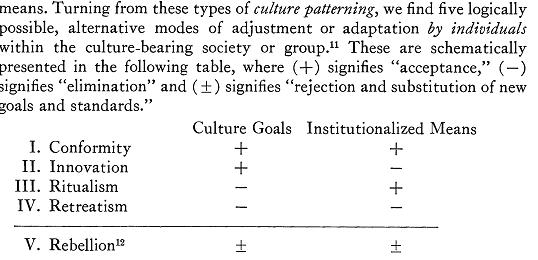
|
1938 Durkheim's The Rules of Sociological Method (Eighth edition) translated by Sarah A. Solovay and John H. Mueller, and edited (with an introduction) by George Edward Gordon Catlin. Published Chicago, 1938, University of Chicago Sociological Series. Republished in 1950 by the Free Press. This was the third translation of Durkheim's major works into English.
|
1939
Neanderthal in a hat might pass for normal in New York.
Picture by Carleton Coon. Coon argued artists' impressions depend very much on superficial things like dress and haircut. (See Southampton and anonymous lecture notes) |
|
Robert Merton taught at Tulane University in New Orleans from 1939 to 1941.
"Before I went to Chicago as a graduate student in 1939, I had been directed to the writings of Dewey, Thomas and Park by Floyd House, who had been a student of Park in the early twenties. House never mentioned Mead that I can recollect. But within a week of my arrival at Chicago, I was studying Mead's Mind, Self and Society, directed to it by Herbert Blumer, who as a young instructor had taught Mead's class after Mead's unexpected death" (Anslam Strauss 1956) |
1939 Harry Alpert's Emile Durkheim and his Sociology New York : Columbia University Press.
1939 Smith Klein and French's first major campaign advertising Benzedrine for "mild depression". Benzedrine is the trademark for their preparation of phenylisopropylamine or amphetamine. source
23.1.1939 Birth of Edward Verne Roberts. See 1980 - 1983 - Died 14.3.1995 - Wikipedia
May/June 1939 Clifford Beers resigned from his duties on the National Committee for Mental Hygiene. 8.6.1939 Clifford Beers signed voluntary admission papers to the Butler Hospital, Providence, Rhode Island.
June 1939 The ship St Louis refused permission to land Jewish refugees from Germany in Cuba. She sailed for Florida. The refugees were refused entry to the USA and Canada. Germany used the ship as a propaganda exercise to demonstrate the international undesirability of Jews. Heroically, the ship's German Captain, Gustav Schroeder, stalled on the voyage back, refusing to return to Germany until he had found a safe haven for his Jewish passengers in European countries. (Jewish Virtual Library - Wikipedia - Righteous among the nations - Holocaust Memorial Museum - Katherine Baxter Local Preacher Girl)
2.8.1939 Einstein to Roosevelt: "In the course of the last four months it has been made probable - through the work of Joliot in France as well as Fermi and Szilárd in America - that it may become possible to set up a nuclear chain reaction in a large mass of uranium, by which vast amounts of power and large quantities of new radium-like elements would be generated. Now it appears almost certain that this could be achieved in the immediate future. This new phenomenon would also lead to the construction of bombs, and it is conceivable - though much less certain - that extremely powerful bombs of a new type may thus be constructed. A single bomb of this type, carried by boat and exploded in a port, might very well destroy the whole port together with some of the surrounding territory. However, such bombs might very well prove to be too heavy for transportation by air."
1940 USA Census:
Sophie Brody. Age at Time of Census: 50
Estimated Birth Year: 1890 Birth Location: California
Residence: Ward 3, Columbia, Columbia Township, Boone, MO
Relationship to Head of Household: Wife
Samuel Brody
Samuel Brody 50 yrs, Male
Eugene Brody
18 yrs, Male
Arnold Brody 16 yrs, Male
Sophie Brody. Born 6.10.1890. Died April 1987 (96 years old)
Last known residence Swampscott, Essex County, MA 01907.
Dr. Arnold Jason Brody, Medical Director, The Greenbrier Clinic White Sulphur Springs, West Virginia. Born 1923
Marian Holen in the 1940 Census
[Marian Elizabeth Holen]
Age 18, born abt 1922 [Died March 2008]
Birthplace Illinois
Home in 1940
2404 Isabella
Evanston,
Cook, Illinois
Household Members
Head Oscar Holen 52
Wife Lillian Holen 52
Daughter Marian Holen 18
Daughter Dorothy Holen 16
Tuesday 5.3.1940 The Bend Bulletin, Bend, Oregon, Tuesday afternoon. "Washington. Government chemists have developed and proved a new drug, known as phenothiazine, which will kill insects without injury to warm-blooded animals, including man"
|
Phenothiazine is a synthesised (man-made) compound.
It was forst prepared in 1883 by the German chemist, [Heinrich] August Bernthsen (29.8.1855 - 26.11.1931). Bernthsen was engaged in structural studies on Lauth's violet and methylene blue, and phenothiazine became the parent compound of the thiazine dyes. (source) The newspaper cutting says it was discovered in 1894. This could refer to the word entering English in M'Gowan's Bernthsen of 1894. In 1893 (England and France) and 1894 (USA) Bernthsen and Paul Julius patented "a new blue dye which fixes itself on cotton goods and the like from a boiling neutral or alkaline bath without the aid of a mordant". Phenothiazine was discovered to have insecticidal properties in 1934 - See 1937. 1954/1955 Chlorpromazine |
15.5.1940 Well publicised "Nylon Day" in which nylon stockings were sold for $1.15 a pair at stores throughout the USA. About 4 million pairs sold out within two days.
1941 The search for a way to produce penicillin in quantities that could be used for medicine moved from Oxford, England, to Peoria, Illinois in the United States. The search was on for moulds. A local woman, Mary Hunt, brought in a mouldy cantaloupe from a fruit market. This doubled the yield. By 1943 penicillin was being used succesfully on war wounds.
George Peter Murdock 1941 in Sociometry 4 p.146 "The nuclear or individual family, consisting of father, mother, and children, is universal; no exceptions were found in our 220 societies". - See 1949
1941 Paul Lazarsfeld and Robert Merton appointed to Columbia University. (Merton appointed professor 1947). Appointments "made in part to resolve differences between MacIver and Lynd over the Department's future direction. Lazarsfeld and Merton were expected to sustain Lynd's and MacIver's respective emphases on empirical and theoretical styles of sociology. Instead, they found common ground in research inspired by "middle-range theory" - testable propositions, derived from fundamental theory, addressing observable phenomena. Their collaboration modernized Giddings' founding vision and pervasively influenced the discipline all over the world." (source)
Herbert Blumer editor of the American Journal of Sociology from 1941 to 1952.
17.2.1941 Henry Luce Life magazine editorial calling for the
creation of the first great American Century:
It is in this spirit that all of us are called, each to his own measure of
capacity, and each in the widest horizon of his vision, to create
the first great American Century."
April 1941? [1939?] Peter Viereck's article "But I'm a conservative"
in The Atlantic Monthly argued for a "new conservatism" to counter
the "storm of authoritarianism" in Europe and moral relativism and
materialism in the USA. He claimed communism and nazism were utopian and
would sanction the murder of oppositions (as in anti-semitism) and that
liberalism shared a naive belief in progress and humanity's essential
goodness.
Peter Viereck Metapolitics: from the Romantics to Hitler. This
argued that Nazism grew out of the Romantic German nationalist movements of
the nineteenth century, rather than the authoritarian Prussian tradition.
8.10.1941 Birth of Jesse Louis Burns who became Jesse Louis Jackson
- 1984:
Rainbow Coalition
Sunday 7.12.1941 Pearl Harbour. Japan and the USA enter the
war.
"Throughout the
17th century and the
18th century and the
19th century, this continent teemed with manifold projects and
magnificent purposes. Above them all and weaving them all together into the
most exciting flag of all the world and of all history was the triumphal
purpose of freedom.
|
8.12.1941 All Star Comics Number 8 December - January. "A Supermn
Publication" - "Lets Go! USA. Keep 'em Flying"
"In a world torn by the hatreds and fears of men appears a woman ... with a hundred times the agility and strength of our best male athletes... She appears as though from nowhere to avenge an injustice or right a wrong! As lovely as Aphrodite - As wise as Athena - With the speed of Mercury and the strength of Hercules - She is known only as Wonder Woman..." |
Talcott Parsons took over from Pitirim Sorokin as head of the Department of Sociology at Harvard University in 1942. He established an interdisciplinary Department of Social relations (1946)
Robert Merton was associate director of Columbia University's Bureau of Applied Social Research from 1942 to 1971. The director was Paul Lazarsfeld.
1942 Susan Estelle (Su) Budd born
"In February 1942, Major General James C. Magee, The Surgeon General, following the example of the previous wartime Surgeon General, established a separate Neuropsychiatry Branch. Colonel Madigan was appointed chief of the new branch. This branch, however, unlike the independent division of World War 1, was one of several branches under the Professional Service Division". (source)
22.6.1942 The Pledge of Allegiance became official: "I pledge allegiance to the Flag of the United States of America, and to the Republic for which it stands: one Nation indivisible, With Liberty and Justice for all". However, in 1943. the United States Supreme Court ruled that school children could not be forced to recite the Pledge as part of their daily routine.
Music based christian evangelism to "youth" started in the United States - where the war was abroad - and was reflected in Britain when the bombs had stopped. In the United States, live radio was used as part of mass gatherings.
19.4.1943 David Reville born in Brantford, Ontario. - A psychiatric inmate 1965 - A founder of the Ontario Mental Patients Association in 1977. See Jim Ward 1980 - History of Madness 2004 - October 2007 Scotland - cyberspace - mad studies 2011 - Scotland 2011 - Lancashire 2011
9.7.1943 Death of Clifford Beers in Providence, Rhode Island
11.1.1943 Letter from Michael Obolensky to Elizabeth Schermerhorn.
26.7.1943 Copyright on "When the Nylons Bloom Again" from Early to Bed with George Marion junior and Fats Waller.
4.12.1943 Presidential address of George Andrew Lundberg to the 38th Annual Meeting of the American Sociological Society, held in New York: "Sociologists and the Peace". Available online - offline
An American Dilemma: The Negro Problem and Modern Democracy by Gunnar Myrdal, with the assistance of Richard Sterner and Arnold Rose. Published New York and London, by Harper and Brothers in two volumes, paged continuously with 1483 pages. . Volume one: "The Negro in a White Nation". Volume two: "The Negro Social Structure" - Wikipedia - See 1938 - 2004 -
1944 The first official meeting of WANA (We Are Not Alone) is held at the Third Street YMCA in Manhattan. The meeting grew from a self-help group that started at Rockland State Hospital. It was organised by Michael Obolensky, a former patient, and Elizabeth Schermerhorn, a former volunteer. Ten members and Ms. Schermerhorn were present. (source) - "The origins of Fountain House lie in the idea which inspired a small group of people back in the early 1940s - the belief that people with mental illness are capable of helping each other. In a little more than sixty years, that vision has yielded a supportive community that annually helps some 1300 people in New York City and is the inspiration for 55,000 people in Fountain House model programs around the world."
September 1944 Eugene Brody received his MD from Harvard. The following day he marrried Marian Holen. The following day she returned to Brown University to complete her Masters degree and he began psychiatric training at Yale. New Haven, Connecticut. Marian Brody enrolled as a doctoral student at Yale. She worked simultaneously as a psychologist in a clinic in New Haven for servicemen returning from World War Two combat. Eugene is quoted as saying (obituary) "She spoke of the trouble the servicemen experienced after the obliteration of civilised rules for living they experienced in combat. She was impressed by the residual damage done to these young men in World War Two." Her work was interrupted in 1946 when her husband was assigned to interview Nazi prisoners of the International Military Tribunal at Nuremberg, Germany. She asked to join him, but was told that that it might take a year for the Army to arrange transportation. She booked passage from New York to France on one of the first ships to be converted to passenger use after the war. She arrived at Le Havre, France, in November 1946 during one of the coldest winters on record. "She recognized me from the tender ferrying her to the dock by the light of fires burning in oil drums to furnish some heat," her husband recalled, adding that he had spent the night in a room above a bar waiting for her. Once in Nuremberg, she applied for a job at the prison. She was told that no women were allowed to work there for fear that they might be taken hostage by imprisoned Nazis, her husband recalled. The Brodys returned to New Haven, where they were affiliated with Yale until moving to Baltimore in 1957. As a volunteer for 25 years in Baltimore, Mrs. Brody was a mainstay of WICS, Women in Community Service, interviewing disadvantaged post- adolescent girls applying for their programs and managing the data processing operations, her husband said.
30.10.1944 Birth of Judi Ross, known as Judi Chamberlin in New York - marriage 1965 - hospitalisations 1966 - Dr Jonas 1967 - left husband 1971 - Mental Patients Liberation Project 1971 - Vancouver Emotional Emergency Centre 1974 - On Our Own 1978 - See UK and world index - Eugene Brody and World Federation for Mental Health - - 2009 - 2010 - Wikipedia
|
Presidency of Harry S. Truman (Democrat) 1945 to 1953 |
|
Ernest Watson Burgess and Harvey J. Locke, 1945/1950:
The Family from
Institution to Companionship.
"The modern democratic family has the following characteristics: 1) freedom of choice of a mate on the basis of romance, companionship, compatibility, and common interests; 2) independence from their parents of the young people after marriage; 3) the assumption of equality of husband and wife; 4) decisions reached by discussion between husband and wife in which children participate increasingly with advancing age; and 5) the maximum of freedom for its members consistent with the achieving of family objectives." (pages 21-22)
"The basic thesis of this book is that the family has been in historical times in transition from an institution with family behaviour controlled by the mores public opinion, and law to a companionship with family behaviour arising from the mutual affection and consensus of its members" (pages 26-27) History of family types developed from Die Familie (1912). Large patriarchal type most closely approximates institutional family. Burgess and Locke say "The Industrial Revolution paved the way for the breakdown of the small patriarchal family (p.21). They quote (p.29) Spencer (1876) in relation to the transition.
"The modern American family residing in the apartment house areas of the city approximates most nearly the ideal type of companionship family" page 27)
|
23.1.1945 Edward Celler said in a speech "The Committee to Investigate Un-American Activities is now a standing investigatory committee with power to initiate legislation".
[See Records of the U.S. House of Representatives - Record Group 233 - Records of the House Un-American Activities Committee, 1945-1969 (renamed the) House Internal Security Committee, 1969-1976 - Prepared by Charles E. Schamel, Center for Legislative Archives National Archives and Records Administration July 1995
April 1945 Kingsley Davis and Wilbert E. Moore, "Some Principles of Social Stratification", American Sociological Review volume 10 pages 242-249. First page - (External summary). "Social inequality is...an unconsciously evolved device by which societies ensure that the most important positions are conscientiously filled by the most qualified persons".
5.29am 16.7.1945 United States Army made the first detonation of a nuclear weapon.
6.8.1945 and 9.8.1945
USA dropped
atomic bombs on Japan to bring the war to an end before Soviet
troops arrived.
Summer 1945
Walden Two written
|
Postmodernism, or, the Cultural Logic of Late Capitalism (1991) by
Fredric Jameson
Late capitalism
Mandel suggests that the basic new technological prerequisites third stage (long wave) of capitalism (late capitalism) were available by the end of World War Two, which also had the effect of reorganising international relations, decolonising the colonies, and laying the groundwork for the emergence of a new economic world system. The economic preparation of postmodernism or late capitalism began in the 1950s, after the wartime shortages of consumer goods and spare parts had been made up, and new products and new technologies (not least those of the media) could be pioneered. Culturally, however, the precondition is to be found in the enormous social and psychological transformations of the 1960s, which swept so much of tradition away on the level of mentalités. The psychic habitus of the new age demands the absolute break, strengthened by a generational rupture, achieved more properly in the 1960s The Americanocentrism of my own particular account is justified only to the degree that it was the brief "American century" (1945-1973) that constituted the hothouse, or forcing ground, of the new system, while the development of the cultural forms of Postmodernism may be said to be the first specifically North American global style. Both levels, infrastructure and superstructures - the economic system and the cultural "structure of feeling" - somehow crystallised in the great shock of the crises of 1973 (the oil crisis, the end of the international gold standard, for all intents and purposes the end of the great wave of "wars of national -xxliberation" and the beginning of the end of traditional communism), which, now that the dust clouds have rolled away, disclose the existence, already in place, of a strange new landscape. |
9.9.1945 Janet Foner born. "a psychiatric survivor with a master's degree, M.P.S.SC., in community psychology". From 1973 on Janet helped develop the movement of psychiatric survivors within the International Re-evaluation Counselling Communities. Co-drafted the Mental Health System Survivors policy statement. Co-founded and co-coordinated Support Coalition from 1990 to 2000. Co-wrote the policy booklet, "What's Wrong with the Mental Health System and What Can Be Done About It". In 1992 became the International Liberation Reference Person for Mental Health System Survivors. "Currently International Liberation Reference Person for Mental Health Liberation." - See Mind Freedom
|
1.11.1945 First edition of Ebony. See
Newseum
|
Tuesday 4.12.1945 Madison Square Garden rally of the Independent
Citizens Committee of The Arts, Sciences and Professions attended by Julian
Huxley, who gave, as an example of a beneficial use of atomic energy, the
idea of exploding atomic bombs above the northern polar regions to raise
the temperature of the Arctic Ocean and warm the entire climate of the
northern temperate zone.
Fifty Books That Significantly Shaped Public Opinion Research, 1946-1995
(Copyright 2002. American Association for Public Opinion
Research) begins with
Mass Persuasion: The Social Psychology of a War Bond
Drive by
Robert Merton, Fiske and Curtis in 1946. - See
public opinion
"Since the mid-1940s, ethylene dichloride has been used
principally as a raw material in the synthesis of other compounds,
particularly
vinyl chloride, methyl chloroform, trichloroethylene,
perchloroethylene, vinylidene chloride, and ethyleneamines".
"Ethylene dichloride is manufactured in the United States by
direct chlorination of ethylene, oxychlorination of ethylene, or a
combination of these methods."
(source). [Chlorine derived from salt. Ethylene
derived from petroleum]
1946 Benjamin Spock's
The Common Sense Book of Baby and Child Care
.
This edition had 58 printings and was the best selling new title issued in
the USA since best-seller lists began in 1895
|
permissive
1946 American Journal of Psychology 1 416/2: "The counselor creates a warm and permissive atmosphere in which the individual is free to bring out any attitudes and feelings which he may have." - See 1956 - 2.11.1960 - 1968 - 1971 - 1971 |
USA National Mental Health Act passed
1946 Eugene Brody's work at Yale was interrupted in 1946, when he became a captain in the Army Medical Corps, serving as chief of the neuropsychiatric service in hospitals of the European command. He was also the psychiatric consultant to the International Military Tribunal in Nuremberg.
1946 C. Wright Mills working at Columbia University
17.1.1946 The first transorbital lobotomy. See (external link) sound portraits which includes interviews with patients. This website was drawn to my attention by John Conneely in New Zealand. Until 1945 Freeman and Watts lobotomies were performed by Watts who was a trained neurosurgeon. Freeman developed a procedure using a modified ice- pick which was "trans orbital" (entry above the eye) that would not require the assistance of a neurosurgeon. Using this procedure, he performed ten operations without telling Watts. The practice led to the break-up of their partnership. [See Scientology]
14.2.1946 ENIAC (Electronic Numerical Integrator And Computer) the first USA valve computer "unveiled" at the University of Pennsylvania. It had 18,000 valves, but could not store a program. In April 1946 a 300,000 dollar deposit was given to Presper Eckert and John Mauchly, the team that invented the ENIAC, for research into a new computer called the UNIVAC (Universal Automatic Computer). The first was The first was delivered on 14.6.1951. [See Scientology]
14.2.1946 Well publicised "Nylon Day" in which nylon stockings were relaunched after the war. Nylon "riots" as people sruggled for pairs.
12.9.1946 Pamela Jane Edwards [later Pamela Jane Edwards Kammer] born Los Angeles, California. Mother's maiden name Prevo. A comunity architect. She lived in and adapted squated premises in Camden, England in the early 1970s. This was used as the first base for the Mental Patients Union. Listed on MPU records as from Studio City, California. An Associate Member of the American Institute of Architects. On her return to the USA she worked for Frank Lloyd Wright, Junior (1890 - 1978) and his son Eric Lloyd Wright (1929-). She maintained correspondence with MPU members in London into the 1990s. She died (in the USA) 19.1.2007.

|
Actress Jeanne Crain Taking a Bubble Bath in a Scene from the Film
"Maggie", Life 30.9.1946
The actress in foam image gained a mention by Roland Barthes in his 1954 psychoanalysis of soap powders and detergents
November 1946 to February 1947: A series of lectures at the Institute for Religious and Social Studies in New York leading to the publication of The Communication of Ideas: A Series of Addresses in 1948 |
1947 The Free Press (publisher), based at Glencoe, Illinois, founded
by Jeremiah Kaplan (1926-1993) and Charles Liebman. It was devoted to
sociology and religion titles. In 1960 it was sold and then merged into
Macmillan Publishers (USA)
1947
George Andrew Lundberg's Can Science Save Us?
New York: Longmans, Green and Co.
1947 The Association for Computing Machinery (ACM) founded. See
Wikipedia
January 1947 to 17.5.1947
Simone De Beauvoir's first visit to the United States.
Second Red Scare (1947-1957)
(Wikipedia).
March 1947
President Truman signed Executive Order 9835, creating the
"Federal Employees Loyalty Program" which set up political-loyalty review
boards to determine the
"Americanism" of Federal Government employees.
Joe McCarthy elected senator for Wisconsin in
1946, serving as senator from 1.3.1947. See
1950 (when he became famous)
-
1953 -
1954 - Died in
office as senator
2.5.1957.
anticommunist political repression of the early Cold War
"Red Scare" used in book titles
1955 (about an
earlier one) and 1964

|
The first Bulletin of the Atomic Scientists of Chicago was published on 10.12.1945. |
11.9.1947 to 14.9.1947 Simone De Beauvoir's second visit: To Chicago to see Nelson Algren
20.10.1947 Un-American Activities Committee opened hearings into alleged communist infiltration of the motion picture industry.
Movie Snake Pit with Olivia de Havilland premiered. Film had such impact that 26 states passed new legislation regarding state mental hospitals. (Kathleen Benoun)
1948 Skinner's behaviourist fantasy utopia Walden Two. Although named, patriotically, after Thoreau's Walden, this is an account of collective "cultural engineering" of a community of 1,000 people using experimental scientific methods in a way reminiscent of Robert Owen, Whilst Owen constructed his first communities and then fantasised about them, Skinner fantasised about his communities first. Others have tried to put them into practice.
"The all absorbing concern of the outside world... is what happens to the family in Walden Two,,, The significant history of our times..is the story of the growing weakness of the family. The decline of the home as a medium for perpetuating a culture, the struggle for equality for women, including the right to select professions other than housewife or nursemaid, the extraordinary consequences of birth control and the practical separation of sex and parenthood, the social recognition of divorce, the critical issue of blood relationship or race - all these are parts of the same field". (end of chapter 16, start of chapter 17)
1948 Harold Lasswell "The structure and function of communication in society" may contain the phrase "Who (says) What (to) Whom (in) What Channel (with) What Effect"
1948 Robert Merton wrote "Manifest and Latent Functions" (chapter one Social Theory and Social Structure) as "an effort to systematise the principle assumptions and conceptions of the slowly evolving theory of functional analysis in sociology" (Biographical postscript 1957, p. 82) The chapter included a comparison of "The ideological orientations" of "Dialectical Materialism" (Marx and Engels) and "Functional Analysis".
1948
Norbert Wiener published Cybernetics, or, Control and
Communication in the Animal and the Machine
"We have decided to call the entire field of control and communication theory, whether in the machine or in the animal, by the name Cybernetics, which we form from the Greek [word for] steersman . we also wish to refer to the fact that the steering engines of a ship are indeed one of the earliest and best developed forms of feed-back mechanisms."
" It has long been clear to me that the modern ultra-rapid computing machine was in principle an ideal central nervous system to an apparatus for automatic control; and that its input and output need not be in the form of numbers or diagrams but might very well be, respectively, the readings of artificial sense organs, such as photoelectric cells or thermometers, and the performance of motors or solenoids. With the aid of strain gauges or similar agencies to read the performance of these motor organs and to report, to "feed back," to the central control system as an artificial kinesthetic sense, we are already in a position to construct artificial machines of almost any degree of elaborateness of performance. Long before Nagasaki and the public awareness of the atomic bomb, it had occurred to me that we were here in the presence of another social potentiality of unheard-of importance for good and for evil. The automatic factory and the assembly line without human agents are only so far ahead of us as is limited by our willingness to put such a degree of effort into their engineering as was spent, for example, in the development of the technique of radar in the Second World War.
Pages 26-29 in the 1948/1961 edition
|
January 1948 Marian and Eugene Brody return to New Haven and Yale
28.1.1948 The Permanent Subcommittee on Investigations authorised by Senate Resolution 189. Senator Joseph R. McCarthy chaired this from 1953 to 1954,
|
|
9.4.1948 Assassination of Jorge Eliécer Gaita the popular Liberal Party presidential candidate in Colombia leading to the Bogotazo rioting that lasted for ten hours and killed some 5,000 people. . Start of La Violencia (The Violence), a ten-year (1948-1958) period of civil war between the Colombian Conservative Party and the Colombian Liberal Party. |
3.8.1948 Alger Hiss denounced before the House Committee on Un-American Activities.
Autumn 1948 Talcott Parsons and others from the Department of Social Relations at Harvard University discuss funding for a "stocktaking" of "theoretical resources" with officials of the Carnegie Corporation of New York. - See 1949 and 1951 and after
1948 Oliver Cromwell Cox Caste, Class and Race: A Study in Social Dynamics -
December 1948 Presidential Address, "Race Contacts and the Social Structure" delivered in Chicago by Edward Franklin Frazier, the first African American President of the American Sociological Society - Wikipedia
Newfoundland ceased being a British Colonial Protectorate
structural-functional analysis:
1949
Robert King Merton's
Social Theory and Social Structure.
Towards the codification of theory and research. Sought a
functional analysis in sociolgy
...the description of the participants (and on-lookers) is in structural
terms, that is, in terms of locating these people in their inter- connected
social statuses.
1949 The first edition of Ruth Nanda Anshen's
The Family: Its Function and Destiny includes articles by
Ralph Linton - Maurice Hindus - Ruth Benedict -
Talcott Parsons and
Robert Merton. Maurice
Hindus's article on The Russsian Family was replaced in the second edition
(1959) by one written by a writer less sympathetic to the USSR.
Robert Merton's description of American culture on the model of an
"American Dream" appears to have been written in 1949, although
the concepts date back to 1938. See
Merton
1949
Samuel Stouffer Studies in Social Psychology in World War
Two: The American Soldier Princeton University Press.
20.1.1949
President Truman's
inaugural address (second term) setting out the United States
opposition to the "false philosophy" of "communism". The negative cold war
theme was set against a positive message about the USA "program for peace
and freedom". He uses the concept of "development" as progressive ideal,
saying the "United States is pre-eminent among nations in the development
of industrial and scientific techniques" and continuing "we should make
available to peace-loving peoples the benefits of our store of technical
knowledge in order to help them realize their aspirations for a better
life".
29.3.1949 University of California President Sproul proposes that
University of California employees, including faculty, be required to swear
to a new Oath stating that they are not members of the Communist party. The
University of California Board of Regents approved Sproul's proposal.
(timeline and documents)
14.4.1949
National Institute for Mental Health formally established
"Research is conducted at a central campus in Bethesda, Maryland, as well
as being funded throughout the United States"
(Wikipedia)
5.5.1949 Alger Hiss forced to resign as president of the Carnegie
Endowment for International Peace,
September 1949 to January 1950 Groups meeting at
Harvard on
the
theoretical stock-take.
George Peter
Murdock: Social Structure New York: Macmillan. 1949
"The family is a social group characterised by common residence, economic co-operation and reproduction. It includes adults of both sexes, at least two of whom maintain a socially approved sexual relationship and one or more children, own or adopted, of the sexually cohabiting adults."
"The nuclear family is a universal human social grouping. Either as the sole prevailing form of the family or as the basic unit from which more complex forms compounded, it exists as a distinct and strongly functional group in every society." |
November 1949 Howard Madison Parshley (1884-1953) begans translating Simone De Beauvoir's Le deuxième sexe into English. Published 23.2.1953. He was also translating a French zoology book on mammals into English.
December 1949 Goffman's field work in the Shetland Islands to May 1951,
|
Senator Joe McCarthy re-elected by a huge majority, "having exploited the general uneasiness felt after the treason trials of Nunn May, Fuchs and Alger Hiss by accusing the State Department of harbouring 205 prominent Communists." (Chambers Biographical Dictionary) |
1950 United States revoked Paul Robeson's passport. He was unable to leave the United States for eight years.
1950 The Lonely Crowd: A study of the changing American character by David Riesman in collaboration with Reuel Denney and Nathan Glazer. Yale University. Studies in national policy, 3.
1950 Robert Freed Bales Interaction Process Analysis: A Method for the Study of Small Groups. Cambridge, Massachusetts - (external link)
1950 Canadian mathematician Albert Tucker gave the name and interpretation "prisoner's dilemma" to Merrill M. Flood and Melvin Dresher's model of cooperation and conflict, resulting in the most well-known game theoretic paradox. (Wikipedia)
January 1950 First issue of the A.P.A. Mental Hospital Service Bulletin (which later became Psychiatric Services. The ninth issue, in September 1950, contained an article "Comics used for mental health education" - See Blondie 1950
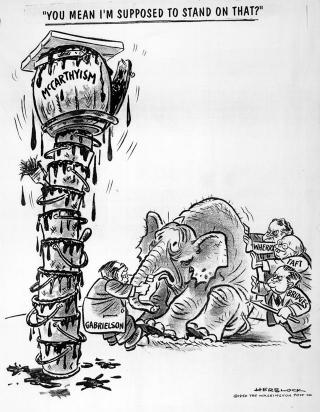
|
Joe McCarthy gives his name to McCarthyism
29.3.1950 Herbert Block (Herblock) cartoon on the Washington Post in which Republican senators, Kenneth S. Wherry, Robert A. Taft, and Styles Bridges and Republican National Chairman Guy Gabrielson push a reluctant Republican elephant to mount an unstable and unpleasant platform. The elephant says "You mean I'm supposed to stand on that?" This was the first use of the word "McCarthyism." - See Library of Congress exhibit. Ellen Schrecker says "We all know that it is technically incorrect to call the anticommunist political repression of the early Cold War McCarthyism." |
10.5.1950 The National Science Foundation created by Congress "to promote the progress of science; to advance the national health, prosperity, and welfare; to secure the national defense." (web) - See 1994
See 1957 UK - 1960 - 1964 - Committee for Sane Psychiatry 1966 - 25.7.1968 - [and NAMH 1969: 1 2] - Citizens Commission on Human Rights 1969 - Robinson v Church of Scientology 1973 - The Hidden Story of Scientology 1974 - "Are Academics Afraid to Study Scientology?" 2014 - Subject index
Dianetics 1950 publicatins
"Terra Incognita: The Mind" by Hubbard in The Explorers Journal,
Volume 28, No. 1, New York, winter-spring 1949/1950
(offline)
"Dianetics is of interest to medicine in that it apparently conquers and
cures all psycho-somatic ills ... it is of interest to institutions where
it has a salutary effect upon the insane".
May 1950 "Dianetics" by Hubbard in Astounding Science Fiction
(offline)
Modern psychiatry holds that predisposition to insanity is heritable and
that there is no cure for several forms of insanity - they can only be
treated by surgically excising a portion of the brain in a
prefrontal lobotomy, or ... the operation known as a
transorbital leukotomy - by
electro-shocking a patient unconscious and running an ice-pick like
instrument into the brain by thrusting it through the eyesocket back of the
eyeball, and slashing the brain with it. Dianetics denies this
thesis. Insanity is not due to heritable factors - but it is contagious.
And any insanity not based on actual organic. destruction of the brain can
be cured, to regain a more-than-normal mental stability and clarity!
Dianetics offers hope where psychiatry can only be gloomy. (]oseph
A. Winter, M.D in his introduction)
Time 24.7.1950 "A new cult is smouldering through the U.S. underbrush. Its name: dianetics. Last week its bible, Dianetics: The Modern Science of Mental Health, was steadily climbing the U.S. bestseller lists."
Passages from Dianetics selected by the Anderson Report (Chapter 22) to illustrate its statement that Hubbard's "special targets are psychiatrists and psychologists, whose realm is the mind. Concerning psycho-surgery and ECT, which have their proper use in the successful treatment of the mentally ill, Hubbard makes a number of completely untrue and unjustifiable statements." "According to a modern writer, the single advance of psycho-therapy was clean quarters for the madman. In terms of brutality in treatment of the insane, the methods of the shaman or Bedlam have been exceeded by the 'civilized' techniques of destroying nerve tissue with the violence of shock and surgery, treatments which were not warranted by the results obtained and which would not have been tolerated in the meanest primitive society, since they reduce the victim to mere zombyism, destroying most of his personality and ambition and leaving him nothing more than a manageable animal. Far from an indictment of the practices of the 'neuro-surgeon' and the ice-pick which he thrusts and twists into insane minds, they are brought forth only to demonstrate the depths of desperation man can reach when confronted with the seemingly unsolvable problem of deranged minds." "The auditor should be extremely cautious, at least for the next twenty years, about any case which has been institutionalised, for he may be getting a case with iatrogenic psychosis - caused by doctors - in addition to the patient's other engrams. Dianetics may help a mind a little in which the brain had been 'ice-picked' or 'apple-cored', but it cannot cure such insanity until some clever biologist finds a way to grow a new brain. Electric shock cases are equivocal: they may or may not respond to treatment, for brain tissue may have been burned away to a point where the brain cannot function normally." "The 'tests' and 'experiments' with human brain vivisection in institutions are not, unfortunately, valid, For all the pain and trouble and destruction caused by these 'experiments,' they were done without a proper knowledge of aberration and mental derangement." "Then one day, since this is one engram among many, the mental hospital gets our patient and the doctors there decide that all he needs is a good solid series of electric shocks to tear his brain up, and if that doesn't work, a nice ice-pick into each eyeball after and during electric shock, the ice-pick sweeping a wide arc to tear the analytical mind to pieces. The wife agrees. Our patient can't defend himself: he's insane and the insane have no rights, you know." |

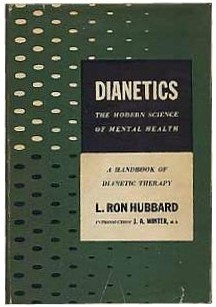
Korean War
25.6.1950 to 27.7.1953
"The Cold War turned hot for the first time"
(Michael Hickey BBC website)
13.9.1950 National Association of Mental Health formed by merging the National Committee for Mental Hygiene - the National Mental Health Foundation - and the Psychiatric Foundation.
|
Before November 1950
The New York State Department of Mental Hygiene presents
Chic Young's Blondie State of New York Department of Mental Hygiene and
King Features Syndicate.
Chic Young and Joseph W Musial [See
Comics 1950]
Inside front cover "Blondie" a one page comic story in which Blondie and her husband, Dagwood, talk about their happy family. This was followed by comic stories and a text end piece by Newton Bigelow
|
|
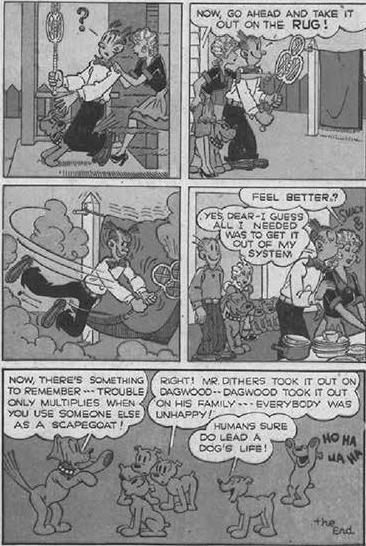
|
Scapegoat/ 3 pages - Dagwood learns not to take his anger out on his
family.
Love Conquers All 5 pages - Dagwood, Alexandder and Cookie learn that they need to not take Blondie for granted. Let's Face It! 5 pages - Dagwood teaches the kids to help out when asked. The Bumsteads 3 pages - Dagwood learns that while it's fun to spend time with the family, having alone time is good also. Your Mental Health 1 page (text article) by Newton Bigelow |
|
| Swee Khee Brenda Seah from Singapore, then an undergraduate at Yale (USA) wrote about this in "The Drawn-Out Battle Against Stigma: Mental Health In Modern American Comics And Graphic Novels" March 2012.. Joseph De Lappe, a research student at The Open University (UK) wrote about this in "All I needed was to get it out of my system' - the early use of comics for mental health therapy in America" in Asylum Spring 2015 |
1.11.1950 George Simpson's "Editor's Preface" to his translation of Emile Durkheim Suicide. A study in Sociology. "The City College of New York". This was published in the USA in 1951 and in London in 1952.
"Of the four major works of the renowned French sociologist, Emile Durkheim, only Le Sucide has remained to be translated, The Elementary Forms of the Religious Life was first published in English in 1915; the Division of Labour in Society in 1933 and The Rules of Sociological Method in 1938"
Moral Education, another work frequently referred to, was translated into English in 1961
6.12.1950 Conference on Psychotherapy with Schizophrenic Patients held in the Department of Psychiatry of the Yale University School of Medicine in New Haven. Led to the publication of Psychotherapy with schizophrenics in 1952. "The papers face realistically the difficulties in therapy, but there is nevertheless a consistent note of restrained optimism".
December 1950 Angelica Schuyler Choate's MA Thesis "The Personality Trends of Upper Class Women"
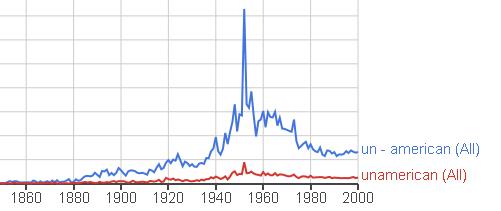
|
American Sociology: the story of sociology in the United States through 1950 by Howard W. Odum (1884-1954) published in New York and London.
structural-functional analysis: In The Social System, Talcott Parsons wrote "the systematisation of theory in the present state of knowledge must be in structural-functional terms". See Structural Functionalism -
Also in 1951, Parsons and eight other theorists published Towards a General Theory of Action - Theoretical Foundations for the Social Sciences
Hannah Arendt (1906-1975) The Origins of Totalitarianism This was published in the United Kingdom with the title The Burden of Our Time
1951 The Catcher in the Rye by J.D. Salinger. A novel of teenage identity retold by the teenager from a mental hospital.
| Psychiatrists saw Manson as "a very emotionally upset youth," "slick" but "extremely sensitive" (1951), "dangerous" with "homosexual and assaultive tendencies" (1952), having "an unstable personality" but being potentially able "to straighten himself out" (1955), being "unable to control himself" with "a tendency to cut up" (1956), having "work habits that range from good to poor" (1957), being "erratic and moody" and "a classic text book case of a correctional institution inmate" (1958), as an "energetic person" who hides "his loneliness, resentment and hostility behind a facade of superficial ingratiation" (1961), being "emotionally insecure" and tending to "involve himself in various fanatical interests" (1963), and, finally, as "in need of a great deal of help in the transition from institution to the free world" (1966). (source) |
1951 Article 31B of the Public General Laws of Maryland enacted. Known as the "Maryland Defective Delinquent Statute" provided for indefinite detention in the Patuxent Institution.
|
January 1951 Scientific American
Isaac Isidor Rabi reviwed
Dianetics: The modern science of mental health
This volume probably contains more promises and less evidence per page than has any publication since the invention of printing. Briefly, its thesis is that man is intrinsically good, has a perfect memory for every event of his life, and is a good deal more intelligent than he appears to be. However, something called the engram prevents these characteristics from being realized in man's behavior. During moments of unconsciousness and pain and at any time from conception onward, the "reactive mind" can still record experience, but experiences so recorded -engrams- are a major source of man's misery, his psychosomatic ills, his neuroses and psychoses, his poor memory, and his generally inefficient functioning. By a process called dianetic reverie, which resembles hypnosis and which may apparently be practiced by anyone trained in dianetics, these engrams may be recalled. Once thoroughly recalled, they are "refiled," and the patient becomes a "clear," who is not handicapped by encumbering engrams and who can thenceforth function at a level of intellect, efficiency and goodness seldom if ever realized before in the history of man. The system is presented without qualification and without evidence. It has borrowed from psychoanalysis, Pavlovian conditioning, hypnosis and folk beliefs, but, except for the last, these debts are fulsomely denied. The huge sale of the book to date is distressing evidence of the frustrated ambitions, hopes, ideals, anxieties and worries of the many persons who through it have sought succor. |
May 1951 Goffman in Paris for a year.
|
15.10.1951 - 29.1.1951. Last visit of
Simone de Beauvoir to her lover, Nelson Algren, in Chicago.
His friend Art Shay took photographs of her through the open bathroom door.
He says she called him a "naughty boy". This photograph was published on
the Nouvel Observateur
magazine cover in Paris on
3.1.2008. The others illustrated the inside stories of De
Beauvoir's adventurous sexual life.
"The only book of this famous "Madame" that he [Algren] had read, and the only one published in English at the time, was "The Ethics of Ambiguity"", but De Beauvoir showed him notes about "The Second Sex". (Art Shey 2008) |
12.11.1951 Musical Paint Yory Wagon opened on Broadway. Contained song "Wand'rin' Star". Wandering stars are the planets, as distinct from the fixed stars.
1952 Herbert Blumer recruited (from Chicago) to chair the Department of Sociology at the University of California at Berkeley, "with a view to transforming a relative backwater into a first class department". (Michael Burawoy and Jonathan VanAntwerpen November 2001). "The University of California at Berkeley was the last great American university to establish a department of sociology. It came into existence after Chicago, Harvard, and Columbia were well established with dominant traditions of their own." (Edward Shiels 1970, quoted in above)
Faces in the Crowd. Individual studies in character and politics by David Riesman in collaboration with Nathan Glazer. Yale University Studies in National Policy 4: 1952.
1952 American Psychiatric Association's first Diagnostic and Statistical Manual of Mental Disorders
Rupert Stocker and his family emigrated from Peckham to become Administrator of the Western Memorial Hospital in Corner Brook, Newfoundland. (External link to history. In 1956 he went to Fredericton, New Brunswick to be the Administrator of the successively enlarging Victoria Public Hospital until his retirement in 1976. [Victoria Public Hospital was the only hospital in Fredericton. In the 1970s it was succeded by the Doctor Everett Chalmers Hospital] - (see north-east of map)
1952 Howard Geld (Howie the Harp) born lower east side of New York City. See Insane Liberation Front 1970 - Mental Patients Liberation Project 1971 - Project Release 1975 - Center for Independent Living 1981 - Alameda County Network of Mental Health Clients 1983 - Oakland Independent Support Center 1986 - 1992 - Community Access 1993 - He died 5.5.1995. - YouTube Video
1952 Personal Counselors Inc. 719 2nd Ave North, Seattle, Washington 98109-4102 established by Carl Harvey Jackins
1952 Myra Kovary born. See website and Mental Patients Alliance
20.3.1952 Billy Graham spoke in London about the three perils facing America: The peril from within - The peril from communism and the peril of God's judgement
|
Presidency of Dwight D. Eisenhower (Republican) 1953 to 1961 |
"Center for the integration of social science theory, 1953-1960" box 54, folder 9850 in Berkeley archives
1953 Science as Morality: An Essay Towards Unity by George Simpson: American Humanist Association Pamphlet 1, Yellow Springs, Ohio. Simpson (1954) described it as Lundberg and Simpson presenting opposite views.
|
Maryln Monroe performing "Diamonds Are a Girl's Best Friend" in
Gentlemen Prefer Blondes.
See death and Andy Warhol tribute See Madonna Material Girl in 1984 See Fredric Jameson 1991 |
January 1953: Senator Joe McCarthy became chair of the Permanent Subcommittee on Investigations where he arraigned a large number of citizens and officials "often with full television publicity". (Chambers Biographical Dictionary)
23.2.1953 Simone de Beauvoir's The Second Sex published in America
March 1953 Conference held at the American Academy of Arts and Sciences. Its Proceedings were published by Harvard University Press in 1954 under the title Totalitarianism, edited with an introduction by Carl J. Friedrich.
4.7.1953 "Time on the range is expressed in minutes before a missile is to be fired. This is called a 'count down'". Monsanto Magazine See 1962 - 1969 -
Skinner's article The Science of Learning and the Art of Teaching laid the foundations for programmed learning.
1954 George Simpson Man in Society; Preface to sociology and the social sciences Garden City, New York, Doubleday, Available online. 90 pages
Individualism Reconsidered, and other essays by David Riesman (529 pages) was published by Glencoe Free Press in 1954.
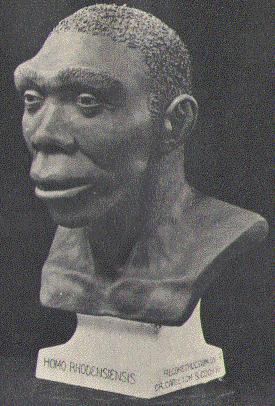
|
Homo Rhodenis -
Rhodesian man. A plastolene reconstruction by
Carleton S. Coon.
Plate one in The History of Man (1954). Coon writes that in his reconstructions "skulls and jaws were restored, and then the missing portions were filled in by imagination. Then the muscles were laid on, and finally the skin and hair were conjured up. The forms of the soft parts, including lips, nose tips, ears and hair, are wholly conjectural" |

|
Kenflex vinyl tiles from a 1954 catalogue. The perfect floor for kitchens, basements, playrooms, every room because it defies grease, dirt and war. Shining vinyl [Polyvinyl chloride] is blended with sturdy asbestos fibers in this non-porous, moisture proof tile". |
18.2.1954 The Church of Scientology of California incorporated in Los Angeles. The Oxford Dictionary says that Hubbard had published a Handbook for Preclears: Scientology in 1951. The Library of Congress lists a number of scientology items in 1952, including a periodical.
17.5.1954 Supreme Court ruling on the case of Oliver Brown et al. v. The Board of Education of Topeka, Kansas ruled that "separate educational facilities are inherently unequal." Racial segregation was ruled a violation of the Equal Protection Clause of the Fourteenth Amendment of the United States Constitution - See Wikipedia
14.6.1954 The 1942 Pledge of Allegiance was amended in 1954 to include the words "under God;". Legislation to add the motto "In God We Trust" to all coins and currency was passed in 1955; and the national motto "E Pluribus Unum" [out of many, one] was changed to "In God We Trust" in 1956.
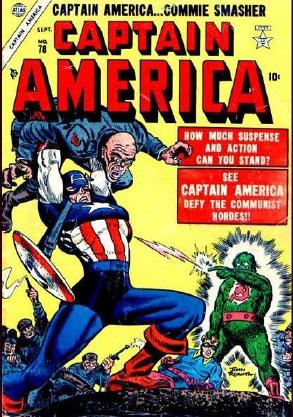
|
September 1954 Cover of Captain America.
After a five year absence, Captain America comics were revived in December 1953. Captain America was no longer an anti-Nazi hero, but was now known as "Captain America Commie Smasher". The last edition was in of this incarnation was September 1954 (source) Being a communist was un American |
27.9.1954 Time Magazine cover "Social Scientist David Riesman: What is the American character?"
2.12.1954
Senator
Joe McCarthy was formally condemned for financial irregularities
and bringing the House into disrepute by
the Senate (now controlled by Democrats). See
On this day
When he attacked Eisenhower he
lost most of his remaining public support.
| December 1954 "The Study Of Man: Class and Opportunity in Europe and the U.S." (offline) by Seymour Martin Lipset published in Commentary |

|
Winter 1954-1955
Talcott Parsons "McCarthyism and American Social Tensions: A
Sociologist's View " Yale Review Volume 44, Winter 1954-1955 pages
226-245, listed in the bibliography to
Parsons and Bales 1955.
Mike Forrest
Keen (1999) summarises Parsons as arguing that the McCarthysit
movement
"could be understood as a symptom of structural strains accompanying a major transformation in American society from isolated nation to international leader, the impact of growing industrialisation, and a free-enterprise economy. Such changes required a stronger commitment to the national community. As a result, those segments of the society with more individualistic and critical traditions (i.e., liberal politicians and academics) came under a suspicion clothed in te garb of loyalty oaths and anti-Communism." |
December 1954 American Journal of Psychiatry 111(6), pp 410- 419. "Psychotherapy of schizophrenia" by Frieda Fromm-Reichman. She warned her patient against "expecting life to become a garden of roses after her recovery" - See 1964
|
Talcott Parsons
and Robert Freed Bales
Family, Socialisation and Interaction Process
Chapter one, "The American Family: Its Relations to Personality and to Social Structure" begins The American family has, in the past generation or more, been undergoing a profound process of change |
1955 Samuel Stouffer Communism, Conformity and Civil Liberties: A Cross Section of the Nation Speaks its Mind Doubleday and Co. "The results of an extensive and illuminating attitude survey, taken in the summer of 1954 and dealing with people's feelings toward Communists and civil liberties. The grimness of the national mood toward Communism is unmistakable." (Henry L. Roberts Foreign Affairs July 1955)
1955 Red Scare: A study in national hysteria, 1919-1920 by Robert Keith Murray. (922- ) Minneapolis, Minnesota: University of Minnesota Press [c1955] 337 pages
|
Erving Goffman (1922-1982) developed his approach to
symbolic
interactionism
in field studies in the Shetland Islands (1949-1951),
leading to The Presentation of Self in Everyday Life (1959).
From 1955 to 1956, Goffman did one year's field research in St Elizabeth's Hospital, Washington, DC, leading to Asylums. Essays on the social situation of mental patients and other inmates (1961). During this time he helped Harold Garfinkel with his work on degradation ceremonies |
1955 Daedalus founded as the Journal of the American Academy of Arts and Sciences.
|
In the year
1903 when young Clifford Beers had just emerged
from a mental hospital with a driving urge to tell his story, he
found a sympathetic listener in
Miss Clara Louise Jepson, friend of his childhood and youth, "I
have so much to tell. I must write
a book," he said to Miss Jepson "Will you help me?" As he
described it later, after his famous book
A Mind that Found Itself
had swept the country: "That supposedly platonic collaboration
lured us on and on, until a few months after my book was published,
we discovered that our hearts had found themselves. In this way
my wife became the royalty on my book, a reward as great as it was
unexpected.
But the marriage of these young people had to be postponed still longer, until Clifford Beers could clear away the debts he had incurred in organizing the new National Committee for Mental Hygiene. He was always generous in the credit he gave to Clara Jepson in those early difficult days. "During the past four years given to organizing the National Committee for Mental Hygiene,"; he wrote to Mrs William James on the day before his wedding, sound advice in the many crises which arose was, I think, the determining factor in the successful accomplishment of my purposes. Miss Jepson's unwavering belief in me during the difficult years of my work,"; he wrote to other friends, "gave me the courage to challenge Destiny.... " And so they were married at last, in 1912, the beginning of 31 years of harmonious life together. Mrs Beers, companion and hostess, took on the additional role of French interpreter during their eventful trips to Europe, when in recognition of his remarkable work, her husband was received by scientists, statesmen, and royalty. Today Mrs Clifford Beers lives quietly in the house she and her husband shared together, on a tree-lined street in Englewood, New Jersey, the mental health movement still the dominant interest in her life.
Nina Ridenour
|
May 1955 Foundation of the British Columbia Association for Retarded Children. See their timeline
18.8.1955 Testimony of Pete Seeger before the Committee on Un-American Activities.
28.8.1955 The murder of Emmett Till from Chicago, Illinois, whilst visiting his relatives in Money, Mississippi.
|
October 1955 Sample of USA Newspapers used for content analysis on
mental health.
"Seeking material directly related to mental-health problems (as we defined them) in the mass media is like looking for a needle in a haystack. If you search every inch of space in three different daily newspapers, the odds are that you will find only one item which is relevant. To find one relevant item it would be necessary to read, on the average, the entire content of two magazines. If you listened to one entire dat of broadcatsing of a radio station, you would, on e the average, find about 2-3 programmes with information or partrayals rleevant to metal healh problems. An almost identical number of relevant programmes would be expected in the entire daily teelcating of one station - 2.4 programmes which in some way relate to mental-health problems. Ths we can conclude that: Information concerning mental illness appears relatively infrequenstly in mass media presentations" (Jum C. Nunnally 1961 in Cohen and Young 1973 p.139) |
1.12.1955 Rosa Parks refused to give her seat on a public bus to a
white passenger - Symbolic start of the United States "civil rights
movement".
Robert Alan Dahl's A Preface to Democratic Theory. A
founding
document of recent pluralist theory, a commentary on and development of,
the Federalist
Papers.
1956
C. Wright Mills' The Power Elite
1956 Carl J. Friedrich and Zbigniew K. Brzezinski
Totalitarian Dictatorship and
Autocracy
24.2.1956 Birth of
Judith Butler - See
1972 -
1984 -
1990 -
1998
March 1956 Harold Garfinkel
"Conditions of successful degradation ceremonies"
"Acknowledgment is gratefully made to Erving Goffman, National Institute of Mental Health, Bethesda, Maryland, and to Sheldon Messinger, Social Science Research Council pre- doctoral fellow, University of California, Los Angeles, for criticisms and editorial suggestions" Garfinkel argued that successful degradation ceremonies are an essential part of all societies. The degradation of the "perpetrator" reveals not only the perpetrator's essential characteristics as undesirable, but unites the witnesses in affirming the values that bind them together. "The features of the mad-dog murderer reverse the features of the peaceful citizen. The confessions of the Red can be read to each [teach?] the meanings of patriotism" (p.423)
|
12.6.1956 Testimony of Paul Robeson before the Committee on Un-American Activities.
Paul Robeson's transatlantic broadcast from New York to coal miners in
Wales
The Open Marxism of Antonio Gramsci by Carl Marzani, New York :
Cameron Associates - See
Social Science Timeline
structural-functional analysis:
The second edition of
Robert King Merton's
Social Theory and Social Structure..
15.4.1957 to 17.4.1957 Symposium on Preventive and Social
Psychiatry held in
Washington DC.
Goffman gave his paper on
"The characteristics of
total institutions"
|
|
July 1957 "Declaration of Sitges" in Colombia lead to the establishment of a National front (1958-1974) in which the Liberal and Conservative parties governed jointly. La Violencia ended and far-reaching social and economic reforms were attempted. |
October 1957 Talcott Parsons' in "The Distribution of Power in American Society," (a review of C. Wright Mills' The Power Elite in World Politics Volume 10, Number 1 wrote:
".. to Mills power is not a facility for the performance of function in and on behalf of the society as a system, but is interpreted exclusively as a facility for getting what one group, the holders of power, wants by preventing another group, the 'outs,' from getting what it wants" "
January 1958 Theoretical Criminology by George Vold
2.9.1958 USA National Defense Education Act (NDEA), signed into law
1958 Anatomy of a murder, a legal novel by "Robert Traver" (John D. Voelker 1903-1991), sometime the Prosecuting Attorney of Marquette County, Michigan and later the 74th Justice of the Michigan Supreme Court. The legal hero rescues the accused from the charge of murder on the grounds that "the power of self-control is an essential ingredient of mens rea. In 1973, Peter Clyne said that "sufficient will-power to choose" appeared to be necessary to support a charge of murder in Philadelphia (very clear), but also Alabama, Arkansas, Colorado, Connecticut, Columbia, Georgia, Illinois, Indiana, Iowa, Kentucky, Lousiana, Massachsesets, Michigan, Montana, New Hampshire, New Mexico, Ohio, Vermont, Virginia and Wyoming. This defence is known as irresistible impulse.
"In Denmark and in North Carolina, where eugenical sterilisation is legally carried out, a large number of cases so dealt with are women who have already given birth to several children and might not have had any more..." (Penrose 1959, p. 102)
1959 C. Wright Mills' The Sociological Imagination - "ordinary men .. do not .. grasp the interplay .. of biography and history (p.10) ... The sociological imagination enables its possessor to understand the larger historical scene in terms of its meaning for the inner life and external career of a variety of individuals (p.11)... social science as the study of biography, of history, and of the problems of their intersection within social structure." (p.149)
Erving Goffman in The Moral Career of the Mental Patient said that "far the more numerous" mental patients in America were "those who enter unwillingly". See UK
1959 William Kornhauser: The Politics of Mass Society
|
January 1959
It's late, it's late
We're 'bout to run outta gas It's late, it's late We gotta get home fast |
late - post - trans - are on their way. |
April 1959 According to Stephen J. Whitfield, Harry S. Truman described the Committee on Un-American Activities as the "most un-American thing in the country today". (no reference given)
| 25.8.1959 National Medal of Science established by an Act of the USA Congress - 1969 awarded to B.F. Skinner - 1994 awarded to Robert Merton |

|
1960? (or 1959) Ken Kesey participating in LSD experiments at Menlo Park Veterans Hospital, and working nights on the wards. This is said to be the background to his novel One Flew over the Cuckoo's Nest (1962). Goffman's collection of essays Asylums was published in 1961, although parts had been published in 1957
1960 John Clausen left the National Institute of Mental Health to join the University of California as professor of sociology.
|
9.5.1960 USA Food and Drug Administration approved Enovid-10.
The first commercially produced birth-control pill. Made by G.D. Searle
Company, Chicago.
|
13.5.1960 Committee on Un-American Activities hearings in San Francisco City Hall outside which city police officers fire-hosed protesting students
8.10.1960 First Presidential TV debate in USA: John F.Kennedy versus Richard Nixon.
During the campaign Dr Benjamin Spock appeared on television with Jacqueline Kennedy, who said "Dr Spock is for my husband, and my husband is for Dr Spock!"
1960 The End of Ideology: On the exhaustion of political ideas in the fifties by Daniel Bell - See also Francis Fukuyama's The End of History. Amy Gdala argues that
"Ideology - and hence History itself - consists entirely of sets of contrasted tales about struggles between antagonistic forces. The forces are both material and metaphorical, or, rather, 'cultural' as we tend to say nowadays. The reason people like Fukuyama and Bell bob up every couple of decades to insist that the struggles are over is, of course, because they think their side has won already." Gdala, A. 2003, p.94)
First edition of Seymour Martin Lipset's Political Man. The Social Bases of Politics
|
Presidency of John F. Kennedy (Democrat) 1961 to 1963 |
17.1.1961 Dwight D. Eisenhower introduced the "military-industrial complex" in his farewell speech - Wikipedia. Terms based on this include the Prison- Industrial Complex - Surveillance-Industrial Coplex - Organic-Industrial Complex - Baby-Industrial Complex - Academic-Industrial Complex - Celebrity-Industrial Complex - Agro-Industrial Complex - Lobbying-Industrial Complex.... (bored? if not, use a search-engine!)
1961 Thomas Szasz, The Myth of Mental Illness
1961 Culture and Social Character. The work of David Riesman reviewed [By various authors]. Edited by Seymour Martin Lipset and Leo Lowenthal. New York: Free Press of Glencoe xiii and 466 pages.
1961 Intelligence and Experience by Joseph McVicker Hunt. The result of an examination of the literature on child rearing and early childhood education from a historical and cultural perspective. This and John Flavell's Developmental Psychology of Jean Piaget (Van Nostrand, 1963) introduced Piaget to American academics. P. E. Vernon in the British Journal of Educational Psychology, Volume 33, in June 1963, said that Hunt put forward "the strongest case yet made for discarding the conception of intelligence as inborn potential which is predetermined by the genes and which matures regardless of environmental conditions." Kral, E.A. 2008
1961 Moral Education. A study in the theory and application of the sociology of education by Emile Durkheim. Translated by Everett K. Wilson and Herman Schnurer. Edited, with an introduction, by Everett K. Wilson: New York : Free Press of Glencoe,
September 1961 Presidential address of Robert E.L. Faris of the University of Washington to the American Sociological Society at St. Louise. Published in December as "Reflections on the Ability Dimension in Human Society" American Sociological Review Volume 26, No. 6, pp 835-843. "Contrary to traditional beliefs, the present limits of ability in our society are not set by genetic factors, but to an important extent by sociological conditions, which support a sort of 'collective ability'"
20.2.1962 Mercury-Atlas 6 put USA astronaut John Glenn into outer space, where he performed three orbits of the Earth. [Following in the star steps of Yuri Gagarin.
"Countdown" (innovative modern jazz) was recorded by the Dave Brubeck Quartet on 12.2.1962 and published on Countdown-Time in Outer Space later in the year with a dedication to John Glenn.
May 1962 Helen Gurley Brown' Sex and the Single Girl published
|
5.8.1962
Marilyn Monroe
died of an overdose.
Andy Warhol's tribute to her appears to me deeply emotional, but not to Fredric Jameson
|
27.9.1962 First edition of Silent Spring by Rachel Carson
documenting the adverse effects on the environment of the indiscriminate
use of pesticides.
14.10.1962 Soviet nuclear missiles photographed on Cuba
December 1962 "The psychological basis for using pre-school
enrichment as an antidote for cultural deprivation". A talk by
Joseph McVicker Hunt
at Arden House, Columbia University.
1962
C. Wright Mills' The Marxists
1962 Ken Kesey, One Flew over the Cuckoo's Nest: a novel by
Ken Kesey.
New York: Viking Press
1962 Daniel Boorstin' The Image: A Guide to Pseudo Events in
America
identifies a shift from reality to illusion: a move away from actual events
to "pseudo-events" which are contrived happenings meant for public
consumption. The public expectation is shaped by a "Graphic Revolution"
defined as "Man's (increasing) ability to make, preserve, transmit and
disseminate precise images." The effect on fame is to create celebrities.
A celebrity is not known for real achievements but is "a person who is
known for his well-knowness". (Based on
Celebrity Culture 2001)
1962
Human Behavior and Social Processes. An
Interactionist Approach (edited by Arnold Rose) contained
thirty four articles by writers from a
"symbolic interactionist" perspective.
1962 Geoffrey Reaume born. See
1992 -
2000 -
2002 -
2004 -
24.10.1962 USA blockade of Cuba
28.10.1962 missiles removed from Cuba
| UK mental patients April 1963 |

|
17.2.1963 Publication of The Feminine Mystique by Betty Friedan
"When a Frenchwoman named Simone de Beauvoir wrote a book called The Second Sex, an American critic commented that she obviously "didn't know what life was all about," and besides, she was talking about French women. The "woman problem" in America no longer existed....
|
"We can no longer ignore that voice within women that says: "I want
something more than my husband and my children and my home."
The problem that has no name-which is simply the fact that American women are kept from growing to their full human capacities - is taking a far greater toll on the physical and mental health of our country than any known disease. If we continue to produce millions of young mothers who stop their growth and education short of identity, without a strong core of human values to pass on to their children, we are committing, quite simply, genocide, starting with the mass burial of American women and ending with the progressive dehumanization of their sons and daughters. These problems cannot be solved by medicine or even by psychotherapy." From an extract on the website of the American Astronomical Society. |
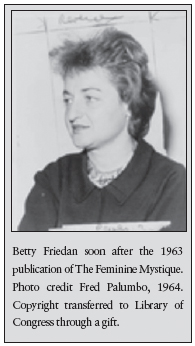
|
20.6.1963 Telephone "hotline" set up between leaders of the USSR and USA
28.8.1963 Martin Luther King "I Have A Dream" speech, Washington DC
|
I have a dream that my four little children will one day live in a nation where they will not be judged by the colour of their skin but by the content of their character. |
26.6.1963 President Kennedy visited Berlin
25.7.1963 Nuclear test ban treaty
Federal Community Mental Health Center Construction Act signed by President Kennedy three weeks before his assassination.
1963 William Bruce Cameron Informal Sociology: A casual
introduction to sociological thinking. Random House studies in
sociology: New York: 170 pages.
"It would be nice if all of the data which sociologists require could be enumerated because then we could run them through IBM machines and draw charts as the economists do. However, not everything that can be counted counts, and not everything that counts can be counted." (page 13)
|
|
Presidency of Lyndon B. Johnson (Democrat) 1963 to 1969 |
| 1964 |

|
|
1964 The Social Setting of Intolerance: The Know-Nothings, the
Red scare, and McCarthyism by Seymour J. Mandelbaum. Scott
Foresman problems in American history. Chicago : Scott, Foresman 176
pages. The series provided history teachers with selections from source
documents along with analysis of problems for use in class discussion.
"This book explores three moments of fear in American history, moments when the genial mask of tolerance was cast aside ... The first deals with intolerance during the 1850s, when members of the secret Know Nothing society charged that foreigners were corrupting America. Their attacks were directed especially against Irish Catholic immigrants ... Unit Two considers the Red Scare of 1919-1920 and Unit Three deals with the period after World War Two, when the term 'McCarthyism' was coined to define an intense search for disloyal citizens and government officials. In presenting each of the three units, this book analyzes the social setting of intolerance--that is, the conditions that led to the fear that America was in danger of subversion from within." Author's introduction |
|
Janury 1964 BioScience the new name for the Bulletin of the American Institute of Biological Sciences. In 1984 it introduced a new word: biodiversity. |
8.1.1964 Lyndon B. Johnson' State of the Union Address included:
"Let this session of Congress be known as the session which did more for civil rights than the last hundred sessions combined" - many Americans live on the outskirts of hope - some because of their poverty, and some because of their colour, and all too many because of both. Our task is to help replace their despair with opportunity. This administration today, here and now, declares unconditional war on poverty in America." (text of speech). See Wikipedia draft by Zweifel. "Making poverty a national concern set in motion a series of bills and acts, creating programs such as Head Start, food stamps, work study, Medicare and Medicaid, which still exist today." (Robert Siegal on NPR) 16.3.1964 Lyndon B. Johnson's Special Message to Congress: "Because it is right, because it is wise, and because, for the first time in our history, it is possible to conquer poverty, I submit, for the consideration of the Congress and the country, the Economic Opportunity Act of 1964" (external link to text) |
1.2.1964: "I Want to Hold Your Hand" by Liverpool (UK) group The Beatles topped the United States charts. The Beatles flew to the United States on Friday 7.2.1964. An estimated 4,000 fans saw them off from Heathrow and a similar number welcomed them at the (newly re-named) John F. Kennedy Airport. (Wikipedia)
| UK mental patients 1964 |
|
|
I Never Promised You a Rose Garden by "Hannah Green".
Deborah (patient) "What good is your reality, when justice fails and dishonesty is glossed over and the ones who keep faith suffer... ?" Furri (therapist) "I never promised you a rose garden. I never promised you perfect justice and I never promised you peace or happiness. My help is so that you can be free to fight for all these things". (Chapter 13) |

|
3.2.1964 Neurotics Anonymous created in Washington DC by Grover Boydston, on the model of Alcoholics Anonymous - (external link)
1964 Librarian Clara Cooley published manuscript History of Western State Hospital, 1871-1950 (Kathleen Benoun)
1964 A poll of American sociologists showed that 80% (of about 3,400) thought "functional analysis and theory" still retain great value for contemporary sociology. (Gouldner, A. 1970 p.168). The poll was conducted by Timothy Sprehe and Alvin Gouldner.
1964 Aaron V. Cicourel, 1964 Method and Measurement in Sociology. New York: Free Press. Cicourel, A.V. (1964). Jan Nespor (external link) says that in "Theory and method in field research" in this book "Cicourel argues for qualitative methods through a knowledgable critique of survey and quantatively oriented research approaches". He describes it as "an influential book by a key figure in the ethnomethodology movement".
|
1965 Project Head Start.
(Wikipedia)
"During the early 1960s an increasing number of psychologists and educators began to study the effects of early experiences on human development. Much research suggested that preschool compensatory education might be an important step for disrupting the cycle of poverty experienced by large numbers of Americans. Combined with powerful social and political factors, this notion led to the authorization of Project Head Start in 1965" (Joan S. Bissell 1972) p. 190) "I a series of studies beginning in 1965, we discovered that a large proportion of black children from impoverished backgrounds were less competent than their more privileged counterparts when dealing with representational material" ( Sigel, Secrist and Forman 1973 p.28) "The Early Childhood Education Project is an experiment in educational intervention begun with two-year old, first-born children from impoverished black families in the inner city of Buffalo" (New York State) ( Sigel, Secrist and Forman 1973 p.28. Included "a brief evaluation of the first year's work") |
| UK mental patients 1965 |
|
"I got married at twenty... this was 1965. No women's liberation, or even the recognition of the need for it" (Judi Chamberlin)
Howard Geld was a 13 year old patient in a psychiatric hospital. Often he could not sleep, and a night attendant taught him to play the harmonica. "When you cry out loud in a mental hospital you get medicated" - "When I was sad, I could cry through the harmonica." He was given the name Howie the Harp on the streets of Greenwich Village, New York. See 1970
1965-1966 David Reville (aged about 22) a psychiatric inmate in Ontario, Canada, for much of the time in what he calls Rockwood Asylum
|
From "Remaining Awake Through a Great Revolution"
Commencement Address for Oberlin College By Rev. Dr. Martin Luther King, Jr June 1965, Oberlin Ohio "all mankind is tied together; all life is interrelated, and we are all caught in an inescapable network of mutuality, tied in a single garment of destiny. Whatever affects one directly, affects all indirectly. For some strange reason I can never be what I ought to be until you are what you ought to be. And you can never be what you ought to be until I am what I ought to be - this is the interrelated structure of reality. John Donne caught it years ago and placed it in graphic terms: No man is an Island, entire of itself; every man is a piece of the continent, a part of the main... And then he goes on toward the end to say: any man's death diminishes me, because I am involved in mankind; and therefore never send to know for whom the bell tolls; it tolls for thee. And by believing this, by living out this fact, we will be able to remain awake through a great revolution."
Growing up in Atlanta during the 1960's civil rights movement, I was influenced by Martin Luther King, Jr.'s call to remember that "we are all tied together in the single garment of destiny, caught in an inescapable network of mutuality."
See 1987
|
USA Medicare Act passed to provide financial support for citizens of 65 and older otherwise unable to meet their medical needs.
Kai T. Erikson (Yale University) published Wayward Puritans. A Study in the Sociology of Deviance He used Emile Durkheim's concept that crime can solidify a society to analyse three "crime waves" in the 17th century puritan theocracy of New England. Erikson's "crime waves" might be considered deviance rather than crime in the normal sense. They are the Antinomian theological disputes, the invasion and persecution of Quakers and the outbreak of witch hunting in Salem. Other sociologists have called them moral panics.
1966 Unobtrusive Measures, by Eugene Webb and others, contained this early reference to the triangulation of research methods
"Once a proposition has been confirmed by two or more independent measurement processes, the uncertainty of its interpretation is greatly reduced. The most persuasive evidence comes through a triangulation of measurement processes" (Webb, E. J. and others, 1966 p.3)
1966: Second edition (first 1958) A Textbook of Psychology by Donald Olding Hebb. Professor of Psychology, McGill University.
1966 Thomas Scheff's Being Mentally Ill
16.6.1966, in a speech in Greenwood, Mississippi after the shooting
of
James Meredith during the March Against Fear, Stokely Carmichael said:
See Britain
1951 -
1967 -
London UK -
murder of Martin Luther
King - 1968
Olympics -
1984 Rainbow Coalition -
1984 UK Black sections
30.6.1966 National Organisation for Women founded.
Wikipedia
"This is the twenty-seventh time I have been arrested and I
ain't going to jail no more! The only way we gonna stop them white men from
whuppin' us is to take over. What we gonna start sayin' now is Black
Power!"
|
|
7.8.1966 Carlos Alberto Lleras Restrepo became President of Colombia, serving to 7.8.1970. Gobierno de la transformación nacional (government of national transformation). Created the national savings fund, Colombian Institute for family wellbeing; the institute to protect non renewable resources; the agency to promote exports; the nacional agency for the construction of schools; and the national institution to promote and finance superior education. |
October 1966 Johns Hopkins International Colloquium on The Language of Criticism and the Sciences of Man. Jacques Derrida read his paper "Structure, Sign, and Play in the Discourse of the Human Sciences"
21.11.1966 "The term 'gender identity' was used in a press release, November 21, 1966, to announce the new clinic for transsexuals at The Johns Hopkins Hospital. It was disseminated in the media worldwide, and soon entered the vernacular. ... gender identity is your own sense or conviction of maleness or femaleness." (John Money quoted Wikipedia)
| 1967 | Declaration of a summer of love |
External link: The Summer of Love (1967) and Woodstock (1969) archive
Black Power: The politics of liberation in America by Stokely Carmichael and Charles V. Hamilton. This argued that the term negro implied black inferiority. Black publications like Ebony switched from Negro to black at the end of the 1960s. (source)
1967 Joe Bataan's album Gypsy Woman included the original version of his song "Ordinary Guy". See Ordinary Guy: A Professor, music and poverty scholar with a "degree in streetology"--Joe Bataan
1967 Discovery of Grounded Theory. Strategies for Qualitative Research by Barney Glaser and Anselm Strauss. "We argue in our book for grounding theory in social research itself - for generating it from the data" (p.viii). "We believe that the discovery of theory from data - which we call grounded theory - is a major task confronting sociology today, for, as we shall try to show, such a theory fits empirical situations, and is understandable to sociologists and layman alike. Most important, it works-provides us with relevant predictions, explanations, interpretations and applications" (p.1).
14.1.1967 The Human Be-In takes place in Golden Gate Park, San Francisco; the event sets the stage for the Summer of Love.
27.1.1967 The United States, Soviet Union and United Kingdom sign the Outer Space Treaty.
26.3.1967 10,000 gather for the Central Park Be-In.
4.4.1967 Martin Luther King denounces the Vietnam War during a
religious service in New York City.
28.4.1967 Muhammad Ali refuses military service.
2.5.1967 Armed members of the Black Panther Party enter the
California state capital to protest a bill that restricted the carrying of
arms in public.
6.5.1967 Four hundred students seize the administration building at
Cheney State College, Pennsylvania, the oldest institute for higher
education for African Americans.
11.6.1967 Race riot in Tampa, Florida after the shooting death of
Martin Chambers by police while allegedly robbing a camera store. The
unrest lasted several days.
12.6.1967 Loving v. Virginia: The United States Supreme Court
declares all U.S. state laws prohibiting interracial marriage to be
unconstitutional.
13.6.1967 Solicitor General Thurgood Marshall is nominated as the
first African American justice of the United States Supreme Court.
26.6.1967 The Buffalo Race Riot begins, lasting until July 1
12.7.1967 After the arrest of an African-American cab driver for
allegedly illegally driving around a police car and gunning it down the
road, race riots break out in Newark, New Jersey, and these riots last for
six days. 14.7.1967 Near Newark, New Jersey, the Plainfield riots
also occur.
16.7.1967 A prison riot in Jay, Florida leaves 37 dead.
23.7.1967 12th Street Riot/Detroit Race Riots: In Detroit, Michigan,
one of the worst riots in United States history begins on 12th Street in
the predominantly African American inner city: 43 are killed, 342 injured
and 1,400 buildings burned.
30.7.1967 The 1967 Milwaukee race riots begin, lasting through
August 2 and leading to a ten-day shutdown of the city from August 1.
1.8.1967 Race riots in the United States spread to
Washington DC
17.10.1967 First public performance of Hair: "When the moon
is in the Seventh House And Jupiter aligns with Mars Then peace will
guide
the planets And love
will steer the stars. This is the
dawning of the age
of Aquarius" - The astrological theory of ages includes Aquarius
succeeding
Pisces, but it is not clear when!
7.11.1967 Carl B. Stokes elected mayor of Cleveland, Ohio, becoming
the first African American mayor of a major United States city.

On 4.12.2017 a google doodle celebrated 50 years of "kids coding" |
"The first running version of Logo was in 1967 and it was a place where kids could play with words and sentences -- explore mathematics, write stories, make games". (Cynthia Solomon 2017) |
|
1968 Andy Warhol's tin of Campbell's tomato soup. The theme began in
1962 and was developed as a series of prints in 1968.
Fredric
Jameson argued that the lack of emotion in Warhol's art was a
feature of
postmodernism.
1968 Second edition of the Diagnostic and Statistical Manual of Mental Disorders. See 1973 |
1968 Joseph Licklieder and Robert Taylor "The Computer as a Communication Device" Science and Technology 76, pages 21-23. See Wikipedia on Licklieder
1968 The Social Club of New Haven, Connecticut: Sue Budd "helped start a social club on a psychiatric ward. The club was very anti-psychiatry in tone. There was some help from professionals at first, but basically Sue ran the club. Sue's husband, Dennis, tells it this way: [The social club] was loosely supervised by a social worker, who saw Sue and me every week. and Sue ran the club. It was most successful. It had a membership of ten to twelve. We shunned the help from the mental health association that was offered to us. A lot of people who were sent to our club were dismissed as hopeless by the staff. A lot of them improved while they were with us." Mel Starkman
1968 The American Association of Suicidology (AAS) founded by clinical psychologist Edwin S. Shneidman, Ph.D.
1968 Science published a brief paper by Linus Pauling called
"Orthomolecular psychiatry". This gave a name to the megavitamin therapy
movement of the 1970s
1968 Ontario (Canada) Mental Health Act written by Barry Swadron
(Source David Reville)
Maria Anne Hirschmann's I Changed Gods published in California. (A
"Destiny Book")
External link:
"Maria Anne Hirschmann, or "Hansi," was orphaned as a baby in
Czechoslovakia during World War II. Brainwashed to be a Nazi youth leader,
she was imprisoned in a communist labor camp before escaping into West
Germany. There she became a Christian and immigrated with her family to the
United States where she learned to love freedom." In 1973 (USA) and 1974
(London) she published Hansi; the girl who loved the swastika which
formed the basis for a comic of the same name in 1976. The comic includes
the line
"It's alright to love what God has blessed" (See
Billy Graham 1952)
Spring 1968 U.S. Information Agency launched quarterly periodical Dialogue [USAI Dialogue (1968-1990) containing articles covering a wide range of topics, The first issue contained an article by Clark Kerr "The New Involvement in Society" that said "For the first time in the history of the United States, university students have been a source of interest for all the nation; a source of concern for much of the nation; and even a source of fear for some of the nation" (Dialogue volume one, issue 1, p. 34, quoted Kidd, H. 1969 p. 34)
10.3.1968 Martha Weinman Lear, "The Second Feminist Wave - What Do These Women Want?: " New York Times Magazine See About.com article by Linda Napikoski. The article included material from an interview with Betty Friedan, author of The Feminine Mystique and founder of the National Organisation for Women, and concluded with the quotation
"What I do know is this: If you agree that women are human beings who should be realising their potential, then no girl child born today should responsibly be brought up to be a housewife. Too much has been made of defining human personality and destiny in terms of the sex organs. After all, we share the human brain."
|
4.4.1968 Martin Luther King murdered in Memphis |
31.5.1968 Winnnipeg Free Press "The New Left seeks to create an alternative society, one whose institutions would promote non- materialistic values". (See Alternative Projects)
|
20.7.1968 Over 1,000 athletes with intellectual disabilities from
the United States and Canada took
part in the one-day event at Soldier Field in Chicago known as both the
"Chicago
Special
Olympics" and
the "First International Special Olympics Games."
They competed in track and field, floor hockey and swimming.
"The Chicago Special Olympics prove a very fundamental fact. That exceptional children - children with mental retardation - can be exceptional athletes, the fact that through sports they can realize their potential for growth." (Eunice Kennedy Shriver in her Opening Ceremonies address)
|
| Special Olympics are held every two years. Since 1973 they have alternated between summer and winter Olympics. 1986 was International Year of Special Olympics. Until 1993 they were all held in the United States. |

12.10.1968 to 27.10.1968 First Olympics games in Latin America held in Mexico City Vera Caslavska quietly protested the invasion of Czechoslovakia by turning her head away during the singing of the Soviet national anthem and Tommie Smith and John Carlos gave a black gloved salute on the podium on 16.10.1968 |
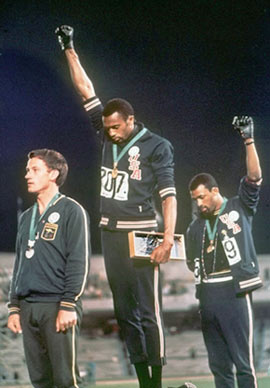
|
Caucuses formed within the American Sociological Association in 1968 and 1969 included the Caucus of Black Sociologists, Radical Caucus and Caucus of Women Sociologists (Rhodes, L.J. 1981, pages 60-61)
|
Presidency of Richard M. Nixon 1969 to 1974 |
1969 Travis Hirschi's Causes of Delinquency - Social bond theory - "Delinquent acts result when an individual's bond to society is weak or broken" (p.16)
Symbolic Interactionism: perspective and method by Herbert Blumer
"By 1969, Kentile was producing vinyl sheet flooring, which is an inexpensive and durable flooring usually cut to the size of a room and installed in one piece." (source)
|
February? 1969
The Citizens Commission on Human Rights was co-founded by the
Church of
Scientology
and
Thomas Szasz.
(Current
website).
In the
same year, the Scientologists attempted a takeover of the
National Association for Mental Health in the UK
The picture of Szasz is taken from a CCHR website about its Board of Advisors. See 1994. The commission and Szasz were jointly involved in 1969 in securing the release of Victor Gyory, |
| Victor Gyory a hungarian refugee with no relatives in the USA spoke little English. On 23.4.1969 police took him toe Bryn Mawr Hospital with lacerations of the wrist, apparently from a suicide attempt. He was moved the next day to Haverford State Mental Hospital. He received a series of electric shocka and, in early June, asked a psychiatric aide what he could do to have them stopped. Three aides (one a scientologist) were suspended for seeking legal aid for him. Support was secured from the American Civil Liberties Union and Citizens Commission on Human Rights. Szasz examined Gyory on behalf of the Commission and Gyory's release was obtained after court proceedings on Tuesday 2.9.1969. |

|
March 1969 Date on an essay by Carol Hanisch called "The Personal is Political" in the Redstockings collection Feminist Revolution The essay defends consciousness-raising against the charge that it is "therapy." Hanisch states
"One of the first things we discover in these groups is that personal problems are political problems. There are no personal solutions at this time."
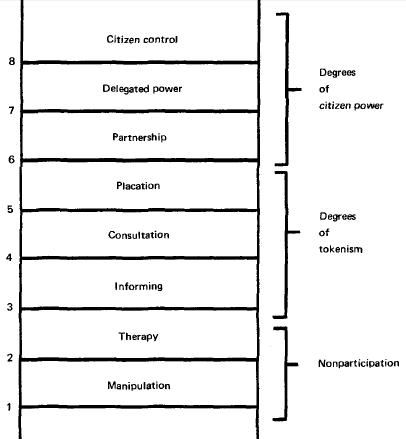
|
July 1969 Sherry Arnstein's
"A Ladder of Citizen Participation,"
published.
Citizen control, delegated power and partnesrhip involve degrees of citizen power. Placation, consultation and informaing involve degrees of tokenism. Therapy and manipulation are nonparticipation
See participation
|
Countdown to the moon
3.6.1969
"Three astronauts..were doing a simulated
countdown
for the first manned Apollo flight." (The Times London
16.7.1969 13:32:00 UTC The countdown for Apollo 11 from the Kennedy
Space Center in Merritt Island, Florida
was watched by millions of people world wide on television
20.7.1969
Men on the moon. See
Wikipedia
24.7.1969 16:50:35 UTC Splashdown in the North Pacific Ocean
9.8.1969 Members of a cult led by Charles Manson murder Sharon Tate,
(who was 8 months pregnant), and several of her friends at Roman Polanski's
home in Los Angeles, California. 10.8.1969The Manson Family kills
Leno and Rosemary LaBianca, wealthy Los Angeles businesspeople.
October 1969 Twenty-four members of the Manson Family, inclusing
Charles Manson, arrested, on charges of arson and grand theft.
10.11.1969 First showing of Sesame Street
Wikipedia
17.11.1969 birth of Rebecca Walker to
Alice Walker. Her father was Mel Leventhal. See
January 1992
Alvin Gouldner's
The Coming
Crisis of Western Sociology. Unlike either
Sorokin in
1928, or Parsons in 1937,
Gouldner's focus is on
American sociology. In particular, criticism of
Parsons
dominates the book.
| "Like many new developments in the United States, mental patients' liberation groups began primarily on the east and west coasts and then spread inland" (Judi Chamberlin). |
|

|
24.2.1970 National Public Radio founded |
Friday, March 13th, 1970 Charles Manson's new court-appointed attorney said he was "distressed and disturbed" by Manson's "erratic, bizzare and uncommunicative" behaviour in their first court appearance together yesterday (12.3.1970). He said he may plead his client not guilty to the Sharon Tate murders by reason of insanity. "Frankly I think it was a little bit of put-on, but I don't know if it was all an act on his part or whether he is mentally troubled," Hollopeter said in an interview. "I'm seriously considering asking the court to appoint a psychiatrist to examine him. And I will probably talk with him about the possibility of an Insanity plea." (archived news)
19.3.1970 Charles Manson dismissed Charles Hollopeter as his lawyer mainly because of his motions that Manson be allowed to undergo psychiatric examination
April 1970 First issue of The Radical Therapist "Therapy means change, not adjustment." Name changed to Rough Times in April 1972. It changed again to State and Mind about 1975. (Source: Wikipedia)
August-September 1970 Radical Therapist volume one, number three
On Women contained:
Late 1970/Early 1971 Start of "what may have
been the first mental patients rights group run for and by mental
patients" , called the Insane Liberation Front -- in Portland,
Oregon. The name Insane Liberation Front was chosen by Tom Wittick.
Howard Geld (17) and his sister Helen joined. See 1971. -
See
Chamberlin 1990
David Rothman's The Discovery of the Asylum. Social Order and Disorder
in the New Republic Little, Brown and Company. Boston - Toronto
N. N. Kittrie's The Right to be Different
Selections from the Prison Notebooks of Antonio Gramsci, edited and
translated by Q. Hoare and G. Nowell-Smith, was published in London and New
York in 1971. See
above on Fordism. But by this time, the economy was preparing to
become a
"post-industrial" or
"post-fordist", more flexible
economy.
1971
Howard and Helen Geld moved back to New York City, where they
started the Mental Patients' Liberation Project. He was Coordinator
of the Storefront Project of MPLP, a storefront crisis center for present
and former mental patients. See
Chamberlin 1990
1971 The Mental Patient's Liberation Front began in Boston,
Massachusetts. See
Chamberlin 1990
1971 Mental Patients Association, Vancouver, Canada established.
(website) -
See
Chamberlin 1990
25.1.1971 In Los Angeles,
Charles Manson
and three female "Family"
members were found guilty of the
1969 Tate-LaBianca murders.
9.4.1971 Charles Manson sentenced to death. Execution not carried
out because, in 1972, the sentence for all California Death Row inmates was
commuted to life imprisonment.
April? 1971 First Hyman Blumberg Symposium on Research in Early
Childhood Education, Johns Hopkins University, Proceedings published 1972
as "Preschool programs for the disadvantaged: five experimental approaches
to early childhood education", edited by
Julian C. Stanley.
touchy-feely Tuscaloosa News (Alabama) "A
considerable amount of time is spent in
encounter groups, gestalt training,
psychodrama or 'T groups'... On almost every campus where this approach has
been tried it has caused an uproar. Faculty critics deride it as 'touchy-
feely' education, with strong currents of anti-intellectualism" (20th
Century Words)
1972 Center for Independent Living, Berkeley, California.
(website history)
1972 The Network Against Psychiatric Assault began in San Francisco.
See
Chamberlin 1990
Editorial, by Judith Brown
Redstockings Manifesto
Male Supremacy, Private Property,a nd the Family: A Critique of Engels,
by Carol Giardina
Brainwashing and Women, by a Redstockings Sister
Consciousness-Raising and Intuition, by Kathie Sarachild
Letter to Her Psychiatrist, by Nadine Miller
Is Women's Liberation a Therapy Group?, by Marilyn Zwieg
Resolution of Women's Caucus, APA, 1969
Mothers of the Millennium, by Judith Brown
Open Letter to Psychiatrists, by Nicole Anthony
Warning, by the New Orleans Women's Study Group
Women's Health Manifesto
Lesbianism, by Martha Shelley
What You Can Do, by the Redstockings, San Francisco
Men and Women Living Together, by a Bread and Roses Member
Kinder, Kuche, Kirche, by Naomi Weisstein
Poem, by Phyllis Parun
Session, by E.M. Broner and Aryeh Seagull
Women's Liberation: A Bibliography
Marriage and Psychotherapy, by Phyllis Chesler
Letters
Movement Groups: Social Welfare Workers Movement
Book Review, by Mnasadica
Intimacy and Oppression, by the RT Collective

|
The first edition of Madness Network News were published in
1972
(Chamberlin 1990). [Leonard Roy Frank wrote "In 1971, I met
David Richman and Sherry Hirsch who had just started a publication called
"Madness Network News." The first issue was an 18 or 20 page mimeographed
newsletter on alternative ways of looking at psychiatry". The first issue I
have is 5 in May 1973. Published "every other month" would take back to
September 1972 for the first issue. Volume 2 no.1 is dated 1973 and Volume
2 no.2
is dated February 1974. See
1973 -
1974 -
1975 -
1976 -
1978 -
1981 -
1982 -
1983 -
1984 -
1985 -
1986 -
See
Chamberlin 1990
November 1972
Rought Times
Volume 3 no 2 nov. 1772. Contents: Mental Patienst Liberation Groups -
Statements and Activities - Research, Legal and Publicity Groups - Mental
Patients Rights. What the Laws are and How to Fight Them - Alternatives -
Unmasking the Enemy - Suicide - Book Review - New, Notces, Announcements. a
Notice about Madness Network News page 6:
a new magazine -
WHAT IS MADNESS NETWORK NEWS?
A Communication Network for the interchange of energy and support of
people in the Bay area who are trying to change the archaic and repressive
aspects of the psychiatric treatment centres that they work and live in.
A Clearing House created for people who want to plug into the
established and/or alternative "mental health" network, either to get help
from it or to work in it.
Research and Evaluation of the different alternatives available to
someone having a psychiatric experience.
Information about such issues as:
Artistic Energy - drawings, poetry, prose, letters - particularly
from people who have experienced "madness" directly and also from anyone
else who wishes to contribute (insane, sane, anti-sane, nonsane, supersane,
asane, metasane - everyone is welcome).
A Voice for the Demystification of the psychotic process.
MADNESS NETWORK NEWS
A Journey Through Inner Space
How do you get into hospital if you want to?
How do you get out?
What is it to be labelled "crazy". Legally and socially?
How to get Aid to the Disabled.
What benefits you can expect from it.
What drugs are used in treating psychosis
What it is like to be hospitalised for psychiatric reasons
And more.............
|
In 1972, Dr. Thomas Hertzberg of Northville State Hospital in Detroit,
Michigan went to a radical caucus of the American Psychological
Association, where psychologists were talking about why it was that
psychologists could hold national conferences to talk about
Consumer/Survivors yet Consumer/Survivors were not going to national
conferences to talk about psychiatric professionals. That radical caucus
knew that there were many abuses in the mental health system to be talked
about. They also had heard that there were a few Consumer/Survivor groups
organizing on the local level.
So, Tom set about to find these groups and to invite them to a planning meeting to be held in Detroit to develop a national Consumer/Survivor conference. Tom located me [Su Budd], Howard Geld Howie the Harp of New York, New York, Dr. Louis Frydman of Lawrence, Kansas, and others. We had a meeting in Detroit at a very nice hotel to plan what was to become the first Conference on Human Rights and Psychiatric Oppression. That conference was held a year later in Detroit. Tom was fired for bringing us together. It was a long time before he could get another job in his field. In the interim, he sold gliders for a living. Psychiatric oppression was alive and well, even for the professionals who believed in us - especially for the professionals who believed in us. The conference that Tom Hertzberg started evolved into the Conference on Human Rights and Psychiatric Oppression and was held yearly for 13 years between 1972 and 1985. During that time, it went through four name changes ending as the International Conference for Human Rights and Against Psychiatric Oppression. This conference attracted people from Canada, the Netherlands, and Britain. Throughout its history, this conference held yearly demonstrations at hospitals. Some of these demonstrations held vigils for our friends and neighbors who died in such places. |
Benjamin Spock addressed the National Women's Political Caucus. Gloria Steinmem told him: "I hope you realise you have been a major oppressor of women in the same category as Sigmund Freud".
Citizen advocacy for the handicapped, impaired, and disadvantaged: an overview Washington. 59 pages, illustrated. First use I have traced of the term citizen advocacy
24.2.1972 Judith Butler sixteen years old. She later referred to "my own tempestuous coming out at the age of 16"
14.10.1972 President Nixon signed the legislation naming the new Federal Bureau of Investigations building the J. Edgar Hoover Building. Hoover had died of a heart attack on 2.5.1972 aged 77. On 25.4.1972, Hoover had reported on his investigation into the activities of John Lennon.
1972 Government of Quebec bought a series of lots that extended from the public road to the cliff where the Escuminac Formation at Miguasha outcropped. In June 1978 a museum was opened. In 1985, the site and its museum became a conservation park. "Miguasha National Park is considered to be the world's greatest palaeontological record of fossils from the Devonian Period" (Wikipedia). A virtual museum website, in French and English was established between 2007 and 2010 with the titles De l'eau à la Terre (From water to land).
"Interpersonal Dynamics in a Simulated Prison", report of an experiment with humans at Stamford University, California, by Craig Haney, Curtis Banks and Philip Zimbardo, International Journal of Criminology and Penology, 1, 1973, pp 69-97
and, on a more positive note:
"I went into Central Park and I saw 20,000 New Yorkers matched one to one with 20,000 mentally handicapped people" (Nigel Evans The Times 12.6.198, which says "The public response, or sympathy and indignation left an indelible impression".)
Retirement of Talcott Parsons from Harvard University
The Cultural Contradictions of Capitalism by Daniel Bell
1973 homosexuality per se was removed from the Diagnostic and Statistical Manual of Mental Disorders and replaced by the category Sexual Orientation Disturbance. "This represented a compromise between the view that preferential homosexuality is invariably a mental disorder and the view that it is merely a normal sexual variant" (source)
About 1973 that Janet Foner became involved in Re-evaluation Counselling, "a peer support network that exists in most countries all over the world, of people who do social change work and emotional healing, by exchanging listening time with each other. That organisation began working on liberation work of all types, beginning with work on ending racism, in 1974".
|
19.1.1973 Science published "On Being Sane in Insane Places" by David Rosenhan. The abstract says: It is clear that we cannot distinguish the sane from the insane in psychiatric hospitals. The hospital itself imposes a special environment in which the meanings of behavior can easily be misunderstood. The consequences to patients hospitalized in such an environment-the powerlessness, depersonalization, segregation, mortification, and self- labeling-seem undoubtedly countertherapeutic. I do not, even now, understand this problem well enough to perceive solutions. But two matters seem to have some promise. The first concerns the proliferation of community mental health facilities, of crisis intervention centers, of the human potential movement, and of behavior therapies that, for all of their own problems, tend to avoid psychiatric labels, to focus on specific problems and behaviors, and to retain the individual in a relatively non-pejorative environment. Clearly, to the extent that we refrain from sending the distressed to insane places, our impressions of them are less likely to be distorted. (The risk of distorted perceptions, it seems to me, is always present, since we are much more sensitive to an individual's behaviors and verbalizations than we are to the subtle contextual stimuli that often promote them. At issue here is a matter of magnitude. And, as I have shown, the magnitude of distortion is exceedingly high in the extreme context that is a psychiatric hospital.) The second matter that might prove promising speaks to the need to increase the sensitivity of mental health workers and researchers to the Catch 22 position of psychiatric patients. Simply reading materials in this area will be of help to some such workers and researchers. For others, directly experiencing the impact of psychiatric hospitalization will be of enormous use. Clearly, further research into the social psychology of such total institutions will both facilitate treatment and deepen understanding. I and the other pseudopatients in the psychiatric setting had distinctly negative reactions. We do not pretend to describe the subjective experiences of true patients. Theirs may be different from ours, particularly with the passage of time and the necessary process of adaptation to one's environment. But we can and do speak to the relatively more objective indices of treatment within the hospital. It could be a mistake, and a very unfortunate one, to consider that what happened to us derived from malice or stupidity on the part of the staff. Quite the contrary, our overwhelming impression of them was of people who really cared, who were committed and who were uncommonly intelligent. Where they failed, as they sometimes did painfully, it would be more accurate to attribute those failures to the environment in which they, too, found themselves than to personal callousness. Their perceptions and behavior were controlled by the situation, rather than being motivated by a malicious disposition. In a more benign environment, one that was less attached to global diagnosis, their behaviors and judgments might have been more benign and effective. |
May 1973 Madness Network News Vol.1 no.5 May 1973. A copy sent to Mental Patients Union, 95-97 Prince of Wales Road, Camden, NW5. England kept by Eric Irwin. "brought to you by... Virginia Davis, Leonard Frank, Sherry Hirsch, Wade Hudson, Richard Keene, Gail Krwitz, LAMP, David Richman, Carol Safer, Tullia Tesauro, Judith Weitzner".
Madness Network News Vol.2 no.1 1973
|
Wednesday, 6.6.1973 The Times (London UK)
Church of Scientology to pay libel damages to former Minister
Robinson v Church of Scientology of California and Others
Mr Kenneth Robinson, former Minister of Health, is to receive a substantial sum from the Church of Scientology of California as damages for libel in respect of statements published in various of its broadsheets. He sued the church; Mr Lafayette Ronald Hubbard, its founder; and Mr Peter Ginever, editor of the broadsheets. Mr F. P. Neill, QC. and Mr Michael Curwen for Mr Robinson; Mr James Comyn, QC, and Mr Alan Newman for the defendants. Mr Neill, announcing the settlement, said that Mr Robinson was a member of Parliament from 1949 to 1970 and Minister of Health in the Labour Government from 1964 to 1968. He had directed a great deal of his energies to mental health. When his party was in opposition he was spokesman on health matters and a leading supporter of the Mental Health Act, 1959. Before he became a minister he had been a vice-president of the National Association of Mental Health. The Church of Scientology of California published and circulated in this country what might be called broadsheets styled variously as Freedom Scientology, Freedom and Scientology, Freedom. Some of the broadsheets had international editions. Mr Ginever was the editor of the broadsheets. Mr Hubbard, the founder of the Church of Scientology claimed the copyright in what was published in the broadsheets. About the autumn of 1968 the defendants commenced a campaign against Mr Robinson through their broadsheets. The reason for the campaign was that the defendants very strongly objected to political decisions in which Mr Robinson as a Minister of the Crown had been involved and which led to a ban being placed on the admission to this country of people coming from abroad to study Scientology. In the campaign extravagant allegations were made against Mr Robinson which were of a gravely defamatory nature. Put shortly, it was alleged that Mr Robinson had instigated or approved of the creation of what were called "death camps", likened to Belsen and Auschwitz, to which persons (including mental patients) could be forcibly abducted and there killed or maimed with impunity. It was further alleged that Mr Robinson had abused his position as a minister in relation to government grants made to the National Association of Mental Health. The broadsheets containing these grave allegations were each distributed to about 100,000 persons, including people in public life (such as MPs) and editors of newspapers and journals. Although the allegations were extravagant, Mr Robinson felt that, in view of the virulence and extent of the campaign against him, he could not allow their publication to pass without taking action. Accordingly he launched the present libel proceedings. Counsel was glad to be able to say that the defendants had now redeemed themselves to the extent that they now acknowledged that there was no truth in what they said about Mr Robinson and they greatly regretted that they ever made such allegations. They had agreed to pay Mr Robinson a substantial sum to mark the gravity of the libels and to indemnify him against his costs. They had further undertaken not to repeat the same or any similar libel. In an otherwise distasteful affair it was a matter for some pleasure that the defendants appeared in court by their counsel to confirm what he had told his Lordship and to offer their apologies to Mr Robinson. Mr Comyn said that he confirmed everything which Mr Neill had said, and on behalf of the defendants he offered their sincere apologies to Mr Robinson for the wrong which they bad done him. The record was, by leave, withdrawn. Solicitors: Goodman, Derrick & Co; Mr Stephen M. Bird, East Grinstead.
|
10.7.1973 Decision by three judges in Detroit (Michigan) that proposed psychosurgery was an experiment and not treatment. "To allow mental patients to consent to the type of psychosurgery proposed in this case and to permit the State to perform it, would be to condone State action in violation of basic First Amendment rights of such patients, because impairing the power to generate ideas inhibits the full dissemination of ideas". [Case referred to in UK Parliament 20.2.1976].
17.10.1973 The Organisation of Petroleum Exporting Countries decided no longer to export oil to countries that supported Israel in the six-day war. The beginning of a period of economic recession in the United States and most of the world when economies ceased to grow from year in the way they had since the second-world war. Wikipedia. David Harvey (1989) argues that the post-war years to 1973 had been governed by "Fordist" and "Keynesian" economics which were too rigid to cope with this crisis and were replaced by a more complex, supple, flexible form of capitalism.
1973 to 1978 Andrew Scull lecturer and then professor in Sociology at the University of Pennsylvania. In 1976-1977 he was engaged in a post-doctoral fellowship in Medical History at University College London - (external link) - See: 1976 - 1977 - 1979 - 1983 -
|
Presidency of Gerald R. Ford 1974 to 1977 |
1974 Vincent Bugliosi, Helter Skelter: The True Story of the
Manson Murders W.W. Norton & Co.
1974 The Hidden Story of
Scientology by Omar V. Garrison
published.
(offline) - See
Scientology books and media
January 1974 Vancouver Emotional Emergency Centre opened
Madness Network News Vol.2 no.2
February
1974
13.4.1974 "Psychosurgery:
The Detroit Case" by Paul Lowinger
The New Republic, pp. 17-19
Madness Network News Vol.2 no.3 June
1974
Madness Network News Vol.2 no.4
September 1974 sent to "Mayola Road MPU, Robin Farquarson House, 37 Mayola
Road, Clapton, London, E5, England" by Leonard Roy Frank, who wrote "We
sure would appreciate hearing about your activities and literature. Heard
about you in Copeman 3. Best of Luck!
October 1974: First
People First convention held at Otter
Crest,
Oregon, USA. Organised by supported mentally handicapped
people who had been discharged from
Fairview Hospital and Training
Centre and others who were living there. The name was voted
on at a planning session. The proposer said:
Madness Network News Vol.2
no.5 December 1974 Special Issue: Prison Psychiatry.
The Cultural Contradictions of Capitalism
by
Daniel Bell
Film: One Flew over the Cuckoo's Nest
(External link: Review)
In 1975,
Howard Geld helped found "Project Release" in New York City.
This developed a client-run community "drop-in" center and client run
residence. As with Robin Farquharson House, in London, these were
completely patient ex/patient controlled. In the USA this was called
"separatist". [See On Our
Own].
California 1981
Madness Network News Vol.3 no.6 1975
[That
is what it says]
April 1975 Women and the News Media, a Symposium sponsored by
the National Science Foundation at the Institute for Scientific Analysis,
San Francisco. This generated (selected papers) Hearth and Home: Images
of women in the mass media edited by Gaye Tuchman, Arlene Kaplan
Daniels and James Benét in 1978. Concept of "symbolic annihilation".
4.4.1975
Microsoft founded by Bill Gates and Paul Allen
Madness Network News
Vol.3 no.1 April 1975
Madness Network News
Vol.3 no.2 July 1975
Madness Network News
Vol.3 no.3 October 1975
Madness Network News
Vol.3 no.4 December 1975
March 1976 Vancouver Emotional Emergency Centre closed, after 26
months, unable to find funds.
Madness Network News Vol.3 no.5 March
1976: Third World Issue
Madness Network News Vol.3 no.6 1976:
Women Look at Psychiatry
"The Deinstitutionalization of the Mentally Ill: A Critical View", article
by
Andrew Scull
in Politics and Society 6 (Summer 1976)
Madness Network News
Vol.4 no.1 October 1976: Sleep-in at Gov. Brown's Office
"We are tired of being seen first as handicapped or retarded or
disabled. We want to be seen as people first".
Williams and Shoultz 1982 page 54)
|
Presidency of James R. Carter 1977 to 1981 |
1977 the National Institute of Mental Health (NIMH) initiated its Community Support Program (C.S.P.). The C.S.P.'s goal was to shift the focus from psychiatric institutions and the services they offer to networks of support for individual clients. - See Chamberlin 1990
1977 First edition of Andrew Scull's Decarceration. Community Treatment and the Deviant - A Radical View. Prentice Hall. New Jersey.
Ontario Mental Patients Association founded 1977 - Called On Our Own from
1980.
Recovery and re-emergence Seattle, Washington :
Rational Island Publishers. ISSN: 2161-6388. Began with no. 1 in
1977 - no.2 in
1979 -
- no.3 in
1983 - no.4 in
1987 - no.5 in
1997 - no.6 in
2008 -
[Library of Congress catalogue gives date of no.1. Rational Island
Publishers catalogue gives date of first printing of all. Other dates can
be found, such as no.5 in 1987
17.2.1977 President Carter issued an executive order creating the
President's Commission on Mental Health. Membership included
Priscilla Allen, 47, is a former patient from San Francisco, who
has been
effectively involved in the passage of legislation to benefit the mentally
ill in California. She serves on the National Patients Rights Committee of
the Mental Health Association. She served on a panel at the American
Academy of Psychiatry and Law on "The Role of Consumer in Mental Health
Service Advocacy" in 1976, and is the author of an important article
published in Psychiatry Quarterly called "Consumer's View of California
Mental Health Care System."
- See
Chamberlin 1990
17.3.1977 to 18.3.1977 fifth "Frontiers
of Sociology Symposium" held on the
Vanderbilt University Campus. Papers from published as
Zald, M.N and McCarthy, J.D. 1979 (Editors) The
Dynamics of
Social Movements: Resource Mobilisation, Social Control and
Tactics.
Technical Assistance for Self-Advocacy a federally funded project
based at the University of Kansas ran from 1978 to 1981. This is the
earliest use of the term
"self advocacy" I have traced (so far). The
earliest book with it in its title is
Williams and Shoultz 1982
(which is the source of my information), listed in UK library catalogues,
but not listed in the Library of Congress Catalogue (online). The only
three American titles with the term in the Library of Congress catalogue
are 1993 Self advocacy for adults with learning difficulties:
contexts and debates by Jeannie Sutcliffe and Ken Simon.
about 1994 The self-advocacy movement by people with
developmental disabilities: a demographic study and directory
of self-advocacy groups in the United States by Nancy
Anne Longhurst. about 1997 Self-advocacy for students who are
deaf or hard of hearing by Kristina M. English.
|
|
7.8.1978 Julio César Turbay Ayala became President of Colombia, serving to 7.8.1982. A state of siege and a National Security Statute instituted in 1978 substantially to counteract drug trafficking also enhanced the government's ability to act against guerrillas. It was also used to suppress popular unrest Turbay lifted the state of siege and nullified the security statute in June 1982, shortly before leaving office. |
On Our Own. Patient-Controlled Alternatives to the Mental Health System by Judi Chamberlin
Madness Network News Vol.5 No.1 Late Summer 1978 "To Hell with Their Profits. Stop Forced Drugging of Psychiatric Inmates"
The History of Shock Treatment Edited by Leonard Roy Frank. San Francisco. 19.10.1978: Copy signed and sent to Joan Martin
Andrew Scull's Museums of Madness. The Social Organisation of Insanity in Nineteenth-Century England (Allen Lane: UK)
Peter Breggin's Electroshock: Its Brain-Disabling Effects New York: Springer, 1979.
1979 Recovery and re-emergence no.2
1979 National Association of Mental Health became the National Mental Health Association
8.5.1979 Death of Talcott Parsons
1979-1981 Getting To Know You Project, built around normalisation principles, been developed in Madison, Wisconsin, in conjunction with staff from the county's learning disability services, with the "the guidance and assistance' of John O'Brien". Model for mental health project in north Manchester, United Kingdom.
1980 O'Brien and Lovett (1992) argue that four "initial efforts" led to person centred planning: 1) a series of 1979 workshops led by Karen Green-McGowan and Mary Kovaks for the Canadian National Institute on Mental Retardation on 24-hour planning for people with severe disabilities. 2) Dr Elizabeth (Beth) Mount in Georgia (USA) training colleagues in Personal Futures Planning, 3) Jack Yates' Program Design Sessions for people moving out of Dever State School, Southeastern Massachusetts. 4) Marcie Brost, Terri Johnson and co-workers "planning with people from three county service boards as a way to define the capacities Wisconsin's system would need to develop in order to deliver individualized services". [No - I do not know what they mean] This was all happening by 1980. Another source says: 1980: Jack Yates developed the Individual Service Design - 1987: Beth Mount developed Personal Futures Planning - 1989: Marsha Forest and Evelyn Lusthaus developed MAPS and Circles - 1992: Michael Smull and Susan Burke Harrison develop Essential Lifestyle Planning - 1995: Jack Pearpoint, John O'Brien and Marsha Forest developed PATH.
Phoenix Rising published in Toronto from 1980 to 1990. Founded by Don Weitz and Carla McKague
About 1980 that Jim Ward, working at Dixon Hall (project to help homeless people) in Eastern Toronto became friends with David Reville
Clifford W. Beers - Advocate for the Insane by Norman Dain.
Myra Kovary: "In 1980, I co-founded the Mental Patients Alliance in Ithaca, NY - a support and advocacy group opposed to forced psychiatry. I initiated what has become a world-wide day of demonstrations against psychiatric oppression and a celebration of MadPride on Bastille Day." - See Chamberlin 1990
Spring 1980 The Journal of Mind and Behavior, Spring 1980, Vol. 1, No. 1, website
1.6.1980 Cable News Network launched. Birth of 24/7 news (USA) - Wikipedia link
3.6.1980 The National Bureau of Economic Research's "Business Cycle Dating Committee met today at the Bureau's headquarters in Cambridge (Massachusetts) and identified January 1980 as the most recent peak in U.S. business activity. Unless there is an extraordinarily sharp and quick reversal of activity, this peak will mark the onset of a recession." "The next task facing the Committee will be to identify the trough of business activity which will mark the end of the recession." [Before 1979 there were no formal announcements of business cycle turning points]. The Bureau has a web page of United States Business Cycle Expansions and Contractions from the 1850s to 2010 (source)
22.6.1980 to 27.6.1980 14th World Rehabilitation Congress, Winnipeg, Canada. "After the decision to deny disabled people a stake of 51% in the governance of RI, the 250 disabled delegates from the four corners of the world, erupted into a frenzied state of anger. A hastily called meeting of disabled delegates took place at 9 pm that evening. Delegates were in small groups, or roaming the room, wondering what was going on and uncertain about what to do. Then suddenly Ed Roberts from California, the originator of the first Centre for Independent Living in the world, took the stage and yelled out over the noise of the room, "Cabbages of the world unite". All became quiet and we a set about organising the world-wide network of what is now called, Disabled People's International". (source)
22.11.1980 Eugene Brody first "President elect" of the World Federation for Mental Health. He became President at the Manilla Conference in July 1981. (Brody 1998 p.92)
|
Presidency of Ronald W. Reagan 1981 to 1989 |
Howard Geld had moved to Berkeley, California. He held various positions at the Center for Independent Living, and was responsible for integrating mental disabilities into the larger disabled community at the Center for Independent Living.
Madness Network News Vol.6 No.2 Winter 1981 Page one: The European Movement from an ex-inmate perspective, by Swan, an American activist travelling in Europe.
30.3.1981 John Warnock Hinckley attempted to assassinate Ronald Reagan in Washington DC See Wikipedia - See Intimate Strangers 1985
Madness Network News Vol.6 No.3 Summer 1981 Starting page 12: European Convention on Human Rights and An Evening with Frits Winterwerp, by Swan.
July 1981 World Federation for Mental Health congress held in Manila, Philippines. Eugene Brody took office as President. "I began to receive literature and correspondence from people active in a variety of self movements for people with emotional and psychological difficulties, including the embryonic ex-psychiatric patients' movement in the United States... It was exciting... to realize the potential of the WFMH as a link between the survivor/users/consumer movement, traditional volunteers, and professionals. With this in mind I got in touch with our Board member, Edith Morgan of London". Edith Morgan organised a London meeting in 1982. "In keeping with her own concerns of that time, however, she did not place people with psychological and emotional difficulties at the centre of our deliberations. ... it was more focused on traditional citizen volunteers than on consumers. Dick Hunter and I, though, were reluctant to give up the original concept and asked for help in achieving it from several of our United States member associations. They responded. The American Psychiatric and Psychological Associations, along with the National Mental Health Association, supported the London travel of American user/survivor Judi Chamberlin, who had already published a volume describing her own experiences and philosophy. (Brody 1998 p.129)
Madness Network News Vol.6 No.4 Winter 1981-1982 Page 8: NAPA Pickets Shock Shop, Berkeley, California, by Anne Boldt and Disabled Hold Law Conference, Toronto, Canada, by Judi Chamberlin. Starting page 10: The European Movement, by Swan Page 16: "Democratic" Psychiatry in Italy by Swan
Madness Network News Vol.6 No.5 Summer 1982
21.7.1982 to 23.7.1982 Cosponsored Mind and World Federation for Mental Health conference in London, attended by Judi Chamberlin as a consequence of Eugene Brody's intervention
24.9.1982 Update on acquired immune deficiency syndrome (AIDS)-- United States.
Madness Network News Vol.6 No.6 Fall/Winter 1982 -1983
|
approximately 1980/1981 Julie Swetnick (Born Mayland 30.12.1962?)
first met Brett Kavanaugh
and Mark Judge who she describes as close friends of one another. Saw at
ten or more
parties 1981 to 1983. They were amongst boys who "spiked" the punch. In
approximately 1982 she believes she was "drugged using Quaaludes or
something similar placed in what I was drinking" and "became the victim"
of "gang" or "train" "rapes where Mark Judge and Brett Kavanaugh were
present".
(Declaration of Julie
Swetnick)
Thursday 1.7.1982? It has been alleged that Christine Blasey (15) was sexually assaulted by Brett Kavanaugh (17) in the presence of Mark Judge in the Summer of 1982. Christine Blasey said Kavanaugh was drunk and held her down on a bed with his body, grinding against and groping her, covering her mouth when she tried to scream and trying to pull her clothes off. She escaped when Judge jumped on them both and they all fell. Brett Kavanaugh's calendar has an entry "Go to Timmy's for skis with Judge, Tom, PJ, Bernie, Squi" for 1.7.1982. Brett Kavanaugh identified these people as Tim Gaudette, Mark Judge, Tom Kaine, PJ Smyth, Bernie McCarthy and Chris Garrett. Brett Kavanaugh, Mark Judge and PJ Smyth had been recalled by Christine Blasey as present at the gathering where she was assaulted. She also recalled a friend Leland Keyser. 1982/1983 school year Mark Judge and Brett Kavanaugh's final year at Georgetown Prep, Catholic school for boys just outside Washington, DC. In the school's 1983 yearbook Brett Kavanaugh says he was a member of the "Beach Week Ralph Club". Part of his entry reads "Who Won Anyway? Keg City Club (Treasurer) - 100 Kegs or bust: Anne Daugherty's - I survived the FFFFFFourth of July: Renate Alumnius; Malibu Fan Club; Ow; Neatness 2, 3, Devil's Triangle ..." - 1983/1984 school year Deborah Ramirez, who attended Yale University with Brett Kavanaugh, alleged Kavanaugh exposed himself to her after they had both been drinking at a college party during the 1983-1984 school year. Brett Kavanaugh joined the Delta Kappa Epsilon fraternity in 1984 during his first year at Yale. A photograph in the Yale Daily News on 18.1.1985 shows DKE members waving a flag woven from women's underwear. Kavanaugh does not appear in the photograph. Kavanaugh was also a member of Truth and Courage, known as the Tit and Clit club. |
In 1983 two prison officers were murdered by inmates at prison in Marion, Illinois, USA. The prison governor put the prison into what he called "permanent lockdown." Laura Sullivan says that this was the first prison in the United States to adopt 23-hour-a-day cell isolation with no communal yard time for all inmates. Prisoners were no longer allowed to work, attend educational programs, or eat in a cafeteria. Within a few years, several other states also adopted permanent lockdown at existing facilities.
Second edition of Andrew Scull's Decarceration. Community Treatment and the Deviant - A Radical View.
1983 Ed Roberts, Joan Leon, and Judy Heumann founded the World Institute on Disability - web
David John Hill's (born 1952) Ph.D. thesis, Schizophrenia: The Medicalization of Social Control University of Cincinnati, 1983. 586 pages. Published in 1983 [1984?] as The Politics of Schizophrenia: Psychiatric oppression in the United States by David Hill. Lanham, MD, University Press of America, 12 introductory pages plus 577 pages. ISBN 081913614X [published February 1984?] and 0819136158 (paperback) [published January 1984?]. - See David Hill in the UK
Peter Breggin's Psychiatric drugs, hazards to the brain New York: Springer, 1983.
1983 Howard Geld a founding member of the Alameda County Network of Mental Health Clients (Berkeley, California)
1983 Kathryn Church obtained her Masters in Psychology from the University of Regina, Saskatchewan, Canada. "Psychiatric survivors ... politicised me as I encountered them, their stories, and their activism while I was employed as an organizer in the mid-80s". She obtained her PhD in Sociology from OISE/University of Toronto in 1993. Followed by a decade a freelance researcher working for and with psychiatric survivor organizations. Forbidden Narratives: Critical Autobiography as Social Science 1995 - "Then, in 2002 I was drawn into Ryerson by the challenge of building a research program for the School of Disability Studies that would resonate with issues and debates in this emergent field."
1983 Recovery and re-emergence no.3
Madness Network News Vol.7 No.1 Spring 1983
May 1983 (Stockholm?) Kerstin Nilsson, Director of Fountain House in Stockholm arranged "an international... meeting bringing together mental health workers from 17 countries to examine the applicability of the social club model for chronic mental patients in a variety of cultural settings" Meeting co-sponsored with the World Federation for Mental Health
5.5.1983 "Interview by Alan Markman with Leonard Roy Frank and Anne Boldt. Boldt and Frank refer to themselves as "ex-psychiatric inmates" and are members of an organisation/ movement called "Psychiatric Inmates Liberation Movement." The organisation's members offer each other support and they believe they will gain strength by gathering together in numbers. At the time of the interview, Frank and Boldt had been part of a demonstration to protest electroshock treatment for psychiatric inmates at Grace Square Hospital. Frank was himself the recipient of shock therapy and believes it is "brutal and dehumanizing" which results in brain damage. The interview includes discussion about other demonstrations and goals for the future". - Broadcast May 5, 1983 on WBAI (Broadcasting around New York) - See Pacific Radio archives PRA Archive #: IZ0373
Madness Network News Vol.7 No.2 Summer 1983
22.7.1983 to 27.7.1983 World Federation for Mental Health congress held Washington DC "the first at which survivor/users and self-help representatives were invited to be on the program" (Brody 1998 p.127)

|
13.10.1983 First commercial wireless call on a DynaTAC cell phone. The illustration is a reeactment in 2007 by Martin Cooper of his first call on a prototype DynaTAC model on 4.4.1973. The brick-like cell phone featured in the US Comedy series Saved by the Bell from 1989 to 1993. |

|
Madness Network News Vol.7 No.3 Winter 1983-1984
March 1984 Dr Caligari's Psychiatric Drugs. (Joan Hughes' collection)
24.7.1984 to 27.7.1984 People First of Washington State organised the first ever international self-advocacy conference for people with mental handicaps and supporters. [International Self-Advocacy Leadership Conference, Tacoma, Washington]. People came from twenty-five states of the USA, from Canada, New Zealand, Australia and England. The conference planned its next gathering, for 1988, in England.
Madness Network News Vol.7 No.4 Fall 1984
1984 Judith Butler received her Ph.D. in philosophy from Yale University. Her thesis was on the French reception of Hegel. A revised version was published in 1987 as Subjects of Desire: Hegelian Reflections in Twentieth-Century France
|
Jesse Jackson stood as a potential Presidential candidate for the Democratic Party in 1984 and 1988. During the campaign Jackson began speaking of a "Rainbow Coalition" |

|
30.11.1984 North American release of Madonna's Material Girl.
"the boy with the cold hard cash Is always Mister Right, 'cause we are Living in a material world And I am a material girl" The European cover was more sexual, putting much more emphasis on Madonna's body and much less on wealth than the USA cover shown here. |
1985 Richard Schickel's Intimate Strangers: The Culture of Celebrity published New York. Examines the illusions of knowing a celebrity as a personal friend, with special attention to the impact of televison bringing stars into the living rooms of their fans. Schickel explores why some admirers become angry at their celebrities. He uses the example of John Hinckley, who shot Ronald Reagan in an attempt to profess his love for Jodie Foster, to show the extremes of feeling neglected by a celebrity. (Based on Eileen Nagle in Celebrity Culture 2001)
June 1985 Laura Tangley, in "A new plan to conserve the earth's biota", BioScience 35, spoke of supporting "research related to biodiversity conservation and inventories of species and ecosystems". She was writing about the US Strategy on the Conservation of Biological Diversity, a Task Force report delivered to Congress in February 1985. See also geodiversity.
Mary Ellen Copeland in Dummerston, VT is a private company categorized under Psychotherapists. Our records show it was established in 1985 and incorporated in Vermont (source)
Madness Network News Vol.7 No.5 Winter 1985
Madness Network News Vol.7 No.6 Summer 1985
Madness Network News Vol.8 No.1 Fall 1985 "Fight Co-Option in the Anti-Psychiatry Movement"
December 1985 Report of the Electro-Convulsive Therapy Review Committee to the Minister of Health, Toronto, Ontario. (Joan Hughes' collection)
James Clifford and George E. Marcus (editors). Writing culture: the poetics and politics of ethnography. Berkeley: University of California. External link: an unsympathetic critique.
George E. Marcus and Michael M. J. Fischer Anthropology as cultural critique: An experimental moment in the human sciences. Chicago: University of Chicago Press.
Charles L. Briggs Learning how to ask: A sociolinguistic appraisal of the role of the interview in social science research. Cambridge University Press. Publisher: "interviewing techniques depend upon fundamental misapprehensions about the nature of the interview as a communicative event as well as the nature of the data that it produces". External link: cv pdf
Madness Network News Vol.8 No.2 Spring 1986
Madness Network News Vol.8 No.3 Summer 1986
"The project that became MindFreedom International began in 1986 as a newsletter called Dendron funded by the Levinson Foundation." 22.12.1986 "Incorporation of originating nonprofit project with start-up funding from Levinson Foundation. The goal is to publish a newsletter, Dendron, and provide a 'Clearinghouse on Human Rights and Psychiatry', to help network mental health consumers, psychiatric survivors, and supporters." [Dendron started 1987 according to the Winter 1998/1999 edition - See 1990
1986 Howard Geld was a founding member of the Oakland Independent Support Center (580 - 18th Street, Oakland, California 94612). He told a friend that this was the culmination of his dream to create a client-run, multi-purpose center that would serve both the mentally disabled and homeless. [Described in 2006 as "a self-help, client run organization for the mentally disabled homeless to assist themselves and support each other in the pursuit of autonomy and independence."]
|
15.7.1986 Robert Mapplethorpe's Black Book published
Stuart Hall wrote in 1988: "The continuous circling around Mapplethorpe's work is not exhausted by being able to place him as the white fetishistic, gay photographer... because it is also marked by the surreptitious return of desire ... questions of race and ethnicity [have] been predicated on the assumption that the categories of gender and sexuality would stay the same ... What the new politics of representation does is to put that into question, crossing the questions of racism irrevocably with questions of sexuality." |

|
1987 Bureaucracy - an interactive fiction computer game released by Infocom. Scripted by Douglas Adams, author of A Hitch Hiker's Guide to the Galaxy |
From 1987 to 1989 (?) Beth Mount, was the Georgia PASS Workshop Coordinator, running Workshops in Atlanta, Georgia. Tony Riley, who worked for Manchester Mind in the UK, went to America for a "conference" on normalisation in the second half of the 1980s. He was in Atlanta for a couple of weeks.
1987 Recovery and re-emergence no.4. This includes "Second revised Draft Policy Statement for Mental Health System Survivors" by Janet Foner and Jamie Alexander (pp 4-16) which was developed to become What's Wrong with the "Mental Health System". And What Can Be Done About It? in 1991.

|
1.6.1987 A-Way Express opened. Founded by survivors from Progress Place Clubhouse and Houselink Community Homes with the help of community developers Jacques Tremblay and Cynthia Carlton. Offering a reliable courier service by public transport throughout Toronto and providing meaningful and supportive employment to people living with mental health challenges. history |
December 1987 "The sex-determining region of the human Y chromosome encodes a finger protein" by David C. Page, R. Mosher, E.M. Simpson, E.M. Fisher, G. Mardon, J. Pollack, B. McGillivray, A. de la Chapelle and L.G. Brown published in Cell 1987 December 24; 51(6): pp 1091-1104. download - See Judith Butler's 1990 discussion of this.
Patricia E. Deegan (1988) "Recovery: the lived experience of rehabilitation" Psychosocial Rehabilitation Journal, 11 (4), 11-19. There is a revised version of this available on the web. "The person credited with starting the 'recovery' movement was Patricia Deegan, a mental health system survivor in the USA. Her article ... does not cite any previous work on recovery. She is arguing that existing models of rehabilitation do not allow for the complexity of the recovery process" (Jan Wallcraft email 7.5.2009) - See recover (word) - Esso Leete 1989 - National Empowerment Center (1992) - W.A. Anthony 1993 - Patricia Deegan 1996 - June 1997 - England 1999 - 13.12.1999 US Surgeon General's report - England 2001 - Scotland 2004 - England 2005 - England May 2009 -
1988 Date given that Mary Ellen Copeland began her studies to find acceptable answers to her own mental health issues. Based in Vermont. See 1985 - 1992 - 1997 - 1999 website - 2000 Colchester, UK - 2001 Birmingham England and Limerick Ireland - Manchester UK
1988: Shrink resistant: the struggle against psychiatry in Canada, edited by Bonnie Burstow and Don Weitz, published: Vancouver: New Star Books.
|
|
1988 Nelsy was thirty eight in 1988. She graduated from University in Colombia and emigrated to London, England. In England she was amazed at how passive people were "Public transport is very expensive, prices rise automatically at the beginning of the year and no-one rises up and riots. |
|
Presidency of George H. W. Bush 1989 to 1993 |
1989: "Demarginalizing the intersection of race and sex: a black feminist critique of antidiscrimination doctrine, feminist theory and antiracist politics", by Kimberlé Crenshaw. University of Chicago Legal Forum
1989: Washington State Centenary celebrations. At Western State Hospital, a Pictorial History of Western State Hospital was published by the hospital's Historic Committee and a psychiatric museum established for the year long celebration. This included a timeline created by Sidney H. Acuff, the hospital's Rehabilitation Services Director. (Kathleen Benoun)
1989 Fresh Start Cleaning and Maintenance, a Consumer/Survivor operated janitorial business within the City of Toronto. [Fresh Start, a cleaning service run by psychiatric survivors]. Diana Capponi joined this in the early 1990s. "That led her to start OCAB, the Ontario Council of Alternative Businesses (now renamed Working for Change).
Spring 1989 "How I perceive and manage my illness" by Esso Leete, Director and founder of the Denver Social Support Group and Program Director of Consumer- Centered Services of Colorado. "Specific carefully planned coping strategies which are seen as critical to the recovery process are presented." external link - Schizophrenia Bulletin volume 8 pages 605-609. Issue Theme: Subjective Experiences of Schizophrenia and Related Disorders - (external link)
| In 1989 California built Pelican Bay, a new prison built solely to house inmates in isolation. Usually counted as the first "Supermax" or control-unit prison. Inmates spend 22.5 hours a day inside an 8-by-10-foot cell and the other 1.5 hours alone in a small concrete exercise pen. Oregon, Mississippi, Indiana, Virginia, Ohio, Wisconsin and a dozen other states all build new, free-standing, isolation units in the 1990s (Source Laura Sullivan 2006 |
| 1990 |
|
1990 International Gay and Lesbian Human Rights Commission (IGLHRC) founded by Julie Dorf (in New York?). Incorporated as a non-profit organization in 1991. Julie Dorf directed the Commission from 1990 to 2000, Julie Dorf was also secretary of the Intersex Society of North America. Judith Butler was a board member and then board chair from 1994 to 1997. See Wikipedia
1990 Judith Butler Gender Trouble: Feminism and the Subversion of Identity
"In May 1990 readers of Dendron held a counter-conference and protest of the Annual Meeting of the American Psychiatric Association in New York City, and 13 groups began an alliance that became named Support Coalition International. 15.5.1990 - Publication Dendron sponsors a several-day international counter-conference and protest of American Psychiatric Association in New York City called a "Support-In." At end of counter-conference, 13 initial sponsoring groups form a new coalition. Mental Patients Liberation Alliance in Syracuse, New York provides organizational and fiscal sponsorship." See - 8.4.1994 - 2.2.1998 - 1998/1999
Chamberlin. J. and Unzicker, R. 1990 "Psychiatric Survivors, Ex- Patients, and Users: An observation of organizations in Holland and England" by Judi Chamberlin and Rae Unzicker.
Chamberlin, J. 1990 "The Ex-Patients' Movement: Where We've Been and Where We're Going" by Judi Chamberlin - National Empowerment Center The Journal of Mind and Behavior Volume 11, Number 3, Summer 1990. Special Issue, Challenging the Therapeutic State,
| 1991 |
|
First edition of Peter Breggin's Toxic psychiatry : why therapy, empathy, and love must replace the drugs, electroshock, and biochemical theories of the "new psychiatry" New York: St. Martin's Press, 1991. 464 pages
2.6.1991 At the Tony Awards, co-presenter Jeremy Irons wore a red ribbon for AIDS awareness.
| 1992 |
|
1992 The End of History and the Last Man by Francis Fukuyama.
1992 Howard Geld
developing a client-run tenant support team at a single room occupancy
hotel for mentally disabled people in Oakland.
1992 Daniel B. Fisher, M.D., Ph.D. helped to found the National
Empowerment
Center in Lawrence, Massachusetts, a consumer-run Research, Training,
and Information Center. Based on their research, he and Co-Director Laurie
Ahern have developed the Empowerment Model of Recovery.
(source) - See
1997/1998 and website
1992 The National Association for Research and Therapy of
Homosexuality (NARTH)
founded by Joseph Nicolosi, Benjamin Kaufman, and Charles Socarides. Based
in California.
(Wikipedia). See
December 1998
1992 The Depression Workbook: A guide for living with depression
and manic depression by
Mary Ellen Copeland; with contributions by
Matthew McKay. Oakland, CA : New Harbinger Publications. 304 pages.
January 1992
Rebecca Walker's article "Becoming the third wave" in Ms
Magazine. [Beginning with commentary on the Senate hearing of 11.10.1991 at
which Anita Hill made allegations of sexual harassment by Clarence Thomas,
who was subsequently confirmed as a Justice of the Supreme Court on
15.10.1991.] See
Third Wave Foundation history.
"Third Wave Foundation is a feminist, activist foundation that works
nationally to support the vision and voices of young women,
transgender and
gender
nonconforming
youth ages 15 to 30. Our purpose is to support and strengthen these young
activists and their allies who work for gender, racial, social, and
economic justice"
29.4.1992 A jury acquitted three white and one hispanic Los Angeles
Police Department officers accused in the videotaped beating of black
motorist Rodney King following a high-speed pursuit. Thousands of people in
the Los Angeles area rioted over the six days following the verdict.
(Wikipedia) - See
Jock Young 2011
"Before there was The End of History there was
The End of Ideology
. Essentially they were the same thing. Fukuyima was only reiterating the
position first set out by Daniel Bell."
(Gdala, A. 2003 p.94)
"So I write this as a plea to all women, especially women of my
generation: Let Thomas' confirmation serve to remind you, as it did me,
that the fight is far from over. Let this dismissal of a woman's experience
move you to anger. Turn that outrage into political power. Do not vote for
them unless they work for us. Do not have sex with them, do not break bread
with them, do not nurture them if they don't prioritize our freedom to
control our bodies and our lives. I am not a post-feminist feminist. I am
the Third Wave."
29.6.1992 to 30.6.1992
Person Centred Planning:
Pennsylvania conference of "people experienced in ... person centered
planning and those interested in learning more about it. Finding A
Way Toward
Everyday Lives - The Contribution of Person Centered Planning, by
John O'Brien & Herbert Lovett, Pennsylvania Office of Mental Retardation
Harrisburg, Pennsylvania, followed this.
"The term, person centered planning, refers to a family of approaches to organizing and guiding community change in alliance with people with disabilities and their families and friends." Listed: Individual Service Design - Personal Future Planning - Essential Lifestyle Planning - Lifestyle Planning - Maps |
Autumn 1992 Geoffrey Reaume developed a 6 week course at Ryerson called "Madness, Medicine and Mythology" - See 2002 and 2004 - mad studies 2011
| Mad People's History, Toronto is a Survivors History Network member |
|
12.11.1992 to 14.11.1992 "Corporate crime: ethics, law, and the state" conference, Kingston, Canada [See published papers]
|
Presidency of William J. Clinton 1993 to 2002 |
1993 "The National Academy Press ... was the first self-sustaining publisher to make its material available on the Web, for free, in an open access mode". (Wikipedia)
1993: Howard Rheingold The Virtual Community: Homesteading on the Electronic Frontier, Reading Massachusetts, Addison Wesley. External link to Howard Rheingold's homepage
1993 Intersex Society of North America (ISNA) founded by Cheryl Chase
1993 The Ontario Council for Alternative Businesses (OCAB) formed to develop and support social enterprises that provide empowerment, employment, training and skills to Consumer/Survivors, and bring attention to the growing need for these opportunities. Formed as a result of the work being done at Fresh Start Cleaning and Maintenance. - website - This has operated different businesses including the cleaning service - the Raging Spoon Café (1997) - the Raging Spoon catering company, Parkdale Green Thumb Enterprises - A-Way Express courier service - Out of This World Café (2002) - Grassroots Research (2002). Some of the workers were the subject of an NFB documentary, Working Like Crazy."
|
August 1993 Last patients left
Northampton State Hospital, Massachusetts.
Click on the Shelley Lawrence photograph to read the article that Maureen Tayor wrote in the Valley Advocate in 1999 |
August 1993 "Sex, Lies & Co-Counseling" by Matthew Lyons published in the Activist Men's Journal. Argues that Re-evaluation Counselling is not a cult, but that the organisation headed by Carl Harvey Jackins is authoritarian and that Jackins is guilty of the systematic sexual abuse of women he counsels.
1993 Howard Geld returned to New York City, where he worked as Director of Advocacy at Community Access, an agency providing housing and supportive services to people with psychiatric disabilities. He started New York City Recipients Coalition, a coalition of 24 different client run organizations throughout New York City.
1993 W.A. Anthony, "Recovery from mental illness: the guiding vision of the mental health service system in the 1990s" Psychosocial Rehabilitation Journal. Describes recovery as "a deeply personal, unique process of changing one's attitudes, values, feelings, goals, skills and/or roles. It is a way of living a satisfying, hopeful, and contributing life even with limitations caused by the illness. Recovery involves the development of new meaning and purpose in one's life as one grows beyond the catastrophic effects of mental illness."
20.3.1993 to 27.3.1993 The first Special Olympics to be held outside the United States was the 5th winter olympics held in Austria Salzburg and Schladming, Austria. The 9th summer olympics in July 1995 was in New Haven, United States. The 6th winter olympics in February 1997 was in Collingwood and Toronto, Canada. The 10th summer olympics in June 1999 was in Chapel Hill, Durham and Raleigh in the United States. The 7th winter olympics in March 2001 was in Anchorage, United States. The summer olympics did not leave the United States until 2003 (Dublin, Ireland)
| 1994 |
|

|
1994 A Chronology of Noteworthy Events in American Psychology By Warren R. Street (425 pages) published by the American Psychological Association. |
February 1994 The 25th anniversary celebration of the Citizens Commissionon Human Rights was addressed by Thomas Szasz, who said of the Commission:
"They were then the only organization, and they still are the only organization, who were active in trying to free mental patients who were incarcerated in mental hospitals with whom there was nothing wrong, who had committed no crimes, who wanted to get out of the hospital. And that to me was a very worthwhile cause; it's still a very worthwhile cause. We should honor CCHR because it is really the organization that for the first time in human history has organized a politically, socially, internationally significant voice to combat psychiatry. This has never happened in human history before."
April 1994
8.4.1994 -
Coalition is incorporated on its own as two nonprofits:
Support Coalition Northwest (based in Oregon) and Support
Coalition International,
later merged.

|
See World Wide
Web
24.4.1994 Scout Report: Week ending April 29, 1994 appears to be the first. 145 American universities had web pages from at least one department. Susan Calcari created and developed the Scout Report newsletter in May 1994, The first internet archive (for which earlier archives can be retrieved) is 3.5.1997 |
June 1994
4.6.1994
Science News (359/3) said
"Personality
disorders, which encompass a bevy of interpersonal problems,
also attract the use of
Prozac and its chemical cousins."
8.9.1994
Robert Merton awarded the
National Medal of
Science -
Columbia University Record 20 (2). 16.9.1994
| September 1994 Publication of The Bell Curve: Intelligence and class structure in American life by Richard J. Herrnstein and Charles Murray. |

|
| 1995 |
|
|
1995 Dorothy Nelkin and Susan Lindee's The DNA Mystique: The gene as a cultural icon |
Sherry Turkle Life on the Screen: Identity in the Age of the Internet, New York, Simon and Schuster. Wikipedia Sherry Turkle
1995 Shery Mead started Stepping Stones in Claremont, New Hampshire. "a peer run crisis alternative to psychiatric hospitalisation" for women who had experienced domestic abuse. A peer run "respite house" where people did not fear hospitalisaion if they talked about intense feelings. (National Empowerment Center article - Alternatives
5.2.1995 Howard Geld (Howie the Harp) died, aged 42. The New York Times obituary
June 1995 The Journal of Computer-Mediated Communication (JCMC) launched - Volume one, number one
15.12.1995 Public launch of the AltaVista [view from the top] search engine. In 2002 AltaVista launched Babel Fish, the web's first Internet machine translation service.
| 1996 |
|
1996 Patricia Deegan "Recovery as a Journey of the Heart", Psychiatric Rehabilitation Journal - describes the inner experience of the despair and demoralisation that came to her along with a diagnosis of schizophrenia - particularly as that diagnosis was given with a prognosis of lifelong limitation. See recovery movement.
25.1.1996 Judgement for Leilani Marietta (O'Malley) Muir in the case of Muir v. The Queen in right of Alberta, awarding damages in respect of wrongful sterilisation and wrongful confinement. (case - Leilani Muir's blog - See Alberta sterilisation law
June 1996 Jane Kenway 'The Information Superhighway and Post- Modernity: the Social Promise and the Social Price' Comparative Education, 32, 2, pp. 217-231. States that approximately 70 per cent of people 'on-line' are from the USA and two-thirds are either technical professionals or involved in higher education, with by far the predominant group consisting of 18-24 year old male university students. (Quoted SRU 21. See email history)
| 1997 |
|
1997 Raging Spoon opened at 761 Queen Street West, Toronto, in a former church that was once home to a variety of non-profit and social service organisations. [Moved 2012]
|
1997 Judi Chamberlin's "Confessions of a non-compliant patient" in
the National Empowerment Center Newsletter (Lawrence,
Massachusetts) - The
web archive of the
National Empowerment Center begins 7.12.1998
"The Mission of the National Empowerment Center is to carry a message of recovery, empowerment, hope and healing to people who have been diagnosed with mental illness. We carry that message with authority because we are a consumer-run organization and each of us is living a personal journey of recovery and empowerment. We are convinced that recovery and empowerment are not the privilege of a few exceptional leaders, but rather are possible for each person who has been diagnosed with mental illness. Whether on the back ward of a state mental institution or working as an executive in a corporation, we want people who are mental health consumers to know there is a place to turn to in order to receive the information they might need in order to regain control over their lives and the resources that affect their lives. That place is the National Empowerment Center." Daniel B. Fisher, M.D., Ph.D. Executive Director - Judi Chamberlin, Staff Associate - Patricia E. Deegan, Ph.D. Director of Training and Education |
In 1997 Mary Ellen Copeland worked with a group of people with lived experience to develop the Wellness Recovery Action Plan or WRAP. Copeland, M. E. (1997). Wellness Recovery Action Plan. Dummerston, VT: Peach Press.
1997 Recovery and re-emergence no.5
June 1997 "The consumer-survivor movement, recovery, and consumer professionals" by Frederick J. Frese and Wendy Walker Davis in Professional Psychology: Research and Practice volume 28(3), pages 243-245. external link
| 1998 |
|
1998 A Beautiful Mind: A biography of
John Forbes Nash, Jr., winner of the Nobel Prize in economics,
1994 by Sylvia Nasar published.
Concordia University in Montreal was host to a conference on
Sex at the Edge. Panel discussions included "Marketing
Porn" and comments include "In some ways, Queer Studies have
become
central to the higher learning experience"
|
1998 Judith
Butler won
first prize in the fourth Bad Writing Contest,
sponsored by the scholarly journal Philosophy and Literature. See
Press Release
Her first-prize sentence appeared in "Further Reflections on the Conversations of Our Time," in the scholarly journal Diacritics in 1997: "The move from a structuralist account in which capital is understood to structure social relations in relatively homologous ways to a view of hegemony in which power relations are subject to repetition, convergence, and rearticulation brought the question of temporality into the thinking of structure, and marked a shift from a form of Althusserian theory that takes structural totalities as theoretical objects to one in which the insights into the contingent possibility of structure inaugurate a renewed conception of hegemony as bound up with the contingent sites and strategies of the rearticulation of power." |
2.2.1998 First Internet Archive of Support Coalition International website - See index
Swanton, O. 14.4.1998 "Trouble in Paradise? As a top US university develops a cyber campus Oliver Swanton explores its aims." The Guardian Higher Education Supplement p.vi cols 1-5. "E-Campus is UCLA's cyber campus". Web archive of http://www.ucla.edu
December 1998 American Psychiatric Association president, Rodrigo Munoz, summed up the association's position: "There is no scientific evidence that reparative or conversion therapy is effective in changing a person's sexual orientation. There is, however, evidence that this type of therapy can be destructive." See Psychiatric News 15.1.1999 - also David Myers 1999 - and NARTH.
Winter 1998/1999 Dendron issue 41/42 - Collection of Joan Hughes
| 1999 |
|

|
Picture of Susan Ashby, a courier. She has her own series of cook
books.
Spring 1999 Release of Working Like Crazy, a National Film Board of Canada co-production with, SkyWorks and in association with TV Ontario. One-hour documentary film by Gwynne Basen and Laura Sky, Documents the lives of six People working with survivor businesses like A-Way Express couriers, the Raging Spoon Restaurant and Fresh Start Cleaning Service.
|
8.2.1999 First archive of Mary Ellen Copeland's website.
20.4.1999 Shooting by two teenage boys, Eric Harris and Dylan Klebold, at Columbine High School in Littleton, Colorado, killing 13 people and wounding more than 20 others and then killing themselves. Said to have been the the worst high school shooting in U.S. history. Wikipedia
26.10.1999 "On advice of attorney David Atkin and to streamline operations" Support Coalition Northwest and Support Coalition International merge. Website: 12.10.1999. See 1.8.2005.
| 13.12.1999 United States Department of Health and Social Services - "first-ever Surgeon General's Report on Mental Health" - Press release - The Report - Overview of Recovery from Chapter two - References for chapter 2 |
See United Kingdom frameworks |

|
1999 Stalking the Sociological Imagination: J. Edgar Hoover's FBI
Surveillance of American Sociology
by Mike Forrest Keen
American sociologists viewed through their FBI files: Du Bois - Burgess - Ogburn - Robert and Helen Lynd - Frazier - Sorokin - Parsons - Blumer - Stouffer - Mills - Edwin Sutherland |
| 2000 |
|
|
Geoffrey Reaume
published "Remembrance of patients past : patient life at the
Toronto
Hospital for the Insane, 1870-1940"
Geoffrey Reaume chronicles the daily life of patients at 999 Queen Street West from 1870 to 1940, examining such aspects as diagnosis and admission, daily routine and relationships, leisure, patients' labour, family and community responses, and discharge and death. |
|
| Mad People's History, Toronto is a Survivors History Network member |
|
|
Presidency of George W. Bush (junior) 2001 - 2009 |

|
11.9.2001 "9.11" Terrorist attack on symbolic buildings in the United States. See Wikipedia |
|
20.9.2001 President Bush: "Our 'war on terror' begins with al Qaeda, but it does not end there. It will not end until every terrorist group of global reach has been found, stopped and defeated."
Autumn 2001 annotated, on-line bibliography of writings that reflect on the culture of celebrity constructed by students at The College of New Jersey, hoping to "promote critical discussion on an important and emergent field of inquiry". See 1962 - 1985
21.12.2001 Film A Beautiful Mind loosely based on the life of John Forbes Nash: "The story begins in the early years (1947) of a young prodigy named John Nash who attends Princeton University. Early in the film, Nash begins developing paranoid schizophrenia and endures delusional episodes where he believes he works for the Government/War. It shows his life struggle through it and how he relapses. The big twist is that you believe his storyline at first until it begins to show otherwise. Its truly an amazing film to watch". (Moumina Krich February 2012)
2001 or early 2002 Congress allocated $4 million to the U.S. Department of Justice to set up a pilot mental health courts program
| 2002 |
|
At the 1,000 bed Laguna Honda Hospital and Rehabilitation Center in San Francisco, work is being re-introduced in a new light, seeking help people recognize and realize their highest level of vocational potential, which will vary greatly. Some people will remain life-long residents, others are recuperating from major illnesses. Others are in rehabilitation following an illness or accident. Many had been homeless. Many have no family involvement. Many have substance abuse issues. Many have never worked. The programme seeks to instil the idea in people that they have something to offer, to identify what that is and to create opportunities for people to succeed. Vivian Imperiale, the Vocational Rehabilitation Coordinator, would welcome email exchanges (Vivian.Imperiale@sfdph.org) from people providing vocational rehabilitation services to diverse populations in or out of a hospital setting.
In 2001 disabled residents went to court claiming they had a right to community care, not institutional care (archive)
Kathryn Church
drawn into
Ryerson "by the challenge of building a research program for the
School of Disability Studies that would resonate with issues and debates in
this emergent field."
Geoffrey Reaume
developed Mad People's History for Ryerson and taught it three
times. See
2004 (David Reville) -
2005 -
2010 -
2011 cyberspace and mad
studies -
2014
Scotland
2002 Ryerson Polytechnical Institute, Toronto, Canada,
changed its
name to Ryerson University
| Mad People's History, Toronto is a Survivors History Network member |
|
The Study of Vertical Zonation on Rocky Intertidal Shores-A Historical Perspective by Keith R. Benson
9.10.2002 First internet archive of "Witchpaper '97 - On the Existence of Mental Illness and/or Witches in Need of a Burning", which includes extracts from David Hill and Judi Chamberlin

|
end of 2002
AltaVista relaunch includes extra functions including Babel
Fish "the web's first Internet machine translation service that can
translate words, phrases or entire Web sites to and from English, Spanish,
French, German, Portuguese, Italian and Russian", as well as image and
multimedia search options.
(source)
|
| 2003 |
|
The first summer Special Olympics to be held outside the United States was the 11th held in June 2003 in Dublin, Ireland. the summer olympics returned to the United States in 2015
October 2003 launch of PLOS Biology as the first journal of the Public Library of Science. An Open Access journal aiming to "rival existing elite journals such as Science and Nature" (about PLOS). "Recognizing the need for prestigious publications to , PLOS entered the publishing arena in October 2003 with the launch of PLOS Biology, followed in October 2004 by PLOS Medicine.
| 2004 |
|

|
January 2004 First episode of The Apprentice, starring Donald Trump. |
May 2004: The Importance of Being Famous: Behind the Scenes of the Celebrity-Industrial Complex by Maureen Orth. "What I think we have constructed in this country is a celebrity industrial complex, which means 24/7 cable, a wired world on the Internet, so much more time to fill. It's so much easier to do it with celebrity than investigate news" (Publisher's weblink - CBS "story" 4.5.2004).
|
Humayun Saqib Muazzam Khan. Captain US Army. Born 9.9.1976 died 8.6.2004
In blocking a suicide bomber's vehicle "he succeeded in saving countless colleagues". He was posthumously awarded the Purple Heart and the Bronze Star. |
Autumn 2004 "The Lasting Legacy of An American Dilemma by Shari Cohen published in Carnegie Results
Autumn 2004 David
Reville
recruited by
Kathryn Church to
take over the
Mad Peoples History course (DST 504) at
Ryerson University, Toronto, and to continue develoment of
A History of Madness (DST 500). In 2011 began to
create a space for
mad studies
| Mad People's History, Toronto is a Survivors History Network member |
|
November 2004 William S Lind's Political Correctness: A Short History of an Ideology, Free Congress Foundation.
"Political Correctness is in fact cultural Marxism - Marxism translated from economic into cultural terms. The effort to translate Marxism from economics into culture did not begin with the student rebellion of the 1960s. It goes back at least to the 1920s and the writings of the Italian Communist Antonio Gramsci. In 1923, in Germany, a group of Marxists founded an institute devoted to making the translation, the Institute of Social Research (later known as the Frankfurt School)... The Frankfurt School gained profound influence in American universities after many of its leading lights fled to the United States in the 1930s to escape National Socialism in Germany."
See 2011: Anders Behring Breivik
|
MindFreedom Journal Winter 2004/2005
Table of contents: United Nations, World Health Organisation and Psychiatry - India and Psychiatry Globalization - USA Wants to Screen You! - Hunger Strike Results - MindFreedom Action - Mad Pride and Bastille Day - Mad Market Sampler - Poetic Justice - Remembering Leaders - Sponsor Group News - Announcements - Join MindFreedom Today |
| 2005 |
|
January 2005 Mad Mary Lamb: Lunacy and Murder in Literary London by Susan Tyler Hitchcock published in the United States. Written by a Virginian, this is a biographical companion to the writings of an English madhouse patient who, having murdered her mother, was released to the community and became story teller and poet to generations of children throughout the world.
September 2005 Donald Trump boasted to Billy Bragg about his fame and ability to grab pussy.
1.8.2005 "Official name change of all activities under one umbrella name of MindFreedom International". - See MindFreedom.org
Autumn 2005 With 300 students signed up, Ryerson's
History of Madness course recruited
Jim Ward as a second instructor
| Mad People's History, Toronto is a Survivors History Network member |
|
23.10.2005 to 26.10.2005 World Conference on Prevention of Family Violence 2005 held in Banff, Alberta, Canada. weblink includes presentations and videos.
| 2006 |
|
mid-July 2006 Stormy Daniels uninspired by a a toadstall.
| Mad People's History, Toronto is a Survivors History Network member |
|
| 2007 |
|
20.2.2007 The Dow Jones Industrial Average peaked. Existing home sales also peaked in February 2007, and began to decline.
April 2007 New Century, an American real estate investment
trust, filed for bankruptcy, starting the sub-prime crisis around the
world. Sub-prime lending means making loans to people who may have
difficulty paying them back on time.
16.4.2007 Virginia Tech massacre See
Wikipedia
August 2007
"Questioning democratic illusions: Anthropology, interviewing and the
making of contemporary society" by Charles L. Briggs. Current Anthropology
48 (4): 587.
(External link to abstract)
September 2007: Although markets in equities "rose strongly earlier on,
they suffered over the summer months as concerns grew about the potential
impact of rising mortgage defaults in the US. The full scale of the problem
is yet to become clear but our view is that with economic and corporate
performance remaining fundamentally sound, recent declines are likely to
represent a short-term set back rater than the beginning of a prolonged
bear market." (Nick
Criticos, Head of Global Retail at F&C Fund Management Limited in the
United Kingdom).
6.9.2007
Charles Manson
"not mentally ill?" discussion:
"To all intents and purposes he is not sane. But legally he is not insane.
He knows right from wrong and that is still the only qualification
required"
December 2007 According the
U.S. National Bureau of Economic Research the US recession began
in December 2007 and ended in June 2009,
| 2008 |
|
2008 Recovery and re-emergence no.6
14.2.2008 Northern Illinois University shooting. See Wikipedia
March 2008 "The last six months has been an eventful one as financial markets and investors deal with the impact of the US sub-prime mortgage crisis, the ensuing credit crunch and whether this would hit consumer sentiment hard enough to trigger a recession in the US". (Nick Criticos, Head of Global Retail at F&C Fund Management Limited in the United Kingdom).
9.4.2008 at 4.19 Mike ("Treybien"), a student journalist in Portland, Oregon wrote in Wikipedia that Charles Manson "became an emblem of insanity, violence, and the macabre". It was just a simplification of "an emblem of transgression, rebellion, evil, ghoulishness, bloody violence, homicidal psychosis, and the macabre", itself an elaboration of "an emblem of evil". Mike's version was still current on 5.5.2012.
|
Presidency of Barack Obama 2009 - 2017 |

|
Barack Obama takes the oath of office with Michelle and daughters Sasha and Malia. |
Dead End - The Lives of Henry Cotton by Gilbert Honigfeld published
2009 Robert Greene's fourth book, The 50th Law, "an elaboration of his ideas on power in context of the life of the rapper 50 Cent." Wikipedia -
"According to Greene, 50 is an example of what Machiavelli called a New Prince, a leader who emerges in a time of chaos or turmoil and rewrites the rules. According to 50, Greene's books describe the laws and strategies used by hustlers on the street, even if they might not know the "technical terms" for what they were doing" Wikipedia
Mad People's History Heads for Cyberspace
In the winter of 2008/2009, it was suggested to
David Reville that
Mad People's History become an online course. This may have started
in the autumn of 2010. David says "I'm into my fourth online semester. I'm
getting the hang of it"
24.3.2009 The open access logo of an unlocked padlock preserved in
the
internet archive of the
http://www.openaccessweek.org

|
Open Access Week - October 19-23, 2009 |

|
Thursday, 20.8.2009 Metcalf Ballroom, George Sherman Union, Boston
University 775 Commonwealth Avenue -
Judi Chamberlin and Marty Federman
invite all their friends to celebrate Judi's life
Missed it? Do not miss Judi's blog Life as a hospice patient
|
Sunday 17.1.2010: The news begins to circulate around the world that Judi Chamberlin has died. Her last blog entry, Tuesday, January 12, 2010, speaks of pneumonia. Visit Judi's virtual memorial
Autumn 2010 Ryerson's
History of Madness course recruited
Erick Fabris as a third instructor
| Mad People's History, Toronto is a Survivors History Network member |
|
4.11.2010 Brandon Stanton started his photo blog Humans of New York
Mad People's History in Cyberspace
12.1.2011
News and Events from
Ryerson said its School of Disability Studies at had joined
the G. Raymond Chang School of Continuing Education to deliver a course
"which looks at the history of madness from the point of view of people who
were or are deemed mad". As well as being taught at the University, this
would now be "available online to provide access to working professionals,
people with disabilities and those outside of Toronto."
David Reville was still the main tutor, but
A History of Madness is now
"team-taught by three mad-identified instructors" and there is
an on-line course, presented by David.
In an online video, David Revile says that
"Mad People's History is a collection of stories - and many of the stories
are told by mad people themselves".
Margery Kempe, for example, told her story to a priest. Whereas
the history of psychiatry is about doctors like
Charcot, mad people's history is about
Blanche
Wittmann, the patient who acted as his prop.
| Mad Studies born | What is mad studies? |
David Reville said that "We're on the brink of seeing the birth of a new discipline - mad studies - and Ryerson is at the forefront." In April 2011 David vsited the United Kindom and, at Preston, asked to speak on academia, saying he was eight years into "a project aimed at creating a space for mad studies" [A History of Madness]. Mad Matters in 2013 put Mad Studies firmly on the international map. The Nederland Mad Studies blog started in August 2013. In the meantime, students from Edinburgh were studying David's course in Toronto and started a Mad People's History and Identity module at Queen Margaret University, Edinburgh in March 2014. A Mad Studies Stream began flowing at Lancaster (England) and a Mad Studies module started in Northumbria in the autumn of 2014. Mad Studies North East held a conference "Making Sense of Mad Studies" in 2015.
| Mad People's History, Toronto is a Survivors History Network member |
|
7.6.2011 Only archive of "Movement History of the Consumer/ Client/ Survivor/ Ex-patient/ Ex-Inmate/ User Community (Timeline)" Contributors: Peter Ashenden, George Badillo, Su Budd, Maggie Bennington-Davis, Gayle Bluebird, Celia Brown, Jacob Bucher, Angela Cerio, Oryx Cohen, Richard Cohen, Ted Chabasinski, Amy Coleante, Eva Dech, Mark Davis, Deb Damone, Doug DeVoe, Gloria Gervais, George Ebert, Mike Halligan, Daniel Hazen, Kevin Huckshorn, Vanessa Jackson, Daniel Fisher, Leonard Roy Frank, Larry Fricks, Ben Hansen, Daniel Hazen, Ellen Healion, Karen Henninger, Marry Maddock, John McCarthy, Richard McDonald, Traci Murry, David Oaks, Stephanie Orlando, Darby Penney, Pat Risser, Joseph Rogers, Susan Rogers, Ruth Ruth, Dally Sanchez, Judene Shelley, Y Z Smith, Lauren Spiro, Peggy Swarbrick, Lauren Tenney, Can Truong, Carlton Whitmore, Debbie Whittle, Sally Zinman, and You - (fill out the form above with a tidbit of knowledge!). Major Works Utilized: (footnotes to be added) Gail Hornstein's First Person Accounts of Madness, Third Edition; Judi Chamberlin's works; Vanessa Jacksons' works; Pat Risser's time line [This one]; www.mindfreedom.org; http://www.aglp.org/gap/timeline.htm; http://www.menstuff.org/issues/byissue/mentalhealthtimeline.html http://www.erowid.org/psychoactives/history/history_article2.shtml ; wikipedia; and the world wide web; http://www.theopalproject.org/ourstory.html
20.9.2011 "Putting the Caped Crusader on the Couch" by H. Eric Bender, Praveen R. Kambam and Vasilis K. Pozios New York Times
2012 Original Raging Spoon building sold to a developer. They found a vacant space at 1658 Queen Street West, in the heart of Parkdale. Their catering operations were operating there by August 2012 and they hoped to open the cafe in the autumn. Working for Change's office is just down the street at 1499 Queen Street West. It also operates The Out of This World Cafe at the Centre for Addiction and Mental Health, Parkdale Green Thumb and Voices from the Street, a speakers bureau comprised of individuals who have had direct experience with homelessness, poverty and/or mental health issues.
17.1.2012
"The American dream is still alive and kicking," "There is no other industry in the world where you can take an investment that's less than the cost of a Ford Focus, give it to some college students and create a $1bn business." (Alexis Ohanian of Reddit, speaking of the internet industry)"
18.1.2012
"Imagine a World Without Free Knowledge For over a decade, we have spent millions of hours building the largest encyclopedia in human history. Right now, the U.S. Congress is considering legislation that could fatally damage the free and open Internet. For 24 hours, to raise awareness, we are blacking out Wikipedia."
""The kids are pretty savvy about getting their information from a variety of Internet sites," Kelli Cauffman, media teacher. New York Times
19.5.2012 Ryerson hosts international conference on Mad Studies - Event, possibly the first of its kind, will gather people who "work at the intersection of mental health, formal education and social movements." (Toronto Star - archive) - agenda
28.8.2012 Video: "Net Cetera: Chatting with Kids About Being Online" published online by the USA Federal Trade Commission.
|
September 2012
The Maid Narratives -
Black Domestics and White Families in the Jim Crow South
by Katherine Van Wormer
|
14.12.2012 The Magnitsky Act or "Russia and Moldova Jackson-Vanik Repeal and Sergei Magnitsky Rule of Law Accountability Act of 2012" signed into law. Wikipedia

|
International Year of
Statistics.
See Social Statistics Read more |
At Billy Graham's 95th birthday party:
Front row: grandson Edward Graham in naval uniform - Billy Graham - Rupert Murdoch.
Thursday 7.11.2013 Donald Trump attended a birthday tribute to Billy Graham in North Carolina, before flying to Moscow in a friend's private jet. He stayed at the Ritz-Carlton hotel. On Friday 8.11.2013 in Moscow. Possibly on the night of Friday/Saturday that the alleged "pee tape" could have been made of his alleged bedroom activities by the Russians. Saturday 9.11.2013 spent at the hotel, and then on a tour of Moscow. In the evening he attended his Miss Universe pageant and the party afterwards, before flying overnight to New York.
|
17.11.2013 We the New York Yearly Meeting (NYYM) of the Religious Society of Friends apologize to Afro-Descendants* everywhere for Quaker participation in the terrible acts of enslaving your ancestors and for the destructive effects that those acts have had on succeeding generations. Slavery is an abomination. We regret that Friends participated in or benefited from slavery. This included trafficking of human beings from Africa, capitalizing on the products of their labor and suffering, and being enriched by an economy based on chattel slavery. We apologize that NYYM allowed its members to hold Africans and their descendants in bondage up until 1777, when Friends were directed by the Yearly Meeting to manumit the people they held in slavery. We abhor the decades of terror and legalized racial segregation that followed the abolition of slavery declared in the 13th amendment, which was ratified in 1865. The amendment reads: "Neither slavery nor involuntary servitude, except as a punishment for crime whereof the party shall have been duly convicted, shall exist within the United States, or any place subject to their jurisdiction." This exception gave rise to a justice system that disproportionately targeted and incarcerated Afro-Descendants, a practice which continues today. We acknowledge in sorrow that those of us who enjoy a high standard of living today are still benefiting from the unpaid and underpaid labor of enslaved peoples and their descendants. We deeply regret that even after emancipation, despite the Quaker testimony of equality, Friends schools denied admission to Afro-Descendants and many Friends meetings enforced segregated seating. We regret the effects that those policies had and continue to have on all of us. Over the centuries, some individual Quakers and Quaker groups have joined efforts to end slavery and eradicate racism and have supported African Americans in their struggle for civil and human rights. We honor the work of these Quakers and are moved to follow their example. Thus we re-commit ourselves to the testimony of equality as regards Afro-Descendants. This work will include challenging existing racist assumptions, and educating ourselves about the direct relationships between the past enslavement of Afro-Descendants and current conditions in the United States. We recognize that this apology is a step towards healing and trust, and that more openings will follow as we strive with DIVINE assistance to discern what we as Quakers are called to do to bring about justice and reconciliation in our beloved community. * Afro-Descendants is a term now officially in use by the United Nations to identify the more than 250 million descendants of enslaved Africans dwelling in North America, Latin America, the Caribbean, and the Slavery Diaspora. |
|
MAD PEOPLE OF COLOUR - A MANIFESTO
Rachel Gorman, annu saini, Louise Tam, Onyinyechukwu Udegbe and Onar Usar We are a group of queer, mad people of colour who experience the 'psy complex' in different ways - sometimes as survivors, patients, ex-patients, or inmates of the racist, sexist, and oppressive psychiatric system, and sometimes through racist, sexist, and oppressive interventions by doctors, teachers, social workers, community members, or police. We write this manifesto because we know that racism, sexism and oppression circulating in the system are also circulating in the mad movement. Over the years we, and other mad people of color, have been in mad movement spaces - sometimes as organizers, and sometimes as participants. We have been present, vocal, and visible - bringing forward our concerns about racism, about our precarious legal status, about the experiences of working class immigrants, and about the violent and subtle ways that people of color are psychiatrized. Yet each time we speak or write these truths, our perspectives are dismissed or deflected by people who want the mad movement to be white and middle-class. We have been accused of attacking white people when we express our views. We have been called 'sanist' for talking about racism in the mad movement. How can it be that we are sanist when we criticize white people for being racist, but white people are not sanist when they call us angry and irrational? Tell us, is sanism something that only happens to white people? We don't believe in an oppression that only white people experience. Audre Lorde taught us that when white people don't confront their own racism, they blame people of color for 'being angry'. We know why we are angry. Racism, sexism, and class oppression make us angry. We know why people attack us for being angry. Guilt, entitlement, and a refusal to work with us fuel your attacks. White mad activists tell us that we are responsible for our own inclusion. We don't want to be 'included' in a white movement: we want you to take responsibility for keeping your movement white. The mad movement presents a mad identity based on white people's experiences and white people's theories. Tell us, is madness something that only white people experience? We know that: We are the experts of our own stories and experiences. We talk to each other. We read African theorists and theorists of color. We listen to each other's experiences of being trans-national. We talk about surviving in more than one cultural context. We cannot separate our experiences of racialization, madness, and other oppressions. White people's experiences of psychiatry are not 'like colonialism'. Colonialism is like colonialism. Race and disability have suddenly become an academic fad for white people. We Demand:
Published in Asylum
September 2015
|
5.11.2014 "Are Academics Afraid to Study Scientology?" by Ruth Graham on JSTOR Daily - See Scientology

|
25.7.2015 Michelle Obama opens the 14th Special Olympics World Summer Games. in Los Angeles. |

|
"My whole life I've been greedy, greedy, greedy,
I've grabbed all the money I could get. I'm so greedy. But now I want to be
greedy for the United States."
Donald Trump at Veterans' rally in Des Moins Iowa, held at the same time as a Fox News debate he refused to attend. Thursday 28.1.2016 |
about 28.4.2016 Paul Manafort joined Donald Trumps campaign team (unpaid). He called himself "campaign chairman and chief strategist". He resigned on 19.8.2016 following security briefings about his relationships with Russia. On 27.10.2017, an indictment was issued against Manafort and business associate Rick Gates that included engaging in a conspiracy against the United States. They pleaded not guilty, but Gates altered his plea to guilty on 23.2.2018.
24.6.2016 Posting by Pastor Michael Anthony reporting that "Donald Trump recently gave his life to Jesus Christ as his saviour".
Tuesday 9.8.2016 "Hillary wants to abolish, essentially abolish the Second Amendment. By the way, and if she gets to pick her judges, nothing you can do, folks. But the Second Amendment people, maybe there is, I don't know." Did Donald Trump Just Suggest His Supporters Shoot Hillary Clinton?
September 2016 Donald Trump - Michael Cohen tape.
November 2016: "I am writing this just before the Clinton v. Trump showdown" (Presidential Election Tuesday 8.11.2016 "It has been the most unedifying of contests. It has shamed America". Hillary Clinton "simply struggled to campaign with any humanity ... against a demagogue called Donald Trump". (Derek Wyatt. KCW Today Kensington, Chelsea and Westminster local paper, page 3 "United States").

|
Arizona Daily Star Wednesday 9.11.2016 "Divided nation chooses Trump" - "Polls, Pundits Proved Wrong. |

|
2017 |
|
Presidency of Donald Trump 2017 - |

|
Melania Trump, an immigrant from Slovenia, became the second first lady to have been born outside the United States of America. Born 26.4.1970 in Slovenia as Melania Knavs, she began modelling career when she was 16. Worked in Slovenia, Milan and Paris, before moving to New York in 1996. She became a United States Citizen in 2016. She has described herself as a full time mother and said that as first lady she will be an advocate for women and children. |
10.5.2017 Election of Moon Jae-in as President of South Korea, after the impeachment of Park Geun-hye. His policies include the (long term) peaceful reunification of Korea and South Korea being "able to take the lead on matters on the Korean Peninsula". He met with Kim Jong-un, leader of North Korea, on 27.4.2018. Their second meeting was on 26.5.2017.
17.5.2017 Robert Mueller appointed to serve as special counsel for
the United States Department of Justice to oversee the ongoing
investigation into "any links and/or coordination between the Russian
government and individuals associated with the campaign of President Donald
Trump, and any matters that arose or may arise directly from the
investigation"
Wednesday 29.11.2017: Bretbart:
"Trump Blasts Theresa the Appeaser: 'Don't focus on me, focus on the
destructive Radical Islamic Terrorism in the UK'". Refers to a
Twitter post by the President of the United States about
Theresa May, the Prime Minister of the United Kingdom.
26.12.2017
Vox interview: If you want to
understand the age of
Trump, read the
Frankfurt School "Trump is just a symbol of negation, a big
middle finger to the establishment. He's a TV show for a country transfixed
by spectacle. And so in that sense, Trumpism is exactly what you'd expect a
"revolution" in the age of mass media to look like." (Sean Illing,
interviwing Stuart Jeffries, who agreed)
Tuesday 6.2.2018
To know Donald Trump's faith is to understand his politics
by
Martyn Percy dean of Christ Church college,
Oxford.
This way to the future:
|
Thursday 1.3.2018.
Ben Hines of North Carolina photographed Parker Curry absorbed in Amy
Sherald's portrait of Michelle Obama.
|

Sunday 15.4.2018 (dated) - Published Tuesday 17.4.2018? The President Is Not Above The Law statement by the Editorial Board of the New York Times
7.5.2018 Melania Trump launched BE BEST - an awareness campaign with three pillars focused on the well-being of children. The three pillars are: well-being, which includes the social and emotional health of children; social media, and understanding both the positive and negative effects it has on our children; and opioid abuse, and how to protect our most vulnerable from the effects of drug abuse while educating parents about the detrimental effects of opioids. (See her main White House website and Be Best website. Also hopes for).
7.5.2018 Jeff Sessions, USA Attorney General: "If you cross the border unlawfully ... then we will prosecute you. If you smuggle an illegal alien across the border, then we'll prosecute you. ... If you're smuggling a child, then we're going to prosecute you, and that child will be separated from you, probably, as required by law". Quoted Wikipedia article on Trump administration family separation policy.
8.5.2018 Iran nuclear deal: President Donald Trump announced United States withdrawal saying the deal was defective and that maximum sanctions on Iran would be re-imposed. BBC analysis

|
|
Saturday 19.5.2018 Meghan Markle becomes the first descendant of an African American slave to marry into the royal family of the United Kingdom.

|
|
26.5.2018 Moon Jae-in (South Korea) and Kim Jong-un (North Korea) hold talks on the border, between Donald Trump's cancellation of a planned summit with Kim Jong-un and its reinstatement.
Monday 4.6.2018: Donald J. Trump (@realDonaldTrump): "As has been stated by numerous legal scholars, I have the absolute right to PARDON myself, but why would I do that when I have done nothing wrong?" and "The appointment of the Special Counsel is totally UNCONSTITUTIONAL! Despite that, we play the game because I, unlike the Democrats, have done nothing wrong!"

|
10.6.2018 Unnamed two year old from Honduras crys as her mother is arrested. Photographed by Getty photographer John Moore. |
12.6.2018 Meeting of Kim Jong-un and Donald Trump in Singapore.

|
Picture from the Rodong Sinmun, North Korean ruling workers' party
newspaper. It said the "meeting of the century" was held to bring an end to
"extreme, hostile relations" between the countries. It credited Kim with
creating the conditions for peace and stability on the Korean peninsula.
|
Friday 15.6.2018 Donald Trump said of Kim Jong Un: "Hey, he is the head of a country and I mean he is the strong head. Don't let anyone think anything different. He speaks and his people sit up at attention. I want my people to do the same." Shortly after he said "I'm kidding".
Sunday 17.6.2018 "Mrs Trump hates to see children separated from their families and hopes both sides of the aisle can finally come together to achieve successful immigration reform." "She believes we need to be a country that follows all laws, but also a country that governs with heart". Stephanie Grisham, the First Lady's communications director, told CNN.
Monday 18.6.2018 No, President Trump, You Are Not Above the Law by Amanda Shanor, Staff Attorney, American Civil Liberties Union. Tag: Executive Branch
19.6.2018 "Democrats ... want illegal immigrants, no matter how bad they may be, to pour into and infest our Country ..." Donald Trump.
20.6.2018 Ivanka Trump (Donald Trump's daughter) tweeted: "Thank you @POTUS for taking critical action ending family separation at our border. Congress must now act + find a lasting solution that is consistent with our shared values; the same values that so many come here seeking as they endeavor to create a better life for their families."
22.6.2018 "Visiting w children at the shelter in #Texas yesterday was very touching. Despite the difficult circumstances children were in good spirits & very kind. It's my sincere hope Congress will be able to reach across the aisle & find a solution!" Melania Trump
24.6.2018 "We cannot allow all of these people to invade our Country. When somebody comes in, we must immediately, with no Judges or Court Cases, bring them back from where they came. Our system is a mockery to good immigration policy and Law and Order. Most children come without parents." Donald Trump.
16.7.2018 Joint press conference after private meeting between Donald Trump nad Vladimir Putin.
Reuters reporter Jeff Mason: "Did you want President Trump to win the election and did you direct any of your officials to help him do that?"
Putin through a translator: "Yes I did. Yes I did. Because he talked about bringing the US-Russia relationship back to normal."
You could interpret that to mean he's answering 'yes' to both," Mason told The Atlantic, but "looking at it critically, he spent a good chunk of that press conference, just like President Trump did, denying any collusion. So I think it's likely that when he said 'Yes, I did,' that he was just responding to the first part of my question and perhaps didn't hear the second part."

24.7.2018 CNN update on Be Best initiative. In London (Friday 13.7.2018) a student asked Melania Trump: "Why is your motto 'Be Best'?". "I want to help children be best in everything that they do, to be best at whatever your passion is, where you're focused -- everything in life, really ... and be best with each other, to be kind," she said.
30.7.2018 I Promise School opens in Akron, Ohio. Saturday 4.8.2018. Melania Trump's spokesperson, Stephanie Grisham, told CNN "It looks like LeBron James is working to do good things on behalf of our next generation and just as she always has, the First Lady encourages everyone to have an open dialogue about issues facing children today." "As you know, Mrs. Trump has traveled the country and world talking to children about their well-being, healthy living, and the importance of responsible online behavior with her Be Best initiative." "[The first lady's] platform centers around visiting organizations, hospitals and schools, and she would be open to visiting the I Promise School in Akron,"
Thursday 2.8.2018 "Two Donald Trumps keep appearing - one is US Commander in Chief, the other Tweeter in Chief." (news.co.au)
Saturday 1.9.2018 Are the politics of "incivility" paving the road to an American fascism? Part 1 of 2 by Henry A. Giroux in Salon "Complaints about civility avoid the big questions of the Trump era: Why is America sliding into authoritarianism?"
Saturday 1.9.2018 "We gather here to mourn the passing of American greatness. The real thing, not cheap rhetoric from men who will never come near the sacrifice he gave so willingly, nor the opportunistic appropriation of those who live lives of comfort and privilege while he suffered and served. The America of John McCain is generous and welcoming and bold, she is resourceful and confident and secure, she meets her responsibilities, she speaks quietly because she is strong. America does not boast, because she does not need to. The America of John McCain has no need to be made great again, because America was always great." Meghan McCain at he father's funeral.
10.9.2018 NBC News fact check on USA economy.
King of kings - lord of lords - for ever

|

|
|
|
Andrew Roberts likes to hear from users: Study
links outside this site
Picture introduction to this site
Andrew Roberts' web Study Guide
Top
of
Page
Study
links outside this site
Picture introduction to this site
Andrew Roberts' web Study Guide
Top
of
Page
 Take a Break - Read a Poem
 Click coloured words to go where you
want
Click coloured words to go where you
want
To contact him, please
use the Communication
Form
|
Sources:
Kathleen Benoun works at the Patients Library of the Western State Hospital at Fort Steilacoom, Washington State. She is a member of a group planning a hospital museum. In May 2003 she completed a Timeline of Highlights in the History of Western State Hospital that sets it in its general psychiatric history. She has allowed me to draw on this. The museum is now (Spring 2004) open, and Western State Hospital Historical Society has its own website Jeptha Greer is researching the history of Robert E. Lee Gilbert Honigfeld is a New Jersey writer whose (as yet unpublished) manuscript of the mental health history of Europe and the USA skilfully blends fact and fiction in an imaginary transatlantic correspondence. The idea for this web page developed out of Andrew Roberts' attempts to relate Gilbert's manuscript to its historical base. See also 2009 Gerald Murphy (The Cleveland Free-Net) put online an American timeline that I have used heavily. There is a copy at this link. Charles Outwin is a member of the Maine Historical Society, Portland, Maine and a Ph.D. candidate in American history at the University of Maine, Orono. His dissertation-in-progress is The Merchant City: a history of Falmouth in Casco Bay, Maine, 1760 - 1775. Diane E. Richardson is special collections librarian Oskar Diethelm Library, Institute for the History of Psychiatry at Cornell University's Medical School. She is currently preparing an online catalogue of the collection. Andrew Roberts lives in Hackney, London, England, where he collects information for this timeline from people who write to him! Warren Street's chronological work on the history of American Psychology has a web presence at Today in the History of Psychology and the chronology of added events Gordon Trueblood is researching the history of the Truebloods. He was born near where John and Agnes Trueblood settled in North Carolina, but now lives in Canada.
Dates In the United Kingdom 12.1.2005 is 12th January 2005
|
© Andrew Roberts and the other authors
7.3.2000-
My referencing suggestion for this page is a bibliography
entry:
Roberts, Andrew 7.3.2000 - American History Timeline
<http://studymore.org.uk/America.htm>
and intext references to
(Roberts, A. 7.3.2000 date).
For example: "(Roberts, A. 7.3.2000 1776)"
See ABC
Referencing for general advice.
Index
Barbados: 1627, 1639, 1655, 1663, 1671
Chicago: 1859 -
1874 -
1876 -
1877 -
1889 -
1890 university -
1892 sociology -
1894 -
1895 journal -
1896 -
Colleges and universities: Harvard, Yale, Pennsylvania, Washington and Lee, Columbia, Virginia, Ann Arbour, Johns Hopkins, Chicago,
Connecticut - Yale College - 1783 - offenders - 1844 - Hospital for the Insane - Clifford Beers -
Israel and Daniel How or Howe 1715, 1761, 1775
Indiana Hospital for the Insane and Medical Museum
Massachusetts:
Dorothea Dix
Israel/Daniel How
Hospitals for the insane:
1832: Worcester
1839: Boston
1852: Taunton
1858: Northampton (closed
1993)
Missouri - Missouri University - Missouri Asylum Number 2 and the Glore Psychiatric Museum
New York
House of Correction, Workhouse and
Poorhouse 1736
Lunatic Asylum 1808
Auburn State Prison
1819
City Lunatic Asylum
1839 State
Lunatic
Asylum at Utica 1843
Elizabeth Packard: 1860, 1863, 1867, 1872
Quaker settlers: Carolina - New Jersey - Pennsylvania,
Separate system (Philadelphia)
Slavery Slavery and social science - 1492 - triangular run 22.1.1510 - 1607 - 1619 - 1627 - 1791 - 1793 - 1794 - 1802 - 1833 - 2.7.1839 - 1840 - 1863 -
Sociology (USA) - 1875 - 1892 - 1894 - 1928 - 1931 - 1942 - 1949 - 1952 - 1964 - 1966 - 1970
separate John Smith
Washington State asylums:
Eastern State,
Western State.
-
reliance on spectral and intangible evidence should not be allowed in
trials
Chiefs of the Iroquois visited and addressed the Continental Congress that was discussing independence from Britain of the colonial states...
In the 1820s, the USA government began moving what it called the "Five Civilized Tribes"...
"the rate of mental disease is greater among inferior stocks... This is difficult to demonstrate by census statistics...
Senator Joe McCarthy became chair of the Permanent Subcommittee on Investigations
I hope you realise you have been a major oppressor of women in the same category as Sigmund Freud
The programme seeks to instil the idea in people that they have something to offer...
January 2005:

Mad Mary Lamb: Lunacy and Murder in Literary London by Susan Tyler Hitchcock |
|---|
American Dreams at "Blommes Links"